ai-powered-markdown-translatorArticle translated from fr to en with gpt-5.6-sol.
Forty-nine announcements for September 2, the third-highest daily total since this monitoring began. Three leading models were released on the same day—Gemini 3.8 Flash from Google, Muse Spark 1.3 from Meta Superintelligence Labs, and Qwen3.8-Max-0902 from Alibaba—and none of them emphasized the race for raw scores.
Four currents run through this edition. First, price, which became the central argument of all three launches. Then local inference, with video generation coming to a desktop machine and an Apple Silicon inference engine whose code was opened the same evening. Model governance in the enterprise, where GitHub imposes data retention for one model while letting users choose the default for all the others. And cybersecurity, with a dedicated model restricted to selected defenders and an alliance joining the Linux Foundation.
Gemini 3.8 Flash and 3.8 Flash Cyber, a model that works harder at the same price
September 2 — Google introduced two models presented by Tulsee Doshi (Senior Director, Product Management) and Raluca Ada Popa (Gemini Security Lead, Google DeepMind): Gemini 3.8 Flash and Gemini 3.8 Flash Cyber. This is the third Flash release in six weeks, and 3.7 Flash was only three weeks old.
Both variants share the same core intelligence, and Google explicitly attributes some of the gains in coding and reasoning to extensive training in the cybersecurity domain: the work done for the defensive model raised the general-purpose model’s performance. The introductory pricing remains unchanged from 3.7 Flash.
| Gemini 3.8 Flash characteristic | Measured value |
|---|---|
| Input price | $0.75 per million tokens |
| Output price | $3.75 per million tokens |
| HLE-Verified | 54.9% |
One point deserves developers’ attention because Google states it plainly: the model consumes more. The reliability gain comes from a design choice—on complex tasks, 3.8 Flash performs additional reasoning steps and calls tools iteratively. At high effort levels, the token bill therefore rises, and Google recommends lowering the effort level or staying on 3.7 Flash for workloads where compute efficiency takes priority. The previous version remains fully supported.
The Cyber variant is the more unusual one. Restricted to trusted defenders through the Fairwind program launched the same day, it targets autonomous vulnerability discovery and, above all, automated remediation.
| Cybersecurity test | Gemini 3.8 Flash Cyber | Comparison points |
|---|---|---|
| CyberGym Pass@1 (C/C++ flaw discovery) | 86.2% | GPT-5.5-Cyber 85.6% · Mythos 5 83.8% · GPT-5.6 Sol 83.6% · 3.5 Flash Cyber 77.5% |
| Internal benchmark across 20 languages | over 70% | Broader scope than C/C++ alone |
| CWE-Bench pass@1 (remediation, Collinear) | 47.2% | Leading frontier model at 47.8%, but at a significantly higher cost |
The internal deployment figures support the cost-performance positioning rather than outright dominance: the Chrome Security team obtains 2.6 times more valid fixes than with the best, much larger commercial models; Wiz measures 7.5% to 9.7% higher recall on its penetration-testing benchmark at 2.3 to 5.2 times lower cost; and the Cloud Vulnerability Research team identified a critical foundational vulnerability in under two hours where research usually takes months. The general-purpose model is already deployed in Antigravity, the Gemini API through Google AI Studio and Android Studio, Stitch interface generation, Gemini Enterprise, and, for Google AI Pro and Ultra subscribers, the Gemini app, Google Search’s AI Mode, and Google Sheets.
🔗 Gemini 3.8 Flash and 3.8 Flash Cyber announcement
The CursorBench score documenting the launch
Cursor added Gemini 3.8 Flash to its model selector a few hours after the presentation, and its own benchmark provides the best available measure of the model’s performance under agentic conditions. The CursorBench changelog, dated the same day, states that 3.8 Flash has been promoted to the Gemini “Latest” version and that 3.7 Flash has moved to a secondary position.
| Model and effort level | CursorBench 3.2 score | Average cost per task | Steps per task |
|---|---|---|---|
| Fable 5.1 Max | 73.4% | $9.64 | 70 |
| Grok 4.6 Extra High | 70.8% | $2.81 | 46 |
| Fable 5.1 High | 69.4% | $4.80 | 44 |
| Opus 5 Extra High | 69.3% | $7.35 | 72 |
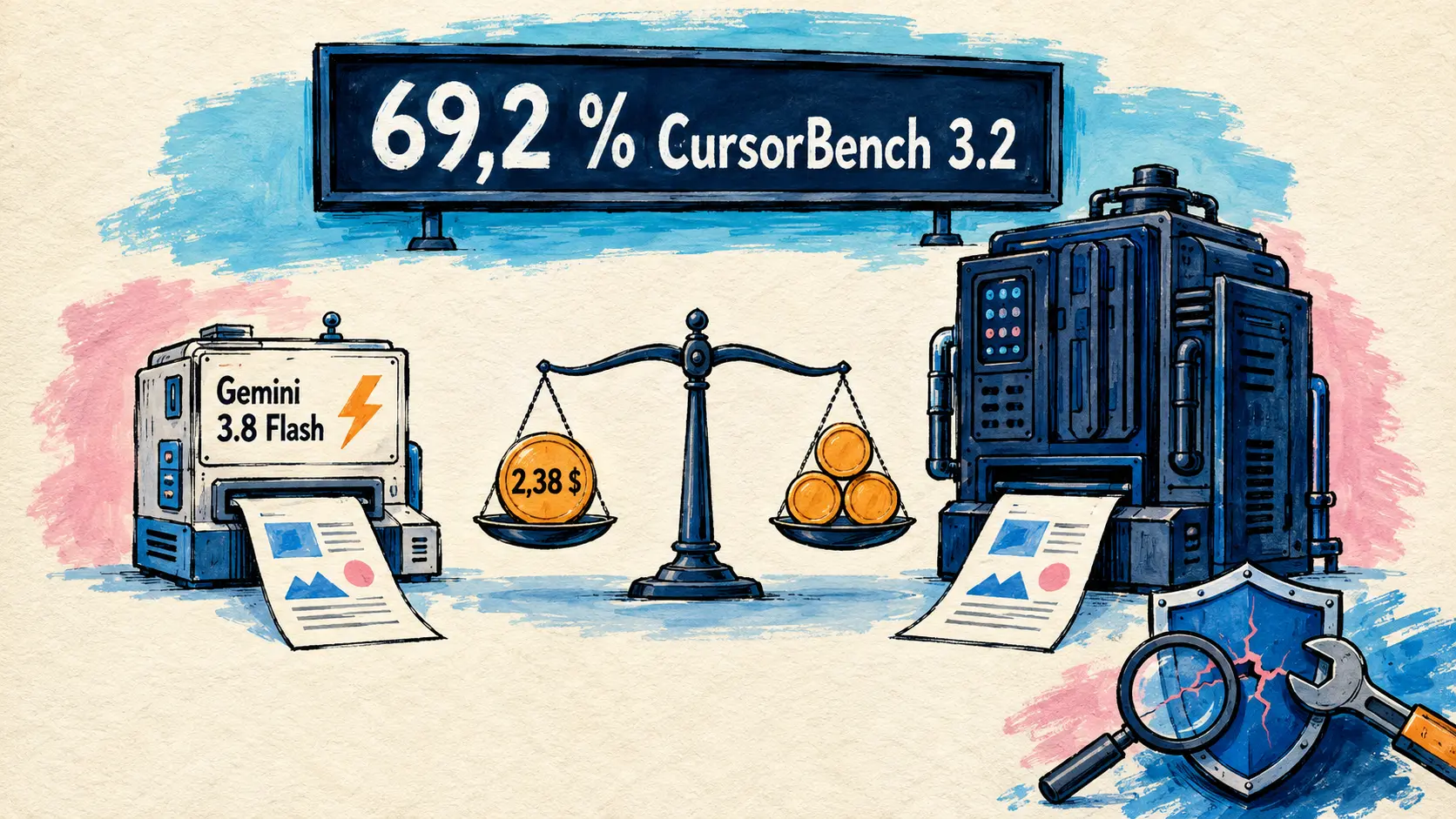
| Gemini 3.8 Flash High | 69.2% | $2.38 | 161 |
| Gemini 3.8 Flash Medium | 67.0% | $1.93 | 136 |
| Gemini 3.7 Flash High | 61.6% | $1.20 | 99 |
The takeaway is immediate: at 69.2%, Gemini 3.8 Flash High achieves a score equivalent to Fable 5.1 High for about half the price, and to Opus 5 Extra High for one-third. The gap from the previous generation is 7.6 points. The steps column, however, highlights the hidden cost of Google’s design choice: 161 steps per task, compared with 44 for Fable 5.1 High. Cursor itself adds two caveats in a footnote—the results have some variance, and the displayed cost is reconstructed from public per-million-token pricing rather than measured from an invoice.
🔗 Gemini 3.8 Flash in Cursor · 🔗 CursorBench results
Muse Spark 1.3, the agentic model from Meta Superintelligence Labs
September 2 — Meta Superintelligence Labs released Muse Spark 1.3, the successor to Muse Spark 1.2, deploying it the same day in Muse Code and in the Meta Model API accessible from dev.meta.ai. It is the lab’s second release in two days, after Muse Voice Transcribe.
The stated focus is not the race for scores but real-world usability. The model is designed to sustain long-horizon work while juggling multiple streams within a single thread: when faced with an open-ended objective, it uses tools to build its own context from messy and contradictory sources, corrects gaps in its plan, and keeps track of what it has learned. The most unusual aspect concerns collaboration: Muse Spark 1.3 is trained to ask clarifying questions when an instruction is ambiguous, call on the user for help when blocked, and request confirmation before taking a consequential action. Comparisons conducted by Meta engineers indicate that it makes about 20% fewer tool calls and uses 25% fewer tokens than version 1.2—a difference that shows up directly on the bill.
| Evaluated category | Benchmark | Muse Spark 1.3 | Muse Spark 1.2 | GPT-5.6 Sol | Opus 5 |
|---|---|---|---|---|---|
| Agent | GDPVal-AA v2 (knowledge work) | 1754 | 1615 | 1710 | 1824 |
| Agent | OSWorld 2.0 (agentic desktop use) | 66.9 | 47.6 | 62.7 | 68.3 |
| Agent | DeepSearchQA (agentic browsing) | 89.4 | 85.9 | 93.0 | 90.4 |
| Agent | AutomationBench (end-to-end workflows) | 49.4 | 38.2 | 46.7 | 50.3 |
| Long context | MRCR 512K-1M | 98.1 | 55.5 | 73.8 | – |
| Coding | DeepSWE v1.1 (long-horizon agentic coding) | 75.4 | 55.0 | 73.0 | 74.0 |
| Coding | SWEAtlas CodeBase QnA | 59.4 | 46.2 | 53.5 | 52.7 |
This table deserves careful reading. Muse Spark 1.3 clearly dominates on long context and coding, but Opus 5 outperforms it on the four agentic tests included here. More importantly, the comparison is not on equal footing, as Meta’s published methodology itself acknowledges: Muse Spark 1.3 and 1.2 were evaluated at the xhigh effort level, while Claude Opus 5 and GPT-5.6 Sol were evaluated in max mode. There is only one exception, DeepSWE v1.1, where Muse Spark 1.3 was measured in max mode—precisely the mode that is not yet available, with Meta saying it will arrive once additional safety testing is complete.
One paragraph in the roadmap stands out for the open ecosystem.
Stay tuned for more updates soon, including bigger models, Muse Spark open weights, and more. — @AIatMeta on X
After a year in which Meta significantly reduced its open-weight releases, the commitment is noteworthy—although it remains to be seen which version it will cover, as no date or scope was provided.
Qwen3.8-Max-0902 takes first place in Code Arena WebDev
September 2 — Qwen released an update to its flagship model: Qwen3.8-Max-0902, a dated snapshot that also responds to the alias qwen3.8-max-2026-09-02. The model retains the structural characteristics of the August version—2.4 trillion parameters and a context window of 1 million tokens—but received an additional post-training phase focused on “Coding & Cowork.”
| Model characteristic | Published value |
|---|---|
| Parameters | 2.4T |
| Context window | 1M tokens |
| Maximum input | 991K tokens (983K in thinking mode) |
| Maximum output | 131K tokens |
| Reasoning budget | 262K tokens |
| Input and output pricing | 6 per million tokens |
| Explicit cache reads | $0.17 per million tokens |
| Implicit cache reads | $0.25 per million tokens |
| Explicit cache creation | $2.50 per million tokens |
| Rate limits | 1M tokens per minute, 15K requests per minute |
The model accepts images, text, and video as input and exposes five built-in tools through the Responses API: code interpreter, image-to-image search, text-to-image search, web extractor, and web search. It was made available through the QwenCloud API the same day.
Also that day, Arena.ai published its Code Arena WebDev results. Qwen3.8-Max-0902 entered directly at the top of the overall leaderboard with 1,691 points, 22 points more than the previous version, 3 points ahead of Claude Opus 5 at the Max setting, and 17 points ahead of Kimi K3 at the Max setting. At a blended price of $5 per million tokens, the model occupies the highest-rated position on Arena’s Pareto frontier, meaning it offers the best score-to-cost ratio in the entire ranking.
The category breakdown adds nuance: first in Data & Analytics and Consumer Product, second in Brand & Marketing, Gaming, and Simulations, and third in Content Creation Tools and Reference-Based Design. The model’s strength therefore lies more in data applications and consumer products than in predominantly creative tasks. Arena says Agent Arena scores are forthcoming.
🔗 Qwen3.8-Max-0902 announcement
Inference leaves the cloud: video on a desktop, a local engine under an open license
This is the day’s underlying trend, and no single announcement captures it on its own. Two major releases and four more discreet signals point in the same direction: running locally what yesterday required a data-center GPU.
September 2 — The FastVideo team at the Hao AI Lab (UCSD) released the local port of FastH3, its distilled version of the open MiniMax H3 video model. Jointly generating video and audio had until now required a data-center GPU; the model now runs on an NVIDIA DGX Spark, two DGX Sparks connected via a QSFP link, or an Apple Silicon Mac with at least 36 GB of unified memory.
The main constraint is not compute power but memory. The DGX Spark includes 128 GB of unified LPDDR5X at around 270 GB/s, roughly one-tenth the bandwidth of data-center HBM, with 121 GB actually available for a workload. The pipeline therefore proceeds in stages: encode the prompt, unload the text encoder, load the transformer, denoise, unload it, then load the VAE. On a discrete GPU, copying the weights back to the host frees device memory; on Spark, that copy falls back into the same pool. The team removed it in favor of loading the DiT directly onto the GPU—the transformer’s loading time drops from 445 s to 39 s, and a 768×1344 run over 124 frames falls from 772 s to 336 s.
| Test machine | First generation | Repeated generation |
|---|---|---|
| Apple M4 Max | 504 s | 465 s |
| DGX Spark | 264 s | 243 s |
| 4x GB200 | 10.2 s | 5.1 s |
Compared with the public vLLM-Omni recipe for DGX Spark, which takes 1,881 s at 1024×576 for five seconds of video and 50 steps, four-step FastH3 comes down to 268 s, or around 7x; the ratio rises to 8.4x at 832×480 and falls back to 7.9x at 1344×768. On M4 Max, encoding an uncached prompt drops from around 80 s to around 17 s, while the TAEH3 decoder cuts decoding from 102 s to 1 s and reduces peak memory from 11.0 to 3.6 GiB. The MLX weights are published in INT8, INT6, and INT4 on Hugging Face, together with the newly released FastVideo Cookbook. The next announced target: the RTX family, including the 5090 and 4090.
That same evening, Perplexity open-sourced Lily, the local inference engine that runs the on-device portion of its hybrid compute system on Mac. The engine had been unveiled the previous day in a research post; the new development is the release of the code under the Apache-2.0 license in the perplexityai/pplx-garden repository, where it joins fabric-lib and pplx-unigram.
The code confirms a commitment to extreme specialization. Lily is not a general-purpose engine: it loads only one checkpoint, Qwen3.6-35B-A3B quantized in affine 4-bit MLX format with a group size of 64, verified at load time. Dense Qwen checkpoints, smaller variants, BF16, GGUF, AWQ, GPTQ, int8, and fp8 are explicitly rejected. Written in Rust with Metal kernels compiled from source at startup, it uses neither PyTorch nor MLX in its execution path and requires an Apple family 10 GPU or later—an M5 or newer—running at least macOS 26. The API surface is just as narrow: only three routes, always greedy decoding, with sampling parameters, streaming, tools, and multimodal content rejected rather than ignored. This narrowness is the interesting point: Perplexity is not delivering a competitor to MLX-LM, but demonstrating that an engine custom-built for a specific platform and model can outperform a general-purpose framework.
Four other releases from the day point in the same direction and are covered in Briefs: TranslatePsy-Nano, translation models ranging from 17 to 42 MB and covering seventeen languages; i64 Systems’ work on experts from an MoE model residing on NVMe without changing a single byte of the output; Cohere’s case for right-sizing small enterprise models; and NVIDIA’s DGX Spark livestream devoted to running Perplexity’s Portable Computer locally. None carries much weight in isolation, but together they shift compute from the data center to the device.
🔗 FastH3 locally · 🔗 Lily open-source release · 🔗 pplx-garden repository
Anthropic open-sources Claude Commerce Agents
September 2 — Anthropic open-sourced Claude Commerce Agents, an Apache 2.0-licensed reference repository for building commerce agents. The announcement intentionally comes ahead of the holiday season, when e-commerce teams plan their deployments.
The blueprint contains two complete agents. The shopping agent lives inside the company’s application: it searches the catalog, assembles a set of items in response to a natural-language request, remembers customer preferences, displays products, comparisons, and the cart in the conversation, then hands off to checkout—and answers customer-service questions in the same thread. The merchant agent is intended for teams running the store: sales analysis, alerts about an item going out of stock before a promotion, pricing recommendations based on historical data, and campaign drafting.
| Repository component | Delivered content |
|---|---|
| Included agents | Shopping agent (customer-facing) and merchant agent (back office) |
| Executable verticals | Retail, travel, telecommunications, ticketing |
| Runtimes | Messages API, Claude Agent SDK, Claude Managed Agents (beta) |
| Deployment platforms | Claude API, Amazon Bedrock, Microsoft Foundry, Google Cloud Vertex AI |
| Claude Code plugin | commerce-builder@claude-commerce-agents |
| Technical prerequisites | Python 3.11 or later, Node 22 |
| Results already observed | Among retailers running shopping agents on Claude: carts up to 35% larger, shoppers 60% more likely to complete their purchase |
The separation between what the model decides and what is actually executed is structural, not declarative. On the consumer side, the backend interface called by the agent simply has no payment method. On the merchant side, every write tool produces a pending change accompanied by a server-generated identifier, and the apply_change function succeeds only for identifiers approved through a genuine human-validation interface. Anthropic specifies that this is an unmaintained reference implementation that does not accept contributions: a starting point to fork, not a dependency to track. All companies in the demonstrations are fictional, and nothing places an order or charges a card.
🔗 Claude Commerce Agents announcement · 🔗 commerce-agents repository
The technical side: caching, latency, and guardrails in code
Published the same day and authored by Ali Shazal and Matthew Koen, the engineering guide accompanying the blueprint summarizes a year of work with retailers, marketplaces, and travel companies. Its first piece of advice is counterintuitive: for an agent that must cover many categories, do not create one sub-agent per domain. A commerce conversation is a single, tightly coupled session, and splitting it up degrades quality—capabilities come from skills, not from multiplying agents.
| Topic covered | Figure provided by Anthropic |
|---|---|
| Rendered commerce response | 500 to 700 output tokens |
| Cached token reads | One-tenth the cost of fresh tokens |
| Cache writes | Premium of around 1.25x, recouped on the second use |
| Target cache hit rate | 90 to 99% |
| Speed of cached reads | 1.5 to 2x faster at around 100,000 tokens |
| Benefit from memory | 13% higher factual recall on the internal evaluation suite |
| Evaluation cases per workflow | 50 to 100 to start |
For model selection, the recommendation is to start with Opus for merchant agents, where analysis dominates, and Sonnet for consumer agents, where latency matters more—then run the entire evaluation suite on every model and every effort level, measuring cost per completed task rather than per model call. The safety section is unequivocal.
The prompt is where safe behavior starts, but in commerce it can’t be where safety is enforced. The failures are financial and often irreversible, and a prompt rule is one injection or one bad sample away from being skipped. — Anthropic, A guide to the anatomy of effective commerce agents
Four rules are therefore enforced in code, defined once and shared across all three runtimes: the model prepares, but a person or policy executes; writes and renders accept only server-issued identifiers; capped transactions must remain capped under repeated requests; third-party content is sanitized.
Computer control moves into the background in Claude Code and Claude Cowork
September 2 — Claude’s computer control (computer use) no longer monopolizes the screen. Until now, starting such a task meant giving up the machine: other windows were hidden while Claude worked in the approved application. Now, in both Claude Cowork and the Code tab of the desktop application, the task continues in the background while the user does something else.
The change is in beta, restricted to Pro and Max plans, and limited to macOS—while computer use itself remains available in research preview on macOS and Windows. There is nothing to enable for those already using the feature; others will find it under Settings > General, bearing in mind that macOS also requires the Accessibility and Screen Recording system permissions.
The security framework remains unchanged. Unlike the Bash tool, which runs in a sandbox, computer use operates on the actual desktop. Access levels remain fixed by application category and cannot be changed: view-only for browsers and trading platforms, click-only for terminals and IDEs—pushing Claude toward the dedicated tool instead of screen control—and full control for everything else. An approval applies to the current session, or for thirty minutes in a session launched from Dispatch.
🔗 Background computer use announcement
Cursor runs its cloud agents on customer-managed machines
September 2 — Cursor published a product post by Jack Pertschuk opening its cloud agents to customer-owned infrastructure. Until now, a Cursor cloud agent ran on a dedicated virtual machine in the company’s cloud. With Self-Hosted Machines, tool execution moves to machines located within the company’s network, while the agent loop, inference, and planning remain with Cursor.
The figure justifying the move is given up front: cloud agents now produce more than 60% of the pull requests that Cursor merges internally. As a growing share of work passes through these agents, the machine on which they run stops being a detail. The company identifies three situations that push a team toward its own machines: running tools in direct contact with the source-control system and internal services, using specialized hardware such as GPUs or Macs for iOS development, or running an operating system that is difficult to package into a cloud-agent image.
| System aspect | Technical detail |
|---|---|
| Registration command | agent worker start, long-lived outbound HTTPS connection |
| Connection direction | Cursor never initiates an inbound connection to the customer’s network |
| Available configurations | My Machines (individual workstation or VM) and Pools (shared team queue) |
| Resumption after inactivity | Hibernation via snapshot, restored with the same worker identifier |
| Sandbox providers | AWS Lambda, Cloudflare, Coder, Daytona, E2B, Modal, Namespace, Vercel |
| Computer control | Linux now supported alongside Mac, via Chrome or Chromium |
Pools scale through a controller that monitors the request queue and starts machines using a script supplied by the team; if no worker is available, the request waits. For the middle ground between resetting a machine and keeping it running—both costly in different ways—Cursor introduces hibernation: the inactive machine is snapshotted and shut down, and if a restart arrives within the reconnection window, the snapshot is restored. Because a pool is not tied to a repository, the same queue can serve several repositories.
One caveat, which the post itself acknowledges: only the execution environment moves. Tool outputs are sent back to Cursor for inference and may contain code, and agent transcripts may be processed and stored there. This is therefore not complete isolation, but a relocation of the execution environment.
Claude Fable 5.1 reaches general availability with integrators
September 1 and 2 — On the very day of its release, Claude Fable 5.1 reached general availability in GitHub Copilot; the next day, Genspark integrated it into its Code Agent and Claw. Two integrators in two days, for the same model: this is a wave of adoption, not two isolated announcements.
At GitHub, coverage is broad—Visual Studio Code, Visual Studio, Copilot CLI, the coding agent, the GitHub Copilot app, github.com, GitHub Mobile on iOS and Android, JetBrains IDEs, Xcode, and Eclipse—for Pro+, Max, Business, and Enterprise plans, with a gradual rollout and billing at the provider’s public rate. But the most notable aspect of this release is not technical; it is contractual.
| Access condition | What applies to Fable 5.1 |
|---|---|
| Administrator policy | Disabled by default; must be explicitly enabled |
| Data retention | Required by default for Anthropic’s safety classifiers |
| Use of retained data | No training of Anthropic models |
| Other Claude models | Zero retention maintained, except for Fable 5 and Fable 5.1 |
| Zero-retention exemption | Eligible companies, through the end of the calendar year |
| After the exemption | Enterprise Frontier Safeguards required |
Unlike Copilot’s other Claude models, Fable 5.1 requires data retention by default: Anthropic retains prompts and outputs to operate its safety classifiers. Enabling the policy therefore constitutes explicit acceptance of this constraint, while leaving it disabled simply makes the model unavailable. The opt-out is temporary and selective: eligible companies may retain zero-retention status through the end of the calendar year while Anthropic deploys its Enterprise Frontier Safeguards, which are expected to provide automated safety monitoring and customer-controlled storage and encryption keys. Eligibility is not available through self-service: it must go through GitHub’s sales team, which support cannot bypass, and even when approved, it does not automatically enable anything.
Genspark, for its part, claims a day-one integration into Genspark Code Agent and Claw, without benchmarks or pricing details. The company joins the list of agentic platforms that switched within hours of the model’s release, alongside Cursor, Devin, Warp, v0, Amp, and Perplexity Computer.
🔗 Fable 5.1 in GitHub Copilot · 🔗 Genspark announcement
GitHub explains how it made Copilot cheaper without compromising quality
September 2 — GitHub published an engineering article by Erik Kristensen, with Napalys Klicius, about reducing Copilot’s cost. The article is unusual for this kind of piece: it provides figures, describes failed experiments, and explains why an obvious optimization can backfire.
The opening thesis is counterintuitive. Counting the tokens in an isolated interaction does not measure efficiency: a concise tool response that omits information the agent needs forces it to rerun the command, making the task slower and more expensive overall. GitHub illustrates the trap with RTK (Rust Token Killer), a utility that shortens shell output before it is read. It successfully shortened some responses, but the subsequent recovery steps added turns: tokens saved locally were spent globally. It was not deployed.
| Evaluated change | Measured gain |
|---|---|
| Removal of line numbers in offline tests | About 5% lower inference cost |
| Removal of line numbers in production on the CLI | About 3% lower average daily cost per user |
Compression of the task tool prompt | 1,300 tokens removed per turn, 2.9% lower normalized cost per active hour |
| Direct delivery of completed background work | About 2.3% lower token-related usage, measured in AI Credits |
| Line numbers and compression in Copilot code review | About 5% of prompt tokens per review for each of the two changes |
| Earlier migration to shared file tools | About 20% lower review cost |
| RTK (Rust Token Killer) | Rejected; overall cost increased in the tested configuration |
The adopted compression policy is deliberately conservative and has three parts: preserve outputs that resemble source code intact, reorganize search results without removing anything, and compress only repetitive installation, build, and test noise. Compression of git diff was part of the early versions; it was removed after benchmark tasks showed agents reopening the original output.
The most instructive episode concerns prompt compression. A meta-prompting loop, in which Copilot iteratively rewrites its own instruction, cut the task tool prompt in half—but the first online experiment revealed a regression that offline evaluations had missed: the loop had converted a cautious instruction about parallelism into a strict ordering rule, serializing independent agents. The fix replaced allowlists and blocklists with a single sentence leaving the decision to the model. The final and most useful lesson: gains do not transfer from one product to another. A tighter set of instructions, inspired by the strong results achieved in Copilot code review, caused the cost of Copilot CLI to increase.
None of these changes made the model smarter. They removed work the model never needed to do. — GitHub Blog, How we make AI coding more cost-efficient
Copilot’s model catalog is being reshaped
September 1 and 2 — Two changelogs published around the same time describe both sides of the same reshaping: what is leaving the Copilot catalog, and who now decides the default model.
Six models were deprecated on September 1 in most Copilot experiences—Copilot Chat, online editing, ask and agent modes, and code completions.
| Retired model | Alternative suggested by GitHub |
|---|---|
| Gemini 3.1 Pro | Gemini 3.7 Flash |
| Claude Opus 4.5 | Claude Opus 4.7, Claude Opus 4.8, or Claude Opus 5 |
| Claude Opus 4.6 | Claude Opus 4.7, Claude Opus 4.8, or Claude Opus 5 |
| Claude Sonnet 4.5 | Claude Sonnet 5 |
| Claude Sonnet 4.6 | Claude Sonnet 5 |
| Raptor Mini | MAI-Code-1.1-Flash |
One exception remains: Claude Sonnet 4.6 is still available to individual subscribers on annual plans. No user action is required, but Copilot Enterprise administrators may need to explicitly enable the replacement models in their policies; otherwise, they will appear neither in VS Code nor on github.com.
At the same time, enterprise-managed settings now allow any model to be used as the default for new conversations. The granularity extends beyond the enterprise level: by declaring the model key as overridable and editing team configuration files in team-mappings.json, an administrator can allow each team to choose its own default, while users not covered by a team configuration inherit the global setting. The feature is generally available for Copilot Business and Copilot Enterprise in the GitHub Copilot app, Copilot CLI, and Visual Studio Code.
🔗 Deprecated models · 🔗 Enterprise default model
The August Ship Log: Copilot in Slack and Teams, and media in the CLI
September 1 and 2 — GitHub’s monthly recap, published as an X Article, is promotional, but it reveals an August release that had not previously been reported: GitHub Copilot is now accessible from Slack and Microsoft Teams. The integration brings the agentic capabilities of Copilot CLI and the GitHub Copilot app into team conversations—mentioning GitHub makes it possible to plan changes, investigate an issue, or hand off a coding task without leaving the thread.
| Item from the August Ship Log | What was released |
|---|---|
| Copilot in Slack and Microsoft Teams | Agentic capabilities from Copilot CLI and the Copilot app |
| Copilot code review, Balanced depth | General availability alongside Lite; default configurable by organization or repository |
| New models highlighted | Gemini 3.7 Flash, MAI-Code-1.1-Flash, Kimi K3 hosted by Fireworks AI |
| GPT-5.6 Sol promotion | Half price through September 3 |
| Automatic model selection promotion | 30% discount for Copilot Max users |
| GitHub Copilot Day | September 10, 2026 |
The recap also documents the Balanced depth for Copilot code review, which reached general availability alongside Lite: Balanced is intended for deeper analysis of pull requests, while Lite is intended for direct changes, and the default depth can be configured at the organization or repository level.
Another release from the month rounds out the command-line side: GitHub CLI’s repeatable --attach flag, available since gh v2.99.0, uploads a local image or video and references it inline in an issue, pull request, or comment. It works with all six commands that write Markdown, and the detail that makes it practical is its handling of existing Markdown: a local path already referenced in the body is rewritten in place, so  retains its alt text and points to the uploaded asset. Alt text is provided after a # in the path. Supported formats are PNG, JPEG, GIF, WebP, SVG, MP4, MOV, and WebM, with limits of 10 MB for images and 100 MB for video on paid plans. GitHub Enterprise Server is not supported in this release. GitHub explicitly emphasizes that coding agents inherit this capability and can now show a result instead of describing it.
🔗 August 2026 Ship Log · 🔗 Media in GitHub CLI
Fairwind Program, Google’s cyber defense offering for trusted defenders
September 2 — On the same day as Gemini 3.8 Flash Cyber, Google launched the Fairwind Program, the channel through which the model is distributed. The reasoning presented by Four Flynn, vice president of security and privacy, starts from a concrete dilemma for defense teams: adopt massive frontier models that are expensive and difficult to control across enterprise codebases, or fall back on smaller open-weight models that struggle to fix complex vulnerabilities.
The answer combines Gemini 3.8 Flash Cyber with CodeMender, Google’s automated remediation harness. The central argument is not detection but remediation: identifying weaknesses creates awareness and fear, while automatically finding and fixing them provides security. The promise is to generate verified, deployable patches in minutes rather than weeks, within the customer organization’s secure cloud environment.
Access is deliberately phased, with three priority groups: governments and national cyber authorities; operators of critical infrastructure in healthcare, telecommunications, energy, and financial networks; and core technology platforms. Participating organizations accept strict constraints—restricting access to internal cybersecurity, incident response, or penetration-testing teams, and deploying protections such as multifactor authentication. Google reports more than 650 participating partners worldwide. Outside the program, any Google Cloud customer can use CodeMender with publicly available models on Gemini Enterprise Agent Platform, alongside AI Threat Defense. The company also says it has surpassed 36 million for 35 cyber clinics that have supported more than 1,250 US hospitals, school districts, and municipal services.
Google’s Command-Line Tooling: Three Releases in Two Days
September 1 and 2 — Google delivered three releases covering the same area in two days, and together they reveal a clear priority: fewer features, more containment and stability.
| Published version | Date | Main content |
|---|---|---|
| Gemini CLI v0.58.0 | September 1 | Seven security-focused changes, promotion to stable channel |
| Antigravity CLI 1.1.23 | September 1 | Two improvements, eleven fixes |
| Antigravity 2.12.0 | September 2 | Seven improvements, nine fixes |
The Gemini CLI stable channel moved to v0.58.0, a promotion that went unnoticed because it came thirty-two minutes after the preview release of v0.59.0. The content is almost entirely defensive. The most substantial fix concerns the macOS sandbox: the Seatbelt profile now isolates Docker and container runtime sockets and binaries, closing off a classic escape route—a confined process that can reach the host’s Docker socket can effectively escape its confinement. Two other changes harden the core: symbolic-link evaluation is now consistent when handling ignored paths, and top-level safety checkers are explicitly declared in the write policy configuration.
Antigravity 2.12.0 introduces two new functional features. Response quoting makes it possible to highlight part of a response and inject it back as context into the next prompt—a direct answer to an everyday problem in long agentic sessions. And the /boost command, reserved for paid users, increases reasoning effort through a multi-agent reasoning pipeline. It arrives on the same day as Gemini 3.8 Flash, which Google acknowledges works harder at the cost of more tokens: both moves point in the same direction, toward explicit user control over the level of effort. The rest addresses genuine irritants: general settings indicate which projects override a setting, split-screen terminal layouts survive window reloads, and a message can be sent while dictation is running.
Finally, Antigravity CLI 1.1.23 streamlines subagent streaming by sending trajectory metadata once per subtrajectory instead of at every step, and accepts via Tab the suggested model name shown as ghost text in /model. Its eleven fixes reveal painful everyday flaws: crashes caused by prompt hooks, tool-call IDs omitted when reconstructing history for Gemini models, permission prompts displaying generic titles instead of readable action descriptions—a real problem, since users are asked to authorize an action that is not described—and subagents declared with enable_mcp_tools=true that failed because they lacked an MCP dispatcher.
🔗 Gemini CLI v0.58.0 release notes · 🔗 Antigravity changelog
Gemini Notebook Short Video Overviews Expand to More Than 70 Languages
September 1 — Gemini Notebook expanded its Short Video Overviews to more than 70 languages, adding three new English variants. The feature turns a notebook’s sources into vertical videos of about 60 seconds, which can now be generated in the user’s language.
The rollout covers web and mobile and remains limited to Ultra and Pro subscribers—the team noted in the same thread that the rollout to Pro users is not yet complete. Two details round out the announcement: the number of sources in a notebook does not count toward token consumption, and Pro users retain the ability to generate Cinematic Video Overviews in English. Moving from English to 70 languages shifts the feature from a demonstration to a genuinely usable tool outside the English-speaking world.
🔗 Gemini Notebook announcement
Editors Are Becoming Model Multiplexers
September 1 and 2 — Two seemingly unrelated announcements describe the same shift: the development environment is becoming an access point for third-party models, and differentiation is moving away from model quality toward the conditions under which the model runs.
Zed released stable version 1.18.0, whose most significant content appears in the AI section of the release notes. In one update, the editor catches up with several recent releases: GPT-5.6’s 1-million-token context window is supported on Amazon Bedrock, Gemini 3.5 Flash-Lite joins the Google AI models, Grok 4.5 and Grok 4.6 join the xAI models, and support for Claude Fable 5.1, released the previous day, is improved. Two of these four additions are external contributions credited in the notes. They are joined by usability improvements specific to working with agents—reloading a broken external agent connection without restarting, reduced memory usage during long sessions, connection errors that name the unreachable host—and a notable fix for users connecting MCP servers: OAuth authentication failed with servers requiring non-standard scopes.
Mistral, meanwhile, made GLM 5.2 available in Vibe Code, its coding agent, for Pro and Team plans. The notable point is not the model but how it is served: Mistral hosts it in Europe on its own infrastructure. A European developer using GLM 5.2 through Vibe Code therefore sends requests to inference operated by Mistral, without those requests passing through Z.ai’s servers. This is the practical expression of the regional inference positioning the company has promoted since August—and the situation is doubly revealing, because Mistral has its own Devstral family yet still chooses to offer an open-weight model developed by a competing lab within its tool.
🔗 Zed 1.18.0 release notes · 🔗 GLM 5.2 in Vibe Code
NVIDIA: Two Engineering Posts and an Alliance Moving Under New Oversight
September 2 — NVIDIA published three items on the same day: two technical posts and one governance announcement.
The first post, the third installment in the series on model co-design, provides five rules for tuning speculative decoding. The technique is well known: a small draft model proposes several tokens that the target model verifies in one parallel pass. The practical question remains open—how many tokens should be speculated, and through which mechanism? During verification, compute grows with (1 + D), while memory accesses remain unchanged: the draft length D should therefore be increased until verification shifts from memory-bound to compute-bound. On a representative expert GEMM, D = 7 reaches this regime with one-eighth of the batch size required at D = 0. When attention dominates decoding time, the optimal length becomes D = 128/G − 1, where G is the number of query heads sharing a KV head; beyond that, it is better to select values where G × (1 + D) is a multiple of 128, the attention kernel’s tile size. The measurements rely on SPEED-Bench, NVIDIA’s speculative decoding benchmark: with Qwen 3.5 122B A10B as the target, the external 35B A3B draft reaches an acceptance length of 6 at D = 9. The post emphasizes an often-overlooked point—higher acceptance does not mean greater acceleration—and ends with a warning: fine-tuning the target changes its output distribution, so a drafter trained for a given checkpoint may lose acceptance even when the target improves.
The second post is a six-step CUDA optimization walkthrough, built around a single example: converting three RGB images to grayscale, then calculating the median of each 32 × 32-pixel tile. The starting point is deliberately faulty code, which Compute Sanitizer immediately diagnoses—an out-of-bounds write in shared memory caused by using a global index where a block index was expected.
| Optimization step | Total time | Step improvement |
|---|---|---|
| Starting code | 6.8 s | — |
| CUB (DeviceTransform and BlockRadixSort) | 635 ms | approximately 10x |
| Pooled memory containers | approximately 244 ms | approximately 2.6x |
| Pinned memory | 25 ms | approximately 10x |
| One CUDA stream per image | 23 ms | approximately 300x cumulative |
Replacing the custom bubble sort with cub::BlockRadixSort alone reduces the median calculation from 2.142 s to 773 µs, a factor of 2717. None of these steps involves low-level optimization: they are API replacements.
Finally, the Open Secure AI Alliance, which NVIDIA helped found, is joining the Linux Foundation. The alliance’s argument shifts the focus away from the usual debate: an agent is not merely a language model; it is a software system comprising models, harnesses that provide context, and guardrails that constrain what it can do. Yet the safety discussion has largely focused on the model alone, even though security depends on the whole system—harnesses, alignment mechanisms, execution environments, identity, policy, observability, and recovery. A request for comments is open on SAFE (Shared AI Findings Exchange), a system for confidentially collecting AI-related incidents and near misses, in collaboration with OpenSSF.
🔗 Speculative decoding · 🔗 Step-by-step CUDA optimization · 🔗 Open Secure AI Alliance
Equinix Inference Exchange: Open Models Across 280 Data Centers
September 2 — Equinix announced Equinix Inference Exchange, a distributed AI inference program that expands its collaboration with NVIDIA and adds Together AI. The arrangement is based on three layers: Equinix provides the physical foundation connected to clouds through Equinix Fabric, NVIDIA supplies its validated enterprise reference architectures, and Together AI runs the platform on top with support for more than 200 open-source models, deployed either in shared environments or dedicated single-tenant environments.
The argument centers on inference location rather than model choice, targeting three use cases: inference at the metropolitan edge to reduce latency, migration of workloads from closed proprietary models to open alternatives, and sovereign AI for regulated companies. The footprint figures convey the scale of the network involved: more than 280 data centers across 77 metropolitan areas, 230 cloud on-ramps, and more than 10,500 interconnected companies.
There is one scheduling caveat, however: Equinix’s press release states explicitly that the solution will be available starting in the first quarter of 2027, while Together AI’s message describes its platform as already active in Equinix’s global data centers. This is a partnership and roadmap announcement, not a service launch.
BenchMIRT, Ai2’s Method for Auditing What Benchmarks Really Measure
September 1 — Ai2 published BenchMIRT, a method that asks a question rarely addressed directly: does a benchmark actually measure the capability it claims to measure? Instead of reasoning from the final score, it drills down to the level of each question and estimates which capabilities actually determine success, drawing on multidimensional Item Response Theory from psychometrics. Training used results from 100 open-weight models, 16 benchmarks, and more than 34,000 questions.
The strongest result is methodological: without being told what each benchmark was supposed to measure, BenchMIRT independently identified two dominant dimensions, safety and general reasoning, which reappeared identically when the analysis was rerun from scratch.
| Audited benchmark | Correlation with reasoning | Correlation with safety | Audit verdict |
|---|---|---|---|
| MMLU-Pro | 0.97 | -0.21 | Consistent with its stated objective |
| BBQ | 0.85 | -0.06 | Tracks reasoning despite being classified as a safety test |
| WMDP | -0.89 | 0.21 | Measures the absence of dangerous knowledge |
| ToxiGen | 0.40 | -0.32 | Weak on both, benchmark saturated at 92% |
BBQ, designed to test whether a model relies on social stereotypes, therefore correlates at 0.85 with general reasoning and not at all with safety: a poor score may say more about the model’s reasoning than about its behavior. The second contribution is practical: by ranking questions according to their discriminating power, Ai2 shows that retaining only 10% preserves roughly the same model ranking, and that the method correctly predicts the answer to an unseen question 79% of the time, compared with 70% for a naïve approach. Two acknowledged limitations: all training models predate March 2025, and the dimensions discovered depend on the set of benchmarks provided.
Runway Dev MCP: The Coding Agent Takes Charge of Media Integration
September 2 — Runway launched Runway Dev MCP, a hosted MCP server that connects its developer platform directly to the coding tool used every day—Claude, ChatGPT, Codex, or Cursor. The argument fits in one sentence: the agent that wrote the integration can now choose the right model for it, configure the tools it relies on, and debug it.
The service covers all three stages of an integration. Before the first API call, the agent queries the catalog to learn which models a project can use, at what price, and with which inputs, then retrieves the exact request schema for the selected model—the goal being to make the correct call on the first attempt instead of guessing. In production, it creates and configures a Model Router that arbitrates among several models according to cost, latency, or quality, with a per-generation cost limit, and can determine which model the router selected for a given call. The same logic applies to Characters. The third stage is debugging: when a generation fails, the agent checks the task through a defined tool and reads the exact reason for the rejection—a moderation rejection, an asset size limit, or a malformed request body—before correcting and retrying. A Quickstart menu creates the API key and then opens Claude Code, Codex, or Cursor with a prewritten message.
DreamX-Creator 1.0, native 2K audio-video generation from a single image
September 2 — Alibaba’s AMAP team unveiled DreamX-Creator 1.0, a 7-billion-parameter model licensed under Apache 2.0 that takes a single image and a text prompt to produce natively synchronized 2K video and audio streams, without chaining separate video and audio models in a cascade.
Three components structure the system: Gated Cross-Modal Attention paired with progressive joint training, enabling bidirectional interaction between the two streams; audio-video reinforcement learning powered by modality-aware multimodal feedback; and single-step autoregressive refinement that brings the video to 2K while preserving motion and the audio’s temporal alignment.
The release remains partial at this stage. The GitHub repository, initialized the previous day, contains the project overview and roadmap, while the technical report has been published on arXiv. Validated weights, inference code, configurations, and evaluation tools are still listed as pending milestones. The work builds on Wan2.2 and OpenMOSS’s MOVA, both explicitly acknowledged.
🔗 DreamX-Creator 1.0 announcement
The OpenAI API distinguishes rapid traffic ramp-up from model overload
September 2 — OpenAI has changed how its API reports two situations that client applications previously could not distinguish.
| HTTP status | Error code | Meaning | Recommended action |
|---|---|---|---|
| 429 | slow_down | Request volume increased too quickly | Observe Retry-After, reduce traffic, then ramp it up gradually |
| 503 | server_is_overloaded | The requested model is temporarily overloaded | Observe Retry-After, then retry, increasing the delay if the error persists |
The distinction has an immediate practical consequence for any retry logic. The documentation specifies that a slow_down error can occur even when traffic remains within the organization’s requests-per-minute and tokens-per-minute limits: it does not indicate an exhausted quota, but rather acceleration deemed too abrupt—in other words, an application can be throttled without exceeding any displayed limit. The rate-limit guide offers a rule of thumb: once traffic reaches one million input tokens per minute, do not increase it by more than 50% every fifteen minutes. When the Retry-After header is absent, OpenAI recommends exponential backoff with a small random delay to prevent every instance of the same service from retrying simultaneously. Organizations whose usage-based traffic regularly encounters these limits are directed to Scale Tier, and to Reserved Tier for GPT-5.6 and subsequent models.
In brief
- Claude Code 2.1.258 — a bug-fix-only release: startup on macOS 12 Monterey, broken since 2.1.255, has been restored, and remote and scheduled sessions no longer fail after permission reapproval. 🔗 CHANGELOG
- Claude Campus Ambassadors — applications are open with three distinct tracks this year: undergraduate, graduate, and PhD and postdoctoral. 🔗 Announcement
- Nokia analyzes 50 million lines of code with Cursor — two engineers from the Core Networks division completed the work in two weeks, where the team estimated it would need around a dozen experts for several months. Vendor case study, with no independent measurement protocol. 🔗 Case study
- TranslatePsy-Nano — Tether AI Research has released two families of compact translation models, EuroNano for nine European languages and AfriNano for eight African languages, in 42, 31, and 17 MB variants with a single checkpoint per language group. 🔗 Announcement
- Puffin-World — a unified multimodal model that represents the world through three native states—physics, geometry, and appearance—released alongside the Puffin-16M dataset. 🔗 Overview
- MoE experts residing on NVMe — i64 Systems keeps expert weights on NVMe with SHA-256 manifest verification and measures byte-for-byte identical outputs between the leased path and the resident path. 🔗 Technical post
- Sakana AI at the CiNet International Conference — CTO Llion Jones and researcher Kai Arulkumaran will give a talk on bridges between neuroscience and machine learning from October 5 to 7, 2026, in Osaka. 🔗 Announcement
- Gemini CLI, September 2 nightly — a single change: improved destination validation and connection routing in web-fetching utilities, continuing the network hardening that began in late August. 🔗 Release notes
- MrBeast enters a multiyear partnership with Google — the agreement extends the relationship with Beast Industries beyond YouTube to Gemini and Google Health, with an initial video on September 5 in which Gemini is used to survive in the jungle, desert, and Arctic. 🔗 Announcement
- Recap of Google’s AI announcements in August — a monthly post aggregating items already covered throughout the month, with no new announcement of its own. 🔗 Recap
- Enterprise Live Migrations generally available — migration of repositories from GitHub Enterprise Server to the cloud with data residency and near-zero downtime, managed through the
gh elmextension. Unrelated to AI, included for completeness. 🔗 Changelog - ElevenLabs names Ashley Kramer chief revenue officer — the company’s only publication during the period, as its product changelog has not changed since August 24. 🔗 Announcement
- NVIDIA streams a DGX Spark live session about Perplexity’s Portable Computer — twenty-six minutes devoted to running it locally, with no descriptive text or transcript. This is the day’s second demonstration positioning DGX Spark as a local porting target. 🔗 Stream
- Kling AI documents Elements on its MCP server — a tutorial on preserving a character’s identity across shots; product education, not a launch. 🔗 Tutorial
- Codex CLI 0.152.1 — a bug-fix release published around twenty hours after 0.152.0: Guardian approval review now respects Node REPL policies supplied through model metadata. 🔗 Release notes
- Cohere makes the case for small enterprise models — the vendor brings together Command R7B, the 3.35-billion-parameter Tiny Aya, and North Mini Code, credited with 33.4 on Artificial Analysis’s Coding Index, to argue for right-sizing. No launch. 🔗 Post
- Perplexity publishes two educational guides — on personal assistants and hallucination detection. The second describes two-stage post-training, with the first stage developing product behaviors and the second relying on more difficult research tasks. 🔗 Guide
What it means
Price has become the main selling point, including for frontier models. Three launches on the same day, and none highlights a record score. Google retains the previous generation’s pricing for Gemini 3.8 Flash and acknowledges that its model consumes more tokens—a rare admission that shifts the question from listed price to the actual cost of a task. Qwen explicitly claims the top of Arena’s Pareto frontier rather than first place outright. Meta measures its gain not in benchmark points but in 20% fewer tool calls and 25% fewer tokens. And the CursorBench table provides the day’s most telling measurement: at 69.2%, Gemini 3.8 Flash costs 4.80 with Fable 5.1 and $7.35 with Opus 5. The steps column nevertheless shows where that price is paid—161 steps versus 44.
Harness engineering is becoming a measurable economic lever. GitHub’s article is the day’s most useful document for anyone building on these models: four optimizations that do not alter the model and each shave off 2% to 5%, with failed experiments documented. Anthropic’s engineering guide says the same thing from the opposite direction—target a 90% to 99% cache success rate from the design stage, and measure cost per completed task rather than per call. Both converge on a point obscured by the model race: with the model held constant, the harness determines a significant share of the bill, and gains do not transfer from one product to another. GitHub demonstrates this by showing that an optimization effective for code review increased costs in the CLI.
Inference is moving onto the workstation, and where computation happens is becoming a design parameter. FastH3 makes video generation fit on a Mac or desktop machine, Perplexity has open-sourced an engine that runs only one model on one type of hardware, Tether has released 17 MB translators, i64 Systems keeps MoE experts on NVMe, and Cohere argues for right-sizing. From the other end, this movement meets the efforts of Equinix, NVIDIA, and Together AI, which distribute inference across 280 data centers for latency and sovereignty reasons. The common thread is not miniaturization but specialization: Lily succeeds because it refuses to support anything other than Qwen3.6-35B-A3B on Apple Silicon, and Perplexity’s bet is that this narrowness is an advantage, not a limitation.
Control and governance are tightening, and they now operate through contracts as much as through technology. GitHub mandates data retention for Fable 5.1—with an exemption that expires at the end of the calendar year—while allowing each enterprise team to choose its default model, and removes six models from the catalog on the same day. Cursor moves agent execution into the customer’s network while specifying that transcripts remain processed on its systems. Google restricts its cyberdefense model to 650 selected partners under written operational conditions. Mistral serves a Chinese model from Europe and makes that its selling point. Finally, BenchMIRT is a reminder that the evaluation tooling underlying some of these decisions itself deserves an audit: a social-bias benchmark that correlates at 0.85 with general reasoning and at -0.06 with safety is not measuring what its label claims.
Sources
- Gemini 3.8 Flash and 3.8 Flash Cyber
- CursorBench results
- Gemini 3.8 Flash in Cursor
- Introducing Muse Spark 1.3
- Muse Spark roadmap
- Qwen3.8-Max-0902
- Code Arena WebDev results
- FastH3 locally on DGX Spark and Apple Silicon
- Lily source code
- Lily open-source release
- Claude Commerce Agents
- commerce-agents repository
- Commerce agent engineering guide
- Background computer use
- Cursor Self-Hosted Machines
- Claude Fable 5.1 in GitHub Copilot
- Genspark integrates Fable 5.1
- How we make AI coding more cost-efficient
- Deprecated Copilot models
- Default model in enterprise-managed settings
- August 2026 Ship Log
- Media in GitHub CLI
- Fairwind Program
- Gemini CLI v0.58.0
- Antigravity changelog
- Short Video Overviews in 70 languages
- Zed v1.18.0
- GLM 5.2 in Vibe Code
- Co-design and speculative decoding
- The modern CUDA toolbox in practice
- Open Secure AI Alliance
- Equinix Inference Exchange
- BenchMIRT
- Runway Dev MCP
- DreamX-Creator 1.0
- OpenAI API changelog
- Claude Code CHANGELOG
- Claude Campus Ambassadors
- Nokia and Cursor
- TranslatePsy-Nano
- Puffin-World
- MoE experts on NVMe
- Sakana AI at the CiNet International Conference
- Gemini CLI, September 2 nightly
- MrBeast, Gemini, and Google Health
- Google’s AI announcements in August 2026
- Enterprise Live Migrations
- ElevenLabs names Ashley Kramer
- DGX Spark and Perplexity Portable Computer live stream
- Kling MCP Elements
- Codex CLI 0.152.1
- Cohere and small models
- Perplexity’s educational guides