ai-powered-markdown-translatorTranslated article from fr to en with gpt-5.4-mini.
On August 20, 2026, GitHub’s CTO publishes a detailed postmortem of the August 17 outage (7h47, the month’s second major incident) and accelerates the move to Azure. Meta AI presents WildArtifactBench, a new evaluation framework for multimodal agents, alongside expanded demonstrations of Muse Spark 1.2. Pika Labs details its full range of audio models (Music, SFX, Soundtrack) with benchmark numbers against Suno, ElevenLabs, and Stable Audio. Around these three announcements, Anthropic beefs up Claude Academy and managed agents, Mistral launches a new document search layer, and about fifteen other updates cover development, open models, and media generation.
GitHub details the 7h47 August 17 outage and speeds up its reliability plan
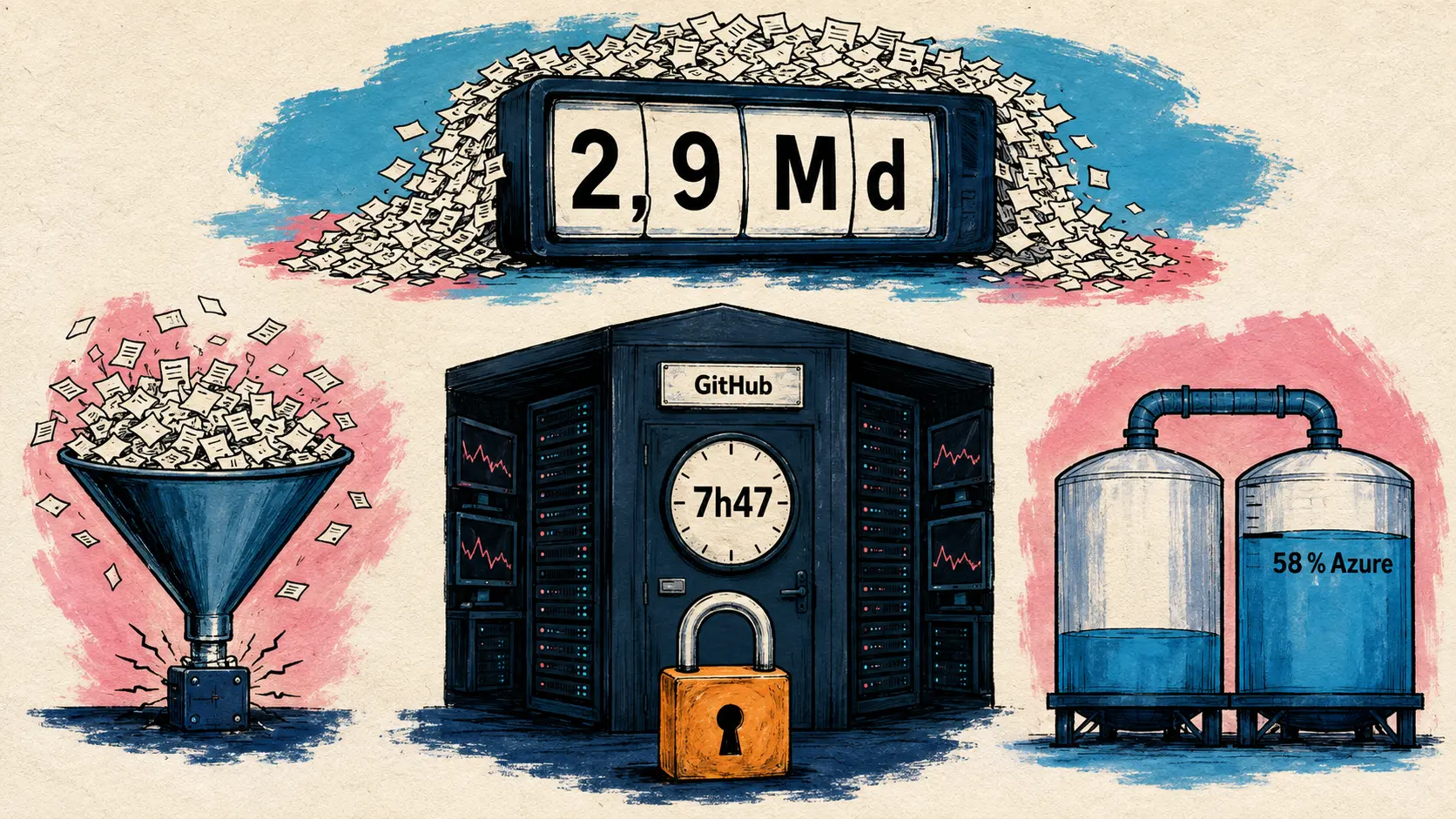
August 20 — Vladimir Fedorov, GitHub’s CTO, publishes a postmortem of the August 17, 2026 outage, which lasted 7 hours and 47 minutes and disrupted github.com, authentication, GitHub Actions, APIs, pull requests, issues, and Copilot. It is the second significant incident of the month, after an Actions outage on August 6. Neither was caused by a code or configuration change: both were capacity failures.
The incident began when an unprecedented traffic spike exceeded the capacity of a critical infrastructure component in GitHub’s Central US data center. The pressure spread across systems, causing authentication failures. Most services recovered during the day, but some Copilot services took longer: errors there triggered a client-side retry loop that amplified traffic during recovery.
Fedorov links the incident to the platform’s growth: since April, monthly commits have risen from 1.4 to 2.9 billion. Since March and April, GitHub has added more than 3 million CPU cores and 120 petabytes of storage, while speeding up its migration to Azure: Azure now handles 58% of the load, up from 12% in May. As an immediate fix, GitHub is introducing consistent retry limits across services.
On August 17, GitHub experienced a significant outage that disrupted developers and organizations around the world. If you were trying to ship software that day, we let you down. — @Vlad_GitHub on X
🔗 The August 17 outage, and the work ahead (github.blog)
Meta AI unveils WildArtifactBench and expands Muse Spark 1.2 demos
August 20 — In a ten-tweet thread, Meta AI presents both an expanded demonstration of Muse Spark 1.2’s multimodal capabilities and the launch of WildArtifactBench, a new internal evaluation framework for multimodal agents. The model is shown analyzing multimodal observations and calling tools to guide a bimanual robot tasked with finding a plastic duck, then tidying a desk — with an example of distinguishing between a hairbrush and a makeup brush to correctly put away a lipstick.
Two concrete capabilities are highlighted: generating digital artifacts (web pages, games) from images, evaluated on the actual rendered result rather than a code comparison; and Muse Spark’s internal use for media generation, alongside Muse Image and Muse Video.
The thread culminates with WildArtifactBench: rather than strict ground-truth-based scoring grids, the framework uses win rates and Elo scores from human and agentic preference judges to cover practical multimodal workflows. Meta is publishing 10 benchmark tasks today along with a design principles document.
Today we’re also previewing WildArtifactBench, an internal evaluation framework designed to assess agents on complex, real-world tasks across diverse deliverable formats. By using win rates and Elo scores from human and agentic preference judges rather than strict ground-truth rubrics, it expands task coverage across practical multimodal workflows. — @AIatMeta on X
Pika details its Pika Audio Models lineup against Suno, ElevenLabs, and Stable Audio
August 18-20 — After announcing its “Pika Audio Models” lineup on August 14, Pika Labs details three products this week, each with numbers.
Pika Music (August 20) accepts four input modalities — text, lyrics, vocal reference, musical reference — which can be combined in a single latent diffusion decoder. It achieves a score close to the market leader on Audiobox Aesthetics, and generates a 90-second song in 6.25 seconds on average, about 14.5x faster than playback time. Pika SFX (August 19) generates sound effects in under a second, at up to 95% lower cost than competitors. Pika Soundtrack (August 18) syncs music, voice-over, and sound effects to the image from a video compressed into latent tokens, and ranks first for audiovisual alignment on a panel of 67 sequences.
| Audio model | Key metric | Pika | Competitor |
|---|---|---|---|
| Pika Music | Audiobox Aesthetics (production) | 8,064 | Suno : 8,151 |
| Pika Music | Speed (90s song) | 6.25 s | ~14.5x playback time |
| Pika SFX | Average latency (50 prompts) | 0.847 s | ElevenLabs v2 : 2.47 s |
| Pika SFX | Average latency (50 prompts) | 0.847 s | Stable Audio 3 SFX : 2.64 s |
| Pika Soundtrack | Semantic alignment (ImageBind) | 0.2457 | Best of the 67-sequence panel |
The three models are available via the Pika API Club.
On our fixed-lyrics benchmark, Pika Music reached the top tier of Audiobox Aesthetics: Content Enjoyment: 7.403, Production Quality: 8.064. For context, Suno scored 7.412 and 8.151 on those respective measures. — @pika_labs on X
🔗 Pika Music (August 20) · Pika Soundtrack (August 18) · Pika SFX (August 19)
Anthropic beefs up Claude Academy, managed agents, and Claude Code
Claude Academy is available
August 20 — Anthropic launches Claude Academy, a platform of free courses and tutorials open to everyone, regardless of skill level: from people discovering AI to those already using Claude every day. The initiative is meant to be a progressive learning path rather than simple product documentation, with the same access for beginners and advanced users. A related post details Anthropic’s educational philosophy on learning AI and Claude Academy’s place in that approach, as the company multiplies education initiatives around Claude alongside its product launches.
Three updates for Claude Managed Agents
August 19 — Anthropic announces three updates to Claude Managed Agents (Claude Developer Platform): memory is now usable with Self-Hosted Sandboxes, with work done in a self-hosted sandbox able to be saved for future sessions; the web_search and web_fetch tools now accept allowed_domains or blocked_domains parameters, to precisely restrict the sites an agent can consult; and the Console session viewer is redesigned for multi-agent sessions, with a one-line minimap per agent, grouped streaming transcript by iteration, and an inspector showing dollar cost per thread and per session.
Claude Code — new Concise output style
August 20 — Claude Code offers a new “Concise” output style: once enabled, Claude prioritizes the result at the top of the response and keeps its answers short by default, while still providing full detail if the user explicitly asks for it. Activation is done via /config → Output style, or directly in configuration with "outputStyle": "Concise" in settings.json. It is a directly useful everyday setting for users looking for faster-to-read answers in the terminal, without losing the ability to dig into a specific point on explicit request.
Cognition’s Devin adds dedicated Slack code channels
August 20 — Cognition launches “Slack Code in Devin” as part of an official launch partnership with Slack: the agent now proactively creates dedicated Slack channels for each coding task, keeping the work focused rather than mixing discussions into existing team channels. Cognition says it specifically reworked Devin’s “personality” for its behavior in Slack, a tone adjustment suited to team chat rather than the terminal or IDE. The announcement anchors Devin in the collaboration tools where product and non-technical teams already communicate, in addition to its existing integrations (GitHub, Linear).
Open models: Liquid AI, Sakana AI, and a large dataset for robotics
Liquid AI’s LFM2.5-DSpark, up to 3.2x inference acceleration
August 20 — Liquid AI releases LFM2.5-DSpark, draft models of ~300M parameters that accelerate inference for the three models in the LFM2.5 family through speculative decoding, with no quality loss — the output sequence remains identical to reference greedy decoding by construction. On H100 GPUs, the measured average speedup is 2.67x for LFM2.5-2.6B (323 → 864 tok/s), 2.10x for LFM2.5-1.2B, and 2.54x for LFM2.5-8B-A1B. For multi-tool scenarios, function-call latency drops by 57% on average. Checkpoints are available in safetensors and GGUF, with day-one support for llama.cpp and direct integration into SGLang.
🔗 LFM2.5-DSpark on Hugging Face
Sakana Translate moves to the new generation of Sakana Namazu
August 20 — Sakana AI’s free Japanese-English-Chinese translation service moves to the new generation of Namazu, combining a renewed base model and improved training methods. On 160 Japanese-English translation tasks evaluated with the internal TransEvalnia tool, Sakana Translate is judged better in more than 50% of cases against each of the competing systems compared. The three existing features (streaming translation up to about 5,000 characters, correction with style diff, translation Q&A) remain free and now run on the new model.
🔗 Sakana Translate announcement
HiPHI, a large open human motion dataset for robotics
August 19 — Noitom Robotics is releasing HiPHI free for research, 617.5 hours of high-precision human motion capture with object interaction — one of the largest datasets of this type ever published, according to the company. Policies trained on this dataset are already running on a real Unitree G1 robot, under the #PhysicalAI label. This kind of open resource fits into the broader push to build datasets for physical AI and robotics, an area closely tracked by the Hugging Face ecosystem, which relayed the announcement.
🔗 @noitomrobotics announcement
Media generation: HeyGen, Black Forest Labs, Ideogram, and NVIDIA
HeyGen launches avatar retouching (Retouch)
August 20 — HeyGen integrates an avatar retouching tool directly into its video editor: imperfection correction (pimples, wrinkles), makeup and lighting adjustment, with a retouch level control to stay faithful to the original avatar. The stated goal is to avoid reshoots driven solely by appearance issues — retouch once, then reuse the result across all subsequent videos. HeyGen emphasizes that the avatar remains recognizable after retouching: it is not about generating a different face, but about refining the existing one.
Black Forest Labs launches FLUX Video Upscale (2K/4K)
August 20 — Black Forest Labs adds a native upscaling module to FLUX 3 Video, to produce or convert videos in 2K/4K with sharper faces, cleaner textures, and more background detail, while preserving the stylistic diversity and realism of FLUX 3 Video. The feature also applies to external videos, not just those generated by FLUX, and is said to be faster than third-party upscaling solutions. Accessible via API and a dedicated demo.
Ideogram publishes a quantized open model and an image background remover on Runware
August 20 — Runware hosts two new Ideogram models: Ideogram 4.0q, an open-weights quantized version of Ideogram 4.0 (9.3 billion parameters) with bounding-box layout control, structured JSON prompting, and LoRA support; and the Ideogram Background Remover, which produces a transparent PNG cutout from any image with good edge fidelity, especially for typography and logos.
NVIDIA claims the fastest open source solver with cuOpt
August 19 — NVIDIA says cuOpt, its open source optimization solver, is the fastest on the Hans Mittelmann benchmarks, a recognized reference in the field, across three classes of combinatorial and linear optimization problems. The company invites the community to test the project directly on GitHub, continuing its strategy of opening software tools around its hardware — cuOpt is especially aimed at logistics and large-scale planning use cases where solving speed becomes a direct operational cost factor.
Mistral, Kimi, and GLM-5.3: document search and cost/performance competitiveness
Mistral launches Agentic Search, an iterative document retrieval layer
August 20 — Mistral announces Agentic Search, a document search layer designed to go beyond the limits of classic RAG, which relies on single-pass retrieval with no possibility of iteration. The system gives the model five file-operation-inspired tools (search, open, navigate, read, grep), works with existing indexes, requires no fine-tuning, and is model-agnostic — tested with Mistral Medium 3.5 and with Z.ai’s GLM-5.2. On FinanceBench (368 SEC filings), Mistral Medium 3.5’s accuracy rises from 26.7% to 86%, and p90 latency drops from 255 s to 154 s. On OfficeQA Pro, GLM-5.2 gains 45.6 accuracy points. Available via the Mistral Search Toolkit, integrated into Studio and Vibe.
🔗 Agentic Search on mistral.ai
Kimi K3 leads Agent Arena’s cost/performance Pareto frontier
August 19 — Agent Arena (LMArena) publishes a cost/performance Pareto frontier for its evaluations of agents on real-world long-horizon tasks. Moonshot’s Kimi K3 (Max) ranks 4th with a performance gain of +10.53%, at a median cost of USD 0.62 per task — the lowest of the eight top models, well ahead of Claude Opus 5 (Max) at USD 3.37 per task for a barely higher score (+12.0%). Grok 4.5 reaches +6.1% at USD 0.22 per task, and Qwen-3.8 Max +6.3% at USD 0.33 per task.
Z.ai’s GLM-5.3 natively integrated into AutoClaw
August 20 — AutoClaw, Z.ai’s work agent, natively integrates GLM-5.3, launched on August 18. Users of the GLM Coding Plan who connect their subscription receive a temporary 1.5x quota boost and monthly AutoClaw credits (Lite 5K / Pro 10K / Max 26K); new users receive 26K AutoClaw credits (USD 20 value), valid for 30 days. GLM-5.3 also gets a score of 69 on the official DeepSWE leaderboard, reported the same day by an external developer.
OpenAI expands ChatGPT desktop in Europe, ChatGPT Sites, and the Codex SDK
ChatGPT desktop (Mac) extends Computer History, multi-app memory, and Record & Replay to Europe
August 20 — OpenAI is expanding three ChatGPT desktop app features for Mac to Europe (EEA, UK, Switzerland), previously limited to the United States: Computer History (already launched on August 13) for Pro, Business, and Enterprise users; multi-app memory that lets ChatGPT remember user activity across apps and websites; and Record & Replay, which turns a regular workflow into a reusable skill by showing it rather than describing it, for ChatGPT Work and Codex.
ChatGPT Sites: URL customization and team collaboration with Codex
August 20 — ChatGPT Sites, the website creation tool built into ChatGPT, now lets users customize the published site’s URL so it reflects the project and is easier to recognize and share. OpenAI is also adding the ability to invite teammates as editors, so multiple people can build and publish on the same project. In this collaborative mode, Codex handles Git management and continuous integration in the background, allowing non-technical teams to collaborate on a site without handling versioning or deployments themselves.
New Exa plugin for ChatGPT Work and Codex
August 20 — OpenAI launches a plugin developed with Exa AI Labs that gives ChatGPT Work and Codex access to more than 100 billion web pages, research articles, and documents. This plugin expands the information-retrieval capabilities of Codex agents and ChatGPT Work beyond their usual sources, continuing OpenAI’s third-party plugin integration strategy for its agentic ecosystem, which began in early August with the launch of Agent Plugins.
Codex SDK: Cisco App Builder and Thrive Holdings/Crete customer cases
August 20 — OpenAI highlights two Codex SDK deployments: Cisco uses it for its App Builder, which lets customers create custom applications for Cisco Cloud Control in natural language; and Thrive Holdings, with Crete, built a tax-preparation system that handled 7,000 returns, reducing preparation time by about one third. OpenAI also highlights broader use of the open-source Codex harness, integrated by teams into existing internal tools, where their own application manages the interface, context, and approvals while the harness handles the agentic loop.
Briefs
- AG-UI adapter for Claude Managed Agents — new cookbook published with CopilotKit, mapping each thread to a managed session with text, tools, and reasoning streaming. 🔗 source
- Configure Auto Mode in natural language — Claude Code’s Auto Mode rules can be written in natural language; adding
$defaultspreserves the built-in rules. 🔗 source - Claude Desktop starts about 2x faster — startup throttling fix in the background, full-speed boot even when the window is hidden. 🔗 source
- v0 (Vercel) — GPT-5.6 Sol and Fast mode at -50% — pricing promotion through September 18, 2026. 🔗 source
- Free SAT practice tests in Gemini — back-to-school reminder: content vetted by The Princeton Review, immediate feedback, and answer explanations. 🔗 source
- Windows 11 arm64 image with Visual Studio 2026 generally available — on standard and larger GitHub-hosted runners. 🔗 source
- Code scanning adds the “Mitigated” dismissal reason — to close an alert when an external control reduces the risk. 🔗 source
- Dedicated GitHub Actions path for GitHub Code Quality — history and usage reports are now separated from other runs. 🔗 source
- Tracking GitHub Code Quality enablement in the audit log — three new events track enablement, disablement, and settings changes. 🔗 source
- CodeQL 2.26.3 improves GitHub Actions queries — modeling JavaScript, TypeScript, and Vue sources. 🔗 source
- Luma details an agency customer case (Aperture) — -75% cost per acquisition and ad budget multiplied by 9, via a three-part system (intelligence, human validation, feedback loop). 🔗 source
- NVIDIA opens GeForce NOW to Firefox — up to 1440p/120 fps for Ultimate subscribers, twelve new games including Gallipoli. 🔗 source
- Suno adds offline playlists — in addition to the playlist redesign announced the day before. 🔗 source
- Qwen3.8-27B leads Harvey’s agentic legal benchmark — open-weight model No. 1 in the Legal Agent Benchmark. 🔗 source
- AI Futures: new OpenAI blog on transformative AI governance — exploration of power-concentration risks tied to transformative AI. 🔗 source
- Stampli speeds up product launches with ChatGPT Work and Codex — Deep Finance product launch in six weeks, production reduced from 243 to 77 estimated person-hours. 🔗 source
What it means
AI infrastructure is hitting capacity limits, not algorithmic limits. The August 17 outage at GitHub is not a bug: it is a platform whose traffic doubled in four months (from 1.4 to 2.9 billion monthly commits) catching up on its capacity debt through Azure migration and millions of added CPU cores. The same tension between scale and reliability appears on the model side: Meta AI’s WildArtifactBench abandons strict grading grids in favor of Elo scores, an admission that evaluating real multimodal agents now goes beyond what ground-truth benchmarks can measure.
Competition is increasingly about cost/performance rather than raw performance alone. On Agent Arena’s Pareto frontier, Kimi K3 (Max) delivers a score almost equivalent to Claude Opus 5 (Max) at one-fifth the cost per task. Mistral applies the same logic on the document-retrieval side: Agentic Search turns single-pass RAG into an iterative system that triples accuracy on dense financial documents, without fine-tuning. And Liquid AI is pushing the needle on local inference, with 300-million-parameter draft models that double the speed of much larger models through speculative decoding.
Agentic platforms are expanding their grip on enterprise workflows rather than remaining chat interfaces. OpenAI is multiplying integration building blocks (Exa, Record & Replay, Codex SDK at Cisco and Thrive Holdings) while Anthropic adds governance controls (allowed/blocked domains for managed agents) and Cognition embeds Devin directly into Slack. These are three different bets on the same playing field: becoming the default layer where non-technical teams delegate work to agents.
Finally, media generation is becoming mainstream at an accelerated pace. Pika publishes benchmarks nearly on par with Suno and up to 95% cheaper than ElevenLabs on sound effects, while Ideogram deploys an open-weight image model on a third-party infrastructure stack (Runware) and Sakana AI measures its translation against competitors across 160 precise tasks. Differentiation is no longer about the simple availability of a model, but about public, verifiable benchmark numbers that are increasingly detailed.
Sources
- The August 17 outage, and the work ahead (github.blog)
- @Vlad_GitHub on X
- Full thread @AIatMeta
- @AIatMeta — WildArtifactBench
- Pika Music
- Pika Music — benchmark
- Pika SFX
- Pika Soundtrack
- @claudeai — Claude Academy
- @ClaudeDevs — Managed Agents
- @ClaudeDevs — Claude Code Concise
- @cognition — Slack Code in Devin
- LFM2.5-DSpark on Hugging Face
- Sakana Translate — announcement
- @noitomrobotics — HiPHI
- @HeyGen — Retouch
- @bfl_ai — FLUX Video Upscale
- @runware — Ideogram 4.0q
- @NVIDIAAI — cuOpt
- Mistral — Agentic Search
- @arena — Pareto frontier
- @AutoClawAIer — GLM-5.3
- @OpenAI — ChatGPT desktop Europe
- @OpenAIDevs — ChatGPT Sites
- @OpenAIDevs — Exa plugin
- @OpenAIDevs — Codex SDK
- @ClaudeDevs — AG-UI adapter
- @lydiahallie — Auto Mode
- @ClaudeDevs — Claude Desktop faster
- @v0 — GPT-5.6 Sol promotion
- Gemini — SAT practice tests (blog.google)
- GitHub Changelog — Windows 11 arm64 VS2026
- GitHub Changelog — Mitigated dismissal reason
- GitHub Changelog — Code Quality Actions path
- GitHub Changelog — Code Quality audit log
- GitHub Changelog — CodeQL 2.26.3
- @LumaLabsAI — Aperture customer case
- NVIDIA — GeForce NOW Firefox
- @suno — offline playlists
- @Alibaba_Qwen — Qwen3.8-27B
- OpenAI — AI Futures
- OpenAI — Stampli