ai-powered-markdown-translatorArticle translated from French to English using gpt-6.1-sol.
DeepSeek open-sources DeepInfer, the inference engine serving DeepSeek-V4.1-Flash in production, and shares figures for its service: 155 000 billion tokens per day on a single cluster. On the same day, Mistral and ElevenLabs launch their models for voice agents through two opposing approaches: a transcription and speech synthesis pipeline with Voxtral 3, and a single speech-to-speech model with Eleven Realtime, while Perplexity runs Computer entirely locally on Mac. Google also open-sources TorchTPU, and OSS Scanner, Anthropic’s service, shares its initial results, including a curl vulnerability that has now been fixed.
DeepInfer: DeepSeek open-sources the inference engine serving DeepSeek-V4.1-Flash in production
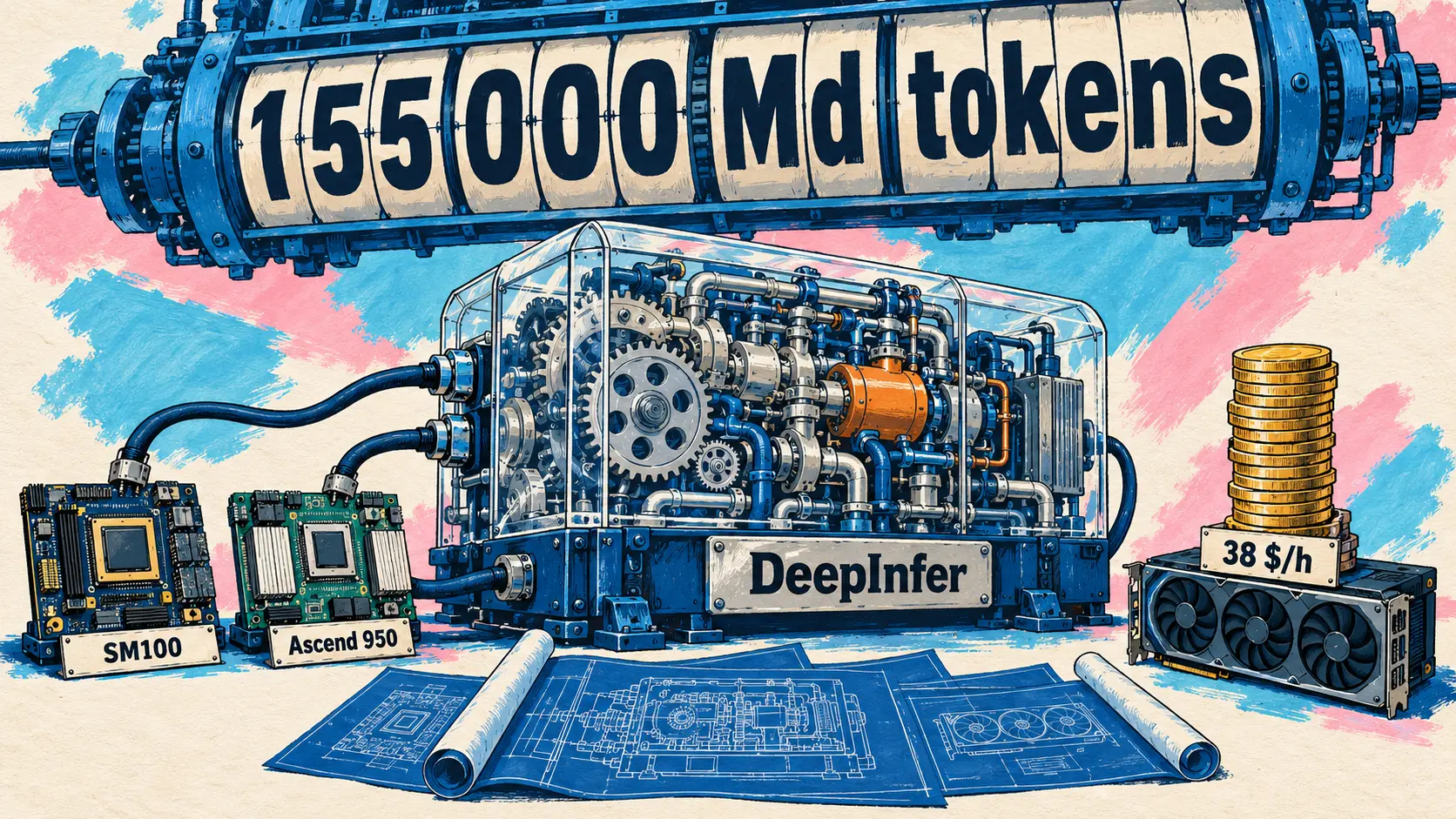
October 20 — DeepSeek open-sources DeepInfer, its in-house inference framework (inference framework) serving DeepSeek-V4.1-Flash in its services, under the Apache-2.0 license. The released version, dedicated to offline inference, supports only this model, on NVIDIA SM100 GPUs and Huawei Ascend 950 NPUs. It incorporates the production components: the kernel libraries already released by DeepSeek (FlashMLA, DeepGEMM, DeepEP, TileKernels, DeepSelect) and TileLang kernels, expert parallelism with load balancing for the MoE component, in-house speculative decoding (DSpark), bounded replay of the sliding attention window to reduce prefill work, and structured outputs using regular expressions, JSON schemas or EBNF grammars.
DeepSeek also open-sources deepseek-recipe (MIT license), the production component that translates requests from the Messages, Chat Completions and Responses APIs into tokens for DeepSeek V4 and V4.1, then converts model outputs into responses. Its logic matches that of the official API: a third-party host gets the same behavior for thinking mode, tool calls and structured outputs. The repository’s deployment FAQ gives an indication of the service’s scale:
| Production data published by DeepSeek | Published value |
|---|---|
| Tokens served by a single cluster | 155 000 billion per day |
| Total revenue at the off-peak rate | 38 dollars per GPU-hour |
| Prefill | standard 8-GPU machines |
| Decoding | 64 to 128 GPU supernodes |
| KV cache retention | more than 72 hours |
Not everything is open. KV cache management and load balancing across replicas, which DeepSeek says are too closely tied to its internal infrastructure, remain closed and are described only in a Zhihu post, and the separation of the vision encoder, prefill and decoding is not provided. Throughput measurements are published only as charts. Initially built mainly on vLLM, with inspiration from SGLang and TensorRT-LLM, DeepInfer will also host inference code for future DeepSeek models; the repository had 11 562 stars that same evening.
🔗 The thread from @deepseek_ai · DeepInfer on GitHub · deepseek-recipe on GitHub
Voxtral 3: Mistral launches transcription and speech synthesis models, and a voice agent SDK
October 20 — Mistral launches Voxtral 3, a family of transcription (speech-to-text) and speech synthesis (text-to-speech) models, accompanied by an SDK for building voice agents. Everything is available from October 20 through the Mistral API, on European, US and global endpoints, as well as in Studio’s testing environments (playgrounds); on-site or private cloud deployment is available on request.
| Voxtral 3 model | Intended use | Announced price |
|---|---|---|
| Voxtral Small Transcribe 3 | Most accurate transcription, diarization | 0,004 dollars per minute |
| Voxtral Mini Transcribe 3 (4B) | Batch transcription, diarization | 0,0035 dollars per minute |
| Voxtral Mini Transcribe Realtime 3 | Real-time transcription, under 500 ms | 0,008 dollars per minute |
| Voxtral Speech 3 | Speech synthesis, batch and real-time | 13 dollars per million characters |
Transcription covers 50 languages, including all 24 official languages of the European Union. It separates speakers (diarization), accepts keywords to better recognize industry vocabulary without fine-tuning (fine-tuning) (context biasing, context biasing) and detects when a speaker has finished speaking. Across 45 languages in the FLEURS benchmark, Mistral publishes these word error rates, with the language either specified to the model or detected automatically:
| Model evaluated (FLEURS, 45 languages) | Language specified to the model | Language detected automatically |
|---|---|---|
| Voxtral Small Transcribe 3 | 4,0 % | 4,1 % |
| Microsoft AI Transcribe 2 | 4,0 % | 4,1 % |
| Voxtral Mini Transcribe 3 | 4,5 % | 4,6 % |
| Gemini 3.5 Transcribe | 4,5 % | 6,1 % |
| Scribe v2 | 4,9 % | 4,9 % |
| GPT Transcribe | 5,6 % | 6,3 % |
| Whisper large-v3 | 14,9 % | 16,0 % |
Mistral says its Small model is better than Whisper, Scribe v2 and Gemini 3.5 Transcribe, but its own chart places Microsoft AI Transcribe 2 on equal footing. In real time, with a 480 ms delay, the Mini model achieves 6,4 % across 35 languages, behind Gemini 3.5 Realtime Transcribe (4,2 %) and Microsoft AI Transcribe 2 Streaming (5,8 %), but ahead of GPT Live Transcribe (8,4 %) and Scribe v2 Realtime (8,7 %).
Voxtral Speech 3 speaks more than 35 languages and over 50 dialects, infers emotion and pacing from the conversation’s context or follows explicit instructions line by line, and Pro Voice reproduces a professional voice from 30 minutes of audio; according to Mistral, it costs less to run than comparable models from OpenAI, Deepgram, ElevenLabs and Google.
The voice agent SDK, built on LiveKit, chains three models in a streaming pipeline: the real-time model listens and detects the end of a sentence, a general-purpose model such as Mistral Small reasons and calls tools, then Voxtral Speech 3 responds. No stage waits for the previous one to finish: each turn completes in under a second according to Mistral, the agent stops speaking when interrupted, makes calls through SIP or WebRTC, and each stage remains a replaceable model. Unlike Voxtral Transcribe 2 (February) and Voxtral TTS (March), Voxtral 3 has not been announced with open weights: the post offers Mistral’s API or deployment on your own infrastructure, to be arranged with the Mistral team, and no repository had appeared on Hugging Face by the evening of the launch.
🔗 Mistral’s post · The thread from @MistralAI
Eleven Realtime: ElevenLabs turns the voice agent into a single speech-to-speech model
October 20 — On the same day as Voxtral 3, ElevenLabs takes the opposite approach. Where Mistral’s SDK chains three separate, replaceable models, each Eleven Realtime model brings the entire voice agent together in a single speech-to-speech model (Speech to Speech): speech recognition, voice activity detection, turn-taking, the LLM and speech synthesis are optimized as one unit. The models speak more than 90 languages and can use the 17 000-plus voices in ElevenLabs’ library.
Two versions are being released. Eleven Realtime v1 Mini, the default model, targets low-cost conversations (assistants, teachers, interactive characters). Eleven Realtime v1 Max reasons before responding and is aimed at complex tasks, such as customer support or multistep workflows with tool calls; it costs more per token. The published results come from Artificial Analysis evaluations cited by ElevenLabs:
| Metric (Artificial Analysis, according to ElevenLabs) | Eleven Realtime v1 Max | Eleven Realtime v1 Mini |
|---|---|---|
| Big Bench Audio (1 000 questions asked aloud) | 98,8 % | 75,9 % |
| Average time to first speech | 0,57 s | 0,62 s |
| Full-Duplex-Bench (pauses, interruptions) | 94,1 % | 95,8 % |
| Tool-based tasks completed successfully | 87,1 % | 60,3 % |
According to ElevenLabs, no model in the Artificial Analysis rankings is both faster and more accurate than v1 Max. Mini handles conversational dynamics slightly better, but Max widens the gap on tasks involving tools.
In ElevenAgents, simply switching an agent’s voice mode from “Custom” to “Realtime” retains the rest of the platform: phone, web, WhatsApp and contact centers. The models are also offered through a Realtime API compatible with OpenAI’s: a developer with an existing integration changes the endpoint and model name and keeps their code, using WebSocket only. Rollout is gradual across workspaces. Mini is available neither in Zero Retention mode nor under HIPAA, unlike Max, and no specific pricing is given: ElevenLabs charges its usual ElevenAgents per-minute rate plus tokens at the chosen model’s rate.
ElevenLabs thus joins the end-to-end voice models already offered by OpenAI (GPT-Live-1, at 0,05 dollars per minute in the API since September 10), Google (Gemini 3.8 Live) and SpaceXSI (Grok Voice 3.0).
🔗 ElevenLabs’ post · The Realtime model documentation
Perplexity Computer runs entirely locally on Mac, including the model
October 20 — Perplexity runs Computer, its agent, entirely on Mac: the model, the harness (harness) and task execution stay on the machine.
Perplexity Computer can now run fully local on your Mac. Work with your native Mac apps and local files, and run tasks without sending sensitive data to the cloud. The model and the agent both run on your Mac. Available now in the Perplexity Mac app. — @perplexity_ai on X
| Launch element | Details according to Perplexity |
|---|---|
| Local models | Qwen 3.6 and PPLX Pro |
| Recommended memory | 36 Go of unified memory or more |
| Supported machines | Supported Apple silicon Macs, such as the new Mac mini with M6 and M5 Pro |
| Eligible plans | Pro, Max and Enterprise |
| Computer credits | not consumed by local tasks |
| Cloud access | with permission, to more than 15 frontier models |
With the user’s permission, the agent works on local files and in applications such as Notes, Messages, Mail or Numbers. PPLX Pro is, according to Perplexity’s tweet, its post-trained version of Qwen 3.8; asked about its size, Aravind Srinivas, Perplexity’s CEO, replies that it is a dense model with 27 billion parameters, and expects 36 GB of memory to become commonplace.
The Mac application now offers two ways to run Computer. Hybrid Compute, launched on September 1, starts in the cloud for search and reasoning and processes private files locally; the new mode starts on the Mac, which handles planning, reasoning and file processing. If the user allows it, the agent accesses the cloud for up-to-date information, web browsing or connected applications, and both code and tools run in isolated sandboxes, with the same security protocols as the cloud version. Perplexity cites three uses: reviewing a portfolio based on private holdings, building a sales proposal from confidential notes and creating a morning priority list from Messages and Mail.
This is the Mac equivalent of Portable Computer, the fully local version launched on August 25 on DGX Spark, then extended in September to Linux, Windows and PCs with AMD Ryzen AI Max processors.
PyTorch beyond NVIDIA GPUs: open-source TorchTPU, native TPUs at Hugging Face and MPS in PyTorch 2.15
Three announcements today bring PyTorch to chips other than NVIDIA’s: Google releases TorchTPU at the PyTorch Conference, Hugging Face integrates it into its libraries on the same day, and Hugging Face’s PyTorch team details what PyTorch 2.15 brings to Macs.
TorchTPU: Google open-sources its native PyTorch stack for TPUs, with vLLM, SGLang, TorchTitan and llm-d 1.0
October 20 — Google open-sources TorchTPU, its native PyTorch stack for TPUs, co-developed with Meta’s PyTorch team. The TPU becomes a PyTorch device like any other (torch.device("tpu")): developers debug in eager execution mode (eager), then move to production with torch.compile, which compiles through XLA. Until now, they had to rewrite their code in JAX or use the old torch_xla.
Two inference engines rely on TorchTPU: vLLM-TorchTPU, developed with Inferact, and SGLang-TorchTPU, developed with RadixArk and already in production at Meta. Google reports 2,01 US cents per million tokens on SemiAnalysis’s InferenceX leaderboard with Qwen 3.5 on Ironwood, and more than 700 tokens per second for a single user on Kimi K3, a model with 2 800 billion parameters. For training, TorchTitan on TPU achieves compute utilization (Model FLOPs Utilization) of up to 52 % on Qwen 3 8B, with trials using up to 8 192 Ironwood chips. Google is also releasing llm-d 1.0, a Kubernetes stack for distributed serving co-created with Red Hat and IBM: on an agentic coding workload, median time to first token falls by more than 85 % and throughput increases by a factor of 2,4 compared with a simple Kubernetes Service.
🔗 The Google Cloud blog post · The vLLM and SGLang engines on TPU · llm-d 1.0
Hugging Face makes TPUs native in Transformers, Diffusers and Kernels
October 20 — Hugging Face integrates TorchTPU into its ecosystem: the TPU becomes a device like any other, without going through PyTorch/XLA or JAX, and Optimum TPU, the layer Hugging Face had maintained until now, is no longer necessary for Transformers and Diffusers. In Transformers, simply load a model with device_map="tpu"; in Diffusers, all it takes is pipe.to("tpu"), with optional compilation and tensor parallelism to distribute large models across multiple chips.
| Case measured by Hugging Face | Published result |
|---|---|
| Qwen-Image-2.1, 1024 × 1024 image in 40 steps (TPU v6e-4) | 3,5 s compiled, 8,0 s without compilation |
| MiniMax-H3, 5,2 s video with audio (TPU v6e-4) | 188 s compiled, 262 s without compilation |
| Qwen3-30B-A3B decoding, batch of 64, Tokamax kernel (v6e-8) | 21,5 times faster |
| Transformers tests passing on TPU | 96,5 % |
The team reported 34 issues to the TorchTPU project, 19 of which have already been fixed, and is preparing nightly CI on TPUs. This is the second native PyTorch backend for a non-NVIDIA accelerator integrated by Hugging Face in two days, following TorchNeuron for AWS Trainium the day before.
🔗 The Hugging Face blog post on TorchTPU
PyTorch 2.15 brings FP8 to Macs and speeds up MoE decoding by up to 6,5 times
October 20 — Hugging Face’s PyTorch team, which works on MPS, the GPU backend for Apple silicon Macs, details what PyTorch 2.15 brings, while it is still a release candidate. FP8 arrives on Macs, with one byte per value, half as much as BF16, and direct multiplication on the GPU. Thanks to native grouped matrix multiplication, MoE model decoding becomes 5 to 6,5 times faster than in 2.14.
| Measurement on Mac | With PyTorch 2.14 | With PyTorch 2.15 |
|---|---|---|
| Qwen3.6-35B-A3B decoding on M3 Ultra | 9,4 tokens/s | 61,3 tokens/s |
| LFM2.5-8B-A1B decoding on M3 Ultra | 23,6 tokens/s | 123,6 tokens/s |
| FP32 Softmax on 128 256 logits | 57 µs | 7 µs |
| Peak driver memory, Wan2.2 VAE | 270,1 Gio | 8,1 Gio |
The Qwen-Image-2.1 VAE encoder, which silently corrupted images on MPS, has been fixed. PyTorch 2.15 requires macOS 15 and Python 3.11, and a preview of 2.16, still subject to change, announces attention written entirely in Metal.
🔗 The Hugging Face blog post on MPS
Open source software security: OSS Scanner’s first results and GitHub’s package firewall
Two announcements target both ends of the open source software supply chain: finding vulnerabilities in project code and filtering packages as they are installed.
OSS Scanner: 114 projects accepted, 77 critical and 803 high-severity vulnerabilities reported, a curl vulnerability fixed
October 19 — Eleven days after its launch, OSS Scanner, Anthropic’s free service that uses its most powerful models to scan critical open source projects, shares its first figures. In a thread shared that evening by @ClaudeDevs, Punit Shah, the service’s product manager, counts around 650 applicant projects and 114 accepted. The scans have already reported 77 critical and 803 high-severity vulnerabilities to maintainers, according to the severity assigned by the model, although not all projects have been scanned yet.
The highlighted case is curl: CVE-2026-92392, a memory access after deallocation (use-after-free) during an HTTP/2 upload, found with an early version of OSS Scanner, was fixed in curl 8.23.0 on October 14. The curl advisory rates it as high severity for versions 8.12.0 to 8.22.0 and credits “Luna with Claude, Anthropic” for the report. Another lesson: most of the initial reports, sent by email with their proof of concept, were rejected, probably because email filters mistook them for malware. Anthropic is therefore testing delivery through GitHub Security Advisories; more than 150 projects were still awaiting a decision, according to an estimate from Punit Shah.
🔗 Punit Shah’s thread · The curl security advisory
GitHub previews filtering for npm packages installed by Actions runners and coding agents
October 20 — GitHub opens a firewall for packages (package firewall) in public preview. The starting observation: more and more attacks exploit package installation to harvest credentials from CI/CD hosts or developers’ machines, without even executing the package’s code. The firewall sits between GitHub Actions executors (runners) or coding agents and upstream registries, inspecting both metadata requests and downloads.
| Key firewall feature | What the preview includes |
|---|---|
| Available checks | Waiting period, GitHub Advisory Database alerts, attestation downgrades |
| Eligible customers | GitHub Enterprise Cloud, including data residency |
| Supported ecosystem | npm only for now |
| Pricing | Free during preview, then usage-based billing, like GitHub Actions |
Coding agents and CI/CD hosts must be configured to go through the firewall instead of querying registries directly, and an exception can be requested for a package that is incorrectly blocked.
Assistants: ChatGPT’s locked chats, Gemini for small businesses and US government agencies
OpenAI and Google are adding features to their assistants for specific needs: conversation privacy in ChatGPT, small businesses and US public services in Gemini.
ChatGPT hides conversations behind a 4-digit PIN
October 20 — ChatGPT introduces locked conversations (locked chats): a selected conversation remains in the account but disappears from history, pinned chats and search. It moves to the Locked chats area in Projects, which opens with a 4-digit account PIN or, on mobile, Face ID, Touch ID or Android device unlocking. The feature is rolling out gradually on the web, iOS, Android and the new desktop app for macOS and Windows, from Free to Pro as well as on Business, Enterprise and Edu, but not on ChatGPT for Healthcare.
OpenAI clarifies its limitations: locking provides neither end-to-end encryption nor a separate vault, and does not change retention periods. Resetting a forgotten PIN permanently deletes all locked chats and the files they protect. In enterprise settings, locked chats remain in OpenAI Compliance Platform logs, and administrators can neither disable the feature nor unlock a chat. Codex conversations, temporary chats and group chats cannot be locked.
🔗 The ChatGPT release notes · The guide to locked chats
The Gemini app opens a space for small businesses
October 20 — Google adds a dedicated small-business homepage to the Gemini app, presented as a single entry point for building a brand, analyzing finances and better understanding customers; according to Google, tens of millions of small-business owners already use Gemini. For visuals, business owners provide their website, brand guidelines, fonts or colors: Gemini uses Nano Banana 2.1 to produce visuals for a launch or campaign and retains that style without another upload. For finances, messy spreadsheets, receipts or purchase histories turn into charts and interactive models in seconds.
Gemini connects to Google Business Profile, Google Ads and Google Workspace, as well as Adobe, Canva, Dropbox, Shopify, Wix, Zoho and Xero. Among the testimonials, a Bordeaux ceramicist (Bleu Clémentine) says she saves two to three hours a day. The rollout begins “in the coming days,” worldwide and for all app users.
Gemini for government services: the Gemini agent enters preview for US government agencies
October 20 — Google Cloud adapts the Gemini agent introduced in early October at Gemini at Work for the public sector: Gemini for government services is available in preview for US federal, state and local agencies, announced Thomas Kurian, head of Google Cloud. The offering brings together skills that apply agencies’ laws, regulations and instructions, connectors that query their systems in place without migrating data, partner agents, including those from SZNS Solutions, a single control plane for security and compliance, and a network of 13 systems integrators.
Google lists seven use cases, from regulatory research with paragraph-level citations to redacting documents before publication, including requests for access to government records (FOIA) and auditing grant spending. The connectors cover Federal Register, regulations.gov and eCFR, Oracle, Salesforce, ServiceNow, Google Workspace and Microsoft 365. Google is working with the state of Missouri and the US Department of Health and Human Services (HHS), and the offering can be deployed within Assured Workloads’ FedRAMP High data boundary; neither pricing nor a general availability date has been announced.
Applied AI: protein binders designed by Claude, QD-Rec’s recommendations and Flora for robots
Three of today’s projects apply models to specific problems: designing proteins against venoms, supporting decision-making and annotating videos to train robots.
Claude designs protein binders against scorpion neurotoxins: 17 validated out of 211 tested
October 20 — Anthropic publishes a protein design campaign conducted by Claude against five scorpion neurotoxins from four regions, from Mexico to the Middle East, on its Science blog. An internal research model, used in Claude Science, reused the prompt from an August study, adapted with Citrini Research, then worked largely on its own, guided by four follow-up prompts from the team: 318 484 designs generated using 12 tools and a final list of 180 designs in 64 hours, using roughly 10 000 GPU hours of compute. Adaptyv Bio and Twist Bioscience tested 211 designs, including 31 added by the team. Under strict criteria, 17 bind to their target, each to just one toxin, and none targets the Brazilian toxin Ts1. The two best, Cn2-B1 and Cn2-B2, bind to the Mexican toxin Cn2 with an affinity of a few nanomolar and appear to target the same site as the LR antibody, which neutralizes it in mice.
This is exploratory work, and we’re not claiming to have produced an antivenom—for that, we’d have to test the binders within living cells, then in mice, among many other steps. But it’s an example of how Claude can concretely assist research in protein design. — @AnthropicAI on X
The 211 designs and their data have been published. A note acknowledges that this amount of compute exceeds the means of most researchers, but says that a simplified prompt, with a single agent and a single GPU for 24 hours, achieves comparable in silico scores.
QD-Rec: Sakana AI evolves diverse recommendations with supporting rationales
October 20 — Sakana AI introduces QD-Rec, which applies open-ended exploration (open-ended search) and the quality-diversity approach (Quality-Diversity) to recommendations for decision support. Rather than ranking candidates, the method searches for candidate-hypothesis pairs: a company to acquire, a prospective customer to approach or an article to read, along with text explaining why it should be chosen. A contextual bandit selects the next candidate by favoring underexplored areas, an LLM writes the hypothesis by adapting or combining those already archived, and a niche-based archive retains new rationales.
Tested on mergers and acquisitions, marketing targeting and article recommendations, with Claude Sonnet 5 or Claude Haiku 4.5 as the proposer and gpt-5.6-terra as the judge, QD-Rec achieves the best average quality and the largest archive in most cases for 1 000 evaluations: for Walt Disney, 2,91 out of 10 and 214 recommendations, compared with 2,40 and 85 without evolution. Sakana notes that these scenarios are not investment advice and that a model put forward a figure absent from the data; the code is published under the Apache-2.0 license.
🔗 Sakana AI’s technical article
Flora: NVIDIA releases the weights of a suite of models that annotates videos for robots
October 20 — NVIDIA’s GEAR lab is releasing the weights of Flora, a suite of models that turns raw videos of robots or humans into training signals: timestamped action captions, outcome rewards for monitoring deployments, and process rewards for reinforcement learning. Flora already serves as a data engine for training GR00T models and annotates 200,000 hours of video per day on 512 GB300 GPUs. According to NVIDIA, it is competitive with GPT-6 Astra at a cost roughly 125 times lower, but the published table paints a more nuanced picture:
| Benchmark and metric | Flora | GPT-6 Astra |
|---|---|---|
| DenseRewardBench, macro F1 (higher = better) | 46,2 | 40,7 |
| RoboReward, mean absolute error (lower = better) | 40,0 | 55,4 |
| DenseCaptionBench Robot200, segmentation F1 | 66,9 | 71,9 |
| WGO-Bench, accuracy (gold-window) | 64,7 | 77,4 |
Flora outperforms GPT-6 Astra on most reward metrics and on human videos, but still trails on robot videos, on two of the three WGO-Bench metrics, on Robometer’s out-of-distribution correlation, and on RubricBench.
🔗 The Flora project page · Jim Fan’s thread
Acquisition and partnership: OpenAI acquires Orchestra Bio, Runway joins the Claude Marketplace
Two business deals today: an acquisition in drug development at OpenAI, and a distribution agreement between Runway and Anthropic.
OpenAI acquires Orchestra Bio to connect Rosalind with drug development
October 20 — OpenAI announces the acquisition of Orchestra Bio, a platform where humans and AI agents jointly advance drug programs: scientists and program managers delegate the monitoring of studies and campaigns to agents. OpenAI gives an example: a failed manufacturing batch can delay the start of a clinical trial; agents then identify the affected activities and schedules, gather information, and compare possible responses, while decisions remain with the teams.
Orchestra’s team and technology are joining Rosalind, OpenAI’s offering for life sciences: GPT-Rosalind for reasoning in biology and chemistry, and Rosalind Workbench for connecting those capabilities to researchers’ tools and data. The stated goal: agents that connect discoveries to studies, decisions, and the next steps for a potential drug. OpenAI notes that, in the United States, it takes an average of 10 to 15 years to go from target discovery to regulatory approval. No acquisition price has been disclosed.
Runway Creative joins the Claude Marketplace, payable against Anthropic spending commitments
October 20 — Runway joins Anthropic’s Claude Marketplace with Runway Creative, its platform for generating and editing video, images, and audio. Eligible enterprise customers can apply part of their Anthropic spending commitment toward purchasing Runway through their Runway or Anthropic representative; no pricing has been published. Runway Creative brings together Gen-4.5, Aleph 2.0, Seedance 2.5, Kling 3.0, and ElevenLabs V4, while Claude provides the reasoning for Runway Agent, which turns a request into a shot breakdown, chooses the model for each shot, and assembles the video. Animations from Claude Motion, in beta on Claude Team and Enterprise, can be exported to Runway to add images, voiceovers, and music.
Runway reports more than 65 million creators, filmmakers, and marketing teams. This is the Anthropic counterpart to Runway Creative’s arrival in the OpenAI Marketplace on September 29.
Measuring models: OpenAI’s MultiLangBench, Ai2’s FairStress, and Cohere Labs’ CALIBER
Three research publications evaluate models from three angles: coding in less common languages, the fairness of their decisions, and the confidence they place in their own answers.
MultiLangBench: GPT-6 Astra builds a SQLite-compatible engine in 20 languages, including COBOL
October 19 — OpenAI publishes a research post on programming languages with limited resources (low-resource), such as COBOL, Fortran, or Visual Basic, for which far less code and documentation exist than for Python, even though they run banking systems or weather forecasts. Its first evaluation, MultiLangBench, released under the Apache-2.0 license, asks models to build a SQLite-compatible database engine from scratch in one of 20 languages, verified by tests adapted from SQLite’s test suite.
| Model evaluated (maximum effort) | Average across 20 languages | COBOL | Fortran | Visual Basic |
|---|---|---|---|---|
| GPT-5.6 Sol | 26,8 % | 10,9 % | 21,4 % | 27,5 % |
| GPT-6 Luna | 40,3 % | 17,1 % | 31,4 % | 41,6 % |
| GPT-6 Astra | 87,4 % | 72,1 % | 83,5 % | 89,4 % |
GPT-6 Luna costs around 0.77 dollars per sample, compared with 3.48 dollars for GPT-5.6 Sol. On a second evaluation, migrating COBOL programs to C++, Java, Kotlin, Python, or Rust with byte-for-byte output parity, GPT-6.1 Sol achieves an 86.6 % success rate at low effort, compared with 5.4 % for GPT-5.6 Sol at the same setting, and costs 39 % less; at higher effort, it reaches 97.9 %. OpenAI notes that a production migration still requires expert review.
🔗 OpenAI’s post · MultiLangBench on GitHub
FairStress: Ai2 measures demographic fairness beyond the final answer
October 20 — Ai2 publishes FairStress, a benchmark that tests models’ demographic fairness beyond their final choice: it also measures how easily a model abandons a well-founded decision when faced with a persuasive argument, and how it justifies that decision. The benchmark includes 300 scenarios involving a choice between two candidates across 29 domains, from hiring to housing, expanded into more than 13 million test cases.
Without demographic information, models behave symmetrically. Across 15 models, the average gap in abandoning a correct answer reaches 6.9 points with an implicit identity and 9.3 points with an explicit label: models more readily drop the better candidate when that candidate is coded as belonging to the majority, which Ai2 calls anti-stereotypical overcorrection. Leading models such as Claude Opus 5 and GPT-5.5 retain the candidate coded as belonging to a minority in around 60 to 65 % of ambiguous cases, and most of the nine correction methods tested do not reliably reduce the asymmetry. Ai2 specifies that its definition of fairness rests on equal treatment; the code is released under the MIT license.
CALIBER: Cohere Labs trains reasoning models to estimate their confidence before and after reasoning
October 20 — Cohere Labs, Cohere’s research lab, presents CALIBER (Calibration Before and After Reasoning), a method that teaches a reasoning model to estimate its chances of success twice: before reasoning, then on the answer it produces. Initial confidence is trained on the model’s success rate over multiple attempts at the same question (seven successes out of ten give a target of 70 %), while final confidence is trained on the correctness of its answer.
On the BigMathDigits benchmark, the 7-billion-parameter model’s expected calibration error (Expected Calibration Error, ECE) falls from 0.059 for the best method using a single confidence estimate to 0.028, a decrease of 52.5 %; without additional training, the reduction reaches 26.8 % on GPQA, 32.2 % on TriviaQA, and 36.2 % on SimpleQA. The 30-billion-parameter model adds nuance to the picture: its ECE (0.022) is only very slightly better than CoCA-lite’s (0.023). Using these estimates to decide when to verify or abstain has not been tested, and no Cohere product has been announced.
🔗 Cohere’s post · The paper on arXiv
The OpenAI API keeps prompts cached for 12 hours, at 2.5 times the input price for writes
October 20 — The OpenAI API now allows prompts to remain cached for 12 hours, compared with 30 minutes by default. The feature targets persistent agents, such as OpenAI’s dots, that reuse the same instructions, tools, and context throughout the day: requests spaced several hours apart still benefit from the reduced rate for cached tokens. The setting uses the Responses API’s prompt_cache_options.ttl parameter, for GPT-5.6 and later models, and the two durations can be combined in a single request: 12 hours for shared instructions, 30 minutes for the recent part of the conversation.
| Pricing type (GPT-5.6 and later) | Multiplier of the uncached input price |
|---|---|
| Cache write, 30 minutes (default) | 1,25 |
| Cache write, 12 hours (Responses API) | 2,5 |
| Cache read | 0,1 (0,05 for GPT-6.1 Sol) |
For context reused throughout the day, OpenAI estimates that the savings far outweigh the additional write cost.
🔗 The prompt caching guide · The @OpenAIDevs thread
Coding agents: Claude Code 2.1.304, Copilot CLI 1.0.101, Vibe CLI 3.0.1, and Devin Fusion
Three coding agent CLIs release versions focused on permissions and reliability, while Cognition measures itself against Claude Code on an independent index.
Claude Code 2.1.304: /claude-api managed-agents-secure, a warning before a costly resume, and 43 fixes
October 19 — Claude Code 2.1.304, released on GitHub at 21:34 UTC, has 76 entries, including 43 fixes. The new /claude-api managed-agents-secure command compares a Claude Managed Agents agent’s settings against Anthropic’s published security guide without changing anything. Pro and Max subscribers are warned when resuming an inactive conversation would consume a significant share of their five-hour usage limit, and can instead open a new conversation where Claude can find the old one. /auto-mode-setup arrives on Bedrock, Vertex, Foundry, and the Claude apps gateway.
Several fixes protect users’ work: claude --worktree no longer deletes a worktree and its branch without asking when HEAD was detached or on another branch, which could cause commits to be lost, and a rm -r on a mounted drive now triggers the security prompt. Tool search becomes enabled by default behind a custom ANTHROPIC_BASE_URL, and Code Review can review every repository in a GitHub organization, including those added later.
🔗 The Claude Code 2.1.304 release notes
Copilot CLI 1.0.101: native structured outputs for subagents and instructions for the permissions judge
October 20 — GitHub releases Copilot CLI 1.0.101 as a stable version, the day after 1.0.100; its 30 entries come from two prereleases published in between. Two additions lead the list: native structured outputs for subagents in dynamic workflows (dynamic workflows), on models that support them, and a assistedApprovalInstructions setting that guides the Assisted Permissions judge’s confirmation decisions.
Permissions become clearer: approval prompts explain the reason for an escalation and suggest a diagnostic command specific to the request, while a shell command that creates and then opens a directory requests path approval instead of being rejected outright. For enterprises, plugins assigned to a Team are installed from that Team’s GitHub marketplaces, and the selector marks the administrator-mandated model as the default. On macOS, the sandbox connects directly to local TCP services when local access is enabled, and local models in providers.json no longer block Auto mode.
🔗 The Copilot CLI 1.0.101 release notes
Vibe CLI 3.0.1: Python 3.12 returns and administrators can prohibit YOLO mode
October 20 — The day after Vibe CLI 3.0.0, Mistral releases 3.0.1 without an announcement: 58 entries, including 9 additions, 15 changes, and 34 fixes. It reverses a decision from 3.0.0: Vibe once again works with Python 3.12 and later, instead of requiring Python 3.14. A new administrator setting, enable_auto_approve, prohibits the auto-approval mode known as “YOLO”: the auto-approve agent disappears and the --auto-approve, --yolo, and bypass_tool_permissions options are ignored, while per-tool permissions remain enforced.
Subagents are tracked more closely: vibe -p waits for those left running by a turn, and the export details their status, model, usage, and cost, each priced according to its own model’s rate. The experimental vibe run-server command runs many non-interactive sessions in a single process, and a response cut off at the output token limit is requested again up to six times.
🔗 The Vibe CLI 3.0.1 release notes
Devin Fusion: 68.2 on the Coding Agent Index, at a cost per task 31 % lower than Claude Code with Opus 5.5
October 19 — Cognition highlights the score of Devin Fusion, its harness pairing a main model with a companion model (sidekick), on Artificial Analysis’ Coding Agent Index, an independent index that scores coding agents across three equally weighted evaluations:
Devin Fusion has claimed a top score of 68 on the @ArtificialAnlys Coding Agent Index with an Opus 5.5 lead and GPT-6 Luna sidekick. Devin Fusion outperforms Claude Code with Opus 5.5 on both performance and price – earning a score of 68 at a 31% lower cost per task. — @cognition on X
The index data confirms the cost gap; Devin Fusion ranks second among 42 configurations:
| Configuration evaluated | Index score | Average cost per task |
|---|---|---|
| Claude Code, Sonnet 5.5 (max) | 68,4 | 14,19 dollars |
| Devin Fusion CLI, Claude Opus 5.5 Max + GPT-6 Luna High | 68,2 | 9,02 dollars |
| Claude Code, Opus 5.5 (max) | 66,0 | 13,04 dollars |
Muse Code with Muse Wonder Full follows at 68.0. Devin Fusion leads clearly on DeepSWE v1.1 (72.6 versus 68.4) and SWE-Atlas-QnA (69.4 versus 66.4), but Claude Code with Opus 5.5 retains the advantage on Terminal-Bench v4 (63.1 versus 62.6). Cognition has not published a new post.
🔗 Artificial Analysis’ Coding Agent Index
Briefs
Coding agents and tools
- Devin’s October 19 release notes — Devin now checks CI status for a commit, branch or tag, as well as a pull request, on GitHub, GitLab, Azure DevOps and Bitbucket; Devin Review gains a rule editor and a Review now button, and the memory’s nightly dreaming (nightly memory dreaming) can now be disabled. 🔗 source
- Agent Manager — Hugging Face releases an Apache-2.0-licensed private workspace, deployed in a Space, for managing dozens of Claude Code, Codex, Gemini CLI, opencode or Hermes agents from the browser. The agents communicate with one another and keep running while users resume from another device. 🔗 source
- MCP tool search at Zed — The Zed team compared 25 ways to find the right MCP tool, including decision models, LLMs and embeddings (embeddings), across 150 queries and 536 tools, and chose weighted BM25 with a few normalization rules, running locally without API calls; no detailed scores or associated product. 🔗 source
- Zed 1.24.4 and 1.25.1 preview — The stable release fixes OpenCode model loading; the preview adds HTML highlighting for svg, mathml and raw tagged templates and CSS highlighting for templates passed to css() in JavaScript and TypeScript; no agent updates. 🔗 1.25.1 preview · 🔗 1.24.4
- v0 on iOS — The v0 iOS app gets Browser Use annotations, announced in a tweet with a video, without a feature description or an entry in the v0 changelog. 🔗 source
- Gemini CLI, October 20 nightly build — After three empty nightly builds, two fixes: screen refreshes no longer clear the terminal’s scrollback history, with /clear and Ctrl+L now clearing only the visible area, and DevTools no longer displays broken UTF-8 characters split across two HTTP packets; the stable v0.64.0 remains unchanged. 🔗 source
- ZCode v3.16.2 — The open source repository for ZCode, Z.ai’s coding environment, syncs to v3.16.2 without release notes: a full sidebar view in the desktop app and, in its marketplace, an anet plugin that delegates tasks to other agents through the A2A protocol. 🔗 source
- The mistral CLI 0.9.0 — The tool for deploying applications on Mistral’s platform adds
mistral upgrade, experimental deployment from disk without a pushed commit and, behind a feature flag,mistral apps listandlogs; a breaking change means private registry tokens are now read only fromMISTRAL_REGISTRY_TOKENorNODE_AUTH_TOKEN. 🔗 source - The Copilot model policies API — REST GET and PATCH endpoints become generally available for reading and changing permitted models at the enterprise, enterprise team, agent application and organization levels, with delegation to organizations or teams available. 🔗 source
Companies and use cases
- Inference hooks for Claude Enterprise — Now out of beta, they send the transcript of each request to the organization’s security server, which allows or denies it before it reaches the model, within 5 seconds by default, across claude.ai, Claude Code, Cowork, Claude Tag and Claude in Chrome; Bedrock, Google Cloud and the API are excluded. 🔗 release notes · 🔗 documentation
- Perplexity and Valarian — Working with this British sovereign infrastructure company, Perplexity runs Computer on regulated institutions’ servers, including air-gapped networks (air-gapped), with open models such as Nemotron, GLM, Kimi, DeepSeek-R1 or Qwen; deployments are available on request, with no pricing or customers named. 🔗 source
- IncidentWatch and IncidentSweep — SpaceXSI explains how two Grok Bots manage its support incidents: one checks for ticket spikes every 5 minutes and alerts the on-call team, while the other closes tickets in engineer-approved batches, including 204 in about ten minutes during a September 18 incident. 🔗 source
- ChatGPT Work at a franchisee — Ted Taylor, who runs three Schlotzsky’s and Cinnabon restaurants in New Mexico, cuts menu price reviews from 5 days to 1 to 2 hours and monthly cash reconciliation from 3 hours to 5 to 10 minutes, a 94% reduction, according to OpenAI’s case study. 🔗 source
- Three Java Champions and Copilot — On the GitHub Blog, Vlad Mihalcea, Patrick Baumgartner and Frank Delporte describe their use of Copilot, from migrating around 900 slides to Marp in eight to ten hours to getting a coding agent’s pull request for a Pi4J bug in half an hour. 🔗 source
- Hippolyte.ai and ElevenLabs — The French recruitment platform conducted 4,830 voice screening interviews in three weeks using ElevenLabs’ speech synthesis, with voice processing in the European Union, raw recordings deleted within 24 hours and an open-weight model self-hosted in France. 🔗 source
- Replit in Japan — Replit opens an office in Japan to bring its application and enterprise agent development closer to Japanese companies, with four events in Tokyo on November 5 and 6, including a workshop with Microsoft; no address, headcount or Japan-specific offering. 🔗 source
Rankings and guides
- ClaimBench — Vals AI’s new benchmark asks whether an excerpt from a 10-K annual report supports a claim, contradicts it or says nothing about it: Perplexity’s pplx-decider-v1.2 leads decision models with 99.69% at $0.000104 per claim, ahead of Mercury Decide (99.08%), with one of the highest latencies (1.23 s). 🔗 source
- MiniMax M3.1 Flash at Parallel — Parallel Web Systems ranks MiniMax’s model, launched the previous day, first in its web search ranking for efficiency, with performance close to DeepSeek V4.1 Flash at roughly one-third of the cost; this is a third-party vendor’s ranking. 🔗 source
- AI gateways according to Perplexity — A guide in the Ideas section describes these proxies placed between applications or agents and models (routing, token budgets, semantic caching, guardrails) and cites a Broadcom test in which a tuned Envoy gateway adds around 2 ms per request; no Perplexity product is presented. 🔗 source
Creation: images, video and presentations
- Bria’s Fibo 2.0 — Diffusers supports this open-weight image editing model from launch. Presented as the first in its category, it is controlled through JSON, renders text correctly and comes in Turbo and Dev variants, according to Sayak Paul. 🔗 source
- Luma’s Art Style Match — The tool applies the style of one to four references to a product image while keeping the product and composition in place; it is presented only in a tweet, with no blog post, model or pricing. 🔗 source
- HeyGen Video 1.0 on Design Arena — According to HeyGen, Design Arena ranks its 1080p model, post-trained on MiniMax H3, third in video and image-to-video. HeyGen presents it as suited to product close-ups and cutaway shots. 🔗 source
- Wan3.0 Prime on OpenRouter — Alibaba places this fast variant of Wan 3.0, starting at $0.068 per second, at the top of the Trending view in OpenRouter’s video ranking, with around 3,000 requests (+85%); Wan 3.0 ranks third there. 🔗 source
- TJ at GTC Berlin — Synthesia turns Jensen Huang’s cartoon double into an interactive avatar, built on its video and voice models and its Interactive Avatar API, that recommends sessions to visitors from more than 100 on October 21 and 22. 🔗 source
- Co-creation in Gemini Notebook — Pro and Ultra subscribers choose the topic, format, length, language and visual style, then review the outline of a presentation (Slide Deck) or the production notes for a summary video (Video Overview) before starting generation; the rollout continues. 🔗 source
Open models, research and hardware
- AnyLanguageModel 1.0 — Hugging Face’s Swift package replaces Apple’s Foundation Models framework by changing one import, allowing the same session to run with the system model, open models through llama.cpp, MLX or Core ML, or hosted providers such as OpenAI, Anthropic or Gemini. 🔗 source
- Post-training agents with TRL — Hugging Face publishes a five-step guide, from supervised fine-tuning on agent traces to training through a real harness with AsyncGRPO, covering distillation, GRPO and OpenEnv environments along the way; educational content, with no new product. 🔗 source
- Nemotron 3.5 Super VL at Thoughtworks — In its second report, Thoughtworks finds that three LoRA adapters gain 5.42 to 9.41 points on held-out legal and healthcare data, with no significant gain on the public CaseHOLD benchmark, and drops a judge whose verdict shifted by 35.1 points depending on its instructions. 🔗 source
- Finer-resolution weather forecasts for France — On the Hugging Face blog, a U-Net with around 2 million parameters, trained in one hour, refines AIFS-ENS temperature forecasts from 28 to 5.5 km: compared with Météo-France stations, error falls by 14% (RMSE) over two days, in what its authors present as a demonstration. 🔗 source
- Coral NPU — Google Research completes the 32-bit architecture of its open neural processor for embedded AI, built on RISC-V, with a matrix unit delivering up to 1 TOPS and a target average power consumption of 10 mW, and releases Coral Compiler v1.0; Synaptics launches its Astra SR200 chip series. 🔗 source
GitHub, beyond AI
- Secret scanning — On November 12, the
businessfield in two families of audit events will change from the enterprise’s display name to its short identifier (slug); revocation, in preview, also accepts Base64-encoded GitHub tokens in private and internal repositories. 🔗 source - Dependabot alerts — The REST API and
dependabot_alertwebhooks return aversion_requirementfield containing the vulnerable dependency’s version or version constraint, on github.com and GitHub Enterprise Cloud, with GitHub Enterprise Server 3.24 to follow. 🔗 source - Dependabot and new package managers — Dependabot supports npm 12, pnpm 11 and 12, and Bun 1.4 for all github.com users, and will include them in GitHub Enterprise Server 3.24. 🔗 source
- Rulesets — All branch protections in a repository can now be converted to rulesets (rulesets) in a single action, with a preview, a choice of enforcement status (Active, Evaluate or Disabled) and the option to keep or delete the original rules. 🔗 source
What it means
Inference is moving beyond an all-NVIDIA setup, and vendors are opening up the engines that power it. DeepInfer runs on both NVIDIA’s SM100 GPUs and Huawei’s Ascend 950 NPUs, TorchTPU makes the TPU an ordinary PyTorch device, including within Transformers and Diffusers, and PyTorch 2.15 speeds up MoE decoding on Mac by more than sixfold. DeepSeek also publishes the economics of its service, with 155 trillion tokens per day on a single cluster and $38 in revenue per GPU-hour during off-peak periods, while deepseek-recipe lets a third-party hosting provider reproduce the behavior of its official API. Context reuse plays an increasingly large role in this calculation: DeepSeek retains its KV cache for more than 72 hours, and OpenAI now sells 12 hours of prompt caching to agents that reuse the same context throughout the day.
For voice agents, Mistral and ElevenLabs champion two architectures on the same day. Voxtral 3 keeps a pipeline of separate models for transcription, an LLM of choice and speech synthesis, which the SDK streams together to complete a turn in under a second; each component can be swapped without rewriting the agent, and prices are listed per minute or per character. Eleven Realtime merges the entire pipeline into a single speech-to-speech model and bets on compatibility with OpenAI’s Realtime API to attract developers who have already integrated it, without quoting a price. Mistral adds hosting in Europe as a selling point, as the Hippolyte.ai case shows what large enterprises require: voice processing in the European Union and recordings deleted within 24 hours.
Where the assistant works is becoming a selling point. Perplexity Computer now runs entirely on a Mac with 36 GB of memory, including the model, and Valarian brings it to air-gapped networks; at Anthropic, Inference hooks let a company’s security server reject a request before it reaches the model. Vendors also spell out the limits of these protections: ChatGPT’s locked chats hide a conversation without encrypting it end to end, and it remains in enterprise compliance logs.
Software supply chain security plays out where agents take action. OSS Scanner flagged 77 critical and 803 high-severity vulnerabilities in eleven days, with severity still assigned by the model itself, while the curl vulnerability received a CVE identifier, an advisory and a fix. GitHub’s package firewall targets the moment of installation, when a malicious package can harvest credentials from a continuous integration runner or a coding agent. Agent CLIs are also giving administrators more control: Vibe CLI 3.0.1 allows YOLO mode to be prohibited, Copilot CLI 1.0.101 lets them guide the judge that approves permissions, and Claude Code 2.1.304 no longer deletes a worktree without asking.
Sources
- The DeepInfer announcement thread (@deepseek_ai)
- DeepInfer (GitHub)
- deepseek-recipe (GitHub)
- Voxtral 3 (Mistral)
- The Voxtral 3 announcement thread (@MistralAI)
- Introducing Eleven Realtime (ElevenLabs)
- Realtime models (ElevenLabs documentation)
- The announcement of local Computer on Mac (@perplexity_ai)
- Perplexity Computer now runs fully local on Mac (Perplexity)
- TorchTPU is now open source (Google Cloud)
- The new vLLM and SGLang engines on TPU (Google Developers)
- llm-d 1.0 (Google Cloud)
- Hugging Face and TorchTPU (Hugging Face blog)
- MPS in PyTorch 2.15 (Hugging Face blog)
- The OSS Scanner recap (@thepunit)
- CVE-2026-92392 (curl)
- GitHub package firewall in public preview (GitHub Changelog)
- The ChatGPT release notes
- Using locked chats in ChatGPT (OpenAI help)
- New Gemini tools for small business owners (Google)
- Introducing Gemini for government services (Google Cloud)
- How Claude designed protein binders against scorpion neurotoxins (Anthropic)
- The thread on protein binders (@AnthropicAI)
- QD-Rec (Sakana AI)
- Flora (NVIDIA GEAR)
- The Flora announcement (@DrJimFan)
- OpenAI acquires Orchestra Bio (OpenAI)
- Runway Joins Claude Marketplace (Runway)
- Advancing coding in low-resource programming languages (OpenAI)
- MultiLangBench (GitHub)
- FairStress (Ai2)
- Rethinking confidence in reasoning models (Cohere)
- CALIBER (arXiv)
- Prompt caching (OpenAI API documentation)
- The 12-hour cache (@OpenAIDevs)
- Claude Code 2.1.304 (GitHub)
- Copilot CLI 1.0.101 (GitHub)
- Vibe CLI 3.0.1 (GitHub)
- The Devin Fusion score (@cognition)
- Coding Agent Index (Artificial Analysis)
- The October 19 Devin release notes
- Agent Manager (@lvwerra)
- MCP tool search (@zeddotdev)
- Zed 1.25.1 preview (GitHub)
- Zed 1.24.4 (GitHub)
- Browser Use annotations on iOS (@v0)
- Gemini CLI v0.66.0-nightly.20261020 (GitHub)
- ZCode v3.16.2 synchronization (GitHub)
- The mistral 0.9.0 CLI (GitHub)
- Copilot model policy API for enterprise, orgs, and teams (GitHub Changelog)
- The Claude Platform release notes
- Inference hooks (Claude documentation)
- Perplexity brings Computer to enterprise infrastructure with Valarian (Perplexity)
- IncidentWatch and IncidentSweep (x.ai)
- Franchisee reconciles cash in 94% less time with ChatGPT Work (OpenAI)
- How 3 Java Champions are using GitHub Copilot (GitHub Blog)
- The Hippolyte.ai case study (ElevenLabs)
- The opening of the Japan office (@Replit)
- ClaimBench (Vals AI)
- MiniMax M3.1 Flash in Parallel’s ranking (@p0)
- What Is an AI Gateway? (Perplexity)
- Fibo 2.0 in Diffusers (@RisingSayak)
- Art Style Match (@LumaLabsAI)
- HeyGen Video 1.0 on Design Arena (@HeyGen)
- Wan3.0 Prime on OpenRouter (@Alibaba_Wan)
- Synthesia Brings TJ to GTC Berlin (Synthesia)
- Co-creating Slide Decks and Video Overviews (@Gemini_Notebook)
- AnyLanguageModel 1.0 (Hugging Face blog)
- Train agents with TRL (Hugging Face blog)
- The Thoughtworks report on Nemotron (Hugging Face blog)
- Downscaling a weather forecasting model (Hugging Face blog)
- Coral NPU, from model to silicon (Google Developers)
- Updates to GitHub secret scanning (GitHub Changelog)
- Dependabot alerts REST API now includes dependency versions (GitHub Changelog)
- Dependabot now supports npm 12, pnpm 11 and 12, and Bun 1.4 (GitHub Changelog)
- Bulk migrate branch protections to rulesets (GitHub Changelog)