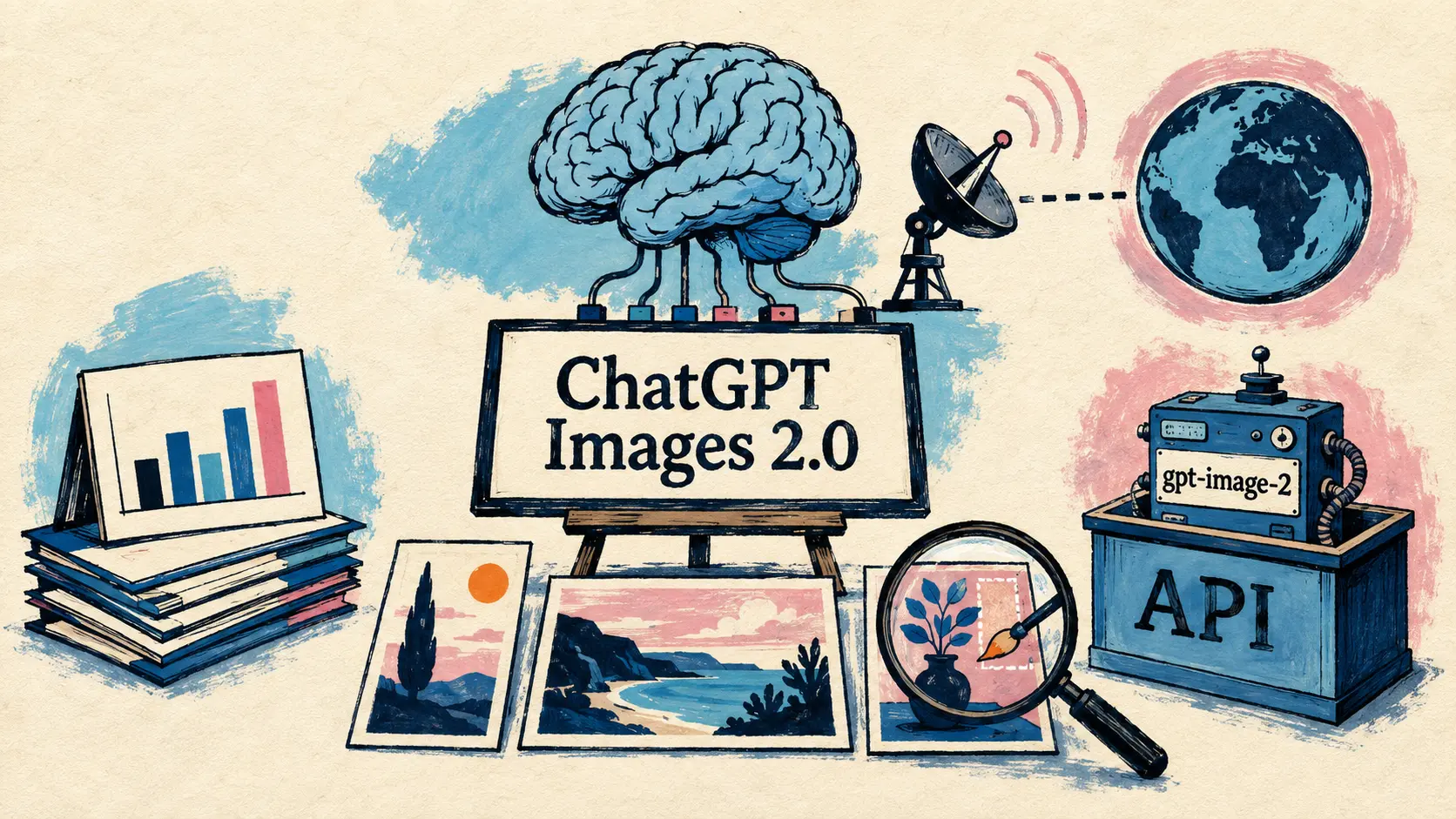
On April 21, 2026, three major announcements dominate the AI news: OpenAI launches ChatGPT Images 2.0 with its first image model capable of reasoning, Google DeepMind unveils two autonomous research agents powered by Gemini 3.1 Pro, and NVIDIA strengthens a tripartite partnership with Adobe and WPP around creative agents for enterprise marketing. Claude Code, Codex and Git 2.54 round out a day rich in tooling updates.
ChatGPT Images 2.0 and gpt-image-2
April 21 — OpenAI launches ChatGPT Images 2.0, available immediately for all ChatGPT and Codex users. The underlying model, gpt-image-2, is simultaneously available via the API.
This new version marks a break from the previous generation: detailed instruction following (instruction following) is significantly improved, object placement and precise relationships are more reliable, dense text rendering has been revised, and several formats (portrait, landscape, square) are natively supported.
The thinking mode (thinking) is the main new feature. ChatGPT Images 2.0 is OpenAI’s first image model with reasoning capabilities. In thinking mode, available to Plus, Pro and Business subscribers (Enterprise soon), the model can:
- Search the web in real time for up-to-date information
- Generate multiple distinct images from a single prompt
- Self-check and correct its own outputs
OpenAI’s research teams detailed the use cases in a thread: multilingual rendering and precise text, slides and professional infographics, multiple formats and resolutions, complex instruction following.
| Feature | Availability |
|---|---|
| ChatGPT Images 2.0 (standard) | All ChatGPT and Codex users |
| thinking mode | ChatGPT Plus, Pro, Business (Enterprise soon) |
| gpt-image-2 API | Available now |
OpenAI’s guiding principle for this launch: the model “moves from image generation to strategic design, from a tool to a visual system.”
🔗 Introducing ChatGPT Images 2.0 🔗 @OpenAI tweet
Google Deep Research and Deep Research Max
April 21 — Google DeepMind launches two autonomous research agents powered by Gemini 3.1 Pro: Deep Research and Deep Research Max.
These agents navigate both the open web and custom data — internal documents, specialized financial information — to produce fully cited professional reports.
Deep Research is optimized for speed and low latency, ideal for interfaces that need quick responses. Deep Research Max leverages extended test-time compute to reason iteratively, refine searches and produce a high-quality report — designed for asynchronous background processing.
| Feature | Detail |
|---|---|
| MCP support | Secure connection to proprietary or third-party sources |
| Native visual generation | First agent to generate charts and infographics (HTML or Nano Banana 2) |
| Collaborative planning | The user can refine the research plan before execution |
| Multimodality | PDFs, CSVs, images, audio, video accepted as input |
| Availability | Gemini API, paid third parties, public preview |
Native visual generation is notable: Deep Research Max can produce charts and infographics directly in its reports, in HTML or via Nano Banana 2, without an external tool. Google Cloud startups and enterprises will benefit from availability to be announced soon.
🔗 @GoogleDeepMind announcement 🔗 blog.google article
NVIDIA × Adobe × WPP — Creative agents for enterprise marketing
April 20 — NVIDIA expands its strategic collaborations with Adobe and WPP to deploy autonomous AI agents in enterprise marketing operations. The announcement is accompanied by a live demonstration at the Adobe Summit on April 21, with Jensen Huang (NVIDIA CEO) and Shantanu Narayen (Adobe CEO).
The new Adobe CX Enterprise Coworker solution is orchestrated by AI agents based on:
- NVIDIA OpenShell: secure, observable and auditable execution environment for agentic workflows
- NVIDIA Agent Toolkit and open-source Nemotron models
- Adobe Firefly Foundry accelerated by NVIDIA AI infrastructure
Concretely, a global retailer can now generate millions of product/audience/channel combinations in minutes instead of months. 3D digital twins (Omniverse + OpenUSD) serve as persistent product identities to automate large-scale high-fidelity content production.
🔗 blogs.nvidia.com article 🔗 @NVIDIAAI tweet
Claude Code v2.1.116
April 19–21 — Claude Code v2.1.116 brings a series of improvements focused on performance, reliability and terminal experience.
The most tangible update: the /resume command is up to 67% faster on large sessions (40 MB+), with better handling of “dead-fork” inputs. MCP startup is also faster with multiple configured stdio servers.
User experience:
- The thinking indicator now shows progress inline (“still thinking”, “thinking more”, “almost done thinking”), replacing the separate hint line
/configcan search by option value (e.g. searching “vim” finds the Editor mode parameter)/doctorcan be opened while Claude is responding, without waiting for the turn to end
Security: auto-allow sandbox no longer bypasses dangerous path checks for rm/rmdir targeting /, $HOME or other critical system directories.
8 terminal fixes include: Kitty keyboard protocol (Ctrl+-, Cmd+Left/Right), Devanagari script rendering, Ctrl+Z blocking via wrapper process, scrollback duplication in inline mode, and several VS Code/Warp/Ghostty fixes.
| Category | Key change |
|---|---|
| Performance | /resume 67% faster on 40 MB+ sessions |
| UX | Progressive thinking spinner, /config by value |
| Security | Sandbox respects critical path protection |
| Terminals | 8 fixes (Kitty, VS Code, Warp, Ghostty, WezTerm) |
| Plugins | Auto-install of missing dependencies |
Live Artifacts in Claude Cowork
April 20 — Anthropic launches “Live Artifacts” in Claude Cowork: dynamic dashboards and trackers directly connected to the user’s applications and files.
Unlike classic artifacts (static), Live Artifacts refresh automatically when opened with current data. They are saved in a new dedicated tab with version history, accessible from any session.
“In Cowork, Claude can now build live artifacts: dashboards and trackers connected to your apps and files. Open one any time and it refreshes with current data.” — In Cowork, Claude can now create dynamic artifacts: dashboards and trackers connected to your applications and files. Open one at any time and it refreshes with current data.
The feature is available on all paid plans via a Claude app update.
Codex in enterprise: Codex Labs and 7 integration partners
April 21 — OpenAI reaches a new milestone in Codex enterprise deployment: 4 million developers use it every week (up from 3 million in early April, or +33% in two weeks), and simultaneously launches Codex Labs as well as a partnership program with 7 global integrators.
Codex Labs brings OpenAI experts directly into organizations for hands-on workshops and working sessions, with the goal of helping teams move from experimental use to repeatable deployment.
The 7 GSI integration partners: Accenture, Capgemini, CGI, Cognizant, Infosys, PwC and Tata Consultancy Services.
| Company | Codex use |
|---|---|
| Virgin Atlantic | Test coverage, technical debt reduction |
| Ramp | Faster code reviews (code review) |
| Notion | Rapid development of new features |
| Cisco | Understanding large interconnected repositories |
| Rakuten | Incident response (incident response) |
Codex now extends beyond software development: browser navigation, image generation, memory, cross-functional task orchestration.
🔗 Scaling Codex to enterprises worldwide
Nano Banana Pro in Google AI Studio
April 20 — Google AI Pro and Ultra subscribers now get expanded access to Google AI Studio with no API key required: access to Nano Banana Pro and Gemini Pro models with increased usage limits.
Just sign in with your subscriber account to go from prototype to production. This evolution positions the Google AI subscription as a practical bridge for developers wanting to experiment without the complexity of per-request billing.
🔗 @GoogleAI announcement 🔗 blog.google article
Kimi FlashKDA open source
April 21 — Moonshot AI releases FlashKDA as open source, their high-performance CUTLASS implementation of Kimi Delta Attention (KDA) kernels.
| Metric | Value |
|---|---|
| Prefill speedup vs baseline | 1.72× to 2.22× on H20 |
| Integration | Drop-in backend for flash-linear-attention |
| Requirements | SM90+, CUDA 12.9+, PyTorch 2.4+ |
FlashKDA works as a drop-in backend for flash-linear-attention. Integration is available via PR fla-org/flash-linear-attention#852.
🔗 FlashKDA GitHub repo 🔗 @Kimi_Moonshot tweet
Git 2.54
April 20 — Git 2.54 is available with three structural changes.
git history (experimental) — New subcommand to rewrite history without going through git rebase -i:
git history reword <commit>: change a commit message and rewrite branches in placegit history split <commit>: split a commit into two interactively
Config-based hooks — Hooks can now be defined in Git configuration files, no longer only in .git/hooks. This makes sharing across multiple repositories via ~/.gitconfig, multiple hooks for the same event, and individual disabling via hook.<name>.enabled = false possible.
Geometric repacking by default — git maintenance now uses the geometric strategy by default, improving performance without additional configuration.
🔗 Highlights from Git 2.54 🔗 @github tweet
Genspark Build in public preview
April 21 — Genspark launches Genspark Build in public preview: an app and website creation tool powered by Claude Opus 4.7, covering the full process from idea to design mockup, prototype and working code.
Plus and Pro users get 3 days of credit-free access from April 21 to 24 (9am PT). Genspark says it is launching “rough edges and all” — the tool is under active development.
The same day, Genspark also integrates Lyria 3 Music into its AI Music Agent and Gemini 3.1 Flash TTS into its AI Audio Agent.
🔗 Genspark Build tweet 🔗 Lyria 3 + TTS tweet
Cohere — Research on speculative decoding for MoE models
April 21 — Cohere publishes a technical research paper on optimizing Mixture-of-Experts (MoE) models with speculative decoding.
The team validates on its production MoE models — including Command A (111 billion parameters) — a non-monotonic gain curve depending on batch size: gains first increase before decreasing. Two key mechanisms are identified: temporal correlation in expert routing reduces the number of unique experts to load into memory by 20 to 31%, and amortization of fixed costs explains the high gains at BS=1.
Genspark Claw: Kimi K2.6 on day one
April 21 — Genspark integrates Kimi K2.6 into its Claw tool on launch day (Day 0), via a partnership with Fireworks AI that supported the pre-launch and testing phases.
Anthropic STEM Fellows Program
April 21 — Anthropic launches the STEM Fellows program, targeting experts in science and engineering to work alongside research teams on projects lasting a few months, based in San Francisco.
What this means
April 21 marks a convergence between reasoning and multimodal generation. gpt-image-2 illustrates a clear trend: generative models are integrating reasoning as an orchestration layer, not just as a quality improvement. The result is a model capable of searching, generating, verifying and correcting within a single session.
Deep Research Max pushes the same logic on the research side: with MCP support, the agent can access structured proprietary data, opening the door to autonomous analytical workflows without exporting sensitive data to third-party services.
The NVIDIA × Adobe × WPP partnership signals that enterprise adoption of creative AI is moving out of the pilot phase. OpenShell as an auditable runtime addresses a real constraint for large organizations: autonomous agents must be observable and traceable, not just performant.
On the tooling side, Git 2.54’s config-based hooks are a quiet but important architectural shift: hooks shared across repositories via ~/.gitconfig will change team practices for standardizing local CI workflows.
Sources - Introducing ChatGPT Images 2.0
- Tweet @OpenAI — Images 2.0
- Scaling Codex to enterprises worldwide
- Gemini Deep Research — blog.google
- Tweet @GoogleDeepMind — Deep Research
- Nano Banana Pro in AI Studio — blog.google
- Tweet @GoogleAI — AI Studio
- NVIDIA × Adobe × WPP — blogs.nvidia.com
- Tweet @NVIDIAAI — Adobe Summit
- CHANGELOG Claude Code v2.1.116
- Live Artifacts Announcement @claudeai
- Highlights from Git 2.54
- Tweet @github — Git 2.54
- Tweet Genspark Build
- Tweet Genspark Lyria 3 + TTS
- FlashKDA GitHub
- Tweet @Kimi_Moonshot — FlashKDA
- Cohere — MoE speculative decoding
- STEM Fellows Announcement @AnthropicAI
This document was translated from the fr version into the en language using the gpt-5.4-mini model. For more information about the translation process, see https://gitlab.com/jls42/ai-powered-markdown-translator