ai-powered-markdown-translatorArticle translated from French to English with gpt-6.1-sol.
OpenAI is bringing its frontier models and Codex to Google Cloud Model Garden, in private preview for selected businesses, and Google now claims to be the only major cloud offering the three leading closed LLMs. Anthropic is opening the preview of Claude Duet, an agent that works independently in its own virtual machine and asks for approval before paying or signing, while OpenAI reports on PHP2Shell, two critical PHP vulnerabilities, one of which was found with GPT-5.6 Sol. At GTC Berlin, NVIDIA is introducing a reference architecture for sandboxing agents and AI factories delivered in containers; Recursive is releasing Flint, an open model for coding locally, and Cohere is launching Rerank 5.
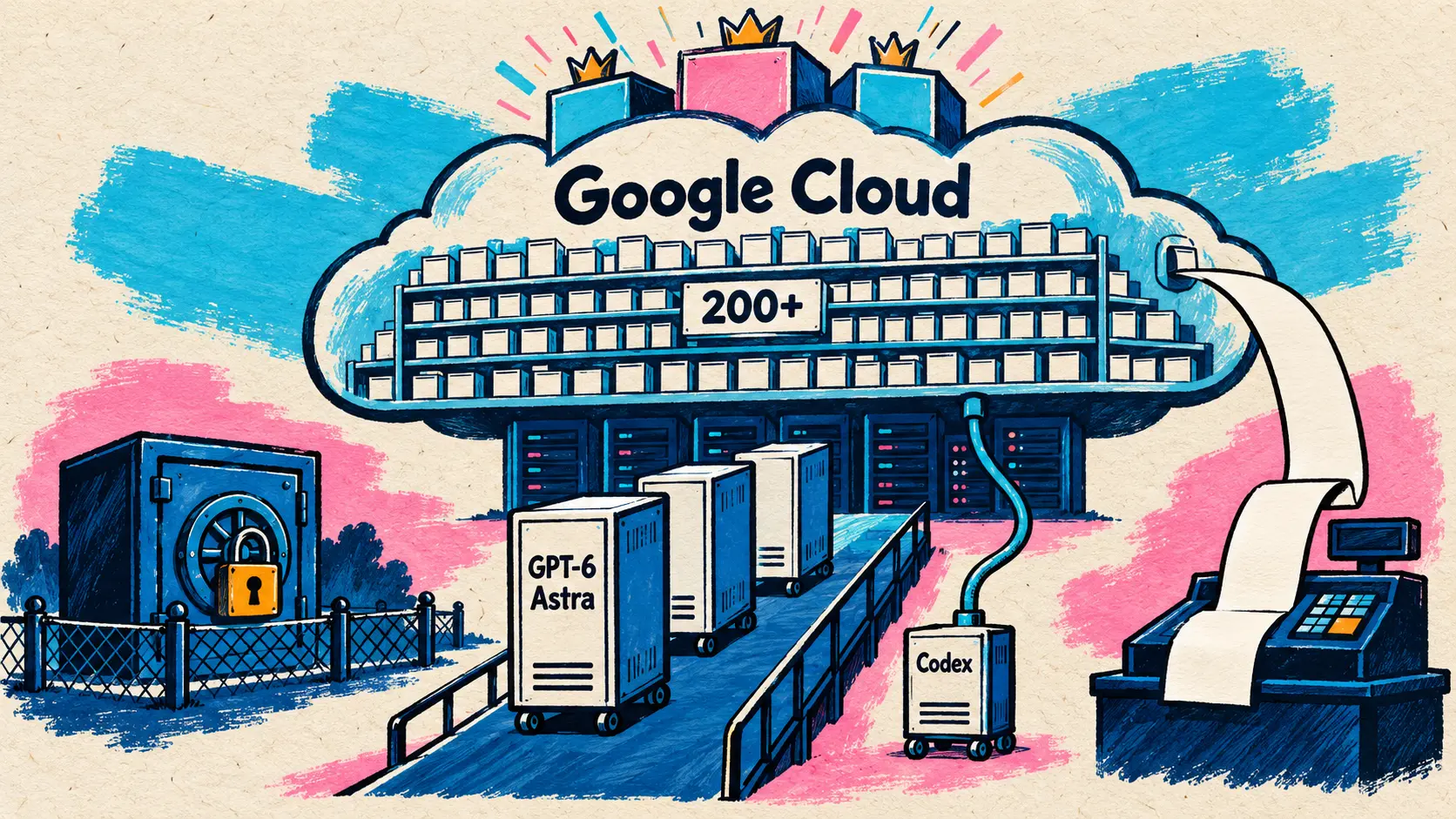
OpenAI models and Codex arrive on Google Cloud, in private preview in Model Garden
October 21 — OpenAI and Google Cloud announce the arrival of OpenAI’s frontier models and Codex agentic workflows in Model Garden, Google Cloud’s model catalog. Google’s post, written by Michael Gerstenhaber, Vice President of Product for Gemini, names the three models involved: GPT-6 Astra for the most demanding work (coding, computer use, professional tasks, scientific research), GPT-6.1 Sol, described as offering intelligence close to Astra at a lower cost, and GPT-6 Luna, the fast, economical model for everyday work at scale.
The rollout has several stages, and the two vendors describe them differently:
| Announced item | Stated timing | Source of timing |
|---|---|---|
| GPT-6 Astra, GPT-6.1 Sol and GPT-6 Luna in Model Garden | Private preview for selected enterprise customers, through an application form | Google Cloud |
| Calls through Google Cloud APIs, Codex CLI and Codex Desktop connected to the Gemini platform for inference | Starting October 21, for these customers | Google Cloud |
| General availability | In the coming weeks | OpenAI |
| No data retention (Zero Data Retention) and Confidential Compute | Coming soon | Google Cloud |
| OpenAI models in Google Antigravity and the Gemini agent (Gemini for business according to Google) | Coming later, with no date | Both vendors |
For purchasing, the models are available through Model Garden and Google Cloud Marketplace: a single Google Cloud bill, usage applied toward existing Google spending commitments and counted toward Flexible Savings Plans, with no separate vendor contract. OpenAI had already offered this use of spending commitments with Oracle Cloud in June. Google also emphasizes governance: prompts, context and responses remain within the customer’s data boundary and are never used to train foundation models, while the models run on dedicated Google Cloud infrastructure, behind isolated gateways, with VPC Service Controls and unified audit logs. No pricing has been published. Google draws a claim from this:
Google Cloud is now the only hyperscale cloud provider offering access to all three leading closed source LLMs, alongside more than 200 first-party, third-party, and open models on a unified enterprise AI platform. — Michael Gerstenhaber, Vice President of Product for Gemini at Google Cloud
OpenAI, for its part, states that Microsoft remains its primary cloud partner. Following Amazon Bedrock on June 1 and Oracle Cloud on June 10, Google Cloud joins the clouds distributing its models, including Codex. The official SDKs released the same day, openai-python 3.36.0 and openai-node 7.41.0, already support Vertex AI for the Responses API.
🔗 OpenAI’s post · Google Cloud’s post · The tweet from @OpenAI
Claude Duet: Anthropic opens a proactive agent in preview, and Grok Bot keeps its dashboards up to date
October 21 — Anthropic is opening the research preview of Claude Duet, a new application in which Claude works as a proactive agent: it flags what needs the user’s attention, carries out assigned tasks, continues working in their absence and asks for approval before acting on their behalf. Access is through a waitlist, initially for Pro and Max subscribers in the United States. Duet is a standalone application, separate from the main Claude application, on iOS, Android and claude.ai; during the preview, it is included in Pro and Max plans and draws on the same usage limits.
Built around Claude Opus 5.5, Duet uses the memory, skills and connected applications from the Claude account. Each morning, it sends a short summary of important items; during the day, it checks connected accounts every few hours, since continuous monitoring would exhaust the plan’s limits faster. Users interact with it by text or voice, in a single thread, and it works in its own virtual machine, with its own browser: neither the computer nor the phone needs to stay on. It draws on more than 6,000 connectors and plugins from the Claude Marketplace (Gmail, Slack, QuickBooks, Stripe, Gusto, Docusign, Shopify…) and can make purchases for the business with Link, Stripe’s digital wallet, which pays using a virtual card without sharing the real card number.
| Type of action requested | What Claude Duet does |
|---|---|
| Read, write, prepare work | Works independently, in the background |
| Send a message, pay, sign, delete | Shows the action and waits for approval |
| Trade securities, transfer money between accounts | Prohibited, even with approval |
| Credit card numbers, identity documents | Sharing blocked by a new classifier |
| Health, personal finances | Shared only on explicit instruction |
Security draws on existing components: credentials are managed as in Claude Managed Agents, actions go through the auto mode classifier, defenses against prompt injection come from work on browser use, and Duet is joining the public vulnerability rewards program (bug bounty) following penetration testing by red teams and an external firm.
Claude Duet draws on years of our safety and security work on agents. It never directly sees your passwords, a new classifier guards against sharing sensitive information, and the important decisions stay with you. We’ll share more on our approach to safety in Claude Duet soon. — @claudeai on X
Anthropic acknowledges the limitations of this first version: Duet can misread a thread or misjudge urgency, personal tasks such as booking tickets are less developed, and it cannot yet show its browser. Background checks count toward plan limits, and larger tasks, such as a financial model or a presentation, consume more of them.
🔗 The Claude Duet announcement
Grok Bot now builds reports and dashboards that it keeps up to date
October 21 — SpaceXSI is pursuing the same idea of an agent that works between requests: Grok Bot can now produce reports, memos and dashboards. Users ask it for a page, then refine it together or assign it to keep the page updated over time. The feature is rolling out the same day to users of the latest versions of the mobile and desktop applications.
The announcement consists of two tweets and a demonstration video, with no post on x.ai: it does not specify the eligible plans, limits or data sources a dashboard can track. It follows a series of Grok Bot additions in October (an email address on the 9th, connectors and speed on the 16th, the iPhone Action button on the 19th) and echoes Claude Dashboards, the dashboards Anthropic has Claude keep up to date, in beta since early October.
PHP2Shell: OpenAI coordinates the response to two critical PHP vulnerabilities, Claude Security moves to continuous scanning
October 21 — OpenAI is publishing a report on two months of coordination around PHP2Shell, two critical vulnerabilities in PHP’s core. According to the post, security firm Calif identified one of them with GPT-5.6 Sol, as part of Patch the Planet, Daybreak’s open source initiative, and Wiz independently discovered and reported both. PHP maintainers led the fixes, with support from OpenAI, Wiz, Cloudflare and others; OpenAI believes that, to its knowledge, frontier AI found these vulnerabilities before attackers did. The stakes reflect the language’s reach: PHP powers around 70% of websites.
The disclosure site php2shell.com details the two CVEs, with severity reaching CVSS 9.2: an unauthenticated attacker can execute code on the server or read the PHP process’s memory (passwords, tokens, API keys). The vulnerable code is in PHP itself, meaning that an application with no flaws of its own can be affected.
| CVE identifier | Vulnerability class | Demonstration according to php2shell.com |
|---|---|---|
| CVE-2026-109618 | Corruption related to memory exhaustion (out-of-memory) | Unauthenticated code execution on WordPress, Drupal and Joomla |
| CVE-2026-109619 | Stale global state between requests, use-after-free | Unauthenticated code execution on WordPress and Drupal, memory reads regardless of the application |
Affected versions go back to PHP 5.4. The only complete fix is to upgrade to PHP 8.2.35, 8.3.36, 8.4.27 or 8.5.12, then restart Apache, PHP-FPM and PHP workers. To help operators, OpenAI is releasing a Codex skill, openai/php2shell-checker, which reads a site’s PHP version from its URL or directly on the server; its repository warns that it can only see the version reported by HTTP headers or by php -v, and that an unknown result does not mean the target is patched.
Given the severity of these flaws and PHP’s widespread use, we consider this one of the most impactful security issues in recent memory. — OpenAI, October 21 post
OpenAI derives a five-step response framework from this, ranging from validating the patch before release, with adversarial testing by frontier models, to publishing guidance, including advance notice to affected organizations and coordination with authorities (for PHP, the White House Super Intelligence Force, ONCD and CISA), and puts four questions to the community, including the length of disclosure windows. The company is opening Codex for OSS subscriptions to all maintainers, directly sponsoring projects such as the Rust Foundation and expecting a sharp increase in discoveries of this kind over the coming months. The same day, it published a plan to equip cyberdefenders (see the Briefs).
🔗 OpenAI’s post · The php2shell.com site · The php2shell-checker skill
Claude Security moves to continuous scanning and tracks fixes, in public beta for Claude Enterprise
October 21 — At Anthropic, Claude Security no longer depends on manually initiated scans: it now monitors repositories as they change. A project groups one or more repositories, connected through Claude’s GitHub application (including GitHub Enterprise Server) or an access token for GitLab and other Git providers; Claude runs an in-depth baseline scan, then analyzes changes according to their risk and complexity. A finding is marked as fixed when the fix is shipped, even outside Claude Security, and reopens if the problem returns. According to Anthropic, thousands of organizations have found more than a million vulnerabilities with the tool since its public beta in April.
Each project receives a knowledge base and a threat model (threat model) that Claude drafts from the code and the team can edit; the severity of each finding depends on it, with an explanation of the attack path, sometimes in diagram form. An API, webhooks, an MCP connector in Claude.ai and Claude Code, and role-based access controls round out the offering. This version is in public beta for Claude Enterprise, can be enabled by administrators, and spans the entire model family, including Claude Mythos, without going through the Cyber Verification Program. Eligible organizations receive $25,000 in usage credits per month for two months, for use through December 31, 2026.
🔗 The Claude Security announcement
Compute infrastructure: containerized DSX POD, Google Cloud A5X instances and Confidential Bare Metal
October 21 — At GTC Berlin, where Jensen Huang said during his keynote that Vera Rubin was in full production, NVIDIA is introducing DSX POD, a reference design for complete Vera Rubin AI factories, manufactured by partners in modular containers. Compute, networking, rack-to-rack cabling, piping, rack-level power and liquid cooling are integrated and validated at the factory, then delivered ready to connect to an already equipped site.
The selling point is deployment time: at a site where power, cooling and networking are ready, NVIDIA says deployment can be cut from six months to as little as 14 days. For Jensen Huang, an AI factory creates value when it starts producing tokens, rather than when construction ends. Seventeen partners (Dell, HPE, Lenovo, Foxconn, Schneider Electric, Vertiv, Bull, Crusoe, Anduril…) are expected to deliver these factories worldwide in early 2027; no price has been disclosed.
| Item announced by NVIDIA | Announced figure |
|---|---|
| DSX POD commissioning | From six months to as little as 14 days |
| Manufacturing partners | 17 |
| First deliveries | Early 2027 |
| Cooling water saved (2 GW site) | Up to 54 million liters per day |
| Energy with DSX MaxLPS software | Up to 30 % less for the same number of tokens |
A companion press release quantifies the DSX platform’s efficiency: closed-loop liquid cooling with dry coolers, bringing cooling water consumption close to zero, saves up to 54 million liters per day at a 2-gigawatt site, equivalent to the daily consumption of 180 000 households; DSX MaxLPS software would reportedly produce the same number of tokens using up to 30 % less energy, and CoreWeave, Google Cloud, Lambda and Nebius plan to use it. The previous day, NVIDIA had also detailed the adoption of its Vera CPUs in Europe by Nebius, Nscale and Verda.
🔗 The DSX POD press release · The DSX ecosystem in Europe
Google Cloud announces its A5X instances on Vera Rubin NVL72, available next month
October 21 — Google Cloud and NVIDIA are introducing A5X instances, which combine Vera Rubin NVL72 systems, ConnectX-9 network cards, Google Cloud’s Virgo network and its fourth-generation liquid cooling, for agentic inference and reinforcement learning at scale. Despite a headline referring to general availability, NVIDIA’s post specifies that it is coming next month, with expansion into Europe planned. Google Cloud ultimately plans to deploy up to 960 000 Rubin GPUs across multiple sites.
The first customer is Ineffable Intelligence, the London-based company founded by David Silver, the creator of AlphaGo, which aims to train systems capable of learning continuously from their own experience. Based on its initial tests, WPP says it has fit creative-agent workloads onto a single A5X instance that previously required a cluster of multiple nodes.
🔗 NVIDIA’s post on A5X instances
Confidential Bare Metal: NVIDIA protects labs’ models on machines they do not own
October 21 — NVIDIA is expanding its confidential computing offering with Confidential Bare Metal, an option designed for labs training or serving frontier models on dedicated third-party infrastructure at a cloud provider, neocloud or enterprise. They install their own software stack, including host and platform software, while retaining control of their models and data through new controls: protection for data in transit, platform integrity measurement and hardware-enforced access restrictions.
The offering now includes three modes (bare metal, Kubernetes containers, virtual machines), extends to Grace Blackwell and Rubin systems and will be integrated into DSX OS, the reference architecture for cloud providers building AI factories. Cohere plans to use it in Cohere Model Vault, and Google Cloud is extending it to its A4X Max instances, based on GB300 NVL72, while making Confidential Computing generally available on its G4 VMs. In September, NVIDIA demonstrated confidential inference on B200 that retained 96,1 to 98,2 % of throughput.
🔗 NVIDIA’s post on Confidential Bare Metal
Enterprise agents at NVIDIA: the OpenShell Reference Architecture, Agent Toolkit and Kumo models
October 21 — At GTC Berlin, NVIDIA introduced the OpenShell Reference Architecture, a reference architecture for building, sandboxing, observing and governing enterprise agents, available now. It extends OpenShell, the open source runtime that places an agent in a sandbox controlled by kernel-level policies, into a complete hardware and software stack. Jensen Huang summarizes the division of responsibilities: agents think on Rubin, act on Vera and are governed on BlueField. In his view, AI capabilities and security must advance together as businesses prepare to deploy billions of agents.
| Stack component | Announced role | Figure cited by NVIDIA |
|---|---|---|
| Vera Rubin NVL72 | Inference for closed models or open models built with Nemotron | 30 times more throughput per megawatt on agentic workloads |
| Vera CPU | Agent harnesses and tool calls | 2 times the performance of x86 processors |
| BlueField-4 DPU with NVIDIA Sentry | Out-of-band monitoring, policies enforced in silicon | Agent shutdown within milliseconds, up to 20 % more agent capacity |
If an agent attempts to move beyond its permitted scope, Sentry quarantines it and shuts it down within milliseconds, according to NVIDIA. The architecture extends down to RTX Spark, DGX Spark and DGX Station workstations, and runs on Linux and Kubernetes (Canonical, SUSE, Red Hat) as well as Windows, with Microsoft Execution Containers, on AWS, Google Cloud and Azure.
Agents powered by models from Anthropic, Cohere, Google, Meta, OpenAI, Perplexity, Reflection and SpaceX Super Intelligence can run on it. Eleven security vendors, including CrowdStrike, Palo Alto Networks, Zscaler, Okta and 1Password, are integrating it, BBVA and Santander are exploring it, and Cadence, Dassault Systèmes, IBM, SAP, Siemens and Synopsys are building on it. SAP is connecting it to the Joule Studio runtime, and ServiceNow is taking the opportunity to make ServiceNow Arc generally available, a long-running personal agent whose actions are governed by OpenShell; its AI Passport passes its policies to OpenShell and Sentry to revoke an agent’s access within seconds.
🔗 NVIDIA’s press release · The tweet from @NVIDIAAI
Agent Toolkit: Agent Knowledge Foundation and the Kumo family of open models
October 21 — Within the same stack, NVIDIA is expanding its open source Agent Toolkit with a component dedicated to enterprise data, Agent Knowledge Foundation. It brings together the CUDA-X libraries (cuDF, cuGraph, cuML, cuOpt, cuVS), a new Auto-Ontology library that translates raw data into business concepts (customers, products, orders) and relationships without moving the data or changing governance controls, the Nemotron Retriever retrieval models and the Kumo family of open models, which makes predictions from tabular, relational or temporal data (Kumo Tabular, Relational, Time Series and Forecast). The toolkit also includes the OpenShell runtime and NemoClaw blueprints, including a new one dedicated to agent optimization.
NVIDIA cites early results from its partners: SAP’s fine-tuned reranker runs nearly 3 times faster, ServiceNow reduces its reranking latency by almost a quarter, and Amazon OpenSearch Service improves relevance with virtually no added latency. Databricks pairs Kumo Anomaly with Genie Ontology, Snowflake makes Kumo Engine and Kumo Relational available in its notebooks, and NVIDIA uses it for its own supply chain, with Palantir. The Kumo family launched in late September with Kumo Tabular.
🔗 NVIDIA’s post on Agent Toolkit
Flint: Recursive releases an open 40-billion-parameter MoE for local coding, and Base Labs releases its decision models
October 21 — Recursive, Richard Socher’s company, is releasing Flint, its first model: a mixture-of-experts designed for agentic coding on local hardware. It has 39,8 billion parameters in total but activates only around 2,5 billion per token, allowing it to run on a laptop. The weights are released under the Apache 2.0 license on Hugging Face, in BF16 and quantized INT4 and NVFP4 versions (GGUF), and the model can be used with Ollama, LM Studio, Unsloth or exo, or for free in OpenCode and Pi.
| Benchmark or feature | Value according to Flint’s model card |
|---|---|
| Terminal-Bench 2.1 | 54,9 % |
| SWE-bench Pro v2 | 89,7 % |
| SWE-bench Verified | 74,2 % |
| Total and active parameters | 39,8 billion, including around 2,5 billion active per token |
| Experts per MoE layer | 256 routed, including 6 active, plus 1 shared |
| Documented context | 262 144 tokens |
The scores are average pass@1 results over at least five trials, measured by Recursive; on Terminal-Bench, solutions found through web search count as failures, and competitors’ scores are partly those reported by their developers, using different protocols. According to Recursive, no other MoE with fewer than 50 billion parameters performs better on these three benchmarks, and Flint rivals dense models with 25 to 40 billion parameters while running more than five times faster. The company reports over 125 tokens per second on a MacBook Pro M4 Pro and over 150 on a 64 GB NVIDIA RTX Spark. The post mentions up to 512k tokens of context, while recommending staying below 256k, and advises breaking complex tasks into smaller pieces: Flint may need more guidance than large closed models.
Flint also serves as a demonstration of the Eureka Machine, Recursive’s automated research system, which cycles through proposing ideas, implementation, testing and choosing the next direction. According to the company, this system contributed to the data, optimizers, training recipes, infrastructure and inference, enabling a small team to build the model from scratch in less than four months.
🔗 Recursive’s post · RecursiveSI/flint on Hugging Face
Base Labs, Baseten’s lab, releases the mammoth-1 and elephant-1 decision models
October 21 — Baseten is releasing two decision models trained by its research lab, Base Labs: mammoth-1, with 27 billion parameters, and elephant-1, with 9 billion. A decision model does not write a response: it returns a probability for each possible answer to a multiple-choice, rating or yes-or-no question, making it possible to set confidence thresholds that determine when to hand over to a human. According to Baseten, it can respond up to 10 times faster than a reasoning model. Both models are post-trained versions of Qwen3.5-27B and Qwen3.5-9B, trained on 6,21 million examples, including cases where the model needs to know to answer “I don’t know.”
| Decision model | Base model | Jev Decision Index 0.4 | Artificial Analysis Decision Index |
|---|---|---|---|
| mammoth-1 | Qwen3.5-27B | 71,24, first out of 208 | 65,9 |
| elephant-1 | Qwen3.5-9B | Best 9B model, tied for 8th | 65,2 |
Both models are free for one week on Baseten’s Model APIs, with no data retention by default. Baseten presents them as open source: their Hugging Face model cards list an MIT license.
Document retrieval for agents: Cohere launches Rerank 5, NVIDIA releases Nemotron 3.5 Embed, Rerank and Parse
October 21 — Cohere launches Rerank 5, the new generation of its reranking (reranking) models for enterprise search, in two versions: Rerank 5 Pro (rerank-v5.0-pro) targets the highest quality, particularly for queries requiring reasoning and for long or specialized documents, while Rerank 5 Fast (rerank-v5.0-fast) targets latency and volume, for example for agents that run many searches per task. Both are available starting October 21 through the Cohere API, at $0.05 per million tokens for Pro and $0.02 for Fast, as well as in Model Vault, Microsoft Foundry, Amazon SageMaker and North. They support more than 100 languages, 32k tokens of context and semi-structured data, and migration requires changing only the model parameter, with no reindexing.
The main new feature is called Context Focus. Disabled by default, this option returns the most relevant passages from each document in the same call, as scored character ranges, so that only these excerpts need to be sent to the LLM. Cohere tested it with a research agent (glm-5-3-flash, 17 sets of 50 questions):
| Search stack tested by Cohere | Correct answers | Tokens consumed |
|---|---|---|
| BM25 alone | 46 % | Baseline |
| BM25 and Rerank 5 Pro | 49 % | Not quantified |
| With Context Focus, default threshold of 0,1 | 57 % | 19 % fewer than without Context Focus |
| With Context Focus, threshold of 0,4 | 58 % | 34 % fewer than without Context Focus, 35 % fewer than BM25 alone |
| Six deep research benchmarks, threshold of 0,4 | 52 %, versus 39 % with BM25 alone | 41 % fewer than BM25 alone |
It is this last figure, measured against BM25 alone, that Cohere’s thread summarizes as “up to 41 %” fewer tokens. The second change is calibrated scores. A relevance score of 0.7 now means a 70 % chance that the document will be useful, and the “more likely useful than not” threshold is 0.50 for Pro and 0.45 for Fast, making it possible to filter by threshold or detect when no relevant results have been returned. Against two independent sets of human judgments, the expected calibration error (ECE) is around 0.06 for both models, compared with 0.23 to 0.38 for Rerank 4 Pro and the two Voyage AI models tested.
On public benchmarks, evaluated with RCP-nDCG@10, Cohere’s in-house measurement method, Rerank 5 Pro ranks first on 39 of the 46 composite datasets and scores 82.2 on BRIGHT, which tests retrieval requiring reasoning: 5.8 points above Voyage AI Rerank 3 and 12.4 above Rerank 4 Pro. Fast processes around 187 documents of 1,000 tokens per second on an A100 GPU, 2.9 times Pro’s throughput. Rerank 5 arrives three weeks after Embed 5 and one week after the short video in which Cohere was already comparing it with Rerank 4.
🔗 Cohere’s blog post · Cohere’s release notes
Nemotron 3.5 Embed, Rerank and Parse: NVIDIA’s multimodal document retrieval for agents
October 21 — On the same day, NVIDIA expands its Nemotron Retriever collection (formerly Nemotron RAG) with embedding, reranking and document extraction models, presented as open and available for commercial use, and released on Hugging Face under the OpenMDW 1.1 license. Nemotron 3.5 Embed comes in an 8B version, a 1B version distilled from the 8B model, and a 1B NVFP4 version, and searches both text and document images (tables, charts, diagrams); Nemotron 3.5 Rerank 8B scores query-document pairs in text and image form, while Nemotron 3.5 Parse, with 631 million parameters, converts pages into structured text.
On ViDoRe v3.1, Embed 8B achieves an nDCG@10 of 61.17, ranking first among dense models as of October 20, and Rerank 8B scores 60.49 compared with 59.17 for Qwen-3-VL-Reranker-8B. Parse ranks first on ParseBench among models with fewer than a billion parameters, scoring 75.20 at 10.5 pages per second on an H100. Like Cohere, NVIDIA highlights agent costs, but uses different benchmarks and baselines:
| Point of comparison | Cohere Rerank 5 | NVIDIA Nemotron 3.5 Rerank |
|---|---|---|
| Distribution | Paid API, Model Vault, Foundry, SageMaker | Weights on Hugging Face, OpenMDW 1.1 license |
| Claimed token savings | Up to 41 %, against BM25 alone on six benchmarks | Around 14 % per agent query, with Embed 8B |
| Highlighted score | 82,2 on BRIGHT (RCP-nDCG@10) | 60,49 on ViDoRe v3.1 (nDCG@10) |
The two savings figures cannot be compared directly: Cohere measures its full stack with Context Focus against keyword search alone, while NVIDIA measures the addition of Rerank after its own embeddings, on ViDoRe v3, BRIGHT and BrowseComp-Plus. For deployment, the NVFP4 version of Embed 1B processes 27.1 % more documents per second on GB200 while retaining 99.85 % of its accuracy.
🔗 NVIDIA’s blog post on Nemotron Retriever
ChatGPT Ads: 26 more countries, 89 in total, and an ad platform driven by an orchestrator LLM
October 21 — OpenAI expands ChatGPT Ads to 26 additional countries, bringing its advertising platform to 89 countries. Following Mexico and Brazil, the expansion covers 14 more Latin American countries, including Argentina, Chile, Colombia and Peru, as well as new markets in Europe, the Middle East, Africa and Asia, such as Nigeria, South Africa, Serbia, Ukraine, Cambodia, Bangladesh and Pakistan. More than 100,000 advertisers have launched campaigns since ads became available just over eight months ago, and more than 1.2 billion people use ChatGPT every week. Ads remain limited to the Free and Go plans; Plus, Pro and Enterprise remain ad-free. At the end of August, the platform reported a billion dollars in annualized revenue and availability in more than 40 countries.
On the same day, two OpenAI engineers, Ritendra Datta and Karthik Gopalratnam, describe the platform’s technical stack. In a conversation, commercial intent develops over multiple turns, something traditional systems designed for a query or a page view handle poorly. OpenAI therefore chose stateful advertising sessions that remember across turns and conversations, a post-trained frontier LLM, the “orchestrator,” which manages the entire flow through tool calls, and a selection service separate from response generation, with its own models and code.
| Stage of the advertising pipeline | What happens |
|---|---|
| Intent | The orchestrator summarizes the conversation into one or more queries |
| Retrieval | Semantic embeddings and approximate nearest neighbor search across multiple indexes |
| Filtering | Budget, spending pace, targeting, rules, deduplication by advertiser |
| Scoring | Relevance, predicted engagement, past performance |
| Auction | Selection of the ad and its price, outside the orchestrator |
ChatGPT does not depend on this system: if it is slow or unavailable, the response appears normally, an ad that arrives too late is not shown, and returning no ad is a normal outcome. The selected ad appears below the response, marked as sponsored, with a short, neutral preamble generated by a model. OpenAI’s most powerful models evaluate the whole system and train smaller models for orchestration or retrieval, and Codex served as a force multiplier in building the stack, even though OpenAI had no advertising system a year ago.
🔗 The expansion to 26 countries · ChatGPT’s advertising stack
AI for biology and medicine: GPT-Rosalind reads a CRISPR atlas, RFD4-Proteina and Cosmos3-H-Dreams
Three announcements apply AI to biology: OpenAI agents analyzing a genetic atlas, an open protein design model accessible in the browser, and a surgical simulator that generates images in real time.
Thousands of GPT-Rosalind agents analyze a mouse brain CRISPR atlas in 32 minutes
October 21 — OpenAI, PerturbAI and Scripps Research tasked thousands of agents powered by GPT-Rosalind with analyzing a CRISPR atlas of the entire mouse brain, which measures the effects of genetic perturbations on millions of cells. Each agent studies one perturbation, examines cellular responses, searches the literature and proposes an explanation; together, they form an atlas of reasoning (reasoning atlas) published on GitHub, with a preprint on bioRxiv.
| Metric reported by the team | Published value |
|---|---|
| Analysis time for the agents | 32 minutes |
| Comparable human analysis (estimate) | Months to a year |
| References cited at the highest workload | More than 700, versus 11 for a single agent |
| Blinded expert preference | 75 % for the distributed agents’ reports |
Two leads emerge. In the cerebellum, perturbing Tsc2 changes the activity of dozens of genes involved in neuronal communication, while perturbing Tsc1 changes almost nothing, a finding to consider in relation to tuberous sclerosis. And perturbing Dctn1, a gene associated with Perry syndrome, increases the expression of genes involved in cholesterol production, leading to a hypothesis experts considered novel, to be tested in the laboratory: could restoring cholesterol distribution in neurons protect them from degeneration?
🔗 OpenAI’s research blog post · The bioRxiv preprint
RFD4-Proteina: NVIDIA and the Baker Lab’s protein design model, free on dedicated GPUs until November 4
October 21 — NVIDIA makes RFD4-Proteina accessible in the browser. This open protein design model, developed with the Baker Lab at the University of Washington’s Institute for Protein Design, jointly generates a protein’s sequence and all-atom structure around a constraint: the target a binder must bind to, or the catalytic motif an enzyme must contain. It handles varied molecular contexts, from small molecules to nucleic acids, glycans and metal ions.
The weights have been on Hugging Face since October 6 under the BSD-3-Clause license; the new development is access through two Spaces, one on dedicated RTX PRO 6000 GPUs, free from October 21 to November 4 at NVIDIA’s expense, and the other on ZeroGPU, which remains free afterward. The model offers a reasoning setting (thinking setting), like LLMs: on a benchmark of 24 targets, with high reasoning, it produces 76.40 distinct designs per GPU-hour that pass in silico validation criteria, compared with 13.24 for Proteina-Complexa, the second-best method. In its blog post on the open models presented at GTC Berlin, NVIDIA also says it leads on more than ten design tasks and is around 13 times faster than RFdiffusion3 on proteins of 200 amino acids. NVIDIA suggests using it for the protein design competition sponsored by Anthropic and Adaptyv.
🔗 The RFD4-Proteina blog post on Hugging Face · The RFD4-Proteina weights
Cosmos3-H-Dreams: a generative surgical simulator that responds to user movements in real time
October 20 — NVIDIA presents Cosmos3-H-Dreams, a generative simulator that reproduces an abdominal surgery scene in real time: the user moves a grasper, grasps the gallbladder and lifts it, and the model generates the corresponding image. Rather than modeling tissue geometry and deformation, this world model (world foundation model) learns visual dynamics from videos and kinematics of actual cholecystectomies performed with CMR Surgical’s Versius robot. According to NVIDIA, it is the first real-time generative surgical simulator trained on clinical procedures to accept live kinematic control.
The model starts from Cosmos3-H-Embodied-Nano, with 16 billion parameters, specialized with 28 action dimensions (pose and gripper state for both arms, energy controls, controller axes and buttons), then distilled into four- and two-step versions that run interactively on a single RTX PRO 6000, thanks to the FlashDreams library. Both checkpoints are on Hugging Face under the NVIDIA Open Model License, along with the code and a recipe for adapting the model to your own data.
🔗 The Cosmos3-H-Dreams blog post on Hugging Face
Robotics and physical AI: the Agile ONE SN humanoid, Isaac Lab 3.0, Alpamayo 2 Edge and Cosmos Data Factory
NVIDIA devoted a large part of its keynote to physical AI: a reference humanoid for laboratories, a robot learning platform now generally available, and new models and tools for autonomous driving and training data. Microducks from Pollen Robotics and Hugging Face even took the stage (see Briefs).
Isaac: the Agile ONE SN reference humanoid, Isaac Lab 3.0 and Isaac OS
October 21 — NVIDIA is expanding its Isaac robotics platform with a reference humanoid for research. Built by Agile Robots, Agile ONE SN comes preconfigured with Isaac GR00T models, and the Halos safety system is set to be integrated. It is scheduled to become available in early 2027, with the aim of cutting lab setup time from a few weeks to a few days; Stanford and ETH Zurich are interested.
| Agile ONE SN specification | Announced value |
|---|---|
| Height and weight | 1,40 m, 40 kg |
| Degrees of freedom | 31, plus 20 for each of the two hands |
| Payload | 3 kg per arm |
| Onboard compute | Jetson Thor, 2 070 teraflops FP4, 128 Go of unified memory |
| Availability | Early 2027 |
The rest of the platform is advancing too: Isaac Lab 3.0, the open source framework for robot learning, reaches general availability with the Newton and PhysX physics engines, and a new open source runtime, Isaac OS, built on Holoscan, connects models, sensors and controls. Three reference workflows for DGX Station show how to fine-tune GR00T 1.7 using reinforcement learning, train dexterous manipulation or post-train Cosmos models to generate synthetic data. NVIDIA is also publishing a library of more than 2 000 simulation-ready objects on Hugging Face, along with Human 1M, a dataset of synchronized videos from three angles with 3D hand tracking, whose full version is reserved for Cosmos Coalition partners. For Jensen Huang, robotics’ ChatGPT moment is fast approaching.
Alpamayo 2 Edge and Cosmos Data Factory: onboard autonomous driving and robot data
October 21 — In the post introducing its open models at GTC Berlin, NVIDIA adds Alpamayo 2 Edge, a compact reasoning model that runs onboard the vehicle, on DRIVE AGX Thor, to understand the scene and plan the trajectory in real time; it is built on NVIDIA Cosmos. On the data side, Cosmos Data Factory brings together blueprints and agent skills to select, annotate, generate and evaluate training datasets, with new tools to improve world models using less compute. Porsche uses it with Voxel51, ANYbotics with Encord, Zalando and CEVA Logistics with Sereact, as does Siemens. The same post introduces RFD4-Proteina and announces that Ising, NVIDIA’s family of quantum computing models, is coming to AWS Parallel Computing Service.
🔗 NVIDIA’s post on its open models
Industry and telecoms: Mistral and NVIDIA team up for engineering, T-Mobile makes the first AI-RAN call
Two announcements take AI beyond the data center: into industrial design offices and mobile network antennas.
Mistral and NVIDIA team up for AI in industrial engineering, with open benchmarks
October 21 — Mistral announces a collaboration with NVIDIA to apply AI to industrial engineering. The two companies want to build engineering workflows centered on AI (AI-native engineering workflows): Mistral Large 4 and Mistral’s data generation and physics modeling pipelines, accelerated by NVIDIA’s CUDA-X and Warp libraries, are intended to shorten simulations and connect simulation, model development and design in a closed loop. Mistral’s models will also be integrated into the Omniverse libraries to generate 3D scenes on GPUs and SimReady 3D objects.
The project’s core focus is evaluation: public benchmarks and open datasets to compare the accuracy of physics models and validate automated pipelines from CAO to simulation, along with evaluations of agentic AI in computer-aided engineering (CAE) and electronic design automation (EDA), for aerospace, automotive and semiconductors. They will measure whether an agent can use engineering tools, carry out multistep tasks and deliver a technically correct result, along with execution time and compute cost. No benchmark names, datasets, dates or amounts are given. The post reiterates that the weights of Mistral Large 4 (around 1 000 billion parameters, 49 billion of them active), trained on 3 800 Grace Blackwell GPUs in Europe, are still scheduled for late October. For Neil Ashton, vice president of computational engineering at Mistral, the pace of engineering has been dictated by the pace of simulation for too long.
🔗 Mistral’s post · The tweet from @MistralAI
T-Mobile makes the first AI-RAN call on a commercial network, with NVIDIA and Nokia
October 21 — NVIDIA announces that T-Mobile has made the first AI-RAN call on a commercial network in Bellevue, Washington, with Nokia. AI-RAN runs radio network processing on GPUs, which can also serve AI models close to users. Jensen Huang summed up the milestone with a phrase: CUDA is now making phone calls, after nearly eight years of work, according to him.
In Europe, Elisa claims the continent’s first AI-RAN field trial, carrying voice, mobile data and vision AI on a single accelerated platform, BT is preparing trials in the UK, and Nokia is installing its CUDA-accelerated anyRAN software on NVIDIA’s Aerial RAN Computer for testing at BT, Deutsche Telekom, Elisa and Orange. Nine operators in EMEA are building or expanding NVIDIA infrastructure, and both Nokia and Cisco are integrating Nemotron models into their autonomous networking software.
🔗 NVIDIA’s AI-RAN announcement
Generative voice and video: Eleven Realtime Translation, HeyGen Voice Turbo and the Kling 4.0 API
Three generative media vendors are advancing their developer offerings: live voice translation, a cheaper voice model and a video API awaited for a week.
Eleven Realtime Translation: ElevenLabs opens a limited alpha for live voice translation during calls
October 21 — The day after introducing Eleven Realtime, its speech-to-speech models for voice agents, ElevenLabs opens a limited alpha of Eleven Realtime Translation, a live voice translation model. During a call, each person speaks their own language and hears the other person in theirs, in a natural voice. ElevenLabs sums up the difference: Eleven Realtime is for agents that talk to people, Realtime Translation is for people who need to talk to each other.
The model covers more than 90 languages and automatically detects each speaker’s language. The output voice can be selected from more than 17 500 voices in the library, or can be a clone of the speaker’s own voice, and an eagerness setting (eagerness control) balances latency and translation quality. Access is restricted to businesses during the alpha, through ElevenAPI, with no pricing or blog post.
🔗 The announcement from @ElevenLabsDevs
HeyGen Voice Turbo: first in Artificial Analysis’ Controlled Voice view, ahead of HeyGen Voice
October 21 — Twelve days after HeyGen Voice, its first in-house voice model, HeyGen launches a faster, cheaper Turbo variant, available through its API; the API’s Turbo endpoint is free until November 30. HeyGen says it holds the top two spots in Artificial Analysis’ text-to-speech ranking. This is the Controlled Voice view, which compares models using the same cloned voices, where Qwen-Audio-3.1-TTS-Plus rounds out the top three and the uncertainty margins leave the leading trio neck and neck.
| Text-to-speech model | Elo in Controlled Voice view | Price listed by Artificial Analysis |
|---|---|---|
| HeyGen Voice Turbo | 1 202 (±19) | 4 dollars per million characters |
| HeyGen Voice | 1 195 (±15) | 30 dollars per million characters |
As on October 9, HeyGen does not lead the Provider Voice view, which compares the voices supplied by each vendor.
🔗 HeyGen’s announcement · Artificial Analysis’ Controlled Voice view
Kling opens the Kling 4.0 API, also available on fal, Higgsfield and Runway
October 21 — Six days after Kling 4.0 became fully available on its website, Kling officially rolls out its video model’s API, which it had said on October 15 would arrive soon, for integration into products and workflows. The announcement provides neither pricing nor a documentation link. The model arrives on several third-party platforms the same day: fal and Higgsfield add it, Kling promotes it on Magnific, and Runway offers three days of unlimited Kling 4 use to every new Max or Team subscriber.
🔗 The announcement from @Kling_ai · Runway’s offer
GitHub has copied 99,99999 % of its repositories to Azure and is moving to a per-reference quorum
October 21 — Two weeks after outlining the principles of its future Git infrastructure, GitHub describes the intermediate step, driven by the agentic shift. Now, 99,99999 % of its repositories live in both its own data centers and Azure, where the first copy arrived in August 2025; most have two of their five replicas there, and Azure already serves around half of Git traffic. The remaining 0,00001 % are the busiest repositories, held back by a network round trip of around 25 ms to an Azure region roughly 1 000 miles away.
The bottleneck comes from the quorum in Spokes, the system that replicates each repository: a write waits for all healthy replicas and locks the entire repository, so the slowest replica sets the pace. GitHub is therefore moving from a per-repository quorum to a per-reference quorum: two writes now wait for each other only if they touch the same branch, which is rare when agents and developers each push to their own. In internal tests, writes to different references achieved 3 to 4 times higher throughput. Azure Blob Storage also joins the quorum through a write “virtual replica,” GitHub’s first fully ephemeral node, and read virtual replicas can be created on demand for repositories that receive 100 to 1 000 reads per write. The final installment in the series is expected at GitHub Universe next week.
JOLT: Perplexity Research and NVIDIA have the same model play teacher and student
October 21 — Perplexity, together with NVIDIA, publishes JOLT (Joint On-policy Learning and Teaching, joint learning and teaching), a post-training method in which a single model plays two roles. Traditional reinforcement learning, such as GRPO, provides only one reward per attempt; self-distillation adds token-by-token feedback, with the same model playing the teacher, which has privileged information such as a verified solution, and the student, which does not. But with its hints, the teacher can take shortcuts beyond the student’s reach: JOLT therefore also trains the teacher, using its own rewards, with a penalty when it strays from what the student would do.
| Benchmark evaluated | Base model | JOLT+ gain over GRPO |
|---|---|---|
| GSM8K | DeepSeek-V2-Lite | +1,5 point |
| MATH | Qwen3-0.6B | +4,2 points |
| LiveCodeBench v6 | Qwen3-8B | +3,0 points |
| AppWorld | Qwen3-4B-Instruct | +9,9 points |
| Terminal-Bench 2.1 (pass@1) | Qwen3-30B-A3B-Instruct | +2,7 points |
The JOLT+ variant, which adds the student’s own reward, outperforms GRPO, the strongest baseline tested, on all five benchmarks; without that reward, JOLT does better than GRPO in mathematics and coding, but remains behind it on AppWorld and Terminal-Bench. The clearest gain is in cost: on MATH, at equal accuracy (63,44 %), GRPO consumed 8,40 million training tokens, compared with 1,30 million according to JOLT’s fitted curve, or 6,5 times fewer. The full paper has been on arXiv since October 7, and the post does not connect the method to any Perplexity product.
🔗 Perplexity’s post · The paper on arXiv
Coding agents: Claude Code 2.1.305, Gemini CLI 0.65 to 0.67, Delta 0.21, Replit Agent with Stripe Atlas and PDD Kit
Agent CLIs fix their regressions and add support for corporate networks, Delta connects to Claude Code, Replit Agent learns to create a company, and GitHub Next promises to prove agents’ code rather than review it. On the OpenAI side, no stable version of Codex CLI has been released since 0.163.0 on October 15; Copilot CLI 1.0.102, Qwen Code, the mistral CLI and the day’s other tools are in Briefs.
Claude Code 2.1.305 fixes requests blocked by tool search on Vertex and Bedrock
October 20 — Claude Code 2.1.305 (38 entries, including 22 fixes) first fixes a regression in 2.1.304: on Vertex, Bedrock and other providers, all requests failed when the endpoint or a gateway rejected tool search (tool search), or when a gateway prohibited ToolSearch or omitted it from --tools. Claude Code now retries without it. On Linux, sandbox.allowNestedUserNamespaces allows sandboxed commands to create user namespaces, for rootless Chromium or podman; the notes warn that this allows them to bypass the sandbox’s file protections.
/usage turns each warning into a one-line fix that names its source, applicable using the f key. For administrators, allowedMcpServers no longer filters out stdio servers from managed-mcp.json that use ${VAR} only in env: a server left off the list will load after the update, and deniedMcpServers allows it to remain disabled. Resuming a Workflow no longer restarts pipeline() and parallel() agents that have already finished. Released on October 21, 2.1.306 adds two fixes, including one for claude -p, which reported being disconnected in a cloud session launched without its environment variables.
🔗 Claude Code 2.1.305 release notes
Gemini CLI: stable v0.65.0, preview v0.66.0 and MCP OAuth on private networks
October 20 — Gemini CLI wrapped up its weekly cycle on the evening of October 20, with preview v0.66.0-preview.0 at 21:04 UTC and stable v0.65.0 at 21:17 UTC; the October 21 v0.67.0 nightly then kicks off the 0.67.0 series. The stable release simply promotes previously covered fixes (custom OTLP headers, faster filtering of ignored files, an end to OAuth loops), but the preview and nightly add four new PRs.
The most useful addition for businesses is the oauth.allowPrivateNetwork setting, enabled for each server in settings.json, which allows connections to MCP servers and OAuth 2.0 providers hosted on an internal network (RFC 1918, RFC 6598 and RFC 4193 ranges, .internal and .local domains), previously rejected by address validation. The shell tool no longer overwrites the user’s Git configuration, which caused git commit to fail because of a missing identity, and an error message merely containing 401, such as port localhost:4012, no longer incorrectly triggers OAuth detection. Gemini 4 Argon is still absent: the repository bot announced that the community PR adding it would be closed within 7 days because it lacked an issue labeled help wanted.
| Published Gemini CLI version | Date and time (UTC) | New content |
|---|---|---|
| v0.66.0-preview.0 | October 20, 21 h 04 | 4 PRs, including MCP OAuth on private networks |
| v0.65.0 (stable) | October 20, 21 h 17 | None, promotion of the 0.65.0 series |
| v0.67.0-nightly.20261021 | October 21, 01 h 33 | The same 4 PRs, start of the 0.67.0 series |
🔗 Gemini CLI v0.66.0-preview.0 · Gemini CLI v0.65.0
Delta 0.21 opens shared threads in Claude Code and connects to Figma’s MCP server
October 21 — Delta, Zed’s multiplayer environment for coding with agents, reaches version 0.21.0, with 12 new features, 14 improvements and 48 fixes. The Open in Claude Code command opens a shared thread in Claude Code, on desktop or the web, provided the Delta plugin for Claude Code is installed, and collaborators joining a thread from an external tool, including Claude Code, appear in the participant bar with their tool’s name. Delta also connects to Figma’s MCP server, a week after Figma listed it among its new MCP partners.
The CLI gains delta update, manual compaction remains available while a local agent is working, and slash commands get action-oriented names (/change-model, /fork, /set-thinking-level). Among the fixes, Grok 4.7 finally uses its entire 500k-token window with a Grok subscription, and agents no longer stop silently when they call an unavailable tool. The delta daemon commands are removed: Delta now starts on demand.
Replit Agent can form a company with Stripe Atlas, now available in Stripe’s MCP server and CLI
October 21 — Replit announces that its agent can now form a company for the user through Stripe’s MCP integration and Stripe Atlas, Stripe’s company formation service; the announcement specifies neither pricing nor Replit-specific conditions. It builds on an update announced half an hour earlier by the @atlas account: Atlas is available in Stripe’s MCP server and CLI.
| Stripe interface used | Role in an Atlas application |
|---|---|
| MCP server | Conversational workflow through an agent: requirements, company information, validations |
| Stripe CLI | Terminal workflow with structured prompts, launchable by a coding agent |
| Stripe Dashboard | Identity, payment, document review, signatures and submission |
According to Stripe’s developer blog post, dated October 19, the same application can be resumed across interfaces. Atlas supports Delaware C corporations and LLCs, including those with multiple founders: it forms the company, obtains the employer identification number (EIN), sets up the gradual acquisition of founders’ shares (vesting) and files 83(b) tax elections. The post lists Claude Code and Cursor among the automatically configured environments, but not Replit, which is making its own announcement.
🔗 Replit’s announcement · Stripe Atlas’s announcement · The stripe.dev post
PDD Kit: GitHub Next and Microsoft Research aim to verify agents’ Rust code, with Chopin integration
October 21 — GitHub Next and Microsoft Research introduce the Proof Driven Development Kit (PDD Kit), which turns a developer’s plan into a formal specification, then proves that the agent’s code satisfies it for every possible input. Using an application’s login flow as an example, PDD Kit discusses the code, infers intent throughout the conversation and proposes a specification in Verus, a proof language for Rust; once the specification is approved, the Verus verifier automatically proves that the code complies with it. Where proof is impossible, the tool falls back on tests and agents that use a computer (computer-use agents). It currently works only with Rust.
GitHub presents it as a research preview intended to enable shipping AI-generated code to production without reviewing it line by line, while Microsoft Research describes it as an exploration of a more rigorous approach; GitHub Next aims for a verified software factory, where engineers review specifications rather than code. The kit is integrated into Chopin, the multiplayer plan editor that GitHub Next released as open source under the MIT license in September. No PDD Kit blog post, repository or documentation accompanies the announcement: a demonstration is scheduled at GitHub Universe on October 28 and 29.
🔗 @GitHubNext’s announcement · The Chopin repository
Briefs
Coding agents and tools
- Copilot CLI 1.0.102 — GitHub’s stable release, with no major new feature, makes prompt mode respect enterprise-mandated automatic model selection, and subagents honor custom and MCP tool approvals; the sandbox respects
NO_PROXYandALL_PROXY; on the same day, GitHub’s MCP server reaches 2.0.3. 🔗 source - Qwen Code v0.25.4 preview — 173 changes since v0.25.3, including
qwen daemon startto control a local daemon, a Managed Agent installable on a single server with systemd units, and a Web Shell that displays each model’s time to first token; the stable release is not out yet. 🔗 source - mistral CLI 0.10.0 — The day after 0.9.0,
mistral apps deletedeletes a deployed application along with its modules and databases, behind a feature toggle (feature flag), and registry updates perform three-way merges of modified template files; a breaking change means older versions reject the newversionfield. 🔗 source - v0 and Slack — Through Slack’s MCP server, v0 reads a workspace’s threads and files, uses them as context for a change and posts progress there, limited to channels accessible to the account, on all plans. 🔗 source
- Shared conversations in Replit — A conversation, an individual item or a discussion’s devURLs can be shared with workspace members with read-only access; no blog post or plan specified. 🔗 source
- Agents CLI extensions — Google details the extension system for its agent tool, open since version 1.5.0 on September 1: the official LangChain extension replaces the 6 ADK-specific commands out of around 24, and a platform team can enforce its own rule, such as an SBOM scan before every deployment. 🔗 source
- Manus Game Dev — Manus now supports animation skeletons (rigging) and animation for 3D characters, and makes 3D generation several times faster, without specifying figures or credit costs. 🔗 source
Assistants and businesses
- Kimi Work 3.2.18 — Enterprise users of Moonshot AI’s agentic application can create custom plugins and publish them to the marketplace, and switch between workspaces grouped by company. 🔗 source
- Viktor switches to Grok 4.7 — The agent presented as an AI employee, which claims more than 70,000 teams and raised $75 million in May, now runs on SpaceXSI’s model, without saying whether it becomes the default model. 🔗 source
- HCLTech joins the Claude Partner Network — The group of more than 230,000 people becomes a Global Premier partner, with an Anthropic Business Unit, Claude in HCL BigFix and HCL AppScan, and Claude Code in its AI Force platform; no financial amount disclosed. 🔗 source
- Terminal X — In an OpenAI case study published on October 20, this startup’s evaluation agent agrees with a fund’s senior reviewer on 88.6% of 500 judgments using GPT-6.1 Sol, compared with 86.4% for the next-best model, which is unnamed. 🔗 source
- AT&T and OpenAI — AT&T’s legal department is expanding its LegalEdge team to build a shared knowledge layer and, as a planned project, a natural-language request portal; decisions will remain with lawyers, according to its general counsel David McAtee, and no figures are provided. 🔗 source
Governance and security
- Anthropic’s first Public Benefit Report — The public benefit corporation’s annual report is organized around five pillars defined with members of the Long-Term Benefit Trust, from technical safety to sharing benefits, and catalogs 166 research works in 2026, compared with 114 in 2025. 🔗 source
- Christopher Stubbs joins the Long-Term Benefit Trust — Harvard’s former dean of science, a member of the team that discovered the accelerating expansion of the universe in 1998, becomes the Trust’s first physicist according to Anthropic, joining others including Ben Bernanke. 🔗 source
- OpenAI’s plan for cyber defenders — The second part of its democratic governance of frontier AI proposes reliable shutdown controls for agents, modernized defenses and independent evaluations to governments and industry, during what OpenAI calls a defender’s window. 🔗 source
- x402 Agent Safety Bench — On this community benchmark for agent payments, Claude Sonnet 5.5, GPT-6.1 Sol and Gemini 4 Argon independently avoid 24 to 26 traps out of 39, DeepSeek V4 Pro just 12, with $142.31 lost; with the benchmark’s skills, none loses money. 🔗 source
- Passkeys on Hugging Face — The Hub accepts passkey login (fingerprint, face, screen lock or security key) instead of a password, and as a second authentication factor. 🔗 source
- Expiring tokens in GitHub CLI 2.103.0 — In public preview,
gh auth login --expiringstores a short-lived access token renewed in the background, so a leaked token becomes unusable within a few hours; this will become the default for new logins in a future release. 🔗 source
APIs and cloud
- Per-project service tiers in the OpenAI API — Platform settings let users choose which service tiers, such as Ultrafast, each project can use, and the organization can restrict them across all its projects. 🔗 source
- Vertex AI in OpenAI’s SDKs — openai-python 3.36.0 and openai-node 7.41.0 support Vertex AI for the Responses API, with usage counters for 30-minute cache writes and consent management for custom voices. 🔗 source
- Gemini on Google Distributed Cloud — At GTC Berlin, Google adds Gemini 3.5 Flash to the internet-disconnected (air-gapped) version of its on-premises cloud, previews enterprise search using RAG (100 MB per file, 500 MB per conversation) and makes HGX B300 systems generally available. 🔗 source · 🔗 RAG search
- Token spending according to Perplexity — A guide lists five sources of overconsumption and details Enterprise settings: 500 credits per month in Enterprise Pro, 15,000 in Enterprise Max, with no rollover, and named limits by group; no new features are announced. 🔗 source
NVIDIA: robotics, industry and hardware
- Microduck in Isaac Lab 3.0 — NVIDIA, Pollen Robotics and Hugging Face publish a tutorial for teaching the small bipedal robot to walk, using the Newton engine and up to 1.25 million simulation steps per second on 16 GPUs, on the day Microducks take the keynote stage. 🔗 source
- SimReady Central — More than 2,000 OpenUSD 3D objects with the properties required for simulation (collisions, mass, friction) become freely available on Hugging Face, from robotic arms to cooling systems. 🔗 source
- Halos SAFE, FOX and cuDSS — NVIDIA launches Halos SAFE, a safety evidence framework for automotive applications, Volvo Cars adopts Hyperion and Alpamayo, the FOX factory agent blueprint enters early access (Siemens expects around 20% savings) and cuDSS becomes generally available. 🔗 source · 🔗 FOX and cuDSS
- NVIDIA suppliers’ capacity — Substrates up 2.5-fold in three years, more than 300% additional advanced packaging at Amkor by the end of 2028 and a $1.1 billion advance to KYEC for new facilities in the United States. 🔗 source
- DGX Station for Windows in December — NVIDIA sets a date for the Windows version announced without a date on October 7, and NVIDIA Sync will be able to link up to eight DGX Spark systems, compared with the two announced in early October. 🔗 source
- NVIDIA and the UER — Ahead of GTC Berlin, on October 19, NVIDIA and the European Broadcasting Union, which brings together more than 115 public media organizations, open their sovereign standards for agents to sovereign clouds, open model publishers and integrators. 🔗 source
Open models and research
- Kumo Forecast and Kumo Anomaly — NVIDIA groups its NV-Tesseract time series models under the Kumo brand, available under Apache 2.0 and on Hugging Face since April; fine-tuned on 50,000 normal observations, Kumo Anomaly improves its average precision from 0.016 to 0.201. 🔗 source · 🔗 Kumo Anomaly
- bekko-static-embedding-v1 — Yuichi Tateno releases multilingual static embeddings under the MIT license that run without a GPU: 43.76 on MNanoBEIR, around 11 points ahead of other static models, within about 1 point of multilingual-e5-small in retrieval. 🔗 source
- MemoProAgent — Researchers from Meta and three universities release, without an announcement, the code for a proactive assistant that retrieves a personal memory and speaks only if it calls for action, with no quantitative results. 🔗 source
What it means
Frontier models are becoming a catalog that every major cloud wants to offer in full. Following Amazon Bedrock and Oracle Cloud in June, OpenAI is joining Google Cloud’s Model Garden, Codex included, and Google claims to be the only major cloud offering the three leading closed LLMs; Antigravity, which already hosts Claude Opus 5.5 and Sonnet 5.5, will also receive OpenAI’s models. For businesses, model choice is becoming independent of cloud choice, since usage counts toward existing commitments; for OpenAI, each cloud is another sales channel, even if Microsoft remains its main partner. GTC Berlin follows the same logic: the OpenShell Reference Architecture runs agents from Anthropic, OpenAI, Google, or Meta on the same stack.
Agents now work without being prompted, and their guardrails are moving into the product, all the way down to the hardware. Claude Duet checks accounts every few hours and acts within its own virtual machine, but waits for approval before paying or signing, and refuses certain actions even when approved; Grok Bot keeps dashboards up to date on its own. At NVIDIA, Sentry monitors agents out of band from a BlueField-4 DPU and stops them within milliseconds, while ServiceNow can revoke an agent’s access within seconds. The question is no longer just what an agent can do, but who can stop it, and at which layer of the stack.
AI is finding vulnerabilities faster than they can be fixed. PHP2Shell affects a language that powers around 70% of websites, with vulnerable versions dating back to PHP 5.4, and OpenAI expects a sharp rise in these discoveries; Claude Security claims to have found more than a million vulnerabilities since April and is moving to continuous scanning to track patches. The bottleneck is shifting toward coordination: advance notice to operators and authorities, and support for maintainers, as proposed in OpenAI’s five-step framework, published on the same day as its plan for cyber defenders. Even the PHP2Shell checker warns that an unknown result does not prove a server has been patched.
An agent’s cost is measured in tokens, and every layer of the stack promises to reduce the bill. Cohere’s Context Focus removes up to 41% of tokens compared with keyword search alone, Nemotron 3.5 Rerank around 14% per agent query, Flint activates only around 2.5 billion parameters per token to code on a laptop, and JOLT matches GRPO’s accuracy on MATH with 6.5 times fewer training tokens. Further down the stack, NVIDIA promises AI factories operational within 14 days and up to 30% less energy for the same number of tokens, while GitHub is overhauling Git replication to handle traffic multiplied by agents.
Sources
- OpenAI models are coming to Google Cloud (OpenAI)
- Google Cloud brings OpenAI models to customers (Google Cloud)
- The announcement from @OpenAI
- Claude Duet (Anthropic)
- The @claudeai thread on Claude Duet
- Grok Bot and its dashboards (@bot)
- Coordinated disclosure of critical vulnerabilities (OpenAI)
- php2shell.com
- openai/php2shell-checker (GitHub)
- Claude Security scans continuously (Anthropic)
- DSX POD (NVIDIA)
- The European DSX ecosystem (NVIDIA)
- Google Cloud’s A5X instances (NVIDIA blog)
- Confidential Bare Metal (NVIDIA blog)
- OpenShell Reference Architecture (NVIDIA)
- The OpenShell announcement (@NVIDIAAI)
- Agent Toolkit and Agent Knowledge Foundation (NVIDIA blog)
- Introducing Flint (Recursive)
- RecursiveSI/flint (Hugging Face)
- mammoth-1 and elephant-1 (Baseten)
- Introducing Rerank 5 (Cohere)
- Cohere documentation release notes
- Nemotron Retriever (Hugging Face blog)
- ChatGPT Ads in 26 new countries (OpenAI)
- Building the ChatGPT ad stack (OpenAI)
- GPT-Rosalind and the CRISPR atlas (OpenAI)
- The preprint on bioRxiv
- RFD4-Proteina and Hugging Face Spaces (Hugging Face blog)
- nvidia/RFD4-Proteina (Hugging Face)
- Cosmos3-H-Dreams (Hugging Face blog)
- The Isaac platform (NVIDIA)
- NVIDIA’s open models for European industry (NVIDIA blog)
- Mistral Advances AI for Engineering with NVIDIA (Mistral)
- The announcement from @MistralAI
- The first AI-RAN call (NVIDIA)
- Eleven Realtime Translation (@ElevenLabsDevs)
- HeyGen Voice Turbo (@HeyGen)
- Controlled Voice ranking (Artificial Analysis)
- The Kling 4.0 API (@Kling_ai)
- Unlimited Kling 4 on Runway (@runwayml)
- The bridge to agent-scale Git infrastructure (GitHub Blog)
- A good teacher meets the student where they are (Perplexity)
- The JOLT paper on arXiv
- Claude Code 2.1.305 (GitHub)
- Gemini CLI v0.66.0-preview.0 (GitHub)
- Gemini CLI v0.65.0 (GitHub)
- Delta 0.21.0 (release notes)
- Replit Agent and Stripe Atlas (@Replit)
- Atlas in Stripe’s MCP and CLI (@atlas)
- Go from idea to company with Atlas (stripe.dev)
- PDD Kit (@GitHubNext)
- githubnext/chopin (GitHub)
- Copilot CLI 1.0.102 (GitHub)
- Qwen Code v0.25.4-preview.1 (GitHub)
- mistral CLI 0.10.0 (GitHub)
- Slack MCP in v0 (@v0)
- Replit conversation sharing (@Replit)
- Agents CLI extensions (Google Developers)
- Manus Game Dev (@ManusAI)
- Kimi Work 3.2.18 (release notes)
- Viktor and Grok 4.7 (@viktor_com)
- HCLTech joins the Claude Partner Network (Anthropic)
- Terminal X (OpenAI)
- AT&T Legal (OpenAI)
- Public Benefit Report (Anthropic)
- Christopher Stubbs joins the Long-Term Benefit Trust (Anthropic)
- Empowering cyber defenders (OpenAI)
- x402 Agent Safety Bench (Hugging Face blog)
- Passkeys for the Hub (Hugging Face)
- Expiring OAuth tokens in GitHub CLI (GitHub Changelog)
- OpenAI API changelog
- openai-python 3.36.0 (GitHub)
- Google Cloud at GTC Berlin 2026 (Google Cloud)
- Gemini RAG search on GDC (Google Cloud)
- How to track and control team token spend (Perplexity)
- Microduck and Isaac Lab 3.0 (Hugging Face blog)
- SimReady Central (Hugging Face blog)
- Halos SAFE and Hyperion (NVIDIA)
- FOX and cuDSS for European industry (NVIDIA blog)
- Supply chain capabilities (NVIDIA)
- DGX Station, DGX Spark and NVIDIA Sync (NVIDIA blog)
- NVIDIA and the UER (NVIDIA blog)
- Kumo Forecast (Hugging Face blog)
- Kumo Anomaly (Hugging Face blog)
- bekko-static-embedding-v1 (Hugging Face blog)
- facebookresearch/Memo-Pro-Agent (GitHub)