ai-powered-markdown-translatorArticle translated from fr to en with gpt-5.4-mini.
On 23 August, the day is less about new capabilities than about real-world usage. Boris Cherny, the creator of Claude Code, explains that he has not written code by hand since November 2025 and places Claude on three capability levels; he also acknowledges Opus’s verbosity as a correction priority for Anthropic. At Google, Gemini 3.7 Flash, released on 13 August, becomes the fastest-adopted Gemini model and enters Google Search, while the open Gemma family crosses one billion downloads. Amp gives human-readable domain names to applications hosted on its orbs, and an open benchmark for drug-property prediction publishes its noise floor alongside each score.
Boris Cherny places Claude on three levels and has not coded by hand since November 2025
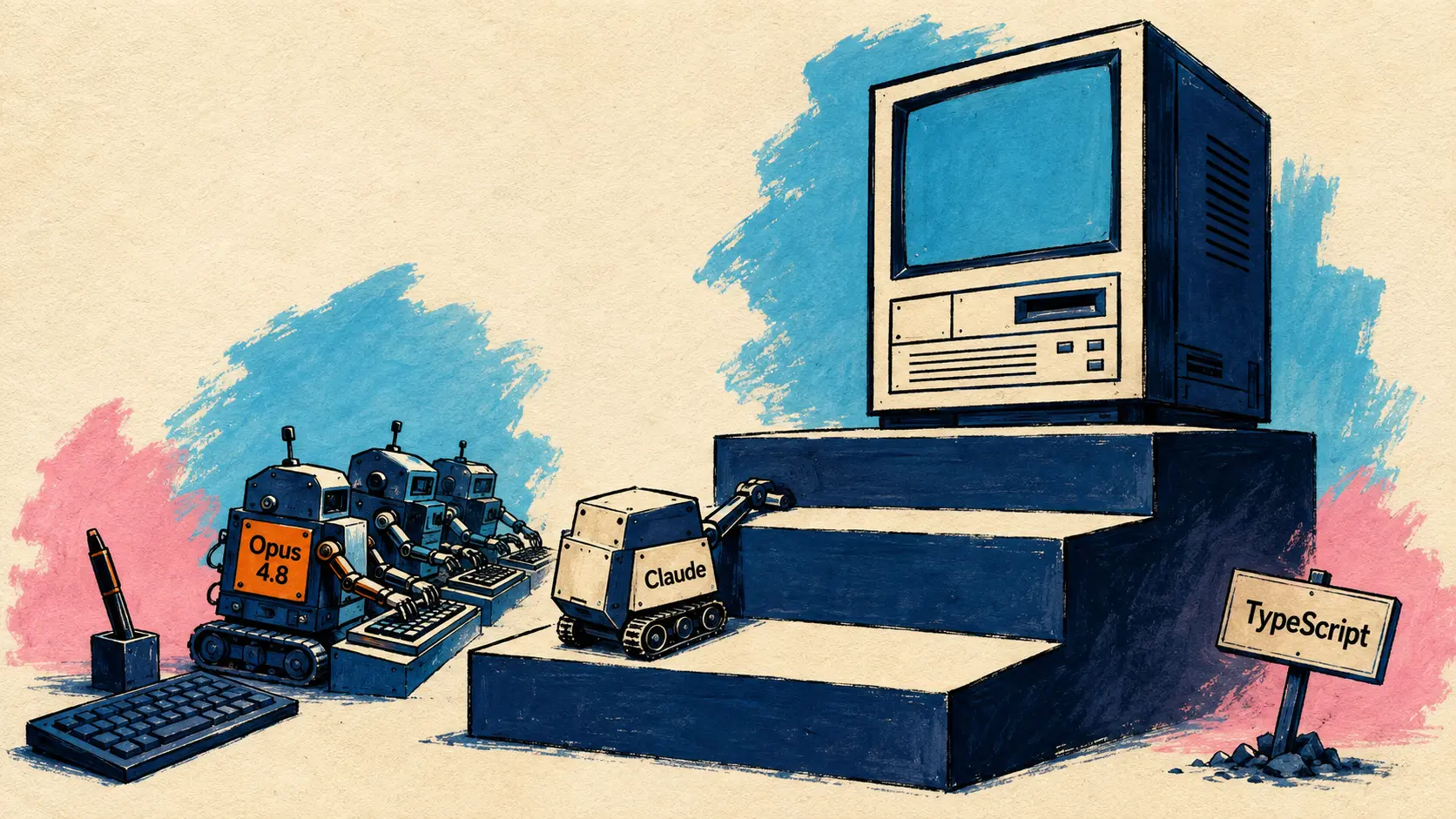
23 August — The creator of Claude Code breaks down model progress into three levels: coding better than he does; doing the engineering work around code better than he does, from debugging to system design; then outperforming most people on most tasks that can be done on a computer. He places Claude at the first level and part of the second, and names Opus 4.8 as the first model that felt better than him. A nuance he adds: for Anders Hejlsberg, the creator of TypeScript, the first level may not yet have been reached.
Back in Nov 2025 I fully stopped writing code by hand, though I continue to code (using agents) every day. […] But engineering is more than coding. — @bcherny on X
Anthropic acknowledges Opus’s verbosity as a priority and ships a stopgap
23 August — When pressed on Opus’s shortcomings, Boris Cherny gives a direct public acknowledgment: verbosity is an identified problem, and a priority for the team. In the meantime, the claude /config outputStyle=concise command activates the Concise style announced on 20 August. That is the real information: Concise is not a comfort option, but the temporary answer to a behavior the team is trying to correct upstream.
The same exchange includes a usage tip given the day before, on 22 August: Opus would be underused for iterative optimization — CPU and memory usage, CI time, latency, frame rate — according to a reproducible pattern, iterating on X with a profiler and a dataset until reaching Y.
We know Opus is not perfect, and it is a big priority for the team to fix it. — @bcherny on X
🔗 Opus and iterative optimization
Gemini 3.7 Flash enters Google Search after record adoption
22 August — Sundar Pichai is not announcing a model: Gemini 3.7 Flash was released on 13 August. He is announcing adoption, the fastest in the Gemini family, and a rollout: the model now runs in Google Search, in addition to the Gemini app. At launch, it was only available to Pro and Ultra subscribers via Spark, the Gemini Enterprise Agent Platform, and the API — its move into Search changes the scale of exposure.
| Evaluated benchmark | Score achieved | Cost per task (USD) |
|---|---|---|
| ARC-AGI-1 | 95.5 % | 0.12 |
| ARC-AGI-2 | 84.6 % | 0.25 |
Gemini 3.7 Flash smashed previous Gemini growth records in its first week, making it our fastest growing model yet. — @sundarpichai on X
🔗 ARC-AGI scores published on 20 August by ARC Prize
Gemma crosses one billion downloads and Google publishes the Awesome Gemma repository
20 August — Clement Farabet and Olivier Lacombe, from Google DeepMind, announce that the open model family Gemma has surpassed one billion cumulative downloads, with more than 100,000 community-published variants over two years. The cited deployments show the scale of the reach: NASA, Satlyt, and Starcloud run Gemma aboard satellites for onboard image analysis; in India, the National Health Authority integrated Gemma 4 into Aarogya Setu 2.0 to standardize medical reports. On the research side, C2S-Scale, built on Gemma by Yale and Google, identified a cancer therapy pathway later verified in live cells. Google accompanies the milestone with a deliverable for developers: the Awesome Gemma GitHub repository, the official directory of projects and tutorials in this ecosystem.
| Measured indicator | Announced value |
|---|---|
| Cumulative Gemma downloads | more than 1 billion |
| Community-published variants | more than 100,000 |
| Projects submitted to the Gemma Challenge | more than 1,600 |
Amp gives readable domain names to the portals of its orbs
23 August — An orb is the remote, disposable machine on which Amp runs an agent; a portal is the HTTP entry point that lets you open in a browser the application being built in that orb. Each portal used to get an unreadable auto-generated address, such as t-01a0095e-9568-whatever-p1234.onamp.dev — usable at a glance, much less so for a link shared with a team. Three options replace them: a custom prefix, a personal domain, or a workspace domain. Amp gives the example of park.mixfox.org, a regular address serving an application hosted on an orb. Configuration is done from the Portal tab or by asking the agent. The stated motivation matters as much as the feature: portals are increasingly less a throwaway preview and increasingly more durable applications. One limitation remains, confirmed by Quinn Slack: sharing does not cross workspace boundaries.
LEADBOARD publishes the noise floor of its drug-prediction benchmarks
22 August — The FINAL-Bench collective has published on Hugging Face an open benchmark for predicting drug properties: 21 tables, 7 disciplines, 212,670 training compounds, and 18,382 test compounds. The paper is less a launch than a methodological demonstration. On the hERG table, replacing a temporal split with a random split raises AUROC from 0.606 to 0.818, with the same molecules, fingerprints, algorithm, and hyperparameters: random sampling places the same chemical series on both sides of the test set. The second finding, about label quality: the hERG noise floor is 0.421, and across the 19 regression tables, simply predicting the mean achieves the best absolute error on seven of them.
| hERG data split | AUROC achieved | Model MAE | Constant MAE |
|---|---|---|---|
| Temporal, cutoff in 2022 | 0.606 | 0.599 | 0.589 |
| Random, average of 5 seeds | 0.818 | 0.457 | 0.671 |
🔗 FINAL-Bench paper on Hugging Face
Briefs
- Why session start from the phone took so long — The day after yesterday’s covered announcement, Boris Cherny explains on 22 August that default security set the schedule: trust and device verification, protection against prompt injection. More updates will follow. 🔗 @bcherny thread
- GitHub brings the Dependabot cooldown back into focus — Non-security version bumps wait three days, giving scanners time to catch a poisoned release; security fixes remain immediate. Delay adjustable via
cooldown. July 23 post brought back into focus on 23 August. 🔗 @github tweet - Stable Audio 3.0 at the Montréal Music Technology Hackathon — A 48-hour hackathon on 22 and 23 August with Music Hackspace and MUTEK, centered on tools for music producers. Stability AI defends open weights there: transparency, artistic control, and a say in how the technology is used. 🔗 Closing video
- DOOM runs on a processor designed by GPT-5.6 Sol — The model assembled a RV32IM processor in the game Turing Complete, named Codex-R32, on which the PureDOOM port compiled into native machine code runs. Demonstration relayed on 23 August by @OpenAIDevs. 🔗 @Angaisb_ thread
What this means
No model was released this weekend, and that is what makes the day readable. What is moving is the deployment of existing models, the number of hands using them, and the correction of what gets in the way in practice. The players are working on adoption, not on announcements.
For developer tooling, Boris Cherny’s testimony matters mainly because of the limit he sets in the same sentence: coding seems solved for some practitioners, engineering does not, and he is careful to cite an expert for whom even the first level has not been reached. The admission about Opus’s verbosity goes in the same direction: a model’s default behavior becomes a product issue in its own right. A configuration stopgap like outputStyle=concise shifts the burden onto the user, which Anthropic explicitly accepts by calling it a temporary fix.
Rollout at scale took three distinct forms this weekend. Gemini 3.7 Flash leaves the subscriber and developer perimeter to enter Search, something made economically viable by a cost of 0.25 USD per task on ARC-AGI-2 for a score of 84.6%. Gemma, for its part, measures adoption in downloads and community variants, with deployments in orbit and public health that do not resemble any demo use case. Amp, finally, draws the consequence of usage it did not anticipate: when throwaway previews become durable applications, they need a stable address.
There remains the question of measurement, and LEADBOARD arrives at just the right moment. A 0.21-point AUROC gap obtained without changing a line of model code, a constant prediction that beats models on seven of nineteen regression tables: a score published without its split, its noise floor, and its trivial baselines is not interpretable. That is exactly what gives weight to the ARC-AGI numbers highlighted by Google the same weekend — third-party measurements, in verified mode, and not in-house results.
Sources
- Boris Cherny — three levels of capability
- Boris Cherny — Opus verbosity and Concise style
- Boris Cherny — Opus and iterative optimization
- Boris Cherny — remote session start security
- Sundar Pichai — Gemini 3.7 Flash in Search
- Logan Kilpatrick — growth of Gemini 3.7 Flash
- ARC Prize — Gemini 3.7 Flash ARC-AGI results
- Google DeepMind — Gemma surpasses one billion downloads
- Amp — domain names for orb portals
- Quinn Slack — sharing remains limited to the workspace
- FINAL-Bench — LEADBOARD on Hugging Face
- LEADBOARD — Hugging Face Space
- GitHub — Dependabot cooldown
- GitHub Blog — the case for a cooldown
- Stability AI — Montréal hackathon
- DOOM on the Codex-R32 processor