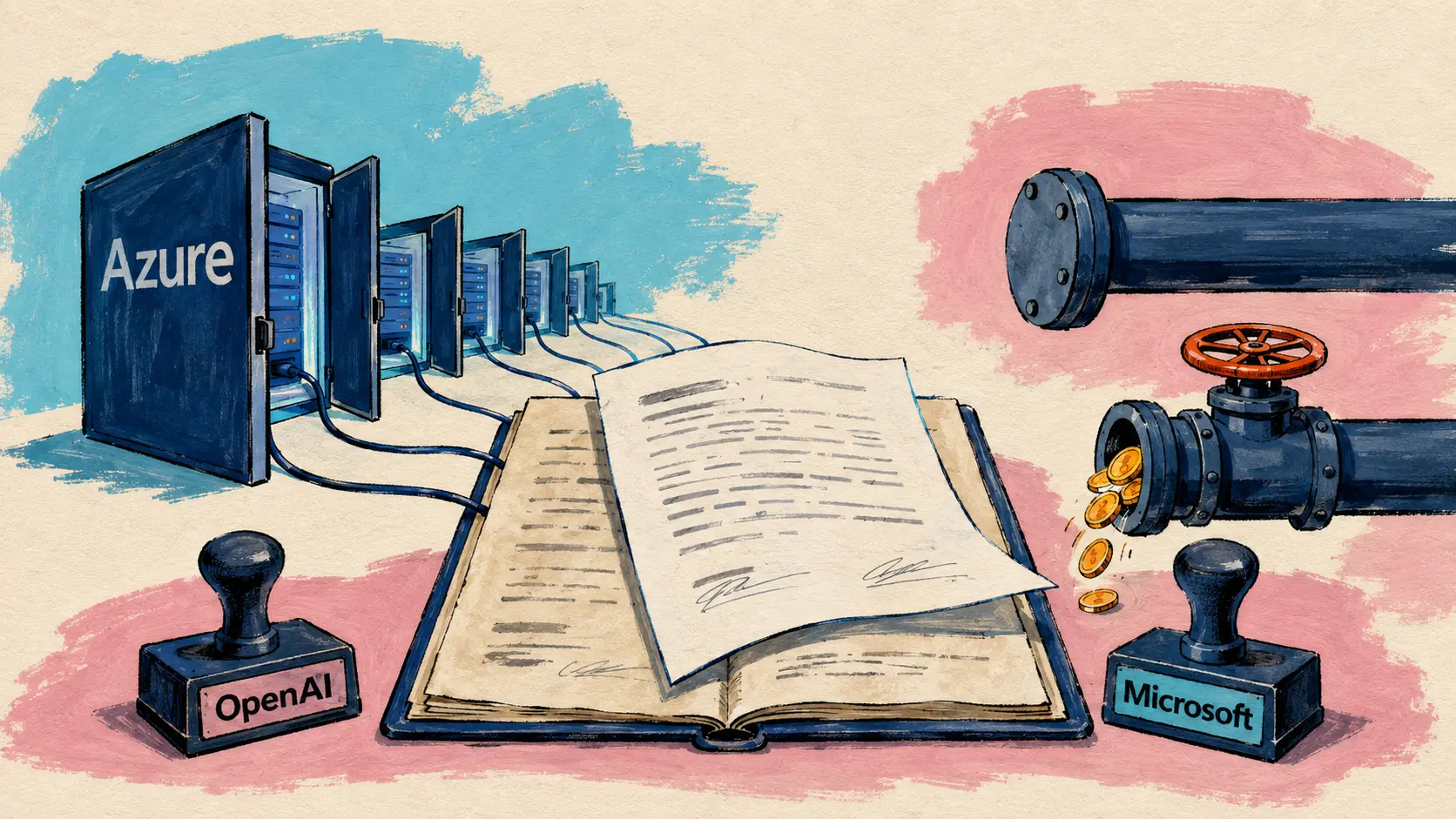
April 27, 2026 marks a dense day of major announcements: OpenAI and Microsoft revise their partnership agreement to give OpenAI more multi-cloud flexibility while keeping Azure as the primary cloud, GitHub reveals the end of “premium request units” in favor of a new usage-based credit billing system, and Google DeepMind formalizes a major scientific partnership with the Republic of Korea. Symphony, OpenAI’s open-source specification for Codex orchestration, rounds out a day that redraws the boundaries of AI infrastructure.
OpenAI × Microsoft — amended agreement through 2032
April 27 — OpenAI and Microsoft announce an amended agreement that simplifies and reorganizes their long-term partnership. Until now, the contractual structure tied OpenAI closely to Azure with an exclusive license and a two-way revenue share mechanism. The new agreement changes the rules of the game.
| Aspect | Before | After (amended agreement) |
|---|---|---|
| Primary cloud | Azure exclusive | Azure remains priority, but OpenAI can use other clouds |
| Microsoft license | Exclusive | Non-exclusive through 2032 |
| Microsoft revenue share → OpenAI | Yes | Removed |
| OpenAI revenue share → Microsoft | Yes | Maintained through 2030, same percentage but capped |
| Microsoft ownership | — | Unchanged (major shareholder) |
The central change is multi-cloud freedom: OpenAI can now sign agreements with other infrastructure providers without violating its commitments to Microsoft. For Microsoft, removing the incoming revenue share (MS → OAI) simplifies accounting, while the non-exclusive license leaves it free to develop its own competing models without restriction.
“The greater predictability in the amended agreement strengthens our joint ability to build and operate AI platforms at scale while providing both companies the flexibility to pursue new opportunities.” — OpenAI
GitHub Copilot — usage-based billing via GitHub AI Credits starting June 1
April 27 — GitHub announces that all Copilot plans will move to a usage-based billing model starting June 1, 2026. The notion of “premium request units” (PRUs) disappears in favor of GitHub AI Credits, consumed according to actual token usage (input, output, cache) based on a per-model rate.
Starting June 1st, GitHub Copilot will move to a usage-based billing model as GitHub Copilot supports more agentic and advanced workflows. — @github on X
Plan prices remain the same — the new part is that the included credits now match the plan’s monthly price:
| Plan | Monthly price | Included AI Credits | Transition bonus |
|---|---|---|---|
| Copilot Pro | $10/month | $10 in credits | — |
| Copilot Pro+ | $39/month | $39 in credits | — |
| Copilot Business | $19/user/month | $19 in credits | $30/month extra (transition) |
| Copilot Enterprise | $39/user/month | $39 in credits | $70/month extra (transition) |
Key points for teams:
- Code completions and Next Edit suggestions remain included without consuming credits
- The fallback mechanism to cheaper models (when PRUs were exhausted) disappears — once credits are used up, usage stops immediately
- Copilot code review will consume GitHub Actions minutes in addition to AI Credits
- Credits are pooled at the organization level — no more lost credits per unused seat
- A preview bill will be available in May to estimate real costs before the switch
- Admins will get new budget controls (enterprise, cost center, team, user)
OpenAI Symphony — open-source specification for Codex orchestration
April 27 — OpenAI’s engineering team publishes Symphony, an open-source specification for orchestrating multiple Codex sessions in parallel. The project was born from a radical internal constraint: build an entire repository without a single line of human-written code, with every contribution generated by Codex.
Symphony solves the bottleneck that quickly emerged in this exercise: context switching between independent Codex sessions took too much human oversight time. The solution automatically orchestrates multiple agents on parallel tasks, keeps them running on devboxes continuously, and lets tickets be submitted from any device — phone, poor connection — so the agents can handle them without intervention.
| Metric | Value |
|---|---|
| Increase in delivered PRs | +500% in 3 weeks (some OpenAI teams) |
| External adoption | Linear reported a spike in workspace creation at launch |
The team’s core insight: when engineers no longer have to actively supervise Codex sessions, the perceived cost of each code change collapses. Teams explore more, prototype more freely, and abandon dead-end ideas more easily.
🔗 OpenAI Engineering announcement
Google DeepMind × Republic of Korea — national scientific partnership
April 27 — Google DeepMind announces a partnership with the Ministry of Science and ICT of Korea (MSIT), on the occasion of the 10th anniversary of the historic AlphaGo match in Seoul. The agreement includes several concrete initiatives:
| Area | Details |
|---|---|
| AI Campus | Creation of an AI campus in Seoul to support Korean academic research |
| Deployed tools | AlphaEvolve, AlphaGenome, AlphaFold, AI co-scientist, WeatherNext |
| Existing adoption | AlphaFold already used by 85,000 Korean researchers |
| Scholarships | 50,000 AI Essentials scholarships for talent development |
| AI safety | Collaboration with the Korean AI Safety Institute (AISI) |
| NAIS | National AI for Science center planned for May 2026 |
“Ten years ago, the historic AlphaGo match in Seoul captured the world’s imagination and showcased the profound potential of artificial intelligence. Together with the Korean government, we’re now looking at how this technology can help accelerate scientific discovery and create new opportunities for economic growth across the region.” — Google DeepMind
OpenAI “Our Principles” — five principles for the AGI era
April 26 — Sam Altman publishes “Our Principles”, a document that lays out OpenAI’s vision for the role of AI in society. The central thesis: AI can transform society on a scale greater than the steam engine or electricity, and the fundamental question is whether the power arising from AGI will be concentrated in a few companies or distributed widely.
| Principle (EN) | French translation |
|---|---|
| Democratization | Democratization |
| Empowerment | Empowerment (Empowerment) |
| Universal Prosperity | Universal Prosperity |
| Resilience | Resilience |
| Adaptability | Adaptability |
Kimi K2.6 — first in the weekly OpenRouter leaderboard
April 27 — Kimi K2.6 takes the top spot in the weekly language model leaderboard on OpenRouter, which aggregates queries from thousands of developers to provide a measure of real-world usage. This position reflects significant developer adoption, especially in agent and long-context use cases where K2.6 had stood out with its 300 parallel sub-agents (announced on April 23).
Briefs
- Z.ai — extension of the GLM-5.1 and GLM-5-Turbo “triple usage” period — Z.ai extends until June 30, 2026 the offer that lets GLM Coding Plan subscribers get the same request volume as GLM-5-Plus at a lower price. 🔗 source
- Genspark × Anthropic — first hackathon in Singapore — 40+ projects, $18,000 in API credits, partners Temasek and Devfolio. Teams built tools to automate business conversations, replace business cards, and capitalize on teams’ collective knowledge. 🔗 source
- Google & Kaggle — GenAI Intensive Vibe Coding Course (June 15-19, 2026) — Return of the free 5-day course, this time with a focus on “vibe coding” (programming in natural language). The first edition brought together 1.5 million learners in November 2025. 🔗 source
- Midjourney — 2K high-resolution ranking for v8.1/8.2 — First full-resolution 2K community ranking session to refine the native high-definition aesthetics of upcoming v8.1 and v8.2 versions. 🔗 source
What this means
The day of April 27 illustrates a reshaping of AI alliances and business models. The amended OpenAI × Microsoft agreement signals that major AI platforms are now seeking to break free from exclusive cloud dependencies — a move that benefits AWS, Google Cloud, and Oracle as much as OpenAI. For developers, the most concrete signal is GitHub Copilot’s shift to AI Credits: the end of model fallback means a long agentic session can exhaust the monthly budget, and teams will need to calibrate usage before June 1. OpenAI’s Symphony pushes in the same direction: parallel agent orchestration is becoming a full-fledged engineering practice, with measurable results (+500% in delivered PRs) that justify investing in infrastructure around Codex. On the geopolitical side, the DeepMind × Korea partnership confirms the trend of major labs striking national agreements to anchor their academic and political presence in key regional ecosystems.
Sources
- OpenAI — The next phase of the Microsoft partnership
- OpenAI Engineering — An open-source spec for Codex orchestration: Symphony
- OpenAI — Our Principles
- Sam Altman on X
- GitHub Blog — GitHub Copilot is moving to usage-based billing
- @github on X
- Google DeepMind — Announcing our partnership with the Republic of Korea
- @GoogleDeepMind on X
- Kaggle GenAI Intensive Vibe Coding Course — blog.google
- @Kimi_Moonshot on X
- @Zai_org on X
- @genspark_ai on X
- Midjourney — High-res rating
- Midjourney — Rank v8.1
This document has been translated from the fr version to the en language using the gpt-5.4-mini model. For more information about the translation process, see https://github.com/jls42/ai-powered-markdown-translator