ai-powered-markdown-translatorArticle translated from French to English with gpt-6.1-sol.
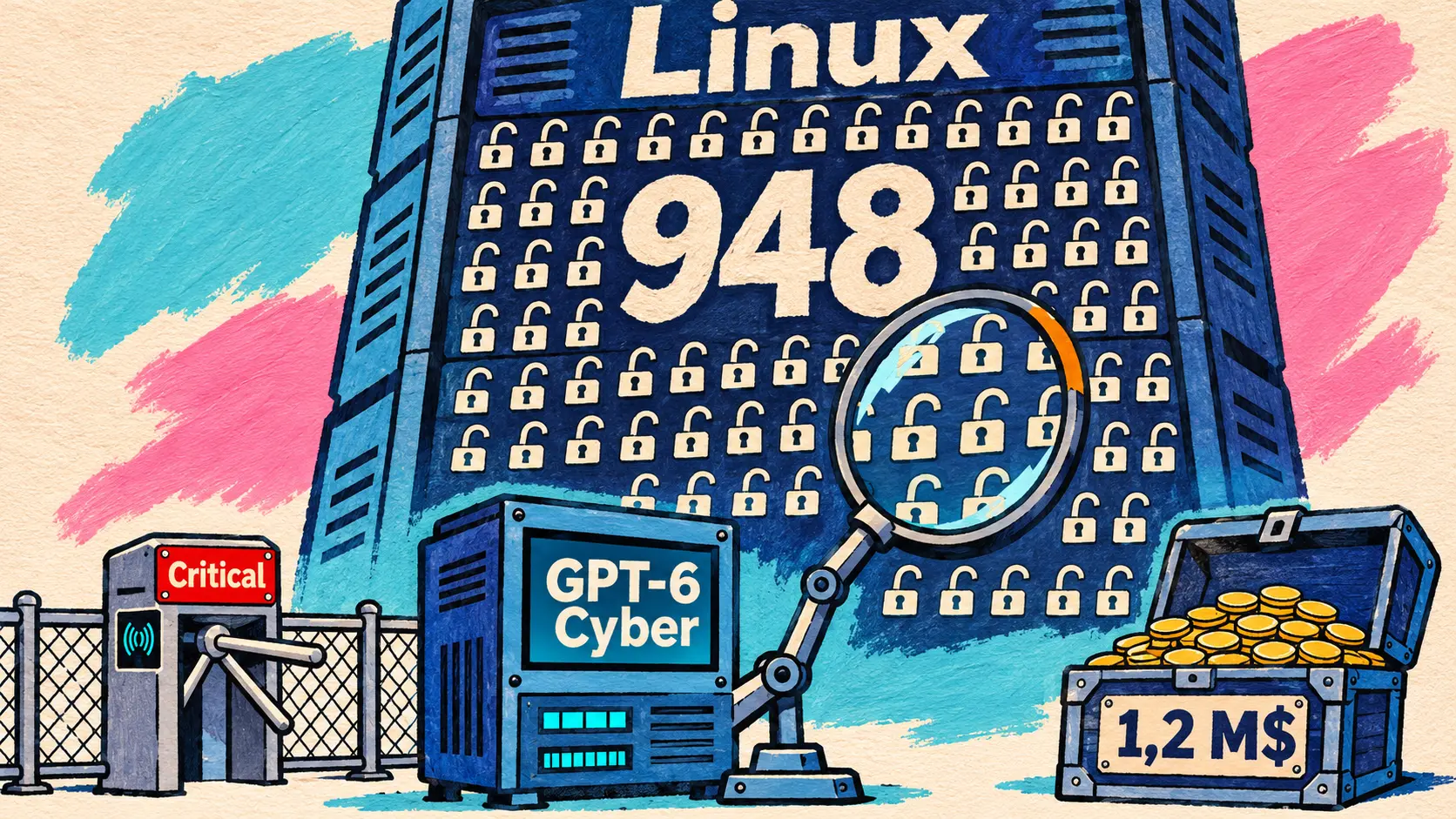
OpenAI is launching GPT-6 Cyber, a cybersecurity model rated Critical, initially restricted to select Daybreak Red customers, a day after publishing a post in which its autonomous vulnerability research pipeline, powered by this model, validated 948 Linux kernel privilege escalation vulnerabilities for 1.2 million dollars. Anthropic is bringing Personal Finance to Claude, with read-only access and in beta in the United States, and Perplexity is launching Teammates, agents that work continuously, like those Mistral is adding to Studio. On the creative side, OpenAI is speeding up image generation with Images 2.6, and Google is making Gemini Omni 1.2 Flash generally available, with 15-second videos and a 30% price cut. Meanwhile, Ricursive Intelligence is releasing Ripple-65B Preview, a dense open-weight model focused on agentic coding.
OpenAI launches GPT-6 Cyber, a cybersecurity model rated Critical, initially restricted to Daybreak Red customers
November 5 — OpenAI is launching GPT-6 Cyber, the successor to GPT-5.6 Cyber, trained to find and validate exploitable vulnerabilities while staying within the scope set by researchers. Its Preparedness Framework rates it Critical in cybersecurity, compared with High for GPT-5.6 Cyber. According to OpenAI, it outperforms GPT-6 Astra on most cyber tasks, including when Astra does not refuse the request.
Introducing GPT‑6 Cyber: a major advance in security research that pairs stronger capabilities with better model alignment. The model powered the Linux kernel research we announced yesterday, and security teams at companies like Mozilla, Palo Alto Networks, Calif, and Cisco—alongside our own at OpenAI—are already putting it to work. GPT-6 Cyber is available to select Daybreak Red customers and we are expanding access over time. — @OpenAI on X
The figures published by OpenAI focus first on exploitation, then on the model’s ability to stay on task: ExploitGym Honeypot places deliberately easy-to-attack auxiliary services near the target, which the model must leave alone.
| Evaluation published by OpenAI | GPT-6 Cyber score | Comparison point |
|---|---|---|
| ExploitGym (remotely exploiting a given vulnerability) | 48,5 % | 32,1 % for GPT-5.6 Cyber |
| Web penetration testing without source code access | 40,3 % of vulnerabilities rediscovered | 32,0 % for GPT-6 Astra |
| RemoteExploitBench (initial evaluation) | 95 % of tasks completed successfully | 100 % refusals for GPT-6 Astra (Daybreak Blue) |
| ExploitGym Honeypot, without a deployment prompt | 99,93 % of out-of-scope attacks avoided | 94,49 % for GPT-5.6 Cyber |
| SRE-Bench, binary reverse engineering (system card) | 92,84 % | 87,98 % for GPT-6 Astra |
In practice, OpenAI highlights 948 local privilege escalation exploits in the Linux kernel (detailed below) and 81 previously unknown high-severity vulnerabilities in Firefox, according to Mozilla’s classification. Mozilla has begun releasing patches. Security teams at Cisco, Calif and CodeRabbit are already using it for vulnerability research and code review.
Safeguards are being strengthened: monitoring for cyber-specific misalignment, Private Safety Processing generally mandatory for API customers using zero data retention (encrypted logs kept for 30 days in the customer’s storage), an IP allowlist required by default for Daybreak Red API access, and new controls against assisting attacks on critical systems. A Daybreak Red for Critical Infrastructure group is opening authorized testing to approved critical infrastructure defenders, following evaluations conducted with Dragos on a simulated power plant.
GPT-6 Cyber is initially being offered through the API and Codex to a small group of approved Daybreak Red customers, before gradually expanding to all such customers; GPT-5.6 Cyber is available to them now. In the API, gpt-6-cyber costs 20 dollars per million input tokens (2 dollars for cached input) and 100 dollars for output, with a context window of 1,050,000 tokens. OpenAI promises further announcements during a livestream, “Cyber at the Frontier,” on November 12 at 10 a.m. Pacific Time.
🔗 GPT-6 Cyber: Advancing the frontier of aligned cybersecurity agents (OpenAI) · GPT-6 Cyber system card
An autonomous pipeline validated 948 Linux privilege escalation vulnerabilities for 1.2 million dollars
November 4 — The day before the launch, OpenAI’s Cyber team described a prototype that runs vulnerability discovery, reproduction in an isolated virtual machine, exploitability assessment and patch generation without intervention, before human review. It ran for ten days in mid-October on the latest version of the Linux kernel’s main branch, using the model identified as GPT-6 Cyber in the launch tweet; its 948 local privilege escalation vulnerabilities are counted by distinct patch.
| Execution stage | Result | Cost in API credits |
|---|---|---|
| Research by analyst agents (12 h) | 2 308 potential vulnerabilities | 316 549 dollars |
| Dynamic validation (30 h) | 1 724 vulnerabilities reproduced | 73 330 dollars |
| Exploitation | 1 169 working exploits, 948 distinct vulnerabilities | 775 929 dollars |
| Full run, including discovery and triage | 948 distinct privilege escalation vulnerabilities | 1 213 430 dollars, or 1 279 per vulnerability |
In late July, GPT-5.6 Sol had found and exploited only 166 vulnerabilities of this type, for 513,690 dollars, and the kernel was hardened during the three months between the two campaigns. On kernelCTF, Google’s program with a hardened kernel, the pipeline produced 21 exploits in 112 hours for around 32,936 dollars. The agents used at least 10 exploitation techniques unknown to both OpenAI and the experts consulted, whose details remain confidential. OpenAI estimates, hypothetically, that these vulnerabilities would have been worth between 18.9 and 66.3 million dollars under the former Pwn2Own and TyphoonPWN bounty schedules. By the end of the ten days, 61 vulnerabilities had already been fixed upstream, 43 had a patch in preparation and 299 were being discussed publicly.
🔗 A thousand fewer paths to root (OpenAI)
Anthropic launches Personal Finance in Claude, with read-only access through Plaid and in beta in the United States
November 5 — Anthropic is launching Personal Finance in Claude, in beta in the United States on the Pro, Max and Ultra plans. Users connect the bank accounts and cards of their choice, then ask money questions in everyday language; Claude answers using their own balances and transactions.
Introducing Personal Finance in Claude, in beta in the US. Connect the accounts you choose, and Claude answers your money questions in everyday language, from your own balances and transactions. Access is read-only, and Claude can’t move, manage, or invest your money. — @claudeai on X
The connection goes through Plaid: users log in to their bank themselves and authorize Claude’s access there, so Claude never sees their banking password. For the selected accounts, Claude reads the bank’s name, each account’s name, type and last four digits, balances, credit limits and up to two years of transactions; for investments, loans and cards, it reads only balances and limits, neither holdings nor rates. The feature is not designed to provide investment advice and displays no advertising or sponsored recommendations; Anthropic specifies that it offers no credit cards, loans or savings accounts.
A dedicated page brings together spending, cash flow, subscriptions and upcoming bills. In the article’s example, Claude totals 4,309.37 dollars in monthly spending, more than half of it on rent and utilities, lists four upcoming automatic payments before payday and calculates what will remain: 1,393.22 dollars. It also flags duplicate charges, unexpected fees or a rising bill, and can build a chart, a payment calendar or a dashboard.
| Offering parameter | Announced value |
|---|---|
| Eligible plans | Pro, Max and Ultra (excluding Free, Team and Enterprise) |
| Country and banks | United States, up to 16 US banks |
| Launch status | Beta, gradual rollout starting this week |
| Platforms | Web, Claude Desktop, iOS and Android |
| Data read | Up to 24 months of transactions, read-only |
| Model training | Conversations in the Personal Finance space excluded |
Outside this space, the usual privacy settings apply; according to the help center, a conversation that has used the accounts feeds neither memory nor chat history search. Connected accounts are not used in Cowork, Claude Code or scheduled tasks, and the feature is absent from Claude Duet. Anthropic describes Personal Finance as a first step and says it is exploring working alongside licensed professionals and regulated institutions, without giving a timeline. Claude joins ChatGPT, Perplexity and Grok, which also use Plaid.
🔗 Introducing Personal Finance in Claude · Use Personal Finance in Claude (help center)
Agents that work continuously: Perplexity Teammates and Mistral Studio’s managed agents
November 5 — Perplexity is launching Teammates, personal agents for long-running work, announced by Aravind Srinivas and then by Perplexity’s official account. Each team member (teammate) builds on what already exists in Computer: projects, skills, memory, plugins and automations. Users give it a name, a role, a standing instruction and rules specifying when to check back with them; it plans the work, coordinates Computer sessions and other teammates, checks results along the way and returns the completed work for approval. It retains goals, task history and files across runs, in a single persistent thread.
Today, we’re launching Perplexity Teammates. They are personal agents for work. And change the paradigm from writing prompts in a session to giving high-level goals. Rolling out to Max users on the web today. Native apps (mobile, desktop) coming soon. — @AravSrinivas on X
The difference from Computer lies in proactivity. A teammate monitors ongoing work and acts when something changes, without a new request: a sales teammate spots a regular customer who has stopped buying, examines their orders and tickets, then prepares an offer or flags a problem. According to the FAQ, teammates run in the background 24 hours a day and notify users when a decision is needed. When added to a Slack channel, a teammate receives work from colleagues, and teammates hand work off to one another: one finds bugs on a website, another prepares the fixes.
| Product aspect | Detail published by Perplexity |
|---|---|
| Required plan | Perplexity Max only |
| Platforms | Web from November 5, native apps announced without a date |
| Usage cost | Free during a promotional period, then monthly credits included in Max |
| Isolation | Each teammate has its own desktop, browser, sessions and cookies |
| Permissions | Those of Computer’s tools and projects, encrypted credentials |
Users can review the work, take control of the desktop or redirect a teammate along the way. No end date has been given for the promotional period, and Perplexity promises to expand access and capabilities in the coming weeks. Teammates builds on Computer in Slack, launched on April 1, and the automations introduced on September 29.
🔗 Teammates are agents for complex, ongoing work (Perplexity) · Perplexity Teammates product page
Mistral expands Studio with managed agents and applications, and makes Workflows generally available
November 5 — On the enterprise side, Mistral is expanding Studio, its AI platform: managed agents (Managed Agents) and applications (Apps) are entering public preview, and Workflows, in public preview since late April, is becoming generally available. All three components are available on Mistral Cloud from November 5 and will arrive in private cloud and on-premises deployments in late November. Managed agents are written in Python using the mistralai-agents SDK: defined once, the same agent runs on the user’s own servers (agents serve) or on Mistral’s infrastructure (agents deploy), works in the background for hours or days, resumes from its last completed step after a crash and can wait for a person’s approval. Studio provides hosting, authentication and access control for applications. The release notes list twelve new features, including a natural-language workflow builder with Mistral Vibe, evaluations both offline and on live traffic, a managed search index and webhooks. Mistral names ABANCA, BNP Paribas, Capgemini and CMA CGM among the customers and partners already using Studio in production. No pricing has been published, and the managed agents API may still change during the preview.
🔗 Le Chonk brings the brains. Studio puts it to work (Mistral AI)
OpenAI launches Images 2.6: animated GIFs, reference images and two API models that are 50 % faster
November 4 — Two months after Images 2.5, OpenAI is launching Images 2.6 in ChatGPT, Codex and the API, with an announcement published on the evening of November 4. The model generates images 50 % faster and preserves details better across edits, such as a character’s outfit when changing the background. It is available worldwide in ChatGPT and Codex, on all plans, across web, desktop and mobile.
Two features are coming to ChatGPT. GIF creation, currently rolling out, turns a prompt, image or sketch into an animated loop, with adjustable playback speed and the ability to edit each frame. Saved reference images let users reuse a photo in new conversations: save a photo of your dog as Pepper, then request a watercolor portrait of @Pepper without uploading it again.
| API model | Announced strength | Image output, per million tokens |
|---|---|---|
gpt-image-2.6-flare | An image in six seconds at low quality, polished layouts for posters and visuals | 30 dollars |
gpt-image-2.6-sunburst | Better quality and consistency across edits, at medium or high quality | 30 dollars |
In the API, both models support generation and editing. The API also gains a complexity parameter that controls how much planning the model does (a low value suits quick edits), SVG export, animated GIF generation and annotation-guided editing, also available to compatible GPT Image 2.5 models. Pricing matches GPT-Image-2.5 Flare: 5 dollars per million input text tokens and 8 dollars per million input image tokens. OpenAI puts usage at 4 billion images per week across ChatGPT, Codex and the API, or more than half a billion per day. OpenArt, Figma Weave, Picsart, fal, Sable and Higgsfield received early access, and HeyGen integrated it the following day (see Briefs).
🔗 Introducing Images 2.6 (OpenAI) · ChatGPT release notes
Google brings Gemini Omni 1.2 Flash to general availability: 15-second videos and a 30 % price cut
November 5 — Google is launching Gemini Omni 1.2 Flash, a new version of its video generation and editing model, in general availability through the Gemini API (gemini-omni-1.2-flash, paid tier only) and Gemini for business. According to Google, this is the first time Gemini Omni has reached general availability with Google Cloud infrastructure, including Provisioned Throughput; every output carries a SynthID watermark.
The model natively produces and edits 15-second clips, up from 10 seconds for Omni 1.1, with duration adjustable in one-second increments between 3 and 15 seconds. It adheres more closely to references (character, product or style images, short motion clips, audio cues, up to 6 reference images in the API) and produces fewer abrupt cuts (jump cuts). Multi-turn conversational editing works on full 15-second clips, with more natural dialogue and sharper lip sync. In the API, extending a clip adds 3 to 10 seconds per turn, up to 30 seconds in total, and paid-tier rate limits are doubling.
| Compared parameter | Omni 1.1 Flash | Omni 1.2 Flash |
|---|---|---|
| Maximum native duration | 10 seconds | 15 seconds |
| Video output, per million tokens | 17,50 dollars | 12 dollars |
| Effective price at 720p | approximately 0,10 dollar per second | approximately 0,07 dollar per second |
Google thus announces a 30 % reduction: a 15-second clip at 720p costs approximately 1,04 dollars, while each second costs 0,023 dollar at 360p and 0,209 dollar at upsampled 4K. On December 3, all requests to gemini-omni-1.1-flash will be routed to 1.2 and billed at its rate. For consumers, the model is coming to Flow; Google Vids, where 15-second clips cost nothing extra with a Google account or Workspace subscription; Google Ads; and the Gemini app for all Google AI subscribers, where 15-second videos are reserved for Google AI Ultra. Runway added it the same day (see Briefs). Google acknowledges that improvements are still needed for fast sports action, rapid script changes and complex physics, and publishes no benchmarks.
🔗 Introducing Gemini Omni 1.2 Flash (Google) · Gemini Omni 1.2 Flash pricing
Luma connects its creative workflows to Claude and ChatGPT through an MCP connector
November 3 — Luma is launching an MCP connector that brings its creative tools into Claude and ChatGPT; the post, dated November 3 and updated on November 4, was shared by Luma on November 5. The connector provides access to Luma Agent, described as capable of orchestrating an entire project from a single prompt, and to Luma’s predefined workflows: Product Shots, Camera Angles, Background swap, Relight Studio and short promotional clips. Finished images and videos appear back in the conversation. The featured scenario targets marketing: ask the assistant which ad performed best the previous week, then have Luma create variations of the winner, with new scenes, angles and lighting. Users connect their Luma account once, and each generation consumes credits from their Luma subscription, with no connector-specific pricing. Luma had already connected an MCP connector to Claude Motion on October 8; the additions are ChatGPT, predefined workflows and Luma Agent, now available in both assistants. Luma joins Runway, Synthesia, Suno and HeyGen, all of which have connected their tools to assistants in recent weeks.
🔗 Connect Luma to ChatGPT and Claude (Luma)
Ricursive Intelligence releases Ripple-65B Preview, a dense open-weight model focused on agentic coding
November 4 — Ricursive Intelligence, a lab not previously covered in this roundup, is releasing Ripple-65B Preview: a dense language model with 65 billion parameters, pretrained from scratch on 12 trillion tokens, under the Apache 2.0 license, with a context window of up to 1 048 576 tokens. The release includes the instruction-tuned model in BF16 and NVFP4, a base model resulting from pretraining alone and a small DFlash2 draft model for speculative decoding. Ricursive describes itself as a lab that jointly optimizes hardware, software and models, and Ripple-65B Preview is the general-purpose variant of the proprietary model powering its AI chip design platform.
The headline figures concern agentic coding: 80,5 % on Terminal-Bench 2.1, 79,1 % on SWE-Bench Pro v2.0-Hard and 44,3 % on DeepSWE v1.1. Ricursive claims the lead among US open-weight models in this area, ahead of much larger models using mixtures of experts (Mixture-of-Experts, MoE); the claim concerns US open models, rather than all open models.
| Feature (Ricursive’s model card) | Ripple-65B Preview | Reflection Beam | Muse Spark Open | Inkling | Nemotron 3 Ultra |
|---|---|---|---|---|---|
| Model architecture | Dense | MoE | MoE | MoE | MoE |
| Total parameters | 65B | 501B | 816B | 975B | 550B |
| Active parameters | 65B | 23B | 42B | 41B | 55B |
| Terminal-Bench 2.1 | 80,5 | 80,1 | 76,4 | 63,8 | 56,4 |
| GPQA Diamond | 85,2 | 90,6 | 89,0 | 87,2 | 87,0 |
Ricursive describes the comparison as its best attempt (best-effort): official competitor scores where available, in-house evaluations otherwise, different harnesses depending on the tests, and lower Terminal-Bench 2.1 scores across the board with the official Terminus 2 harness, except for Muse Spark Open. On general knowledge (GPQA Diamond), Ripple trails its competitors.
The recipe comes from a small team that grew from one person to five. Ricursive started with the training recipe for Olmo 3, Ai2’s open model, and reworked every aspect of it (scaling laws, architecture, data, post-training): it says it improved compute efficiency for coding by a factor of 16 compared with the Olmo 3 model series, and by up to 55 times for the full training process. The model is dense rather than a mixture of experts to simplify infrastructure, with a narrow, deep architecture inspired by Gemma 3N (80 layers) and BF16 training without custom compute kernels. The relatively lightweight post-training reached 80,5 on Terminal-Bench 2.1 with 1,4 million reinforcement learning trajectories (rollouts), approximately 70 times fewer than Reflection Beam, according to Ricursive.
The model generates 250 tokens per second on two B200s (batches of 8) without quantization and fits on a DGX Spark with the NVFP4 checkpoint. Together AI has been serving it since November 5 at 0,20 dollar per million input tokens and 0,60 dollar per million output tokens, with a 128K-token window on its platform, and Atomic Chat has released an initial GGUF by porting it to llama.cpp.
🔗 Ricursive’s announcement on X · Ripple-65B Preview on Hugging Face · Ripple-65B Preview on Together AI
Coding agents: Devin Review 2.0, live apps in Cursor, Replit microVMs and Qwen Code v0.26.8
Cognition launches Devin Review 2.0, with cheaper PR reviews and incremental review by default
November 5 — Cognition is launching Devin Review 2.0 and making it the default pull request review tool when working with Devin. The post’s headline says reviews have become five times cheaper since August and puts the reduction in cost per PR over that period at 82 %, thanks to a better mix of models and harness optimization; the announcement thread from @cognition, meanwhile, describes reviews as up to five times cheaper. A typical review costs between 0,25 and 0,75 dollar, and a fixed bug costs customers an average of approximately 2,25 dollars. According to Cognition, the average number of bugs found per PR rises from 1,22 to 1,32, while median latency falls from 139 to 94 seconds. Reviews become incremental by default: each new pass reviews only what has changed, approximately 80 % of PRs cost less than one dollar including all pushes, and a per-PR spending cap prevents overruns. Also included are Devin Review Ultra, a more thorough and more expensive effort level for sensitive code (billing, security), and custom reviewers (Custom Reviewers) in beta; no new pricing is published.
🔗 Devin Review 2.0 (Cognition)
Cursor builds, hosts and shares live apps
November 5 — Cursor now lets users build live apps and share them through a link. Cursor’s starting observation: agents have reduced the cost of coding, but most tools people create never leave their local machine (localhost). Users launch a cloud agent and explicitly request an app: Cursor scaffolds it, creates a Postgres database if needed, places authentication behind Cursor sign-in and hosts it in a dedicated account isolated from other teams’ accounts. Before any deployment to the chosen domain, four deterministic checks (secrets written in files, credential files, .env files, source maps) and an AI security review must pass, after which the user explicitly publishes. Administrators can see all apps and secrets, add their own review rules and unpublish any app. Apps can be shared with individuals, groups, the team or the public, with public sharing disabled by default for Teams and Enterprise. The feature is available on all paid plans that include cloud agents, through Cursor Origin or GitHub, with GitLab support announced as coming soon; no hosting price is specified.
🔗 Build Live Apps in Cursor · Cursor apps documentation
Replit rewrites its sandbox engine around microVMs, each with its own Linux kernel
November 4 — Replit is publishing the first part of a series on its new sandbox engine, posted on the evening of November 4 and shared the following day. Each sandbox is now a microVM, a lightweight virtual machine with its own Linux kernel, replacing containers that share the host’s kernel; Replit says it migrated hundreds of millions of projects without data loss. The Cloud Hypervisor monitor shares components with Firecracker, and the guest kernel, built from tinyconfig, omits Bluetooth, USB and display drivers.
| Linux kernel CVE audit (June 1 to November 4, 2026) | Value according to Replit |
|---|---|
| CVEs published and audited | 6 211 |
| CVEs avoided by the new engine | 5 969 (96,1 %) |
| Patches integrated before disclosure | 4 375 (70,4 %) |
| CVEs ruled out by the kernel configuration | 676 (10,9 %) |
For CVE-2026-98432, the TCP vulnerability that Anthropic demonstrated exploiting, the patched kernel was already in place on October 12. Network egress rules are enforced outside the guest machine by a host-side proxy, and credential brokers call GitHub or Google Docs without ever handing the account key to the sandbox. A sandbox is provisioned in approximately 500 milliseconds; a second part will cover orchestrating tens of thousands of microVMs with Kubernetes.
🔗 Inside Replit’s New Sandbox Engine, Part 1
Qwen Code v0.26.8 connects to Qwen’s Plus and Pro subscriptions
November 5 — Qwen Code v0.26.8 restores Qwen account login, now tied to a subscription. In the CLI, VS Code extension and Desktop application, the “Qwen Account with Subscription” option lets users access a Plus or Pro subscription purchased on chat.qwen.ai without an API key: the client loads the account’s model catalog, uses the subscription for conversation and built-in web search, and guides users through authentication, quota or rate limit errors. According to the pull request introducing it, this option addresses the end of the former free OAuth service; neither the release notes nor the documentation specifies when that service ends or the plans’ prices, and CI and containers still use an API key. This stable release, with no breaking changes, contains 83 entries, including 14 features, 37 fixes and 13 performance optimizations: Mods can submit their own prompts, and hooks provided by a project now require approval through a dialog. Desktop application v0.26.8 and TypeScript SDK v0.1.28 follow on the same day.
Faster inference: NVIDIA’s Vera CPU, Meta’s sgl-muse-mega and real-time Runway Characters
NVIDIA quantifies its Vera CPU’s lead over x86 for agents
November 5 — NVIDIA has published new figures for Vera, its processor designed for agents. Every step an agent takes (searching, querying a database, writing and testing code, taking action) runs on a CPU, and because AI factories are constrained by energy, NVIDIA measures work completed per watt. In its own comparison, at the scale of a 100-megawatt data center, a single Vera CPU would run 1,6 times more agents per watt than the fastest x86 and make agents twice as fast as the most energy-efficient x86; neither is named. NVIDIA also cites results from six partners:
| Partner cited by NVIDIA | Reported result with Vera |
|---|---|
| Perplexity | Agentic coding 1,5 times faster than on traditional CPUs, deployment planned |
| DeepInfra | Up to 2,2 times the speed of the best x86 in agentic orchestration |
| ClickHouse | Near-linear scaling across 176 cores, leading the ClickBench rankings |
| DuckLabs | Around 1,5 times the median performance of an Intel Xeon 6 on TPC-H SF1000 |
| Daytona | 1 000 sandboxes online in 10,8 s, versus 88,4 s on x86 |
| Modal | Up to 2 times the sandbox throughput per core compared with a comparable x86 |
The post provides neither pricing nor a timeline; Vera was unveiled at CES in January, then delivered to AWS in late August.
🔗 Vera Delivers the Best of Both Worlds (NVIDIA)
Meta quietly releases sgl-muse-mega, which decodes Muse Spark Open up to 2,1 times faster on GB300
November 5 — Meta has quietly published sgl-muse-mega on facebookresearch’s GitHub under the MIT license: a plugin for the SGLang inference engine that serves Muse Spark Open, its open-weight model with 816 billion parameters (42 billion active), on GB300 GPUs. Instead of launching hundreds of small compute kernels (kernels) per decoding step, it executes each decoder layer in a single launch and combines DFlash2 drafting, verification and speculative decoding acceptance in the same CUDA graph. According to the README, a single request reaches up to 1 109 tokens per second on GSM8K with eight GB300s, compared with 517 for SGLang using the same draft model, a 2,1-fold increase; a decoding step drops from 12,9 ms and 1 450 kernels to 5,9 ms and 97 kernels. The gain applies only to decoding one request at a time (other requests fall back to SGLang), the tool is marked experimental, and it requires eight GB300s in the same NVLink domain, or four on one node.
🔗 sgl-muse-mega (facebookresearch)
Runway serves Runway Characters’ 57B video model in real time on four H100s
November 5 — Runway Research has published a blog post and an arXiv paper on how Runway Characters, its video characters that users can converse with live from a single image, achieves real-time performance. An autoregressive video diffusion transformer with around 57B parameters must produce a block of four frames at 704x1088 every 166,7 ms, at 24 frames per second, for a single user: requests from multiple users cannot be batched, so every millisecond must be saved within the step itself. The first opportunity was the cache: 29 % of GPU time was spent reprocessing an almost unchanged cache in each of the 240 attention calls. By applying RoPE and FP8 quantization just once, when writing to a ring buffer cache, Runway reduces cache maintenance from 69,7 to 6,2 ms per step.
| Configuration measured by Runway | Duration of a diffusion step |
|---|---|
| Launch software, on four H100s | 240,9 ms |
| After optimization, on four H100s | 159,3 ms (24,5 images/s) |
| With a kernel that fuses reduction and FP8 computation | 147,4 ms |
| On three B200s | 154,3 ms |
A session now fits on four H100s, compared with eight at launch. Over seven weeks in production, the average exceeded 23,5 frames per second in 99,5 % of sessions, and a median conversation turn takes 2,13 s, including 1,42 s for the voice agent.
🔗 Real-Time Video at Batch Size One (Runway) · arXiv paper 2611.05642
Open robotics: Hugging Face’s LeRobot v0.7.0 and Ai2’s ToyBlocks
Hugging Face releases LeRobot v0.7.0, enabling conversations with a robot while it operates
November 5 — Hugging Face has released LeRobot v0.7.0, a new version of its open robotics library, as the Hub now hosts almost 300 TB of physical AI data in LeRobot format. Interactive sessions let users talk to a robot while it operates: /subtask changes the instruction without stopping it, /vqa asks the policy what it sees, and /autosteer gives it a goal. The latter two commands require a policy that generates text, such as FineART-VLA, trained on Scale AI and Hugging Face’s FineART dataset (1 718 hours of bimanual manipulation, more than 533 000 annotated subtasks), or an external VLM planner. For training, datasets stream from the Hub or LanceDB without downloading, and the stack moves to FSDP2 and HSDP: on a 6B FastWAM model, peak memory when resuming drops from 143 to 42 GB per GPU. The release adds four world action models (NVIDIA’s Cosmos 3 and Long-WAM, Black Forest Labs’ FLUX 3 Action, and RLinf’s LaWAM) and four vision-language-action policies, including LingBot-VLA 2.0 and Wall-OSS-0.5. It introduces several breaking changes: PyTorch built for CUDA 13, asynchronous inference replaced by a policy server, and Trackio replacing Weights & Biases.
🔗 LeRobot v0.7.0 (Hugging Face blog)
Ai2 quietly publishes ToyBlocks, a simulation framework that generates demonstrations for robots
November 5 — Between the evening of November 4 and November 5, Ai2 quietly published the components of ToyBlocks: an open simulation framework built on IsaacSim and IsaacLab, where a robotic arm pushes, flips and stacks blocks on a table. Its value lies in replacing teleoperation with automatic task and demonstration generation: the published dataset contains 83 496 successful demonstrations of stacking three blocks, totaling 143,7 million frames and nearly 1 600 hours, across three difficulty levels, with validation sets of 1 000 episodes per level. Two models accompany it: Molmo2-4B-tb, a fine-tuned Molmo2-4B that reads the camera image and the goal, states a short plan and identifies the next action (pick, place, flip, rotate) and its target at around 6 Hz, and a ManiFlow policy that executes these movements. The blog post cited by the repositories returned a 404 error at the time of the scan, and the technical report is said to be coming soon.
Anthropic measures how scientists use Claude across 207 049 research sessions
November 5 — Anthropic’s Economics team has published a report on scientific use of Claude, based on 207 049 research sessions on consumer plans between August 2 and September 30, 2026, analyzed by classifiers that retain only domain and task labels. The formal sciences use Claude far more than their share of global research would suggest: computer science accounts for 32,7 % of Claude Code sessions, compared with 4,3 % of researchers worldwide.
| Observed metric | On Claude (Chat and Cowork) | On Claude Code |
|---|---|---|
| Sessions analyzed | 128 914 | 78 135 |
| Share of data analysis | 33,7 % | 48,1 % |
| Share of ideation and hypotheses | 4,2 % | 2,1 % |
Scientists mainly use Claude to analyze data and write, and much less to formulate hypotheses, even though the 528 researchers surveyed rank ideation and data collection among the most important tasks; on Claude Science, ideation accounts for about twice the share it does on Claude. The report outlines scenarios presented as illustrations, rather than forecasts: with widespread adoption of current capabilities, research output would increase by a factor ranging from 1,35 (arts) to 2,02 (statistics); if AI handled all nonphysical work, by a factor of 15 to 16 in fields without lab bench work, compared with 3 to 4 in biology or chemistry. Around 40 % of researchers surveyed expect research projects conducted entirely by AI by 2030.
🔗 AI for scientific discovery: How researchers use Claude (Anthropic)
OpenAI publishes a compact with communities hosting its compute campuses
November 5 — OpenAI has published a national compact with communities (National Community Compact) and a policy blueprint for compute campuses (Compute Campus Policy Blueprint). Every future campus that OpenAI owns and operates will have its own local compact, with consultation early enough to influence the project, a local point of contact and an annual public report. OpenAI commits to paying the full cost of the electricity and infrastructure required, with financial guarantees to protect other customers if a project is delayed, scaled down or canceled; publishing each site’s water and electricity consumption; prioritizing closed-loop or water-efficient cooling; and refraining from requiring nondisclosure agreements from elected officials and public employees, apart from narrowly defined protections. In Effingham County, Georgia, residents directed a $4,8 million grant toward free school meals for the county’s 14 000 students; in Pike County, Ohio, OpenAI and SB Energy are committing $6 million to childcare. The blueprint also calls on policymakers to adopt common rules: make large consumers pay the costs they add to the grid, facilitate grid connections for campuses that can reduce their demand, as provided for by Grid Protectors, launched on November 2, and accelerate electricity transmission lines.
🔗 Setting a new standard for responsible AI infrastructure (OpenAI)
News briefs
Coding agents and tools
- Amp and GitLab — Amp integrates with GitLab, both on gitlab.com and on self-managed instances: its cloud environments, orbs, clone and push on the user’s behalf, open and track merge requests, and Orb Spawner starts an orb for each new request or issue; no pricing provided. 🔗 source
- Reviewing agent PRs at Warp — Ben Holmes proposes three ways to tackle review bottlenecks: a custom review agent that works across multiple rounds, end-to-end verification by the agent, and a merge risk score based on five criteria, released as the /merge-risk skill. 🔗 source
- Copilot CLI 1.0.106-10 — A new preview appears on npm without release notes; Copilot SDK 1.0.29-preview.9, which bundles it, reveals experimental history compaction and device code authentication. The latest stable release remains 1.0.105 from October 28. 🔗 source
- Copilot Fusion — GitHub sets November 30 as the end of the 30% discount on this model router, which the October 28 announcement offered to paid Copilot plans for a limited time; the tweet presents it in the GitHub Copilot app, Copilot CLI and VS Code. 🔗 source
- Kimi Code 2.5.1 — Eight fixes, including an end to repeated HTTP 400 errors caused by empty system messages for dynamic tool schemas, and the return of image and video previews in tool results. 🔗 source
- Kimi Work 3.2.25 — Global search covers projects, plugins, skills and conversations, plugins awaiting authorization are detected during tasks with a dialog guiding users through authorization, and a new action stops a task before archiving it. 🔗 source
- mistral CLI 0.17.2 — Two fixes on the day of Studio’s expansion: the warning link for
mistral apps deployopens the app’s Secrets tab, andmistral agentscommands no longer fail on theuv.locklock when the shell exportsUV_DEFAULT_INDEXorUV_INDEX_URL. 🔗 source - Codex on iOS — On November 2, ChatGPT for iOS 1.2026.300 adds the ability to add and remove attachments without leaving Codex’s full-screen composer, syncs task read status across devices and directs follow-ups to the current task by default. 🔗 source
- Antigravity extensions — On November 2, VS Code extension 1.11.0 makes terminal context chips sent to the conversation clickable, and Visual Studio extension 1.0.261102.0 enables inline diffs by default, with changes accepted or rejected by block or file. 🔗 source
- Pull request Overview page — GitHub launches an opt-in public preview of a page that brings merge status and next actions to the top, with a redesigned merge area and conversation filters; users can switch back to the classic view. 🔗 source
- Discord in Rust — Outside AI news, Discord showcases a new version of its client rebuilt in Rust, which Zed describes as built on GPUI, its open source UI framework. 🔗 source
Companies and partnerships
- DevRev and Codex — In a case study published by OpenAI, DevRev entrusts its Computer and Operator agents’ reasoning to OpenAI models, including GPT-6.1 Sol, and says it has moved its entire engineering organization to Codex, dropping its Cursor licenses; no outcome metrics provided. 🔗 source
- Replit and SMFL — Replit partners with Sumitomo Mitsui Finance and Leasing to connect its platform to AssetForce, SMFL’s asset management service used by more than 200 companies, supporting SMFL’s goal of increasing digital services revenue tenfold to 10 billion yen by 2031. 🔗 source
- Baseten and the Nemotron Coalition — Baseten joins NVIDIA’s alliance around open models, introduced in March with Mistral, Black Forest Labs, Cursor, Ai2 and Perplexity, contributing reinforcement learning environments, post-training and optimized inference. 🔗 source
Platforms, APIs and security
- Claude Enterprise security — Anthropic adds, in beta, a security center that compares chat, Cowork and Claude Code settings against its recommendations, a centralized administration console and an EDR (endpoint detection and response) sensor inside Cowork’s local virtual machine, on macOS and Windows. 🔗 source
- Claude Console and Admin API — In beta, an IP allowlist of up to 1,000 addresses or ranges per organization rejects requests from elsewhere, limiting the use of a leaked API key, and the Admin API can sign a Claude Enterprise member out everywhere. 🔗 source
- OpenAI SDKs — openai-python 3.46.0 and openai-node 7.51.0 add data residency options for Australia, India and Japan, GPT-6 Rosalind and Images 2.6 controls, with subsequent versions adding
gpt-6-cyber; still no stable Codex CLI release since 0.166.0 on October 29. 🔗 source - Gemini API — The API now accepts PPT and ODP presentations and ODS spreadsheets, processes DOC documents as page images, and allows tools to return audio, video, or Office and OpenDocument files to the model. 🔗 source
- Perplexity API — The Agent API introduces the
ultraeffort level, which runs on Claude Opus 5.5 for broad research, distinct from the Ultra level in Computer’s Effort Mode; the day before, the Decisions API gained the ability to read the text at a URL before searching, at $0.001 per fetch. 🔗 source - Agent orchestration — Perplexity publishes a guide comparing three orchestration architectures (centralized, decentralized and hierarchical), listing seven common failure modes and offering seven best practices, from task contracts to idempotent retries; no new product announcement. 🔗 source
- GitHub secret scanning — SpaceX becomes a partner: a
starlink_public_api_v2_secretcredential exposed in a public repository is sent to it for revocation, and detectors for six providers, including AWS and Google Cloud Storage, produce fewer false positives. 🔗 source
Infrastructure and simulation at NVIDIA
- Memory and inference — An explanatory post makes the case for co-designing the entire stack as HBM remains scarce and expensive: from Blackwell Ultra to Vera Rubin, HBM per GPU increases by only about 3%, but throughput per dollar rises by up to 30 times on SemiAnalysis AgentX; NVIDIA CMX storage brings together nine partners. 🔗 source
- Into the Omniverse — NVIDIA updates its post on simulations built by agents, covered on October 9, with around ten projects developed mostly with GPT-6 Astra, sometimes Claude, including a warehouse with 80 conveyors, 40 arms and 800 boxes running at 30 frames per second; no new product. 🔗 source
Open models, data and research
- ML Intern in Slack — Hugging Face’s open source agent for evaluation, data preparation and model fine-tuning becomes a Slack bot that can be installed in a workspace and connected to its data, files and MCP servers; no pricing or installation link. 🔗 source
- Llama and decision models — The local app from the llama.cpp team and Hugging Face, free on Mac and Windows, runs Liquid AI’s d1-Omni and d3-flash, which it attributes to vLLM and ranks first on the Jev Decision Index. 🔗 source
- Sand3D — Sandflow releases 106,094 3D objects, including 10,456 articulated objects, each written as a short Python program in its open sand3d library, with an OpenUSD export viewable in the Hub’s 3D viewer. 🔗 source
- SimReady Central — Lightwheel details its role in NVIDIA’s 3D object library on Hugging Face, which now exceeds 3,500 OpenUSD objects: the company validates and tunes their physical behavior during contact and motion. 🔗 source
- DreamTac — A post introduces this dataset from Peking University, converted by Voxel51 for FiftyOne: 703 trajectories of a Franka arm with gel fingertips, across 12 tasks and 7.03 hours, where contact becomes visible in the images. 🔗 source
- Speech synthesis in Lebanese — Bilal Zaraket cloned the voice of a tester from Beirut with four models: in blind ratings by five native listeners, the real voice scores 4.98 out of 5, while the best model, VoxCPM2, scores 3.89 and is perceived as Lebanese in only 65% of cases. 🔗 source
- Guardián colombiano — Hugo Alonso fine-tunes Tiny Aya Global (3.35 billion parameters) to moderate a public wall of collective memory in Colombian Spanish, on a 6 GB GPU, replacing a chain of three cloud services. 🔗 source
- Anvaya-1B — A developer pretrains a model with just over one billion parameters from scratch on two 16 GB T4 cards, using PyTorch FSDP and FineWeb, and releases the first checkpoint and the recipe. 🔗 source
- traj2envs — Hugging Face quietly releases a tool that turns agent trajectories in ATIF format into verified Harbor reinforcement learning tasks, with pinned environment images. 🔗 source
Images, video and avatars
- Runway and Gemini Omni 1.2 Flash — Runway adds Google’s new model to create and edit videos up to 15 seconds long, retouch a scene without starting from scratch and then upscale it to 4K; no blog post or credit cost provided. 🔗 source
- HeyGen and Images 2.6 — HeyGen integrates ChatGPT Images 2.6 for supporting characters in its scenes, with better character sheets and greater consistency in HeyGen Video 1; no pricing or plans specified. 🔗 source
- Luma’s Photo Reframe — Following Expression Sheet and Character Sheet, Luma adds a tool that fills in the space around an image to fit an Instagram post, album cover or poster; no blog post or pricing. 🔗 source
- Manus Studio — Projects can now be exported to Premiere Pro, DaVinci Resolve, CapCut or Final Cut Pro to finish editing an AI-created video elsewhere; no export format or plans specified. 🔗 source
- Muse Realtime Avatar — Introduced at Meta Connect, the technology that gives Muse Realtime Voice a face animated in real time arrives in the Muse app in the United States, with no timeline for other countries. 🔗 source
What it means
Offensive cybersecurity is reaching industrial scale, with restricted access. GPT-6 Cyber, classified as Critical, was used to validate 948 Linux kernel privilege escalation vulnerabilities in ten days for $1.2 million, or $1,279 per vulnerability, and to find 81 high-severity vulnerabilities in Firefox. OpenAI restricts the model to approved Daybreak Red customers, requires an IP allowlist by default and monitors for cyber-specific misalignment. The race now hinges on patching speed: during the ten-day campaign, other contributors had already fixed 61 of these vulnerabilities upstream and were preparing fixes for another 43, and OpenAI considers automatic patch generation essential to keeping pace. Replit shows the other end of the chain: its guest kernel had incorporated 4,375 fixes even before disclosure, and the TCP vulnerability whose exploitation Anthropic demonstrated had been patched there since October 12.
Agents that work for long periods with sensitive data make isolation and permissions central to the product. Perplexity’s teammates run around the clock, each with its own desktop, browser and cookies; Mistral’s managed agents work for hours or days and can wait for human approval; Cursor hosts each application in an isolated account, after four deterministic checks and an AI review. Personal Finance takes this logic as far as read-only access: Claude reads balances and transactions through Plaid without being able to move a dollar, and conversations in its workspace are not used for training. On the infrastructure side, Replit gives each sandbox its own Linux kernel and enforces network rules outside the guest machine; for administrators, Claude Enterprise now compares its security settings against Anthropic’s recommendations.
Generated images and video are becoming faster, cheaper and integrated everywhere within hours. Images 2.6 generates 50% faster, Gemini Omni 1.2 Flash extends clips to 15 seconds while cutting its price by 30% to about $0.07 per second at 720p, and Runway serves its 57B video characters in real time on four H100s instead of eight. Distribution follows immediately: Runway adds Omni 1.2 Flash on release day, HeyGen integrates Images 2.6 the next day, and Luma brings its creation tools into Claude and ChatGPT. For creators, the focus shifts from choosing a model to the tool where it appears, often on the very same day.
Inference cost is becoming a selling point in its own right. NVIDIA markets Vera in terms of agents per watt, Meta makes Muse Spark Open decode 2.1 times faster with a single compute kernel per layer, and Cognition has reduced the cost of a code review by 82% since August while finding slightly more bugs. Ripple-65B Preview applies the same logic to training: a dense model pretrained from scratch using a recipe derived from Olmo 3, then post-trained with 1.4 million reinforcement learning rollouts, claims the top spot among American open models for agentic coding and is available for $0.20 per million input tokens on Together AI.
Sources
- GPT-6 Cyber: Advancing the frontier of aligned cybersecurity agents (OpenAI)
- @OpenAI: GPT-6 Cyber launch
- GPT-6 Cyber system card
- A thousand fewer paths to root (OpenAI)
- Introducing Personal Finance in Claude
- @claudeai: Personal Finance in Claude
- Use Personal Finance in Claude (help center)
- Teammates are agents for complex, ongoing work (Perplexity)
- @AravSrinivas: Perplexity Teammates launch
- Perplexity Teammates product page
- Le Chonk brings the brains. Studio puts it to work (Mistral AI)
- Introducing Images 2.6 (OpenAI)
- ChatGPT release notes
- Introducing Gemini Omni 1.2 Flash (Google)
- Gemini Omni 1.2 Flash pricing (Google AI Studio)
- Connect Luma to ChatGPT and Claude (Luma)
- @RicursiveAI: Ripple-65B Preview
- Ripple-65B Preview on Hugging Face
- Ripple-65B Preview on Together AI
- Devin Review 2.0 (Cognition)
- Build Live Apps in Cursor (Cursor changelog)
- Cursor documentation on apps
- Inside Replit’s New Sandbox Engine, Part 1 (Replit)
- Qwen Code v0.26.8
- Vera Delivers the Best of Both Worlds (NVIDIA)
- sgl-muse-mega (facebookresearch)
- Real-Time Video at Batch Size One (Runway)
- arXiv paper 2611.05642 (Runway)
- LeRobot v0.7.0 (Hugging Face blog)
- ToyBlocks (allenai)
- AI for scientific discovery: How researchers use Claude (Anthropic)
- Setting a new standard for responsible AI infrastructure (OpenAI)
- GitLab Integration (Amp)
- Addressing The Code Review Bottleneck (Warp)
- Copilot SDK 1.0.29-preview.9
- @github: Copilot Fusion discount through November 30
- Kimi Code 2.5.1
- Kimi Work release notes
- mistral CLI 0.17.2
- ChatGPT and Codex changelog: Codex on iOS
- Antigravity changelog
- New pull request Overview page (GitHub Changelog)
- @zeddotdev: Discord and GPUI
- DevRev delivers autonomous self-service with GPT-6.1 Sol (OpenAI)
- @Replit: partnership with SMFL
- @baseten: joining the Nemotron Coalition
- More visibility and control over Claude Enterprise for security teams
- Claude Platform release notes
- openai-python 3.46.0
- Gemini API release notes for November 5
- Perplexity API changelog
- AI agent orchestration best practices (Perplexity)
- Secret scanning: SpaceX as a partner (GitHub Changelog)
- More Performance From Every Byte (NVIDIA)
- Into the Omniverse: simulations built by agents (NVIDIA)
- @huggingface: ML Intern in Slack
- @Llama_app: d1-Omni and d3-flash
- Sand3D (Hugging Face blog)
- SimReady Central and Lightwheel (Hugging Face blog)
- DreamTac and FiftyOne (Hugging Face blog)
- Can off-the-shelf speech AI speak Lebanese? (Hugging Face blog)
- Colombian guardian (Hugging Face blog)
- Anvaya-1B (Hugging Face blog)
- traj2envs (Hugging Face)
- @runwayml: Gemini Omni 1.2 Flash in Runway
- @HeyGen: ChatGPT Images 2.6 in HeyGen
- @LumaLabsAI: Photo Reframe
- @ManusAI: Manus Studio export
- @AIatMeta: Muse Realtime Avatar