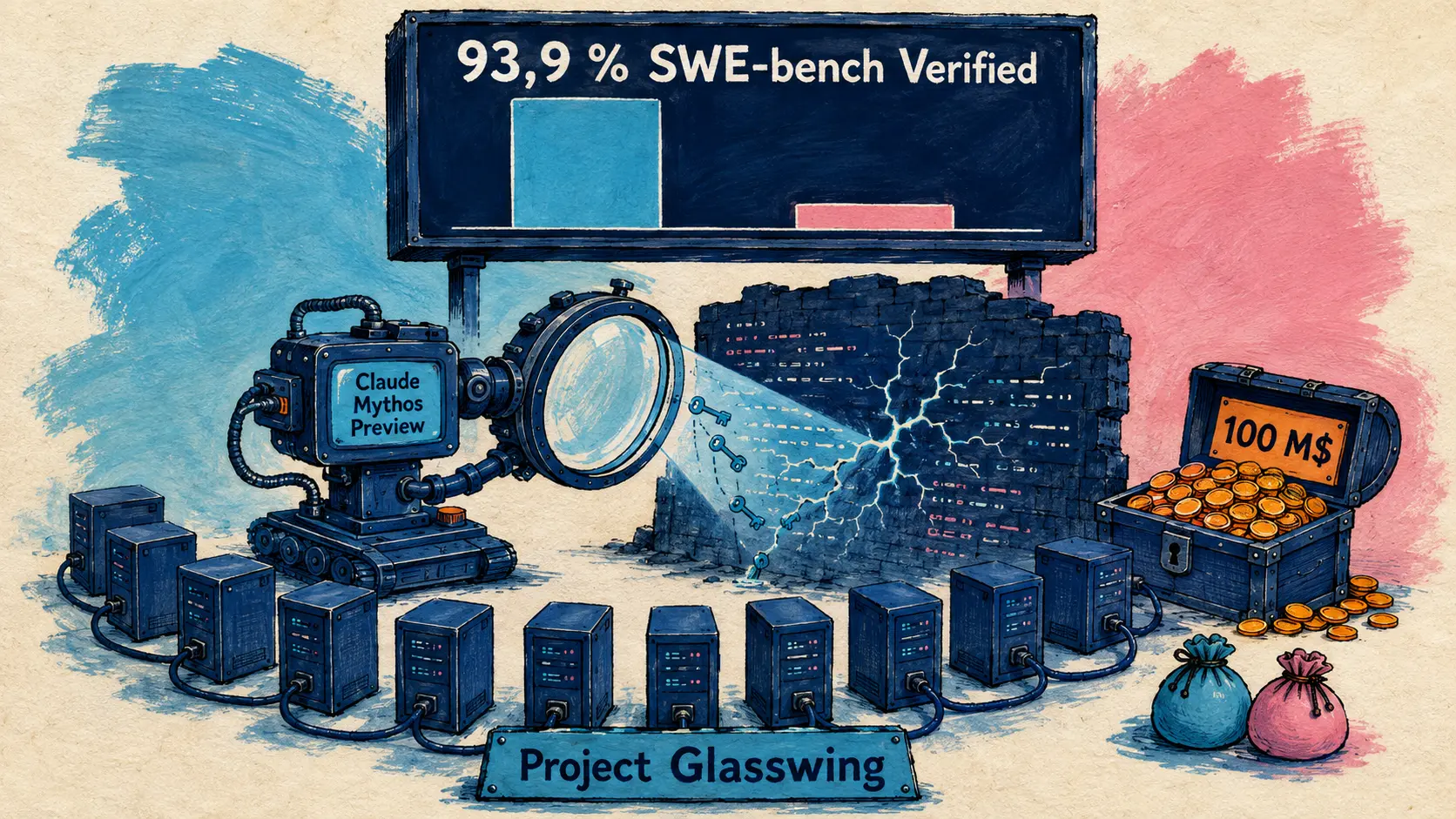
The week of April 5 to 9, 2026 was dominated by two major announcements: Anthropic unveiled Project Glasswing, a coalition of eleven major tech companies around Claude Mythos Preview to detect zero-day vulnerabilities at scale, while Meta made its return with Muse Spark, its first non-open-weights model in a year. Meanwhile, Google, OpenAI, GitHub and Perplexity each released notable updates for their developers and users.
Project Glasswing and Claude Mythos Preview
April 7, 2026 — Anthropic announced Project Glasswing, a software security initiative bringing together eleven organizations: Amazon Web Services, Apple, Broadcom, Cisco, CrowdStrike, Google, JPMorganChase, The Linux Foundation, Microsoft, NVIDIA and Palo Alto Networks. The initiative is built on the capabilities of a new frontier model with restricted access: Claude Mythos Preview.
What Mythos Preview does
The model demonstrated an ability to identify thousands of zero-day vulnerabilities in major operating systems and web browsers, some of which had remained hidden for decades. Three concrete examples illustrate the scope of the findings:
- A 27-year-old flaw in OpenBSD that allows any connected machine to be crashed remotely
- A 16-year-old vulnerability in FFmpeg, hidden in a line of code tested more than five million times without being detected
- Several flaws in the Linux kernel enabling privilege escalation up to full machine control
These examples show that Mythos Preview is not doing surface-level detection — it is finding buried logic errors in critical codebases, continuously audited by thousands of researchers for years.
Benchmarks
Mythos Preview’s performance on reference benchmarks shows a clear step up compared with Opus 4.6:
| Benchmark | Mythos Preview | Opus 4.6 |
|---|---|---|
| SWE-bench Verified | 93.9 % | 80.8 % |
| SWE-bench Pro | 77.8 % | 53.4 % |
| Terminal-Bench 2.0 | 82.0 % | 65.4 % |
| Multilingual SWE-bench | 87.3 % | 77.8 % |
| CyberGym (cybersecurity) | 83.1 % | 66.6 % |
| GPQA Diamond | 94.6 % | 91.3 % |
| Humanity’s Last Exam (without tools) | 56.8 % | 40.0 % |
The jump on SWE-bench Verified — from 80.8% to 93.9% — is particularly significant: it is the most widely used benchmark for measuring a model’s ability to solve real bugs in real open source repos. On CyberGym, dedicated to cybersecurity, the gain of more than 16 points places Mythos Preview in a class of its own for offensive and defensive security tasks.
Financial commitment and governance
Anthropic is committing $100 million in usage credits for project partners, along with $4 million in direct donations to open source security organizations:
- $2.5M to Alpha-Omega and OpenSSF via the Linux Foundation
- $1.5M to the Apache Software Foundation
This level of financial commitment signals that Anthropic is positioning Glasswing as a long-term initiative, not just a communications partnership. The report on fixed vulnerabilities will be published within 90 days.
Availability and pricing
Mythos Preview is not being made publicly available immediately. Once the initial credit phase ends, the model will be accessible to participants at $25/$125 per million tokens (input/output), via the Claude API, Amazon Bedrock, Google Cloud Vertex AI and Microsoft Foundry.
A detailed technical report on the vulnerabilities and exploits discovered is available on Anthropic’s Red Team blog, and the full system card is published on anthropic.com.
“This project represents a watershed moment for AI-assisted cybersecurity — not because of what Claude can do today, but because of what it will be able to do as capabilities continue to scale.”
🔗 Project Glasswing · Mythos Preview System Card · Red Team report
Meta Muse Spark: Meta returns with a closed model
April 8, 2026 — Meta announced Muse Spark, the first model in the new “Muse” family, developed by Meta Superintelligence Labs (MSL) — a new internal entity dedicated to advanced AI research. It is Meta’s first model since Llama 4 in April 2025, after a year of silence, and above all the first Meta model not available in open-weights.
Capabilities and positioning
Muse Spark is positioned as a step toward “personal superintelligence” (personal superintelligence). The model spans several domains with advanced capabilities:
| Domain | Description |
|---|---|
| Multimodal | Advanced visual perception and understanding, cross-visual information integration |
| Reasoning | Step-by-step reasoning, thinking before answering (test-time reasoning) |
| Health | Medical image analysis, personalized dietary recommendations |
| Agentic | Agentic capabilities for complex tasks |
| Contemplating mode | Orchestration of multiple agents reasoning in parallel (gradual rollout) |
The model incorporates “thought compression” to optimize reasoning tokens, and supports test-time scaling via multiple parallel agents. Contemplating mode, still in gradual rollout, is one of the most anticipated features: it allows multiple agents to be assigned to the same problem in parallel, each reasoning independently before synthesis.
Performance
According to Artificial Analysis (April 8, 2026), Muse Spark reaches a score of 52 on the Artificial Analysis Intelligence Index, placing it in the global top 4 behind Gemini 3.1 Pro, GPT-5.4 and Claude Opus 4.6. A notable comeback for Meta, which re-enters the field of top frontier models directly.
Architecture
Meta describes three scaling axes for Muse Spark:
- Pretraining: complete overhaul of the stack over nine months, with architecture and data improvements
- Reinforcement Learning: scalable amplification of post-pretraining capabilities
- Test-time reasoning: extended reasoning without increased latency thanks to agent parallelization
Safety and availability
Meta says it conducted extensive evaluations via its Advanced AI Scaling Framework v2. Apollo Research performed third-party evaluations on a pre-launch checkpoint and found strong refusal behavior in high-risk domains (biology, etc.).
Muse Spark is available starting April 8 on meta.ai and in the Meta AI app. API access is in private preview for selected partners — no immediate public access.
🔗 Meta AI Blog — Muse Spark · Announcement tweet · Artificial Analysis benchmark
Anthropic: infrastructure and agents
Google + Broadcom partnership — several gigawatts of TPU from 2027
April 6, 2026 — Anthropic announced an agreement with Google and Broadcom for several gigawatts of next-generation TPU compute capacity, scheduled to come online starting in 2027. This is the largest infrastructure commitment in Anthropic’s history.
The growth context is significant:
- Annualized revenue (run-rate revenue) now exceeds $30 billion, up from about $9 billion at the end of 2025
- More than 1,000 enterprise customers spend more than one million dollars per year each, up from 500+ in February 2026 — a doubling in less than two months
“This groundbreaking partnership with Google and Broadcom is a continuation of our disciplined approach to scaling infrastructure: we are building the capacity necessary to serve the exponential growth we have seen in our customer base while also enabling Claude to define the frontier of AI development.”
— Krishna Rao, CFO of Anthropic
Most of the new compute will be installed in the United States, continuing the November 2025 commitment to invest $50 billion in US infrastructure. Claude remains the only frontier model available on the three major cloud platforms: AWS Bedrock, Google Cloud Vertex AI and Microsoft Azure Foundry.
Managed Agents — decoupled architecture, 90% lower latency
April 8, 2026 — Anthropic’s Engineering Blog published a technical article detailing the architecture of Managed Agents, the hosted service for running long-running agents on the Claude platform.
The core idea is to decouple the brain (Claude and its harness) from the hands (execution sandbox, tools) and the session (event log). Each component becomes an independent interface, replaceable and scalable separately.
Measured results of the decoupling:
| Metric | Improvement |
|---|---|
| p50 TTFT (time to first token) | -60 % |
| p95 TTFT | -90 % |
The decoupling also solves two security problems: credential isolation (OAuth tokens are never accessible from the code execution sandbox) and resilience (if the harness goes down, a new one restarts from the last session event without loss of context).
Google Gemini
Gemini CLI v0.37.0 — Dynamic Sandbox, Chapters and persistent Browser
April 8, 2026 — Gemini CLI v0.37.0 introduces three changes for developer workflows:
| Feature | Description |
|---|---|
| Dynamic Sandbox Expansion | Dynamic sandbox expansion + worktree support for Linux and Windows |
| Chapters (Narrative Flow) | Thematic grouping of tools into “chapters” for better session structure |
| Advanced Browser Capabilities | Persistent browser sessions and dynamic tool discovery in the browser agent |
The Chapters feature brings narrative continuity to long sessions: each group of actions forms a “chapter” with its own logic, making it easier to follow and resume a complex session. The browser agent gains persistence — sessions remain active between calls, and available tools are discovered dynamically.
Interactive simulations and 3D models in Gemini App
April 9, 2026 — Gemini App can now turn complex concepts into interactive visualizations directly in chat. A user can adjust physical parameters in real time (speed, gravity, mass) and see the effect on a working simulation — lunar orbit, molecular rotation, dynamic systems. Available worldwide with the Pro model in the prompt bar. Not available for Education and Workspace accounts immediately.
🔗 3D simulations in Gemini App
Gemini Notebooks — synchronization with NotebookLM
April 8, 2026 — Google launches Notebooks in Gemini App: persistent workspaces that sync Gemini App and NotebookLM for complex projects. Notebooks make it possible to organize conversations, custom instructions and files (documents, PDFs). A source added in Gemini App automatically appears in NotebookLM, and vice versa. Available this week for Google AI Ultra, Pro and Plus subscribers on the web. Mobile and free access coming soon.
🔗 Gemini Notebooks + NotebookLM
OpenAI
New Pro tier at $100/month — 5x more Codex
April 9, 2026 — OpenAI introduces a new Pro tier at $100/month, positioned between the Plus tier (~$20/month) and the existing Pro tier at $200/month. It offers five times more Codex usage than Plus, designed for long and intensive sessions.
| Tier | Price | Codex usage |
|---|---|---|
| Plus | ~ $20/month | Standard |
| Pro (new) | $100/month | 5× Plus |
| Pro (existing) | $200/month | Maximum |
At the same time, OpenAI extends the 2x Codex usage promotion for existing $200/month subscribers until May 31, 2026 and resets their rate limits.
”Next phase of enterprise AI” — note from Denise Dresser
April 8, 2026 — Chief Revenue Officer Denise Dresser publishes a summary after her first 90 days. Key points: enterprise activity now represents more than 40% of revenue (on track to parity with consumer by the end of 2026), Codex exceeds 3 million weekly users (+5x since early 2026), and ChatGPT has 900 million weekly users. OpenAI presents two strategic tracks: OpenAI Frontier (agents crossing enterprise systems) and a unified AI superapp for teams.
Safety Fellowship and Child Safety Blueprint
April 6-8, 2026 — OpenAI announces two safety initiatives. The OpenAI Safety Fellowship (Apr. 6) is an external research program open until May 3, 2026, compensated with compute resources, for work on evaluation, robustness and agentic oversight — schedule: September 14, 2026 to February 5, 2027. The Child Safety Blueprint (Apr. 8) proposes a framework to fight the exploitation of children by AI, co-developed with NCMEC, Thorn and the Attorney General Alliance, structured around three axes: modernizing laws on AI-generated CSAM content, improving reporting, and integrating safety by design (safety-by-design).
🔗 Safety Fellowship · Child Safety Blueprint
GitHub Copilot
OWASP Top 10 security scan from the terminal April 9, 2026 — GitHub Copilot CLI integrates an automated security workflow directly from the terminal. In just a few commands, developers can launch a full scan on their repository, map the results to the OWASP Top 10 categories, and automatically open GitHub issues for each detected vulnerability — without leaving the CLI environment. A direct complement to Project Glasswing for teams already using GitHub tooling.
“Rubber Duck” agent — automatic review
April 8, 2026 — The GitHub Research team releases a “Rubber Duck” agent for Copilot CLI. Inspired by the classic debugging technique (explaining your code out loud to find problems), the agent automatically analyzes submitted code and produces a structured review directly in the terminal. Experimental but officially reposted by @github.
🔗 Copilot CLI OWASP Tweet · Rubber Duck Tweet
Perplexity
Plaid integration — personal finances in Perplexity Computer
April 9, 2026 — Perplexity launches an integration with Plaid, allowing users to connect their bank accounts, credit cards, and loans directly in Perplexity Computer. Access is read-only — data does not pass through Perplexity’s servers. The Plaid network covers more than 12,000 institutions (Chase, Fidelity, Vanguard, Robinhood, etc.). Use cases: net worth calculation, budget tracking, debt repayment planner, retirement projection. Available on desktop in the United States and Canada.
| Tier | Features |
|---|---|
| Standard | Link portfolio, basic Portfolio access |
| Pro / Max | Advanced analytics, interactive dashboards |
Billion Dollar Build — startup competition
April 8, 2026 — Perplexity launches the “Billion Dollar Build,” an 8-week competition where teams use Perplexity Computer to build a company with a path to a $1 billion valuation. Finalist rewards: up to $1 million in investment from the Perplexity Fund + up to $1 million in Computer credits.
🔗 Plaid Integration Blog · Billion Dollar Build Tweet
Agents and tools
Manus integrates with Slack — three modes
April 6, 2026 — Manus (now affiliated with Meta) launches a full suite of Slack integrations built around three modes: an agent in DM with persistent memory for personal tasks, a mention @manus in team channels for collaborative tasks (no persistent memory — each thread is a new task), and an MCP connector to automate reports and summaries on your behalf from manus.im. Available on a paid Slack plan.
Genspark AI Workspace 4.0 — Claw Desktop, Office plugins
April 8, 2026 — Genspark launches version 4.0 of its AI workspace with four components: Claw for Desktop (Computer Use and Browser Use to control the computer), Microsoft Office plugins for PowerPoint, Excel, and Word, Speakly (real-time translation and meeting note-taking), and Advanced Workflows on a new OpenCode engine.
Generative media and hardware
Stability AI Brand Studio — creative platform for brands
April 8, 2026 — Stability AI launches Brand Studio, a full creative production platform designed for enterprise marketing teams. At the heart of the system is the Brand Central Hub: Brand ID models trained on a brand’s visual assets (photographic style, palette, patterns, logo placement). Producer Mode turns a brief into a structured production plan and executes it automatically step by step. Curated Model Routing intelligently selects the most suitable model from Stability AI and third-party offerings (including Seedream and Nano Banana). On the enterprise side: SSO, role-based access controls, approval workflows. Launch partner: creative agency Huge. Availability: Core plan (free trial) + Enterprise plan.
🔗 Brand Studio by Stability AI
NVIDIA — National Robotics Week
April 9, 2026 — For National Robotics Week, NVIDIA publishes a resource article on its Physical AI technologies: NVIDIA Cosmos (world foundation models), Isaac Sim (simulation), Jetson lineup (edge AI), Nemotron and NemoClaw (open source). No new hardware announcement — a pedagogical overview of NVIDIA’s robotics ecosystem for developers.
Claude Code — updates v2.1.94 / v2.1.96 / v2.1.97
Three new releases were published during the week.
| Version | Date | Key points |
|---|---|---|
| v2.1.94 | Apr. 5-6 | Bedrock support powered by Mantle, default high effort for API-key/Bedrock/Enterprise, compact Slack MCP link display |
| v2.1.96 | Apr. 7 | Bedrock regression fix: 403 "Authorization header is missing" error with AWS_BEARER_TOKEN_BEDROCK |
| v2.1.97 | Apr. 8-9 | Ctrl+O focus view toggle in NO_FLICKER mode, refreshInterval setting status line, ● N running indicator in /agents, Cedar syntax highlighting |
v2.1.94 also introduces a notable behavior change: skill plugins declared via "skills": ["./"] now use the name field from the frontmatter rather than the directory name. v2.1.97 fixes several Bash permission issues (environment variable prefixes, network redirects) and a bug where permission rules whose name matched a JavaScript prototype property (toString, etc.) were silently ignored in settings.json.
What this means
The week of April 5 to 9, 2026 marks an acceleration in two intersecting directions. On one side, Anthropic is moving beyond a consumer product logic and into critical infrastructure logic: Project Glasswing and the Google/Broadcom partnership signal that Anthropic is positioning itself as a provider of AI capabilities at the level of the global tech ecosystem, not just as a competitor in the benchmark race. The commitment of $100 million in credits and $30 billion in annualized revenue reinforces this reading.
On the other side, Meta returns with Muse Spark by breaking with its open-weights policy. This is a significant strategic shift: Meta is choosing to compete in the closed frontier segment rather than maintain its open source positioning. The creation of Meta Superintelligence Labs and the first non-Llama model signal a deep reorientation of the group’s AI strategy.
For developers, the week is dense but coherent: Gemini CLI gains persistence and structure, GitHub Copilot expands its security scope, Perplexity pushes toward personal data, and Claude Code continues its rapid update cycle.
Sources
- Project Glasswing — Anthropic
- Claude Mythos Preview System Card
- Mythos Preview Red Team Report
- Google + Broadcom Partnership — Anthropic
- Managed Agents Engineering Blog
- Claude Code CHANGELOG
- Project Glasswing Tweet @AnthropicAI
- Introducing Muse Spark — Meta AI
- Meta Muse Spark Tweet
- Benchmark Artificial Analysis — Muse Spark
- Gemini CLI Changelog v0.37.0
- Gemini App 3D Simulations
- Gemini + NotebookLM notebooks
- Next phase of enterprise AI — OpenAI
- OpenAI Safety Fellowship
- OpenAI Child Safety Blueprint
- Copilot CLI OWASP Tweet
- Rubber Duck agent Tweet
- Perplexity + Plaid
- Billion Dollar Build Tweet
- Manus for Slack
- Genspark AI Workspace 4.0
- Stability AI Brand Studio
- NVIDIA National Robotics Week
This document was translated from the fr version into en using the gpt-5.4-mini model. For more information about the translation process, see https://gitlab.com/jls42/ai-powered-markdown-translator