ai-powered-markdown-translatorArticle translated from French to English using gpt-6.1-sol.
Anthropic launches Claude Fable 5.2 and Claude Mythos 5.2, two versions of the same model priced at 8 and 40 dollars per million tokens instead of 10 and 50, and up to 30 % faster than the 5.1 generation. That same evening, Cursor, Devin, Perplexity and v0 make it available to their users, the first three with their own measurements, while Anthropic shows what the model has already produced: three electronic devices, Fermat’s proof redone by 1 000 agents, and 72 best-known solutions surpassed on MIPLIB. Meta responds on cost with Muse Ember, its smallest model, Google expands its eighth generation of TPU with the 8tx and 8i Max systems, and NVIDIA introduces GR00T 2 at CoRL, an open world-action model for robotics.
Claude Fable 5.2 and Claude Mythos 5.2: the same model, cheaper and up to 30 % faster
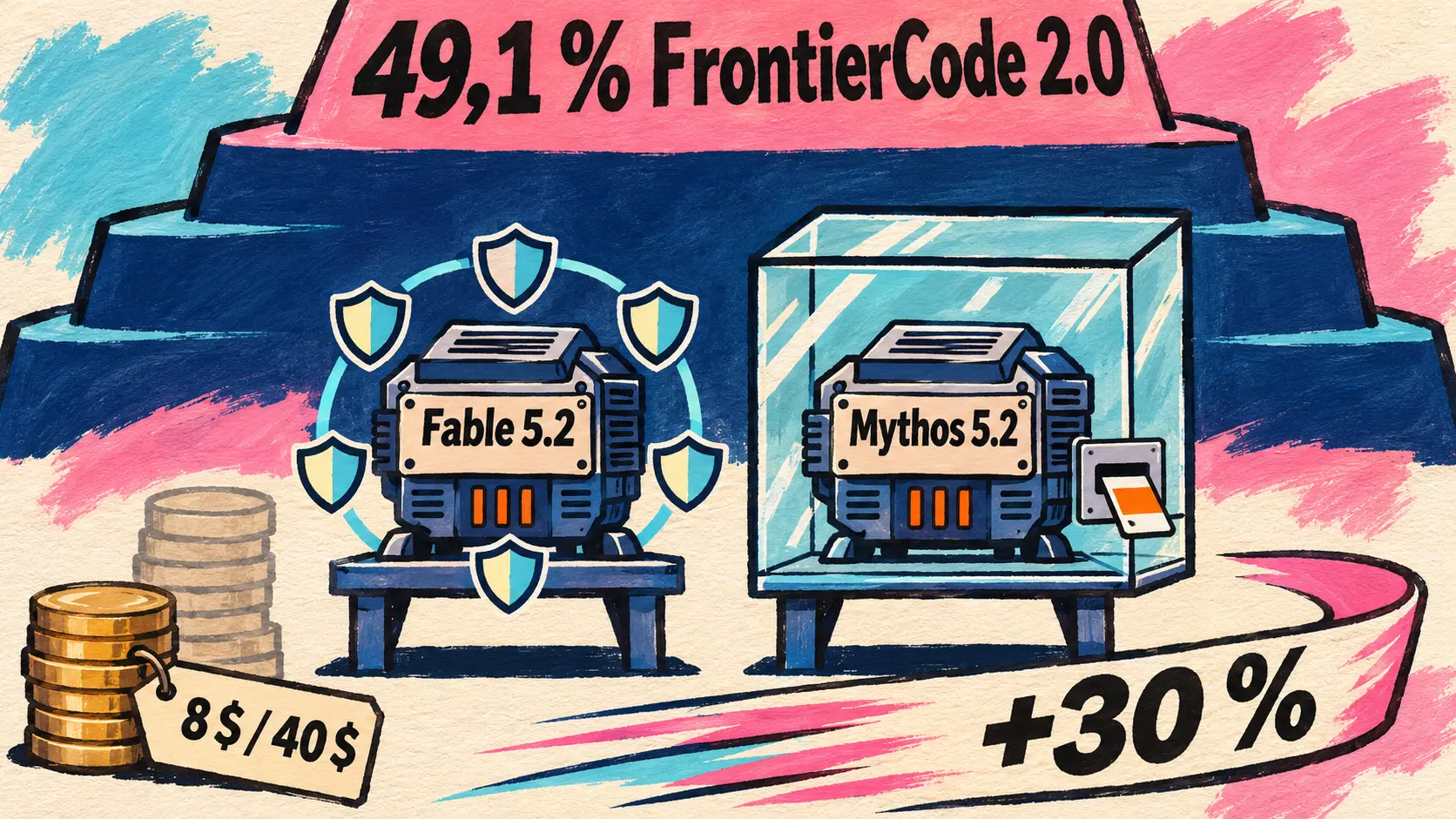
November 9 — Anthropic launches Claude Fable 5.2 and Claude Mythos 5.2, two versions of the same model. Fable 5.2 comes with strengthened cybersecurity and biology safeguards and is available to all users; Mythos 5.2 is restricted to organizations admitted to the Cyber Verification Program or the Life Sciences Verification Program. According to Anthropic, both models improve in coding, reasoning and vision, and generate their responses up to 30 % faster than Fable 5.1 and Mythos 5.1. The price drops by 20 %.
Introducing Claude Fable 5.2 and Claude Mythos 5.2, designed to tackle the most daunting technical challenges. They’re capable collaborators on ambitious projects in many fields, and show improvements in areas like coding, reasoning, and vision. — @claudeai on X
| Pricing type (per million tokens) | Fable 5.2 and Mythos 5.2 | Fable 5.1 and Mythos 5.1 |
|---|---|---|
| Input | 8 dollars | 10 dollars |
| Output | 40 dollars | 50 dollars |
| Fast mode, up to 2,5 times faster (input / output) | 16 / 80 dollars | not specified |
| Cache reads (according to the Claude Code notes) | 0,20 dollar | not specified |
On the API, claude-fable-5-2 and claude-mythos-5-2 offer a context of one million tokens, up to 128 000 output tokens and always-on adaptive thinking. Preserved thinking (preserved thinking) extends to all accounts: changing the system prompt, tools or an earlier message before resubmitting a Fable 5.2 thinking block causes a 400 error, and computer use is available only through computer_toolset_20260801. The default effort is high on Claude Platform and medium in the Claude apps and Claude Code. The model is available on the Claude API, Amazon Bedrock, Google Cloud and Microsoft Foundry, and across all paid plans; Claude Code makes it its default Fable model that same day (see the coding agents section). Anthropic still recommends starting with Claude Opus 5.5 and moving up to Fable only for the most ambitious tasks, a rule detailed in a guide by Addy Osmani published on claude.dev (see Briefs).
For agentic coding, the gain is primarily economic. On FrontierCode 2.0, Fable 5.2 at High effort reaches 45,3 %, matching the best Opus 5.5 score (45,5 % at Max effort) at roughly half the cost per task, and rises to 49,1 % at xhigh, the highest score among the released models tested according to Anthropic. The model does not lead everywhere: Gemini 4 Carbon outperforms it on AutomationBench. The scores below are Anthropic’s, measured with safeguards and at the highest available effort, unless otherwise stated.
| Benchmark (domain) | Fable 5.2 | Fable 5.1 | Opus 5.5 | GPT-6 Astra | Gemini 4 Carbon |
|---|---|---|---|---|---|
| FrontierCode 2.0 (agentic coding) | 49,1 % (xhigh) | 32,4 % (xhigh) | 45,5 % | 42,8 % | 41,1 % (medium) |
| FrontierSWE v2 (agentic coding) | 69,9 % | 56,3 % | 62,3 % | 65,5 % | 61,2 % |
| AutomationBench (business workflows) | 51,4 % | 31,4 % | 42,5 % | 41,4 % | 53,9 % |
| OSWorld 2.1 (computer use) | 89,3 % | 83,5 % | 87,2 % | 79,5 % | 81,5 % |
| Humanity’s Last Exam (with tools) | 74,2 % | 65,6 % | 67,7 % | 57,2 % | not compared |
| RoboDojo Sim (robotics) | 64,9 % | 27,6 % | 39,4 % | 29,8 % | not compared |
| CVE Rediscovery (cybersecurity, Mythos 5.2/5.1) | 89,6 % | 78,3 % | 81,3 % (without safeguards) | not compared | not compared |
Anthropic says that more than 90 % of changes merged into its main codebase are now written by Claude, with human oversight, and cites an operating system prototype written in eight days, starting from an empty folder, by more than 1 000 subagents. In science, the model solved two open problems in black hole physics (preprints published), and Mythos 5.2 predicted the structure of adeno-associated virus capsids, used in gene therapy: 28 out of 34 within 3 Å.
Mythos 5.2 is presented as Anthropic’s most capable cybersecurity model: on CVE Rediscovery (1 829 CVEs), it finds 10,2 % more vulnerabilities than Opus 5.5, although Anthropic places vulnerability identification at roughly the same level as Opus 5.5 in its own evaluations. Sandbox escape attempts fall to 3,1 %, compared with 21 % for Mythos 5.1, but both models more often suspect that they are being evaluated. Fable 5.2’s classifiers reportedly produce around 55 % fewer blocks than those of Fable 5.1 in early tests, with blocked requests falling back to Opus 4.8 (cybersecurity) or Opus 5 (biology). Finally, Enterprise Frontier Safeguards, monitoring compatible with zero data retention, enters private beta with Bridgewater, Salesforce and Stripe.
🔗 Claude Fable 5.2 and Claude Mythos 5.2 (Anthropic) · Claude Platform release notes · Thread by @ClaudeDevs
Launch offers: up to three Fable resets, and one week of Fable included for Pro
November 9 — For the launch, Anthropic is giving paid subscribers Fable usage limit resets, according to a help page linked from the launch post. A reset restores the Fable usage consumed during the week and fully replenishes the 5-hour window, including other models; it does not raise limits and is triggered from the Usage section of settings, using the Reset for free button. The offers apply to Fable 5.2, Fable 5.1 and Fable 5.
| Eligible plan or seat | What is offered | Expiration (Pacific Time) |
|---|---|---|
| Pro, standard Team seats | Fable included in the plan, up to 50 % of weekly limits, plus 1 reset | 16 November 2026, 23 h 59 |
| Max, Ultra, premium Team seats and legacy per-seat Enterprise plans | 1 reset (subscription under 6 months), 2 (6 to 12 months) or 3 (over 12 months) | 8 March 2027, 23 h 59 |
Paid billing must have been in place before November 9 at 10 a.m. PT. The Free plan, self-serve, usage-based and HIPAA-ready Enterprise plans, and standard seats on legacy per-seat Enterprise plans are excluded. For Pro and standard Team seats, Fable returns to usage credits after the week.
🔗 Claude Fable 5.2 launch offers (Claude Help Center)
What Fable 5.2 has already produced: three devices with Diode, Fermat redone by 1 000 agents, chemistry and MIPLIB
Three publications from the same day show the 5.2 generation at work, sometimes using a preliminary version of the model.
Diode: three electronic devices designed from start to finish, working without rework
November 9 — With printed circuit board manufacturer Diode Computers, Anthropic shows Claude Fable 5.2 designing three devices from a short prompt: a USB-C conference speaker with Bluetooth, a home voice assistant hub and a pocket virtual pet. The model wrote the specifications, drew the schematics, routed four-layer circuit boards, designed the 3D-printable enclosures and wrote the firmware; all three prototypes work without any circuit rework. Since KiCad’s router could route only one trace at a time, Claude wrote its own in about half an hour.
The improvement mainly comes from geometric reasoning: 69 % on PCB Gym, Diode’s internal benchmark, compared with 25 % for Fable 5, and 83,5 % on BenchCAD 2.1, almost twice the score of Fable 5.1. Anthropic discloses a commercial relationship with Diode and notes that these prototypes have undergone neither electrical validation, thermal testing nor certification.
🔗 Claude can design electronic prototypes from start to finish (Anthropic)
Fermat: 1 000 agents redo the formalization in 28,7 hours, without a dedicated platform
November 9 — In September, Anthropic published the first complete formalization of Fermat’s Last Theorem: 11 days of work by dozens of agents guided by a researcher on the Prove2Me platform. A claude.dev post by Barry Zhang, Tianyi Peng, Elle Najt, Keller Scholl and Lance Martin describes how 1 000 agents running a preliminary version of Fable 5.2, one lead and 999 helpers, redid this work without that platform or human direction: 28,7 hours according to the post (the launch post rounds this to 30 hours), three times fewer output tokens and a proof seven times shorter. With the same setup, Opus 5.5 completes only 26 % in 18 hours, according to the launch post.
Each agent had a virtual machine without network access, with Lean, Mathlib, its own Git branch and a shared Postgres database, where the lead created its coordination tables in ten minutes. Up to around 750 helpers worked on Langlands–Tunnell, the most demanding result, split into 2 418 tasks. A classifier checked every command and every file modification: out of more than one million tool calls, none was blocked.
🔗 Safely scaling multi-agent teams with Claude Fable 5.2 (claude.dev)
Organic chemistry and MIPLIB: the demo thread adds two results absent from the post
November 9 — Two hours after the launch, the @claudeai account publishes a demo thread. In organic chemistry, Claude mapped out a complete synthesis route for each of four molecules from unpublished work by the labs of Noah Burns (Stanford), Timothy Newhouse (Yale) and Sarah Reisman (Caltech), in about half an hour, starting from a simple image, without internet access and with code as its only tool; the tweet’s illustration attributes these routes to Mythos 5.2. The partner chemists judge the work to be at the level of an early-stage PhD student, but none of the routes has been tested in a laboratory.
Of 203 open problems, Claude beat the listed mathematical solution in 72 cases, and in 45 cases proved that a solution was optimal. — @claudeai on X
MIPLIB brings together optimization problems, such as crew scheduling or delivery route planning; according to the tweet’s image, teams of up to 300 agents worked on them using an earlier version of Fable 5.2. On a timetable for 42 trains, designed to reduce peak electricity consumption, the agents improved on the best-known timetable by 2,6 % in under two hours, then proved that no better one existed. The solutions were submitted to MIPLIB.
Fable 5.2 on day one at Cursor, Devin, Perplexity and v0, each measured on its own benchmark
On launch evening, three tools publish their own measurements of Fable 5.2, each on its in-house benchmark. v0, Vercel’s app creation tool, also makes the model available, without figures (see Briefs).
| Tool making Fable 5.2 available | Vendor benchmark | Fable 5.2 score | Closest competitor cited |
|---|---|---|---|
| Cursor | CursorBench 4.0 | 60,0 % at Max effort, 32,79 dollars | Opus 5.5 Max: 57,8 %, 13,43 dollars |
| Devin (Cognition) | FrontierCode 2.0 | 49,1 % | Opus 5.5: 45,5 % |
| Perplexity | WANDR | 0,851 for 14,51 dollars per task | Gemini 4 Argon: 0,802 for 7,88 dollars |
Cursor: first on CursorBench 4.0, with effort levels that should not be carried over from Fable 5.1
November 9 — Cursor makes Fable 5.2 available that same day. At maximum effort, the model leads CursorBench 4.0 with 60,0 %, ahead of Claude Opus 5.5 Max (57,8 %); at the default effort (High), it scores 56,9 %, compared with 49,2 % for Fable 5.1. Cursor warns that the effort levels no longer behave like those of Fable 5.1 and recommends starting from the default setting rather than carrying over the old one. Its leaderboard illustrates this:
| Fable 5.2 effort level | CursorBench 4.0 score | Cost per task |
|---|---|---|
| Max | 60,0 % | 32,79 dollars |
| High (default) | 56,9 % | 9,70 dollars |
| Extra High | 56,3 % | 15,48 dollars |
| Medium | 54,8 % | 4,66 dollars |
| Low | 53,2 % | 3,94 dollars |
Extra High falls below High at a higher cost, and Low already outperforms Fable 5.1 at maximum effort (51,8 % for 17,28 dollars). Cursor lists the model at 8 and 40 dollars per million tokens, without a changelog or details on eligible plans.
🔗 Announcement by @cursor_ai · CursorBench 4.0 leaderboard
Devin: first on FrontierCode 2.0 at 49.1%, and ahead of Fable 5.1 even at low effort
November 9 — Cognition makes Fable 5.2 available in Devin Desktop and Devin CLI and places it at the top of FrontierCode 2.0, its benchmark of real engineering tasks scored on quality and readiness to be merged (mergeability). Fable 5.2 scores 49.1%, ahead of Claude Opus 5.5 (45.5%), which had led since the benchmark launched on October 27, GPT-6 Astra (42.8%), Sonnet 5.5 (41.0%) and Gemini 4 Carbon (40.0%); Fable 5.1 topped out at 32.4%. According to the post, at low reasoning effort, Fable 5.2 already exceeds Fable 5.1’s best result for less than a third of the cost per task; the tweet says a third of the cost. A solution that fails a blocking criterion receives 0, and the cost is the average spending per run at public API rates. Cognition provides no Devin pricing.
🔗 Claude Fable 5.2 is now available in Devin (Cognition) · Announcement from @cognition
Perplexity: 0.851 on WANDR, a record according to its in-house benchmark
November 9 — Perplexity makes Fable 5.2 available in Computer, its agent, for Pro and Max subscribers, and in Search for Max subscribers only. On WANDR, its in-house benchmark for evidence-backed research, the model scores 0.851 at $14.51 per task, presented as a record on the Pareto frontier, which comprises models that no other model beats on both score and cost. According to the chart published by Perplexity, the sole source of these figures, Fable 5.2 surpasses Gemini 4 Argon, the record holder since October 16 with 0.802 at $7.88, for around 1.8 times its cost per task. Fable 5.1, retested, scores 0.684 at $13.16, compared with 0.601 when it arrived in September. The tweet specifies neither the effort level nor the cost in credits in Computer. This score is not comparable to the 85.9% for the Agent API’s ultra level published on November 5, a configuration with multiple agents.
🔗 Announcement from @perplexity_ai
Meta launches Muse Ember, its smallest model, at $0.10 per million input tokens
November 9 — Meta launches Muse Ember, presented as its smallest and most efficient model. It targets work that agents repeat all day: sequential tool calls, coding subtasks (reading files, running tests, making targeted fixes), routing, extraction and analysis of long documents. It has a context of one million tokens, outputs up to 512,000 tokens and natively understands text, images, audio and video. It is the first model trained with Muse Wonder Full, as Meta announced when launching Muse Wonder in October; within the lineup, Muse Wonder handles the hardest problems, Muse Spark handles coding and agentic workflows, and Muse Ember handles repeatable tasks at scale.
The model is available in Muse Code and on the Meta Model API under the name muse-ember-1.0, with support for the Responses API, at $0.10 per million input tokens, $0.004 for cached input and $0.50 for output. No release of the weights has been announced.
On the @ArtificialAnlys Intelligence Index, it achieves performance comparable to Claude Haiku 5.5 at roughly one-third of the cost per task, while scoring higher than GPT-6 Luna across all of Luna’s reasoning settings. — @AIatMeta on X
That is Meta’s central claim; its post adds that Muse Ember matches Haiku 5.5’s best score. Both models score 36 on the index, and the chart caption specifies that Muse Ember’s costs are estimates at the proposed rates.
| Comparison published by Meta | Muse Ember (max) | Muse Spark 1.3 (max) |
|---|---|---|
| Artificial Analysis Intelligence Index | 36 | 37 |
| Cost per index task | 0,14 dollar | 2,39 dollars |
| Price per million tokens (input / output) | 0,10 / 0,50 dollar | 1,25 / 4,25 dollars |
| Benchmark at max setting (according to Meta) | Muse Ember | Claude Haiku 5.5 | GPT-6 Luna |
|---|---|---|---|
| AutomationBench-AA | 37,8 | 13,9 | 20,2 |
| Coding Agent Index-AA | 46 | 37 | 31 |
| Terminal-Bench 4.0 (best harness) | 40,9 | 39,2 | 16,4 |
| OSWorld 2.1 (partial credit, internal) | 69,5 | 68,9 | 50,5 |
| FrontierCode 2.0-AA | 27,2 | 34,9 | 25,2 |
| Artificial Analysis Intelligence Index | 36 | 36 | 28 |
At the maximum reasoning setting, Muse Ember outperforms Claude Haiku 5.5 and GPT-6 Luna on seven of the ten published benchmarks, but Haiku 5.5 remains ahead on FrontierCode 2.0-AA. Several figures come from Meta’s internal evaluations, including its own Personal Superintelligence Index, and Terminal-Bench 4.0 compares each model using its best published harness. Vals AI’s independent ranking points in the same direction: Muse Ember is its cheapest model, at $0.15 per test, with 60.5% overall, 0.8 points behind DeepSeek V4.1 Flash for around a quarter of its cost.
Meta says it evaluated Muse Ember under its Meta Superintelligence Scaling Framework, below the high-risk thresholds, and had it tested by Box, Cline, Oracle, Cloudflare and You.com; the company says even more efficient models are in training.
🔗 Muse Ember (Meta research blog) · Vals AI ranking
Google adds TPU 8tx and TPU 8i Max to its eighth generation of TPUs, with no date or pricing
November 9 — In a post by Amin Vahdat, Google expands its eighth generation of TPUs with two new systems, TPU 8tx and TPU 8i Max. Following the TPU 8t (training) and 8i (reasoning) introduced in April, Google says this is the first time four TPU systems have been released in the same year. The company stresses that these are new systems built around existing chips (packaging, memory, networking, security), rather than new chips, an approach that lets it deliver specialized supercomputers in months instead of years.
| TPU system | Intended use | Specifications announced by Google |
|---|---|---|
| TPU 8t | Large-scale training | up to 2,7 times the training performance of the previous generation |
| TPU 8i | Real-time reasoning | 80 % better inference price-performance than the previous generation |
| TPU 8tx | Confidential inference, small training runs | 8t silicon, 5th-generation AMD EPYC hosts, up to 2 times lower latency than the 8t |
| TPU 8i Max | Very long contexts, rack density | two 8i chips per package: 2 times the compute, SRAM and HBM bandwidth of the 8i |
The TPU 8tx targets regulated businesses and governments. Security operates at the hardware level: data and model weights remain protected and isolated during computation (confidential compute), with a near-zero performance penalty according to Google. The same machine can fine-tune a model on private data, distill a large model or train agents through reinforcement learning without moving sensitive data. The TPU 8i Max tackles the memory wall, when dozens of agents work on an entire codebase or hours of video.
The software follows suit. A suite of open source TPU agents, in preview, plugs into Claude Code, Cursor and Google Antigravity to migrate to TPUs, diagnose bottlenecks and tune kernels using natural language; XLA Serving Engine serves models in C++ on TPUs, GPUs and CPUs; TPU Sync reduces KV cache transfer latency and time to first token by more than 90%; Agent Compute Engine automatically suspends idle agent sessions. Cloud Pathways, the Google DeepMind runtime behind Gemini, and GKE dynamic slicing (up to 5 times faster job startup, up to 4.5 times faster recovery after a failure) move to general availability.
Google claims nearly 100 TPU customers, who can now deploy them in their own data centers. However, it provides neither an availability date nor pricing for TPU 8tx and TPU 8i Max, and its results on the InferenceX and AgentX benchmarks come with no figures.
🔗 TPU 8i Max and TPU 8tx (blog.google) · Google Cloud post · Introducing TPU Sync (Google Cloud)
NVIDIA presents GR00T 2 at CoRL, an open world action model, with no license or download link
November 9 — At the opening of the Conference on Robot Learning (CoRL) in Austin, NVIDIA presents GR00T 2, which it describes as an open frontier world action model, built on its Cosmos platform. The model was trained on robot and human data, including 100,000 hours of human egocentric videos released as open source by NVIDIA, to learn fine manipulation skills and transfer them from one robot body to another without robot demonstrations. An API allows agents to chain its skills and recover from their mistakes.
| Metric announced by NVIDIA | Announced value |
|---|---|
| GR00T 2, tasks completed without task-specific demonstrations | 40 out of 50, at least once |
| GR00T 2, average success with 1 demonstration per task | 71 % across 50 tasks |
| GR00T 2, average success with 5 demonstrations per task | 95 % |
| Isaac Lab 3.0 with Newton, versus Isaac Lab 2.3 with PhysX | up to 2,5 times the training throughput |
| AlphaNIST, single policy versus separate policies | over 98 % versus 81 %, around 39 times less GPU time |
| EgoHand, downloads on Hugging Face | over 40 000 in two weeks |
NVIDIA places GR00T 2 among the top three models on the RoboCasa365, RoboLab, RoboDojo and MolmoSpaces leaderboards, with several first-place finishes, without numerical scores. Nexuni is testing it for laundry processing, Foxconn for server manufacturing, Siemens for evaluation, and MicroAGI uses it, following reinforcement post-training, to swap Ethernet cables with a robotic arm.
On the simulation side, Isaac Lab 3.0, available since October 21, relies more heavily on the open source Newton physics engine for deformable objects (cables, fabrics) and articulated hands. AlphaNIST provides an example: a single policy learns all 20 assembly tasks on the NIST Assembly Task Board using a simple success-or-failure signal. For evaluation, NVIDIA releases Isaac Lab-Arena 0.4 in developer preview and two open benchmarks: DexBench, designed with RLWRLD (15 tasks in four scenes, from retail to hospitality), and VABAR, designed with UC Berkeley (six industrial tasks). These are joined by a Video to Data workflow, which transforms human videos into simulated robot demonstrations, and EgoHand, an open model for 3D hand reconstruction.
The post presents GR00T 2 as open, but provides no license, download link or availability date.
NVIDIA in Korea: NVLink Fusion with Rebellions and SK Telecom, Dynamo recipes and physical IA
November 9 — During NVIDIA AI Day Seoul, NVIDIA publishes a series of Korean announcements. The main one is a collaboration with chip designer Rebellions and operator SK Telecom, supported by Korea’s Ministry of Science and ICT: Rebellions will connect its future Rebel R200 neural processing units (NPU) to the NVIDIA platform through NVLink Fusion and build its systems on the MGX rack architecture, and SK Telecom plans to deploy them in its IA data center, for models such as A.X K2 and for public services under the government’s AI for All project. Inference would be disaggregated: NVIDIA GPUs would read the prompt (prefill), while Rebellions NPUs would generate the tokens. Neither a date nor a volume is provided.
NVIDIA also publishes Dynamo recipes for four Korean open models (A.X K2, K-EXAONE 2.0, Solar Open 2 and Motif-3), optimized for B200 GPUs, with up to 2 times the performance out of the box according to NVIDIA. LG AI Research opens API access to K-EXAONE-2.5, trained with Nemotron datasets including Nemotron-Personas-Korea (7 million personas), and Hyundai Motor Group explores NemoClaw and OpenShell. NVIDIA also announces an investment in Point2 (radio-frequency interconnects) and planned investments in Motif Technologies, RLWRLD and Upstage, with no amounts disclosed. In the same series, Samsung, Kakao Mobility and LG Electronics detail their physical IA projects with NVIDIA (see Briefs).
🔗 Press release from NVIDIA, Rebellions and SK Telecom · Dynamo recipes for Korean models · Secure agents in Korea · Investments in Korean startups
Coding agents: Claude Code 2.1.321, Vibe CLI 3.1.1, Qwen Code, Copilot CLI, Antigravity CLI, Amp and Delta
Claude Code and Vibe CLI publish the day’s two most substantial releases. Qwen Code v0.27.1, Copilot CLI 1.0.108 in stable, Antigravity CLI 1.5.2, Amp’s Portals and Windows app, and Delta’s rewritten editor are summarized in Briefs, under Coding agents and tools.
Claude Code 2.1.321 makes Fable 5.2 the default Fable model and fixes 74 issues
November 9 — Claude Code 2.1.321 accompanies the launch: Fable 5.2 becomes the default Fable model (one-million-token context, $8 and $40 per million tokens, cache reads at $0.20). Saved Fable 5.1 selections switch to the fable alias, immediately on Pro and Max, and on Team and Enterprise once the organization permits it; /model claude-fable-5-1 allows users to switch back. claude remote-control --settings applies a settings file to every session launched.
Of 118 entries, 74 are fixes, including several vulnerabilities: MCP OAuth tokens could be sent to another host after a redirect, a read-only Bash command could run outside the sandbox without asking, and deny rules did not apply to a cp or mv targeting a directory. If the fast service hits a limit or goes down, fast mode first falls back to the same model at standard speed. Mods written by Claude activate without asking in auto and bypass modes, with deny rules still enforced. No 2.1.320 was released, the stable npm channel remains on 2.1.311, and the Agent SDK follows with TypeScript 0.3.321 and Python 0.2.180.
🔗 Claude Code 2.1.321 release notes
Vibe CLI 3.1.1 adds four hook events, a Vim mode, and configuration imports from other agents
November 9 — Five days after 3.1.0, Mistral releases Vibe CLI 3.1.1, without an announcement on X. Despite its patch version number, it contains 92 entries: 17 additions, 26 changes, 44 fixes, and 5 removals. Hooks gain four events: pre_agent, before the model reads a message, which can block it, rewrite it, or add context; notification, when Vibe is waiting for approval or a response; session_start and session_end. The built-in skill /vibe:import finds other coding agents’ configurations and imports their instructions, skills, subagents, commands, hooks, MCP servers, and permissions.
The input area gains Vim modes, and /pr lists the session’s pull requests, opens the first failing CI check, or writes a prompt to unblock the PR; this tracking is now enabled by default. The release removes /teleport, the --teleport option, and /remote-project. For Mistral Large 4, thinking levels change to Low, Medium, and High, the values the API now accepts, and plugin skills take the plugin’s name (my-plugin:review instead of my_plugin:review), requiring updates to custom agents.
🔗 Vibe CLI 3.1.1 release notes
ChatGPT dots work across multiple local computers, selected for each task
November 9 — Dots, ChatGPT’s persistent agents launched in late September, can now use multiple local computers: users connect several to the same dot, then choose which one to use for a task. OpenAI Developers highlights developer use cases: building and testing an application on a dedicated machine while coding on a laptop, testing a change in Xcode on a second Mac and receiving screenshots, reproducing a bug on a machine with an older SDK, or having the agent navigate an interface without taking over the user’s screen or cursor.
According to the help page, each computer connects through the ChatGPT application installed on it, in the Computers section of the dot’s profile, and must remain online with the application open. For independent tasks, users ask the dot for a separate thread per computer. An offline status does not revoke access, which must be explicitly removed, and this permission remains separate from the connection to Codex and from Work Sync. OpenAI does not specify the eligible plans or the rollout schedule.
🔗 Announcement from @OpenAIDevs · Connect computers and apps to your dot
OpenAI brings back the Codex edition ModRetro Chromatic, with a plugin for creating Game Boy Color games
November 9 — OpenAI Developers is putting the Codex edition ModRetro Chromatic back on sale at OpenAI Supply Co., OpenAI’s store. The handheld console runs Game Boy Color games and costs 200 dollars with a programmable cartridge and a case. First offered exclusively at DevDay, it returns with a new look; the store lists a restock date of November 19, with shipping limited to the United States, Canada, Australia, New Zealand, Japan, the United Kingdom, and the European Union.
The console serves as a showcase for the ModRetro Chromatic plugin, published by ModRetro and installed through the Codex plugin catalog in the ChatGPT desktop application. It uses GB Studio and provides sprite and animation tools, a collision map displayed alongside the scene, an emulator opened in Codex’s built-in browser, and button sequences executed with a screenshot at each step. More experienced developers can write C with GBDK-2020 or build their own engine in assembly. Installing a game via USB cable onto a rewritable cartridge erases the existing game and may erase its saves, without a backup.
🔗 Announcement from @OpenAIDevs · Build a retro handheld game with Codex and ModRetro Chromatic · Codex edition Chromatic on OpenAI Supply Co.
Google AI Studio creates Google Maps Platform applications from a prompt, without a credit card
November 9 — Google AI Studio lets users create applications based on Google Maps Platform directly from a prompt. Users describe their idea to Gemini, such as an interactive 3D tour of New York, and AI Studio configures Google Maps Platform and manages the API key without redirecting them, then displays an interactive map in the preview; it can also connect an existing Google Cloud project. The Maps APIs (styled maps, photorealistic 3D cities), Places (local search, place details), Routes (multi-stop directions), and Environment (air quality, pollen) are available, and three examples can be remixed in the gallery: City Immersive Tour, Pet Grooming Route Optimizer, and Store Locator & Near Me Finder.
The trial is free and requires no credit card, within the sandbox quotas: 100 calls per day per API, reset every 24 hours. Production use requires linking a Google Cloud billing account, at standard Google Maps Platform rates.
🔗 From prompt to app: build with Google Maps in AI Studio (Google Developers) · Announcement from @GoogleAIStudio
ElevenLabs launches Campaign Manager to put ElevenAgents in charge of outbound calling campaigns
November 9 — ElevenLabs launches ElevenAgents Campaign Manager, which puts its voice agents in charge of entire outbound calling campaigns. Users provide a contact list and a goal, such as a qualified lead or a confirmed appointment: the agent calls within the chosen time windows, retains context between calls, calls back later, books the requested slot or tries another number or another person at the account, then stops as soon as the goal is reached or the contact asks it to.
The module sets rules for calls: attempt caps (with a separate cap for callbacks), do-not-call lists updated as soon as a contact asks to stop, and mandatory disclosures in the agent’s introduction. Each contact has a timeline of decisions, uncertain cases go into a queue for review, and everything can be exported as CSV. Beta-tested in insurance, banking, and e-commerce, it increased the share of leads handled each day at The AA Ireland from 50–60% to 100%, according to its CTO Jeremy O’Sullivan. Campaign Manager is available now, by phone and on WhatsApp, with email and SMS announced as coming soon, and no separate pricing.
🔗 ElevenAgents Campaign Manager (ElevenLabs) · Announcement from @ElevenLabs
Open data and research: NVIDIA’s synthetic Japanese datasets and Amazon’s HOPE pruning
Two posts published today on the Hugging Face blog, one about training data and the other about the memory used by mixture-of-experts models.
NVIDIA and Elith release two synthetic Japanese datasets for finance and data protection
November 9 — NVIDIA releases two synthetic Japanese datasets on Hugging Face, designed to work together. Nemotron-Personas-Finance-Japan, created with Elith, extends Nemotron-Personas-Japan to finance: 9 million personas in Japanese (1 million records with 50 fields), with household composition, assets, and financial behavior grounded in official statistics, totaling around 1.5 billion tokens under the CC BY 4.0 license. According to the authors, it is the first open persona dataset of this size to combine Japanese public statistics with household finance data.
Nemotron-PII-Japan provides 100,000 synthetic Japanese business documents across eight domains (including healthcare, finance, government, and legal), with 56 annotated types of personal data, including the My Number identifier, to train models that detect and mask this data. NVIDIA fine-tunes a GLiNER model on 95,000 documents. The overall idea: simulate customers with the first dataset, then use the second to check that a processing pipeline protects their data.
🔗 Nemotron-Personas-Finance-Japan (Hugging Face blog) · Nemotron-PII-Japan (Hugging Face blog)
Amazon presents HOPE, a method for pruning MoE experts that accounts for experts working together
November 9 — In a post by Alex M Tseng, an Amazon team presents HOPE (Higher-Order Pruning of Experts), a method for removing the least useful experts from a mixture-of-experts (MoE) model without retraining. An MoE keeps all its experts in memory even though only a few are used for each token: in Qwen3.5-122B, they account for 95% of the model’s roughly 250 GB. Current methods score each expert in isolation; HOPE also measures interactions between pairs of experts that often activate together.
Tested on Qwen3.5-122B, Qwen3.5-35B, and GLM-4.5-Air against REAP, MAN, EAN, and Frequency, with 10–50% of experts removed, the method achieves the best average rank (2.07 across 5 methods), according to Amazon, and its lead grows with the pruning rate: at 50%, up to +6.1% on agentic coding tasks compared with the best competing method. It is compatible with quantization, with an overhead of one to two seconds per layer.
🔗 Amazon’s HOPE post (Hugging Face blog)
Briefs
Coding agents and tools
- Qwen Code v0.27.1 — Stable release from November 9, two days after v0.27.0, with no breaking changes: 122 entries, including 26 features and 65 fixes. Managed Agent gains optional personal memory backed by Mem0, along with archiving and self-service MCP server installation; Desktop v0.27.1 and the TypeScript SDK v0.1.31 follow the same day. 🔗 source
- Copilot CLI 1.0.108 goes stable — Released as stable on November 9, with no additions beyond the 1.0.108-0 and 1.0.108-1 prereleases covered on November 7:
/indexcommands, shared tgrep indexing by default, a sandbox setting for Windows and 72 fixes. 🔗 source - Antigravity CLI 1.5.2 — Release dated November 6 in the changelog:
--dangerously-skip-permissionsno longer automatically approves protected commands or access outside the workspace when a Gemini Enterprise administrator requires review; plugins with unsafe names are rejected, and cloud plugin skills arrive in--remote-agentsessions. 🔗 source - Amp Portals on runners — Portals, previously limited to orbs, now work on users’ machines: a development server launched by the agent opens from the thread’s Portal tab, accessible in a browser and in the iPhone and iPad apps according to the documentation. Enable them via Allow Portals or
amp --no-tui --remote-control-portals; portals are private except on shared runners, and never public according to the documentation. 🔗 source · 🔗 documentation - Amp for Windows — On November 7, Quinn Slack, Amp’s CEO, released an experimental Windows app with a self-updating installer; reported bugs earn credits, and a solid version is promised in about three to four days. The download page also lists an experimental Linux app. 🔗 source
- Delta’s thread editor — On Delta’s blog, Agus Zubiaga describes rewriting the editor to turn threads into a shared, annotatable document rather than a chat, abandoning Zed’s editor architecture; Zed sums it up by saying they had to start from scratch six times. An engineering post, with no new release. 🔗 source · 🔗 Zed’s tweet
- v0 and Fable 5.2 — Vercel’s app creation tool makes Claude Fable 5.2 available on launch evening, with a direct entry point at
v0.app/?fable52, without specifying plans or pricing. 🔗 source
Platforms, APIs and companies
- Choosing a Claude model — In a guide published on claude.dev, Addy Osmani recommends starting with Opus 5.5 at medium effort, moving down to Sonnet 5.5 or Haiku 5.5 for well-defined work or high volume, and moving up to Fable 5.2 for the hardest projects, after first trying one higher effort level. On SWE-bench Pro, Opus 5.5 on low with failed tasks retried on high reaches around 97% for $0.17 per task, versus 95.3% for $0.29 with everything on high. 🔗 source
- Asynchronous functions in the Agents API — Michael Luo, from OpenAI’s Agents API team, introduces asynchronous functions: the agent continues working after calling a tool, without waiting for its result, allowing it to start a slow search early or handle independent parts of a request. He also highlights the 12-hour prompt cache, already covered on October 20. 🔗 source
- OpenAI SDKs — openai-python 3.48.0 adds streaming options for agent sessions, and the Python and Node (7.54.0) SDKs recognize gpt-6-rosalind in the Responses beta; Codex CLI has published no stable release since 0.167.0 on November 6, only 0.169.0 prereleases without notes. 🔗 source
- ChatGPT Enterprise on AWS Marketplace — ChatGPT Enterprise (ChatGPT, ChatGPT Work, Codex and dots) can now be purchased through AWS Marketplace, using existing AWS billing and with spending counting toward AWS commitments; the same features as buying directly, according to OpenAI, with no pricing announced, following Google Cloud and Oracle in October. 🔗 source
- Kuken Industries — The Japanese cooling tower manufacturer finds a spare part drawing in 4.5 minutes instead of nearly an hour, using a tool built on OpenAI’s API by startup Recursive; it expects around 90% fewer search hours over a year. 🔗 source
- Perplexity’s guide to memory — Perplexity explains AI assistant memory and details its own: it works across all models, is specific to each Project, appears among the sources when used and can be deleted; on consumer accounts, its contents may be used to improve models unless the AI Data Retention setting is turned off; never on Enterprise accounts. 🔗 source
Security
- Secret scanning in Actions logs — GitHub secret scanning now scans GitHub Actions workflow logs at the end of a run, in public preview on GitHub Enterprise Cloud with Secret Protection or Advanced Security; the enterprise policy is disabled by default, with no scanning of old logs or notifications during the preview. 🔗 source
- Fizzl’s x402 exam — Frits Zwager turns the x402 Agent Safety Bench into an exam open to any agent on Fizzl’s website: 19 purchase tasks with simulated sellers, including 14 dishonest ones, paid for in test USDC on Base Sepolia. 🔗 source
Open models and community
- Harness adapters — A follow-up to the harness-hub project presented on November 6: LoRA training is complete for Liquid AI’s LFM2.5-24B and LFM3 and webAI’s Twil-8B, in the pi, hermes and opencode harnesses; the team reports up to 43% higher tool efficiency and 15% higher accuracy for LFM3, and up to 37% higher efficiency for Twil-8B. 🔗 source
- Editing weights for medicine — Maziyar Panahi (OpenMed) improves small Qwen models’ performance on medical exams by modifying their weights without training: Qwen3.5-2B goes from 52.0 to 70.5% on MedQA, with no significant change in mathematics; the gain comes partly from the response format, the post notes. 🔗 source
- Qwen3.8-27B fine-tuned on a Mac Studio — Roman Melnyk turns Qwen3.8-27B into an assistant for Kafka, Strimzi, Kubernetes and Argo CD, entirely on a Mac Studio M3 Ultra with 512 GB; the 4-bit version fits in around 15 GB, and the author considers this first result mixed. 🔗 source
- Step 5 at Together AI — On November 8, Together AI says it more than tripled the throughput of StepFun’s Step 5 by optimizing its serving stack with agents (MoE routing, scheduling, kernels, speculative decoding, sparse attention), without providing an absolute figure. 🔗 source
- 3D gallery on the Hub — According to Caleb Fahlgren, whose post was shared by Hugging Face, datasets containing .glb, .ply, .stl files or splats automatically appear as a 3D gallery; more than 350 public datasets benefit, following October’s OpenUSD viewer. 🔗 source
- Hugging Face and Qai hackathon in Doha — Aritra Roy Gosthipaty and four Hugging Face coauthors look back on this November 5–7 hackathon, described as Hugging Face’s first in the Gulf: more than 500 applications, 150 participants, 40 teams, 15 finalists and 3 winners. 🔗 source
- Sakana AI mobile app — Sakana AI is recruiting testers through November 15 for the beta of its first mobile app, provisionally named Sakana AI App, without describing its features. 🔗 source
Robotics, 3D and video
- Physical AI in Korea — In NVIDIA’s Korea series, Samsung accelerates its semiconductor design calculations (around 1,600 times with PhysicsNeMo, from 18 hours to 41 seconds), Kakao Mobility targets Level 4 autonomous driving on NVIDIA Hyperion with Kia vehicles, and LG’s CLOiD robot, powered by Isaac GR00T, works in an actual factory; no timeline or volume is given. 🔗 source
- Humanoid assembling IKEA furniture — On November 8, Harpreet Sahota converts an excerpt from the 2026 Humanoid IKEA Assembly Challenge for FiftyOne: 6 episodes and 30.7 minutes of a humanoid with 35 motors and seven cameras, with motor torque synchronized with the wrist cameras. 🔗 source
- Meshy’s SAM3D-Part and BranchTokens — SAM3D-Part extracts a complete part from an existing 3D object with one click, with a Chamfer distance around 72% lower than OmniPart across 500 objects (paper accepted at SIGGRAPH Asia 2026, weights released); BranchTokens, developed with Purdue, reduces 3D skeleton generation error by 16.9% compared with Auto-Connect. 🔗 source · 🔗 BranchTokens
- Runway’s Sightline — A new App Studio app: it creates a 360 panorama of a location, lets users frame shots from every angle with consistent scenery, and exports it in 3D to serve as an environment; it uses Runway credits, with no cost or model specified. 🔗 source
What this means
A frontier model is now benchmarked on launch day by the companies integrating it, using their own benchmarks. Cursor, Cognition and Perplexity publish their Fable 5.2 figures within hours of launch, each on its own in-house benchmark, and Claude Code immediately makes it its default Fable model. These measurements do not all tell the same story: on CursorBench, Extra High effort performs worse than High at a higher price, and on WANDR the record comes at around 1.8 times Gemini 4 Argon’s cost per task. Cursor’s advice to start again from the default setting applies beyond its own tool: a new model requires recalibrating effort.
Cost per task is becoming the unit of comparison. Anthropic cuts Fable’s price by 20% and highlights matching Opus 5.5’s score at around half the price; Meta puts Muse Ember on par with Claude Haiku 5.5 at around a third of the cost per task, according to its own figures; Cursor, Devin and Perplexity all display a cost per task alongside the score. Beneath the models, Google is expanding its TPU systems for inference, and Amazon is looking to reduce MoE memory requirements with HOPE. However, TPU 8tx and 8i Max arrive without a date or pricing, which still prevents comparisons.
Demonstrations are scaling up: 1,000 agents for Fermat, up to 300 per team on MIPLIB, more than 1,000 subagents for an operating system prototype. Anthropic accompanies these figures with measured safeguards: a classifier on each of the more than one million tool calls in the Fermat experiment, sandbox escapes reduced to 3.1%, and Mythos 5.2 restricted to verification programs in cybersecurity and biology. However, the fact that both models more often suspect they are being evaluated makes these safety measurements harder to interpret.
In robotics, openness remains to be confirmed. NVIDIA calls GR00T 2 an open model and publishes two open benchmarks, DexBench and VABAR, but its post provides neither a license nor a download link. In Korea, NVIDIA is building a sovereign AI ecosystem where its GPUs coexist with Rebellions’ NPUs through NVLink Fusion: the platform is opening up to other designers’ chips while remaining at the center of inference.
Sources
- Claude Fable 5.2 and Claude Mythos 5.2 (Anthropic)
- Fable 5.2 and Mythos 5.2 announcement (@claudeai)
- Claude Platform release notes
- @ClaudeDevs thread on Fable 5.2
- Claude Fable 5.2 launch offers (Claude Help Center)
- Claude can design electronic prototypes from start to finish (Anthropic)
- Safely scaling multi-agent teams with Claude Fable 5.2 (claude.dev)
- @claudeai demonstration thread
- MIPLIB in the @claudeai thread
- Fable 5.2 in Cursor (@cursor_ai)
- CursorBench 4.0 leaderboard (Cursor)
- Claude Fable 5.2 is now available in Devin (Cognition)
- Fable 5.2 in Devin (@cognition)
- Fable 5.2 in Perplexity (@perplexity_ai)
- Muse Ember (Meta research blog)
- Muse Ember announcement (@AIatMeta)
- Muse Ember in the Vals Index (@ValsAI)
- TPU 8i Max and TPU 8tx (blog.google)
- TPU 8tx and TPU 8i Max (Google Cloud blog)
- Introducing TPU Sync (Google Cloud blog)
- GR00T 2 and robotics simulation at CoRL (NVIDIA)
- NVIDIA, Rebellions and SK Telecom (NVIDIA Newsroom)
- Dynamo recipes for Korean open models (NVIDIA)
- Secure agents in Korea (NVIDIA)
- Investments in Korean startups (NVIDIA)
- Claude Code 2.1.321 release notes
- Vibe CLI 3.1.1 release notes
- Multiple computers for one dot (@OpenAIDevs)
- Connect computers and apps to your dot (ChatGPT)
- Codex edition ModRetro Chromatic (@OpenAIDevs)
- Build a retro handheld game with Codex and ModRetro Chromatic (OpenAI Developers)
- Codex edition Chromatic (OpenAI Supply Co.)
- From prompt to app: build with Google Maps in AI Studio (Google Developers)
- Google Maps Platform in AI Studio (@GoogleAIStudio)
- ElevenAgents Campaign Manager (ElevenLabs)
- Campaign Manager (@ElevenLabs)
- Nemotron-Personas-Finance-Japan (Hugging Face blog, NVIDIA)
- Nemotron-PII-Japan (Hugging Face blog, NVIDIA)
- HOPE, MoE expert pruning (Hugging Face blog, Amazon)
- Qwen Code v0.27.1
- Copilot CLI 1.0.108
- Antigravity changelog
- Portals on Your Runner (Amp)
- Amp for Windows (@sqs)
- Amp runner documentation
- Building a thread UI on hard mode (Delta)
- Delta’s new editor (@zeddotdev)
- Fable 5.2 in v0 (@v0)
- Which Claude model should you build with? (claude.dev)
- Agents API asynchronous functions (@AzianMike)
- openai-python 3.48.0
- ChatGPT Enterprise on AWS Marketplace (OpenAI)
- Kuken Industries (OpenAI)
- AI memory (Perplexity)
- Secret scanning in Actions workflow logs (GitHub Changelog)
- Fizzl’s x402 exam (Hugging Face blog)
- Harness adapters (@yb2698)
- Weight-space programming in medicine (Hugging Face blog, OpenMed)
- Kafka assistant on Mac Studio (Hugging Face blog)
- Step 5 at Together AI (@togethercompute)
- 3D gallery on the Hub (@calebfahlgren)
- Hugging Face and Qai hackathon (Hugging Face blog)
- Sakana AI app beta (@SakanaAILabs)
- Physical AI in Korea (NVIDIA)
- Humanoid IKEA Assembly Challenge in FiftyOne (Hugging Face blog)
- SAM3D-Part (Hugging Face blog, Meshy)
- BranchTokens (Hugging Face blog, Meshy)
- Sightline (@runwayml)