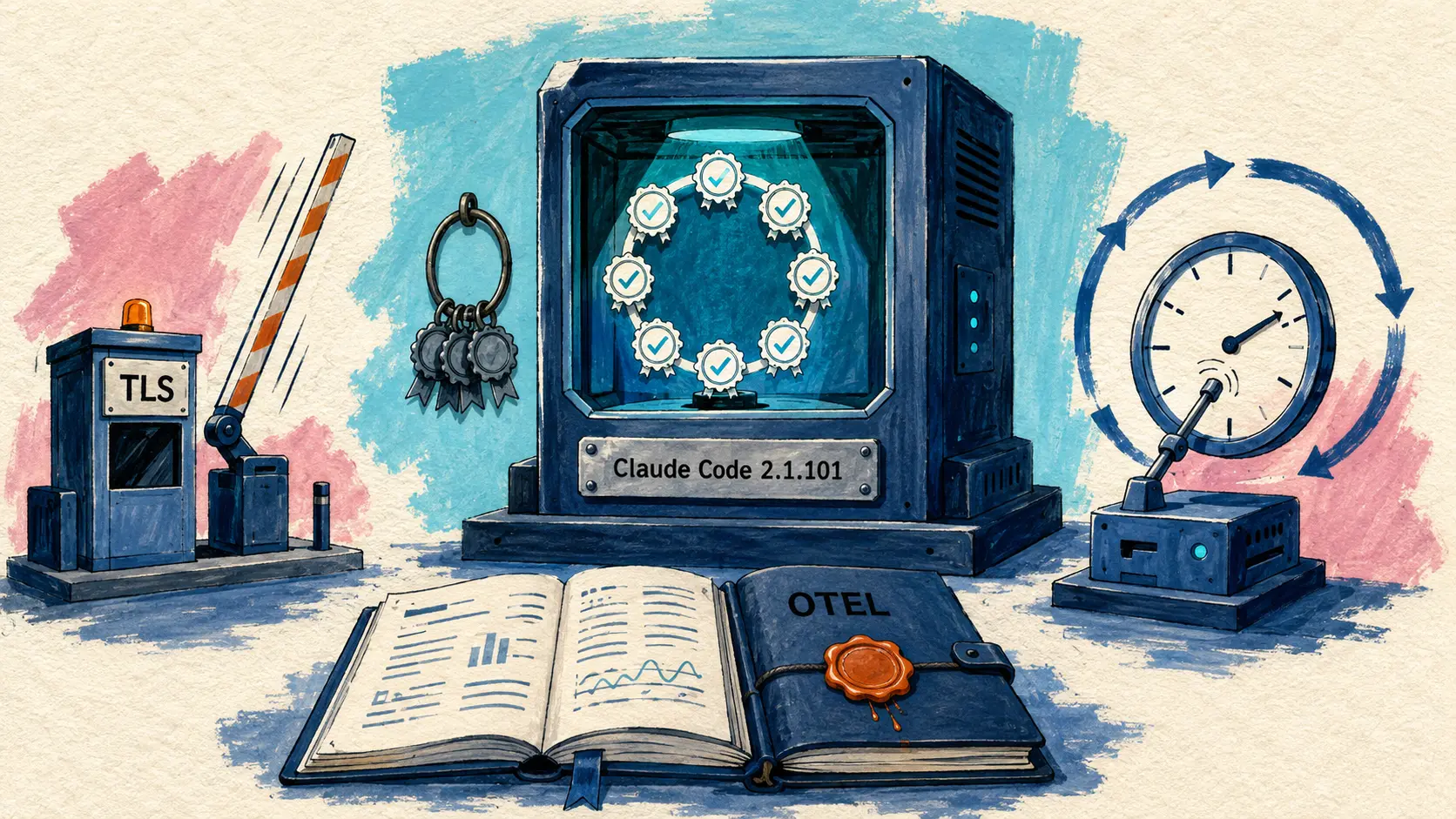
April 10, 2026 concentrates most of the activity: Claude Code moves to version 2.1.101 with several notable improvements for agentic workflows and enterprise environments, Anthropic publishes three in-depth articles on agent philosophy and multi-agent coordination, and GitHub suspends new Copilot Pro trials following abuse of its platform. On the creative tools side, MiniMax releases Music 2.6 (the only item dated April 11) and MMX-CLI, Pika opens up agent monetization, and Runway deepens its partnership with NYU Tisch.
Anthropic / Claude
Claude Code v2.1.101 — CA certificates, dynamic /loop, OTEL tracing
April 10 — Claude Code releases version 2.1.101, focused on workflow robustness, enterprise environment support, and developer experience.
| Feature | Description |
|---|---|
| System CA certificates | Trust granted by default to the OS certificate store — enterprise TLS proxies work without extra configuration (CLAUDE_CODE_CERT_STORE=bundled to revert to built-in CAs) |
/team-onboarding | New command to generate an onboarding guide for new team members, based on local usage |
/ultraplan and remote sessions | Automatic creation of a default cloud environment without first going through web configuration |
| Improved brief mode | New automatic retry when Claude responds in plain text instead of a structured message |
| Focus mode | Claude writes more self-contained summaries, knowing the user only sees the final message |
| Rate-limit errors | Displays the reached limit and reset delay instead of an opaque countdown |
claude -p --resume <name> | Now accepts session titles set via /rename or --name |
| Settings robustness | An unrecognized hook event name in settings.json no longer causes the entire file to be ignored |
| OTEL tracing | Respects OTEL_LOG_USER_PROMPTS, OTEL_LOG_TOOL_DETAILS, OTEL_LOG_TOOL_CONTENT variables — sensitive span attributes are no longer emitted without explicit opt-in |
query() SDK | Proper cleanup of subprocesses and temporary files during an break in for await or an await using |
Native support for system CA certificates is particularly useful for enterprise network deployments: no more juggling custom certificate environment variables for each TLS proxy.
Dynamic /loop without an interval
April 10 — Included in v2.1.101, the /loop command now supports dynamic mode: without an explicit interval, Claude determines the frequency of the next tick itself based on the current task. It can also use the Monitor tool directly to avoid polling.
“Claude now supports dynamic looping. If you run /loop without passing an interval, Claude will dynamically schedule the next tick based on your task.” — @noahzweben on X
Blog: “Seeing like an agent” — tool philosophy in Claude Code
April 10 — The Claude Code team publishes an in-depth article on the design philosophy of its tools: designing from the agent’s point of view (agent-first tool design).
Key points from the article:
- Agent-first perspective: imagine which tools would be useful for the model, not just for the user
AskUserQuestion: developed after two failed attempts, this tool allows Claude to ask structured questions rather than interrupting with plain text- Evolution with capabilities: as Claude improves, some tools become restrictive — Todos gave way to the Task tool for better agent coordination
- Autonomous context search: shift from predefined context retrieval (Retrieval-Augmented Generation) to tools that let Claude search on its own (grep, agent skills)
- Progressive disclosure: technique for enriching features without multiplying the number of tools
- Tool surface balance: keep around 20 tools to avoid overwhelming the model
Blog: “Multi-agent coordination patterns” — 5 approaches
April 10 — Reference article on multi-agent coordination patterns for the Claude platform, with practical recommendations on when to use each approach.
| Pattern | Description | Use case |
|---|---|---|
| Generator-Verifier | One agent produces, another evaluates iteratively | Critical outputs with precise criteria |
| Orchestrator-Subagent | A lead agent delegates and synthesizes | Well-bounded, independent tasks |
| Agent Teams | Persistent agents that draw from a queue | Parallel work with accumulated context |
| Message Bus | Publish/subscribe via a router | Event-driven pipelines |
| Shared State | Coordination via a shared database | Real-time collaborative research |
The starting recommendation: begin with orchestrator-subagent, then evolve according to observed needs.
🔗 Multi-agent coordination patterns
Blog: security programs in the face of AI-accelerated attacks
April 10 — Article published in the Claude Enterprise / Agents category, aimed at security teams: how to adapt enterprise security programs to the acceleration of attacks made possible by AI tools.
🔗 Preparing your security program for AI-accelerated offense
GitHub Copilot
CLI metrics integrated into usage totals
April 10 — Until now, Copilot CLI activity was reported separately in a totals_by_cli section — global totals only reflected IDE activity. With this update, CLI activity is integrated into the main totals of API usage metrics (enterprise, organization, and per user).
What changes in practice:
- Global fields (
code_generation_activity_count,loc_added_sum, etc.) now combine IDE + CLI - CLI appears in dimensional breakdowns under
feature=copilot_cli - The existing
totals_by_clisection remains unchanged
Watch out for existing dashboards: figures will increase mechanically — admins need to review their alert thresholds.
🔗 Copilot CLI activity in usage metrics totals
Pause of new Copilot Pro trials
April 10 — GitHub is temporarily suspending new free Copilot Pro trials, in response to a significant rise in abuse of its trial system. Ongoing trials are not affected; Copilot Free and paid subscriptions remain fully available. GitHub says trials will reopen once its protection mechanisms are strengthened.
Qwen & xAI
Qwen Code v0.14.0–v0.14.2 — Channels, Cron Jobs, Sub-agents
April 10 — Alibaba releases versions v0.14.0 to v0.14.2 of Qwen Code, with three major new features.
| Feature | Description |
|---|---|
| Channels | Remote control from Telegram, Discord, and other platforms — without staying in the terminal |
| Cron Jobs | Automatic scheduling of recurring tasks (example: “check whether the tests pass every 30 minutes”) |
| Sub-agent Model Selection | Model choice per subtask — for example Qwen3.6-Plus for core logic and a lightweight model for subagents |
Channels make it possible to control Qwen Code from a messaging interface, opening up remote supervision use cases without direct terminal access. Model selection per subagent makes it possible to optimize the cost/quality ratio depending on each subtask’s complexity.
🔗 Tweet @Alibaba_Qwen — Qwen Code v0.14
Grok Push to Talk on mobile
April 10 — Grok launches Push to Talk in its mobile app: hold the button to speak, precise control over when Grok listens. The feature helps avoid accidental voice recognition activations.
Gemini
Gemini App — “paper cut” 3D style
April 10 — Gemini App launches an image generation feature that transforms any photo into a rounded, smooth 3D paper-cut illustration (paper cut). Available on desktop and mobile app from “Create image”.
🔗 Tweet @GeminiApp — paper cut 3D
Generative media
Runway × NYU Tisch School of the Arts — expanded educational partnership
April 10 — Runway deepens its collaboration with the NYU Tisch School of the Arts by giving access to its AI tools suite to two programs: the Interactive Telecommunications Program (ITP) and Interactive Media Arts (IMA), as well as the Hyper Cinema Lab (a NYU-wide initiative). Students in both programs will benefit from full access to Runway tools for their creative projects. CEO Cristóbal Valenzuela noted that ITP is the program where Runway was founded.
🔗 Runway × NYU Tisch — official announcement
Pika — monetizing AI Self agents
April 10 — Pika launches the ability to make real money with its AI Self agent. Creators can now monetize their agents directly on the platform, without an intermediary.
🔗 Tweet @pika_labs — AI Self monetization
MiniMax MMX-CLI — infrastructure for agents
April 10 — MiniMax launches MMX-CLI, described as their first infrastructure designed for agents rather than humans. The key distinction highlighted: MMX-CLI is designed to be consumed by autonomous agents, not interactive users.
MiniMax Music 2.6
April 11 — MiniMax releases Music 2.6, with original background music (BGM) generation from a scene description. The model follows the prompt’s narrative structure: tension, build-up, resolution.
🔗 Tweet @MiniMax_AI — Music 2.6
Luma — new post-production features
April 10 — Luma announces a set of video editing features: PDF export, clip assembly, collage creation, watermarks, audio replacement, trim, format conversion.
🔗 Tweet @LumaLabsAI — post-production
What this means
Claude Code version 2.1.101 marks a step in enterprise adoption: native support for system CA certificates removes one of the most common points of friction in enterprise networking, and OTEL tracing with explicit opt-in directly addresses the privacy requirements of security teams. The two in-depth articles published the same day — tool philosophy and multi-agent patterns — suggest Anthropic is trying to document its design choices as Claude Code grows in complexity.
GitHub’s suspension of Copilot Pro trials illustrates a well-known tension in freemium offerings: the more useful the tool, the more free-trial abuse increases. The decision to pause rather than modify the terms reflects a cautious approach — better to lose conversions than compromise platform stability.
On the generative media side, three distinct announcements (Pika, MiniMax, Runway × NYU) converge on the same movement: creative AI is looking for its business models (direct monetization at Pika) and its institutional outlets (university partnership at Runway). MiniMax Music 2.6 and MMX-CLI also show a player accelerating on two fronts simultaneously — audio and agent infrastructure.
Sources
- Claude Code v2.1.101 CHANGELOG
- Tweet @noahzweben — dynamic /loop
- Seeing like an agent — Anthropic
- Multi-agent coordination patterns — Anthropic
- Preparing your security program for AI-accelerated offense — Anthropic
- Copilot CLI activity in usage metrics totals — GitHub
- Pause of Copilot Pro trials — GitHub
- Tweet @Alibaba_Qwen — Qwen Code v0.14
- Tweet @grok — Grok Push to Talk
- Tweet @GeminiApp — paper cut 3D
- Runway × NYU Tisch — official announcement
- Tweet @pika_labs — AI Self monetization
- Tweet @MiniMax_AI — MMX-CLI
- Tweet @MiniMax_AI — Music 2.6
- Tweet @LumaLabsAI — post-production
This document was translated from the fr version into the en language using the gpt-5.4-mini model. For more information about the translation process, see https://gitlab.com/jls42/ai-powered-markdown-translator