ai-powered-markdown-translatorTranslated article from fr to en with gpt-5.4-mini.
The day of June 11, 2026 brings together four major announcements: Anthropic launches Claude Corps, a national fellowship program backed by $150 million; OpenAI acquires Ona to give Codex persistent cloud execution environments; GitHub opens its Agentic Workflows in public preview; and Midjourney makes V8.1 the default model with 4× resolution and 4-second generations.
Claude Corps — $150 million to train 1,000 fellows
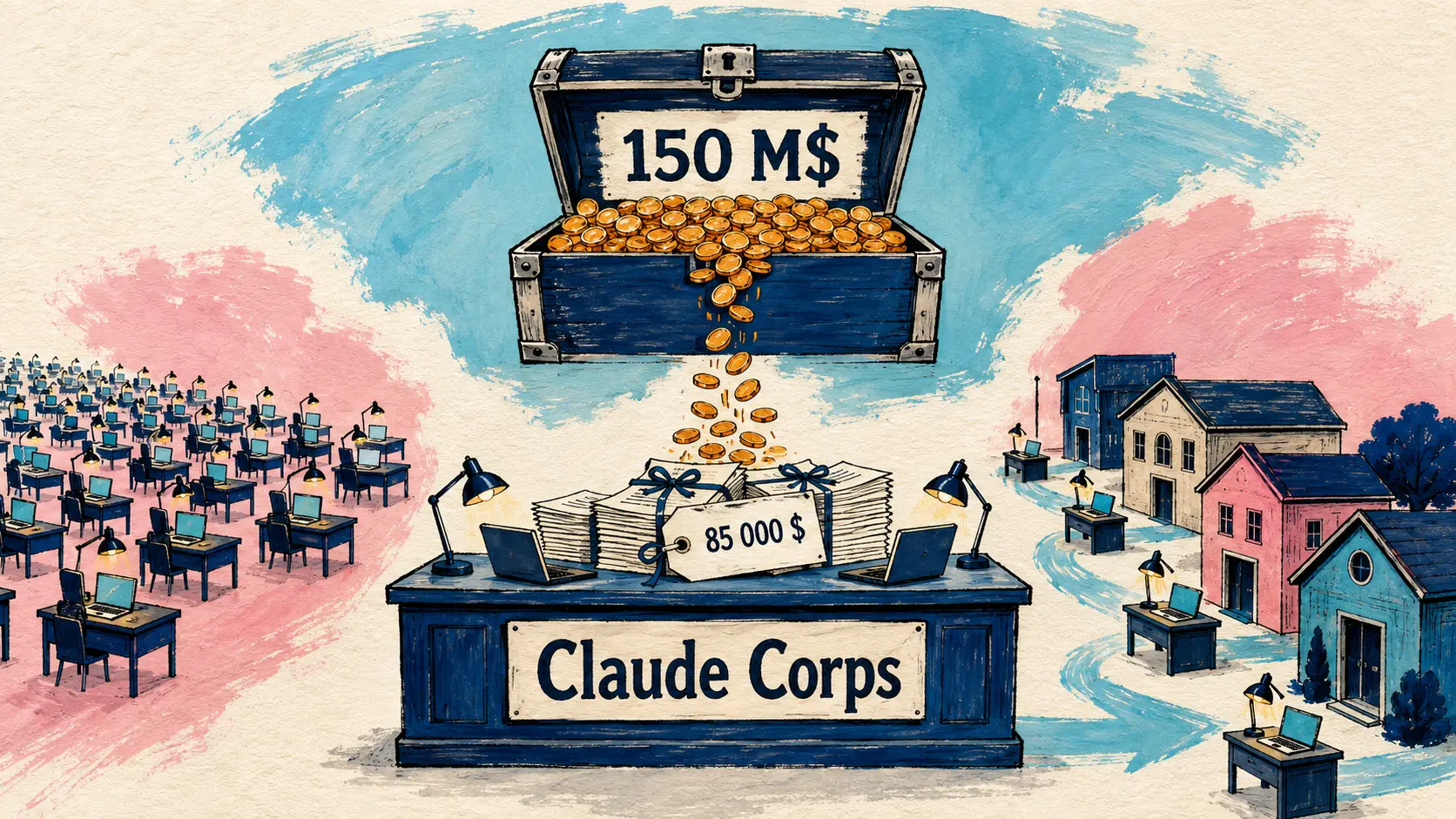
June 11 — Anthropic is launching Claude Corps, a national fellowship program backed by an initial $150 million budget. The goal is concrete: train 1,000 young professionals to use Claude and place them in American nonprofits for one year, full time and in person.
Program structure:
| Role | Organization | Responsibility |
|---|---|---|
| Funding & strategy | Anthropic | Claude expertise, unlimited tokens |
| Official employer | CodePath | Training, programming (1st US provider of university CS education) |
| Evaluation | Social Finance | Impact measurement, long-term financial vehicle |
Conditions for fellows:
- Full-time salary: $85,000/year + benefits
- Duration: 12 months (initial intensive training + 5 h/week of ongoing training)
- Criteria: 18+, less than 2 years of experience, work authorization in the United States
Cohort schedule:
| Cohort | Applications until | Start |
|---|---|---|
| 1st (100 fellows) | July 17, 2026 | October 2026 |
| 2nd | Open | January 2027 |
| 3rd | Open | August 2027 |
Examples of host organizations: Braven (Chicago — first-generation student placement), Code the Dream (Durham — free coding training), International Rescue Committee, Code for America, YMCA of Greater Charlotte (300,000 people served).
Anthropic explicitly ties Claude Corps to its policy on the impact of AI on employment, presenting it as a model for expanding the benefits of AI during a period of major economic transformation. Part of the technical infrastructure will be open-sourced.
OpenAI acquires Ona for persistent Codex agents
June 11 — OpenAI announces the acquisition of Ona, a startup specialized in secure cloud execution and agent orchestration. The goal: equip Codex with persistent cloud environments so agents can keep working even when laptops are closed.
Key figures:
| Indicator | Detail |
|---|---|
| Codex users/week | 5 million+ |
| Codex growth since January | +400% |
| Developers supported by Ona | 2 million |
| Acquisition status | Subject to regulatory approvals |
Problem solved: Codex is currently limited to active sessions on a single device. With Ona, agents will run in the organization’s cloud — OpenAI providing the intelligence, while the client retains full control over security, access, activity logs, and governance. This model directly addresses the compliance requirements of large enterprises.
“Enterprises want powerful agents that can do real work while meeting the security and control requirements of their environments. Ona will help us make Codex easier to deploy securely across production workflows for customers operating at the highest standards of trust and scale.” — Thibault Sottiaux, Core Products Lead, OpenAI
At closing, the Ona team will join OpenAI’s Codex team.
🔗 @OpenAINewsroom — X announcement
Access to OpenAI models and Codex via Oracle Cloud Infrastructure
June 10 — OpenAI and Oracle announce a partnership allowing Oracle Cloud Infrastructure (OCI) customers to access OpenAI frontier models and Codex via their existing Oracle Universal Credits. The idea: organizations with an existing OCI commitment do not need to create a new purchasing process — they consume OpenAI services as part of their planned cloud commitment. Availability is announced for the coming weeks; Oracle customers can contact their sales representative for pricing details. This partnership fits into OpenAI’s strategy of reducing adoption friction for enterprises already committed to major cloud infrastructure.
🔗 OpenAI — Oracle Cloud Partnership
GitHub Agentic Workflows in public preview
June 11 — GitHub launches its Agentic Workflows in public preview, a feature that automates reasoning-based tasks — ticket triage, CI failure analysis, documentation updates — by integrating coding agents directly into GitHub Actions.
Technical operation:
| Aspect | Detail |
|---|---|
| Definition | Natural-language Markdown → compiled Actions YAML |
| Security | Read-only by default, sandboxed container, Agent Workflow Firewall |
| Integration | Reuses existing GitHub Actions runners and policies |
| Plans | All (Free, Pro, Pro+, Business, Enterprise) |
The automations are defined in natural language in Markdown files; GitHub Agentic Workflows compiles them into standard Actions YAML, with no break from the existing infrastructure.
“With GitHub Agentic Workflows, we’re able to expand how we apply agents to real engineering work at scale, including changes that span multiple repositories.” — Alex Devkar, SVP Engineering & Analytics, Carvana
Testimonials: Carvana (multi-repo changes), Marks & Spencer (automated triage, vulnerabilities, dependencies), Hud.io (quality control before merge). A quick-start guide and prebuilt workflows are available in the GitHub Next agentics repository.
🔗 GitHub Changelog — Agentic Workflows
Midjourney V8.1 becomes the default model
June 11 — Midjourney announces that V8.1 replaces V7 as the default model, following community feedback during the testing period.
What’s new in V8.1:
| Feature | Detail |
|---|---|
| HD resolution | 2× size, 4× resolution vs V7 |
| Generation speed | 4 seconds (SD), 12 seconds (HD) |
| Text rendering | Better than ever |
| Prompt adherence | Better consistency on detailed descriptions |
| Compatibility | Style references, personalization, and V7 aesthetics preserved |
Transition notes: the omni V7 reference remains available while the improved version for V8 is finalized; the V8.0 alpha model will be deprecated in two weeks.
Anthropic: Fable 5, Apple Foundation Models, DXC alliance
Fable 5 — Guardrails made visible, Opus 4.8 fallback
June 11 — Anthropic is correcting a lack of transparency in the rollout of Claude Fable 5: the safeguards applied to frontier LLM development requests become visible. Starting this week, flagged requests will transparently fall back to Opus 4.8 — the same mechanism used for cyber and biological domains. The API will return an explicit refusal reason (available on the server side within a few days). Anthropic acknowledges that invisible guardrails were a poor trade-off and apologizes for it. Error-reporting mechanism: /feedback command in Claude Code, thumbs-down in Claude.ai, or API call form.
Apple Foundation Models support for Claude
June 10 — Apple developers can now use Claude via the native Apple Foundation Models framework for multi-step reasoning, code generation, and extended contexts. The integration makes it possible to call Claude via Apple’s system APIs, without going directly through the Anthropic API — targeting iOS, macOS, and other Apple platforms. In practice, developers building applications with Apple’s Foundation Models framework can choose Claude as the backend model for tasks requiring long context or complex reasoning, while staying within the Apple ecosystem.
Anthropic / DXC Technology alliance
June 11 — Anthropic announces a multi-year global alliance with DXC Technology (115,000 employees in 70 countries). DXC will train tens of thousands of Claude-certified forward-deployed engineers working directly with customers in banks, airlines, insurers, and government agencies. First concrete proof: the DXC OASIS platform (launched in April 2026) was developed more than 95% by Claude, with a 10× productivity gain, and already serves more than 50 customers.
| Priority area | Application |
|---|---|
| Insurance | Agentic solutions, core system modernization |
| Modernization as a Service | Analysis and refactoring of legacy codebases |
| Cybersecurity | “Permanent security engineer” sub-agent in SOCs |
| Application services | OASIS agents integrated into application maintenance |
Google DeepMind: sports, collective research, education, Europe
TacticAI × Palmeiras — Football and graph neural networks
June 11 — Google DeepMind partners with Palmeiras, the first football club to deploy TacticAI in production. The system, based on graph neural networks, models all 22 players as nodes connected by their physical interactions. It enables the analysis team to virtually test defensive setups and predict open play dynamics up to 8 seconds ahead.
| Aspect | Detail |
|---|---|
| Architecture | Graph neural networks |
| Prediction window | Up to 8 seconds |
| Use case | Real-time defensive simulation |
$10M research fund — collective behaviors of AI agents
June 11 — Google DeepMind, Schmidt Sciences, Coop.AI, and ARIA Research (with support from Google.org) are launching a $10 million fund devoted to studying the emerging collective behaviors of interacting AI systems. When millions of AI agents interact, new and potentially unpredictable group behaviors can appear — a still poorly documented area. The fund aims to finance interdisciplinary research projects to better understand and anticipate these group dynamics at scale, especially when specialized agents collaborate or compete in shared environments.
Gemini study in Sierra Leone — educational partner AI
June 10 — Results of a randomized controlled trial conducted over eight weeks in Sierra Leone, where the school-age population exceeds the number of available teachers. Gemini prompts focused on understanding problems rose from 68% to 90% — students were using AI to learn, not just find answers.
“We evaluated AI’s impact by looking beyond test scores to behavioral shifts. Over eight weeks, results suggest students were using AI to understand concepts, not just find answers – with Gemini queries about how to tackle problems rising from 68% to 90%.” — @GoogleDeepMind on X
Gemini notebooks available in Europe
June 11 — Gemini app notebooks are now available in the European Economic Area, the United Kingdom, and Switzerland. They make it possible to organize projects in a dedicated space that remembers sources, instructions, and conversation history. The feature was already available in other regions; this European rollout represents a key step in regulatory compliance (GDPR). Notebooks are accessible on gemini.google or in the Gemini mobile app — users can create their own now.
GitHub Copilot: unified /settings and removal of PATs
Unified /settings command for Copilot CLI
June 11 — GitHub Copilot CLI now has a unified, schema-driven configuration entry point. The new /settings command consolidates the scattered commands (/theme, /streamer-mode, /experimental) and the options that previously required manual editing of the configuration file. Three modes: full-screen dialog (/settings), direct edit (/settings <clé> <valeur>), restore a setting (/settings reset <clé>). Autocompletion, type-aware editors, built-in search (/), reset (Ctrl+R). Update via copilot update.
🔗 GitHub Changelog — /settings
Agentic Workflows — End of personal access tokens (PAT)
11 June — GitHub Agentic Workflows can now use the GITHUB_TOKEN integrated into GitHub Actions, eliminating the need to create and store a personal access token. This removes the operational and security risks associated with long-lived PATs at scale. In organization repositories, the policy “Allow use of Copilot CLI billed to the organization” must be enabled. Update: gh extension upgrade aw.
Generative media: Runway × Lionsgate, ElevenLabs
Runway × Lionsgate — Equity investment and IP co-development
11 June — Lionsgate (NYSE: LION) is taking an equity stake in Runway and launching a joint program to develop new intellectual property. First production: a short episodic series based on the Lionsgate catalog + Runway generative models. Lionsgate, the first Hollywood studio to appoint a Chief AI Officer, will be the presenting partner for the Runway AI Festival. The initial partnership had been signed in September 2024 for pre-visualization and storyboarding.
🔗 Runway — Lionsgate partnership expansion
ElevenLabs Dubbing v2 — Matthew McConaughey in multilingual mode
11 June — Matthew McConaughey is using ElevenLabs Dubbing v2 to reach his international fans in their native language, while preserving the actor’s iconic vocal characteristics. ElevenLabs highlights this use case as a showcase for Dubbing v2: the technology translates and dubs video content while preserving the original speaker’s tone, intonation, and rhythm. The tweet mentions “the big kickoff” — probably an international advertising campaign. This mainstream celebrity example illustrates the commercial maturity of AI dubbing tools for the entertainment industry.
Grok / xAI and Qwen: Plugin Marketplace, PawBench
Grok Build Plugin Marketplace
11 June — xAI launches the Grok Build Plugin Marketplace, a plugin marketplace integrated directly into Grok Build (terminal coding agent). Each plugin bundles skills, slash commands, agents, hooks, MCP servers, and language protocol (LSP) servers into a single installable package, pinned to a SHA commit for security.
| Available plugin | Features |
|---|---|
| MongoDB | Explore data, manage collections, optimize queries |
| Vercel | Manage deployments, check builds, configure domains |
| Sentry | Analyze error traces, debug production |
| Chrome DevTools | Control browser live, record performance traces |
| Cloudflare | Workers skills, Durable Objects |
| Superpowers | Popular agent-driven workflows |
Installation: /marketplace in Grok Build, then i. Catalog open to developers via pull request on xai-org/plugin-marketplace.
🔗 xAI — Grok Build Plugin Marketplace
AgentScope PawBench — The harness matters as much as the model
10 June — AgentScope (Alibaba/Tongyi Lab) launches PawBench, a benchmark designed to evaluate agent harnesses independently of the model used. Key result on 150 real tasks with 9 models and 3 harnesses: keeping the model fixed, changing the harness can vary the score by 11.5 points overall — the equivalent of a major model upgrade. The gap between the best and worst harness reaches 5.6 points.
Perplexity and Cohere: search and speech recognition
Perplexity — Native Deep Research in Computer
11 June — Perplexity integrates Deep Research as a native skill in Computer. The integration connects Deep Research to Computer’s agentic (agent harness) engine, with access to code generation as a search tool (search as code), persistent execution environments (long running sandboxes), connectors, and licensed data. The “Search as Code” architecture allows the model to write code that assembles the research itself, running thousands of retrieval steps in parallel tailored to each question — outperforming the old Deep Research on every benchmark. Available immediately for Pro and Max subscribers.
Cohere Transcribe — First on Hugging Face Far-Field ASR
10 June — Cohere Transcribe, Cohere’s open-source speech recognition model, reaches first place on the new Hugging Face Far-Field ASR benchmark. This benchmark measures performance under varying signal-to-noise conditions — meeting rooms, contact centers, phone calls. Cohere Transcribe ranked first across all metrics in these enterprise environments.
“Cohere Transcribe, our open-source speech recognition model, is #1 on the new @huggingface Far-Field ASR benchmark.” — @cohere on X
Briefs
- OpenAI Codex — Black hole simulations — Chi-kwan Chan (Event Horizon Telescope, University of Arizona) uses Codex to explore new algorithms for simulating plasmas around black holes. 🔗 openai.com
- Antigravity v2.1.4 — Google Antigravity CLI releases version 2.1.4: overhaul of the quota screen, PDF attachment support, new
/btwcommand, 4 fixes. 🔗 antigravity.google - Runway AI Festival 2026 — New York premiere of Runway’s 4th international AI festival on June 11, sold out. Lionsgate presenting partner. 🔗 @runwayml on X
- xAI × eToro — Tori, eToro’s AI agent (40 million users in 75 countries), integrates real-time market sentiment data via SpaceXAI models. 🔗 xai.com
What this means
The June 11 timeline illustrates a turning point in agent design: after months in which AI “helped” developers, the OpenAI×Ona and GitHub Agentic Workflows announcements outline a model where agents work autonomously in persistent, secure, natural-language-defined cloud environments. The fact that GitHub compiles Markdown into YAML Actions, and that Ona lets Codex keep running with the computer closed, signals that the infrastructure of agentic computing is starting to standardize.
Claude Corps and the DXC Technology alliance illustrate two complementary axes for large-scale AI deployment: the civic-society axis (placing recent graduates in nonprofits to spread Claude skills) and the enterprise axis (certifying tens of thousands of engineers to modernize banking, aviation, and government systems). The concrete proof — 95% of OASIS code generated by Claude, 10x productivity — changes the nature of the commercial argument.
The generative media ecosystem is consolidating around strategic partnerships rather than model releases: Lionsgate is taking equity in Runway and co-developing new IP, while ElevenLabs is showcasing McConaughey as an international face for Dubbing v2. This is no longer a technology demo — it is integration into the entertainment industry’s production chain.
AgentScope’s PawBench result deserves special attention: an 11.5-point gap depending on the harness used, with the model held constant. This challenges the usual focus on model performance and suggests that agentic systems engineering — execution framework choice, context management, orchestration — is becoming a performance lever as important as the model itself.
Sources
- Anthropic — Claude Corps
- Anthropic — DXC Alliance
- @ClaudeDevs — Fable 5 Safeguards
- @ClaudeDevs — Apple Foundation Models
- OpenAI — Ona acquisition
- @OpenAINewsroom — Ona
- OpenAI — Oracle Cloud
- OpenAI — Black hole Codex
- GitHub Changelog — Agentic Workflows public preview
- GitHub Changelog — Copilot CLI /settings
- GitHub Changelog — No-PAT Agentic Workflows
- Midjourney — Updates
- Runway — Lionsgate partnership
- @ElevenLabs — Dubbing v2 McConaughey
- @runwayml — Runway AI Festival
- @GoogleDeepMind — TacticAI Palmeiras
- @GoogleDeepMind — USD 10M research fund
- @GoogleDeepMind — Sierra Leone
- @GeminiApp — Notebooks Europe
- Google Antigravity — Changelog v2.1.4
- xAI — Grok Build Plugin Marketplace
- xAI — eToro Tori
- @Ali_TongyiLab — AgentScope PawBench
- @perplexity_ai — Deep Research in Computer
- @cohere — Transcribe Far-Field ASR #1