ai-powered-markdown-translatorArticle translated from French to English with gpt-6.1-sol.
Google launches Gemini 4 Hydrogen, a fast model that surpasses Gemini 4 Argon on Artificial Analysis’s Intelligence Index, and deploys it the same day in Search, the Gemini app, Antigravity, Cursor and Devin. Thinking Machines releases Inkling 2 Small’s weights under Apache 2.0, OpenAI opens two cyberdefense products, Daybreak Red Team and Daybreak Defense Factory, and Google makes its smart glasses with Gemini available for preorder. At Anthropic, Claude joins Google Meet meetings, Managed Agents can be fully self-hosted, and the IPO website sets out its timeline.
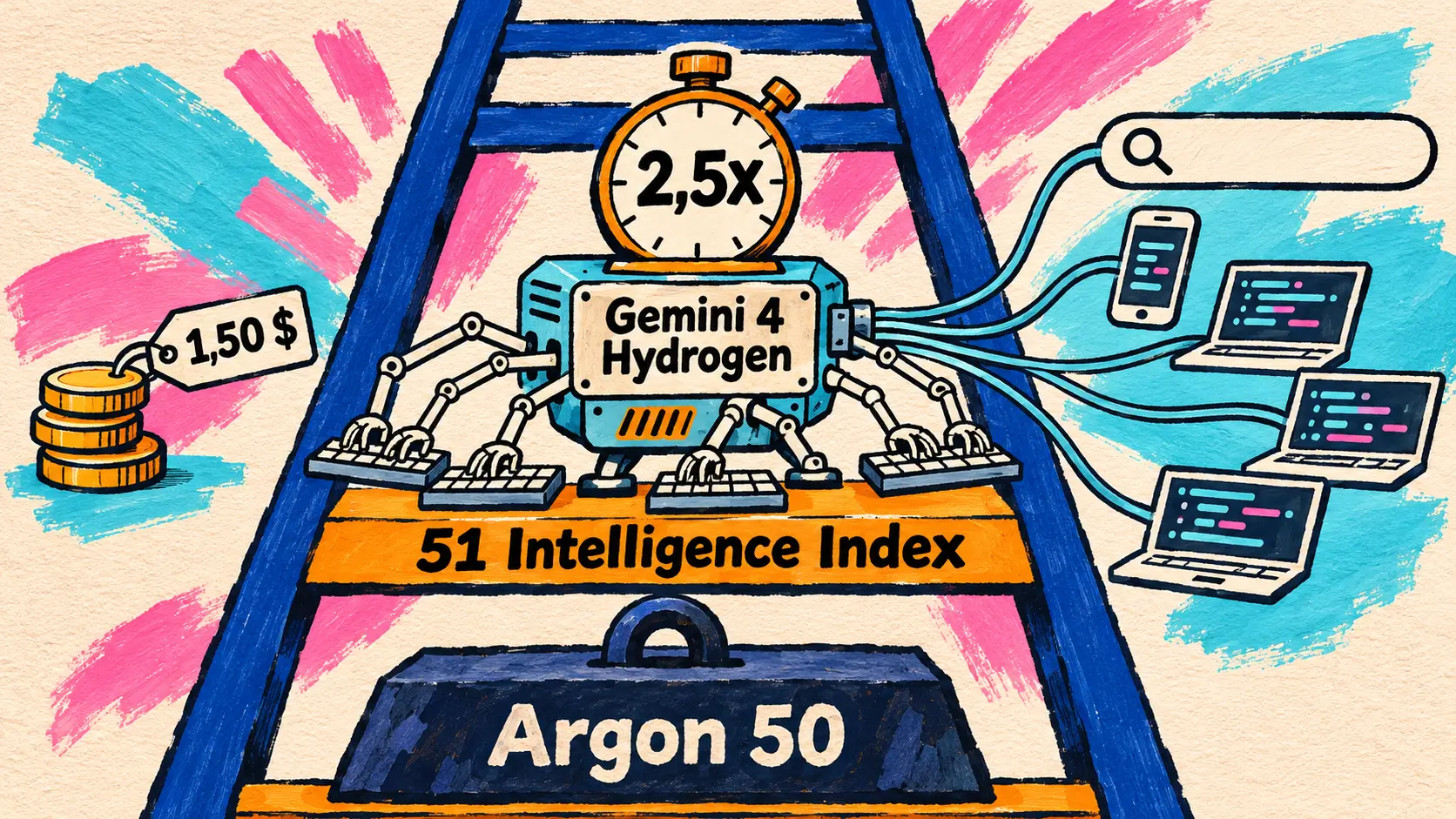
Gemini 4 Hydrogen: 2,5 times faster than Gemini 3.8 Flash, ahead of Argon on the Intelligence Index, at 1,50 dollars per million tokens
November 12 — Google rounds out the Gemini 4 series with Gemini 4 Hydrogen, following Argon and Carbon. While those two models target extended reasoning on the hardest problems, Hydrogen is designed for speed: everyday coding, agents chaining tool calls, and multimodal document synthesis. Google presents it as the upgrade from Gemini 3.8 Flash and earlier Gemini 3 and 2.5 models.
Meet Gemini 4 Hydrogen: built for rapid coding, multimodal synthesis, and everyday workflows. It finishes tasks 2.5x faster than 3.8 Flash and surpasses Argon on the @ArtificialAnlys Intelligence Index. — @GoogleDeepMind on X
On Artificial Analysis’s Intelligence Index, Hydrogen scores 51 at its default setting, compared with 50 for Argon, and 54 at the highest thinking level. Compared with 3.8 Flash, Google reports tasks completed 2,5 times faster, a Terminal-Bench 4.1 score more than tripled, and over 5 times fewer fabricated claims: the model flags missing context instead of guessing.
| Benchmark or metric (Google’s figures) | Gemini 4 Hydrogen | Comparison point |
|---|---|---|
| Artificial Analysis Intelligence Index | 51 (high), 54 (xhigh) | Gemini 4 Argon: 50 |
| Terminal-Bench 4.1 | 57 % | Gemini 3.8 Flash: 18,2 % |
| Task speed (high setting) | 2,5 times faster | Gemini 3.8 Flash |
| HLE-Diamond | 58,8 % | Leading its category |
| Vals Tax Agent Bench | 52,3 % | 1st overall |
| Agents’ Last Exam v1.1 | 71,6 % | Ahead of other models, according to Google |
For developers, gemini-4-hydrogen is generally available in the Gemini API, including on the rate-limited free tier. Paid pricing is the same across the entire million-token context: 1,50 dollars per million input tokens, 7,50 dollars for output (including thinking), and 0,075 dollars for implicitly cached input. This is the pricing Gemini 3.8 Flash will return to at the end of its promotion, which runs through December 31 (0,75 and 3,75 dollars). Hydrogen adds a fourth thinking level, xhigh, above low, medium and high; high is the default, whereas 3.8 Flash used medium. The unified context reaches 1 048 576 tokens, with 65 536 output tokens per synchronous request and up to one million through background execution. Migrating from 3.8 Flash requires a few adjustments: explicit caching is no longer available, parameters temperature, top_p and top_k are ignored, and the minimal thinking level is rejected.
The model arrives the same day in the Gemini app worldwide (free users access it through automatic model selection), in Google Search for everyone, in Gemini for Google Sheets initially for Google AI Pro and Ultra subscribers, and in Antigravity for paying Pro and Ultra subscribers. It also becomes the default model for the Antigravity agent in Gemini Managed Agents. However, no pull request mentioning Hydrogen had been found in the Gemini CLI repository at the time of our check.
On safety, Google reports up to 81 % fewer instruction violations in agentic tasks, misaligned actions and shortcuts reduced by a factor of 12, 96,7 % on its internal honesty evaluation, and more than 2,3 times better resistance to indirect prompt injections (Gray Swan). A model card has been published.
🔗 Gemini 4 Hydrogen announcement (blog.google) · What’s new in Gemini 4 Hydrogen for the API (Google AI Studio) · Gemini API pricing · Model card (PDF)
Google Search switches to Hydrogen, Search’s “biggest model update” according to Google
November 12 — Google Search adopts Gemini 4 Hydrogen for all its users worldwide. Robby Stein, Search’s vice president of product, calls it Search’s biggest model update to date. The search engine should better understand intent, including for multipart questions, highly specific questions, or those written with typos. It expands its query fan-out technique, which runs parallel searches on a question’s subtopics, thus offering a wider range of links. Responses become more visual, with images, comparison tables and tools created for the question, in every language supported by AI Mode. Google publishes no figures for this aspect.
🔗 Gemini 4 Hydrogen in Search (blog.google)
Antigravity Orchestrator alternates between Carbon and Hydrogen within a session, using 24 % less quota
November 12 — Google Antigravity adds an Orchestrator option to its model selector. It does not choose one model for the entire task: it hands control between Gemini 4 Carbon and Gemini 4 Hydrogen throughout a single session, in both directions. Carbon explores the code in read-only mode, resolves ambiguities and builds a plan; Hydrogen writes the changes, updates packages and runs tests, then hands control back to Carbon if it gets stuck.
According to Antigravity’s post, Orchestrator approaches the success rate of Carbon alone while consuming an average of 24 % less quota and finishing 19 % faster on Terminal-Bench 4.1; the blog.google post places the same figures on Terminal-Bench 4.0. Orchestrator is initially restricted to Google AI Ultra subscribers, while Hydrogen alone is available to paying Pro and Ultra subscribers. According to Antigravity, “tens of thousands” of agent swarms have also been launched within a few days of /swarm’s arrival.
🔗 Gemini 4 Hydrogen in Google Antigravity
Cursor: 54,3 % on CursorBench at default effort, compared with 39,6 % for Gemini 3.8 Flash
November 12 — Gemini 4 Hydrogen arrives in Cursor on launch day. According to Cursor’s tweet, the model scores 54,3 % at its default effort on CursorBench, the editor’s in-house benchmark, compared with 39,6 % for Gemini 3.8 Flash. A second tweet gives its pricing in Cursor: 1,50 dollars per million input tokens and 7,50 dollars for output. Cursor’s evaluation page, meanwhile, details three effort levels.
| Model and effort (Cursor evaluation page) | CursorBench score | Cost per task |
|---|---|---|
| Gemini 4 Hydrogen, High effort | 54,3 % | 5,59 dollars |
| Gemini 4 Hydrogen, Medium effort | 46,7 % | 1,76 dollars |
| Gemini 4 Hydrogen, Low effort | 27,9 % | 0,28 dollars |
| Gemini 4 Carbon, High effort (reference) | 60,4 % | 9,22 dollars |
🔗 Announcement from @cursor_ai · Cursor evaluation page
Devin: 38,2 % on FrontierCode 2.0 for 2,40 dollars per task
November 12 — Cognition also makes Gemini 4 Hydrogen available in Devin Desktop and Devin CLI. On FrontierCode 2.0, its benchmark assessing the quality of code produced on real-world tasks and its mergeability, Hydrogen scores 38,2 %, less than one point behind GPT-6.1 Sol and close to Gemini 4 Carbon. Cognition mainly emphasizes the cost: 2,40 dollars per task, around 40 % less than Carbon’s 4,04 dollars. At medium effort, Hydrogen already exceeds Gemini 4 Argon’s best result for less than one-seventh of its cost per task.
| Model evaluated (excerpt from Cognition’s chart) | FrontierCode 2.0 score |
|---|---|
| Claude Fable 5.2 | 49,1 % |
| Claude Opus 5.5 | 45,5 % |
| Gemini 4 Carbon | 40,0 % |
| GPT-6.1 Sol | 39,0 % |
| Gemini 4 Hydrogen | 38,2 % |
| Gemini 4 Argon | 26,3 % |
🔗 Gemini 4 Hydrogen in Devin (Cognition)
Inkling 2 Small: Thinking Machines releases the weights of its multimodal MoE with 594B parameters, including 17B active, under Apache 2.0
November 12 — One week after launching it with closed weights, Thinking Machines releases Inkling 2 Small’s weights on Hugging Face under the Apache 2.0 license. The model had been available since November 5 on Tinker, the lab’s fine-tuning platform, while external safety testing and red-teaming were being completed, following the approach Thinking Machines described in “a safe path to open weights”.
Inkling 2 Small’s weights are now available for download on HuggingFace under an Apache 2.0 license. Make Inkling your own! — @thinkymachines on X
This is the lab’s second generation of models, following Inkling-Small (276B parameters, including 12B active): a Mixture-of-Experts with 594 billion parameters, including 17 billion active, that accepts image inputs, without audio, and offers adjustable effort. The weights arrive with a deployment ecosystem: integration with Unsloth, SGLang, vLLM and TokenSpeed, post-training with Miles, SkyRL and Snowflake Cortex Training, and APIs from NVIDIA, Fireworks, Together, Baseten, Nebius, Modal and Cloudflare. The model card on Hugging Face lists a context window of up to one million tokens.
Thinking Machines reports a score of 31 on Artificial Analysis’s Intelligence Index (30,6 in its table), behind DeepSeek-V4.1-Flash-1017 (32,6), GLM 5.3 (31,7) and Gemini 3.8 Flash (30,8), and behind Claude Haiku 5.5 (36,5). On its own measurements, the model remains behind DeepSeek-V4.1-Flash-1017 on most coding benchmarks, but ahead of GLM-5.3-Flash.
| Thinking Machines metric | Inkling 2 Small | DeepSeek-V4.1-Flash-1017 | GLM-5.3-Flash | Kimi K3 | Claude Haiku 5.5 |
|---|---|---|---|---|---|
| Active / total parameters (B) | 17 / 594 | 16 / 552 | 18 / 320 | 104 / 2 800 | Not specified |
| AA Index v5.0 | 30,6 | 32,6 | 27,8 | Not specified | 36,5 |
| FrontierCode v2.0 | 25,4 % | 28,5 % | 17,6 % | 17,3 % | 34,9 % |
| DeepSWE v1.1 | 72,1 % | 77,0 % | 63,4 % | 68,5 % | 59,9 % |
| SWE-Bench Pro v2 (Hard) | 86,3 % | 89,7 % | 82,8 % | 88,2 % | 52,9 % |
| MMMU Pro (vision) | 81,6 % | 80,6 % | 79,0 % | 80,5 % | 79,1 % |
On GPU kernel optimization (PMPP-Hard), Inkling 2 Small solves 54,25 tasks out of 69 in ten hours, compared with 63 for GPT-6 Astra and 60 for Claude Opus 5.5. The post details the recipe: pretraining on 8 400 billion tokens in 68 hours on NVIDIA GB300 NVL72 racks, entirely in NVFP4, followed by successive phases reaching a context of one million tokens, fed mainly by trajectories sampled from earlier models, including Kimi K3. Post-training fits into a single reinforcement learning run: 1 075 steps, more than 17 million rollouts, 2 048 GPUs for nine days. The model was tested in OpenCode under the codename Fledge-Alpha.
Thinking Machines also lists its limitations: the model is not the most concise, does not always choose the right tool when many skills are available, and is less polished in conversation. On safety, the lab considers its offensive cybersecurity capabilities below the frontier of open models, and estimates that its “helpful-only” variant provides only a marginal gain in CBRN knowledge.
🔗 Inkling 2 Small (Thinking Machines) · Inkling-2-Small on Hugging Face
Daybreak Red Team and Daybreak Defense Factory: OpenAI opens agent-based penetration testing and a tool that turns vulnerabilities into fixes
November 12 — OpenAI held its Cyber at the Frontier keynote that day at 10 a.m. PT, focusing on its cybersecurity announcements. Its page links to two products under the Daybreak brand and to the Daybreak access request form. At the time of our check, OpenAI had published neither a blog post nor a tweet about the keynote: the following information comes from the product pages and documentation.
| Daybreak product | Status as of November 12 | What it does |
|---|---|---|
| Daybreak Red Team | Early access, registration required | Web application penetration testing by a team of agents |
| Daybreak Defense Factory | Preview, plugin for ChatGPT | GitHub repository analysis, Snyk, Endor Labs and Wiz imports, fixes for review |
Daybreak Red Team uses a coordinated team of agents that starts with a web application’s source code and context to explore attack paths and confirm vulnerabilities. It also validates findings from code scanners, bug bounty programs or disclosure reports, checks that a fix blocks the exploit, and reruns the evaluation when the application changes. The scope is enforced through isolated environments and a Guardian review, with controls over which applications and endpoints the agents can reach. The product should not be confused with Daybreak Red, the existing access tier for specialized cyber models for authorized research.
Daybreak Defense Factory aims to turn a backlog of vulnerabilities into fixes. It installs as a preview plugin in ChatGPT, on the web or in the desktop application, for workspaces with Daybreak access. Cloud analyses run in Codex cloud and require a personal GitHub connection, with three modes: repository analysis, continuous monitoring of new commits or scheduled analysis. The tool also reviews pull requests and imports findings from Snyk Open Source, Endor Labs and Wiz, up to 10 000 occurrences per selection. Nothing is applied automatically: every proposed fix requires review, “Fix with Codex” lets users refine it, and “Create PR” opens a draft pull request. Cloud analysis is unavailable for GitLab repositories.
Repository analyses and continuous monitoring are billed by token usage, at the plan’s rates and outside the included allocation, with free analysis credits that do not expire. The pages name no model and provide neither performance figures nor specific pricing. Defense Factory builds on Codex Security Cloud, introduced on September 29, and The Defense Factory approach described in September.
🔗 Cyber at the Frontier (OpenAI) · Keynote date and time (OpenAI Cybersecurity page) · Daybreak Red Team · Daybreak Defense Factory · Documentation (Codex Security) · Codex Security FAQ
OpenAI secures its hundreds of persistent OpenClaw agents with the Codex sandbox
November 12 — The OpenAI Developers blog explains how OpenAI governs the persistent agents it runs internally, including hundreds of OpenClaw agents and more than 500 agents working proactively in the background. Unlike a Codex session, a persistent agent runs continuously and can act without waiting for the user.
The first rule is to separate trusted code (network, identity, sandbox) from model execution: OpenAI added remote harness execution to the open source project, placing the OpenClaw gateway in a separate cluster. The agents run in the Codex sandbox: network access is restricted to an allowlist, writes are limited to their working directory, and secrets are entrusted to a credential broker. Auto-review has a second agent validate every action, each agent has its own identity linked to a ChatGPT Service Account, and everything is logged. OpenClaw Enterprise, an open source agent control plane, is in pilot, with version 1.0 targeted by the end of the year.
🔗 Securing persistent agents like OpenClaw at OpenAI
Smart glasses with Gemini: Google opens preorders, starting at 395 dollars at Warby Parker and 449 dollars at Gentle Monster
November 12 — Google is opening preorders for its smart glasses (Intelligent Eyewear) with Gemini, developed with Samsung and two eyewear brands, Gentle Monster and Warby Parker; Samsung’s role is not detailed. Preorders are available online and in stores through both brands, with demonstrations at selected Gentle Monster, Warby Parker and Google Store locations. Sales begin on December 10.
| Eyewear range | Available models | Starting price | Listed countries |
|---|---|---|---|
| Gentle Monster | 6 colorful models, most available with prescription lenses | 449 dollars | United States and South Korea |
| Warby Parker | Alden, Reid and Wren, as eyeglasses or sunglasses | 395 dollars | United States and South Korea Google accounts only |
The frames look like conventional glasses. Saying “Hey Gemini” or tapping the temple is enough to ask Gemini about what you are looking at, such as the history of a mural spotted on the street. Google Maps provides audio directions, and Google Translate translates speech in real time in more than 70 languages. For blind or visually impaired users, Guided Vision describes the surroundings, and Aira Explorer connects them with a human visual interpreter.
The glasses weigh around 41 g and last up to 9 hours depending on usage; their case provides up to 7 recharges, and charging to 60 % takes around 30 minutes. They feature a 12 Mpx ultrawide camera (video up to 3K), open-ear speakers and IPX4 protection. They connect over Bluetooth to a Pixel 7 or newer running Android 17, an iPhone 13 Pro or newer (at least 6 GB of RAM) running iOS 26.6 or later, or a recent Galaxy S or Z.
Google emphasizes privacy. Images seen by Gemini are neither saved in history nor used for training or advertising, and bystanders’ faces are obscured before processing. An external indicator signals photo and video capture and blocks capture if covered, while a physical switch turns everything off. Google Play applications are prohibited from using the glasses’ camera for live social streaming or real-time facial identification.
🔗 Smart glasses preorders (blog.google) · Privacy protections (blog.google) · Specifications and compatibility (glasses.google)
Anthropic IPO: final pricing expected on November 18 and trading to begin on November 19, according to the official website
November 12 — In a tweet, Anthropic highlights its IPO website, ipo.anthropic.com, whose launch date is not specified. Its FAQ provides the timetable: subject to regulatory approval, final pricing is expected on November 18 and trading is expected to begin on November 19 (U.S. Eastern Time), on Nasdaq under the ticker symbol “ANT”. According to the November 10 post launching the roadshow, the offering comprises 825 million shares priced between 70 and 78 dollars.
| Figure published on the website (“Q3’26”) | Displayed value |
|---|---|
| Revenue | 17,0 billion dollars, more than 12 times the year-earlier figure |
| Operating margin | -3 %, and an adjusted margin of 15 % (non-GAAP measure) |
| Net loss | 23,3 billion dollars, including 21,9 billion in non-cash charges |
| Compute efficiency | Increased by more than 4 times since the first quarter of 2025 |
According to the website, the non-cash charge is linked to the increase in valuation. Its European version describes an offering to retail investors in nine European Economic Area countries, including France; according to the FAQ, the maximum price of 120 dollars per share listed in the European prospectus is not the expected price, and the final price will be the U.S. offering price.
🔗 IPO website, European version · Tweet from @AnthropicAI · Roadshow launch (Anthropic)
Claude Meetings in beta: Claude joins Google Meet calls on Team and Enterprise plans
November 12 — Anthropic is launching Claude Meetings in beta, rolling out to Team and Enterprise plans. Claude joins the call as a visible participant: users can ask it questions aloud or in the chat, and it responds in writing by default. During the meeting, it builds documents and whiteboards that other participants from the organization can edit simultaneously, and captures notes and action items; everything is then collected on a meeting page in claude.ai.
Only Google Meet is supported for now. Inviting Claude is enabled by default on Team and requires an administrator to enable it on Enterprise; organizations with zero data retention (ZDR), HIPAA-ready configurations or customer-managed encryption keys (CMEK) are excluded during the beta. Claude retains the transcript, a summary and screen descriptions, but not the audio, and avoids calls with an external guest by default. Notes, transcripts and responses are free during the beta, except for responses that use a connected tool; artifacts created in meetings remain free until February 10, 2027.
Self-hosted Claude Managed Agents in private beta: harness, sandboxes and session history on customer infrastructure
November 12 — Claude Managed Agents, Anthropic’s API suite for building and deploying autonomous agents, can now run entirely on customer infrastructure, in private beta. Previously, only the sandboxes could be self-hosted, in public beta since May 19. The agent harness, sandboxes, credentials and session history now reside in the company’s cloud or on its servers, operated by the company itself.
Model requests go wherever the customer chooses: Anthropic, Amazon Bedrock, Google’s Agent Platform or Microsoft Foundry, or the customer’s own gateway, using the same APIs as the hosted service; zero data retention (ZDR) applies if enabled. Credentials remain outside the sandbox, network access is restricted to an allowlist of hosts, and each session produces a log that can be exported in OpenTelemetry format. The beta is limited to eligible organizations, through their Anthropic sales representative.
🔗 Operate Claude Managed Agents inside your security perimeter
Specialized open models: transcription from Salesforce, voice from Zyphra and decision-making from Perplexity
Three open-weight models, all under Apache licenses, each target a specific task. Their figures come from their developers.
SOV-Transcribe-1: Salesforce releases a transcription model ranked first among open models on Artificial Analysis
November 12 — A Salesforce team is releasing SOV-Transcribe-1 on Hugging Face, its first open-weight speech recognition model, under the Apache 2.0 license. It is a speech-augmented language model for non-streaming transcription, with 4 billion active parameters out of 26 billion total according to the post (27 billion according to the Hub model card). According to the team, it ranks first among open models on Artificial Analysis (7th overall). It also accepts instructions, such as keywords to improve the transcription of uncommon names. The technical report has not yet been published.
| Benchmark (team measurements) | SOV-Transcribe-1 | Cited comparison points |
|---|---|---|
| AA-WER, error rate (lower = better) | 2,28 % | Nemotron 3.5 Transcribe 2,81 %, Voxtral Small 2,77 % |
| HALAS, real calls (lower = better) | 25,69 % | Qwen3-ASR 1.7B 26,01 %, Voxtral Small 27,35 % |
| VoiceCodeBench, error-free recordings | 76,3 % | 2nd out of 23 systems |
🔗 SOV-Transcribe-1 (Hugging Face)
ZONOS3-Mini: Zyphra clones voices in real time in 43 languages with 100M active parameters
November 12 — Zyphra is releasing ZONOS3-Mini, a speech synthesis model under the Apache 2.0 license that clones a voice without prior fine-tuning (zero-shot) in 43 languages. It activates only 100 million parameters out of 800 million, whereas ZONOS2 used an 8-billion-parameter model, thanks to a new 15 Hz audio codec and a hybrid Gated DeltaNet and attention architecture with a mixture of experts. Training took 2,5 days on 112 H100 GPUs. Weights, quantized versions and runtimes (in-browser with WebGPU, MLX, C++, SGLang-Omni) are available, with the code under the MIT license. Zyphra ranks it first among open models on its own index, ahead of Fish S2 Pro and MOSS TTS v1.5.
| Test device (Zyphra measurements) | Time to first sound |
|---|---|
| Pixel 9, in the browser | Less than 570 ms |
| MacBook Air M3 | Less than 150 ms |
| H100 GPU (median) | 80 ms |
Decider v1.3: Perplexity adds passage extraction to its open decision models
November 12 — Perplexity releases Decider v1.3 (27B, based on Qwen3.8-27B) and Decider Flash v1.3 (4B, distilled from the former), its open-weight decision models. These general-purpose classifiers return probabilities for closed-ended questions in a single pass, without generating text. The weights are available under an Apache license on Hugging Face, free on OpenRouter until November 19, and the Decisions API keeps its pricing: $0.02 and $0.01 per million input tokens, with free output. The new feature, locate, extracts passages matching a description from a text, along with their positions; exclusive to v1.3, it reads only the text and excludes web_grounding.
| Perplexity evaluation | Decider v1.3 | Comparison point |
|---|---|---|
| Query classification (63 tasks) | 91,6 % | +6,54 points over production classifiers |
| Reranking (72 tasks, nDCG@10) | 83,99 | +2,24 over Jev 1.14 |
| locate extraction (17 out-of-domain tasks) | 69,0 | Liquid d1: 43,3 |
| Agreement with LLM judges (1 million queries) | 93,98 % | Decider v1.2: 93,68 % |
🔗 Perplexity Decider v1.3 · Free access on OpenRouter (@perplexitydevs)
Runway moves into 3D: model generation with Tripo H3.1, then a chosen angle serves as a reference for images or video
November 12 — Runway now supports 3D. The Tripo H3.1 model generates detailed 3D models from text or an image, and users can also import their own. They can then choose any angle of the model as a reference for their next image or video, and export the model to other 3D tools. Runway had already approached 3D through apps: 3D Camera Control in App Studio (October 26), then Sightline (November 9), which exports its 360 panorama in 3D. This time, 3D model generation enters the application itself, powered by a third-party model. The announcement, made in a tweet without a blog post or changelog entry, specifies neither the credit cost, the eligible plans, nor the export formats.
Coding agents: Amp, Delta, and Replit Agent
Amp replaces its Dial with a model and effort selector
November 12 — Amp is retiring the Dial, the four-mode control (low, medium, high, ultra) launched in July. A standard selector replaces it: users choose the model and its effort level for each thread, and can change both along the way. The reason comes down to billing: since Amp began accepting users’ subscriptions and API keys, the selected model also determines who pays, and the selector shows the connection billed for each model. Changing models during a thread comes at a cost: the prompt cache belongs to a model, so the first message afterward costs more. The Staff Pick option uses the team’s preferred model, currently Claude Opus 5.5, and serves as the default for new threads. Dial settings are not carried over.
| Former Dial mode | Default associated model |
|---|---|
| low | GLM-5.3-Flash |
| medium | Claude Opus 5.5 |
| high | GPT-6 Astra |
| ultra | Claude Fable 5.2 |
Delta welcomes Claude Agent through ACP v2, using the user’s Claude subscription
November 12 — Delta, the multiplayer environment from the Zed team, welcomes its first external agent: Claude Agent, connected through the Agent Client Protocol (ACP). Users sign in with their Claude subscription, consuming its included usage, or with an Anthropic Console account, billed as API usage. Delta has written an open-source ACP adapter for the Claude Agent SDK, which loads skills, commands, and memory like Claude Code and picks up MCP servers already configured. Claude Agent runs locally for now, and is not yet available on the Cloud Runners launched the previous day. The team says it is releasing the feature earlier than usual because it was the most requested, and considers it still immature. The integration relies on ACP v2, which supports background work: v2 is in draft, with Preview expected in the coming weeks and Stable shortly afterward. Codex is the next agent targeted.
🔗 Claude Agent in Delta (Delta blog post)
Replit Agent makes business purchases with Link and Visa, and launches Google Ads campaigns
November 12 — Replit gives its Agent two new tasks. With agentic commerce (Agentic Commerce), the Agent searches for supplies based on what it knows about the business, then a browser sub-agent provided by Browserbase fills the cart on the merchant’s website. Everything stops at checkout: the owner approves the final total in Link, Stripe’s wallet, with Visa handling agent-initiated payments. The browser session is isolated, shell access is disabled during payment, and approval controls are enforced in code. The feature is available on Core and Pro plans, initially in the United States; the blog post discusses one-off purchases, while the documentation also covers fixed-price subscriptions.
With agentic advertising (Agentic Ads), the Agent creates or connects a Google Ads account, writes ads, generates images, and adds conversion tracking to the application. The campaigns use Performance Max, with an average daily budget of at least $15, for Pro subscribers worldwide on a personal Workspace.
🔗 Replit Agent, purchases and advertising (Replit blog post) · Agentic Commerce documentation · Agentic Ads documentation
Briefs
Coding agents and CLI
- Codex CLI 0.167.2 — Released on the evening of November 11, it enables incremental delivery of tool updates by default on Google Cloud Vertex AI, following Amazon Bedrock in 0.167.1. On November 12, openai-python 3.50.0 and openai-node 7.56.0 add
input_transformations, which reports reasoning items removed from the input and why. 🔗 source - Codex on iOS — Version 1.2026.307 of ChatGPT for iOS, released on November 10, allows users to paste images and files into Codex’s full-screen composer, dictate annotations, and switch drives on Windows hosts; manual pairing now works with VoiceOver. 🔗 source
- Copilot CLI 1.0.110-2 and 1.0.110-3 — Two prereleases, with 95 and then 8 fixes: /compact respects the session’s AI credit limit, the CLI warns when
--yoloor--allow-allare ignored, andcopilot -preports MCP servers that have not started. SDK 1.0.32-preview.2 extends BYOK to Gemini’s native Interactions API; the latest stable release remains 1.0.109. 🔗 source - Antigravity CLI 1.5.7 and 1.5.6 — Version 1.5.7 starts any session without a saved mode in Auto mode, including headless sessions (
-p), while a strict permission setting retains priority. Version 1.5.6, released on November 11, animates /swarm board (a queen and one bee per active agent) and addscontinuation_activeto Stop hooks to prevent loops. 🔗 source - Gemini CLI — Still no new release since v0.68.0, and the nightly build has failed again. Two fixes have been merged into the main branch:
gemini models listdisplays the actual output limit (65,536 tokens instead of the hardcoded 8,192), and long silent streams are no longer cut off at 300 seconds when a longer timeout is configured. 🔗 source - Kimi Code 2.6.0 — Full-screen mode collapses consecutive tool calls and model thinking into summary lines, configurable in /settings, and the agent can edit a file multiple times without rereading it. The local server API changes without being flagged as incompatible: transcription endpoints disappear in favor of a WebSocket stream. 🔗 source
- Qwen Code v1.0.0-preview.1 — A prerelease focused mainly on fixes: Qwen subscribers regain access to their subscription’s models after signing in, and Qoder models now execute their tool calls in parallel. 🔗 source
- mistral CLI 0.18.1 — A single fix: on macOS 27, the tool no longer exits silently on launch (code 137), thanks to properly signed macOS binaries. 🔗 source
- DeepSeek Harness 0.2.2-rc.2 — Released on November 11, this 38th prerelease of DeepSeek’s coding agent, still without a stable version, allows users to review a worktree’s changes by branch, commit, or file type using GitHub reviews, and adds named sub-agents across multiple levels. 🔗 source
- Gemini 4 Carbon in Warp — Warp makes Carbon available in Warp Factories, its terminal, and its software factory benchmarking tool, to compare it against agent tasks already run; no pricing or scores. 🔗 source
- Astryx in v0 — v0 adds Astryx, presented as Meta’s design system: once selected for a project, v0 generates the interface using its components, patterns, and templates; no plan or pricing specified. 🔗 source
Applications and API
- Grok Bot on Mac — SpaceXSI’s desktop application can now use Messages, Mail, Notes, Reminders, Calendar, Location, and Contacts, with each application authorized separately; no plan, version, or country specified. 🔗 source
- Kimi Work 3.2.27 — Moonshot AI’s desktop application arrives on Intel Macs, runs long tasks in the background, and shares its plugins between Work and Chat modes; a fix prevents projects from being saved in the installation folder, where an update could delete the files. 🔗 source
- Claude for Manufacturing — Anthropic launches a plugin for Team and Enterprise plans with 17 skills (sales, quality, operations, procurement, design) and four connectors (Autodesk Fusion, Infor, Microsoft 365, Oracle NetSuite), with each workflow stopping for human review; it does not control machinery. 🔗 source
- Opus 5.5 for everyday use — An Anthropic guide recommends Opus 5.5 for knowledge work, backed by internal tests (16 out of 18 reports without fabricated figures or citations, a merger analysis in 63 minutes versus 93 for Opus 5), and advises increasing effort before switching models. 🔗 source
- Email addresses in ChatGPT Enterprise — Global administrators for Enterprise, Edu, and Healthcare can change the addresses of users not managed by SCIM, within a verified domain in the same tenant, with a limit of 2 changes per 24 hours and 20 over the account’s lifetime. 🔗 source
- Perplexity Agent API — Since November 11,
max_output_tokenscan be omitted with all models, including Anthropic’s: each generation can produce up to 128,000 output tokens, subject to the model’s limit, with the 2026-11-11.0 versions of the effort levels. 🔗 source
GitHub
- End of ARM32 in GitHub Actions — Linux and Windows hosted runners will stop executing ARM32 jobs by December 8, 2026, as Node 24 does not support the architecture; self-hosted ARM32 runners lost support on September 23. 🔗 source
- Secret scanning and Cloudflare — Cloudflare Access service tokens (
cloudflare_access_service_token) are now detected automatically in repositories; the changelog does not say whether Cloudflare is joining the partner program. 🔗 source - Direct links to public monitoring alerts — Each alert monitoring enterprise secrets exposed on github.com now has its own URL, which can be saved or shared with colleagues who have access; the feature remains exclusive to GitHub Enterprise Cloud with Secret Protection or Advanced Security, at no extra cost. 🔗 source
Companies and use cases
- J.Crew Style Advisor — JCrew.com’s AI stylist suggests complete outfits drawn from the brand’s photo shoots in the United States; designed with Claude Fable 5.1 and prototyped with Opus 5.5 in Claude Code, it runs in production on Sonnet 5.5 and Haiku 5.5. 🔗 source
- Amplitude — Its product agent Wave runs roughly 80% on OpenAI models; according to Amplitude’s evaluations, GPT-6.1 Sol scores 67.5 versus 69.3 for another model on the data science agent, at $1.28 versus $2.63 per run. 🔗 source
- Holiday Extras — The travel company rebuilt its application with Codex in two weeks, compared with more than six months previously; conversion increases by 32.5% and the error rate drops from 19% to 9%, over different comparison periods. 🔗 source
- Gilbert + Tobin — The Australian law firm reports 87% active ChatGPT usage and prepared the annual review of its 120 partners with ChatGPT Work for around $62 in usage. 🔗 source
- Lara Avci and Codex — OpenAI Developers profiles this member of the Codex Ambassador program, who supports European founders; her websites and games built with Codex attracted more than 30,000 visitors in less than four days. 🔗 source
Images, video, and 3D
- Character Swap & Insert at Luma — Released on the evening of November 11, the tool replaces or inserts a character, vehicle, or animal while keeping the same shot; no pricing or underlying model specified. 🔗 source
- Gemini Omni 1.2 Flash in HeyGen — Text and image to video, clips of up to 15 seconds with audio generated simultaneously and multi-turn editing; no pricing or credit cost. 🔗 source
- HeyGen and Grok Bot — HeyGen offers to train Grok Bot on a brand’s tone in Slack and give it a HeyGen avatar ID, so teams can produce videos in the style of user-generated content; no integration details or pricing. 🔗 source
- Moderation at Runway — Runway explains that it has replaced third-party classifiers with fixed categories with its own rules, applied by LLMs and updated within hours: fights and horror are allowed, while abuse is blocked more effectively. 🔗 source
- TRELLIS.2 fine-tuned with LoRA — Hugging Face publishes a guide to fine-tuning this 3D generation model on 188 shoes; across nine test objects, the F-score rises from 0.276 to 0.803. 🔗 source
Open models and research
- ForeSpark — Meta releases the code for this parallel speculative decoding scheduling method without an announcement; according to the README, it achieves up to 1.77 times the throughput of DSpark and 2.49 times that of autoregressive decoding on vLLM. 🔗 source
- Origami by Wirkung — Five open models (Qwen3.5-9B and 27B, Gemma 4 31B, MiniMax-H3, Kolibri-1) converted without retraining into files 4.3 to 7.5 times smaller; the blog post provides no measurement of retained quality. 🔗 source
- Construction-Site-Traversability in FiftyOne — Voxel51 converts data from a tracked robot making loops around two construction sites: 1 h 45 of driving, 9,760 m of terrain, 62,995 color images, and as many lidar scans. 🔗 source
Ecosystem
- OpenAI and child safety — At the Paris Peace Forum, OpenAI signed a charter for safer AI for children and committed $2 million to the research network of the coalition behind it; findings will be published, including negative results. 🔗 source
- Cohere — Jaya Baloo, cofounder of AISLE and former CISO of Rapid7, Avast, and KPN Telecom, becomes Cohere’s first chief information security officer; the post does not say whether the acquisition of AISLE has been finalized. 🔗 source
- Synthesia in the AI 100 — Synthesia appears in Newcomer and Bessemer’s inaugural ranking of the top 100 private AI companies, and highlights its more than 65,000 customers and a $200 million Series E round at a $4 billion valuation. 🔗 source
- Perplexity’s guide to the context window — It explains measurement in tokens and input and output limits, and compares GPT-6 Astra (1.05 million tokens), Claude Opus 5.5 (1 million), and Gemini 4 Argon (1,048,576), with no new product announcements. 🔗 source
What it means
The fast model is catching up with the larger one, and coding tools are measuring the cost. Gemini 4 Hydrogen outperforms Argon on Artificial Analysis’s Intelligence Index and, in Devin, comes within 1.8 points of Carbon for around 40% less per task. On Cursor’s evaluation page, the gap is more pronounced: 54.3% at $5.59 per task in High, compared with 60.4% at $9.22 with Carbon. Antigravity Orchestrator and Amp’s selector draw the same conclusion on the product side: we no longer stick with a single model for an entire session, but switch according to the stage, with a cost for every switch in Amp, where the prompt cache is lost.
Open weights are arriving in stages, accompanied by figures reported by vendors. Inkling 2 Small spent a week with closed weights on Tinker while external safety tests were conducted, before being released under Apache 2.0 along with its entire deployment ecosystem. The day’s three specialized models, for transcription, voice, and decision-making, share an open license and evaluations conducted by their creators, sometimes using their own index, as in Zyphra’s case. With the SOV-Transcribe-1 technical report still unpublished, these rankings remain to be cross-checked.
Agents are taking on security tasks, and their vendors detail the guardrails governing them. Daybreak Red Team tests applications in isolated environments under Guardian review, and Defense Factory proposes fixes without ever applying them on its own. OpenAI subjects its own OpenClaw agents to the Codex sandbox, Auto-review, and a separate identity for each agent; Anthropic applies similar principles to self-hosted Managed Agents, with credentials outside the sandbox, a list of allowed hosts, and a complete log. Replit, meanwhile, stops its Agent at checkout and enforces approval in the code, not in the model.
The assistant is entering spaces where other people are present, and the two relevant announcements address this point from the outset. Claude Meetings retains the transcript without the audio and, by default, avoids calls that include a guest from outside the organization. Google’s glasses mask bystanders’ faces before processing, signal capture with an indicator light that prevents capture if covered, and Google Play prohibits real-time facial identification on them.
Sources
- Gemini 4 Hydrogen announcement (blog.google)
- Gemini 4 Hydrogen (@GoogleDeepMind)
- What’s new with Gemini 4 Hydrogen for the API (Google AI Studio)
- Gemini API pricing
- Gemini 4 Hydrogen model card (PDF)
- Gemini 4 Hydrogen in Search (blog.google)
- Gemini 4 Hydrogen in Google Antigravity
- Gemini 4 Hydrogen in Cursor (@cursor_ai)
- Cursor evaluation page
- Gemini 4 Hydrogen in Devin (Cognition)
- Inkling 2 Small (Thinking Machines)
- Inkling 2 Small weights (@thinkymachines)
- Inkling-2-Small on Hugging Face
- Cyber at the Frontier (OpenAI)
- AI for cybersecurity teams (OpenAI)
- Daybreak Red Team (OpenAI)
- Daybreak Defense Factory (OpenAI)
- Codex Security documentation
- Codex Security FAQ
- Securing persistent agents like OpenClaw at OpenAI
- Smart glasses preorders (blog.google)
- Glasses privacy protections (blog.google)
- Glasses specifications and compatibility (glasses.google)
- Anthropic IPO website, European version
- IPO (@AnthropicAI)
- Roadshow launch (Anthropic)
- Introducing Claude Meetings
- Operate Claude Managed Agents inside your security perimeter
- SOV-Transcribe-1 (Hugging Face)
- ZONOS3-Mini (Hugging Face)
- Perplexity Decider v1.3
- Decider v1.3 free on OpenRouter (@perplexitydevs)
- 3D in Runway (@runwayml)
- Bye Bye, Dial (Amp)
- Claude Agent in Delta (Delta post)
- Replit Agent, purchases and ads (Replit post)
- Replit Agentic Commerce documentation
- Replit Agentic Ads documentation
- Codex CLI 0.167.2 (GitHub)
- ChatGPT and Codex changelog, iOS version 1.2026.307
- Copilot CLI v1.0.110-2 (GitHub)
- Antigravity changelog
- Gemini CLI, PR 30253 (GitHub)
- Kimi Code 2.6.0 (GitHub)
- Qwen Code v1.0.0-preview.1 (GitHub)
- mistral CLI 0.18.1 (GitHub)
- DeepSeek Harness 0.2.2-rc.2 (GitHub)
- Gemini 4 Carbon in Warp (@warpdotdev)
- Astryx in v0 (@v0)
- Grok Bot on Mac (@bot)
- Kimi Work release notes
- Introducing Claude for Manufacturing
- Using Claude Opus 5.5 as your daily driver for knowledge work
- ChatGPT Enterprise and Edu release notes
- Perplexity API changelog
- End of ARM32 support in GitHub Actions (GitHub Changelog)
- Cloudflare detector for secret scanning (GitHub Changelog)
- Direct links for public monitoring (GitHub Changelog)
- J.Crew Style Advisor (claude.com)
- Amplitude (OpenAI)
- Holiday Extras (OpenAI)
- Gilbert + Tobin, Sam Nickless (OpenAI)
- Lara Avci and Codex (@OpenAIDevs)
- Character Swap & Insert (@LumaLabsAI)
- Gemini Omni 1.2 Flash in HeyGen (@HeyGen)
- HeyGen and Grok Bot (@HeyGen)
- Closing the Gap Between Policy and Practice (Runway)
- TRELLIS.2 fine-tuning with LoRA (Hugging Face)
- ForeSpark (GitHub)
- Origami by Wirkung (Hugging Face)
- Construction-Site-Traversability in FiftyOne (Hugging Face)
- Children First Declaration (OpenAI)
- Jaya Baloo, Cohere’s first CISO
- Synthesia in the AI 100
- Perplexity’s guide to the context window