ai-powered-markdown-translatorArticle translated from French to English with gpt-6.1-sol.
An internal Anthropic research model traced the origin of the seeds for NIST ECDSA curves, supplied without explanation by the NSA, in less than half an hour: they came from an ordinary pseudorandom generator seeded from the clock in 1997 and 1998, making a backdoor much less plausible according to Anthropic. Reflection releases the weights for Beam, a mixture of experts with 501 billion parameters under the Apache 2.0 license, supported from day one by more than 40 partners, while four Gemini 4 Argon agents beat Minecraft in 27 hours and Claude Mythos 5 improves on the best published quantum circuits across eight tasks. On the product side, GPT-6 Astra Pro now distributes a task among multiple agents in ChatGPT, and Grok Bot completes its computer tasks three times faster.
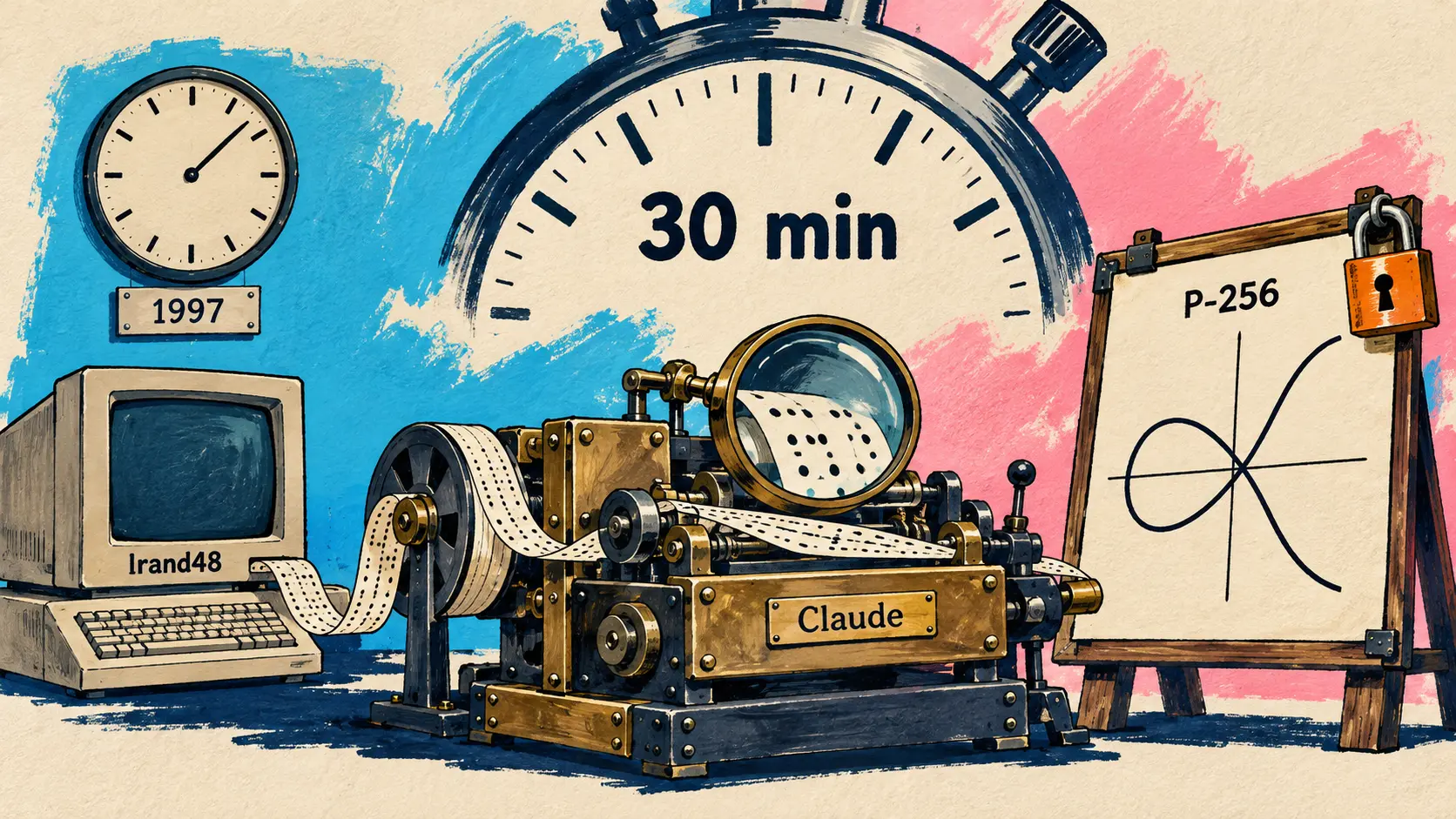
NIST ECDSA curves: Claude traces the origin of their seeds to a generator seeded from the clock in 1997 and 1998
October 16 — Anthropic’s Frontier Red Team explains how Claude solved a longstanding cryptographic mystery. When NIST adopted the ECDSA signature algorithm in 2000 in the FIPS 186-2 standard, its standard elliptic curves came with “seeds” whose hashes determine the coefficient b of each curve. Supplied by the NSA without explanation, these values had fueled suspicions of a backdoor for years, and a public bounty organized by Filippo Valsorda awaited whoever could trace their origin. The best-known lead, a humorous phrase passed through a hash function, which Jerry Solinas (NSA) had mentioned in 2015 before his death in 2023, had yielded nothing.
An Anthropic staff member posed the question to an unnamed internal research model without suggesting that lead. In less than half an hour, Claude found the origin of the seeds for P-192, P-224, P-256, P-384 and P-521: none is a hash; all come from lrand48, the C library’s pseudorandom generator, initialized with a Unix timestamp. After screening 34 combinations of generators and output slices, Claude spotted the signature of lrand48 in the most significant bits, reconstructed its internal state through lattice reduction (the LLL algorithm), then worked backward to the initializations behind the ten seeds involved, five from NIST and five from the ANSI X9.62 standard, all dating between May 1997 and April 1998.
| Point examined by Claude | Result published by Anthropic |
|---|---|
| Time to discovery | less than 30 minutes |
| P-256 example | candidate no. 1842 from a run on August 16, 1997 (no. 876 from the same run was also valid) |
| Binary-curve seeds recovered | B-233, B-283, B-409 and B-571, which read as February 1984, or April 17, 1998 if the timestamp is doubled |
| Base points explained | six curves generated in May 1997 (P-192 and five example curves from ANSI X9.62), using the FreeLIP generator |
| Still unexplained | the seed for B-163; the base points for P-224, P-256, P-384, P-521 and the binary curves |
These base points come from FreeLIP, Arjen Lenstra’s library: according to Anthropic, no NIST base point had been explained before. The criterion used to discard some valid candidates also remains unknown. Finally, the post reproduces the model’s reasoning as it questions its own discovery before confirming it through computation:
This is astonishing: it solves the 25-year-old mystery. Hmm wait. Let me be skeptical: am I in some sort of simulated/test environment? — Claude, reasoning quoted in the post by Anthropic’s Frontier Red Team
Anthropic emphasizes the implications: no cryptographic break, no new attack, no weakness, and “no action required.” A seed drawn from the clock using an ordinary generator, which anyone can now replay, instead makes a backdoor “much less plausible.” The code that reproduces the seeds and the six base points is published under the CC0 license, and the $36,864 bounty will be donated to the Internet Security Research Group (ISRG).
🔗 The post by Anthropic’s Frontier Red Team · Filippo Valsorda’s bounty
Open models: Reflection releases Beam weights, alongside pplx-decider-v1.2, Granite Switch 4.1, Bonsai 2 and an NVIDIA corpus in 22 Indian languages
October 16 — Eleven days after its unveiling, Reflection releases the weights for Beam, its first open-weight model, under the Apache 2.0 license. This Mixture-of-Experts (MoE) model with 501 billion parameters, including 23 billion active per token, targets coding, reasoning and long-running agent tasks, with a one-million-token context and text-only input and output. On October 5, Reflection had only opened early access and promised the weights “later in October.”
The release includes weights in BF16, FP8 and NVFP4, the tokenizer, the reference implementation, a DFlash2 draft model for speculative decoding and Mirror CLI, the open source harness used to train Beam (Python interface, Rust agent core, parallel agents in separate Git worktrees, skills and MCP connections). More than 40 partners support it from day one: Transformers (v5.20.1), vLLM, SGLang, Unsloth, Axolotl and Dynamo on the software side; AWS, Google Cloud, Azure, Together AI, Fireworks AI, OpenRouter and Ollama for hosting; Dell and HPE for on-premises deployments. Reflection’s API is in public beta.
The Hugging Face post details the architecture: of 52 layers, 43 use 512-token sliding-window attention and 9 use global attention, reducing the KV cache to 36 KiB per token instead of 208 KiB, or 36.08 GiB per one-million-token sequence instead of 208 GiB. The weights take up around 1 TB in BF16 and 280 GB in NVFP4, and Hugging Face recommends four B200 GPUs to serve the model.
| Benchmark (Reflection’s figures) | Beam in BF16 | Beam in FP8 | Beam in NVFP4 |
|---|---|---|---|
| SWE-bench Verified | 81,6 % | 80,2 % | 80,7 % |
| Terminal Bench v2.1 | 80,1 % | 78,9 % | 78,4 % |
| SWE Bench Pro v1 | 66,1 % | 65,9 % | 65,6 % |
| AIME 2026 | 97,7 % | 98,0 % | 97,5 % |
| GPQA Diamond | 90,6 % | 90,3 % | 89,3 % |
| MCP Atlas | 80,8 % | 81,5 % | 80,5 % |
According to NVIDIA, Beam was trained on GB300 NVL72 racks and delivers more than 70,000 tokens per second per GPU on Blackwell Ultra from day one, with no special tuning (out of the box); a few hours later, NVIDIA announced around 90,000, without specifying its measurement conditions (batch size, context, number of GPUs). The NVFP4 checkpoint is published on Hugging Face, also under Apache 2.0.
🔗 Reflection’s post · Hugging Face’s post · The model card · NVIDIA’s post · Throughput increased to 90,000 tokens per second
pplx-decider-v1.2 and its Flash version: Perplexity releases two open-weight decision models for its Decisions API
October 16 — Perplexity updates the models for its Decisions API, launched on October 1. The pplx-decider-v1.2 model replaces v1.1 as the 27-billion-parameter decision model at the same price, while pplx-decider-flash-v1.2, a new 4-billion-parameter model distilled from the 27B models, arrives at half the price. Both read text and images, output remains free, and the weights are on Hugging Face under the Apache 2.0 license; calls that still specify v1.1 or v1 automatically switch to v1.2.
| Decision model | Base model | Input price (per million tokens) | Decision Index 0.3 score | Vision Decision Index 0.3 score |
|---|---|---|---|---|
| pplx-decider-v1.1-27b | Qwen3.8-27B | 0,02 dollar | 62,30 | 73,22 |
| pplx-decider-v1.2 | Qwen3.8-27B | 0,02 dollar | 68,09 | 77,43 |
| pplx-decider-flash-v1.2 | Qwen3.5-4B | 0,01 dollar | 58,88 | 72,53 |
Version 1.2 changes the request format: the model reads the state followed by all the questions in a single sequence, so several questions about the same state cost roughly as much as one. Grouping helps when questions describe facets of the same decision (+11.3 points on SATA-Bench) and hurts when they pit independent candidates against one another (−4.8 on ToolRet). Perplexity also added the official training sets of some Decision Index benchmarks to its training data, with any test-set contamination removed. On a GB200, v1.2 responds to a single request with a median latency of 96 ms.
🔗 pplx-decider-v1.2 on Hugging Face · pplx-decider-flash-v1.2 on Hugging Face · The Perplexity API changelog
Granite Switch 4.1: IBM combines conversation, decisions and speech transcription in a single open model
October 15 — IBM releases Granite Switch 4.1 on the Hugging Face blog, in 8B and 30B versions under the Apache 2.0 license. Each model combines a conversational model, two decision adapters and a speech recognition model, served through a single endpoint.
| Granite Switch 4.1 component | Role announced by IBM |
|---|---|
| Decision adapter (aLoRA) | general decisions, in /v1/systemone format |
| Guardian adapter (aLoRA) | safety-related decisions, ahead of Jev 1.13, Microsoft-Decision-1, GPT-Luna-Decisions and Clef-Flash on average, according to IBM |
| Granite-Speech-5.0-Turbo-CTC | transcription, presented as the fastest model on the Open ASR Leaderboard |
The adapters are Activated LoRA: they reuse the KV cache produced by the base model, so a decision made after a response does not require recomputing the context, and the whole system uses roughly the same memory as the base model alone. The models run in vLLM with a plugin and natively in llama.cpp, as a drop-in replacement for /v1/systemone calls. IBM also shows a 3B Granite Switch trained to play Doom, making 60 to 100 decisions per second compared with the 10 reported for Jev, and plans an SDK for training custom adapters in Mellea. Comparisons with other decision models are provided only in charts.
🔗 IBM’s post · Granite Switch 4.1 30B on Hugging Face
Bonsai 2: PrismML releases ternary vision models from 2B to 9B, fitting into 0.43 to 2 GB
October 15 — PrismML releases Bonsai 2 in 2B, 4B and 9B versions, models with ternary weights (−1, 0 or +1) derived from Qwen3.5 that also understand images, under the Apache 2.0 license. They retain the base model’s 262,144-token context, and the Bonsai 2 family now includes four sizes, from 2B to 27B.
| Bonsai 2 model | Ternary weight size |
|---|---|
| 2B | 0,43 Go |
| 4B | 0,95 Go |
| 9B | 2,0 Go, versus around 17,9 Go in FP16 |
PrismML says it focused on use as a local assistant: instruction following, avoiding repetitive loops, tool calls on phones and responses without unnecessary text. The 9B reportedly uses around 40% fewer tokens on common instruction-following and math tasks, with no comparison baseline specified, and runs at up to 34 tokens per second on an iPhone 18 Pro Max, compared with 120 for the 2B. The most compact formats require PrismML’s fork of llama.cpp, as official llama.cpp only reads the Q2_0 format; an MLX version is available for Macs.
🔗 PrismML’s thread · The 9B model card in GGUF format
Nemotron-pretraining-Indic-v1: NVIDIA and AI4Bharat detail a corpus of around 2.8 trillion tokens in 22 Indian languages
October 16 — NVIDIA and AI4Bharat, the IIT Madras laboratory dedicated to Indian languages, detail Nemotron-pretraining-Indic-v1, the pretraining corpus cited the previous day among the data for Nemotron 3.5 Super VL: around 2.8 trillion tokens, including 2.601 trillion in native scripts and 224.6 billion romanized, across the 22 languages listed in the Indian Constitution, spoken as native languages by 97% of Indians according to the 2011 census. The corpus is not yet online: it will be released “soon,” along with the GPU-accelerated generation pipeline that produced it.
The texts are translations of English documents drawn from 15 subsets of Nemotron-CC-v2. For 12 languages, Gemma-4-31B-it translates entire documents, scores each translation using an MQM-inspired rubric (with a threshold of 75 out of 100) and repairs low-quality outputs, allowing 438.4 billion tokens to be recovered; the other 10 use Bodhan AI’s Indic Translate. Ten billion of these tokens, within a 100-billion-token continued pretraining run, improved Nemotron 3.5 Super VL by 4.98 to 9.82 points on five Indian benchmarks, a measurement that does not isolate the contribution of this corpus alone. NVIDIA acknowledges that these translations do not replace texts written directly in these languages and that quality control remains mostly automated.
🔗 The post by NVIDIA and AI4Bharat
AI in the lab: Claude Mythos 5 improves eight quantum circuits, Google DeepMind searches for antimicrobial peptides with Antigravity
October 16 — Anthropic publishes work carried out by Andi Gu, a member of its STEM Fellows program, under the supervision of Alek Kemeny, a quantum physics specialist at Anthropic, with Susanne Yelin (Harvard) and Mikhail Lukin (Harvard and QuEra Computing). The setup: plain-language specifications for eight circuits, and an automated evaluator that checks each proposal and scores it by multiplying the number of qubits by the number of gates. Claude Mythos 5 works in a closed loop, with no human intervention between rounds, and finds designs for all eight primitives that use both fewer qubits and fewer gates than the best published designs, sometimes by an order of magnitude or more.
| Task assigned to Claude Mythos 5 | Published result | Comparison point |
|---|---|---|
| Elliptic curve point addition | 17 times fewer gates, with 12 % more qubits | smallest published design |
| Reed-Solomon decoder for the DQI algorithm | 12 times fewer gates; 19 reserved qubits instead of 665 | Google’s previous construction |
The first result concerns the central step in quantum algorithms for the elliptic curve discrete logarithm problem. Claude worked on it for 53 hours with minimal human intervention, producing the first reversible implementation of the divsteps method without stored branch history, verified through simulation and then formalized in Lean. The post compares this figure with another: it took eight years and many groups to reduce the estimated cost of simulating FeMoco by a factor of about 150 000. For Anthropic, such gains reduce the quantum resources needed for useful applications, meaning practical quantum computers could arrive sooner than expected. The team had to work with a cautious Claude, which double-checked its gains and preferred established methods, by requiring it to pursue several approaches in parallel.
🔗 Anthropic’s post · The paper on arXiv
Google DeepMind searches for new antimicrobial peptides with Antigravity and adds a 3D viewer
October 15 — Google DeepMind shows how Antigravity, its agentic development platform, can serve as an agentic science workbench. In the session described, a biologist sets the goal of finding and computationally validating new antimicrobial peptides in Streptococcus pseudopneumoniae, and the agent orchestrates databases, structural analysis and literature synthesis. It relies on ProtNLM, a Google model that predicts a protein’s function from its sequence and annotates millions of uncharacterized UniProt entries.
The agent selects a bacteriocin of 97 amino acids (UniProt A0A0U0D591), with no significant homolog among the reviewed proteins in Swiss-Prot, whose AlphaFold model folds like a bacteriocin with a known structure. It then proposes a mechanism of action drawn from the literature and writes a laboratory protocol. This candidate and several others from the same pipeline are undergoing laboratory validation: the post describes a plausible lead, not a result. It notes that antimicrobial resistance could cause around 10 million deaths per year by 2050, according to one estimate.
The post also introduces the Biomolecular Structure Viewer, a 3D viewer integrated into Antigravity and shared by the agent and the researcher: the agent highlights regions to illustrate its hypotheses, and the researcher’s annotations, such as a note pinned to a binding pocket, are fed back to it. Neither a date nor access conditions are specified.
🔗 Google DeepMind’s post · Antigravity for science
Tools for researchers: Google opens Deep Review to everyone, SAIR launches Open Math OS, OpenAI offers the Rosalind Academic Plan to American labs
October 14 — At Research@ 2026, Google Research opens Deep Review to the public, an agentic AI system that reviews complex technical documents and checks their content: logical consistency, mathematical statements, facts grounded in sources, comparisons with existing work and suggestions for improvement, while substantive judgments remain with humans. It succeeds the Paper Assistant Tool, tested with STOC 2026, ICML 2026, NeurIPS 2026 and ICLR 2027: authors of more than 16 000 voluntarily submitted manuscripts received private feedback before the deadline, independently of the conferences’ official review process.
Access is worldwide, with two free reviews per week; a Gemini API key unlocks higher limits and the Deep Review API. The service currently accepts PDF and plain text, also targets Google Docs, presentations, law and finance, and Google commits not to use the documents to train its models (they are retained for one year for display). Google points to the influx of submissions to justify the tool:
| Submission year | Papers submitted to ICLR, NeurIPS and ICML |
|---|---|
| 2023 | around 23 000 |
| 2024 | around 32 000 |
| 2025 | around 45 000 |
| 2026 | more than 74 000 |
On the same day, Google Earth AI’s Geospatial Reasoning agent received a technical report, two new benchmarks published for researchers (GeoKTools and GeoExpertQueries), and expanded experimental access through Ask Google Earth and an Agent-to-Agent (A2A) service.
🔗 Google Research’s post · Research@ 2026 on Google’s blog · The post on the Geospatial Reasoning agent
Open Math OS: the SAIR Foundation launches a mathematics research platform built on open models
October 16 — The SAIR Foundation launches Open Math OS, which it presents as the infrastructure for “mathematics 2.0,” one month after announcing the Open Math Model initiative. Hugging Face, Lean, EPFL and @cscsch are launch partners, and Thomas Wolf, who co-founded Hugging Face, shared the announcement. Each project gets a cloud machine available 24 hours a day, with more than 100 mathematical and scientific tools preinstalled; compute is free for accepted teams, subject to application.
Mathematicians choose an open model (Kimi K3, DeepSeek V4.1 Flash, GLM 5.3 or Nemotron 3 in the interface shown) and can launch Ultramath mode, where several agents explore different approaches to the same problem in parallel; the site’s demonstration shows a proof verified in Lean and then incorporated into a LaTeX paper. Projects are private by default, training on the work requires the authors’ explicit consent, and authors retain ownership of and credit for their ideas.
🔗 SAIR’s thread · The Open Math Model website
Rosalind Academic Plan: up to 30 free ChatGPT seats for 12 months for American university labs
October 15 — OpenAI launches the Rosalind Academic Plan, an offering for university life sciences labs, currently limited to American universities.
| Plan benefit | Associated condition |
|---|---|
| Up to 30 ChatGPT Business Standard seats | 0 dollars per user per month, for up to 12 months |
| Commercially available frontier models | within the plan’s usage limits |
| GPT-Rosalind and Rosalind Workbench | after approval for trusted access |
| Shared research data | not used for training by default |
Rosalind Workbench orchestrates tools for medicinal chemistry, genomics and experimental assistance. The principal investigator or lab manager applies on behalf of their team; an application does not grant immediate access, and universities already under an OpenAI Enterprise contract follow their own process. OpenAI targets seven areas, from drug and protein design to antimicrobial resistance, and cites work from the Zhao lab (UCSF), the Bourdenx lab and Brian Hie’s team (Stanford and Arc Institute). GPT-Rosalind, launched on April 16, has been available through trusted access via the API, Codex and ChatGPT Enterprise since September 11.
🔗 OpenAI’s post · OpenAI’s thread
Gemini 4 Argon: four agents beat Minecraft in 27 hours, Perplexity makes it available to Pro and Max subscribers and through its Agent API
October 16 — Four Gemini 4 Argon agents completed Minecraft from scratch: in a random survival world, in Easy mode and with hostile monsters, they defeated the Ender Dragon after 27 hours and 2 783 programs. Maxence Faldor recounts the experiment in an X Article shared by @GoogleDeepMind, and details it with Satinder Singh and Roberta Raileanu in a technical report on arXiv. These are Argon’s general-purpose coding agents, the ones engineers use every day: no Minecraft-specific tools, no assigned roles.
The agents see no images and press no keys: each controls a player by writing short programs for the open source Mineflayer library, reads their output and coordinates with the others through the game’s chat and a shared memory. Ten minutes after starting, they had divided up the work (tools, food, diamonds, portal). To find the stronghold, one of them threw two objects from two locations and calculated the intersection of their trajectories, coming within 43 meters of a stronghold 1,3 kilometers away. The final battle cost them 69 respawns: after around 21 hours of play, one agent realized that the crystals were healing the dragon and that a stack of dirt was enough to reach them.
| Experiment metric | Recorded value |
|---|---|
| Time to victory | 27 h 14 min |
| Programs written | 2 783, of which 22 % ended in errors |
| Chat messages | 229 |
| Total respawns | 605, including 69 against the dragon |
A fifth agent, the Observer, monitored the game for any cheating or specification gaming: neither it nor a manual review of a sample of the logs found any. The authors acknowledge the experiment’s limitations: the world is read through an API that provides the exact position of blocks and creatures, and a plugin calculates routes. This is an independent research experiment, neither an official Minecraft milestone nor approved by Mojang or Microsoft.
🔗 Maxence Faldor’s article · Google DeepMind’s shared post · The technical report on arXiv
Perplexity makes Gemini 4 Argon available to Pro and Max subscribers, with a record 0,802 on WANDR
October 16 — Perplexity adds Gemini 4 Argon, generally available from Google since October 13, for its Pro and Max subscribers. The announcement consists of a tweet and a chart: on WANDR, its in-house benchmark for source-backed research, Argon scores 0,802 at 7,88 dollars per task, the best score in the chart.
| Model evaluated | WANDR score | Cost per task |
|---|---|---|
| Gemini 4 Argon | 0,802 | 7,88 dollars |
| GPT-6 Astra | 0,735 | 13,34 dollars |
| GPT-6.1 Sol | 0,654 | 3,70 dollars |
| Claude Opus 5.5 | 0,647 | 3,69 dollars |
| Claude Fable 5.1 | 0,601 | 12,76 dollars |
| GPT-6 Sol | 0,566 | 2,23 dollars |
| Claude Sonnet 5.5 | 0,550 | 2,73 dollars |
| Grok 4.7 | 0,528 | 9,30 dollars |
| DeepSeek V4 Pro 0813 | 0,359 | 0,75 dollar |
For developers, the API changelog has indicated since the evening of October 15 that the Agent API accepts google/gemini-4-argon, at introductory pricing in effect through November 30, 2026: 2 dollars per million input tokens, 0,10 dollar for cached tokens and 10 dollars for output tokens, including reasoning tokens.
🔗 Perplexity’s announcement · Agent API models
Consumer agents: GPT-6 Astra Pro divides a task among several agents in ChatGPT, Grok Bot runs three times faster and connects to Robinhood, Coinbase and eToro
October 16 — OpenAI updates GPT-6 Astra Pro in ChatGPT: faster responses, better use of plugins and tools and, above all, several agents handling different parts of the same task in parallel. Users track each agent’s progress and open completed tasks to review their work. The feature is available to Pro subscribers in the Chat tab.
OpenAI provides neither quantified speed gains nor a benchmark, and neither the ChatGPT release notes nor the model release notes mentioned the update as of the evening of October 16. The tweet, published at 20:00 UTC under the name “GPT-6 Pro,” was corrected 27 minutes later to “GPT-6 Astra Pro”; since GPT-6 became available to all users on October 7, ChatGPT’s Pro reasoning effort has relied on GPT-6 Pro (Astra). Work with multiple agents had previously been presented as a beta feature for GPT-6.1 Sol, since September 29.
Grok Bot completes computer tasks three times faster, reads X Chat and connects to Robinhood, Coinbase and eToro
October 16 — Grok Bot, SpaceXSI’s agent that connects to its users’ tools, details its updates in a thread of ten posts, with no post on x.ai. The main update concerns speed: according to the @bot account, computer tasks finish three times faster on average, and responses to everything else arrive in less than half the time.
| Area concerned | Announced update |
|---|---|
| Speed | computer tasks three times faster on average, other responses in less than half the time |
| Voice | faster, more reliable calls, better memory of past conversations |
| Interface | redesigned chat cards, new font, themes, notifications only on the device in use |
| “plus” aliases to restrict a routine to mail sent to a specific address | |
| X | mentioning @bot in a post launches a task; reading X Chat once the X account is connected |
| Connectors | Robinhood, Coinbase, Trello, PostHog, beehiiv and eToro, among others |
Teams can also submit their own connectors: a form on x.ai offers to distribute a plugin or MCP server to Grok Bot and Cursor users, and soon to Grok users, following marketplace review.
🔗 Grok Bot’s thread · The plugin submission form
Generative media: voices created from descriptions for GPT-Live, Pika in ChatGPT, Ideogram 4.5 from 0.8 to 22 cents per image, Mirelo SFX 2.0 in Runway
October 16 — The GPT-Live API opens voice creation from a description (prompt-to-voice) to all its customers: a custom voice is described in text, through the API or the voice Playground, then reused in GPT-Live sessions. Creation is free, generated speech is billed at the usual session rate, and these voices work only with GPT-Live, not with the Text to Speech API, the Realtime API or Chat Completions. No reference or consent recording is required, but OpenAI requires adult voices, prohibits impersonation and asks that AI-generated speech be disclosed; two customers may obtain similar voices.
Nine preset voices, recorded with native-speaking voice actors according to @OpenAIDevs, also join GPT-Live:
| Spoken language | Added voices |
|---|---|
| German | Nuri, Juni and Flitz |
| French | Brise and Sillage |
| Hindi | Nira |
| Japanese | Harema and Shida |
| Korean | Noeul |
The previous day, the changelog added native integration of the Decisions API into GPT-Live: the application acts while the user speaks, either because Live calls Decisions directly (native delegation), or because Live notifies the application, which then queries Decisions (custom delegation), and decisions can be triggered by transcription fragments. The guide uses the example of an in-car voice assistant that adjusts the temperature or defogging. These updates concern gpt-live-1: GPT-Live-1.1, rolled out in ChatGPT on October 15, does not yet appear in the API changelog.
🔗 OpenAI Developers’ thread · The custom voices guide · The guide to the Decisions API with voice
Pika brings its creation tools into ChatGPT, with a plugin developed in partnership with OpenAI
October 16 — Pika announces, in partnership with OpenAI, a Pika × ChatGPT plugin extension (Pika X ChatGPT plugin extension) that brings its creation tools into ChatGPT’s conversation and side panel. Users can adjust tool options, visual presets and generations without leaving the conversation, or open a more immersive Pika window where ChatGPT works alongside them. According to its thread, Pika brings more than 40 image, audio and video applications and more than 100 generation models; the plugin listing includes 13 skills, from product advertising to podcasts, and an onboarding flow that determines how Pika asks before spending credits.
Pika adds 250 credits to each account after the first generation through the plugin, and publishes no plugin-specific pricing. OpenAI introduced ChatGPT plugin extensions on October 7, with Adobe, Canva, Figma and Shopify among the first.
🔗 Pika’s thread · The Pika plugin listing in ChatGPT
Ideogram 4.5 comes in four quality modes, from 0.8 to 22 cents per image
October 15 — Ideogram details the pricing range for Ideogram 4.5, its image editing model launched on September 30: four quality modes, from 0.8 to 22 cents per image, all at native 2K. The cheapest, Very Low, edits an image in 8 seconds for 0.8 cents, without artifacts accumulating across edits. According to Ideogram, citing Design Arena, this mode pushes the Pareto frontier for image editing in both price and speed: every higher-rated model costs more and runs more slowly. Design Arena ranks it 23rd in its Image Editing Arena, with an Elo of 1189.
Ideogram does not detail the prices of the two intermediate modes. Asked about the open weights promised at launch, Ideogram’s account replies that it is working on them, without giving a date.
Runway integrates Mirelo SFX 2.0, which adds sound to a video while preserving dialogue
October 16 — Runway adds Mirelo SFX 2.0 to its platform, a model that automatically creates a video’s sound design (sound design): it generates complete soundscapes from the frames, synchronized with each one, while leaving dialogue intact. Asked about a duration limit, Runway replies that it works on clips of any length. Neither pricing nor credit costs have been published, Runway’s changelog does not yet mention the model, and Mirelo has not published an announcement of its own. Following ElevenLabs’ Eleven v4 in late September, Runway continues to add third-party audio models alongside its video models.
🔗 Runway’s announcement · The reply about clip length
Coding agents: the Claude Code team details its code review process, Codex CLI 0.163.0, canvases and Muse Wonder in Cursor, Gemini CLI points to Antigravity CLI
October 16 — The Claude Code team explains on claude.dev how it reviews its own code, with Claude writing around 90% of it. The post by Addy Osmani, Morgan Westlee Lunt and Qing Wang presents two figures: from June to September, merged pull requests more than doubled, and the share that had to be reverted fell by more than 40%. The goal is for most pull requests to merge with at most one human in the loop, who may be their author.
Each change passes through several layers: checks by Claude before the pull request (tests, compilation, static analysis, then a diff review by a second agent with fresh context), CI, Code Review, a blocking security review, a merge queue (merge queue) and a gradual rollout. A classifier sets the risk level based on the change, not the author: no human approval for documentation or an addition behind a flag, one person for an ordinary product change or a sensitive area such as the cache or system prompts, two for the highest-risk changes. An agent’s approval never counts as a person’s. During Code Review’s research preview, the share of internal pull requests receiving substantive comments had already risen from 16% to 54%.
The post also quantifies a problem specific to agents: reviews that fail to converge. One CLI pull request went through more than fifty rounds in a single night. With a cap of three rounds, reviews limited to the new diff and reports grouped by bug class, reviews converge faster:
| Metric (internal Claude Code pull requests) | Before the changes | After the changes |
|---|---|---|
| Approved after a single review and correction round | 65 % | 78 % |
| Requiring five rounds or more | 8,9 % | 1,5 % |
| Average number of reviews before approval | 2,08 | 1,32 |
The post ends with an implementation checklist: a short CLAUDE.md, local /code-review and /security-review, a REVIEW.md file written by code owners, documented risk levels, a merge queue and past incidents replayed daily as an evaluation set.
🔗 The Claude Code team’s post · The post shared by @ClaudeDevs
Codex CLI 0.163.0: steering during responses, search in /config and Daybreak enabled by default
October 15 — OpenAI releases Codex CLI 0.163.0 at 21:30 UTC, the first stable release since 0.162.1 on October 9, with 227 entries since 0.162.0. Daybreak, placed behind the cli_daybreak option in 0.161.0 on October 7, is now enabled by default for eligible accounts, and codex exec can select it with an OpenAI API key when the server grants access.
| Area concerned | Change introduced in 0.163.0 |
|---|---|
| Steering | a follow-up message sent during a response steers Codex immediately; interrupting a turn also stops active Code Mode cells |
/config command | search for preferences across all categories, with supported settings applied immediately |
/keymap command | configurable leader key (Ctrl+X by default); voice mute moves to F9 |
/daemon command | restart the managed background server, then reconnect automatically |
| Tools | independent read-only tools run in parallel |
| Network proxy | permission checked before DNS resolution, duplicate Host headers rejected |
Resuming a thread also restores its permissions and network approvals, and Codex no longer bundles a modified zsh: it uses its standard shell executor.
🔗 The Codex CLI 0.163.0 release notes
Cursor: cloud agents build shareable canvases, the Environments API enters beta, Meta’s Muse Wonder reaches 46.1% on CursorBench
October 16 — Cursor’s cloud agents can now build interactive canvases (canvases): users ask them for a dashboard or report while they work, then share the finished canvas with their team through a link. The Environments API enters beta: it programmatically creates and manages these agents’ environments, including cloned repositories and environment.json configuration. An environment now supports up to 500 repositories, and large multi-repository environments start 5 times faster, according to Cursor. The changelog entry cited by the thread was not yet online on the evening of the 16th, so the eligible plans, pricing and date for leaving beta remain unknown.
October 15 — Three days after its launch by Meta, Muse Wonder arrives in Cursor at 4 dollars per million input tokens and 20 per million output tokens, matching Meta’s API pricing. Cursor highlights 46.1% on CursorBench at the default effort level, the best score for a Muse model; the public CursorBench 4.0 leaderboard details the other effort levels.
| Model and effort level | CursorBench 4.0 score | Cost per task | Leaderboard rank |
|---|---|---|---|
| Claude Opus 5.5 Max | 57,8 % | 13,43 dollars | 1st |
| Muse Wonder Max | 50,4 % | 5,25 dollars | 12th |
| Muse Wonder Extra High | 48,2 % | 4,24 dollars | 15th |
| Muse Wonder High | 46,1 % | 3,51 dollars | 21st |
| Muse Wonder Medium | 45,2 % | 2,82 dollars | 22nd |
| Muse Wonder Low | 41,7 % | 1,91 dollar | 32nd |
| Muse Spark 1.3 Max | 41,6 % | 2,64 dollars | 34th |
🔗 Cursor’s thread on cloud agents · Muse Wonder in Cursor · The CursorBench leaderboard
Gemini CLI declares itself unoptimized for Gemini 4 Argon and points to Antigravity CLI
October 16 — Google added a warning at the top of Gemini CLI’s README overnight. The notice recalls that, for free-tier and Google One users, Gemini CLI was replaced by Antigravity CLI on June 18, 2026, then states in bold, before inviting users to use Antigravity for Argon:
Gemini CLI has not been optimized for Gemini 4 Argon. — Gemini CLI README, pull request 29774
A second change, merged a little over an hour later, broadens the message to all the latest Gemini models and points to Antigravity CLI for the best coding experience. Along the way, the README loses its longstanding selling points: the “Why Gemini CLI?” section and its free tier of 60 requests per minute and 1,000 per day, advanced capabilities and GitHub integration; signing in with a Google account now applies only to paid organizational Code Assist licenses.
These notices continue the transition announced on May 19: since June 18, Gemini CLI has remained available to Code Assist Standard and Enterprise licenses and paid API keys, with the promise of access to the latest Gemini models. Three days after Argon’s general availability, the community proposal adding it to Gemini CLI’s selector (pull request 29737) has still not been merged.
🔗 Pull request 29775, which cleans up the README · The May 19 post on the transition to Antigravity CLI
Briefs
Agents and coding tools
- Amp shows its runners’ desktops — You can now view and control a macOS or Linux runner’s desktop from a thread, for example to try an iOS application built by Amp, through a browser or the iPhone and iPad apps; anyone who can write in a runner’s thread can also control its desktop. 🔗 source
- v0 — Files too large to preview can be downloaded from the Code tab, the iOS app gains skill and design system pickers as well as video attachments, and Gemini 4 requests no longer fail at high effort levels. 🔗 source
- Copilot CLI in preview — Three previews in one day (1.0.99-2, 1.0.99-3 and 1.0.100-0), with no stable release: semantic code search becomes the default setting for online sessions, the
--disable-client-telemetryoption disables client telemetry, and a frozen MCP server no longer blocks the session. 🔗 source - Copilot in Slack and Teams — @GitHub now works across multiple repositories in a single conversation: open or merged pull requests, investigations spanning both frontend and backend, activity summaries; shared Slack messages and threads provide context. 🔗 source
- Qwen Code v0.25.3-preview.0 — A day after the stable v0.25.2 release, a preview with 64 entries puts QwenCloud at the top of /auth, gives the Managed Agent full Shell access with an approval toggle, and displays trajectories live in the Web Shell. 🔗 source
- Gemini CLI, nightly 0.66.0 — The first nightly in the series, with nine fixes: synchronized output to prevent flickering under tmux, Git prompts that froze the interface, .env variables finally resolved in MCP settings, and SKILL.md files with single-line descriptions; stable and preview remain unchanged. 🔗 source
- DeepSeek Harness 0.2.1-alpha.5 — The 29th preview with no stable release: four fixes (the skills menu after enabling a plugin, redundant terminals, PTC mode instructions, the Page Up key on Windows and Linux) and a hook allowing plugins to rename models by provider. 🔗 source
ChatGPT, Claude and enterprise AI
- ChatGPT Sites for Enterprise — @OpenAIDevs announces general availability for Enterprise, with US or EU data residency for new Sites, verified domains and private tunnels to internal APIs; the Enterprise release notes describe an admin preview rolling out, while Plus and Pro lose their fixed Sites limit. 🔗 source
- ChatGPT Slides rolls out — Announced at DevDay on September 29, collaborative presentations are arriving in Space for eligible Pro, Business and Enterprise subscribers, with real-time co-editing, presenting from ChatGPT and export to PowerPoint, PDF or Google Slides. 🔗 source
- Stack Overflow for Agents — According to an OpenAI case study, two engineers shipped the product in a few weeks using Codex; its ChatGPT plugin tripled sign-ups overnight, and a Stack Internal connector takes 4 days to build instead of 3 to 6 weeks. 🔗 source
- Sullivan & Cromwell — The law firm built Agreement Analyzer with OpenAI, prototyped in-house using Codex by John Savva, which produces a memorandum and proposed changes to a draft contract for a lawyer to review; the case study provides no figures on gains. 🔗 source
- An Anthropic sales representative’s agents — Shahboz Ibragimov, from the Japan team, describes six agents on Claude Managed Agents (lead triage, Salesforce, responses in Japanese or English, meeting notes), Claude Tag for follow-ups, and Sonnet or Opus depending on the judgment required; around 60 hours of work saved according to his weekly log. 🔗 source
- American Forge — Cognition and the National Design Studio are launching a six-month residency placing engineers within the US government, which the post says has more than 29,000 old or outdated federal websites; applications are open, with no compensation or number of places specified. 🔗 source
Generated voice and video
- HeyGen Video 1 in HeyGen’s MCP — Describe the video you want to your agent (ChatGPT, Claude, Claude Code or Cursor) and it comes back ready to publish, within seconds according to HeyGen; renders are deducted from the plan’s credits. 🔗 source
- NTT Docomo Business and ElevenAgents — The operator is testing its CONN voice assistant, built on ElevenAgents, in Aizuwakamatsu (Fukushima) to inform and converse with elderly residents who cannot go outside because of the snow; feedback is described as positive, with no figures. 🔗 source
- ElevenLabs certifications — ElevenLabs renews its ISO/IEC 27001, 27701, 42001, 27017 and 27018, SOC 2 Type II and PCI DSS Level 1 certifications, and adds SOC 2 Type I for ElevenProductions. 🔗 source
Models, benchmarks and research
- Mistral Large 4 on STEMBench — Mistral highlights Ulam’s scientific benchmark, where its model scores 2.501 out of 4 without tools (2.602 in engineering, 2.597 in astronomy): 6th among 10 configurations and 4th without tools, behind Muse Wonder, Claude Opus 5.5 and Hy4 Preview; the top two, GPT-6 Astra xhigh and GPT-6.1 Sol, ran with tools in Codex. 🔗 source
- Jebadiah v2.1 — Two open decision models of 27B and 9B, released on October 10 under Apache-2.0, score 55.94 (35th) and 44.91 (74th) among 168 on the Decision Index, behind Jev 1.13 (60.11). 🔗 source
- Nemotron 3.5 Super VL and charts — According to Thoughtworks, a LoRA trained for 3.3 hours on 24,000 generated charts takes a preliminary model checkpoint from 16.96% to 78.13% on 224 CharXiv questions, at the cost of a net loss of 104 questions elsewhere. 🔗 source
- Intel’s Arc Pro B65 — A community benchmark under llama.cpp measures SYCL with flash attention as 31.2% faster than Vulkan in prefill across three roughly 30B models in 4-bit: the first token of a prompt of around 16,000 tokens arrives in 20.5 seconds instead of 42 for two of them. 🔗 source
- TB-Lite Verified — Hugging Face quietly publishes a corrected version of the OpenThoughts-TBLite benchmark for terminal agents: five faulty tasks removed out of 100, a scoring issue capping results at 0.997 fixed, and no scores published. 🔗 source
- Sakana AI’s AutoIllustrate — A catch-up item from October 14: an Apache-2.0 command-line tool turns a paper’s “methods” section into an editable draw.io figure, then into a restyled PNG; it was used for the figures in The Agentic Scientist. 🔗 source
- LLM sycophancy according to Meta — facebookresearch quietly publishes the prompts and scoring rubrics for the paper “From Preference Data to Personalization,” which classifies responses into seven types, from frank disagreement to explicit validation; no model or figures. 🔗 source
- Anthropic and the Simons Foundation — Anthropic commits $5 million in funding, compute and Claude access for mathematicians, managed by the Simons Foundation; together with the foundation and OpenAI, which is also committing $5 million, the total reaches $15 million according to the Simons Foundation, awarded in part through calls for proposals. 🔗 source
Guides and awards
- LLM security according to Perplexity — A guide covers the ten risks in the OWASP Top 10 for LLM Applications 2026, with an incident and defenses for each, and reiterates Perplexity’s protections (Computer’s sandbox, BrowseSafe for Comet, zero retention by third-party providers); no new features. 🔗 source
- Studying with AI — Perplexity publishes five research-backed methods (being quizzed, spacing out study, re-explaining, interleaving, tracking progress) and cites Gallup and the Lumina Foundation: 57% of US students use AI weekly for their coursework. 🔗 source
- Two inventions of the year for TIME — The magazine includes Meta’s Omnilingual ASR, speech recognition for more than 1,600 languages, and NVIDIA’s NemoClaw, an autonomous agent confined to a sandbox, among its best inventions of 2026. 🔗 Meta · 🔗 NVIDIA
GitHub: licenses, runners and access
- Open source license compliance — Generally available for GitHub Enterprise Cloud with Code Security: an enterprise license policy is enforced on pull requests through a ruleset, and a new endpoint allows coding agents to check whether a package complies with it. 🔗 source
- Xcode 27 image — Outside AI, the GitHub Actions Xcode 27 runner image (macOS 27, Apple Silicon only) reaches general availability, with the xcode-27 and xcode-27-xlarge labels unchanged. 🔗 source
- Evergreen — Outside AI, GitHub introduces the GitHub App that revokes unconfirmed external collaborators’ access every quarter and archives, without ever deleting them, inactive repositories in a shared organization used by more than 1,400 employees. 🔗 source
What this means
Elliptic curves featured in two Anthropic posts on the same day, approaching the subject from both ends. Looking back, Claude identifies the generator and timestamps behind the NIST seeds: nothing is broken, Anthropic reiterates, but tampering becomes much less plausible, and anyone can reproduce the result with the code published under CC0. Looking ahead, Claude Mythos 5 finds an elliptic curve point addition circuit requiring 17 times fewer gates for 12% more qubits, a core component of the quantum algorithms that would compute the discrete logarithm on elliptic curves, the problem on which ECDSA’s security depends. Anthropic concludes that useful quantum computers could arrive sooner than expected: confidence in how these curves were generated is growing just as the estimated cost of the quantum circuits that could one day threaten them is falling.
In laboratories, agents are working longer on their own, and verification is becoming a condition of their credibility. Claude Mythos 5 ran for 53 hours against an automated evaluator, with a proof formalized in Lean; the Argon agents played for more than 27 hours under the supervision of an Observer tasked with spotting cheating; Antigravity’s agent drafts a protocol, but its bacteriocin still awaits laboratory validation. Tools for researchers follow the same logic: Deep Review checks statements and consistency before submission, Open Math OS relies on Lean and keeps projects private by default, and the Rosalind Academic Plan only grants access to GPT-Rosalind after approval for trusted access.
Among open models, licensing is once again a selling point. The day after Muse Spark Open, released under the Muse Model License with restricted commercial terms, Beam arrives under Apache 2.0, with more than 40 partners on day one, an NVFP4 checkpoint and the harness used to train it. Smaller models adopt the same license and target efficiency: the smallest Bonsai 2 fits into 0.43 GB and runs on a phone, and decision models are taking shape as a category, with pplx-decider-v1.2 and its Flash version at $0.02 and $0.01 per million tokens, Granite Switch 4.1 adapters that reuse the base model’s cache, and a shared ranking, the Decision Index.
The harness now matters as much as the model. Reflection ships Beam with Mirror CLI, Google directs Argon users to Antigravity CLI rather than Gemini CLI, and the Claude Code team links a doubling in merges to a redesign of its review pipeline, where a classifier decides how many humans are required. For consumers, agents are expanding their reach: GPT-6 Astra Pro splits a task among several agents, Grok Bot connects to Robinhood, Coinbase and eToro, and ChatGPT plugins become a distribution channel, from Pika’s tools to tripled sign-ups for Stack Overflow for Agents.
Sources
- Anthropic’s Frontier Red Team post on ECDSA curves
- Filippo Valsorda’s bounty for NIST seeds
- Beam is now available (Reflection)
- Beam (Hugging Face blog)
- Beam-1.0-501B-A23B model card (Hugging Face)
- Beam on Blackwell Ultra (@NVIDIAAI)
- Beam throughput increased to 90 000 tokens per second (@NVIDIAAI)
- pplx-decider-v1.2 (Hugging Face)
- pplx-decider-flash-v1.2 (Hugging Face)
- Perplexity API changelog
- Granite Switch 4.1 (IBM’s Hugging Face blog)
- Granite Switch 4.1 30B (Hugging Face)
- Bonsai 2 (@PrismML)
- Ternary-Bonsai-2-9B-gguf (Hugging Face)
- Nemotron-pretraining-Indic-v1 (NVIDIA’s Hugging Face blog)
- Designing efficient quantum circuits (Anthropic)
- Claude Mythos 5’s quantum circuits (arXiv)
- Accelerating the search for antimicrobial peptides (Google DeepMind)
- Antigravity for science
- Analyzing technical documents with Deep Review (Google Research)
- Research@ 2026 (Google blog)
- Putting Earth AI to work (Google Research)
- Open Math OS (@SAIRfoundation)
- Open Math Model
- Introducing the Rosalind Academic Plan (OpenAI)
- The Rosalind Academic Plan (@OpenAI)
- A team of Gemini 4 Argon agents beats Minecraft (@maxencefaldor)
- Google DeepMind’s repost (@GoogleDeepMind)
- The Minecraft technical report (arXiv)
- Gemini 4 Argon in Perplexity (@perplexity_ai)
- Agent API models (Perplexity)
- GPT-6 Astra Pro in ChatGPT (@OpenAI)
- What’s new in Grok Bot (@bot)
- Submitting plugins to Grok Bot (x.ai)
- GPT-Live voices (@OpenAIDevs)
- Custom voices guide (OpenAI)
- GPT-Live and the Decisions API (OpenAI)
- Pika × ChatGPT (@pika_labs)
- Pika plugin listing (ChatGPT)
- Ideogram 4.5 quality modes (@ideogram_ai)
- Mirelo SFX 2.0 on Runway (@runwayml)
- Clip duration according to Runway (@runwayml)
- Solving code review at Anthropic (claude.dev)
- @ClaudeDevs’ repost
- Codex CLI 0.163.0 (GitHub)
- Canvases and the Environments API (@cursor_ai)
- Muse Wonder in Cursor (@cursor_ai)
- CursorBench leaderboard
- Gemini CLI pull request 29774 (GitHub)
- Gemini CLI pull request 29775 (GitHub)
- Transitioning Gemini CLI to Antigravity CLI (Google Developers)
- Amp and the runners desk
- v0 changelog for October 16
- Copilot CLI 1.0.99-2 (GitHub)
- Copilot in Slack and Teams (GitHub changelog)
- Qwen Code v0.25.3-preview.0 (GitHub)
- Gemini CLI v0.66.0-nightly.20261016 (GitHub)
- DeepSeek Harness 0.2.1-alpha.5 (GitHub)
- ChatGPT Sites for Enterprise (@OpenAIDevs)
- ChatGPT release notes
- Stack Overflow and its ChatGPT plugin (OpenAI)
- Sullivan & Cromwell (OpenAI)
- A day in the life of an Anthropic salesperson in Japan (Claude)
- American Forge (Cognition blog)
- HeyGen Video 1 in HeyGen’s MCP (@HeyGenDev)
- NTT Docomo Business and ElevenAgents (ElevenLabs)
- Certification renewals (ElevenLabs)
- Mistral Large 4 on STEMBench (@MistralAI)
- Jebadiah v2.1 (Hugging Face blog)
- Nemotron 3.5 Super VL and CharXiv (Hugging Face blog)
- Intel Arc Pro B65 (Hugging Face blog)
- TB-Lite Verified (GitHub)
- AutoIllustrate (GitHub)
- Tracing sycophancy in large language models (GitHub)
- Anthropic and the Simons Foundation (@AnthropicAI)
- What is LLM security? (Perplexity)
- How to use AI for studying (Perplexity)
- Omnilingual ASR among TIME’s inventions (@AIatMeta)
- NemoClaw among TIME’s inventions (@NVIDIAAI)
- Open source license compliance (GitHub changelog)
- Xcode 27 image (GitHub changelog)
- Staying Evergreen (GitHub Blog)