ai-powered-markdown-translatorArticle translated from French to English with gpt-6.1-sol.
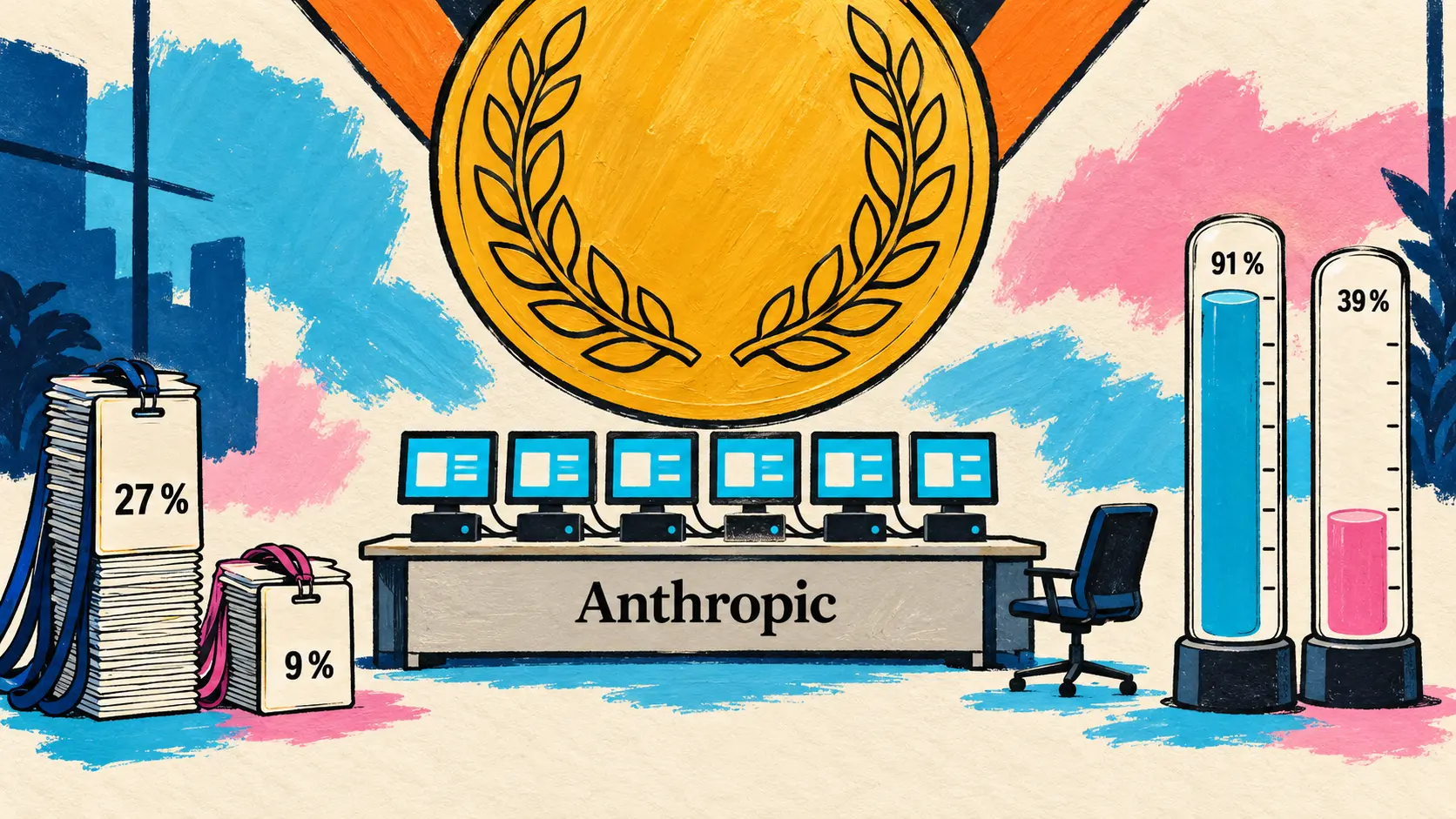
Anthropic is using its own teams as a research subject: juniors have fallen from 27 % to 9 % of technical hires, agents launched by employees worked six times as many hours as the employees themselves in August, and 91 % of those employees believe AI could make a Nobel Prize-worthy discovery by 2030, compared with 39 % of Americans. DeepSeek releases V4.1-Flash-1017 under the MIT license, ahead of GPT-5.6 Sol and Claude Opus 5 on DeepSWE v1.1 at unchanged prices, and opens its Search and Fetch web search APIs to everyone. Google Research agents control laboratory robots and help produce nanomolar protein binders against a tumor target, Claude Code starts responding three times faster than in August, and NVIDIA details its RTX Spark PCs for developers.
Anthropic studies its own jobs: juniors fall to 9 % of technical hires, its employees expect far more from AI than Americans do
October 16 — Anthropic’s Economics team publishes two reports from The Anthropic Institute that use the company itself as a research subject. The first, “How employment is changing at Anthropic” (How employment is changing at Anthropic), combines internal data (headcount, AI usage, output, calendars, hiring decisions) with 17 employee interviews. The second, “The AI expectations gap” (The AI expectations gap), compares a Morning Consult survey conducted in August among 10 980 American adults with an internal survey of 1 334 employees; a second wave in September yields similar results.
| Metric tracked at Anthropic | Measured change |
|---|---|
| Share of juniors among technical hires | from 27 % to 9 % |
| Share of juniors in technical departments | from 21 % to 14 % since early 2025 |
| Interactive agent hours per employee hour | 6 in August 2026 |
| Commits per engineer | 5 times the pace of six months ago |
| Coding sessions by nontechnical staff, per month | from 2 (August 2025) to 90 (May 2026) |
The decline in entry-level hires is the clearest finding, and AI plays an acknowledged role: in April 2026, around a third of machine learning managers and a fifth of software engineering managers said they were hiring less because of it. Agents, meanwhile, have taken on a larger role: in March 2026, their combined hours exceeded employees’ hours for the first time. Among 192 engineers who switched to coding agents, compared with 74 who did not, the amount of code added rose sharply, without agent-written code being deleted or reverted more often afterward.
The downside is human attention, which has become the bottleneck: interactive sessions remain idle around 80 % of the time, waiting for a reply, and reading everything they produce would take more than half the working week. Meta-work (meta-work), which involves writing specifications for agents, having one agent review another’s work, or monitoring processing pipelines, rose from 10 % to 22 % of sessions between fall 2025 and spring 2026, and the median employee spends 20 % more time in meetings than a year ago. Hiring assessments place greater emphasis on autonomy and judgment; Anthropic says it is setting up an early warning system (early warning system) for exposed roles and prioritizing internal redeployment.
The second report shows that employees and the general public agree on what AI can do today, but not on how quickly it will improve:
| Response measured, by 2030 | Americans surveyed | Anthropic employees |
|---|---|---|
| Nobel Prize-worthy discovery considered possible | 39 % | 91 % |
| Share of own work AI could do (average) | 28 % (workers) | 75 % |
| GDP growth implied by responses (median) | 5,4 % | 17,1 % |
Yet both groups reason in the same way: the more people think AI will do a large share of their work, the more unemployment they expect, and American workers who believe it could do at least 80 % of their work expect 12,2 % unemployment in 2030, compared with 4,2 % today. GDP growth is derived from the economic scenario model Anthropic presented in September. Finally, the median employee estimates that AI already does 51 % of the work of building a frontier model and expects that share to reach 95 % by the end of 2030: the report specifies that these are personal opinions collected through a survey, not company forecasts.
🔗 How employment is changing at Anthropic · The AI expectations gap · The introductory post
Open models: DeepSeek releases V4.1-Flash-1017 and opens access to its Search and Fetch APIs, NVIDIA’s partners post-train Nemotron 3.5 Super VL
October 17 — DeepSeek releases DeepSeek-V4.1-Flash-1017, a new version of V4.1-Flash, its 552-billion-parameter multimodal MoE model launched on September 10. The model card describes a minor update (minor update), but the gains on agent tasks are substantial: 77,0 % on DeepSWE v1.1 versus 74,2 % for the previous version, and 42,3 versus 31,2 on Terminal-Bench 4.0. The weights are released under the MIT license on Hugging Face and ModelScope, and the model is live on the website, app and API.
Stronger benchmark performance, faster task completion, and shorter outputs than the previous version—a Pareto improvement in performance and cost. — @deepseek_ai on X
The price remains unchanged. The name deepseek-flash now serves this version, with a context of one million tokens and up to 384K output tokens; the old names deepseek-v4-flash and deepseek-v4-flash-vision-exp are still accepted, but their requests also run on V4.1-Flash-1017. The pricing page still lists 0,30 dollars per million input tokens (excluding cached tokens) and 1,20 dollars for output during peak hours, with prices halved during off-peak hours, as on September 13. The lower cost therefore comes from shorter responses: the chart in the release notes, available only as an image, places the max setting at 77,0 % on DeepSWE v1.1 for around 0,2 dollars per task, above all the other points. The closest, GPT-6.1 Sol, tops out at around 75 % for roughly 0,65 dollars, while the best points for GPT-6 Astra, Gemini 3.8 Flash, Claude Opus 5 and Claude Fable 5, at approximately 70 % to 74 %, cost around 2 to 15 dollars per task.
| Benchmark | V4.1-Flash-1017 | V4.1-Flash | K3 | GLM-5.3 | GPT-5.6 Sol | Opus 5 |
|---|---|---|---|---|---|---|
| HLE without tools | 42,6 | 36,8 | 43,5 | 42,0† | 44,5 | 56,3 |
| Terminal-Bench 4.0 | 42,3 | 31,2 | 12,6 | 37,9 | 39,9 | 51,8 |
| DeepSWE v1.1 | 77,0 | 74,2 | 67,5 | 66,9 | 73,0 | 74,0 |
| ProgramBench | 29,1 | 20,3 | 17,5 | 19,0 | 23,0 | 37,0 |
| NL2Repo-Bench | 68,2 | 65,4 | 58,0 | 58,0 | 56,8 | 75,3 |
| Automation-Bench v1.0.6 | 60,5 | 54,8 | 46,7 | 48,8 | 45,8 | 50,3 |
| Agents’ Last Exam | 35,4 | 31,8 | 27,6 | 28,5 | 26,7 | 28,6 |
| Apex Bench v1.1 | 72,1 | 64,6 | 47,8 | 56,6 | 54,3 | 65,8 |
†: HLE text subset, the only score given for GLM-5.3 (V4.1-Flash-1017 scores 44,0 on it). Source: the model’s Hugging Face card.
For closed models, the table includes only GPT-5.6 Sol and Claude Opus 5, not their successors. V4.1-Flash-1017 outperforms them on DeepSWE v1.1, Automation-Bench, Agents’ Last Exam and Apex Bench, but remains behind Opus 5 on HLE without tools (where GPT-5.6 Sol also leads it, 44,5 versus 42,6), Terminal-Bench 4.0, ProgramBench, NL2Repo-Bench and the three visual benchmarks with tools in the model card (Chartography, BabyVision and ZeroBench-main); against the open models K3 and GLM-5.3, it loses only to K3, on HLE without tools (43,5 versus 42,6). DeepSeek attributes these gains to reinforcement learning with self-feedback (reinforcement learning with self-feedback) on complete projects, and optimizes the model for DeepSeek Harness, Tencent CodeBuddy and WorkBuddy. For local execution, the release provides no chat template in Jinja format, but instead a reference Python implementation of the prompt format, and recommends at least 256K output tokens; no new technical report accompanies this version.
🔗 DeepSeek’s release notes · The model card on Hugging Face
Search and Fetch: DeepSeek opens its web search APIs to everyone, at 0,75 dollars per 1 000 successful requests
October 17 — In the same thread, DeepSeek opens two web search services to all its API users. Search queries DeepSeek’s in-house search engine, which it says handles hundreds of millions of queries per day, and returns structured results: each includes a relevance score from 0 to 3, a 600- to 800-character summary intended for the model, the publication date and an authority level from 0 to 4. Fetch retrieves a page and converts it to Markdown, subject to the target site’s access rules.
| Offering detail | Value stated by DeepSeek |
|---|---|
| Price of each API | 0,75 dollars per 1 000 successful requests |
| Limit per account | 5 requests per second on each API |
| Results per search | from 1 to 50 (10 by default) |
| Calls from Harness, Claude Code, Codex | free until October 31 at 16 h UTC |
Only responses with results are billed: failures, empty searches and timeouts are free, and the number of results requested does not affect the price. DeepSeek’s server-side API tools, called from DeepSeek Harness, Claude Code or Codex, already relied on these APIs, and those calls remain free until October 31; Harness v0.2.1-rc.2 integrates Search and Fetch into its web search settings.
🔗 The Search and Fetch guide · The announcement from @deepseek_ai
Nemotron 3.5 Super VL: post-trained by NVIDIA’s partners, it matches more expensive closed models on their tasks
October 16 — The day after launching Nemotron 3.5 Super VL, its open model with 120 billion parameters (12 billion active) covered here on October 15, NVIDIA publishes a thread citing 21 partner posts, almost all published on launch day. Many show how the model performs once post-trained on a specific task, each measured using the partner’s own evaluations: NVIDIA shares them without a common methodology.
| Partner cited | Post-trained use | Result reported by the partner |
|---|---|---|
| AfterQuery (with Hebbia) | Expert credit tasks | from 47 % to 74 % of tasks fully solved, at around 1/7 the cost of the closed models compared |
| Trajectory | Harvey’s Legal Agent Bench | matches Opus 4.7, at 1,34 dollars per million tokens versus 15 |
| Alex Dimakis | Autonomous ML researcher | from 28 % to 35 % on AutoResearchExam, matching Qwen 3.8 Max, which is 20 times larger |
| Handshake | Life sciences documents | accuracy doubled with more than 2 000 expert data points |
| Multiverse Computing | Model compression | Comet 60B, half as many parameters, within 5 % of the original accuracy |
The thread also shows the tooling taking shape around the model: availability on Tinker, the River API, Applied Compute’s AC2 and ModelScope (BF16 and NVFP4 weights), the launch of the Fastino Training API for SFT and RL loops, and serving at 962 tokens per second per user on two H200 GPUs with Mindbeam’s Litespark engine.
Agents in the lab: Google Research gives them pipetting robots and obtains nanomolar binders against a tumor target
October 16 — Google Research presents three studies that bring AI agents to the wet lab bench (wet lab): they no longer just design molecules; they run experiments, read the results and revise their methods, under scientists’ direction.
The first building block, VERID (VERified Infrastructure for Discovery Laboratories), is a digital twin of the robotic pipetting workstation, built on the open source PyLabRobot framework. It tracks the arm, the volume in each well, reagents and available tips in real time, rehearses each protocol in simulation within seconds and blocks physically impossible commands. In one reported case, the simulator rejects an eight-channel aspiration in a trough that is too narrow: the agent replans, then develops a factorial design that isolates a contamination bias left by the tips.
| Experiment conducted with agents | Result reported by Google Research |
|---|---|
| Aptamers against α-thrombin, three cycles | 0 %, then 26,0 %, then 42,1 % confirmed binders, at 98,5 % specificity |
| Aptamers against myoglobin | specificity fell from 75,0 % to 19,1 %, recovered to 72,4 %; 33,5 % binders in cycle 3 |
| De novo protein binders against FAP | single-digit nanomolar affinity, 8,6 times faster structure prediction |
| Human-agent collaboration, at equal compute | in silico success rate nearly doubled compared with a scientist working alone |
The myoglobin case demonstrates closed-loop learning: in the second cycle, the agents bet on G-quadruplex motifs that bind to everything, detect the collapse in specificity in the laboratory data and rewrite their design rules on their own. Against FAP, a receptor overexpressed in solid tumors, the pipeline retains only the binding site during structure prediction. Google details its safeguards (noninfectious biological systems, biosecurity screening of every sequence, mandatory simulation before execution, human oversight), but does not say which model powers the agents.
🔗 The Google Research post · VERID (PDF) · The aptamer sandbox (PDF) · Epitope excision (PDF)
Coding agents: Claude Code starts responding three times faster, 2.1.302 makes fork subagents the default across interfaces, Replit moves into its customers’ cloud environments
October 16 — Claude starts responding sooner, @ClaudeDevs announces. In Claude Code, the conversation sent to the model on each turn is now compressed with gzip to reach it faster, and cloud sessions start as soon as users begin typing their requests. The table accompanying the announcement measures the wait before the first token between August and October:
| Interface measured | August 2026 | October 2026 | Claimed speedup |
|---|---|---|---|
| Claude Code, local sessions | 4,07 s | 1,33 s | 3 times |
| Claude Code, cloud sessions | 16,99 s | 6,00 s | 2,8 times |
| Claude, chat and Cowork | 3,36 s | 2,17 s | 1,5 times |
| Claude API, including model processing time (median) | 1,53 s | 1,01 s | 1,5 times |
The first three rows exclude model processing time and report the 90th percentile. Compression is not entirely new: Claude Code 2.1.300 already applied it on October 14 to large requests to api.anthropic.com, with the CLAUDE_CODE_GZIP_REQUEST_BODIES=0 variable to disable it. No version number is given for the early startup of cloud sessions.
🔗 The announcement from @ClaudeDevs
Claude Code 2.1.302: fork subagents by default outside the terminal, a choice of auto mode classifier model, 43 fixes
October 16 — The day after 2.1.301, Claude Code 2.1.302 (63 entries, including 43 fixes) extends behavior previously specific to the terminal to other interfaces: fork subagents are now enabled by default in claude -p, the Agent SDK, the desktop app and VS Code (CLAUDE_CODE_FORK_SUBAGENT=0 to disable them), and both the desktop app and VS Code always run the main conversation’s subagents in the background.
| Area affected | Change introduced in 2.1.302 |
|---|---|
| Auto mode | CLAUDE_CODE_AUTO_MODE_MODEL selects the classifier model run on the client side |
/config command | Idle compaction entry to disable or reenable compaction during inactivity |
| Third-party providers | with no mode specified, claude -p and the Agent SDK start in default mode if telemetry is disabled or the installation is fresh |
| Prompt and agent hooks | at most 12 concurrent executions per event |
| Read tool | images larger than 128 Mo are rejected instead of being loaded into memory |
Among the other fixes, a scheduled routine that partially fails is no longer restarted from the beginning, which could publish the same report twice, and exFAT or FAT32 drives no longer block writes on Windows.
🔗 The Claude Code 2.1.302 release notes
Replit Bring Your Own Cloud: the platform in the customer’s Azure, Google Cloud or AWS environment, and Claude Haiku 5.5 in Power mode
October 16 — Replit launches Bring Your Own Cloud (BYOC), which runs all or part of Replit in a company’s cloud environment (tenant) on Microsoft Azure, Google Cloud or Amazon Web Services. For developers, nothing changes: publishing still uses the same Publish button.
| Deployment option | What runs in the customer’s environment | Availability stage |
|---|---|---|
| Full BYOC | the entire platform, including the Agent harness, and published applications | private preview |
| BYOC for Published Apps | only published applications, with development remaining on Replit | early access |
| Image Exports | a Docker image, a Terraform file and an SBOM, deployed by the customer’s team | early access |
Tunnels are outbound only, with double mTLS encryption, and customer-managed encryption keys (CMEK) are reserved for contracts with full physical isolation. The documentation sets out the limits: the control plane remains with Replit, Full BYOC is neither an isolated (air-gapped) installation nor a fully self-hosted Replit, and model inference is still handled by Replit. No pricing has been published. The changelog from the same day adds Claude Haiku 5.5 to the Power mode selector for Core and Pro plans, where Claude Sonnet 5.5 arrived on October 2.
🔗 The Replit post · The BYOC documentation · The October 16 changelog
RTX Spark: NVIDIA details its PCs for developers, with JetBrains’ Junie Local and claimed speedups over the Core Ultra X9 388H
October 16 — On the release day for RTX Spark laptops, whose launch software it presented on October 13, NVIDIA explains on its technical blog what the machine offers developers: coding, testing and deploying on a single PC, with coding agents running locally on up to 128 Go of unified memory. The laptops are available, and small desktop computers will follow in November, presented as suitable for continuously running agents.
| Workload | Test used by NVIDIA | Claimed speedup over the Core Ultra X9 388H |
|---|---|---|
| Coding agents | AA-AgentPerf-local with Qwen3.8-27B | 4,6 times |
| Fine-tuning (LoRA) | Unsloth on Llama-3.1-8B | 2,7 times |
| Compilation | Linux kernel, Phoronix Test Suite | 1,8 times |
These are NVIDIA’s measurements, compared with Intel’s Panther Lake 12Xe chip. On the software side, Windows Developer Config, developed with Microsoft, installs the main development frameworks, disables notifications and improves the terminal; on Windows on Arm, more than 2 000 Conda packages are ready to use and more than 97 % of the 15 000 most widely used Python packages have an Arm version. JetBrains introduces native support for Junie Local, which adjusts its context window to GPU memory, GitHub Copilot runs locally through Windows ML with llama.cpp, and the AI for Media SDKs (video super-resolution, frame generation, TrueHDR) arrive as a Python package on PyPI.
🔗 The NVIDIA technical blog post
Briefs
Coding agents and tools
- Devin release notes for October 16 — Following the October 14 notes, covered on the 15th, Cognition publishes 19 entries: /devin commands on GitLab merge requests, Bitbucket Cloud merge status in Devin Review, pull request searches across five code hosting platforms, built-in tools for issues and labels, and an Enterprise setting that hides the old MCP marketplace without disconnecting already installed servers. 🔗 source
- Copilot CLI 1.0.100-1 — Two and a half hours after 1.0.100-0, covered the previous day, this second prerelease makes the unified session browser the default view for
/sessions,/sessionand/resume, and removes language markers from voice dictation; still no stable release since 1.0.98 on October 14. 🔗 source - Gemini CLI, October 17 nightly — Four fixes that close issues from March and April: automatic updates finally check the binary actually running, instead of repeatedly reporting false success when multiple installations coexist in the PATH,
keybindings.jsonaccepts ankeysarray, and shutdown signals reach the child process under ACP, systemd or in a container. 🔗 source - Antigravity CLI 1.4.0 and Antigravity app 2.24.0 — Catching up on October 15 and 14: the CLI displays its status in the terminal tab (OSC 7501 sequence) and reworks
agy plugin validateto reflect the actual loading rules; the app, following 2.23.0 covered on October 13, revamps its sidebar, adds /compact and lets users choose Flash Lite, Flash or Pro for each automation. 🔗 source - DeepSeek Harness 0.2.1-rc.1 and rc.2 — The first two release candidates in the 0.2.1 series: rc.1 bundles the changes from prereleases alpha.1 through alpha.5, while rc.2 supports V4.1-Flash-1017 and the Search and Fetch APIs; the repository has 31 releases since August 17, all prereleases. 🔗 source
- bun lint — Catching up on October 15, Bun, acquired by Anthropic in late 2025, announces an ESLint-compatible linter for its next release, with more than 1,000 built-in rules, that reads eslint and oxlint configurations; claimed to be 26 times faster than ESLint, ranging from 11 to 43 times across the five repositories measured, it has no release date yet. 🔗 source
OpenAI in enterprises and among developers
- Itaú and ia.i — According to an OpenAI case study, the Brazilian bank is opening ia.i, its text or voice conversational interface, to around 300,000 customers and aims to reach its entire customer base by the end of 2026; GPT-5.x models power Customer DNA (around 70 million customers), and its multi-provider IARA platform runs a legal solution covering more than 90 million documents. 🔗 source
- Benefit Street Partners and Codex — At this credit-focused investment manager, portfolio manager Anant Kumar built the first version of a loan valuation tracker in one day (10 to 12 hours of development in total) and a credit agreement analyzer refactored with GPT-6 Astra; investment committee questions that used to take days or weeks can now be handled in a day. 🔗 source
- ChatGPT Enterprise and Edu — Admin-managed synced connectors are being retired in favor of the real-time Google Drive, SharePoint and Microsoft Teams apps, with new content controls, while the Admin Console’s External access page centralizes access for Sign in with ChatGPT, connected apps and Ads data. 🔗 source
- Failover between providers — Catching up on October 14, the OpenAI Developers blog explains how to switch between OpenAI’s direct API and its models on Amazon Bedrock or Azure OpenAI: only for transient errors or rate limits that threaten the deadline, never for invalid requests, refusals or exhausted quotas; a Codex prompt adds failover that is disabled by default. 🔗 source
- Hardware projects built with Codex — OpenAI Developers highlights a community gallery of 20 projects ranked by votes and open to submissions, from an old Kindle turned into an AI usage dashboard to a DEFCON badge whose circuit was designed by Astra, from routing in KiCad to ordering from JLCPCB, according to its creator. 🔗 source
APIs, models and web search
- Perplexity Agent API — Sixteen older models (seven Claude 4.x, five Gemini 3.x, four Grok 4.x) are removed from the documentation, calculator and examples, without the entry saying that their identifiers will stop responding; GPT-6 Astra ($10 per million input tokens, $50 for output) and DeepSeek V4 Pro ($1.32 and $3.96) are added. 🔗 source
- pplx-decider-v1.2 on OpenRouter — Released with their weights on October 16, Perplexity’s two decision models arrive on OpenRouter the same day, at $0.02 (27B) and $0.01 (4B) per million input tokens, with free output and a 262K context, as with v1.1 on October 7. 🔗 source
- Embed 5 Fast versus EmbeddingGemma 2 — Cohere claims to outperform Google’s model on more than 95% of 163 datasets, but using RCP-nDCG@10, its own evaluation method; with standard nDCG@10, its ViDoRe v3 chart shows 59.3 versus 47.6, without a list of datasets, comparing a paid API model with an open model with 740M parameters. 🔗 source
- SpaceXSI TypeScript SDK 0.2.4 — Without an announcement, it adds the
guidelinesparameter toresponses.create(), per-category instructions for model output (refusing a category, offering support for self-harm), 21:9 and 5:2 video formats and the grok-voice-3.0 and grok-voice-2.0 identifiers, and marks Live Search as deprecated in favor ofweb_searchandx_search. 🔗 source - AI Mode and AI Overviews — Catching up on October 15, Google adds more inline links, placed higher in its generated answers, expands its news carousels highlighting preferred sources (Preferred Sources) to more countries and languages, with usage up more than sevenfold since the start of the year, and tests a dedicated section for official pages. 🔗 source
Open models and community research
- FLUX 3 Image Klein — Two days after the model’s release, Black Forest Labs fixes its workflows (ComfyUI v0.41.3, updated Hugging Face Space), recommends its prompt upsampling for 2K and publishes the recommended system prompt on GitHub for doing without it. 🔗 source
- Author filter on the Hub — Hugging Face’s Models and Datasets pages can be filtered by user or organization through a new button on each profile; a card reminds users which account they are browsing when they add task, size, library or license filters. 🔗 source
- Ammu-1.0-OffOnTopic-Guardrail — Kalyan KS releases four classifiers ranging from 150M to 17M parameters under the MIT license to assess whether a request falls outside the scope set by the system prompt; according to the author, the largest scores 91.56 Macro-F1, compared with 81.95 for DeepSeek V4 Flash 0731 and 79.12 for GPT-6 Luna. 🔗 source
- An undeployed memory classifier — Javad Taghia explains why the encoder fine-tuned to decide AtMem’s memory writes was not put into production: an increase from 18.4% to 73.8% on a sealed test, but only 16 correct decisions out of 100 synthetic observations replayed under production-like conditions, compared with 30 for deterministic rules, and 15 to 230 times slower. 🔗 source
- SPICY-KV — According to Yuge Y (ElithiaTechnologies), this method, which groups keys before RoPE, compresses DeepSeek-R1-Distill-Qwen’s KV cache by 28.6 times while retaining 100.0% (1.5B) and 91.7% (7B) recall on RULER, whereas merging after RoPE drops to 0.0%; these are the author’s measurements, without peer review. 🔗 source
What this means
Anthropic’s report shifts the employment question. At a frontier lab, interactive agents launched by employees already work six times as many hours as the employees themselves, and human attention is becoming the scarce resource: reviewing, specifying, monitoring. Entry-level workers are the first to feel the impact, accounting for 9% of technical hires compared with 27%, while interviews place greater weight on autonomy and judgment. Google Research describes the same division of labor in the lab: the scientist sets the strategy, the agent executes it, and the pair finds almost twice as many candidates in silico as a scientist alone. The expectations gap remains: 91% of Anthropic employees consider AI capable of a Nobel-worthy discovery by 2030, compared with 39% of Americans, and their answers imply GDP growth three times as high (17.1% versus 5.4%).
Speed gains run into the same limit. Claude Code cuts the wait for the first token from 4.07 to 1.33 seconds locally and enables fork subagents by default outside the terminal, but Anthropic’s study shows that the machine is no longer the main bottleneck: interactive sessions remain idle around 80% of the time, waiting for a response, and reading everything they produce would take more than half a working week. Reducing latency shortens the user’s wait for the machine, not the wait of sessions awaiting a human.
For open models, cost per task now matters more than price per token. DeepSeek leaves its pricing unchanged, but V4.1-Flash-1017 produces shorter outputs and claims 77.0% on DeepSWE v1.1 for around $0.2 per task, while the best closed model in its chart, GPT-6.1 Sol, tops out at around 75% for roughly three times as much; its score table, however, compares only GPT-5.6 Sol and Opus 5, not their successors. NVIDIA’s partners make the same case for targeted tasks, with a post-trained Nemotron 3.5 Super VL matching Opus 4.7 on Harvey’s Legal Agent Bench, at $1.34 per million tokens versus $15. And DeepSeek now also sells web search for its agents, at $0.75 per 1,000 queries: model, tools and harness come from the same provider.
Finally, agents are moving closer to real-world environments, and each provider is setting its own guardrails. Google Research rehearses every protocol in a digital twin before touching a reagent, with biosafety screening and human oversight. Replit installs its platform and its Agent’s harness in the customer’s cloud, but retains the control plane and inference on its own infrastructure. NVIDIA, with RTX Spark, is betting on coding agents that run on the developer’s machine, from Junie Local to Copilot, ahead of desktop computers designed for agents that never stop.
Sources
- How employment is changing at Anthropic (Anthropic)
- The AI expectations gap (Anthropic)
- Working at the frontier shapes expectations for the future (Anthropic)
- DeepSeek-V4.1-Flash-1017 (DeepSeek release notes)
- DeepSeek-V4.1-Flash-1017 model card (Hugging Face)
- The V4.1-Flash-1017 announcement (@deepseek_ai)
- Search and Fetch guide (DeepSeek)
- The launch of Search and Fetch (@deepseek_ai)
- Nemotron 3.5 Super VL partners (@NVIDIAAI)
- Grounding AI agents in biological reality (Google Research)
- VERID (PDF, Google)
- The aptamer sandbox (PDF, Google)
- Epitope excision (PDF, Google)
- Claude responds faster (@ClaudeDevs)
- Claude Code 2.1.302 (GitHub)
- Bring Your Own Cloud to Replit (Replit)
- Bring Your Own Cloud documentation (Replit)
- Replit changelog for October 16
- Code, test and deploy on one machine with NVIDIA RTX Spark (NVIDIA)
- Devin release notes for October 16
- Copilot CLI 1.0.100-1 (GitHub)
- Gemini CLI v0.66.0-nightly.20261017 (GitHub)
- Antigravity changelog
- DeepSeek Harness 0.2.1-rc.2 (GitHub)
- bun lint (@bunjavascript)
- Itaú and generative AI (OpenAI)
- Benefit Street Partners (OpenAI)
- ChatGPT Enterprise and Edu release notes
- Designing failover across OpenAI model providers (OpenAI Developers)
- Hardware projects built with Codex (@OpenAIDevs)
- Perplexity API changelog
- pplx-decider-v1.2 on OpenRouter (@perplexitydevs)
- Embed 5 Fast versus EmbeddingGemma 2 (@cohere)
- SpaceXSI TypeScript SDK 0.2.4 (GitHub)
- What’s new in AI Mode and AI Overviews (Google)
- FLUX 3 Image Klein workflows (@bfl_ai)
- Filter models and datasets by author (Hugging Face)
- Ammu-1.0-OffOnTopic-Guardrail (Hugging Face blog)
- AtMem’s memory classifier (Hugging Face blog)
- SPICY-KV (Hugging Face blog)