ai-powered-markdown-translatorArticle translated from fr to en with gpt-5.4-mini.
June 18–19, 2026 brings together several major announcements: Anthropic launches Artifacts in Claude Code, making it possible to generate shareable interactive pages directly from the working session. OpenAI simultaneously announces the arrival of Noam Shazeer — founding co-author of the Transformer architecture — and the Codex Record & Replay feature, which turns a demonstration into a reusable skill. Midjourney, known for image generation, creates a medical division around an ultrasound scanner prototype.
Claude Code Artifacts — interactive pages shared via private link
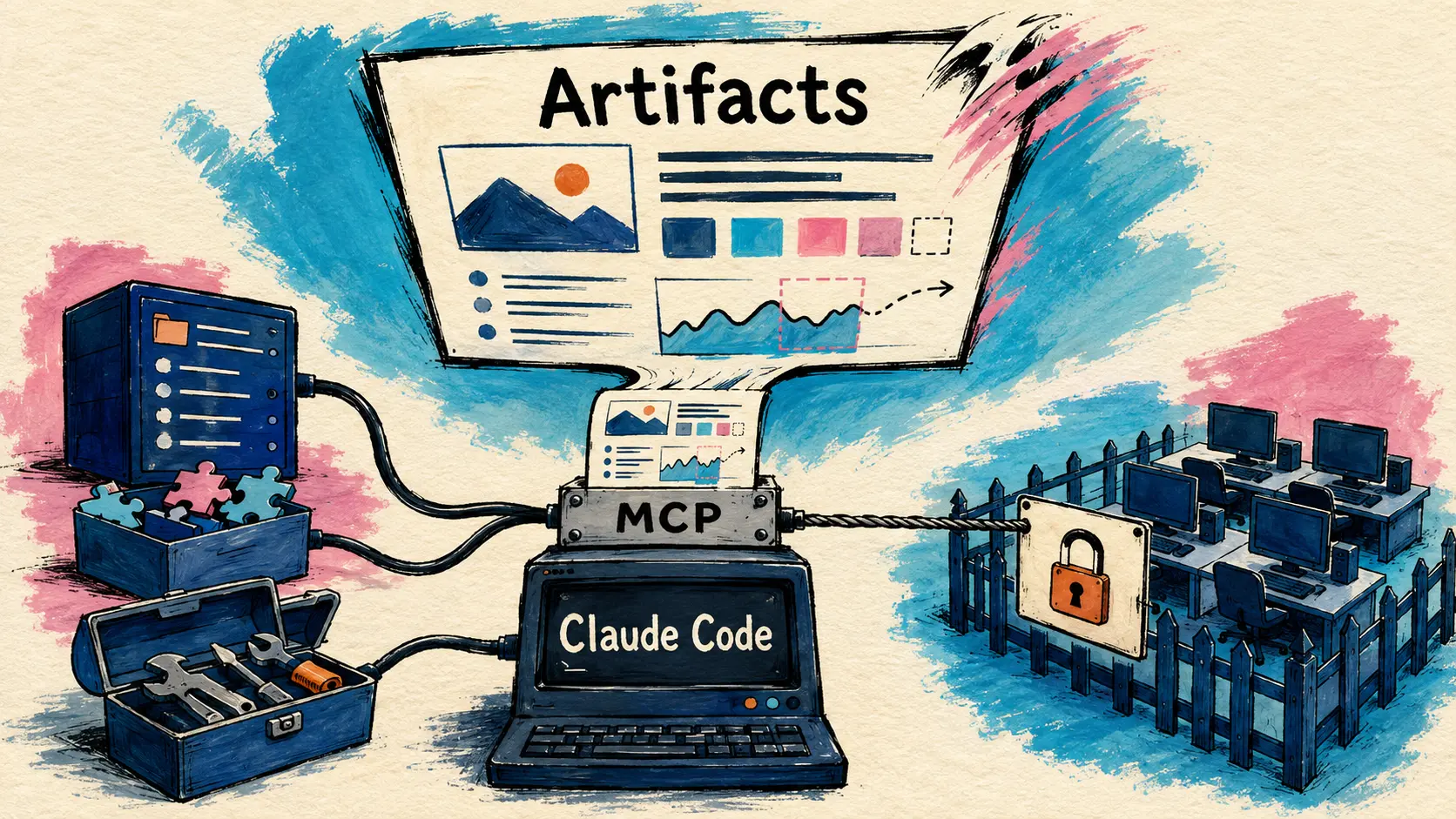
June 18 — Anthropic launches Artifacts in Claude Code: interactive pages generated directly from the working session, accessible through a shareable private link within the organization.
Artifacts draw on the full context of the session — codebase, plugins, skills, connected tools — and update automatically as the session progresses. Anyone with the link always sees the latest version.
Typical use cases:
| Use | Description |
|---|---|
| PR walkthrough | Automatically generated pull request presentation |
| Project dashboard | Real-time updates as the session progresses |
| Visual explanations | Complex code, system diagrams |
| Data analysis | Instantly shareable with the team |
Boris Cherny, Claude Code lead at Anthropic, describes Artifacts as a shift in how he collaborates with Claude: he uses them for visual explanations of tricky code, animation previews, and data analyses shared with the team.
Availability and mechanism:
| Aspect | Detail |
|---|---|
| Plans | Beta, Team, and Enterprise only |
| Mechanism | MCP extension (adoptable by any client/server/identity provider) |
| Sharing | Private link, restricted to the organization |
| Update | Automatic as the session progresses |
“Artifacts are now live in Claude Code. Ask Claude to turn what it’s working on into a page and send the link to your team. The page updates as the session keeps working.” — @ClaudeDevs
🔗 Claude Code Artifacts announcement
Noam Shazeer joins OpenAI
June 18 — Noam Shazeer announced that he is joining OpenAI, in a tweet that reached 9 million views in a few hours.
Who is Noam Shazeer? He is a co-author of the paper “Attention Is All You Need” (2017), which introduced the Transformer architecture — the foundation of all current large language models, from GPT to Gemini and Claude. After more than twenty years at Google, he left the lab in 2021 to co-found Character.AI, the personalized chatbot platform. In 2024, Google hired him back as part of a deal with Character.AI.
His arrival at OpenAI is a strong signal in the talent war: one of the intellectual architects of Transformers, a co-creator of the infrastructure on which all modern AI rests, chooses to join Sam Altman’s lab rather than remain in the Google ecosystem.
“I’m excited to share that I’ll be joining OpenAI and look forward to working with the exceptional team there. It was a difficult decision to move on. I’m incredibly proud of the amazing team at Google and everything we’ve built together. It has been an honor and a pleasure to work with all of you.” — @NoamShazeer
Codex Record & Replay — show a workflow once, reuse it
June 18 — OpenAI announces Codex Record & Replay, a feature that turns a demonstration recording into a reusable skill.
How it works: the user shows Codex a recurring workflow — filling out an expense report, submitting a leave request, or any repetitive task in a web interface or application. Codex records the demonstration, then automatically converts it into an inspectable and editable skill. The user keeps full control over the start and end of the recording.
This demonstration-based approach (learning from demonstration) lowers the automation barrier: unlike traditional approaches that require writing scripts, Record & Replay lets any user — without technical skills — turn repetitive tasks into autonomous agents. The pinned tweet on @OpenAIDevs drew 3.3 million views.
What changes in practice:
| Before | With Record & Replay |
|---|---|
| Write an automation script | Show the task once |
| Required technical knowledge | Accessible to any user |
| Skill locked in the script | Inspectable and editable skill |
🔗 Codex Record & Replay announcement
Midjourney Medical — new medical AI division with ultrasound scanner
June 18 — Midjourney, known for its AI image generator, announced Midjourney Medical, a new separate division accompanied by a first product: the Midjourney Scanner, a medical ultrasound imaging system. The announcement generated 16.6 million views and 38,000 likes.
The technical video published the same day shows a device with a ring of multiple transducers for high-resolution ultrasound imaging. In the AMA exchanges organized right after that (305,000 views, 875 questions), Midjourney clarified that the images shown come from an “initial prototype” and that there is still “a lot of room for improvement” — an important cautionary signal about the current maturity level.
The engagement is remarkable for a medical announcement: 10 million views for the technical tweet, and an AMA generating massive community interest. But concrete details about technical specifications, go-to-market timelines, and planned regulations have not been communicated at this stage.
Engagement data:
| Publication | Views | Engagement |
|---|---|---|
| Midjourney Medical announcement | 16.6M | 38k likes, 9k RT |
| Scanner technical video | 10M | 27k likes, 5k RT |
| AMA | 305k | 4k likes, 875 questions |
🔗 Midjourney Medical announcement
Claude Code v2.1.183 — enhanced automatic mode safety
June 19 — Version 2.1.183 of Claude Code introduces safety blocks in automatic mode to prevent accidental data destruction.
Commands now blocked if not explicitly requested:
| Command | Blocking condition |
|---|---|
git reset --hard, git checkout -- ., git clean -fd | Not requested by the user |
git stash drop | Not requested |
git commit --amend | If the commit was not created by the agent in the session |
terraform destroy, pulumi destroy, cdk destroy | If the stack was not explicitly mentioned |
The update also introduces a new /config key=value syntax for changing a setting directly from the prompt (in interactive mode, -p mode, and Remote Control), as well as /config --help to list available keys. A warning now appears on stderr when the requested model is deprecated. Several fixes address TUI issues in Windows Terminal, tmux panes, and WebSearch subagents.
GitHub Copilot — credit metrics, Opus 4.6 deprecation, PRs by author
Copilot Usage Metrics API — ai_credits_used field per user
June 19 — The Copilot metrics API exposes a new ai_credits_used field per user per day, available in users-1-day and users-28-day reports at the enterprise and organization levels. This field measures overall AI credit consumption — without breakdown by feature or model — and does not correspond to the billed amount (the billing API remains the reference for invoicing).
🔗 Copilot Usage Metrics changelog
Opus 4.6 (fast) deprecation on June 29
June 18 — GitHub announces the deprecation of Opus 4.6 (fast) across all Copilot surfaces on June 29, 2026. The recommended replacement model is Opus 4.8 (fast). Copilot Enterprise administrators will need to enable access to the new model in their model policies if necessary.
🔗 Opus 4.6 deprecation changelog
PRs created by Copilot in author:@me searches
June 18 — Pull requests created by Copilot cloud agent on behalf of a user now appear in author:@me searches on github.com/pulls. Attribution shows “username with Copilot” as the author. The feature is available on github.com and GitHub Mobile now; the REST and GraphQL APIs will follow on July 16, 2026.
Black Forest Labs — advocacy for open AI at the G7 summit
June 18 — Robin Rombach, co-founder and CEO of Black Forest Labs (BFL, 90 people, Germany and the United States), was invited to the G7 summit in Évian for an AI session bringing together Trump, von der Leyen, and Macron.
BFL is the company behind several of the most popular open-source generative AI models, including Stable Diffusion. Rombach argued for a regulatory framework favorable to open AI, saying that vision models will become “critical economic infrastructure” similar to language models. He highlighted BFL’s safety results: its latest open models show 10 times fewer vulnerabilities for non-consensual deepfakes and CSAM than open models from other major tech companies.
🔗 Black Forest Labs article on the G7
OpenAI research — reinforcement learning produces durable beneficial models
June 18 — OpenAI’s alignment team publishes research showing that reinforcement learning (RL) targeting beneficial traits — honesty, epistemic humility, metacognitive transparency, corrigibility, universal fairness — produces generalized improvements well beyond the training domain.
Key results:
| Result | Detail |
|---|---|
| Generalization | Improvement on 44 of 53 external and internal benchmarks |
| Cross-domain transfer | Training only on health data improves alignment in other domains |
| Adversarial resistance | Trained models are harder to steer toward harmful behavior |
| Resistance to malicious fine-tuning | Better robustness against fine-tuning aimed at inaccurate medical advice |
The models compared include GPT-5.5 Thinking, GPT-5.5 Instant, GPT-5.4 Thinking, o3, Claude Opus 4.7, Gemini 3.1 Pro, and Grok 4.20 on beneficial-trait criteria. This research suggests that reinforcing beneficial behaviors can generalize beyond the training context — a notable result for long-term AI safety.
Briefs
-
Claude Code weekly limits bug — About 3% of Max and Pro users encountered a bug showing an incorrect usage limit, in some cases blocking message sending. Fixed on June 19 with 5-hour and weekly limit resets for all affected users. 🔗 Source
-
Google DeepMind × UK government — Google DeepMind partners with DSIT, MHCLG, and the i.AI incubator to develop an AI prototype for handling planning permission applications, aiming to reduce processing times by up to 50%. 🔗 Source
-
GitHub Issues: duplicate detection and MCP fields — Creating an issue now suggests up to 3 existing similar issues (preview). The GitHub MCP server also allows reading and writing issue fields for AI agents. 🔗 Source
-
Luma Skills — Luma AI launches reusable workflows: a video generation output is turned into a tool applicable to any asset with consistent quality. Available on lumalabs.ai/app. 🔗 Source
-
Luma Timeline and EDL Export — Luma AI adds an integrated video editing space (Timeline) and export to professional finishing suites frame by frame (EDL Export), with no loss of quality. 🔗 Source
-
Pika Influencer Ignition Kit — Pika launches a pack of 4 AI skills for content creators (Persona Builder, Content Director, Viral Hook, Fix My Look), available via the Pika MCP for any compatible agent. 🔗 Source
What It Means
Agentic developer tooling is entering a phase of collaborative maturity. Claude Code Artifacts and Codex Record & Replay address the same need: making AI agents’ work visible, shareable, and reproducible. On one side, Anthropic makes it possible to turn a work session into an interactive page accessible to the team in real time. On the other, OpenAI makes it possible to capture a workflow demonstrated once and turn it into a reusable skill. These two approaches converge toward a model where the AI agent is no longer an isolated tool but a collaborator whose actions are documented and transferable.
Autonomous-mode security is becoming a differentiator. Claude Code v2.1.183 introduces explicit blocks on unsolicited destructive commands — git reset, terraform destroy, cdk destroy. It is a signal that teams are now deploying agents in auto mode on sensitive environments and that safeguards must evolve accordingly. OpenAI’s research on beneficial RL follows the same direction: building models whose alignment generalizes and withstands adversarial attacks, including after malicious fine-tuning.
Talent dynamics are redistributing symbolic weight among labs. The arrival of Noam Shazeer at OpenAI — co-author of the original Transformer paper, having passed through Google and Character.AI — is a major symbolic event. It illustrates the fluidity of career paths between major labs and OpenAI’s persistent attractiveness for foundational figures in the field. This hiring comes as competition on frontier models intensifies, with career trajectories reshaping the industry’s intellectual alliances.
Generative media is expanding into unexpected physical applications. Midjourney Medical represents an unusual pivot for a company known for artistic image generation: moving into an ultrasound medical imaging device. At this stage, it is an initial prototype with “plenty of room for improvement,” according to the company itself. The community’s massive engagement (more than 26 million combined views across the two main tweets) signals genuine interest, but details on specifications, timelines, and the regulatory framework remain to be defined.
Sources
- Claude Code Artifacts — announcement from @claudeai
- Claude Code Artifacts — announcement from @ClaudeDevs
- Claude Code CHANGELOG v2.1.183
- Claude Code limits bug @ClaudeDevs
- Noam Shazeer joins OpenAI
- Codex Record & Replay — @OpenAIDevs
- OpenAI Alignment Research — beneficial RL
- Copilot Usage Metrics API — ai_credits_used
- Deprecation of Opus 4.6 (fast) in Copilot
- Copilot PRs in author searches
- GitHub Issues — duplicates and MCP fields
- Midjourney Medical — announcement
- Midjourney Scanner — technical video
- Midjourney Medical — AMA
- Black Forest Labs — open AI G7
- Robin Rombach @robrombach at the G7
- Google DeepMind × UK government
- Luma Skills
- Luma Timeline + EDL Export
- Pika Influencer Ignition Kit