ai-powered-markdown-translatorArticle translated from fr to en with gpt-5.4-mini.
June 26, 2026 is a packed day on several fronts: OpenAI unveils the limited preview of the GPT-5.6 series (Sol, Terra, Luna), a new naming system with lower prices on Terra and Luna; Anthropic publishes its sixth Economic Index, “Cadences,” with the results of a survey of 9,700 users; Gemma 4 crosses 200 million downloads in 2.5 months and becomes the first multimodal model on Cerebras at 1,500 tokens per second. On the developer tooling side, GitHub Desktop 3.6 adds worktrees and the Copilot SDK, Copilot for Jira reaches general availability, and the LSP Setup skill brings semantic intelligence to Copilot CLI across 14 languages. HeyGen announces $200 million in ARR in eight months, and Cohere positions itself around enterprise sovereignty in response to government restrictions on GPT-5.6.
GPT-5.6 Sol, Terra and Luna — limited preview of the new OpenAI generation
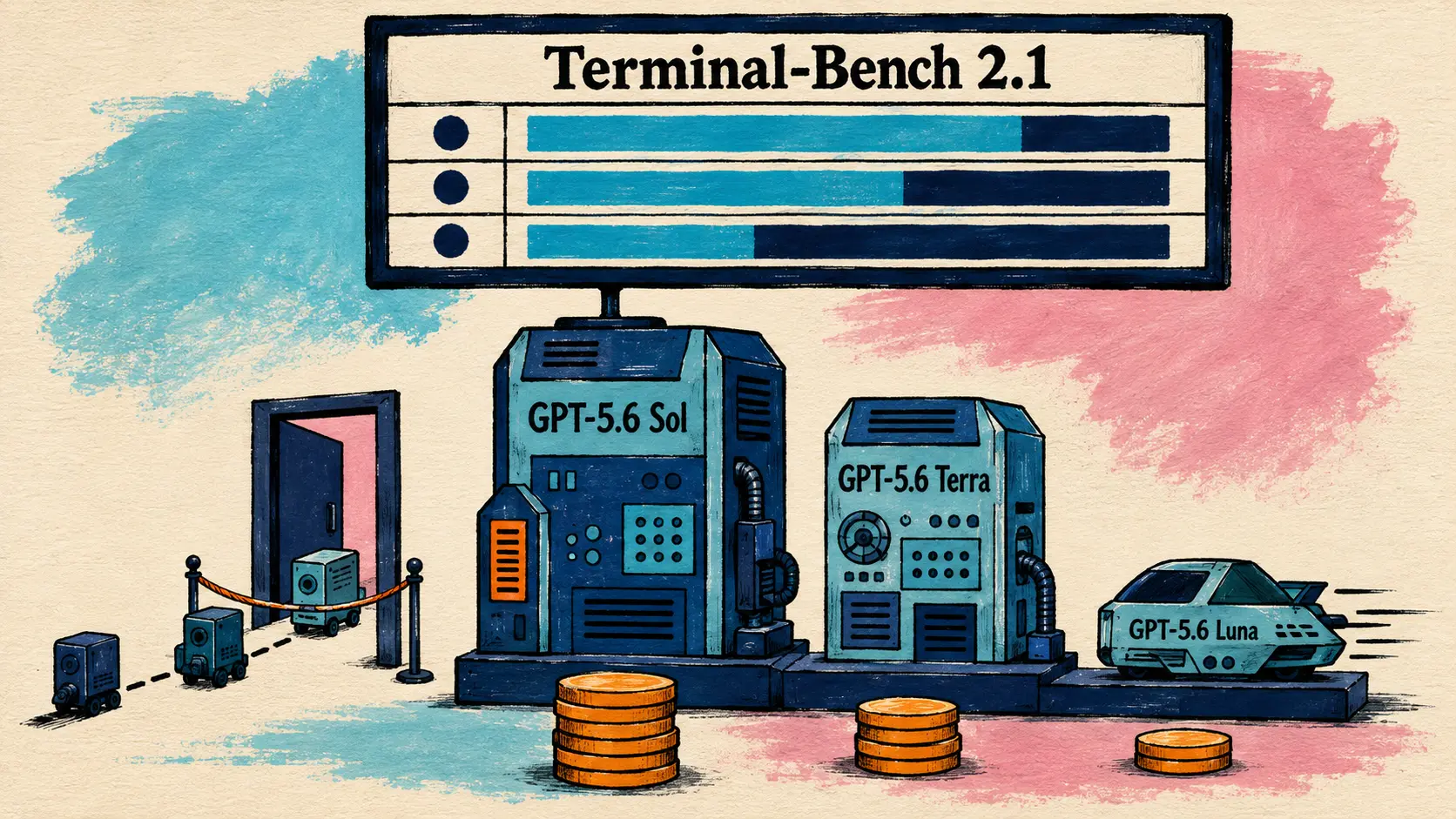
June 26 — OpenAI launches a limited preview of the GPT-5.6 series, made up of three models with distinct positioning. The series introduces a new naming system: the number (5.6) identifies the generation, while Sol, Terra, and Luna designate durable capability tiers that can evolve independently.
“Introducing a limited preview of GPT-5.6 Sol, our next generation frontier model, as well as GPT-5.6 Terra, a balanced model for efficient, everyday work, and GPT-5.6 Luna, a fast and affordable model for high-volume work.” — @OpenAI on X
Three models, three capability levels
- GPT-5.6 Sol: next-generation flagship model, the most capable to date for cybersecurity, code, and biology. Introduces a maximum reasoning effort level and an ultra mode that uses sub-agents to speed up complex tasks.
- GPT-5.6 Terra: balanced model for everyday work, with performance comparable to GPT-5.5 but twice as cheap.
- GPT-5.6 Luna: fast and economical model for high volumes, at the lowest cost in the range.
Pricing and performance
| Model | Input (per million tokens) | Output (per million tokens) | Positioning |
|---|---|---|---|
| GPT-5.6 Sol | $5 | $30 | Flagship / Frontier |
| GPT-5.6 Terra | $2.50 | $15 | Balanced, 2× cheaper than GPT-5.5 |
| GPT-5.6 Luna | $1 | $6 | Fast / economical |
On benchmarks, Sol sets a new state of the art on Terminal-Bench 2.1 (code/CLI) and outperforms GPT-5.5 on GeneBench v1 (biology) with fewer tokens. On ExploitBench² (cybersecurity), Sol is comparable to Mythos Preview with about one-third of the output tokens. Sol will be available on Cerebras at up to 750 tokens per second starting in July 2026.
Strengthened safety and restricted availability
OpenAI says it has deployed the most robust safety stack to date: more than 700,000 A100-equivalent GPU hours devoted to automated red teaming, real-time classifiers for cybersecurity and biology, and account-level review to detect persistent malicious behavior. GPT-5.6 Sol does not cross the “Cyber Critical” threshold in OpenAI’s Preparedness Framework.
At the request of the U.S. government, OpenAI is starting with a limited preview for a small group of trusted partners, before a broader rollout “in the coming weeks” via the API, Codex, and ChatGPT.
🔗 OpenAI Blog — GPT-5.6 Preview
Anthropic Economic Index — sixth report “Cadences”
June 26 — Anthropic publishes the sixth report of the Anthropic Economic Index, titled “Cadences.” It is the first edition to combine continuous hourly sampling, a classifier for produced artifacts, and the results of a survey of 9,700 Claude users.
New methodology
| Change | Description |
|---|---|
| Hourly sampling | Data collected continuously (no longer on a 7-day window) — observable hour-by-hour variations |
| Artifact classifier | Each conversation categorized by its main output (explanation, document, code, etc.) |
| Granular data | Split between Claude conversations (chat + Cowork) and 1P API, aggregated at the monthly level |
The rhythms of usage
Usage reflects the calendar and daily habits: the share of personal conversations rises from ~35% on weekdays to ~50% on weekends. Cooking recipes are requested 2.3 times more often at 6 p.m. than on average; sleep advice peaks around 5 a.m. Tax-related requests were eight times more frequent on April 14 (the day before the U.S. filing deadline) than the May average. On Claude Code, the uses that drop the most on weekends are back-end architecture and API debugging; the ones that rise the most: AI agent design, quantitative trading, and video games.
What Claude produces
93% of conversations produce an identifiable artifact: explanations (17%), documents and reports (15%), advice (11%), code and scripts (~16% combined). Apps and websites consume more than three times the tokens of a median conversation. Claude responds, on average, at a reading level about one year of schooling above the prompt — the gap is largest for images and charts (+2.6 years), games (+1.9), and apps (+1.7).
The survey of 9,700 respondents
| Indicator | Value |
|---|---|
| Expect significant changes to their responsibilities within 12 months | >1/3 |
| Think AI will be able to handle most of their tasks within 12 months | >35% |
| Report productivity gains in speed | 86% |
| Report productivity gains in amount of work | 82% |
| Report productivity gains in quality | 69% |
| Learn more thanks to AI | 68% |
| Feel AI increases the value of their skills | 57% |
| Think it is likely they will lose their own job | ~10% |
| Think it is likely their younger colleague will lose their job | >1/3 |
Core finding: the users who delegate the most to Claude are also the most optimistic about AI’s impact on their job and skills — without that being accompanied by a reduction in perceived learning. Women make up 12% of the paired sample; after controlling for differences in occupation, they use Claude Code 6.3 percentage points less, but spend more active time on chat.
🔗 Anthropic Economic Index — Cadences report
Claude Code v2.1.193 — autoMode, OpenTelemetry and bash autocompletion
June 25 — Claude Code v2.1.193, released late in the evening, brings several new features focused on automatic mode control, observability, and terminal ergonomics.
| Feature | Detail |
|---|---|
autoMode.classifyAllShell | All Bash/PowerShell commands go through the automatic mode classifier |
| Auto-mode refusal reasons | Recorded in the transcript, the toast, and the /permissions tab |
OpenTelemetry claude_code.assistant_response | Logs the model response text (hidden by default; OTEL_LOG_ASSISTANT_RESPONSES=1) |
Bash path autocompletion (!) | Suggested paths in real time as you type |
| MCP auth notification | Notice to /mcp if servers require authentication at startup |
| Idle shell auto-response in the background | Commands waiting for input receive an automatic response (disable via CLAUDE_CODE_DISABLE_BG_SHELL_PRESSURE_REAP=1) |
Several regressions are fixed: pinned background agents are no longer re-prompted to “continue where you left off” after each automatic update, and the phantom “general-purpose (resumed)” sub-agent that restarted the main conversation is removed. The headersHelper MCP restarts and reconnects automatically after a 401/403 return.
Google / Gemini — Gemma 4 on Cerebras, 200M downloads and June Drops
Gemma 4 × Cerebras — first multimodal model at 1,500 tokens/s
June 26 — Gemma 4 becomes the first multimodal model available on Cerebras. The 31B version runs at 1,500 tokens per second on Cerebras infrastructure. A 24-hour virtual hackathon is scheduled for June 28 with $5,000 in prizes for participants, who get early access to Gemma 4 on Cerebras via Luma (Cerebras × Google Gemma 4: $5,000 Hackathon).
🔗 @googlegemma tweet — Cerebras × Gemma 4
Gemma 4 — 200 million downloads in 2.5 months
June 25 — The Gemma 4 family surpasses 200 million downloads in just 2.5 months since launch. For context, the entire Gemma family totaled 100 million downloads at the launch of Gemma 3 — so Gemma 4 doubled that total in 2.5 months. This milestone was retweeted by @GoogleDeepMind, showing how much weight Google assigns to this result.
🔗 @googlegemma tweet — 200M downloads
Gemini Drops June 2026 — real-time voice images and SMB tools
June 26 — The Gemini app publishes its June monthly recap (“Gemini Drops”): real-time image generation with voice and new tools for small businesses. The tweet links to a Google blog post detailing the month’s features.
🔗 @GeminiApp tweet — Gemini Drops June 2026
GitHub Copilot — Desktop 3.6, Jira GA and semantic CLI intelligence
GitHub Desktop 3.6 — Worktrees and Copilot SDK
June 26 — GitHub Desktop 3.6 brings two major changes: support for Git worktrees and deeper Copilot integration through the new Copilot SDK.
| Feature | Detail |
|---|---|
| Copilot SDK | Common foundation for all Copilot features in Desktop |
| Commit authoring | Generates messages respecting .github/copilot-instructions.md and AGENTS.md |
| Conflict resolution | AI explains conflicting changes and suggests a resolution to accept or edit |
| Git worktrees | Work on multiple branches in parallel without stashing or repeated cloning |
| Model picker | Choose the model for each Copilot feature |
| BYOK | Connect to a third-party provider or a local model |
Available for macOS and Windows (GitHub Desktop 3.6.0). Worktrees are especially useful with coding agents that create isolated workspaces (worktrees).
🔗 GitHub Changelog — Desktop 3.6
GitHub Copilot for Jira — General Availability
June 25 — GitHub Copilot for Jira moves into general availability (GA) after a public preview since March 2026. GA brings two new capabilities: progress streaming (coding agent updates sent in real time to the Jira ticket without switching context) and post-session steering (after opening a draft PR, the user can give new instructions directly in Jira; the agent continues on the same PR). Organization onboarding for GitHub and repositories is simplified.
🔗 GitHub Changelog — Copilot for Jira GA
LSP Setup skill — semantic intelligence across 14 languages for Copilot CLI
June 25 — GitHub Copilot CLI gets a new LSP Setup skill that gives it genuine semantic code intelligence — definitions, references, types — via LSP (Language Server Protocol) servers, replacing the grep/decompilation approach. Coverage: 14 languages. LSP server configuration and installation are handled by the skill.
🔗 GitHub Blog — LSP Setup skill · @github tweet
Open models and research — HF Jobs vLLM and Sakana CoffeeBench
HF Jobs — OpenAI-compatible vLLM server in one command
June 26 — Hugging Face publishes an official guide for launching a private, OpenAI-compatible vLLM server on HF Jobs infrastructure with a single command (hf jobs run --flavor a10g-large --expose 8000 vllm/vllm-openai:latest vllm serve Qwen/Qwen3-4B). No Kubernetes, no servers to provision, billed by the second.
| Aspect | Detail |
|---|---|
| Available GPUs | A10g-large (1.50 USD/h), H200×2, H200×8 |
| Protocol | OpenAI-compatible (ChatCompletions), HF token authentication |
| SSH access | hf jobs run --ssh + hf jobs ssh <job_id> |
| Tested models | Qwen3-4B, Qwen3.5-122B-A10B (MoE, 2×H200) |
| Gradio interface | Streaming support with collapsible reasoning |
| Coding agent | Pi framework integration (provider-agnostic) |
| Inference Endpoints difference | Jobs = experimentation/evals, Endpoints = production with scale-to-zero |
Prerequisite: huggingface_hub >= 1.20.0.
Sakana CoffeeBench — 90-day multi-agent simulation of the coffee supply chain
June 26 — Sakana AI, in collaboration with Azusa Audit Corporation, publishes CoffeeBench: a benchmark evaluating the long-term management capabilities of LLM agents. Six companies (farmers, roasters, retailers), each managed by a distinct agent, conduct price negotiations, place orders, and manage their inventories over 90 simulated days with the goal of maximizing net profits. The results reveal significant behavioral differences between models: some agents negotiate actively, others analyze without acting and end up in the red. The research will be presented at the ICML 2026 workshop “Failure Modes in Agentic AI.” The tweet received 173,800 views.
🔗 Sakana — CoffeeBench · arXiv 2606.16613 · @SakanaAILabs on X
HeyGen surpasses 200 million USD in ARR in eight months
June 25 — HeyGen, the identity-first AI video platform, announces that it has surpassed 200 million USD in ARR (annual recurring revenue), doubling in eight months. The growth reflects rapid adoption both by independent creators and by 85% of Fortune 100 companies.
| Metric | Value |
|---|---|
| ARR | 200 million USD (doubled in 8 months) |
| Users | 30 million |
| Countries | 196 |
| Languages | 175+ |
| Fortune 100 | 85% |
| Videos created | 118 million |
| Capital efficiency | 2.70 USD ARR per dollar raised |
HeyGen highlights Avatar V (15 seconds of video are enough to create a digital twin), HyperFrames (open source Apache 2.0 framework for agentic video creation, 21,600 GitHub stars in one month), and HeyGen MCP integration for AI agent workflows. 63 features were launched in 3 months.
🔗 HeyGen Blog — 200 million USD ARR
Cohere — enterprise sovereignty in the face of GPT-5.6 restrictions
June 25 — Cohere publishes an aggressive positioning tweet on sovereignty and enterprise control, in reaction to OpenAI’s announcement limiting GPT-5.6 to a small group of partners at the request of the U.S. government.
“When you use Cohere, there are no staggered releases. No sudden disablements. We trust you completely: ‘[The customer] is in full control. We can’t see in, we can’t switch it off.’” — @cohere on X, citing Aidan Gomez, CEO of Cohere
This positioning comes on the same day OpenAI announces that GPT-5.6 Sol, Terra, and Luna will be available “generally only in the coming weeks,” for now only to a small group at the request of the U.S. government. The tweet received 18,900 views.
Briefs
-
Warp — Cloud Software Factory series (article 1) (June 25) — First article in a Warp series on building a cloud software factory with skills and loops. This episode covers the “automatic triage skill” for automating ticket triage in a development workflow. Educational content (7 min read). 🔗 Warp Blog
-
Sakana Fugu — arXiv technical report 2606.21228 (June 26) — Official Fugu technical report published on arXiv, complementing the June 22 launch. Documents the Fugu, Fugu-Ultra, and Fugu-Llama architectures on coding, reasoning, roleplay, and agentic task benchmarks (including SWE-Bench Pro). 🔗 arXiv 2606.21228 · Tweet @SakanaAILabs
-
Antigravity 2.2.1 (June 25) — Google’s AI development environment releases version 2.2.1: new integrated “Antigravity Guide” skill, audio file rendering, substring file search, 19 improvements, and 17 fixes. Previous version: 2.1.4 from June 11. 🔗 Antigravity — changelog
-
Copilot code review — efficiency updates (June 25) — Copilot code review now uses native CLI/SDK tools (grep, rg, glob, view), reducing costs by 20% while maintaining quality. Medium analysis depth enables attribution in the PR summary comment and organization-level review depth configuration. 🔗 GitHub Changelog
-
MAI-Code-1-Flash extended to Copilot Business and Enterprise (June 26) — The MAI-Code-1-Flash model is now available to Copilot Business and Copilot Enterprise plans. 🔗 GitHub Changelog
-
Cohere — “Taps sign” meme reaction (June 26) — In response to restricted access to GPT-5.6 Sol, Cohere posts a humorous meme on X featuring a photo of Aidan Gomez on the cover of FORTUNE, implying their CEO has already said the essential point. The tweet reaches 37,800 views and 444 likes. 🔗 Tweet @cohere
What it means
Fragmentation of access to frontier models is becoming a business issue. GPT-5.6 Sol is launched in limited preview at the request of the U.S. government — an unprecedented phased rollout at this scale for OpenAI. Cohere responds immediately with a position on full customer sovereignty (“We can’t see in, we can’t switch it off”), signaling that enterprise control over AI models is becoming a differentiating sales argument. The following day’s meme confirms that this positioning is deliberate and coordinated. The GPT-5.6 Sol/Terra/Luna series also represents a notable naming shift: durable names that can evolve independently, rather than a fixed version number.
Measuring AI’s economic impact is gaining depth and nuance. Anthropic Economic Index “Cadences” is the first edition to combine real usage data with a survey of 9,700 respondents. The results add nuance to the dominant narrative: 86% report productivity gains in speed, but the users who delegate the most are also the most optimistic — without this being accompanied by a reduction in perceived learning. The gender gap (12% women in the paired sample, -6.3 points of Claude Code usage) remains poorly explained but is documented for the first time at this granularity. The temporal rhythms of usage (tax filings at 2 p.m., earnings at 6 p.m., sleep at 5 a.m.) offer a concrete reading of how AI fits into everyday life.
Development team tooling is densifying simultaneously on several fronts. GitHub Desktop 3.6, Copilot for Jira GA, and the LSP Setup skill for Copilot CLI arrive on the same day, forming full coverage of the development cycle: desktop (Desktop), project management (Jira), terminal (semantic CLI on 14 languages). Claude Code v2.1.193 adds OpenTelemetry observability for model responses and automatic shell command classification, two features that address enterprise compliance and traceability needs. HF Jobs vLLM, meanwhile, lowers the entry barrier for on-demand inference without infrastructure to manage.
Open models and AI video are reaching commercial milestones that reshuffle the board. Gemma 4 doubles in 2.5 months the historical total of the Gemma family at the launch of Gemma 3, and becomes the first multimodal model to run on Cerebras at 1,500 tokens/s. HeyGen (200 million USD ARR, 2.70 USD ARR per dollar raised) shows that AI video can achieve rare capital efficiency in the tech sector. Sakana’s CoffeeBench illustrates a third form of contribution: multi-agent benchmarks over long horizons (90-day supply chain) that capture behaviors classical evaluations do not see — gaps that will be presented at ICML 2026.
Sources
- OpenAI Blog — GPT-5.6 Preview
- @OpenAI Tweet — GPT-5.6
- Anthropic Economic Index — Cadences report
- @AnthropicAI Tweet — Economic Index
- Claude Code v2.1.193 changelog
- @googlegemma Tweet — Gemma 4 × Cerebras
- @googlegemma Tweet — 200M downloads
- @GeminiApp Tweet — June 2026 Gemini Drops
- GitHub Changelog — Desktop 3.6
- GitHub Changelog — Copilot for Jira GA
- GitHub Blog — LSP Setup skill
- @github Tweet — LSP Setup
- HF Blog — vLLM on HF Jobs
- Sakana — CoffeeBench
- arXiv 2606.16613 — CoffeeBench
- @SakanaAILabs Tweet — CoffeeBench
- HeyGen Blog — 200 million USD ARR
- @cohere Tweet — enterprise sovereignty
- @cohere Tweet — Taps sign meme
- Warp Blog — Cloud Software Factory
- arXiv 2606.21228 — Sakana Fugu Technical Report
- @SakanaAILabs Tweet — Fugu Technical Report
- Antigravity — changelog
- GitHub Changelog — Copilot code review efficiency
- GitHub Changelog — MAI-Code-1-Flash Business/Enterprise