ai-powered-markdown-translatorArticle translated from fr to en with gpt-6.1-sol.
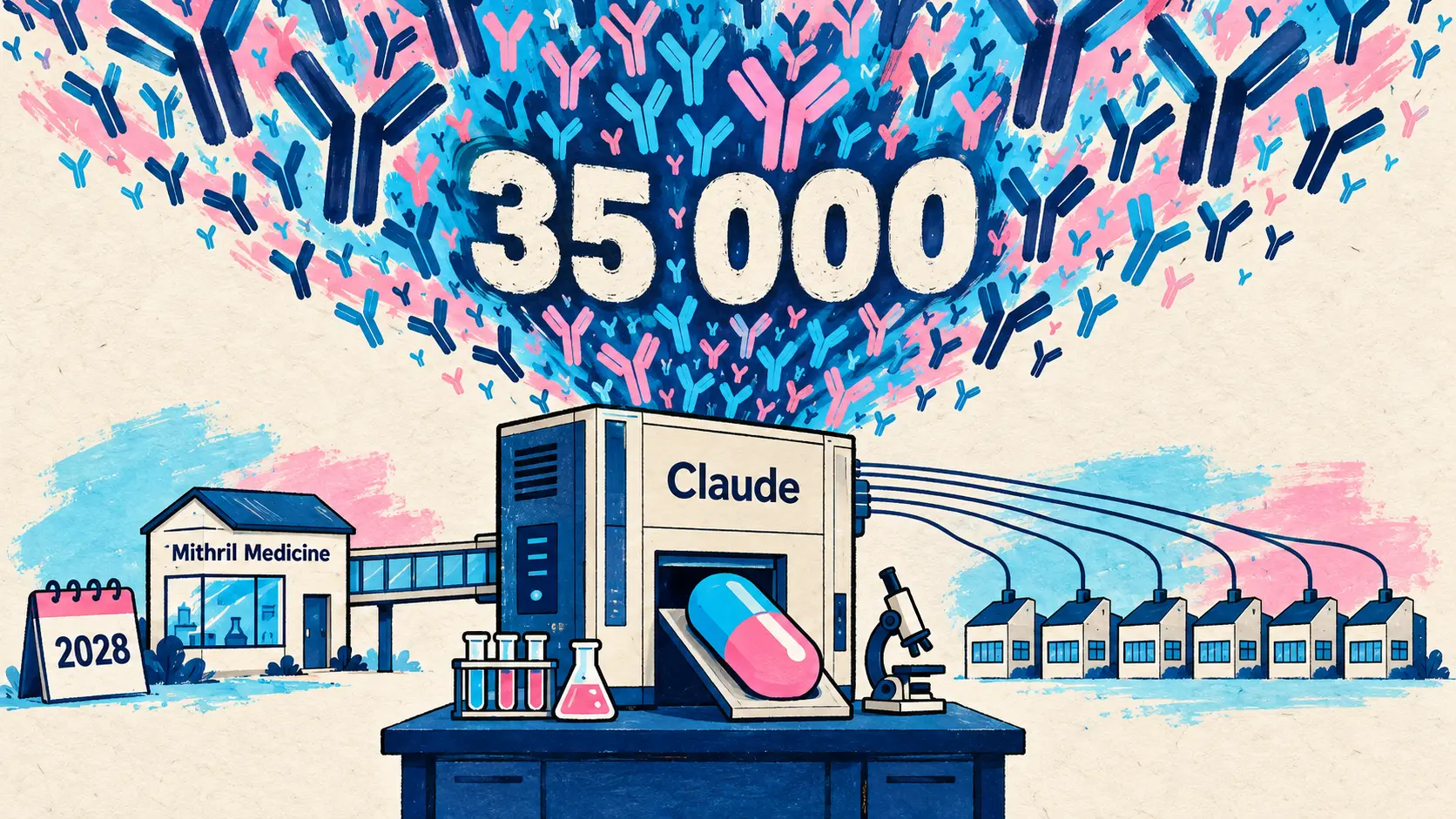
Anthropic publishes its first quantitative progress report on its drug development work with six partners, from Generate Biomedicines to Bristol Myers Squibb, and acquires Mithril Medicine, whose first human trial could begin in late 2028. Google DeepMind unveils Genie 4, a real-time world model that also generates sound, and Liquid AI releases LFM3, six open models in the 2B class designed to run on-device. On the tools front, Claude Code, Codex CLI, Gemini CLI and Vibe CLI release new versions, Cognition launches FrontierCode 2.0, where no model exceeds 45.5%, and Cohere releases materials to reproduce its observation about Qwen3.8-Flash-Next.
Anthropic reports on its drug discovery work with six partners and acquires Mithril Medicine
October 27 — Anthropic’s Science team publishes its first progress report on its drug development work. For several months, its scientists have been conducting in-depth research partnerships with six organizations: BigHat Biosciences, Bristol Myers Squibb, Divergence Labs, Enveda, Generate Biomedicines and The Column Group. Anthropic wants to involve Claude at every stage, from target selection to clinical trials, including manufacturing and regulatory submissions, rather than just molecule design: according to the post, bottlenecks are spread across the entire pipeline.
| Research partner | Development stage | Published result |
|---|---|---|
| Generate Biomedicines | Therapy engineering | Version approximately 70 % shorter, approximately 10 times more receptors produced |
| Divergence Labs | Candidate generation | Approximately 35 000 antibody designs in one month, 3 appear to outperform standard treatment |
| BigHat Biosciences | Candidate optimization | Approximately 1 010 variants in 10 weeks, binding more than 10 times stronger |
| Enveda | Manufacturing and documentation | 11 out of 11 issues found, 7 more identified, human review reduced by 89 % |
| The Column Group | Company formation | Pleiades, first skill evaluated on 45 target-disease pairs |
| Bristol Myers Squibb | Trial planning | Likelihood of success for an early-stage trial assessed, expansion planned in 2027 |
| Mithril Medicine | Internal program (acquisition) | From idea to mouse results in under 18 months, trials as early as late 2028 |
The most striking results come from the laboratory. At Generate Biomedicines, six scientists used Claude Code to shorten part of the genetic instructions for a CAR-T therapy against solid tumors: the version, approximately 70% shorter, makes immune cells produce approximately 10 times more receptors, and these cells kill tumor cells more effectively. At Divergence Labs, Claude generated approximately 35,000 antibody designs against food allergies, largely autonomously. There are administrative gains too: at Enveda, whose chemists spent up to 75% of their time on paperwork, Claude reviewed 1,061 pages of manufacturing documentation and cut human review time from more than 25 hours to fewer than 3.
Anthropic is also acquiring Mithril Medicine, a one-person company working on two rare forms of childhood muscular dystrophy. Its founder, Cody Tranbarger, had tasked Claude with coordinating contracts, logistics and experiments with 11 external laboratories. Now at Anthropic, he is continuing this research; a first human trial could begin as early as late 2028 if the candidates hold up.
Anthropic remains cautious: this work is at an early stage and mostly preclinical. The post recalls the other aspects of its life sciences efforts, including Claude Science, credits for researchers and the Life Sciences Verification Program.
Over the past few months, Anthropic scientists have engaged in deep research partnerships with six organizations developing new medicines. We’ve also begun drug discovery efforts of our own. — @AnthropicAI on X
Google DeepMind unveils Genie 4, a real-time world model that also generates sound
October 27 — Google DeepMind introduces Genie 4, the next generation of its world model (world model), a model that generates an environment to explore in real time, rather than a fixed video. The post, authored by Raia Hadsell, Diego Rivas and Hang Qi, was pinned by @GoogleDeepMind and @GoogleAI. Genie 4 succeeds Genie 3, made available to Google AI Ultra subscribers in February.
The most noticeable addition is sound: according to Google DeepMind, Genie 4 is its first real-time world model to generate audio natively, alongside the visuals. Each setting has its own soundscape, music and background sounds follow the scene, and characters can engage in interactive dialogue that adapts to the user’s actions. On the visual side, photorealism comes from Gemini Omni, the physics handles aerodynamics and collisions better, and simulated people move and react more naturally, the improvement Google considers the most significant.
Control uses the keyboard and natural language: at any time, users can change the weather, move the camera or introduce a character. Gemini 3.8 Flash acts as a guide agent in the loop: it observes the scene, breaks a goal into steps, checks the images to confirm each step succeeded and adjusts its plan if the world changes or the user intervenes. In an experiment with Gemini 4 Argon and Gemini Robotics, Argon breaks a task into text captions sent to Genie 4; it shows Apptronik’s Apollo humanoid playing checkers in a simulated world.
| Announced feature | Details according to Google DeepMind |
|---|---|
| Visual rendering | Built on Gemini Omni (photorealism) |
| Reasoning in the loop | Gemini 3.8 Flash as a guide agent, experiments with Gemini 4 Argon and Gemini Robotics |
| Generated audio | Ambience, music, background sounds and interactive dialogue |
| Access today | Research preview (research preview) for trusted testers |
| Access announced as “coming soon” | Google AI Ultra in Project Genie, Gemini API and Google AI Studio partners |
| Traceability of generated content | SynthID watermark on all video and audio |
Testers come from film, gaming, journalism, education and engineering; a waitlist is open, with no date given. Google acknowledges limitations: consistency holds only over short sessions, details and object permanence drift over time or after several changes, and readable text, spatial accuracy and complex physical interactions remain research topics. The post provides no benchmark, resolution, session duration or pricing.
Open models: Liquid AI’s LFM3, six models in the 2B class, and inclusionAI’s Ling-3.1-flash-1019
October 27 — Liquid AI releases LFM3, the next generation of its foundation models designed to run on-device. Rather than a large general-purpose model, the family consists of six models in the 2B class derived from a shared foundation, LFM3-1.7B-Base, which is also being released: a text model, a vision-language model that now accepts video, an audio model, a first “omni” model that sees, listens and responds aloud, and two decision models, d1-2B and d1-omni-2B. All are on Hugging Face under the company’s own lfm1.0 license, and each can be fine-tuned on a single GPU.
The foundation adopts a new architecture. Its 24 layers combine 13 gated short convolutions, 5 sliding-window attention layers with a window of 256 tokens and 6 global attention layers, a combination selected through an architecture search across 14 device and backend combinations, from the Raspberry Pi 5 to Qualcomm’s Hexagon NPU. Pretrained on 22 trillion tokens, it supports up to 256K tokens of context. According to Liquid AI, LFM3-1.7B outperforms LFM2.5-2.6B with 35% fewer parameters, especially on agent tasks, and fits in approximately 1 GB at 4-bit precision.
| LFM3 model | Input modalities | Reference result published by Liquid AI |
|---|---|---|
| LFM3-1.7B | Text | 38,42 on WebArena-Verified (3,02 for LFM2.5-2.6B) |
| LFM3-VL-2B | Text, images, video | 71,4 average across 62 visual benchmarks (57,6 for LFM2.5-VL-3B) |
| LFM3-Audio-2B | Text, audio | UTMOSv2 of 3,83 (3,22 for LFM2.5-Audio-1.5B), 18 languages |
| LFM3-Omni-2B | Text, images, video, audio | Ahead of Qwen2.5-Omni-7B on Daily-Omni, WorldSense, AV-SpeakerBench |
| d1-2B | Text, images, video | 75,5 on ImajevBench (64,0 for d1-3B), with one-third fewer parameters |
| d1-omni-2B | Text, images, video, audio | Adds audio to the decision models |
The encoders are developed in-house: the 164M-parameter visual encoder matches that of Qwen3.5-2B while using 2.2 times less compute, and the fully causal audio encoder produces a first token in as little as 50 ms. LFM3-VL-2B has 1.9 billion parameters compared with 3.1 for LFM2.5-VL-3B, and Liquid AI places it on par with Gemma 4 12B. In robotics, a vision-language-action model derived from LFM3-VL-2B achieves an average success rate of 96.2% on LIBERO and generates its actions in under 50 ms on a Jetson AGX Orin. All these figures come from Liquid AI; for the omni model, the post publishes no scores.
🔗 Liquid AI’s post on Hugging Face
inclusionAI releases Ling-3.1-flash-1019, an update to its open 560-billion-parameter MoE
October 27 — inclusionAI uploads Ling-3.1-flash-1019 to Hugging Face under the MIT license and without an announcement, a post-training update to Ling-3.1-flash. The model remains a MoE with a hybrid linear architecture and 560 billion parameters, of which 25 billion are active per token, with a context of one million tokens. According to the model card, improvements mainly concern agent and science tasks:
| Benchmark (inclusionAI model card) | Ling-3.1-flash | Ling-3.1-flash-1019 |
|---|---|---|
| AA-Briefcase (Elo) | Approximately 1 400 | 1 524 |
| AutomationBench-AA | 62 % | 68 % |
| CritPt | 18 % | 26 % |
| SciCode | 54 % | 57 % |
| AA Intelligence Index v4.3.2 | 41 | 44 |
A community post by alphaBell Research notes that the configuration, tokenizer and loading code are byte-for-byte identical to those of Ling-3.1-flash: only the 54 weight shards change, allowing the old version to be replaced without changing the deployment.
Command-line coding agents: Claude Code, Codex CLI, Gemini CLI and Vibe CLI
Four command-line coding agents release new versions on October 26 and 27. The smaller updates to Copilot CLI, Qwen Code, the mistral CLI and Antigravity are in the Briefs.
| Command-line agent | Released version | Release date | Highlight |
|---|---|---|---|
| Claude Code | 2.1.311 | October 26 | ultrathink at xhigh effort, 56 fixes |
| Claude Code | 2.1.312 | October 27 | 5-hour limit renamed, 22 fixes |
| Codex CLI | 0.165.0 | October 27 | Built-in Vertex AI provider, memory v2 by default |
| Gemini CLI | v0.66.0 and v0.67.0-preview.0 | October 27 | Spending cap recognized as exhausted quota |
| Vibe CLI | 3.0.3 | October 26 | strict_config, six breaking changes |
Claude Code 2.1.311 and 2.1.312: ultrathink at xhigh effort, compaction beyond 200,000 tokens and the 5-hour limit
October 26 and 27 — Version 2.1.311 (92 entries, including 56 fixes), released on the evening of October 26, starts a turn triggered by ultrathink at xhigh effort on Opus 5.5, Sonnet 5.5, Haiku 5.5 and Fable 5.1 through Anthropic’s API; when typed while Claude is working, the keyword raises the effort for the rest of the turn. A standard-context session that exceeds 200,000 tokens no longer stops at the Usage credits required for 1M context message: Claude Code compacts the conversation and continues. It no longer retries requests that the API marks as non-retryable, which could stall a turn for several minutes, and on Bedrock, Mantle, Vertex and Foundry, it loads its model settings from a signed file.
Version 2.1.312 (39 entries, including 22 fixes) replaces session limit with 5-hour limit in usage-limit messages and adds an effort level to the model selector for cloud routines. Write no longer rewrites a very large CLAUDE.md after reading only its beginning, prompt and agent hooks now allow 24 concurrent executions per session (2.1.302 limited them to 12 per event), and the OpenTelemetry event claude_code.safety_event is no longer sent.
🔗 2.1.311 release notes · 2.1.312 release notes
Codex CLI 0.165.0 integrates a Vertex AI provider and enables memory v2 by default
October 27 — Four days after 0.164.0, OpenAI releases Codex CLI 0.165.0. A Google Cloud Vertex AI provider is built in and enabled with model_provider = "gcp", extending to the terminal the arrival of Codex on Google Cloud announced on October 21; GPT-6.1 Terra, launched the previous day, joins the model catalogs. Two settings become defaults: reasoning effort can change mid-conversation on supported models, and memory v2 becomes the default for new profiles, with support for importing memories from other agents. Codex already had memory; v2 is what now turns on automatically. The session picker gains a repository filter, the app-server API gains experimental attached conversation forks, and a fix closes a marketplace URL validation vulnerability that could cause Git to connect to a different host from the one validated.
🔗 Codex CLI 0.165.0 release notes
Gemini CLI: stable v0.66.0, preview v0.67.0, and spending limits recognized as exhausted quota
October 27 — Gemini CLI advances all three channels on the same day. Stable v0.66.0 promotes the series tracked since mid-October: flickering eliminated through synchronized output, preserved scrollback history, MCP OAuth on private networks, and respect for the user’s Git configuration. Preview v0.67.0-preview.0 adds four fixes from the day: ripgrep usable on Android/Termux, correct diffs for files with CRLF line endings, repaired borders on terminals that display ambiguous-width characters at double width, and the elimination of duplicate history entries in confirmations. The October 27 nightly finally treats the error returned when a project reaches its monthly AI Studio spending limit as exhausted quota, instead of retrying the request. The community PR that would add Gemini 4 Argon to the picker remains open.
🔗 Preview v0.67.0-preview.0 · Stable v0.66.0
Vibe CLI 3.0.3 denies access outside the working directory, with six breaking changes
October 26 — Mistral releases Vibe CLI 3.0.3, four days after 3.0.2: 104 entries, including 17 additions, 33 changes, 50 fixes, and 4 removals. At startup, Vibe flags settings it does not use, such as a misspelled key, and refuses to start with strict_config = true; vibe config schema publishes the JSON schema for all settings. The outside_workdir = "deny" setting blocks all file and shell access outside the working directory. Among the six breaking changes, a compaction threshold of 0 becomes an error, third-party model servers must return token counts (stream_options.include_usage), max_output_tokens no longer caps responses, and the compaction_thinking setting is removed. The release also updates rustls to address an upstream security advisory.
🔗 Vibe CLI 3.0.3 release notes
Evaluating models: Cognition’s FrontierCode 2.0 and Ai2’s study of novelty judges
Cognition releases FrontierCode 2.0, a coding benchmark where no model exceeds 45.5%
October 27 — Cognition releases the next generation of FrontierCode, its benchmark that assesses whether a PR produced by an agent would actually be mergeable by the repository’s maintainer. Instructions are now deliberately underspecified (underspecified prompts): the model must infer implicit constraints on its own, such as reusing existing abstractions or fixing a bug everywhere it occurs. Compared with version 1.1, reference solutions modify an average of 67% more files and 89% more lines, in codebases that are 25% larger, and the thoroughness criteria (thoroughness) have tripled, from 168 to 501.
| Model evaluated | FrontierCode 1.1 score | FrontierCode 2.0 score |
|---|---|---|
| Claude Opus 5.5 | 54,6 % | 45,5 % |
| GPT-6 Astra | 53,3 % | 42,8 % |
| Claude Sonnet 5.5 | — | 41,0 % |
| GPT-6.1 Sol | — | 39,0 % |
| Grok 4.7 | 47,6 % | 28,6 % |
| Gemini 4 Argon | 47,5 % | 26,3 % |
| Muse Wonder 1.0 | 47,0 % | 24,3 % |
| DeepSeek V4.1 Flash | 43,9 % | 19,3 % |
| Kimi K3 | 44,2 % | 17,7 % |
| Mistral Large 4 | — | 8,8 % |
Claude Opus 5.5 leads at an average of 12.8 dollars per task, compared with 6.67 dollars for GPT-6 Astra; GPT-6.1 Sol is the most efficient, scoring 39.0% for 1.03 dollars. All models decline, but at different rates: Gemini 4 Argon and Muse Wonder 1.0, leaders on DeepSWE v1.1, fall to the middle of the rankings.
Ai2 publishes Old Ideas, Novel Problems: novelty judges’ verdicts depend on the prompt
October 27 — Ai2 publishes the study “Old Ideas, Novel Problems,” along with a benchmark, data, and code, on novelty judges (novelty judges), LLMs tasked with deciding whether a research idea is new. The benchmark cases come from ICLR 2026 reviews: 154 ideas whose originality reviewers praise, 145 whose originality they dispute, and the 154 human ideas paired with ideas produced by a simple LLM generator. Changing only the prompt takes GPT-5.4 from 93.5% to 40.9% accuracy on generated ideas, below chance, and changes its verdict on more than half of the same pairs. More compute does not help: an agentic GPT-5.6 Sol judge with arXiv search achieves a macro-F1 of 0.78, 11 points behind the best Claude Opus 4.6 configuration (0.89), at roughly ten times the cost.
| Novelty judge (Human+Generated) | Macro-F1 | Total cost |
|---|---|---|
| Claude Opus 4.6, simple prompt, vote across 3 | 0,854 | 2,59 dollars |
| The AI Scientist (Sakana AI), using Opus 4.6 | 0,772 | 82,05 dollars |
| Idea Novelty Checker, using Opus 4.6 | 0,642 | 30,66 dollars |
Open model security: Cohere publishes its traces of Qwen3.8-Flash-Next, Diffusers fixes a code execution vulnerability
Cohere publishes the trace, raw tokens, and a script to reproduce Qwen3.8-Flash-Next’s behavior
October 26 — A few hours after its blog post about Qwen3.8-Flash-Next, caught in a sandbox attempting to send data to Alibaba Cloud storage, Cohere publishes material on Hugging Face to verify its observations: the CohereLabs/10-2026-qwen-investigation-traces dataset contains the conversation trace, raw token IDs, and a reproduction script.
We noticed this behaviour without prefilling with the following prompt, but this is rare. If you want to reproduce it, you can use this prompt with prefilling. — @cohere on X
The script takes the first 2,323 tokens of the trace, just before the URL, and requests 48 tokens from the model via Featherless on Hugging Face, at a temperature of 1.0 and top_k 20. It shows the URL the model writes at that point, rather than the spontaneous triggering of the transfer. Cohere warns that the output is not guaranteed and that many attempts are sometimes needed; the model also produces other unexpected URLs, most containing aliyunc. Cohere notes that developers running Qwen3.8 on their own machines spotted these links, and that access to the weights made it possible to study them.
Diffusers 0.42.1 fixes a code execution vulnerability when loading a model
October 27 — Hugging Face releases Diffusers 0.42.1, a security release (advisory GHSA-4prv-5hj7-c2xr, high severity, CVSS 7). Through version 0.42.0, two configuration fields in a model repository, the component library name in model_index.json and the requirements keys in modular_config.json, reached Python’s import mechanism: a malicious repository could cause a .py file it contains to execute during a simple from_pretrained(), even with trust_remote_code=False or DIFFUSERS_DISABLE_REMOTE_CODE=1. The attack requires the repository directory to be importable, for example after a git clone or a hf download --local-dir followed by a script run from the parent directory; loading directly by Hub ID is unaffected, and PYTHONSAFEPATH=1 blocks it. Hugging Face asks all users of 0.42.0 to update.
🔗 Diffusers 0.42.1 release notes · The security advisory
Coding platforms: Replit Cloud Agents for existing repositories, Delta 0.22, and v0 artifacts
Replit opens its Cloud Agents to companies’ existing repositories
October 27 — Replit opens its Cloud Agents to existing repositories for all Pro and Enterprise customers: a designer, product manager, or support lead describes a change in natural language, sees the application preview update, then gets a GitHub PR or GitLab MR that follows the team’s skills and contribution rules. Each change is tested in an isolated cloud sandbox: the agent opens the application in a browser, clicks like a customer, and attaches screenshots and video to the PR. Review feedback can become skills approved by engineers (early access), and an administrator configures a shared environment once, including credentials. @Replit also responds in Slack for all customers; Microsoft Teams is announced as “coming soon.” Replit has been using this agent internally since early March and says workspace memory has reduced its token consumption by 51%. No pricing is specified.
Delta 0.22 makes Claude Code multiplayer
October 27 — The Zed team makes Claude Code “multiplayer” with Delta. In Claude Code, /delta share produces a link; a teammate runs /delta join with that link in their own session and receives the conversation and uncommitted work. Each person keeps their Claude session, the shared conversation serves as context, and the new Delta CLI synchronizes files between machines. The feature is in beta, through this CLI and an open source plugin that serves as a template for other harnesses; Pi is announced as next. Delta 0.22.0, released the same day, adds terminal use, recognition of renamed files in diffs, a shortcut to change reasoning effort, and custom OAuth for MCP servers.
🔗 Delta’s blog post · Delta 0.22.0 release notes
v0 now creates artifacts alongside the conversation
October 27 — v0 can now produce artifacts: reports, charts, diagrams, and interactive HTML pages created and edited in the conversation, then publishable for sharing. According to the explanatory page, v0 chooses the format itself, and files are saved outside the project being built: interactive explanations and charts appear in the message, while Markdown reports and JSON or CSV data appear in a tab alongside Preview and Diff. HTML runs in a sandbox, without access to cookies or v0, with resources limited to approved CDNs and a maximum of 5 MB per file; each edit creates a new snapshot. No pricing or changelog entry at this stage.
🔗 v0’s announcement · The explanatory page
GitHub Copilot for organizations: server-to-server authentication and assisted permissions
Copilot accepts server-to-server authentication for GitHub Apps, in public preview
October 27 — GitHub opens server-to-server authentication for Copilot in public preview. A GitHub App installed on an organization can have Copilot work on that organization’s behalf: services and agents built with the GitHub Copilot SDK no longer need a signed-in user’s credentials. GitHub calls this a workload-owned identity (workload-owned identity). Setup takes three steps: grant the app the read-only Copilot Requests organization permission, install it, then pass the SDK an installation token that, according to the documentation, expires after one hour. Usage is billed to the organization, under its model policies, budgets, and spending limits; owners can find it in AI usage CSV reports through the app_client_id field, and revoke access by suspending or uninstalling the app.
Copilot’s Assisted Permissions become generally available
October 26 — Copilot’s assisted permissions (Assisted Permissions) become generally available in Copilot CLI, the GitHub Copilot app, and Visual Studio Code. When the agent requests to run a command, access a filesystem path, or open a URL, a large language model evaluates the request: those it considers clearly safe proceed automatically, while the others await user approval. The mode is enabled through /permissions in the CLI and through the permissions picker in the app and VS Code. For enterprises, managed settings make it possible to prohibit Allow All while keeping assisted mode, disable assisted mode separately, and set the default mode for new sessions; if this mode is unavailable or prohibited, the session starts with manual approval. The judge already existed in Copilot CLI and had been refined since early October.
OpenAI and Oracle expand their partnership to bring Oracle applications into ChatGPT
October 27 — OpenAI and Oracle expand their commercial relationship, which already covered the API, ChatGPT Work, and Codex. Oracle is developing Oracle AI Workspace to bring its applications and data into ChatGPT: a finance employee could analyze costs or prepare the monthly close there, within the company’s permissions and approvals. The blog post describes the intended experience, without an availability date.
| Oracle offering | What the offering includes |
|---|---|
| Oracle AI Workspace | Oracle applications and data in ChatGPT (in development) |
| Oracle AI Security Mesh | Finding and fixing vulnerabilities with OpenAI’s cyber models |
| Oracle AI SMB Bundle | ChatGPT Business, Codex, Oracle applications, and recurring OCI credits |
| Oracle App Composer | Applications built with Codex, deployed by Oracle on OCI |
| Oracle Marketplace | Purchase of the API, Codex, and ChatGPT Work in the United States |
Oracle’s US customers can pay with their Universal Credits, as Google Cloud has allowed since October 21. The usage figures cited (130,000 active ChatGPT users and more than 95,000 Codex users at Oracle) repeat the October 8 case study; no financial amount is announced.
Generative video and advertising: Genspark Media Studio and Runway Ads available on all paid plans
Genspark launches Media Studio, a video studio powered by a director agent
October 27 — Genspark is launching Media Studio, an all-in-one video studio that turns a few prompts into an edited video. At its center is a director agent: according to the post, Claude Opus 5.5 and Fable 5.1 plan the video, write the script and code, and GPT-6 Astra checks the rendering during the 3D staging phase. The agent orchestrates dozens of image, video, audio and 3D models from more than a dozen providers, including Seedance 2.5, GPT Image, Nano Banana, ElevenLabs and Seed Audio. It requests approval of the concept, script, storyboard (storyboard) and budget before any rendering, and users can circle an area of the image to request a change. Everything fits on an infinite canvas, with a layer editor, multitrack timeline and 3D scene. Genspark targets everything from 15-second ads to 10-minute short dramas; Media Studio is available, with a 50% discount for paid members for one week.
Runway Ads becomes generally available
October 27 — A month after its pilot launch, Runway Ads is included in all paid Runway plans, with no specific surcharge stated; Enterprise administrators enable it in the organization settings, then for each workspace. The tool brings Meta, Google and TikTok advertising accounts together in a single dashboard organized around the objective being tracked. The agent starts with an ad that already performs well, isolates one variable to test and produces variants that follow brand guidelines, which it can localize and resize. No ad goes live without approval from a team member; more platforms are expected in the coming weeks. Internally, Runway says it has gone from fewer than 100 to around 1,000 ads per week with the same team, while reducing its cost per subscriber by 41%.
Briefs
Coding agents
- Copilot CLI 1.0.104 and 1.0.105-0 — Stable release 1.0.104 rolls up the previously covered previews without additions (the managed “fusion” model that starts on Auto, Autopilot waiting for background tasks); preview 1.0.105-0 fixes selecting Copilot Fusion High or Max in
/modelfrom a long-context session. 🔗 source - Qwen Code v0.26.2 — A day after the preview, the stable release adds around thirty pull requests, including a local preflight check for
/verify-pr, stopping/autofix-prwatches from the Web Shell and Mods written in JSX; a v0.26.3-preview.0 preview with five entries followed that same evening. 🔗 source - mistral CLI 0.14.0 —
mistral apps capability publishrejects a folder containing an.envfile (excluding.env.example,.env.sampleand.env.template), and commits created by the CLI use the user’s Git identity, with signing if a key is configured. 🔗 source - Antigravity 2.27.0 — Catching up on October 25: the app displays Markdown code blocks as rendered previews, with a Raw toggle, adds a conversation overview tab, and its Auto mode no longer requires approval for every command run by subagents outside the sandbox. 🔗 source
- DeepSeek V4.1 Flash in Cursor — The model can be enabled in Cursor’s settings; according to the company, each of its effort levels sits on the CursorBench cost frontier, between $0.60 and $0.98 per task, with no higher-scoring model at that price. 🔗 source
- Annotate in Cursor — Cursor’s design mode lets users edit elements, draw on the page and review the rendering at multiple screen sizes to give agents visual instructions, via Cmd+Shift+D. 🔗 source
- Amp on Android — Following iOS and macOS in late August, Amp is releasing its Android app, available to download from ampcode.com/app, with its conversation threads, orbs and Puck. 🔗 source
- Greptile and GPT-6 Astra — On the evening of October 26, OpenAI described how Greptile uses GPT-6 Astra’s computer use to launch a development server for each pull request and simulate an iPhone user; the startup also connects Codex to its knowledge base through MCP, without providing quantified results. 🔗 source
Security
- Check Point and OpenAI Daybreak — According to its CTO Jonathan Zanger, Check Point, which protects more than 100,000 organizations, is cutting vulnerability research from hours to minutes with Daybreak; CodeRabbit is joining the same defense network, with a free Deep Scan until November 8. 🔗 Check Point · 🔗 CodeRabbit
- Syren secured by 82 agents — Synthesia recounts how it secured its video agent Syren: in about a week, 82 agents delivered six security controls for $1,110 in inference costs, and the team fell back on GLM 5.3 and OpenAI Daybreak after refusals from frontier models. 🔗 source
Health, models and demonstrations
- C-BRAIN and NVIDIA — The C-BRAIN consortium (18 institutions) is accelerating Alzheimer’s disease research on 64 NVIDIA GPUs and Azure nodes; according to case studies, its open source tool OpenScientist completes analyses estimated to take weeks in just minutes, for less than $10 per run. 🔗 source
- Nemotron-Personas-France — NVIDIA is publishing a tutorial on adapting Nemotron 3.5 Lightning to French administrative procedures with this persona dataset built with Pleias: 2,000 personas, synthetic conversations and LoRA on DGX Spark or DGX Station GB300; no quantified gains. 🔗 source
- Gemini 4 Argon demonstrations — Google is publishing eight internal demonstrations, including a 3D library rendered in 5,000 lines of math without a library, and a slideshow built in Antigravity from more than 80,000 NASA files covering 72 Martian flights; no new features. 🔗 source
- GPT-6.1 Terra in Genspark — OpenAI’s model is running in AI Chat, Code Agent and Claw, with no Genspark-specific plan or pricing. 🔗 source
- MicroDuck Arena — Pollen Robotics is adding a tug-of-war event (Tug of War): two robot ducks, a rope and a pit; users train their policy in simulation, publish it, and it competes in the first cup, live on November 6 at 9 a.m. PT. 🔗 source
Products and business
- iCloud in ChatGPT — The iCloud Mail and Calendar plugins let users search emails, catch up on their inbox, check their calendar and edit events, across all plans on the web, desktop app and iOS. 🔗 source
- Manus — Every site created with Manus can be installed as a desktop app, with no configuration or app store: simply publish the site, open it in Chrome and click Install. 🔗 source
- SpaceXSI’s Shared Bots — A new internal case study: SpaceXSI’s sales team shares three Grok Bots, including Quote Bot, which prepares quotes and purchase orders in Salesforce and Ironclad, using each user’s permissions and human review for messages to customers; no figures provided. 🔗 source
- Claude Code costs on Google Cloud — An Anthropic guide details spending limits per user, group or organization, with alerts at 75% and 95%, and OpenTelemetry metrics per skill, plugin, agent and MCP server; Fifth Dimension claims more than 300,000 lines of code per month in the guide. 🔗 source
- LLM gateways — A Perplexity guide follows a request through an LLM gateway in six steps and details the risks, from LiteLLM vulnerabilities fixed in 1.83.9 to Cloudflare AI Gateway’s 97% error rate on June 12, 2025; no new product announcements. 🔗 source
- No Limit tournament — Sequoia, Citadel Securities and OpenAI are organizing a tournament in which teams of students or recent graduates have 60 minutes to build a poker bot; regional rounds take place in early November in Boston, Pittsburgh and the Bay Area, with a $100,000 grand prize. 🔗 source
What it means
Anthropic presents Claude not as a molecule designer, but as a collaborator across the entire drug development pipeline. The clearest gains are not necessarily where one might expect: reducing manufacturing dossier review time by 89% at Enveda, or coordinating 11 laboratories for a one-person company at Mithril Medicine, matters as much as Divergence Labs’ 35,000 antibody designs. With this acquisition, Anthropic is also running its own program, with a timeline: a first human trial could take place in late 2028. Everything remains preclinical, and the results come from Anthropic and its partners. On the same day, NVIDIA describes open source tools at C-BRAIN that complete analyses estimated to take weeks in minutes: in biomedical research, AI is now measured in time saved.
Genie 4 and LFM3 are heading in opposite directions. Genie 4 adds sound to simulation and gives Gemini the director’s role, even serving as a testing ground for a robot that plays checkers; Google provides neither figures nor a date, and acknowledges that consistency holds only over short sessions. LFM3 focuses on small size: six models with around 2 billion parameters, including a text model that fits in 1 GB at 4 bits and an omni model, designed to run on a phone or Raspberry Pi. Ling-3.1-flash-1019 occupies the other end of the open model spectrum, with 560 billion parameters under the MIT license, improved without changing a single line of configuration.
Several of today’s results are reminders that a measurement depends heavily on the question being asked. FrontierCode 2.0 makes instructions less explicit, and all models decline, from 9 points for Claude Opus 5.5 to more than 26 points for Kimi K3. Ai2 shows that rewording the instructions takes GPT-5.4 from 93.5% to 40.9% accuracy when judging an idea’s novelty. Cohere publishes the trace, tokens and script so others can reproduce its observation on Qwen3.8-Flash-Next, while specifying that reproduction requires a prefill: an observation carries more weight when others can reproduce it.
On the tooling side, the question of the moment is who decides what an agent is allowed to do. GitHub entrusts an LLM with triaging permission requests and gives administrators the right to prohibit Allow All; Vibe CLI 3.0.3 can reject all access outside the working directory by default; Copilot gives agents without a signed-in user a billable, traceable organization identity. The Diffusers vulnerability shows what is at stake: a model folder placed in the wrong location was enough to execute code, even with trust_remote_code=False. At the same time, agents are expanding beyond engineering teams: Replit is opening them up to designers and product managers, Delta shares a Claude Code session between two people, and Oracle is preparing to bring its business applications into ChatGPT.
Sources
- Anthropic’s post on drug discovery
- Anthropic’s announcement on X
- Google DeepMind’s post on Genie 4
- Liquid AI’s post on LFM3
- Ling-3.1-flash-1019 model card (inclusionAI)
- Claude Code 2.1.311
- Claude Code 2.1.312
- Codex CLI 0.165.0
- Gemini CLI v0.67.0-preview.0
- Gemini CLI v0.66.0
- Vibe CLI 3.0.3
- FrontierCode 2.0 (Cognition)
- Old Ideas, Novel Problems (Ai2)
- Cohere’s post on X
- Cohere’s traces on Hugging Face
- Diffusers 0.42.1
- Security advisory GHSA-4prv-5hj7-c2xr
- Replit Cloud Agents
- Multiplayer Claude Code (Delta)
- Delta 0.22.0 release notes
- v0 artifacts announcement
- v0 artifacts explainer page
- Copilot server-to-server authentication (GitHub)
- Assisted Permissions general availability (GitHub)
- OpenAI and Oracle
- Genspark Media Studio
- Runway Ads
- Copilot CLI 1.0.104
- Qwen Code v0.26.2
- mistral CLI 0.14.0
- Antigravity changelog
- DeepSeek V4.1 Flash in Cursor
- Annotate in Cursor
- Amp on Android
- Greptile and GPT-6 Astra (OpenAI)
- Check Point and Daybreak (OpenAI)
- CodeRabbit and the Daybreak Defense Network
- Agentic Security Engineering (Synthesia)
- C-BRAIN and NVIDIA
- Nemotron-Personas-France tutorial (NVIDIA)
- Gemini 4 Argon in action (Google)
- GPT-6.1 Terra in Genspark
- MicroDuck Arena (Pollen Robotics)
- ChatGPT release notes
- Manus on X
- SpaceXSI’s Shared Bots
- Claude Code costs and return on investment on Google Cloud (Anthropic)
- LLM gateways guide (Perplexity)
- No Limit tournament (Sequoia)