ai-powered-markdown-translatorArticle translated from fr to en with gpt-6.1-sol.
Google DeepMind announces Gemini 4 Carbon, its most powerful model, ranked first on the Artificial Analysis Intelligence Index v5.0 and state of the art in cybersecurity, but initially restricted to a group of cyber defenders in the Fairwind Program. GitHub opens its Universe 2026 conference with around thirty announcements: Copilot Fusion in general availability, Copilot included in GitHub Enterprise, a unified cloud experience, Copilot Memory, automations that learn from their results, and an Octoverse report showing that more than 40% of pull requests now start with an agent. NVIDIA releases Nemotron 3.5 Transcribe, an open transcription model supporting 40 languages, and the committee chaired by David Gross explains how it will examine OpenAI’s proof on quantum Yang-Mills theory.
Google DeepMind announces Gemini 4 Carbon, its most powerful model, initially restricted to cyber defenders in the Fairwind Program
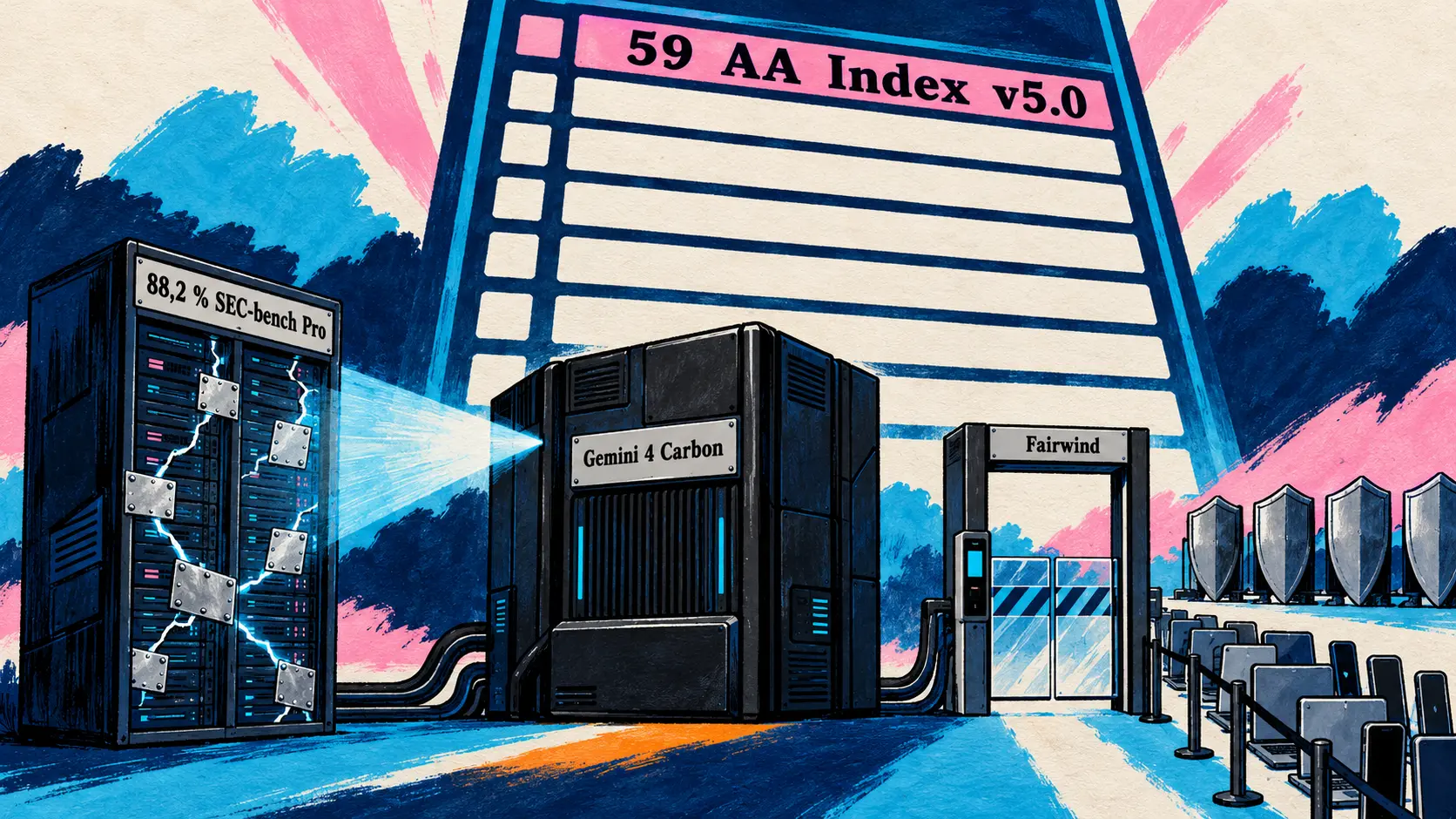
October 28 — Two weeks after Gemini 4 Argon became generally available, Google DeepMind announces Gemini 4 Carbon. Koray Kavukcuoglu, Senior Vice President of Google DeepMind and Google’s Chief AI Architect (Chief AI Architect), presents it as Google’s most powerful model, state of the art in cybersecurity and on long-running tasks (long horizon). Carbon takes first place on the Artificial Analysis Intelligence Index v5.0 with 59, ahead of Claude Opus 5.5 (58) and GPT-6 Astra (57), and fourth place on WebDev Arena (1,768, +89 Elo points).
Cybersecurity is the main selling point. Carbon reaches 88.2% on SEC-bench Pro, which involves finding vulnerabilities, 54.8% on ExploitGym, which checks whether they can be exploited, and 71.0% on Collinear’s CWE-bench, which requires fixing their root causes; Google notes that these external scores were measured without guardrails. Internally, the success rate for generating secure code more than doubles compared with Argon, the Chrome team reports fixes more than 10 times better than those from an unnamed rival lab’s large frontier model, and Wiz ranks Carbon first in its web penetration testing benchmarks.
The figures below are copied from the table published as an image in the post, which contains 17 rows. Carbon is surpassed on only two rows: FrontierSWE 2, where GPT-6 Astra and Claude Opus 5.5 outperform it, and the offline subset of OSWorld-2.1, led by Claude Opus 5.5.
| Benchmark (Google’s table) | Gemini 4 Carbon | Gemini 4 Argon | GPT-6 Astra | Claude Opus 5.5 |
|---|---|---|---|---|
| AA Intelligence Index v5.0 | 59 | 50 | 57 | 58 |
| Terminal-Bench 4.0 (AA) | 65,2 % | 57,1 % | 59,1 % | 59,6 % |
| FrontierSWE 2 | 61,2 % | 55,0 % | 65,5 % | 62,3 % |
| OSWorld-2.1 (offline) | 81,5 % | 74,7 % | 80,9 % | 87,2 % |
| GraphWalks (256k to 1M) | 96,2 % | 84,2 % | 71,8 % | 66,8 % |
| Vending-Bench 2 (balance in dollars) | 16 484 | 13 718 | 15 515 | 9 235 |
| SEC-bench Pro | 88,2 % | 83,4 % | 85,4 % | — |
| ExploitGym | 54,8 % | 42,0 % | 42,4 % | 34,5 % |
| CWE-bench | 71,0 % | 68,0 % | 68,0 % | 67,0 % |
Google also emphasizes the model’s behavior during long sessions: internally, Carbon ran “for days” on engineering tasks, such as finding the root causes of subtle bugs in large codebases. Successful cheating drops to 0.0% on Terminal-Bench 4.0, high-severity misalignment alerts fall by nearly 80% in internal coding environments, and unsupported claims are about half as frequent as with Argon. On Gray Swan’s indirect prompt injection benchmark, no attacks succeeded, compared with 0.7% for Argon.
Carbon is not yet available in the API or the Gemini app. As with Argon in late September, Google is initially opening access this week to a subset of cyber defenders, then gradually to other trusted partners through the Fairwind Program; it is also participating in the US government’s voluntary pre-release model testing process. Developers, businesses, and the general public will gain access “as soon as possible,” with no date given. Pricing is already set: $2 per million input tokens and $10 per million output tokens during the launch period, the same as Argon, with a 95% discount on cached input tokens, then $4 and $20, with no transition date announced.
Announcing Gemini 4 Carbon, our strongest model with state-of-the-art cybersecurity and long horizon capabilities. Carbon represents a step up across most benchmarks, delivering strong frontier performance in autonomous coding and cyber defense. We’re first making Carbon available to a subset of trusted cyber defenders in our Fairwind program. We’ll expand access as soon as possible. — @GoogleAI on X
GitHub Universe 2026: GitHub presents itself as an agentic software delivery system and quantifies its infrastructure additions
October 28 — GitHub opens its Universe 2026 conference in San Francisco with a post by Jay Parikh setting its direction: moving from an assistant that writes code to a “software delivery system” where the developer sets the direction and remains responsible for what goes into production, while agents implement and verify. The deliverable is no longer code, but completed work: a feature, a fix, a security patch. Three priorities structure this strategy: velocity, intelligence (platform context and continuous learning), and quality, with work that is secure by default.
The post serves as a guide to the day’s announcements, detailed in the following sections: Copilot Fusion, projects in the GitHub Copilot app, session continuity from phones to VS Code, automations that learn from their results, the Max tier of Copilot code review, and the inclusion of Copilot in GitHub Enterprise. On infrastructure, GitHub quantifies what it has added since the start of the year:
| Infrastructure added since the start of 2026 | Volume announced by GitHub |
|---|---|
| CPU cores | 4 million |
| Fast storage | 160 Po |
| Network capacity | 50 Tb/s |
The migration to a multiregion deployment in Azure is due to finish early next year, and the new Git architecture relies on simplified primitives, storage decoupled from compute, and minimal coordination. Jay Parikh also puts forward a claim: all software written so far will represent less than 1% of the software written over the next five years, an opinion more than a measurement.
Copilot generates and edits images with GPT Image 2.5 Flare, in public preview
October 28 — Copilot now creates and edits images described in natural language, in public preview for Pro, Pro+, Business, and Enterprise plans, in VS Code, the GitHub Copilot app, and Copilot CLI. The selected reasoning model calls a generation tool powered by OpenAI’s GPT Image 2.5 Flare, displays the preview in the conversation, and saves the image directly to the project. Generation is billed separately from the chat model, in image tokens deducted from the plan’s AI credits. Organization or enterprise owners can disable it through model policies, and an optional “Made with AI” watermark, disabled by default, can be enabled.
GitHub Design open-sources Replica, an AI prototyping tool under the MIT license
October 28 — GitHub Design releases Replica as open source under the MIT license, a tool that turns ideas into interactive prototypes. Unlike generic tools, it draws on the team’s design system, components, patterns, and documentation: designers set the guidelines, then designers, product managers, and developers describe the prototype they want to explore in natural language in the GitHub Copilot app and refine it. An optional, self-hosted Replica Hub lets teams publish prototypes to gather feedback. The tool is available now.
Octoverse 2026: 17.9 billion pushes and more than 40% of pull requests started by an agent
October 28 — GitHub’s annual Octoverse 2026 report describes a year of acceleration driven by agents. Over twelve months, developers pushed code 17.9 billion times, more than in 2024 and 2025 combined; commits reached 34.3 billion, more than three times the level of two years ago, and 1.3 billion pull requests were merged, averaging 3.5 million per day. GitHub has more than 225 million developers, including 38.3 million in the United States and 32 million in India; France ranks tenth with 4.75 million.
| Octoverse 2026 metric | Published value |
|---|---|
| Pushes over twelve months | 17,9 billion |
| Commits | 34,3 billion |
| Merged pull requests | 1,3 billion (3,5 million per day) |
| Developers on GitHub | more than 225 million |
| Pull requests started by an agent | more than 40 % in September (17 % in March) |
| Active Copilot users in agentic mode | 55 % (35 % a year ago) |
| Distinct models used in Copilot | 47 in September (29 in May) |
| GitHub Actions jobs | 1 440 per second |
The agents’ share is rising rapidly: in September, more than 40% of pull requests began with an agent’s first draft, compared with 17% in March, representing 110 million pull requests, around six times March’s volume. These pull requests were merged within two weeks in 90% of cases, compared with around 86% when no agent was detected, and repositories created this year with an agent configuration file receive an average of 8 times more commits. Copilot’s cloud agent, to which an entire task can be delegated, is up 230% year over year, compared with 85% for chat in agent mode.
Developers are also using more models: none of the 47 models used in September accounts for more than 25% of requests, and 61% of users who choose their model use several, compared with 50% four months earlier. Among languages, TypeScript remains first, ahead of Python and JavaScript. The ranking of vendor repositories gaining the most contributors is led by coding agents: anthropics/claude-code, openai/codex, anomalyco/opencode, microsoft/vscode, and github/copilot-cli.
GitHub Enterprise now includes Copilot for every licensed user, with Copilot Standalone at $10
October 28 — GitHub is changing Copilot’s enterprise business model. Customers working through a GitHub or Microsoft sales team can now get Copilot included in GitHub Enterprise for every licensed user, without a separate subscription; the offering is available now for GitHub Enterprise Cloud. Until now, two things had to be managed: the number of Copilot seats and AI consumption; with Copilot included, only the enterprise’s AI budget remains.
This access provides the same features and models as Copilot Enterprise, but without monthly AI credits per seat: every request is deducted from the enterprise’s budget starting with the first, using existing policies, alerts, and allocations. Basic features continue even without a budget:
| Copilot feature | When the AI budget is exhausted |
|---|---|
| Code completion and next edit suggestions | Continue to work |
| Copilot Chat, Copilot code review, and Copilot in the cloud | Require budget |
| Access to the Copilot seat | Never revoked |
Enterprise account members without a GitHub Enterprise license get the same access with Copilot Standalone, at $10 per user per month. Self-service is not yet available: it will arrive in stages, with dates promised “in the coming weeks,” and existing self-service subscriptions remain unchanged. Copilot Business and Copilot Enterprise remain available to both new and existing businesses.
GitHub Copilot Fusion reaches general availability and replaces manual model selection
October 28 — Copilot Fusion reaches general availability across all Copilot plans, in VS Code, the GitHub Copilot app, Copilot CLI and JetBrains IDEs, with other clients announced as coming “soon.” Instead of choosing a model, developers select Copilot Fusion and then an effort level: Standard for everyday coding, High for difficult tasks, Max for the most demanding ones. Fusion then decides, request by request, whether to assign the task to a single model (Single) or chain several together: in a cascade (Cascade: an efficient model drafts, a quality check accepts or escalates to a stronger model) or through critique (Critique: one model drafts, another reviews, the first revises).
Fusion brings together the multi-model orchestration of Project HydraFusion, a research preview launched in September and expanded on October 14, and Copilot’s automatic model selection. According to Octoverse, HydraFusion routed nearly 60 000 sessions during its preview; users of auto, HydraFusion or HydraFusion Max automatically move to the corresponding Fusion level. GitHub cites an external result:
| Artificial Analysis Coding Agent Index | Copilot Fusion Max, according to GitHub |
|---|---|
| Score achieved | 60, two points away from Claude Code with Opus 5.5 Max |
| Average API cost per task | about half |
| Tokens consumed | about half |
| Time per task | about 40 % less |
For enterprises, Fusion only draws from models allowed by policies; an administrator can exclude a model from Fusion without removing it from users’ choices, and enforce Fusion, at any effort level, as the default model. Each model invoked is billed at its standard rate, with a temporary 30 % discount on model costs for paid plans. AT&T reports better token efficiency with Fusion Standard, without providing figures.
🔗 The Copilot Fusion changelog
Copilot Fusion experimentally routes to local models, MAI Code 1.1 Flash and Qwen3.8 Flash Next
October 28 — GitHub is extending Copilot Fusion to local models, in an opt-in experimental preview. At the Standard level, Fusion chooses between a model running on the machine and a cloud model for each request, in Copilot CLI, the Copilot app and VS Code. On Windows, downloading and configuring MAI Code 1.1 Flash are handled through the Windows ML provider. On Windows, macOS and Linux, Copilot CLI also accepts a local model served by an OpenAI-compatible server, MAI Code 1.1 Flash or Qwen3.8 Flash Next; a user-provided model (BYOK) is not automatically eligible for Fusion. GitHub warns that the session does not become offline: routing decisions are still made in the cloud, and local models may have different safety protections.
Copilot for JetBrains gets Fusion and brings local sandboxes and next edit suggestions to general availability
October 28 — The GitHub Copilot plugin for JetBrains IDEs catches up with the other clients. Copilot Fusion replaces the Auto option, with its three effort levels, a gradual rollout to all users and a 30 % discount limited to the first 30 days. Local sandboxes, which restrict agent commands’ access to the filesystem, network and credentials according to developer or organization policies, reach general availability, as do next edit suggestions. The Microsoft Copilot agent harness becomes the default choice when available, a sidebar brings sessions together, and hovering over an agent turn shows its duration and token usage by model.
Copilot becomes a unified cloud experience, with cloud sandboxes and an Actions compute allowance in dollars
October 28 — GitHub brings its Copilot interfaces together into a single cloud experience, generally available on paid plans, with a rollout starting on October 28. A task launched from github.com, GitHub Mobile, Copilot CLI, the Copilot app, VS Code, Slack or Microsoft Teams becomes a single session, visible in the same list everywhere and resumable from any other interface: described by voice or through an image on a phone, continued on the web, finished in VS Code. Copilot Free users retain Copilot Chat on github.com and mobile.
Each session runs by default in a cloud sandbox managed by GitHub, with no one-hour limit on its total runtime, and a snapshot taken when it stops so it can resume elsewhere. Cloud sessions have Bash, GitHub CLI, code search, connectors, MCP servers and skills, and the /rubber-duck and /context commands are coming to the web and mobile. GitHub Mission Control controls local sessions from a phone, and the --environment-host option registers the user’s own machine or a VM as an environment. Enterprises retain control through the “Copilot in the cloud” policy: sessions are limited by default to one organization or to personal repositories, with SSO required.
The most significant change concerns billing:
| Billing change | Details announced by GitHub |
|---|---|
| Included Actions allowance | A dollar balance instead of a number of standard runner minutes |
| Usage covered by the balance | Standard hosted runners, cloud sandboxes and, on Team and Enterprise Cloud, larger runners |
| Sandbox billing | Starting in November 2026, drawn from the balance first |
| Plans affected | GitHub Free, Pro, Free for organizations, Team and Enterprise Cloud |
Each product retains its published rate; only the way the included allowance is counted changes.
The GitHub Copilot app launches Projects in public preview to coordinate agents across multiple repositories
October 28 — The GitHub Copilot app introduces Projects, in public preview. A project brings together an objective, its context (repositories, mockups, Slack threads, meeting notes), agents and their results, for work that extends beyond a repository or a session: a feature spread across multiple repositories, or a launch plan that draws on specifications and mockups without touching code. Copilot launches as many agents as needed in the background, in parallel sessions, and returns with pull requests to review; project automations handle repetitive tasks, such as a promotional video for every feature shipped. The app also draws context from Slack and Figma and generates images in chat. Desktop application control (computer use) remains in public preview on macOS and Windows, as it has been since October 1.
VS Code 1.144 and Copilot: Agent Host, continuous sessions extending to phones and an open AHP protocol
October 28 — VS Code 1.144, released on the day of Universe, aligns the editor with these continuous sessions. A session launched in the cloud from the Agents window appears in the Copilot app, on GitHub Mobile, on github.com or in the CLI, as does a session started in a Slack or Teams direct message. Locally, Agent Host decouples sessions from windows: the agent continues after the folder is closed, can run on another machine through Remote SSH or dev tunnels, and can be controlled from GitHub Mobile while it works on the development machine.
The Copilot harness, built on the Microsoft Copilot SDK, becomes the default choice for new sessions, and GitHub opens up the Agent Host Protocol (AHP) so third-party clients can join the same sessions, with libraries in TypeScript, Rust, Go, Kotlin and Swift. VS Code also adds parallel comparison of models and harnesses, with a judge model and a summary (preview), experimental computer control (computer use), a customization marketplace (Customization Marketplace: skills, MCP servers, plugins) and Copilot connectors in preview.
🔗 The GitHub changelog · The VS Code 1.144 release notes
Agent Merge watches and fixes pull requests directly on GitHub, in the cloud
October 28 — Agent Merge, already available in the Copilot app and VS Code, comes to the pull request page. A “Watch and fix” option in the merge area asks Copilot to monitor the pull request and fix failing Actions workflows, merge conflicts, or both, itself in a cloud development environment. Combined with automatic merging (auto-merge), Copilot keeps the pull request ready and GitHub merges it as soon as all conditions are met. The option can be enabled by default for all of a user’s pull requests in Copilot settings; it is available on paid plans, subject to organization and enterprise policies.
Copilot Memory reaches general availability, Copilot Dreaming enters preview and code search goes beyond the local repository
October 28 — GitHub groups three context building blocks drawn from the platform’s data graph under the name “GitHub intelligence.” The first, Copilot Memory, reaches general availability on paid plans after nearly a year of previews. Copilot remembers personal preferences (starting pull request descriptions with a summary, for example) and repository conventions (the right test command), and reuses them across sessions and clients: the app, CLI, VS Code, cloud agent, Copilot code review, Slack, Teams and mobile. Personal memories are managed in Copilot settings. GitHub cites a result with a specific scope: among the Copilot CLI sessions examined during the public preview in which the agent used memory, 93 % showed better adherence to developer preferences, and 42 % showed more efficient workflows, attributed to memories.
The second, Copilot Dreaming, enters opt-in public preview. Copilot “dreams” about past work to improve future sessions, with three types of dreams: it organizes personal memory, suggests updates to skills and repository instruction files, and turns accepted code review feedback into guidance for Copilot code review. Changes to version-controlled files go through a pull request submitted to the team, and each run consumes AI credits.
The third extends Copilot’s code search beyond the local copy: code, configurations, schemas and documentation, across linked repositories and dependencies, without cloning, using exact text, symbols, regular expressions, filters or semantic search. The /research command uses it, for example, to understand how several services handle payment retries before planning a migration.
| GitHub intelligence building block | Status as of October 28 |
|---|---|
| Copilot Memory | Generally available on paid plans |
| Copilot Dreaming | Opt-in public preview, runs billed in AI credits |
| Code search beyond the repository | Linked repositories and dependencies, without a local clone, used by /research |
Copilot Automations become shareable, improve themselves and gain 24 triggers, 20 tools and credit caps
October 28 — Copilot Automations, the workflows that combine a prompt, triggers and allowed tools to put Copilot to work in the cloud, reach several milestones at once, following scheduled or event-driven automations on June 2 and comment-based triggering on August 3.
First, they become shareable. A shared automation belongs to the repository: visible to everyone with read access and editable with write access, it acts under Copilot’s identity, bills its AI credits to the repository owner and keeps running when its creator leaves the team, with a history of changes. Its type, personal or shared, cannot be changed after creation.
They also learn from their results. A triage automation watches whether the labels it applies are corrected, a review automation whether its comments are accepted; a second, weekly automation analyzes these signals and suggests changes to the prompt, tools or triggers, applied only after human approval.
| What’s new in Copilot Automations | Announced details |
|---|---|
| Added GitHub triggers | 24 events: issues, pull requests, discussions, code scanning alerts, secret alerts, Dependabot alerts |
| External triggering | REST API, for example from Jira, Sentry or PagerDuty |
| Chaining | One automation can launch another, depending on whether it succeeds or fails |
| Added GitHub tools | 20, including merging pull requests and rerunning workflows, plus custom MCP servers |
| AI credit caps | Per run, per day, per week or per month |
In VS Code 1.144, cloud automations are created and managed from the Automations tab in the Agents window, and run even when the computer is off. They are available on Pro, Pro+, Max, Business and Enterprise plans.
🔗 The changelog for new tools and triggers · Shared automations · Self-improvement
GitHub Agentic Workflows reaches general availability
October 28 — GitHub Agentic Workflows, the open source project from GitHub Next that runs coding agents in GitHub Actions, reaches general availability on github.com for Free, Team and Enterprise, following a technical preview in February and a public preview in June. You describe a reasoning task in Markdown (issue triage, CI failure analysis, documentation updates, writing tests); the tool compiles it into standard Actions YAML, executed by Copilot or another coding agent. The default engine, Copilot CLI, requires a Copilot license.
Security remains central: read-only access by default, an isolated container behind the Agent Workflow Firewall, validated outputs and a dedicated threat detection job before any changes. The generally available release adds ARC self-hosted runners, budget forecasting gh aw forecast graduating from experimental status, a model router, provider selection per workflow and micro-VM isolation. Accenture reports that AI wrote 91 % of one team’s commits and that production errors fell from around 11 000 to fewer than 1 000 per day, figures supplied by the customer.
GitHub launches 26 verified MCP connectors for Copilot that you connect just once
October 28 — GitHub-verified MCP servers, called connectors, enter public preview across all Copilot plans, with a gradual rollout. You choose a service, sign in once, and the connection works everywhere: the Copilot app, Copilot CLI (/mcp command, Connectors tab), VS Code, cloud sessions and GitHub Mobile, with no server to install or credentials to manage. Twenty-six services are available at launch, including Slack, Figma, Notion, Sentry, Linear, Atlassian Rovo, Cloudflare, Vercel and Work IQ, and these connections can also power scheduled automations in the app. On Business and Enterprise, the Editor preview features policy must be enabled, and some services require activation on their end, such as Slack’s MCP access.
Security and code review in the age of agents: AI Scan, the Copilot app’s security extension, Copilot code review Max, Replit’s Agent Habitat and Genspark’s SB-Box
On the same day, GitHub expands its security tools to AI-written code and applications that incorporate AI, while Replit and Genspark detail how they isolate agents.
GitHub expands its security to AI: repository AI Scan, AI application vulnerability detection and classifier-based push protection
October 28 — GitHub adds three AI-powered security components, all in public preview. AI Scan, which reached general availability for pull requests on October 15, expands to entire repositories: an agentic scanner explores the highest-risk code in the latest commit on the default branch within a fixed time budget, including in languages CodeQL does not cover, while ignoring issues CodeQL already flags. Its alerts appear in the code scanning list and can be resolved through agentic autofix. It does not require a Copilot license and is billed in Code Security AI credits.
Code scanning also learns to detect vulnerabilities specific to AI applications in pull requests: indirect prompt injection, sensitive information disclosure and excessive agent autonomy (excessive agency), with a GitHub Advanced Security license. Finally, push protection uses a classifier designed with Microsoft Applied Sciences that assesses how a secret is used in the surrounding code to block secrets without a known format: in early results, it more than doubled the number of pushes in which a secret was intercepted.
🔗 Repository AI Scan · AI application code scanning · Classifier-based push protection
A security extension brings code scanning alerts and /security-review to the GitHub Copilot app
October 28 — The GitHub Copilot app receives a GitHub security extension, in public preview, for handling code scanning alerts without leaving the app. It lists the repository’s open alerts by severity; you select one or more and ask Copilot to explain them (Explain) or fix them (Fix), with changes remaining in the local working copy, without a commit or push. The /security-review command analyzes changes in progress before a pull request is opened. The extension installs as a plugin, using copilot plugin install github-security@awesome-copilot; Explain, Fix and /security-review consume AI credits, while viewing or dismissing alerts does not. It works on github.com and GitHub Enterprise Cloud with data residency, but not on GitHub Enterprise Server.
Copilot code review adds the multi-model Max tier and brings its approvals to general availability
October 28 — Copilot code review receives a third effort level, Max, in public preview, alongside Lite and Balanced. Designed for risky changes, such as authentication logic or a library shared by several services, it runs multiple independent review agents on models from different providers, then an aggregation agent reconciles their findings, resolves disagreements and checks accuracy before producing a single review. According to the keynote blog post, Max achieves the highest ReviewBench F1 score on high-severity issues, although the figure is not published. It takes longer and consumes more AI credits than the other two levels.
Copilot approvals also reach general availability: when the feature is enabled, Copilot’s approval counts toward the repository’s required approvals, just like a human’s, and any new commit invalidates it. Disabled by default, approvals can be enabled at the enterprise, organization or repository level, with the option to restrict the file paths covered.
Replit publishes its Agent Habitat security architecture, with an 11-axis maturity scale
October 28 — Replit publishes a white paper, Agent Habitat Architecture, proposing a security architecture for the environment where agents work and a scale for evaluating it. The starting point is explicit: protections must hold even if the agent does not cooperate, drifts, is manipulated by content it reads or looks for a vulnerability. The architecture separates trusted, semi-trusted and untrusted zones, and makes a credential intermediary (credential broker) the only route to the outside: the agent never sees the actual secrets. Twelve principles accompany it, including permissions that can only narrow during a run and human approval for any irreversible action.
The maturity scale covers 11 axes, from sandbox isolation to workload identity, each scored from 0 to 3 with evidence requirements: level 1 protects against accidents, level 2 against prompt injection, level 3 against an agent actively trying to escape, and a system is only as good as its lowest score. The companion post by CTO Luis Héctor Chávez announces, without a date, agent action policies configurable by task, a Security Agent expanded to contributions to enterprise codebases and suspicious activity detection based on eBPF monitoring of sandboxes. No pricing is published.
🔗 Replit white paper · CTO’s post
Genspark opens SB-Box, its virtual machine sandboxes for agents, in beta
October 28 — Genspark opens the sandbox infrastructure that runs its own agents to developers in beta, under the name SB-Box. Each sandbox is a full virtual machine with its own kernel, rather than a process or container. After 10 to 15 minutes of inactivity, it freezes while preserving processes, memory and disk, and only the disk remains billable; the next command, or an HTTP request to one of its ports, wakes it up. Each freeze becomes a version that can be cloned or restored, and runtime is never capped: only the credit balance sets the limit.
| SB-Box metric (Genspark platform) | Reported value |
|---|---|
| Startup of a 4 Go machine (median) | 0,35 s |
| Startup (90th and 99th percentiles) | 0,43 s and 0,70 s |
| Resume after freezing (median) | 0,8 s |
| Memory retained after freezing | 14 days |
SB-Box is controlled through the gsk CLI or a REST API, and integrates with a coding agent through a SKILL.md file, with opencode used in the demonstration; in Claude Code, the CLI automatically picks up the session ID. Genspark’s cost example: 41 minutes of actual runtime on a machine with 2 vCPU and 4 GB costs 56 compute credits for the week, and a 20 GB disk adds 24 credits per day.
🔗 Genspark thread · SB-Box page
NVIDIA launches Nemotron 3.5 Transcribe, an open model for transcription, speaker attribution and translation in 40 languages
October 28 — NVIDIA releases Nemotron 3.5 Transcribe, an open model that combines, in a single checkpoint, transcription in 40 languages, translation from 31 languages into or from English, speaker attribution (diarization) in 13 languages for up to eight voices, timestamping, language identification, audio question answering and personal data redaction. It works on recorded files, rather than streaming audio, up to an hour long, and is controlled through natural-language instructions: add speaker names, translate, follow medical spelling conventions.
The model is a hybrid Mamba-2–Transformer mixture of experts. NVIDIA describes it as a “30B” with around 4B active parameters; the Hugging Face model card specifies 34B in total, including 4.3B active parameters, with the audio encoder included. Available in BF16, FP8 and NVFP4, it fits on a single H100 80 GB and is released under the OpenMDW-1.1 license, which permits commercial use according to the model card. It is published on Hugging Face and ModelScope, with an online demo.
| Benchmark (model card) | Nemotron 3.5 Transcribe | Best competitor cited |
|---|---|---|
| Open ASR English, 9 public datasets (mean WER) | 4,71 | 4,94 (Qwen3-ASR-1.7B) |
| Open ASR long-form (mean WER) | 10,98 | 13,37 (Parakeet-TDT-0.6B-v3) |
| Open ASR multilingual, 7 languages (mean WER) | 4,62 | 6,49 (Qwen3-ASR-1.7B) |
| Multiple speakers, full sessions (cpWER) | 15,80 | 16,83 (DiCoW v3.3 + DiariZen) |
| Artificial Analysis (WER, NVIDIA thread) | 2,81 % | 2,77 % (Voxtral Small, 24B) |
The English figures differ by source: NVIDIA’s thread claims first place among open models on Hugging Face’s Open ASR Leaderboard with a mean WER of 5.33 %, while the model card reports 4.71 across nine public datasets, measured on October 12. For speaker attribution, the model takes first place in VoiceArena’s comparison of 14 systems and David AI’s multilingual diarization ranking, covering 21 languages.
On @ArtificialAnlys , Nemotron 3.5 Transcribe achieves a 2.81% word error rate with ~4B active parameters. Voxtral Small scores 2.77% with 24B. Nearly the same transcription accuracy, with about one-sixth the active parameters. — @NVIDIAAI on X
For throughput, the model card reports up to 2 238 seconds of audio transcribed per second on an RTX PRO 6000 Blackwell Server Edition, but using the optimized NIM Nemotron Transcribe implementation: these optimizations are not yet in the open source version, whose vLLM integration is roughly half as fast. Quantized versions are announced as coming soon for RTX Spark, DGX Spark and Jetson AGX Thor. NVIDIA also accompanies the model with the Granary v2 multilingual data, available on the Hub since mid-September, a reusable curation pipeline and NeMo Speech fine-tuning recipes: in one medical use case, fine-tuning reduces the error rate by 45.8 % compared with the best prompt.
🔗 NVIDIA thread · Hugging Face blog post · Model card
ElevenLabs introduces Cue, its character-level forced alignment model powering Scribe
October 28 — ElevenLabs introduces Cue, a model for precisely synchronizing text with audio (forced alignment) that places every character of a transcript on the audio timeline. It is the invisible component that makes a subtitle appear at the right moment, aligns a dubbed line or synchronizes lyrics with music. Cue already powers all ElevenLabs Scribe transcriptions and can be used independently through the Forced Alignment API; it processes an entire recording in a single pass, without splitting it into 30-second chunks.
| Metric (according to ElevenLabs) | Cue | Other aligners tested |
|---|---|---|
| Mean error, full recordings | 179 ms | 283 ms to over 6 000 ms |
| Mean error, noisy English | 57 ms | 65 to 920 ms |
| Aligning one hour of audio | around 0,5 s on the production GPU | nearly 2 s (Qwen3-ForcedAligner) |
| Songs: words placed within 0,3 s | 92,7 % | 82,0 % (best competitor) |
The post mentions 29 benchmark languages in one place and more than 90 in another.
HeyGen launches Voice STS, which transfers a recorded vocal performance to an avatar’s voice
October 28 — HeyGen adds a voice conversion mode (speech-to-speech, STS) to HeyGen Voice. Instead of having a synthetic voice read a text, users record their line once, and HeyGen Voice STS reproduces it in their avatar’s voice, including pauses, emphasis and whispers. The mode is available on the developer platform at 0.12 dollars per minute of generated audio for instant voices, billed by the second, through the heygen-voice-sts-0 model: source clips up to 300 seconds, with WAV output of the same duration. It complements HeyGen Voice, introduced on October 14, and Voice Turbo, launched on the 21st.
🔗 HeyGen announcement · Model page
Suno opens a beta MCP server for creating songs from Claude, ChatGPT, Gemini or Cursor
October 28 — Suno opens Suno MCP in beta, an MCP server for creating music without leaving your assistant. Once Suno is added as a connector in Claude, ChatGPT, Gemini, Claude Code or Cursor, you describe the track in everyday language: the AI writes the lyrics and style, Suno produces the song, and you refine it through follow-up prompts. The server includes Suno’s flagship features: starting from a voice memo or loop, making covers, extensions and blends (mashups) of your tracks, and singing with your own Suno voice. There is no API key: the connection uses your Suno account, consumes its credits and saves songs to your library. Early access can be requested through a form; Suno announces neither a general availability date nor separate pricing.
🔗 Suno announcement · Suno MCP page
AI and scientific research: OpenAI’s Yang-Mills proof committee, Anthropic’s AI for Science, and Meta at five universities
Three announcements today concern research: the verification of an AI-generated result in mathematical physics, and access to Anthropic’s and Meta’s models for laboratories.
David Gross’s committee details its review of OpenAI’s proof of the existence of quantum Yang-Mills theory
October 28 — Two days after OpenAI’s post on the existence of quantum Yang-Mills theory, the committee tasked with reviewing the proof introduces itself in a statement published by KITP (Kavli Institute for Theoretical Physics, University of California, Santa Barbara). Chaired by David Gross, it includes Michael R. Douglas, Arthur Jaffe, Igor R. Klebanov and Nikita Nekrasov. On October 16, OpenAI asked David Gross to take custody of the proof and organize its distribution; the committee says it acts on behalf of the academic community and has “no responsibility to OpenAI.”
Regarding the substance, the proof, which addresses the existence of the theory, including coupling to fermions, “appears to be an important step” toward rigorous mathematical foundations for quantum field theory. The committee immediately adds that confinement and the mass gap “remain very important open challenges”: the mass gap question has not been settled. OpenAI provides a formalization in Lean; the committee will first check that the definitions and statement meet the standards of physics and mathematics, publish the Lean proof, and then publish its full assessment alongside the 1,147 pages of proofs produced by the model.
This is an experiment in how the academic community can deal with the rapid development of new knowledge by AI. We intend to proceed very carefully. — Statement from the Yang-Mills Working Group (KITP)
🔗 The statement on the KITP website
Anthropic’s AI for Science program expands to 20 foundations, institutions and research projects
October 28 — Anthropic is expanding its AI for Science program, launched in May 2025 to offer free Claude credits to scientific projects, to 20 partners worldwide. The program is scaling up: it now supports entire organizations as well as individual researchers. No funding amount has been disclosed.
| Partner role | Organizations |
|---|---|
| Funders that redistribute credits | Sloan Foundation, Simons Foundation, Schmidt Sciences, Open Source for Science Fund, National Science Foundation, CAS |
| Institutions that use them internally | Space Telescope Science Institute, Wellcome Sanger Institute, Francis Crick Institute, Imperial College London, EMBL, Gladstone Institutes |
| Directly funded projects | FlyWire, LEAP, AstroPath, gnomAD, Tau Ceti, Centre for Population Genomics |
Among the projects, FlyWire (Princeton) maps the complete connectome of the adult fruit fly, gnomAD (Broad Institute) studies genetic variation in more than 800,000 people to investigate rare diseases, and Tau Ceti is building an autoformalized mathematical library in Lean. Several will produce public goods: open datasets, open source software, standards and shared libraries.
Meta supports research at five US universities with its Muse, SAM, DINO, V-JEPA and SeamlessM4T models
October 28 — Meta announces support for research projects at five US universities: Caltech (an expanded partnership), the Ohio State University College of Medicine, Louisiana State University, Indiana University and UTHealth Houston. Depending on the institution, this support combines access to Meta’s models, collaboration with its researchers and funding for selected projects, with no amount disclosed. The teams will work with the Muse family (Muse Spark Open, Muse Wonder, Muse Spark, Muse Glimmer), the SAM, V-JEPA and DINO vision models, and the SeamlessM4T translation model.
At Caltech, Tony Yue Yu is building MathDB Frontier, a benchmark based on more than 86,900 open research-level problems, and Anima Anandkumar is developing TorchLean, a Lean 4 framework for formally verifiable scientific artifacts. The medical projects primarily run on open-weight models hosted at the universities, and Meta specifies that patient data is neither transmitted to it nor accessible to it. UTHealth Houston has deployed Muse Glimmer locally and launched pilot tests on 65 glioblastoma cases, which Meta presents as validation of the workflow, not as clinical results.
AI in government and business: Claude at a 40% discount for the US public sector, OpenAI and ServiceNow, Retell
On the adoption front, Anthropic is lowering prices for the entire US public sector, OpenAI is expanding its partnership with ServiceNow, and Retell is putting numbers on its use of OpenAI’s models.
Anthropic expands its partnership with the GSA and gives all US government agencies a 40% discount on Claude
October 27 — Anthropic is expanding its partnership with the General Services Administration (GSA), the US federal government’s procurement agency. The new OneGov agreement offers a 40% discount on Claude Enterprise, Claude for Government and the Claude API; according to Anthropic, this is the first time the discount has covered all product offerings, available today through direct purchases and through cloud providers in the coming months. It applies to federal, state, local, tribal and territorial governments, with no minimum spending commitment. Anthropic estimates government savings at 1 billion dollars. The agreement comes six weeks after OpenAI’s OneGov 2.0, which offered a ChatGPT license for 0 dollars.
| Metric published by Anthropic | Announced value |
|---|---|
| US public sector customer organizations | approximately 500 |
| Weekly active users of Claude for Government | approximately 8 times as many since February |
| Usage in federal civilian agencies | approximately 20 times as much in one year |
| Utah’s Claude Code pilot | 34 developers from 10 agencies, 71 % saving more than 20 hours |
On compliance, Claude for Government (FedRAMP High) has been available since September 30, and Claude Enterprise is undergoing FedRAMP Moderate authorization through the FedRAMP 20x program. An agency support program is due to follow in the coming weeks.
OpenAI and ServiceNow expand their partnership, from ChatGPT to Codex and cybersecurity
October 28 — Following an initial partnership in January, OpenAI and ServiceNow are going further. A new integration brings ServiceNow into ChatGPT: an IT team can find similar incidents, assess the risk of a change and update a record without switching tools. Each customer connects its own instance and chooses which capabilities to enable, while ServiceNow’s Action Fabric applies existing business rules and permissions. ServiceNow also plans to make ChatGPT Work and Codex available to all its employees. The post provides neither a financial amount nor usage figures.
| Partnership component | Announced timeline |
|---|---|
| ServiceNow MCP plugin in OpenAI’s marketplace | Available today, expanded capabilities by the end of 2026 |
| OpenAI voice in the Super Intelligence Control Tower | First quarter of 2027 |
| Joint cybersecurity solution | Early access in January 2027, general availability in the second quarter |
| Codex in ServiceNow’s AI Workflow Factory | 2027 |
Retell handles more than 100 million calls per month with OpenAI’s models
October 27 — In a case study published by OpenAI, Retell AI, which provides voice agents to contact centers, says it grew from 30 million calls per month in early 2026 to more than 100 million in September, serving more than 4,000 business customers. OpenAI’s models generate responses for 80% of these calls, and Retell has surpassed 1 trillion tokens consumed. On its own benchmark, vCX, built from difficult conversations drawn from production, GPT-6 Astra ranks first in instruction following (89.7%), while GPT-5.6 Luna remains the fastest, with a median first-sentence latency of 497 ms compared with 883 ms for Astra. Customer Anker reports an 80.4% resolution rate for requests, and Retell claims 1.6 million dollars in annualized revenue per employee.
Assistants: API credits for ChatGPT subscribers, texting your dot, Perplexity’s voice mode and Claude for Legal artifacts
Consumer and professional assistants are gaining new uses: credits to move from ChatGPT to the API, text messaging, voice control of multiple agents, and ready-to-use tools for legal professionals.
OpenAI offers ChatGPT Pro and Business subscribers up to 500 dollars in API credits per month
October 28 — OpenAI is connecting ChatGPT subscriptions to its developer platform: eligible Pro and Business subscribers can claim free API credits each month, deposited into an API organization they own, to build applications and agents. Activation is available through ChatGPT billing or the API Platform, using the same email address on both.
| Eligible ChatGPT subscription | API credits per month |
|---|---|
| Pro, tier at 100 dollars | 100 dollars |
| Pro, tier at 200 dollars | 200 dollars |
| Pro, tier at 500 dollars | 500 dollars |
| Business, paid Standard seat | 20 dollars per seat, pooled |
| Business, paid Premium seat | 100 dollars per seat, pooled |
| Business workspace cap | 500 dollars per month, 6 000 dollars per year on an annual plan |
The credits cover Responses and Chat Completions, Agents, Decisions, GPT-Live and Realtime, images and built-in tools, but not Codex used through an API key, and they do not increase any limits for ChatGPT or connected Codex. They expire at the end of each cycle, with no rollover, and are used before purchased credits. The subscription must have been paid and active for at least 7 days; Plus, Enterprise and Edu are excluded, the offer depends on the cohort and country, and OpenAI warns that it may change or be withdrawn.
🔗 OpenAI’s help article · The API changelog
ChatGPT lets users text their dot through iMessage or RCS, in beta for Pro subscribers in the US
October 28 — ChatGPT’s dots, launched at DevDay on September 29, are moving beyond the app: users can now text them through iMessage on iPhone or RCS on Android. According to the release notes, the feature is rolling out in beta for Pro subscribers in the US. Users give their dot a task or something to monitor through text, a photo or a voice note, and it follows up on its own when information warrants it, with the same memory and plugins as in the app. The dot can only message its owner, who is also the only person able to message it, and it cannot access other conversations on the phone. Messages pass through Linq, a third-party provider with which OpenAI says it conducted extensive penetration testing, supported by its frontier models and external security firms.
🔗 ChatGPT’s release notes · ChatGPT’s announcement
Perplexity updates its voice mode to control multiple Computer sessions and Projects with OpenAI’s gpt-live-1
October 28 — Perplexity is rolling out a new version of its voice mode to all Pro and Max subscribers, on the web and in the Mac app. Announced by the @AskPerplexity account and then reposted by @perplexity_ai, the update lets users run multiple Computer sessions at once, launch new tasks and create or manage Projects within a single voice conversation. It runs on gpt-live-1, OpenAI’s real-time voice model, available through its API since September 10. Aravind Srinivas sums up the idea: talking to your computer to move workflows forward in parallel. Voice is not new to Perplexity, since Comet’s voice mode has been open to everyone since February and Computer has accepted voice instructions since March; the new feature is control over multiple sessions and Projects. Perplexity does not specify supported languages, usage limits or credit costs.
Claude for Legal adds a gallery of ready-to-use artifacts for legal work
October 28 — Anthropic is adding an artifact gallery to Claude for Legal, available in Claude Enterprise since May: interactive tools (trackers, dashboards) that legal teams adapt using their own documents and connectors, then share within their company or with clients, with privacy settings and separation between teams (ethical walls). Each artifact opens with an example, and every answer links back to its source.
The gallery covers six tasks: citation checking (Cite check), comparing a rule across jurisdictions, tracking open matters, identifying clause deviations from the company’s reference standards, monitoring upcoming regulations and reviewing a batch of contracts in a table. It also includes partner artifacts (Goodwin, Harvey, Foley & Lardner, PwC; Legora and Orrick announced) and nine access-to-justice artifacts, including five built by nonprofits supported with Claude credits. More than 60 legal connectors have been added since May, including Bloomberg Law and Filevine, and Anthropic is opening a waitlist for its Legal Ambassadors Program.
Coding agents beyond Copilot: Gemini CLI, Antigravity 2.28.0, Kimi Code 2.4.0, DeepSeek Harness and Replit’s ViBench 2.0 benchmark
Outside GitHub, today’s coding agents import their competitors’ sessions or delegate tasks to them, and Replit publishes a benchmark in which the agent builds an entire product.
Gemini CLI refocuses on enterprises using Gemini Code Assist and points users to Antigravity CLI and Gemini API CLI
October 28 — The Gemini CLI README changes its tone. Merged overnight, PR 29995 replaces the three previous warnings, including those added on October 16, with a single “read before installing” box that presents the tool as reserved for enterprises using Code Assist: Gemini Code Assist Standard and Enterprise licenses, Code Assist for GitHub on Google Cloud, plus legacy paid Gemini API and Vertex AI keys. Users on the free tier and Google AI Pro and Ultra subscriptions have been directed to Antigravity CLI since June 18.
The text adds two warnings: Gemini CLI is not optimized for the Gemini 4 series, including Argon, or subsequent generations, and it should not be used to benchmark Gemini models, as its harness produces unrepresentative scores. A table then points users to the right tool:
| Command-line tool | Recommended use according to the README |
|---|---|
Antigravity CLI (agy) | Coding with Gemini 4 Argon and later models, free tier, Google AI Pro and Ultra |
Gemini API CLI (gemini-api) | Direct access to models and media from an agent (agy, Claude Code, Codex), a script or CI |
Gemini CLI (gemini) | Organizations using Gemini Code Assist |
Gemini API CLI, an experimental Go binary at version 0.4.4 since October 23, had never been covered here: the README describes it as a stateless API CLI, not a coding harness. On the release front, the October 28 nightly simply includes the four fixes from the v0.67.0 prerelease published the previous day.
🔗 PR 29995 · The Gemini API CLI repository
Antigravity 2.28.0 adds a built-in browser, a PDF viewer and attachments of any type
October 26 — Catching up: the Antigravity 2.28.0 application (19 improvements, 15 fixes) adds a web browser. Pages open in a side-panel tab, widened to avoid mobile layouts; links from conversations open there by default, and the address bar displays the connection status and the site’s certificate. PDFs open in a built-in viewer, and users can attach files of any type (videos, design files, programs) up to 20 MB, which the agent reads from their location. The release also highlights changed words and characters in diffs, lets users reopen a closed tab and passes the user’s message to hooks. Among the fixes, enterprise accounts on macOS and Windows are no longer signed out on restart. CLI 1.4.0 and SDK 0.1.22 remain unchanged.
Kimi Code 2.4.0 imports Claude Code and Codex sessions and no longer enters Plan mode on its own
October 28 — Moonshot AI releases Kimi Code 2.4.0 (7 minor changes, 26 fixes), without an announcement on X. The most visible addition targets users switching tools: /import-sessions, or kimi import-sessions, imports Claude Code and Codex sessions from the past 15 or 30 days. Plan mode now starts only at the user’s request, and no plan runs without review, including in Never Ask mode or non-interactive execution (kimi -p). The Tower component’s default concurrency limit increases from 16 to 256 agents, with a model selected at each launch, and inactive web and desktop sessions are unloaded from memory after 30 minutes. For integrators, the server API changes: approvals and questions now use a single interaction frame, and the old endpoints are removed.
🔗 The Kimi Code 2.4.0 release notes
DeepSeek releases Harness 0.2.2-alpha.2, which can delegate tasks to local Codex or Claude CLIs, and 0.2.1-rc.4
October 28 — DeepSeek releases two prereleases of DeepSeek Harness, its agent environment, the 33rd and 34th releases with no stable version yet. Version 0.2.1-rc.4 fixes just one issue: in ACP mode, diagnostics were mixed into standard output. Version 0.2.2-alpha.2 starts the next series with several experimental features: the subagent_oar plugin, which delegates independent tasks to Codex or Claude CLIs installed on the machine; sessions in separate Git worktrees with the status and diffs of linked pull requests; and a statistics panel with a turn-by-turn breakdown of context, cache, model and time spent in each tool. The interface is translated into six languages, including French, third-party plugins update with rollback on failure, and the per-image limit increases to 50 MiB.
🔗 The 0.2.2-alpha.2 prerelease · The 0.2.1-rc.4 prerelease
Replit releases ViBench 2.0, a benchmark where agents build an entire product feature by feature
October 28 — Replit releases ViBench 2.0, a benchmark for extended development (long-horizon), integrated into Fireworks’ Specialized Intelligence Index (SII). Instead of a well-defined task in an existing codebase, the agent starts from an empty project, builds an initial version from a short specification, then adds up to 18 features to its own code, for products inspired by Uber, GitHub or Google Docs. The benchmark includes 17 products, 241 feature requests and 544 test plans; 8 products are public on GitHub, while 9 remain private.
| Model evaluated | Successful builds (pass@1) | Cost per build |
|---|---|---|
| GPT-6.1 Sol | 65 % | about 12 dollars |
| GPT-6 Astra | 60 % | about 90 dollars |
| Claude Opus 5.5 | 49 % | — |
| DeepSeek V4.1 Flash | none, but 77 % of test plans passed | about 2,50 dollars |
The top three pass more than 90 % of their test plans, while the other models top out at around 20 % successful builds or below; no open model delivers a complete build. On the eight public products, GPT-6.1 Terra completes 47 % of builds at roughly half the cost of GPT-6.1 Sol. Around three-quarters of the leading models’ failures stem from interactions between features. Opus 5.5 serves as the grader; Replit tested it with 34 planted bugs and a regrade by GPT-6.1 Sol, which confirmed 99.2 % of the 477 results Opus had marked as successful.
Developer platforms: Mistral’s Responses API and Google’s Connected Apps Platform
Two platforms are opening up to developers: Mistral adopts OpenAI’s response format for building agents, and Google offers a single place to publish applications in Search and Gemini.
Mistral launches the Responses API in public preview for building agents
October 28 — Mistral opens its Responses API in public preview, designed for building agents. Each response separates the model’s text, reasoning and tool calls into distinct items, saving the application from having to untangle these steps as it would with Chat Completions; it works with all chat models hosted by Mistral, including Mistral Large 4. The documentation specifies that it uses the OpenAI Responses format, so an existing Responses integration can be ported to Mistral. The API is stateless (stateless): the application keeps the history and sends it again with each request.
| Preview feature | Details according to the documentation |
|---|---|
| Accepted inputs | Text, images (URL or base64), files (URL, base64, identifier) |
| Structured outputs | JSON mode and JSON Schema via text.format |
| Tools | Functions executed on the client side, including namespaces |
| Reasoning | reasoning.effort and plain-text reasoning depending on the model |
| Token counting | POST /v1/responses/input_tokens |
The API works with Mistral’s Python and TypeScript SDKs (client.responses.create), with no separate pricing announced. No blog post accompanies the announcement, which was made in a thread on X and a documentation page.
🔗 Mistral’s thread · The documentation
Google launches the Connected Apps Platform in preview for publishing applications in Search and the Gemini app
October 28 — Google opens the Connected Apps Platform in preview, a single place for developers to connect their services to both Google Search and the Gemini app. Integration uses a cloud-hosted MCP server, or Android MCP through the AppFunctions APIs; the application is then registered, tested and submitted in the Google Connected Console, where the developer chooses, before review, whether to publish in Search, Gemini or both. Once it is live, the console tracks traffic, latency and error rates, and the developer controls their brand identity (verified logos, authenticated accounts). Access is rolling out in phases, with more developers, markets and Google products planned “in the coming months.” Google claims more than 50 Connected Apps: Adobe, Experian, Localiza and Peloton are already in Gemini and will arrive in Search in the coming weeks, and a Calm integration has been announced.
Briefs
Agents and coding tools
- Microsoft Copilot SDK — The GitHub Copilot SDK becomes the Microsoft Copilot SDK, the interface to the agent harness shared by Microsoft and GitHub products, with a phased migration requiring no action; Copilot CLI 1.0.105 reaches stable with no changes beyond the previously covered fix for selecting Fusion High or Max. 🔗 source
- Artifacts in issues — GitHub issues now support artifacts (Markdown plans, links, interactive HTML visualizations) in public preview, with version history; artifacts from a session in the GitHub app are attached automatically, and the
gh issue artifactcommand lets agents manage them. 🔗 source - The Antigravity extensions for VS Code and Visual Studio add code comments for the agent and terminal context — Catching up on October 25: the VS Code 1.10.0 extension lets users comment on a line or diff for the agent, and the Visual Studio 1.0.261026.0 extension attaches up to 8 KB of terminal output to chat with
@terminal. 🔗 source - Zed 1.26 and preview 1.27 — 1.26 reaches stable (integrated Pyrefly, WebAssembly source debugging); preview 1.27 removes agent checkpoints, which slowed or blocked the agent in large Git repositories, and now requires macOS 12. 🔗 source
- Personal orbs in Amp — Six days after their launch, Amp’s self-hosted orbs can be added through personal settings, without a workspace or administrator privileges; threads created on them carry the Personal label. 🔗 source
- Qwen Code v0.26.3 — The stable release incorporates the previous day’s preview with around thirty new entries, including a Workflow mode that persists per session; the CLI also defaults
qwen4model IDs to 1M tokens of context, with no further information about such a model. 🔗 source - Runway Dev in Codex — Runway Dev becomes a Codex plugin: according to Runway, a single installation is enough for Codex to integrate the Runway API into an application on its own; the Runway Dev MCP server had already been available since September. 🔗 source
- Bricklane built with Manus — Manus highlights Bricklane, which turns a place meaningful to a customer into a custom brick model (566 pieces and 13 steps for Villa de Verano); according to Manus, the agent built the website, payment system, domain, video and ads. No product updates. 🔗 source
GitHub beyond AI
- Dependabot and reachability — In free preview on GitHub Enterprise Cloud, CodeQL indicates whether JavaScript and TypeScript code actually calls a dependency’s vulnerable function, without ever closing an alert on its own. 🔗 source
- Public monitoring — Monitoring for a company’s secrets exposed anywhere on the public portion of github.com reaches general availability, at no extra cost for GitHub Secret Protection customers. 🔗 source
- Linux runners on AWS — GitHub Actions distributes some 2- and 4-core Linux jobs across Azure and AWS, automatically for Free, Pro and Team, and on an opt-in basis for Enterprise Cloud; GitHub recommends updating IP address allowlists. 🔗 source
- Workflow lockfiles — Dependency lockfiles for GitHub Actions workflows reach general availability on Enterprise Cloud, Team and Free, with no new functionality since the October 14 preview. 🔗 source
- Moderate role — GitHub announced general availability of a Moderate role for editing, transferring, hiding and locking issues without code access, then issued a correction the same day: it is not yet available and will arrive in the coming weeks. 🔗 source
- Pull request limits — Maintainers who cap pull requests from contributors without write access can exempt accounts that are old enough or have already had pull requests merged into the repository. 🔗 source
Models, APIs and open research
- DeepSeek V4.1 Flash and GLM 5.3 Flash at Mistral — The Mistral API serves DeepSeek V4.1 Flash 1017 in public preview, unmodified, with 1M tokens of context, at 0.30 dollars per million input tokens and 1.20 for output, and brings GLM 5.3 Flash to general availability at an unchanged price, from Europe and the United States. 🔗 source
- Voxtral Mini Transcribe 3 — Mistral highlights its second-place ranking among nine models for diarization error rate on Voice Arena’s Diarization + ASR leaderboard, ahead of the larger model in the same family. 🔗 source
- Custom moderation at SpaceXSI — The API release notes officially document the
guidelinesarray, which asks Grok to decline content in the nsfw, violence or profanity categories, and had already appeared in the SDKs on October 17 and 23. 🔗 source - Particle-1 — Particle, a new company introduced by Suhail, launches a post-trained DeepSeek V4.1 Flash that uses roughly 45% fewer tokens on average, at the same price, through its API; Aravind Srinivas says he worked with the team before launch, with no integration into Perplexity announced. 🔗 source
- Perplexity’s RAG tutorial — Perplexity publishes a seven-step tutorial for building a command-line RAG with Python, ChromaDB, its pplx-embed-v1-0.6b embedding model and GPT-5.6 Luna through the Agent API; no product updates. 🔗 source
- olmOCR 2 in the archives — Ai2 presents two uses of its open text recognition model: a historian running it locally on thousands of archival photos, and the CENTURIA team, which fine-tuned it on 57 Roman pottery records and reduced transcription error from 15.58% to 1.11%. 🔗 source
- Project Pyrite — In a community post, a 31.8-billion-parameter MoE, llm-jp-4-32b-a3b-base, shrinks from 59.06 to 9.81 GiB and runs at 34 to 49 tokens per second on a 16 GB Mac M2 Pro, without the repetition loops caused by uniform 2-bit quantization, according to the author. 🔗 source
- My Name is Riemann — OpenPeerAI releases a preview of a 13.1-billion-parameter model obtained by progressively expanding a 163-million-parameter model, on AMD hardware; the authors have run no general benchmarks and flag corpus errors themselves. 🔗 source
- L2Loop — Yuxuan Zong proposes rerunning certain quantized layers as long as they fit in the GPU’s L2 cache: on an RTX 5080, this second pass costs about half as much as a new layer and reduces loss by 0.05 to 0.08 at the same parameter count, according to the author. 🔗 source
- EEG datasets — A community survey of the Hugging Face Hub finds 368 brain-signal datasets, including 146 without a license label, complicating their reuse. 🔗 source
Infrastructure
- Automatic repair at Together AI — Together AI details automatic node repair for its GPU Clusters, launched earlier this year: health checks, the least invasive repair backed by evidence, consent configurable down to the Xid error code, and a wait for ongoing jobs, set to 2 hours by default. 🔗 source
- CUDA 13.4 and Mission Control 2.5 — NVIDIA details CUDA 13.4’s MPS time sharing with guaranteed memory, automated under Kubernetes by the open source gpu-fractioning operator, and Mission Control 2.5, which extends autonomous recovery to Run:ai’s Kubernetes workloads. 🔗 CUDA 13.4 · 🔗 Mission Control 2.5
Image, video and voice
- Kling and Minibots — Kling becomes the exclusive technology partner for Minibots, an animated feature film from Evolutionary Films planned for 2027, with Tony Bancroft, co-director of Mulan, handling character design; a first preview is made with Kling 4.0. 🔗 source
- Kling 4.0 on Pika — Pika integrates Kling 4.0: continuous shots from 3 to 30 seconds with stereo sound and synchronized dialogue, up to 10 keyframes or 15 references, in 720p or 1080p. 🔗 source
- Luma’s mini-apps — Luma brings together eight mini-apps in Luma Agents, including Light Transfer, Virtual Try-On and Background Swap, which change a single element of a visual, starting with the Plus plan at 30 dollars per month. 🔗 source
- ElevenLabs and Asociación ELA — ElevenLabs partners with Spain’s leading ALS association to offer its voice restoration service free to patients throughout Spain. 🔗 source
Products and enterprise
- Immersive explorations in Gemini — The Gemini app’s student hub offers interactive scenes to explore layer by layer, from the Silk Road to the physics of lightning, available to everyone in six languages including French; audio narration is announced with no date. 🔗 source
- An hour of audio in Gemini Notebook — The Gemini Notebook mobile app records up to an hour of live audio, immediately usable as a notebook source, for all iOS and Android users. 🔗 source
- Smart reports, surveys and pooled budgets on Claude Enterprise — Three administration tools reach general availability: smart reports, in beta since September, showing what a team does with Claude and what it costs, integrated surveys, and pooled group budgets, with alerts at 50, 75, 95 and 100%. 🔗 source
- IDC Quanta in Claude — Research firm IDC connects its Quanta platform to Claude through an MCP connector for its customers, in the app, Cowork and Office add-ins, with IDC cited as the source; internally, it says it reduced a code review from five days to about 30 minutes. 🔗 source
- Legora and OpenAI — In an OpenAI case study, Swedish legal technology company Legora reduces nondisclosure agreement reviews from around 20% to less than 1% of its legal team’s capacity; at a Fortune 100 customer, contract turnaround time falls by 90%. 🔗 source
- The future of the firm — The second essay in OpenAI’s series on the next economy: two authors, writing in a personal capacity, imagine AI below, alongside or between employees in the organizational chart; no product or figures. 🔗 source
What it means
Gemini 4 Carbon confirms an emerging pattern: a lab’s most powerful model reaches defenders first. Like Argon in late September, Carbon goes through the Fairwind Program and voluntary testing by the US government before reaching the API, and Google publishes offensive scores measured without safeguards, 54.8% on ExploitGym, alongside behavioral metrics: successful cheating at 0.0% on Terminal-Bench 4.0, no successful indirect prompt injection attacks at Gray Swan. Pricing is known before access is available, but the date is not. On the same day, code security changes scale: GitHub makes an agentic scanner available across an entire repository and detects vulnerabilities specific to AI applications, while Replit proposes a scale for rating an agent’s environment on the assumption that the agent may not cooperate.
At Universe, GitHub is no longer selling a model but a system. Fusion takes model selection out of the developer’s hands, with a quantitative argument: within two points of Claude Code with Opus 5.5 Max on the Artificial Analysis Coding Agent Index, for roughly half the price. Copilot Memory and Dreaming accumulate context across sessions, and automations learn from their results. Billing follows suit: Copilot included in GitHub Enterprise without a separate seat, an Actions allowance denominated in dollars and shared with sandboxes, credit caps per automation. Octoverse shows the scale of the shift: more than 40% of pull requests start with an agent, and the Claude Code and Codex repositories are among those gaining the most contributors.
Agents are also moving increasingly between tools. Kimi Code imports Claude Code and Codex sessions, DeepSeek Harness delegates tasks to their CLIs, Fusion can route to Qwen3.8 Flash Next running locally, Mistral adopts the OpenAI Responses format, and Gemini CLI itself points users to Antigravity CLI and Gemini API CLI. MCP is becoming the common connector: 26 verified connectors at GitHub, Suno in Claude or ChatGPT, ServiceNow in OpenAI’s marketplace, Search and Gemini through the Connected Apps Platform. ViBench 2.0 highlights the current limit: when an agent builds an entire product, no open model finishes the job, and the best models fail mainly where features intersect.
On the research side, the statement from David Gross’s committee puts OpenAI’s result in perspective: a significant step toward a rigorous quantum field theory, but confinement and the mass gap remain open, and nothing will be published before the Lean formalization has been verified. Anthropic and Meta are opening their models to entire institutions, with no amounts disclosed. In voice, NVIDIA releases an open model that almost matches Voxtral Small while activating only about 4 billion parameters, ElevenLabs improves the invisible component that aligns words with audio, and HeyGen charges by the minute to transfer a vocal performance onto an avatar.
Sources
- Google DeepMind post on Gemini 4 Carbon
- Gemini 4 Carbon announcement on X (@GoogleAI)
- Jay Parikh’s post on GitHub Universe 2026
- Image generation in Copilot (GitHub)
- Replica (GitHub)
- Octoverse 2026 report
- Copilot included in GitHub Enterprise
- Copilot Fusion (GitHub)
- Copilot Fusion and local models (GitHub)
- Copilot in JetBrains (GitHub)
- Copilot cloud experience (GitHub)
- GitHub Copilot app at Universe (GitHub)
- Copilot in VS Code at Universe (GitHub)
- VS Code 1.144 release notes
- Agent Merge (GitHub)
- GitHub intelligence: Copilot Memory, Dreaming, and code search
- New tools and triggers for Copilot Automations
- Shared automations (GitHub)
- Self-improving automations (GitHub)
- GitHub Agentic Workflows generally available
- Verified MCP connectors for Copilot (GitHub)
- Repository AI Scan (GitHub)
- Code scanning for AI applications (GitHub)
- Classifier-based push protection (GitHub)
- Copilot app security extension (GitHub)
- Copilot code review Max and approvals (GitHub)
- Agent Habitat Architecture white paper (Replit)
- Replit CTO’s post on agent security
- SB-Box announcement (Genspark)
- SB-Box overview page
- Nemotron 3.5 Transcribe announcement (NVIDIA)
- Nemotron 3.5 Transcribe on Artificial Analysis (NVIDIA)
- NVIDIA post on Hugging Face
- Nemotron 3.5 Transcribe model card
- Cue (ElevenLabs)
- HeyGen Voice STS announcement
- HeyGen Voice page
- Suno MCP announcement
- Suno MCP page
- Yang-Mills Working Group statement (PDF)
- Statement on the KITP website
- AI for Science (Anthropic)
- Meta’s support for academic research
- Meta announcement on X
- Anthropic’s partnership with the GSA
- OpenAI and ServiceNow
- Retell and OpenAI
- API credits for ChatGPT subscribers (OpenAI Help)
- OpenAI API changelog
- ChatGPT release notes
- Announcement of text messages with your dot (@ChatGPT)
- Perplexity voice mode (@AskPerplexity)
- Claude for Legal artifacts (Anthropic)
- Gemini CLI PR 29995
- Gemini API CLI
- Antigravity changelog
- Kimi Code 2.4.0
- DeepSeek Harness 0.2.2-alpha.2
- DeepSeek Harness 0.2.1-rc.4
- ViBench 2.0 (Replit)
- Mistral’s Responses API on X
- Mistral’s Responses API documentation
- Connected Apps Platform (Google)
- Microsoft Copilot SDK (GitHub)
- Artifacts in issues (GitHub)
- Zed 1.27.0-pre
- Personal Orbs (Amp)
- Qwen Code v0.26.3
- Runway Dev in Codex
- Bricklane (Manus)
- Dependabot and reachability (GitHub)
- Public monitoring generally available (GitHub)
- Multicloud GitHub Actions runners
- GitHub Actions workflow lockfiles
- Moderate role (GitHub)
- Exemptions from pull request limits (GitHub)
- DeepSeek V4.1 Flash 1017 on the Mistral API
- Voxtral Mini Transcribe 3 on Voice Arena (Mistral)
- SpaceXSI API release notes
- Particle-1
- Perplexity RAG tutorial
- olmOCR 2 and archives (Ai2)
- Project Pyrite
- My Name is Riemann (OpenPeerAI)
- L2Loop
- EEG datasets on Hugging Face
- Automatic GPU cluster repair (Together AI)
- CUDA 13.4 and GPU sharing (NVIDIA)
- Mission Control 2.5 (NVIDIA)
- Kling and Minibots
- Kling 4.0 on Pika
- Luma mini-apps
- ElevenLabs and Asociación ELA
- Immersive explorations in Gemini (Google)
- Audio recording in Gemini Notebook
- Smart reports, surveys, and shared budgets (Anthropic)
- IDC Quanta in Claude (Anthropic)
- Legora and OpenAI
- The future of the firm (OpenAI)