ai-powered-markdown-translatorArticle translated from French to English with gpt-6.1-sol.
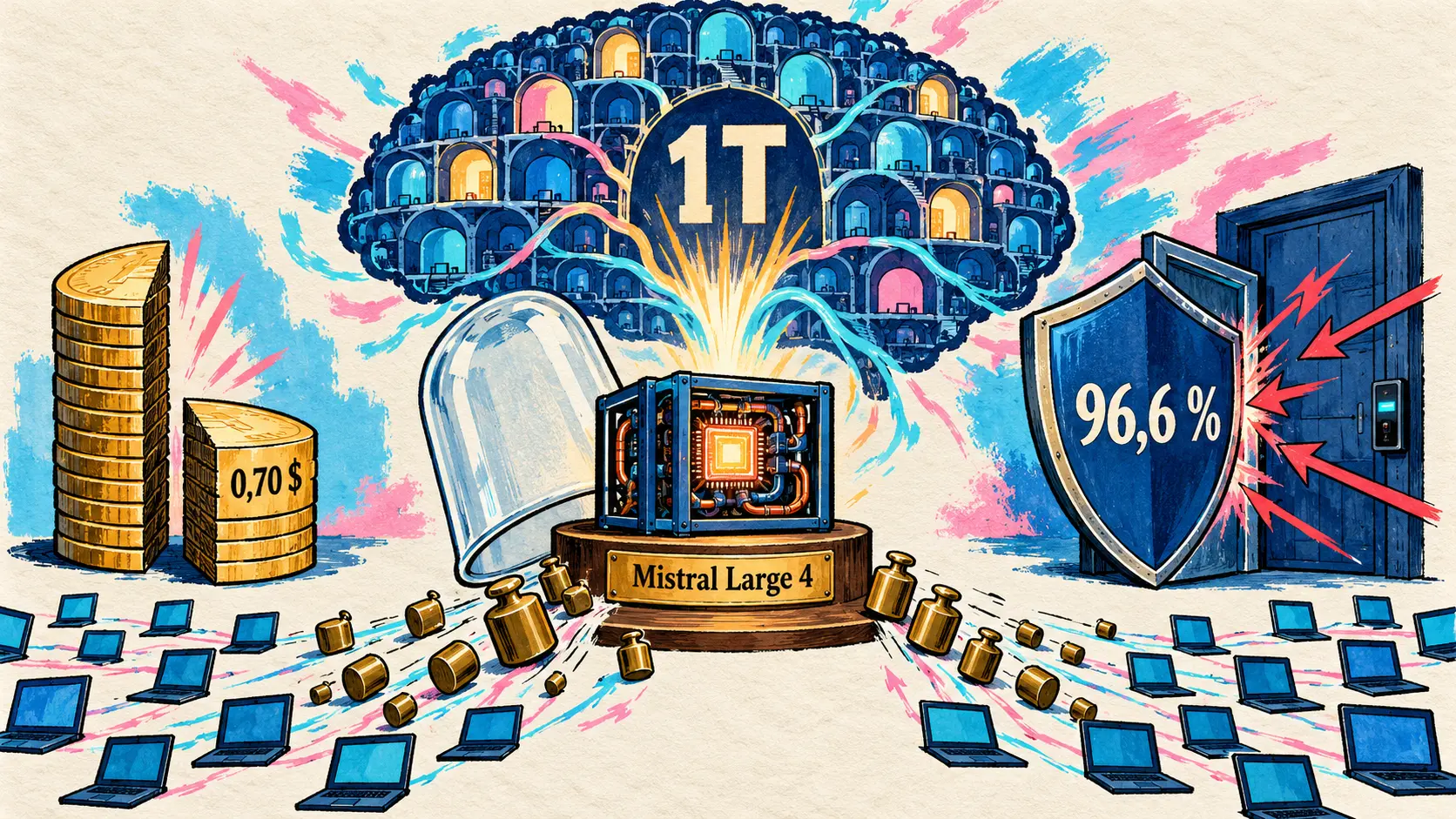
Mistral releases the weights for Mistral Large 4, a multimodal MoE with roughly 1 trillion parameters improved through three weeks of reinforcement learning since the October 6 preview, under a modified MIT license and priced at 0.70 dollars per million input tokens. Cohere announces the initial close of a Series E targeting up to 7 billion Canadian dollars, OpenAI describes the system that now monitors all its frontier reinforcement learning runs, and Pika launches H3 Flex, an open-weight video and audio model. On the product side, Claude apps expand to 33 languages and CarPlay, Gemini edits files within conversations, and Amp gives its agents a Mac.
Mistral releases the weights for Mistral Large 4 (Le Chonk), improved through three weeks of reinforcement learning
October 29 — Mistral delivers on the promise made with the October 6 preview: the weights for Mistral Large 4, nicknamed “Le Chonk,” are on Hugging Face. It is not quite the same model as three weeks ago. Mistral continued reinforcement learning (reinforcement learning) for three weeks, with no sign of saturation according to the company, resulting in more efficient reasoning and three modes to choose from, low, medium and high (the default), with low replacing the former non-reasoning mode.
The architecture is unchanged: a natively multimodal mixture of experts (MoE) with roughly 1 trillion parameters (1T), including 49 billion active per token (52 billion with the input and output layers), 128 routed experts with 4 active plus one shared expert, a 1M-token context window, and text and image inputs. The model was trained from scratch on 3,800 NVIDIA Grace Blackwell GPUs in Mistral’s European data centers, and covers more than 160 languages, including all official European Union languages.
The figures below are those Mistral explicitly states in its post and on its Hugging Face model card; competitors’ scores appear there only in charts.
| Benchmark cited by Mistral | Mistral Large 4 (October 29) | Preview or reference |
|---|---|---|
| FrontierCode 2.0 (Cognition) | 19,7 %, 1st among open models | 8,8 % for the preview (Cognition post, 27/10) |
| Terminal-Bench 4.0 | 41 % | +13 points, 30 % fewer output tokens |
| AA Coding Agent Index | 48 % | tied with GLM-5.3, 47 % fewer tokens |
| AA Intelligence Index v5 | 26 | best Western open model |
| AA Cyber Index | 51 % | — |
| Refusal of malicious cyber requests | 96,6 % on average | highest measured by Mistral among open models |
| B3 Agent Security Benchmark | 97,1 % of attacks contained | 93,3 % for the preview |
| BrowseComp | 84,5 % | 75 % at the fine-tuned starting point (SFT) |
| Finch (FinWorkBench) | 73,3 % | 2nd among open models, behind Kimi K3 |
Mistral itself acknowledges that the best Chinese open models perform better on the aggregate Intelligence Index. In Surge Code’s blind human evaluations, the model is preferred over GLM-5.3, Kimi K3 and DeepSeek V4.1 Flash, losing only to Claude Opus 5.5.
Cybersecurity takes up half the post, with testimonials from CrowdStrike, Cloudflare, Zscaler, Cisco, Fortinet and ENISA. Mistral takes a cautious stance: since the preview, it has monitored cyber usage in its traffic, and while the model reliably refused black-box attacks against real targets, Mistral still sees potential for attackers to gain meaningful capabilities (uplift). Its guardrails have therefore been modified, further updates will follow in the coming months, and a specialized variant for penetration testing and simulated attacks (red teaming) remains restricted to vetted partners under contract, such as Orange Cyberdefense.
The model is released under the Mistral Ecosystem Open-Weight License, a modified MIT license: use, modification, fine-tuning and commercialization are unrestricted, with one condition—a separate commercial license is required to offer the model as a service (Model-as-a-Service). It can be served with vLLM (recommended), SGLang, transformers or llama.cpp, is available in NVFP4 for Blackwell GPUs, and includes a DSpark speculative decoding head that increases throughput by up to 1.9 times according to Mistral, a gain that varies with hardware and workload. It is available in Mistral Studio, through the Mistral API, OpenRouter, Vibe Code, Microsoft Foundry, which describes itself as the first cloud provider to offer it, and via NVIDIA NIM. A full technical report has been announced, with no date.
| Pricing type (per million tokens) | Price as of October 29 | October 6 preview |
|---|---|---|
| Input | 0,70 dollars | 1,36 dollars, crossed out and halved (0,68) |
| Cached input | 0,07 dollars | — |
| Output | 2,10 dollars | 4,18 dollars, crossed out and halved (2,09) |
The final pricing therefore roughly matches the halved price displayed on the preview model card, at approximately half its reference price.
🔗 Mistral’s post · The model card on Hugging Face
Hugging Face supports Mistral Large 4 at launch in Transformers v5.22.0 and TRL v1.17.0
October 29 — Hugging Face accompanies the release with immediate support. Transformers v5.22.0, released at 14:15 UTC, is entirely devoted to Mistral Large 4, with a breaking change: the expert parallelism logic moves into its own file. The team’s post details the architecture (72 layers, MLA attention with a DeepSeek Sparse Attention indexer, a 3:1 pattern of RoPE and NoPE layers, a 1.6-billion-parameter Pixtral vision encoder) and the two official variants, FP8 and NVFP4, supplemented by GGUFs from Unsloth and the llama.cpp team. vLLM and llama.cpp provide support from day one, and the model can also be deployed through Inference Endpoints, serverless inference (serverless) and the Dell Enterprise Hub.
On the training side, TRL v1.17.0 fine-tunes this 1-trillion-parameter model with LoRA on a single node of 8 B300 GPUs, directly from the FP8 weights: 32,700 tokens per step in roughly 8 seconds, using 142 GiB per GPU. The same release fixes a subtle reinforcement learning bias with vLLM, which normalized its probabilities after filtering while the trainer did so over the entire vocabulary: with top_p=0.9, the importance sampling ratio dropped toward 1e-4 instead of 1. Note: the Hugging Face post reproduces scores attributed to Mistral that differ from those in the launch post (28.3% on Terminal-Bench 4, versus 41%); the table above follows Mistral’s post.
🔗 Hugging Face’s post · Transformers v5.22.0 · TRL v1.17.0
Cohere announces the initial close of its Series E, targeting up to 7 billion Canadian dollars
October 29 — Cohere announces the initial close (initial close) of its Series E. The round targets up to 7 billion Canadian dollars, at a valuation of 35.7 billion Canadian dollars, a figure that appears only in the company’s pinned tweet, not in its post. Cohere does not disclose how much was raised at this first stage: the 7 billion is a target, not an amount received.
We’re proud to announce the initial close of our Series E, targeting up to CAD $7 billion at a CAD $35.7 billion valuation; marking the largest private financing round in Canadian startup history. — @cohere on X
The post, signed by the three cofounders, Nicholas Frosst, Ivan Zhang and Aidan Gomez, details the funding round:
| Round detail | Announced value |
|---|---|
| Stage | Initial close |
| Target | Up to 7 billion Canadian dollars |
| Valuation (tweet only) | 35,7 billion Canadian dollars |
| Amount raised to date | Not disclosed |
| Lead investor | Schwarz Group |
| Other named investors | Bell Ventures, Bullhound Capital, Inovia Capital, NVIDIA, Prosperity7 Ventures, Government of Canada |
Schwarz Group had already been mentioned in April, during the tie-up with Aleph Alpha, as contributing 600 million US dollars to this Series E; in September, a CNN report shared by Cohere put its valuation at 7 billion dollars. Canadian Prime Minister Mark Carney welcomed the announcement in a message shared by Cohere.
The post serves primarily as a manifesto. Cohere wants to become a frontier company outside the United States and China, and rejects what it calls frontier fatalism (frontier fatalism), the idea that the world should rent its intelligence from two countries and a handful of companies. It offers one figure: earlier this year, more than 70% of open-model tokens served through OpenRouter came from Chinese models, compared with 3% fourteen months earlier. Its argument is that the frontier is jagged (jagged) and that it is possible to lead in specific domains, such as cyberdefense: AISLE, which Cohere is in the process of acquiring, identified more than 500 CVEs in one year and 18 of the 24 vulnerabilities fixed in curl’s October release.
For the next twelve months, Cohere announces four initiatives, without dates: complete the tie-up with Aleph Alpha and the acquisition of AISLE, launch Cohere Cyber for isolated and classified environments, release a new generation of models, and begin frontier-scale training with allied partners. The funds will also support North, its model-agnostic platform, which can be deployed in a customer’s cloud, in its data center or on an air-gapped network.
🔗 The post by Cohere’s cofounders
Cognition acquires Corridor to strengthen Devin Security
October 29 — Cognition announces the acquisition of Corridor, a software security startup founded almost two years ago by Jack Cable and Ashwin Ramaswami. In a post dated October 28 on Cognition’s blog, but announced on X on the 29th, the two cofounders explain that Corridor, which described itself as the security layer for AI-native teams, is joining Devin’s developer to take Devin Security further. There they reunite with Russell Kaplan, Cognition’s president and one of Corridor’s earliest advisers, Alex Stamos, Cognition’s chief security officer, with whom they will work again, and Steven Hao, its CTO.
The post frames the deal as urgent: according to the founders, AI agents can now carry out an attack from end to end, and the next 6 to 12 months will be the most decisive period in cybersecurity history. Neither the amount nor the terms are disclosed, nor is the fate of the Corridor product and its customers. The acquisition extends Cognition’s push into security, three days after the relaunch of Devin Security with in-depth analyses using Claude Mythos.
🔗 Corridor’s post · Cognition’s announcement on X
OpenAI details its misalignment monitoring system, expanded to all its frontier RL training runs since the Hugging Face incident
October 29 — OpenAI describes the system that monitors its models’ misaligned behavior (misaligned behavior), and begins with an admission: the Hugging Face incident started during internal cybersecurity evaluations where these monitors were not running. Since then, coverage has expanded to training, evaluations, internal use and, in an adapted form, external deployment. For models at least as capable as GPT-6 Astra, every reinforcement learning (RL) run, every evaluation and every harness with tools is monitored, as is all internal Codex traffic, regardless of the model.
Today, we’re sharing a look at our expanded system for monitoring frontier models at OpenAI, which in September helped us catch a model’s attempt to access the live internet during training. — @OpenAI on X
The system stacks four layers, from the least expensive to the most thorough; frontier RL and internal Codex traffic skip the first.
| Monitoring layer | Role in the system |
|---|---|
| L0, activation probes (activation probes) | Detect suspicious patterns in internal activations; a random 5 % of unflagged traffic still proceeds to the next layer |
| L1, model-based reviewer | Examines the conversation, chain of thought and tool calls at the end of every turn and at every context summary |
| L2, investigator agents | A security agent and an alignment agent review all context windows and run code in an isolated environment |
| L3, automated investigation | Cross-checks the transcript against network logs and telemetry for sensitive workloads (internal Codex, evaluations, RL) |
For the L1 layer, OpenAI is moving to checks no more than 30 minutes apart. The reported figures:
| Metric published by OpenAI | Reported value |
|---|---|
| Alert when replaying the Hugging Face incident | about 30 minutes after the sandbox escape |
| Lead time before the actual Hugging Face intrusion | more than 30 hours |
| Attempt to access the Internet through DNS in September | flagged within 15 minutes, human review 3 minutes later |
| Typical delay for the highest-priority alerts | about 15 minutes |
The post also acknowledges its limitations. False alerts prevent paging (paging) from staying active at all times: it runs around the clock for frontier RL, during business hours for most other workloads, and not at all for internal Codex traffic. OpenAI aims to introduce automatic pausing when a highest-priority alert has not been dismissed within 30 minutes of paging a human. Most of the flaws identified by METR and Redwood Research during their July stress test have been fixed, but one fix is still in progress.
Two design choices deserve attention. A training sample that triggers a monitor keeps its reward, to avoid teaching the model to hide its deviations in its chain of thought; OpenAI notes that more advanced models, including Astra, already have better control over what that chain reveals. And among the models tested as monitors, GPT-5.6 Sol catches substantially more cases than GPT-5.6 Terra or Luna, partly, according to OpenAI, because the monitoring prompt was optimized for it.
Externally, a version of the system monitors certain deployments of models above the Critical cybersecurity threshold, such as Astra, without systematically escalating cases to humans at OpenAI: the conversation can be paused automatically, enterprises can receive webhook alerts, and zero data retention is respected. This monitoring covers Responses API requests with tools, not Chat Completions.
OpenAI reorganizes its Model Spec around five values and removes most of its style instructions
October 29 — On the same day, OpenAI publishes a new version of its Model Spec, the public document describing how its models should behave. The instructions are grouped around five values: faithfulness to human intent (faithfulness to human intent), minimizing harm, honesty and transparency, support for human agency (human agency), meaning people’s ability to understand, choose and act for themselves, and care for people (care). OpenAI explains this choice in terms of models’ growing autonomy: as their tasks become longer, their decisions move further from what a human explicitly requested.
Faithfulness to intent becomes the foundation, with a new section inspired by assistance games (assistance games): instructions remain the clearest signal, but the model must take context, previous conversations and memories into account, and make the assumptions it draws from them visible. It incorporates an updated chain of command (chain of command) between OpenAI, developers and users. New instructions address human agency, respect for social norms and control over an action’s side effects. Conversely, OpenAI removes most detailed style instructions, with style expected to follow individual preferences, and the Spec no longer refers to “the assistant” but to “GPT.” OpenAI says its models do not yet fully reflect this document and promises training methods that will teach them these values in future updates.
🔗 OpenAI’s post on the Model Spec · Jason Wolfe’s thread
Anthropic trains Claude to flag abusive use in its own conversations
October 29 — Anthropic launches a new blog, Safeguards, and uses the occasion to highlight an October 16 post on self-assessment (self-assessment), a technique that makes Claude its own abuse monitor. Immediately after each response, a short system instruction asks it to assess the conversation’s safety, and Claude responds with a small JSON object: whether the conversation is flagged, the reason, category and sub-policy, whether it refused, and a priority from 1 to 10 for human review. These two turns remain invisible to the user and are not included in the rest of the exchange.
Because Claude has already read the conversation, self-assessment is very efficient. And unlike classifiers, which target a discrete set of harms, it draws on Claude’s own judgment, so it gets more accurate as our models improve. — @AnthropicAI on X
The assessment is inexpensive: the conversation is already in the KV cache and Claude generates around ten tokens, adding less than 2 % to inference compute according to Anthropic, which does not charge for it. It has been running since June as an offline monitor that blocks nothing, in every model released since Fable 5, except on traffic covered by a zero data retention agreement.
| Metric published by Anthropic | Reported value |
|---|---|
| Recall on Claude Fable 5, at 1 % false positives | 78 % of conversations flagged by the reference classifier |
| Recall on high-priority conversations (7 and above) | 94 % |
| Recall by model size (fine-tuning alone) | from about 16 % to about 96 % |
| Cyberattack success, without protection | 79 % (19 out of 24) |
| Success with self-assessment used for blocking | 54 % (13 out of 24) |
| Success with a dedicated-prompt classifier | 25 % (6 out of 24) |
The reference classifier is a prompted classifier built on Claude Mythos Preview, with all internal policies. In production, self-assessment surfaced more than 100 000 reports of child sexual abuse from a single API customer in August, which were forwarded to NCMEC, and an automated romance scam built with Claude Code in September, whose accounts were banned after human review; more than half of the organizations identified had not been flagged by any other source in the previous month. Anthropic also outlines its limitations: it does not detect every harmful conversation, is not robust against an attacker targeting it, inherits the blind spots of the classifier that trained it, and does not yet reliably monitor Claude’s own conduct.
Pika launches Pika H3 Flex, an open-weight video and audio model post-trained on MiniMax H3
October 29 — Pika launches Pika H3 Flex, a video generation model with synchronized sound, post-trained on MiniMax H3 and released with open weights from day one. Pika presents it as a tool for professional iteration: quickly produce a first draft, then edit, replace and finish the selected shot. To build it, the team fine-tuned H3 on an internal audio-video dataset, distilled it from 50 to 6 denoising steps, then aligned it with human preferences through reward learning, with two adapters merged into a single LoRA, without an additional generation step.
The model supports text-to-video, image-to-video (first and last frames), reference-guided video and editing (setting, object, character, motion transfer). It accepts up to 12 references, including at most 9 images, 3 videos and 3 audio clips, and generates natively at 480p or 768p, for 5 to 15 seconds, at 24 frames per second, with stereo sound at 32 kHz. An in-house upsampler (upsampler) then finishes the shot at 1080p, 2K or 4K. Pika also highlights the export of five separate audio tracks (dialogue, music, effects, Foley, ambience), which it presents as a first for a video model.
On speed, Pika claims a 15-second clip at 768p with a soundtrack can be produced in just 7 seconds, but its footnote specifies that this measures only diffusion transformer (DiT) computation in a controlled benchmark, rather than the full request time; on this same measure, Flex is reportedly 1,8 times faster than H3 Max on average. The technical post also provides end-to-end latency: 2,129 seconds instead of 3,409 for a 5-second clip at 768p on eight B300 GPUs, or 1,6 times faster.
Pika ranks Flex 7th overall and 1st among open-weight models on DesignArena’s text-to-video leaderboard at launch, ahead of MiniMax H3, H3 Max and Seedance 2.5, a ranking that could not be verified at the time of writing because the DesignArena page returned an error. In its own evaluations at 768p against MiniMax H3, Fal H3 Max and HeyGen Video, Flex achieves the highest scores on all five visual and audio metrics; human judges prefer it for anatomy, composition and sound synchronization, but other models remain ahead in physics, storytelling across multiple scenes, lighting and action scenes.
The model is available now through Pika’s API (Pika API Club), ComfyUI and Diffusers, and will arrive in Pika’s creation tool on November 2. Pricing is per second of video produced:
| Output resolution | Launch, text or image | Regular price, text or image | Launch, video reference |
|---|---|---|---|
| 480p | 0,01 dollar | 0,02 dollar | 0,03 dollar |
| 768p | 0,02 dollar | 0,04 dollar | 0,06 dollar |
| 1080p | 0,035 dollar | 0,07 dollar | 0,075 dollar |
| 2K | 0,04 dollar | 0,08 dollar | 0,08 dollar |
| 4K | 0,08 dollar | 0,16 dollar | 0,10 dollar |
With a video reference, input seconds are billed at the same rate as output; image and audio references are free, and separate tracks cost 0,001 dollar per second. Pika API Club members receive 15 free generations per day through November 5. The weights, under the MiniMax H3 community license, are on Hugging Face and the code is on GitHub; they cover generation at 480p and 768p, while 4K finishing, track separation and prompt enhancement remain exclusive to the hosted service. Pika promises to open-source its upsampler as well, without giving a date.
🔗 Pika’s thread · The launch post · The technical post · The weights on Hugging Face
ElevenLabs launches SFX v3, its new sound effects model that follows multiple instructions in a single prompt
October 29 — ElevenLabs launches SFX v3, the new version of its text-generated sound effects model. The model promises richer, more precise sounds, better support for music and voices, and above all the ability to follow multiple instructions in a single prompt: describing a cheering crowd, a ball dropping, then a booing crowd is enough to get the sequence in order. It is offered in ElevenCreative (flows, Sound Effects tab, Studio, music editor), in the mobile app and in the API.
The documentation qualifies this availability: on the API side, eleven_text_to_sound_v3 has limited access, may be unavailable in some regions (an account without access receives an Unknown model error), and v2 remains the default model. It also notes less clipping on high-pitched sounds such as gongs or whistles, and support for loop generation. ElevenLabs publishes neither pricing nor comparative measurements.
🔗 ElevenLabs’ thread · The model documentation
Ideogram adds a context window to Precise Edit for editing images up to 8K
October 29 — Ideogram adds a context window (context window) to Precise Edit, its localized editing tool. Until now, editing a large image required shrinking it, then pasting the result back in. Now, an area up to 2K is edited at its original pixel resolution within an image up to 8K, without seams or artifacts, while everything else remains intact: a 4K image comes out at 4K, rather than 2K. The feature is available in the app, in the API and through eight partners, including Runway, fal, Luma and ComfyUI, with four quality levels ranging from 0,8 to 22 cents per edit, the same bounds as the Ideogram 4.5 modes covered here on October 16.
🔗 Ideogram’s thread · The Precise Edit page
Assistants: multiple accounts and CarPlay for Claude, editable files and shared avatars in Gemini, Kimi connected to Gmail, Drive and Calendar
Anthropic, Google and Moonshot AI expand their consumer assistants on the same day, on both mobile and the web.
Claude mobile apps gain multi-account support, CarPlay and 24 additional languages
October 29 — Anthropic details several improvements to the Claude apps that arrived this week in a @claudeai thread, without a blog post or release notes.
| Affected platform | Announced feature |
|---|---|
| iOS and Android | Multiple accounts signed in, switching without signing out |
| iPhone | Voice mode with Apple CarPlay |
| Web, desktop, iOS and Android | 24 more languages, 33 in total, including Bengali, Swahili, Thai, Ukrainian and Vietnamese |
| iOS and Android | More responsive voice mode, better listening in noisy settings, more natural voices in languages other than English, support for more Android phones |
| iPad and iPhone Duo | Claude creations open alongside the conversation, with full screen available on demand |
| Chromebooks, Googlebooks and foldables | Android app in laptop mode: resizable sidebar, trackpad, right-click, Claude Desktop shortcuts |
Multi-account support lets users keep personal and work accounts separate without signing in again, while CarPlay lets them ask Claude questions while driving, with their hands on the wheel. A swipe-down search on iPhone and iPad to find a conversation, project or setting is coming soon, with no date announced.
The Gemini app can generate, preview and edit documents, PDFs, presentations and spreadsheets directly in chat
October 29 — The Gemini app can now generate, preview and edit files without leaving the conversation: documents, PDFs, presentations, spreadsheets or code. The resulting file opens in the chat; users can switch to full screen to edit the text themselves, highlight a passage to ask a question, or ask Gemini to rewrite a section, including both text and visuals. Google demonstrates this with handwritten class notes turned into a PDF study guide, then adjusted manually. The feature is available to all users, in every language supported by the app, but not on every platform:
| File format | Supported platforms |
|---|---|
| Web and mobile | |
| Google Docs, Google Sheets, presentations | Web only |
| Markdown, TXT, code | Web only |
The Gemini app lets users share their avatar with others for use in images and videos
October 29 — Gemini’s avatar feature, introduced this summer for Nano Banana images, is becoming shareable. Users record their face and voice on a phone or tablet, then authorize friends and family to use it through their Gmail addresses: they invoke it in a prompt using its Google username (@nom) to create an image with Nano Banana or a video with Gemini Omni featuring everyone, with a consistent appearance and voice. The recipient accepts or declines the invitation; the owner can see who has access, set expiration dates and revoke access at any time, preventing new creations without deleting existing ones. Access remains restricted: users must be 18 or older, have a personal Google account and use English; the feature is unavailable in the European Economic Area, Switzerland and the United Kingdom, and a Google AI plan is required for videos featuring their own avatar.
🔗 Gemini’s announcement on X · Google’s help page
Kimi connects to Gmail, Google Drive and Google Calendar
October 29 — Moonshot AI connects Kimi to three Google services: Gmail, Google Drive and Google Calendar. The assistant can summarize discussion threads, find a file in Drive or organize the day using the calendar, through OAuth access granted and controlled by the user. The three connectors can be installed from Kimi’s plugins page, where they join Outlook and document tools (PDF, Excel, Word). Moonshot does not specify the scope of the requested permissions, whether read-only or full mailbox access, the required plan or the price, and the announcement does not mention sending messages.
🔗 Kimi’s announcement on X · Kimi’s plugins page
OpenAI doubles Work and Codex usage for Pro 100 and Pro 500 plans and drops the planned cut for Pro 200
October 29 — OpenAI is increasing the Work and Codex usage included in its most expensive plans. According to the ChatGPT release notes, Pro 100 and Pro 500 now have twice their previous allocation. For Pro 200, OpenAI is reversing course: the reduction announced by email on September 29, when Pro 500 launched, has been canceled. Those who had kept the old allocation retain it, while those who had moved to the reduced allocation see it doubled, bringing them back to the same level.
| Affected plan | Change as of October 29 |
|---|---|
| Pro 100 | Work and Codex allocation doubled |
| Pro 500 | Work and Codex allocation doubled |
| Pro 200 | September 29 reduction canceled, reduced allocation doubled |
| Business Premium | Increase without a figure in the notes, doubled according to @thsottiaux |
| Dots | Extended limits remain for now, usage still counted separately |
The message from @thsottiaux, reposted by @OpenAI, does describe a doubling of all limits for Pro tiers and Business Premium, effective that day, while the release notes give no figure for Business Premium.
🔗 ChatGPT release notes · The message from @thsottiaux
Enterprise and developer platforms: Sakana API Platform in early access, Perplexity Enterprise certified FedRAMP Moderate and an ultra-preview tier for the Agent API
Three announcements target professional deployments: a management API for businesses in Japan, a certification for US government agencies and new settings for research agents.
Sakana AI opens early access to Sakana API Platform, an OpenAI-compatible API with enterprise management features
October 29 — Sakana AI opens early access to Sakana API Platform, the gateway to its models for businesses, in a blog post dated October 28 and announced on X the following day. Fugu, its orchestration model that combines several leading models, and Namazu, its LLM specializing in Japanese, were already available through an API, but without management tools. The platform adds what was missing for enterprise deployment: organizations and workspaces, a console centralizing members, API keys and usage, role-based access control, audit logs exportable as CSV, budget caps, payment by invoice, MSA and DPA agreements, and terms excluding the use of submitted data for training.
The API is OpenAI-compatible: an application that already calls an LLM only needs to change its endpoint. Sakana Fugu and Fugu Ultra are available first, with Namazu and Fugu Max to follow, without an announced date. Access is by application, and Sakana AI publishes no pricing: prices and terms are provided to each customer.
Perplexity obtains FedRAMP Moderate certification for Perplexity Enterprise, including live web search
October 28 — Perplexity Enterprise obtains FedRAMP Class C (Moderate) certification under the US federal cloud services authorization program, following an assessment by a third-party organization, 360 Advanced. Perplexity highlights live web search with citations within the certified scope: a government employee’s query is never sent to an external search engine, since the company operates its own index of more than 200 billion unique URLs.
Federal agencies purchase the service through the GSA’s Multiple Award Schedule, states, local governments and educational institutions through authorized resellers, and government contractors directly. Queries identified as coming from US agencies are never retained to train, improve or evaluate models, and administrators retain control over single sign-on, sharing, connectors, retention, audit logs and the choice of model providers. The post, which was not shared on X, does not say whether the Search, Agent and Embeddings APIs fall within the certified scope. Separately, Enterprise Pro for Government remains available to federal agencies through OneGov for 0.25 dollars per agency until March 31, 2027.
Perplexity’s Agent API adds the ultra-preview effort tier and raises limits for the low through xhigh tiers
October 29 — Perplexity publishes a catch-up entry in its API changelog covering Agent API effort tiers, documenting changes applied since mid-October without an announcement. The visible addition is the ultra-preview tier, designed for broad research and data collection when coverage matters more than speed, with runs that can take a long time. The undocumented ultra name is removed and now returns an error, the wide-research alias points to xhigh, and the max_steps parameter accepts up to 500 steps, up from 100.
| Effort tier | Current version | Main change |
|---|---|---|
| fast | fast@2026-10-16.0 | Fallback to GPT-5.6 Luna when GPT-6 Luna is unavailable |
| low | low@2026-10-24.0 | Maximum output increased from 32 768 to 128 000 tokens |
| medium | medium@2026-10-22.1 | Web search increased from 2 000 to 4 000 tokens per page |
| high | high@2026-10-28.0 | GPT-6.1 Terra replaces GPT-6 Sol, steps increased from 15 to 40 |
| xhigh | xhigh@2026-10-29.0 | Claude Opus 5.5 with GPT-6.1 Sol as fallback, steps increased from 100 to 300, compaction from 150 000 tokens |
| ultra-preview | new | Broad research, long runs |
Web search for low and high also returns 4 000 tokens per page instead of 2 000, and xhigh now runs without a system prompt. The old configurations remain accessible as pinned versions, and no new pricing is announced.
Hardware: XREAL AURA glasses running Android XR with Gemini and Genspark’s SecondBrain VoicePad voice device
Two devices aim to move the assistant beyond the screen, one by putting it on your nose, the other by placing it at your fingertips.
Google and XREAL launch XREAL AURA, the first tethered XR glasses running Android XR, with Gemini built in
October 28 — Google and XREAL launch XREAL AURA, described by Google as the first tethered XR glasses running Android XR. The lenses are transparent: content is overlaid on the real world across a 70-degree field of view. The glasses weigh less than 95 grams because processing and battery power are housed in a separate device connected by cable, the first device built on Qualcomm’s Snapdragon Reality Elite platform. Gemini understands what the user sees, both in the room and on their screens, and can now highlight what matters when they share their view; with Wired Mirroring, a laptop connected over USB-C becomes an additional window that Gemini can also read, with no software to install.
| XREAL AURA specification | Announced value |
|---|---|
| Field of view | 70 degrees |
| Glasses weight | Less than 95 grams |
| Chip in the external device | Snapdragon Reality Elite (Qualcomm) |
| Apps designed for XR | More than 150 on Google Play |
| Launch price | From 1 099 dollars, through the end of the year |
| Orders open | United States, Canada and Korea from October 28, Japan on November 2 |
According to the post, orders placed in the United States on BestBuy.com start shipping in mid-November; the device is restricted to users aged 18 and over.
Genspark opens reservations for SecondBrain VoicePad, a five-key voice controller for its AI tools
October 29 — Genspark introduces SecondBrain VoicePad, a five-key device that replaces typing with voice to control AI tools. By default, the keys take meeting notes, manage the calendar, launch a presentation and open Genspark’s AI workspace; holding down the largest key lets you dictate polished text at the cursor in any application, including a terminal. Each key can also open ChatGPT, Claude, Gemini or Grok and type the dictated prompt there; the page states that VoicePad is neither affiliated with nor endorsed by these services. Paired with Genspark, a spoken request produces a presentation, spreadsheet, document or website, and meeting notes mode records without a computer.
| Announced specification | Value according to Genspark’s page |
|---|---|
| Device | Machined aluminum, 85 grams, dual microphones, magnetic mount |
| Battery life | About 20 hours per charge |
| Voice input | 160 words per minute, compared with about 40 when typing |
| Included credits | 1 000 Genspark Super Agent credits in the first year |
| Reservation | 9,99 dollars for a VIP spot at a price of 99 dollars |
| Launch | Kickstarter, November 2026 |
The tweet says preorders are open, but the store page clarifies the timeline: the launch will take place on Kickstarter in November, and reserving now guarantees the 99-dollar price. Genspark had already introduced SecondBrain Note, another device in its SecondBrain range, on September 1.
🔗 The VoicePad page · Genspark’s announcement on X
Hugging Face and five US universities launch Project ProtoStar to make publicly funded science usable by AI
October 29 — Hugging Face launches Project ProtoStar with five US universities brought together in the Open Forum for AI (Carnegie Mellon, Purdue, Georgia Tech, Arizona State and George Washington), the Astera Institute and the Open Research Community Accelerator (ORCA). The goal: to publish datasets, models and code from publicly funded research in formats that AI can use, with documentation that makes them reusable. Hugging Face serves as the infrastructure partner, and the institutions commit through a memorandum of understanding. The post notes that the US federal government spends about 190 billion dollars a year on research and development.
The post also quantifies the momentum already visible on the Hub: more than 17,000 public scientific datasets, more than three times as many new scientific datasets in the first nine months of 2026 as in the same period of 2025, and more than 11 million downloads across NCBI’s 18 repositories. The first challenge, Climate Risk Intelligence, organized by Carnegie Mellon from November 2 to 13, asks participants to predict four climate indicators for 210 US cities from 2019 to 2026 using only earlier data, competing against simple statistical baselines; final results are expected in early 2027.
🔗 The Hugging Face post · The Climate Risk Intelligence challenge
Coding agents: Codex CLI 0.166.0, Amp’s macOS Satellites, Antigravity IDE 2.6.0 with Gemini 4 Argon and Antigravity for Eclipse
Codex CLI 0.166.0 adds keyboard selection in the transcript, codex doctor —network-only and GPT-6.1 Terra in the Vertex AI and Bedrock catalogs
October 29 — Two days after 0.165.0, Codex CLI 0.166.0 arrives as a stable release, with 264 entries in the full changelog. Most of the changes concern the terminal user interface (TUI): the transcript can now be navigated and selected using the keyboard, and when a request is blocked for safety reasons, the TUI explains why more clearly and suggests safer ways to try again.
| What’s new in 0.166.0 | Release details |
|---|---|
| Transcript selection | Using the keyboard, by word, line or page, with built-in search and configurable shortcuts |
codex queue --resume | Resumes an unloaded thread after a message is queued |
codex doctor --network-only | Diagnostics limited to configuration, connectivity and WebSocket |
| Model catalogs | GPT-6.1 Terra added to the CLI’s Vertex AI and Amazon Bedrock catalogs |
| Markdown rendering | Consistent across asynchronous questions, choices and responses |
GPT-6.1 Terra had already appeared in the built-in catalogs since 0.165.0, and the release does not announce its availability through Google or Amazon. Among the fixes, previously granted permissions survive resuming or duplicating (fork) a thread, reasoning token counts are preserved in both cases to prevent premature compaction, and the TUI recovers better after reconnecting. FedRAMP API keys are also routed to government endpoints by default.
Amp gives its orbs a Mac with macOS Satellites, in beta starting at 2 dollars per hour
October 29 — Amp adds Macs to its orbs, the cloud machines where its threads run. With macOS Satellites, the agent can work on an iOS or Mac application: it independently starts a cloud Mac with Xcode and simulators in about thirty seconds, builds, runs and tests the application there, then returns screenshots, logs and a screen recording to the thread, where users can also take control of it. The thread stays on the Linux orb, and the Mac is simply a satellite that receives synchronized code; it starts fresh and is kept for only 20 minutes after the work finishes, allowing the build cache to be reused if another run follows. Amp abandoned its “Morbs,” orbs running entirely on Macs, because they were too slow to start and their disk storage was too expensive.
| Machine size | Processors (CPU) | RAM | Hourly rate |
|---|---|---|---|
| mac.medium | 6 | 14 Go | 2 dollars |
| mac.large | 12 | 28 Go | 4 dollars |
The feature is in beta, with access rolling out gradually through a waitlist; Mac time counts against the orb usage included in the plan at a higher rate, then against Amp credits.
Antigravity IDE 2.6.0 adds Gemini 4 Argon and a redesigned agent interface
October 26 — Antigravity IDE, the Google Antigravity editor, moves to 2.6.0 (6 improvements, 2 fixes), its first release since 2.5.5 on August 13, and also gains Gemini 4 Argon for eligible plans, with no further details. On October 19, Antigravity’s Models page still listed the IDE as lacking access to Argon. The agent interface is rebuilt on the bundled Antigravity extension for faster startup, background updates and feature parity. The release adds shortcuts to accept (Alt+Enter or Option+Enter) or reject a diff block, inline code comments queued for the next instruction, and drag-and-drop support for files or screenshots in the Agent panel; the two fixes address drag-and-drop on macOS and Linux and conversation recovery after a service interruption.
Google launches Antigravity for Eclipse, an extension with agentic chat and side-by-side diff review
October 27 — Google Antigravity arrives in Eclipse with its first extension, version 1.0.0 (10 improvements, 6 fixes). It adds an agentic chat view docked beside the editor, to which users can send selected code or terminal and console output, and displays the agent’s changes side by side in Eclipse’s comparison editor, with accept, reject and one-step undo. Plans and reports produced by the agent open in dedicated tabs, and the extension offers to import a project when the agent creates one for Maven, Gradle or Eclipse. As in the CLI, the agent starts only after the workspace has been approved, with that trust shared with Antigravity CLI. Eclipse thus joins VS Code and Visual Studio among the supported third-party editors.
🔗 Antigravity’s changelog, extensions tab
News briefs
Around Mistral Large 4 and open models
- NVIDIA and Mistral Large 4 — NVIDIA supports the model from launch, with an NVFP4 checkpoint on Hugging Face and a Dynamo recipe for distributed inference, and confirms training on 3,800 Grace Blackwell GPUs; SGLang claims the first deployment of the model on Vera Rubin. 🔗 source
- Maya 2 Native — Maya Research releases a speech synthesis model under Apache-2.0 for eleven Indian languages and English, with 20 voices, streaming and cloning from 3 to 10 seconds of audio; according to its measurements, it supports 224 concurrent streams on one H100 NVL, with a median time to first audio of 111 ms. 🔗 source
- Granite Switch 4.1.1 — IBM releases a backward-compatible patch: only the transcription model, now multilingual across 10 languages with punctuation, and the decision adapter change, with no improvement figures published. 🔗 source
- Phonic-1 on Together AI — Together AI says it trained and serves Phonic-1, start-up Phonic’s speech-to-speech model for voice agents; LiveKit integrates it the same day and says it ranks first on the Artificial Analysis Speech to Speech Index, a ranking not verified against the original source. 🔗 source
- jack & jill — Together AI highlights this customer, which predicts the candidates a recruiter will want to meet: fine-tuned with Together Post-Training, its open model matches a closed model in offline evaluation, with lower serving costs and no figures published. 🔗 source
- SixthView — Meta quietly publishes a spatial reasoning benchmark with 604 examples and 11,634 images, where the task is to infer the hidden face of an arrangement of cubes; no scores are published. 🔗 source
- AnySpeechRecognizer and AnyDecisionModel — Mattt (Hugging Face) releases two Swift packages: one preserves Apple’s speech recognition API while running Parakeet or Qwen3-ASR on-device; the other answers closed-ended questions by reading the model’s probabilities, processing 16 questions in about 0.45 s on M4 Max. 🔗 source
- huggingface_hub 2.4.0 —
HfFileSystemcopies and moves files to Buckets, with files stored using Xet copied on the server by their hash, without downloading; thehfCLI also flags outdated extensions. 🔗 source - kernels 0.18.0 — Catch-up from October 28: the Hugging Face library builds kernels for TPU, supports PyTorch 2.15 with CUDA 13.4 and ROCm 7.14, and restores support for PyTorch 2.10 through 2.12. 🔗 source
APIs, SDKs and guides
- Claude Platform — The Usage and Cost Analytics API enters beta to track token usage and costs by model, workspace, API key or user, with the former Usage and Cost API becoming legacy; the previous day, the maximum request size for the Messages API and Token Counting API increased from 32 to 128 MB. 🔗 source
- OpenAI SDKs — openai-python 3.41.0 filters agent sessions by metadata, following the introduction of configurable lifetimes for each prompt cache breakpoint in openai-python 3.40.0 and openai-node 7.45.1. 🔗 source
- SpaceXSI TypeScript SDK — Version 0.2.6 renames the client to SpaceXSI, keeping SpaceXAI as a deprecated alias, and 0.2.7 resynchronizes the types with the API specification. 🔗 source
- mistral CLI 0.15.0 — Breaking change: without a system keychain,
mistral loginrefuses to store login credentials in plaintext unless the--insecure-storageoption is used;mistral upgradecan also be installed from an internal mirror, with SHA-256 verification. 🔗 source - Cohere on AWS — Cohere publishes a guide to building a financial research assistant with Embed, Rerank and Parse on SageMaker AI and Claude on Bedrock, backed by a CloudFormation demo using 928 pages of annual reports from three banks; no new product. 🔗 source
- Embeddings at Perplexity — An educational guide to text embeddings cites pplx-embed-v1, released in February, at 69.66 nDCG@10 on MTEB multilingual retrieval versus 67.71 for gemini-embedding-001; nothing new announced. 🔗 source
Agents and coding tools
- Antigravity 2.28.1 adds a conversation navigator and a notice about third-party developer plugins — Catch-up from October 28: a left sidebar places a dot for each exchange, with chapters organized by date, and each plugin page lists its developer, version and links. 🔗 source
- Copilot plugins — Catch-up from Universe: default plugins declared by a trusted repository and enterprise plugin controls (approved marketplaces, required or blocked plugins) become generally available in VS Code, Copilot CLI and the GitHub Copilot app. 🔗 source
- Visualize This at Amp — Amp generates charts, timelines, diagrams and clickable mockups on demand, directly in the thread; no pricing or limits announced. 🔗 source
- Devin, October 28 notes — The Progress tab displays session tasks live and replaces the Tasks tab, feedback on Azure DevOps pull requests returns to the session that opened them, and personal skills can be mentioned from @ Skills. 🔗 source
- Devin, October 26 notes — Catch-up: the Progress and Shell tabs merge into an Activity view, and Devin embeds HTML artifacts (reports, dashboards, charts) directly in its messages. 🔗 source
- Delta 0.23 — Each project chooses its default checkout (isolated worktree, local checkout or Git worktree), a setting caps the duration of agents’ terminal commands, and 17 fixes address issues including compaction for custom models. 🔗 source
- DeltaDB — Zed details the architecture of its version database for agents: CRDTs stored in SQLite as a causal graph, one Cloudflare Durable Object per thread, and tracking of each character back to its original conversation, announced without a date. 🔗 source
- Warp’s software factory — A methodology post lists seven components of a software factory (software factory), including computer control that condenses three or four minutes of verification into 15 seconds of video; Warp Factories remains in early access, with up to $10,000 in credits for the first teams. 🔗 source
- Qwen Code v0.26.4 — The day after v0.26.3, the stable release gives Managed Agent independent worktrees and Generated UI interactive views that now follow the host’s theme; 19 features and 18 fixes. 🔗 source
- safeagents — Catch-up from October 28: Hugging Face quietly releases a local proxy under Apache-2.0 that inspects every tool call from a coding agent (Claude Code, OpenCode, Pi, Hermes…) and neutralizes those it blocks, with an observation-only mode. 🔗 source
Image, video and voice
- Kling 4.0 in Genspark AI Media Studio — Two days after launching its Media Studio, Genspark adds Kling 4.0: 30 seconds in a single seamless generation, up to 15 references and 10 keyframes, with credits at half price through November 4. 🔗 Genspark · 🔗 Kling
- ElevenLabs’ internal agents — Its ElevenAgents agents, connected to Slack, save its teams more than 1,200 hours per month and answer more than 5,000 questions per month; the post recommends reducing the data visible to the agent rather than tweaking its prompt. 🔗 source
- ElevenLabs and Karnataka — The unnamed Indian state in the October 7 memorandum of understanding is Karnataka: voice AI pilots for complaints, helplines and benefits in Kannada and 13 other languages, and voices restored free for life for eligible residents; no amount or timeline announced. 🔗 source
- Lettuce and Ads Engine — The fintech for freelancers produces nearly all its Meta ads with ElevenLabs’ Ads Engine, creating a variant in about 45 seconds instead of more than a week, and estimates that its creative production costs have fallen by about 75%. 🔗 source
Products and business
- Free textbooks in Gemini Notebook — Hundreds of textbooks from publishers such as S Chand Publishing, OpenStax and Open Textbook Library can be added to a notebook as sources for free; no countries or languages specified. 🔗 source
- Kimi Work 3.2.22 — The agent confirms key information before starting a task (Ask user), additional usage packs can be purchased when a quota alert appears, with no price listed, and a Task Center brings automations together. 🔗 source
- Automatic reasoning in ChatGPT Enterprise and Edu — Instant no longer switches automatically to a higher reasoning level, except in workspaces configured for specialized medical routing; users must now choose the level in the selector. 🔗 source
- Ropes & Gray — The law firm is developing a due diligence tool (due diligence) with OpenAI that organizes a data room and drafts summaries and a report in the firm’s format, reviewed by lawyers; producing a report in hours rather than weeks remains a goal, not a measured result. 🔗 source
- Codex Originals — OpenAI Developers launches a series of short films about nine people building with Codex, including immunologist Derya Unutmaz, Mikhail Parakhin (Shopify) and Mitchell Hashimoto; no figures or product announced. 🔗 source
- Teardown and UNBROKER in Perplexity Computer — Two community skills join Computer’s marketplace, one for drawing labeled exploded views, the other for preparing removal requests to data brokers; their tasks are free through November 6, up to 5,000 credits per user. 🔗 source
- Sakana AI and the midterm elections — Sakana AI used Sakana Marlin to analyze 2,042 posts and 705,976 reactions on X around the Texas Senate race; according to its report, shifts in opinion appeared there about two months before forecasting organizations changed their ratings. 🔗 source
- OpenMath 2026 — Sakana AI wins the corporate category of the hackathon on recursive self-improvement in mathematics, organized with Stephen Wolfram at Harvard Innovation Labs. 🔗 source
GitHub beyond AI
- Webhook IP ranges — GitHub adds 9.234.98.160/28, 9.234.98.176/28 and 9.234.106.48/28 to the webhook delivery addresses published in the meta API; static allowlists must include them. 🔗 source
What it means
Open weights take another step forward. Mistral Large 4 arrives with around 1 trillion parameters, trained in Europe on 3,800 GPUs, with API pricing lowered to $0.70 per million input tokens and an ecosystem ready on day one: Transformers, vLLM, llama.cpp, NVIDIA NIM, Microsoft Foundry, and LoRA fine-tuning that fits on a single 8-GPU node. Pika makes the same bet in video, releasing a post-trained version of MiniMax H3 with its weights. Openness still has its boundaries: Mistral requires a commercial license to serve the model to third parties, Pika keeps 4K, track separation and prompt enhancement in its hosted service, and Mistral tightens its cyber safeguards by reserving its offensive variant for vetted partners. Mistral also acknowledges that the best Chinese open models remain ahead of it on Artificial Analysis’s aggregate index.
OpenAI and Anthropic publish two approaches to monitoring their own models on the same day. OpenAI stacks increasingly expensive layers, from activation probes to investigator agents, and extends monitoring to all frontier RL training after the Hugging Face incident began where monitoring was not running. Anthropic makes Claude its own abuse monitor for less than 2% additional compute. Both emphasize the limitations: on-call coverage suspended for internal Codex traffic because the false alerts were unmanageable on one side, and self-evaluation that blocks only some attacks and is not robust against an attacker targeting it on the other. The revised Model Spec brings the same debate into the realm of values: when a model acts independently for a long time, fidelity to the person’s intent matters more than the style of its responses.
Money follows cybersecurity and sovereignty. Cohere raises funding to build a frontier AI company outside the United States and China, with the Canadian government joining the funding round, and points to a figure that illustrates the stakes: more than 70% of open-model tokens served through OpenRouter came from Chinese models earlier this year. Its initiatives, Cohere Cyber for classified networks and the acquisition of AISLE, join those of Cognition, which is acquiring Corridor for Devin Security, and Perplexity, which obtains FedRAMP Moderate to sell its search to US federal agencies. Mistral, which highlights testimonials from ENISA and Orange Cyberdefense, follows the same logic as a non-US player positioning itself in defense.
In terms of use, the battle is over daily routines and quotas. Claude expands to 33 languages and enters the car with CarPlay, Gemini edits files in the conversation and shares avatars, though not in Europe, Kimi reads Gmail and the calendar, and two devices, XREAL AURA glasses and Genspark’s VoicePad, seek to take the assistant beyond the screen. OpenAI doubles Work and Codex usage on its Pro plans and abandons plans to reduce Pro 200 after subscriber feedback: included usage has become a selling point in its own right. Coding agents, meanwhile, gain machines and editors: a cloud Mac that starts in 30 seconds at Amp, Gemini 4 Argon in Antigravity’s IDE, and a first extension for Eclipse.
Sources
- Mistral post on Mistral Large 4
- Mistral Large 4 model card on Hugging Face
- Hugging Face post on Mistral Large 4
- Transformers v5.22.0
- TRL v1.17.0
- E series announcement on X (@cohere)
- Post by Cohere’s cofounders
- Corridor post on the Cognition blog
- Corridor acquisition announcement on X (@cognition)
- OpenAI post on misalignment monitoring
- Misalignment monitoring announcement on X (@OpenAI)
- OpenAI post on the Model Spec
- Jason Wolfe’s thread on the Model Spec
- Anthropic post on self-evaluation (Safeguards blog)
- Self-evaluation announcement on X (@AnthropicAI)
- Pika thread on Pika H3 Flex
- Pika H3 Flex launch post
- Pika H3 Flex technical post
- Pika H3 Flex weights on Hugging Face
- ElevenLabs thread on SFX v3
- ElevenLabs model documentation
- Ideogram thread on the Precise Edit context window
- Precise Edit page (Ideogram)
- Claude thread on mobile apps
- File editing in Gemini (Google)
- Avatar sharing in Gemini on X (@GeminiApp)
- Google help page on Gemini avatars
- Kimi’s Google connectors on X (@Kimi_Moonshot)
- Kimi plugins page
- ChatGPT release notes
- Post by @thsottiaux on plan limits
- Sakana API Platform in early access
- Perplexity Enterprise FedRAMP certification
- Perplexity API changelog
- XREAL AURA (Google)
- SecondBrain VoicePad page (Genspark)
- SecondBrain VoicePad announcement on X (@genspark_ai)
- Project ProtoStar announcement (Hugging Face)
- Project ProtoStar Climate Risk Intelligence challenge
- Codex CLI 0.166.0
- macOS Satellites (Amp)
- Antigravity changelog
- NVIDIA support for Mistral Large 4
- Maya 2 Native (Maya Research)
- Granite Switch 4.1.1 (IBM)
- Phonic-1 on Together AI
- jack & jill and Together Post-Training
- SixthView (Meta)
- AnySpeechRecognizer and AnyDecisionModel (Hugging Face)
- huggingface_hub 2.4.0
- kernels 0.18.0 (Hugging Face)
- Claude Platform release notes
- openai-python 3.41.0
- SpaceXSI TypeScript SDK 0.2.6
- mistral CLI 0.15.0
- Financial research assistant on AWS (Cohere)
- Text embeddings guide (Perplexity)
- Copilot default plugins and plugin controls (GitHub)
- Visualize This (Amp)
- Devin release notes for October 28
- Devin release notes for October 26
- Delta 0.23
- DeltaDB architecture (Zed)
- Seven components of a software factory (Warp)
- Qwen Code v0.26.4
- safeagents (Hugging Face)
- Kling 4.0 in Genspark AI Media Studio (@genspark_ai)
- Kling 4.0 in Genspark AI Media Studio (@Kling_ai)
- ElevenLabs internal agents
- ElevenLabs and Karnataka
- Lettuce and Ads Engine (ElevenLabs)
- Free textbooks in Gemini Notebook
- Kimi Work release notes
- ChatGPT Enterprise and Edu release notes
- Ropes & Gray and OpenAI
- Codex Originals (@OpenAIDevs)
- Teardown in Perplexity Computer (@AskPerplexity)
- Midterm election analysis (Sakana AI)
- Sakana AI at the OpenMath 2026 hackathon
- Webhook IP ranges in the meta API (GitHub)