ai-powered-markdown-translatorArticle translated from fr to en with gpt-5.4-mini.
This July 8 is marked by three major model launches: Grok 4.5 from SpaceXAI, co-trained with Cursor for code and agentic tasks; GPT-Live from OpenAI, a new full-duplex voice architecture that replaces Advanced Voice Mode; and Robostral Navigate, Mistral’s first robotic navigation model. Cognition rounds out the picture with SWE-1.7, Runway opens a unified API platform for media generation, and Gemini CLI moves to stable version 0.50.0. Twelve notable stories and three brief items complete this overview, spanning developer agentic tooling, code benchmark reliability, and open source inference.
Grok 4.5: SpaceXAI launches its smartest model, co-trained with Cursor
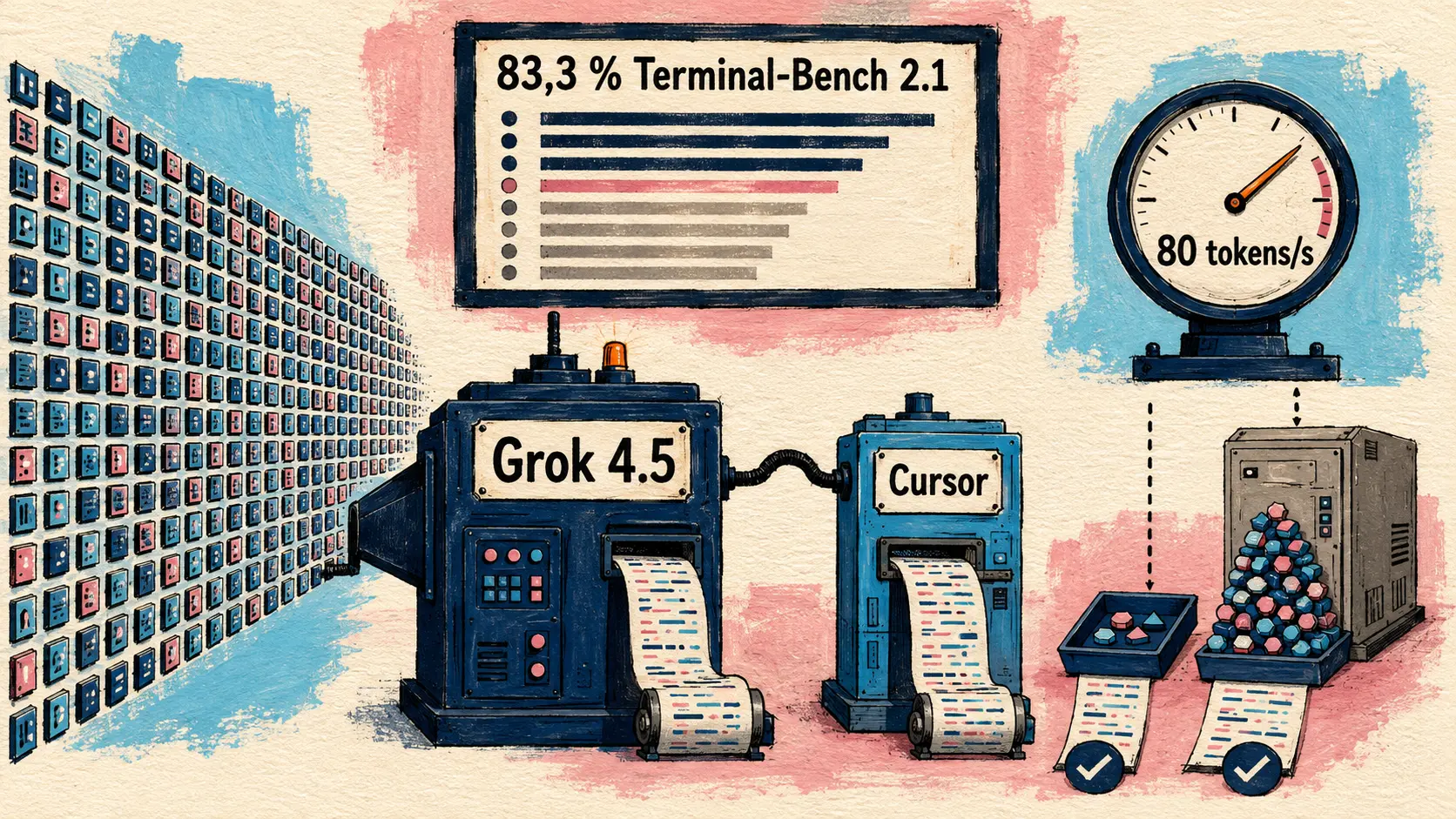
July 8 — SpaceXAI (formerly xAI) launches Grok 4.5, described as its smartest model to date, designed to excel at code, agentic tasks, and knowledge work. Notably, the model was trained jointly with Cursor, a partnership explicitly highlighted by SpaceXAI.
“Today, we’re launching Grok 4.5, SpaceXAI’s smartest model built to excel at coding, agentic tasks, and knowledge work. It’s our strongest model ever and was trained alongside Cursor.” — SpaceXAI, x.ai/news/grok-4-5
On the published benchmarks, Grok 4.5 places itself in the leading pack without consistently dominating:
| Benchmark | Score |
|---|---|
| DeepSWE 1.0 (pass@1) | 62.0 % |
| Terminal-Bench 2.1 | 83.3 % |
| SWE-Bench Pro | 64.7 % |
On the efficiency side, the model runs at 80 tokens/second and uses about 4.2× fewer output tokens than Claude Opus 4.8 (max mode) on SWE-Bench Pro (15,954 tokens on average versus 67,020). Training relied on tens of thousands of NVIDIA GB300 GPUs and large-scale reinforcement learning on hundreds of thousands of software engineering tasks.
| Type | Price |
|---|---|
| Input | $2 / M tokens |
| Output | $6 / M tokens |
Grok 4.5 becomes the default model in Grok Build, where it can build complex Excel files, PowerPoint presentations with native shapes, and Word documents. It is available today in Grok Build, in Cursor (all plans), and via the SpaceXAI console — but not yet in the European Union, where rollout is expected in mid-July.
OpenAI launches GPT-Live, its new full-duplex voice models
July 8 — OpenAI launches GPT-Live, a new generation of voice models that replaces Advanced Voice Mode as the engine for ChatGPT Voice. Unlike previous generations — transcription/LLM/synthesis cascade, then a turn-taking model waiting for silence to respond — GPT-Live is built on a full-duplex architecture: it listens and speaks at the same time, gives backchannels (“mhmm”, “okay”) while the user is talking, and decides several times per second whether it should speak, listen, pause, interrupt, or invoke a tool.
Second architectural shift: GPT-Live delegates complex tasks (web search, deep reasoning, agentic work) to a frontier model — GPT-5.5 at launch — while keeping the conversation going verbally as that work runs in the background. OpenAI plans to evolve this model behind the scenes as new frontier models are released.
“GPT-Live is built on a full-duplex architecture, meaning it can listen and speak at the same time. […] While it works, GPT-Live can keep talking with you and maintain the flow of conversation.” — OpenAI, Introducing GPT-Live
Two versions are being rolled out today to all ChatGPT users (iOS, Android, web): GPT-Live-1 for Go/Plus/Pro, GPT-Live-1 mini for free users. API access is planned soon, waitlist open. On internal evaluations (GPQA, BrowseComp, a τ³-Voice Telecom variant), GPT-Live-1 clearly outperforms Advanced Voice Mode and is preferred by human raters. More than 150 million people use voice and dictation on ChatGPT every week.
On the safety side, OpenAI has expanded its tests to audio-native evaluations (self-harm, psychosis, emotional dependence on AI, violence, sexual content), added active real-time safeguards, and strengthened protections for teenagers, with possible parent notification in case of signs of distress.
Cognition launches SWE-1.7 in Devin, a lower-cost new code model
July 8 — Cognition launches SWE-1.7, described as the most capable model it has trained to date, reaching frontier-level intelligence at a significantly lower cost — the team calls it a shift in the cost/performance Pareto curve. The model starts from a Kimi K2.7 base (already heavily post-trained with RL), and the additional gains achieved by Cognition challenge the idea of a “post-training ceiling”: according to the team, reinforcement learning can still push capabilities much further than previously thought.
SWE-1.7 is available today in Devin (Web, Desktop, and CLI), served via Cerebras at 1,000 tokens/second.
| Evaluated model | FrontierCode 1.1 Main |
|---|---|
| SWE-1.6 | 9.4 % |
| SWE-1.7 | 42.3 % |
On Terminal-Bench 2.1 and SWE-Bench Multilingual, SWE-1.7 sits between Kimi K2.7 Code and frontier models (GPT-5.5, Claude Opus 4.8), while costing significantly less per task. The technical article details four workstreams: preserving entropy during RL training (top-p sampling with distribution replay, to avoid exploration collapse), multi-cluster training spread across three continents with fault tolerance (compressed weight updates completed in 1 to 2 minutes for a 1 trillion parameter model), anti-cheating data curation, and self-compaction for long tasks (up to six hours per run), where the model learns to summarize its own working state.
On the behavior side, SWE-1.7 explores the codebase more systematically before acting, investigates root causes of bugs more thoroughly, and produces more condensed reasoning thanks to an alternating length penalty applied during training.
🔗 SWE-1.7: Frontier Intelligence at a Fraction of the Cost
Mistral enters robotics with Robostral Navigate
July 8 — Mistral AI launches Robostral Navigate, its first model dedicated to embodied navigation: an 8-billion-parameter model that moves a robot from a single RGB camera — without LiDAR or depth sensor — and a natural-language instruction.
“Announcing Robostral Navigate, our first model for embodied navigation: an 8B robotics navigation model that guides robots to autonomously perform tasks specified with natural language. Single RGB camera. State-of-the-art on R2R-CE.” — Mistral AI, July 8 tweet
On R2R-CE (Room-to-Room in Continuous Environments), the reference benchmark for instruction-based navigation, Robostral Navigate reaches the state of the art on unseen validation:
| Approach | R2R-CE success rate |
|---|---|
| Robostral Navigate (single RGB camera) | 76.6 % |
| Best previous single-camera approach | ~66.9 % |
| Best depth / multi-camera approach | ~72.1 % |
The model predicts the coordinates of the target position directly in the camera image rather than metric movements, which makes it robust to changes in camera intrinsics. Built entirely in-house (without a third-party open-source VLM), it is initialized from Mistral’s specialized VLM for pointing/counting/object localization, and trained on around 400,000 simulated trajectories collected across 6,000 scenes. A prefix-caching technique with tree attention masking reduces the number of training tokens by 22× compared with step-by-step sampling; online RL post-training (CISPO, in-house algorithm) adds another 3.2 success-rate points without signs of saturation.
Robostral Navigate runs on wheeled, legged, and flying robots, and targets manufacturing, delivery, logistics, and hospitality use cases.
Runway launches Runway Dev, a unified API platform for media generation
July 8 — Runway launches Runway Dev, an AI media platform for developers and enterprises: a single API to integrate the best image, video, audio, and real-time avatar models. Already used by teams at Adobe, ElevenLabs, Shutterstock, Figma Weave, Gamma, and Silverside.
The platform is built around four components:
| Component | Function |
|---|---|
| Models | Access to Runway first-party models (Gen-4.5, Aleph 2.0, Act-Two) and third-party models (Seedance, GPT Image 2, ElevenLabs), model switching in a single line of code |
| Recipes | Ready-to-use endpoints packaging Runway’s prompting/workflow expertise (ad localization, product ad, product swap, multi-shot video) |
| Workflows | Custom pipelines combining multiple models/modalities, triggerable via a private API endpoint |
| Characters | Real-time interactive avatars (voice, tool calling, knowledge base) — exclusive to Runway Dev, for customer support, training, or interactive entertainment |
The cited use cases give a sense of scale: a broadcaster produces 800 to 1,000 ads per year with a team of 5 people, a retailer generates more than 1,000 product visuals per month, a 500-person in-house agency runs a single agentic pipeline from brief to final render, and a delivery platform localizes its product videos into 27 languages.
Runway Dev is positioned as an enterprise-grade platform: SOC 2 Type II certification, IP indemnification, built-in content moderation, 99.9% guaranteed uptime, and contractual commitments not to train on customer data. Access via dev.runwayml.com.
Gemini CLI v0.50.0 goes stable with Tool Registry Discovery
July 8 — Google releases Gemini CLI v0.50.0, a new stable release (tagged “Latest” on GitHub) that succeeds v0.49.0 and becomes the recommended version, separate from the nightly v0.51.0-nightly.* line previously followed.
The headline feature of this release is Tool Registry Discovery: new tool-registry discovery capabilities that automatically detect and register the tools available to the agent, without manual configuration. This release also marks a significant hardening of the release verification and CI pipeline: scripts are now ignored during npm ci verification (to avoid arbitrary code execution during installation), a mechanism prevents “workspace binary shadowing” (a local binary accidentally masking the official binary), and additional protections cover bad NPM releases as well as promotion job crashes.
Gemini CLI remains the #1 priority source for the Gemini tracker on this blog, and this v0.50.0 illustrates a broader trend in the tool over recent weeks: beyond new features, a growing share of each release is focused on the robustness and security of the publication chain itself — already seen with the macOS sandbox hardening in earlier versions.
GitHub Copilot in VS Code: the June 2026 recap (v1.123 to v1.127)
July 8 — GitHub publishes its monthly recap of Copilot in Visual Studio Code, covering versions v1.123 to v1.127 (June – early July 2026). Several agentic features move into general availability or preview:
| Feature | Status |
|---|---|
| Agentic built-in browser tools (navigation, screenshot, web app validation) | GA |
| Parallel multi-chat sessions in the Agents window | Available |
| Cost visibility (session, delegated sub-agent, additional usage) | Available |
| Model provider discovery from the Marketplace | Available |
| 1M-token context windows (compatible Anthropic/OpenAI models) | Available |
| Official Ollama extension | Available |
Beyond this table, the recap details a more autonomous Autopilot (better task-completion detection), chat session sync across the GitHub account, gutter comments on agent changes, PR creation with title and description generated from session context, managed Copilot settings for administrators (Windows/macOS device management and JSON file), pre-registered MCP OAuth credentials, a 2-hour delay before automatic extension updates, and secure navigation of new folders before trust (Workspace Trust).
The accumulation of these changes over five monthly releases illustrates how quickly Copilot is moving the slider from occasional assistance toward autonomous multi-session agenting, with cost control now as granular as per delegated sub-agent.
🔗 GitHub Changelog — June 2026 VS Code releases
OpenAI: SWE-Bench Pro audit and new Codex CLI version
SWE-Bench Pro Audit — ~30% of Tasks Deemed Defective
After previously recommending that the community switch to SWE-Bench Pro (following flaws identified in SWE-bench Verified), OpenAI conducted a similar audit of this new benchmark and withdrew its recommendation. An automated analysis pipeline flagged 286 potentially problematic tasks out of the 731 in the public set; a review combining investigative Codex agents and five independent human engineers per task confirms that 200 to 249 tasks (27.4% to 34.1% depending on the counting method) are actually defective — overly strict tests, under-specified prompts, poor coverage, or misleading prompts. OpenAI calls on the community to build new benchmarks directly by experienced developers rather than automatically extracted from open source pull requests.
🔗 Separating signal from noise in coding evaluations
Codex CLI 0.143.0
New stable release: remote plugins are now enabled by default (with npm source support for the marketplace), authentication traffic and the Responses API can go through macOS/Windows system proxies (PAC/WPAD), and the codex remote-control pair command generates manual pairing codes for a running daemon. The Amazon Bedrock catalog gains the GPT-5.6 Sol, Terra, and Luna models, and MCP tool discovery is now enabled by default. On the fixes side: ConPTY input handling on Windows, better recovery for remote execution servers that are temporarily offline, and security updates for dependencies (OpenSSL, Hono, fast-uri, quick-xml, crossbeam-epoch).
Cognition and Amp: reliability of open models and remote agents
Measuring the reliability of open-source-derived models
Alongside the launch of SWE-1.7, Cognition publishes a study on the reliability of models built from predominantly Chinese open source bases (Kimi K2.7 Code, DeepSeek-V4, GLM 5.2): a tendency to reproduce Communist Party-aligned discourse, and a risk of differential capabilities (less secure code depending on the user’s perceived identity). Across a set of 145 politically sensitive questions and a differential safety test under six personas, SWE-1.7 scores comparably, or even better, than GPT-5.5 and Claude Opus 4.8 — whereas raw Kimi K2.7 routinely complies with problematic requests that SWE-1.7 refuses. Cognition observes no statistically significant behavioral difference tied to the personas tested.
🔗 Measuring the Trustworthiness of Open-Source-Derived Models
Amp: remote agents from any machine
Amp can now start new remote agents from ampcode.com on any machine capable of running the amp command — not just in “orbs” (ephemeral cloud machines), but also a laptop, a server, or a cloud development box. The feature is enabled via "amp.remoteThreadCreation.enabled": true in the configuration; each Amp client started then accepts new threads in its current working directory. A headless “Runner Mode” (amp --no-tui) completes the set: multiple runners can run simultaneously on the same machine, identified by the host + working directory pair, without requiring Git versioning.
Gemini: expanded managed agents and CLI security fixes
Gemini API — expanding Managed Agents
Google is expanding the capabilities of the Gemini Interactions API Managed Agents: asynchronous background execution (background: true, with a tracking ID for later reconnection), direct connection to remote MCP servers without writing proxy middleware, custom function calling combined with built-in sandbox tools, and refreshing network credentials on an existing environment without losing sandbox state (files, installed packages, cloned repositories). The published examples use the @google/genai JavaScript SDK and the antigravity-preview-05-2026 model.
🔗 Expanding Managed Agents in Gemini API
Gemini CLI v0.51.0-preview.0 — security fixes
This preview release bundles several security and robustness fixes: case-insensitive blocklist of sensitive paths combined with human-in-the-loop for the VS Code extension, a directory escape via symlink in the memory import processor, removal of a leak of reasoning traces (thoughts) in the cleaned history, defensive resolution of paths referenced by @, making ~/.gitconfig read-only in the macOS sandbox, and updating the Vertex base URL.
🔗 Release v0.51.0-preview.0 — GitHub
GitHub Mobile: Copilot CLI notifications and conflict resolution
Live notifications for Copilot CLI sessions
GitHub Mobile live notifications, already available for the cloud agent, are now extending to remote Copilot CLI sessions. Through iOS Live Activities (17.2+) and Android Live Update Notifications (16+), the user sees the session status in real time (running, waiting for a response, inactive, completed) and can open logs directly from the notification. It works for sessions launched from Copilot CLI, VS Code, or other supported surfaces, and can still be turned off in settings.
🔗 GitHub Mobile: Live notifications for Copilot CLI sessions
Resolving merge conflicts with the Copilot cloud agent
GitHub Mobile now makes it possible to unblock a conflicting pull request directly from mobile: a “Fix with Copilot” button in the merge panel pre-fills a comment asking Copilot to resolve the conflicts, then launches the cloud agent. The app shows conflict alerts and clear feedback in case of success or failure. The @copilot mention in a PR comment remains available for other tasks (fixing failing Actions workflows, responding to code reviews, adding tests).
🔗 GitHub Mobile: Fix merge conflicts with Copilot cloud agent
Anthropic: two Claude Cowork case studies
Automating marketing reporting and campaigns
Claude Blog details how Anthropic’s marketing ops team automated part of its work with Claude Cowork. Ian Chan replaced a weekly reporting process that took him one to two days with a scheduled task that runs every Sunday evening, relying on three dedicated skills: report preparation, a review that checks every number against a trusted source, and turning follow-up points into Asana tasks. Annabel Custer, for her part, automated marketing campaign setup through a “dispatcher” skill that reads a Slack channel every hour and routes each request, with an independent audit agent that verifies the work without prior context.
🔗 How Anthropic’s marketing operations team uses Claude Cowork
Thomson Reuters: “Fiduciary-Grade” AI with Claude
Second case study: Thomson Reuters (Westlaw, Practical Law, CoCounsel Legal) integrates Claude into products used by lawyers demanding extreme precision, under the concept of “Fiduciary-Grade AI.” Joel Hron, CTO, imposes four requirements on a model before production: self-checking citations rather than trusting the model’s memory, holding up across long chains of tool calls, human involvement in the work, and freeing up time for tasks that were previously out of reach. Thomson Reuters also uses Claude Cowork for operational automation and Claude Code for building long-running agents, and says it is eager to explore Claude Fable 5.
🔗 Working at the frontier: Thomson Reuters
Hugging Face and Together AI: open source inference speeds up
The transformers vLLM backend reaches native speed
Harry Mellor (the vLLM team) and Lysandre (Hugging Face co-founder) demonstrate that the transformers modeling backend for vLLM now matches, and even surpasses, the native throughput of hand-written vLLM implementations. Across three Qwen3 models tested head-to-head: Qwen3-4B goes from 46,850 to 47,443 tokens/s (100.0% of native), Qwen3-32B from 14,310 to 14,660 tokens/s (100.1%), and Qwen3-235B-A22B MoE FP8 from 31,382 to 33,152 tokens/s (102.0%). Model authors can thus automatically benefit from ultra-fast vLLM inference without manual porting, via vllm serve <modèle> --model-impl transformers.
🔗 Native-speed vLLM transformers backend — HuggingFace Blog
Together AI launches Provisioned Throughput
Together AI announces Provisioned Throughput, a reserved-capacity inference format for frontier open models, with token-based pricing and a 99% availability SLA. Available today for MiniMax M3 and GLM-5.2, with a minimum commitment of one month. Economic example on MiniMax M3: one capacity unit (PTU, $0.05 per minute) at full utilization works out to about $0.36/M input tokens and $2.16/M output tokens, versus $5 and $25 at Claude Opus 4.8 list price — up to 90% cheaper. Together AI says its API token volume has grown from 30 billion to more than 400,000 billion tokens per month in nine months.
🔗 Provisioned Throughput — Together AI Blog
Briefs
- Claude Code v2.1.204 — single fix: hook events were not flowing properly during
SessionStarthooks in headless sessions, which could cause remote workers to be incorrectly considered idle and idle-reaped in the middle of a hook. 🔗 CHANGELOG.md - FrontierCode 1.1 — Cognition revises the methodology of its agentic code benchmark: programmatic detection of cheating via consultation of reference solutions (up to 37.2% of Claude Fable 5 runs affected on version 1.0), 75 relaxed scoring criteria, and new scores for Claude Sonnet 5 (42.7%) and Claude Fable 5 (53.5%, still in the lead). 🔗 FrontierCode 1.1
- NVIDIA and LangChain optimize Deep Agents for Nemotron 3 Ultra — LangChain’s Deep Agents harness tuned for the open Nemotron 3 Ultra model achieves an aggregate score of 0.86 for $4.48, versus $43.48 for the closest closed model in performance — an inference cost about 10× lower. 🔗 Tweet @NVIDIAAI
What this means
The frontier-model race is being replayed on cost as much as on intelligence. Grok 4.5, SWE-1.7, and the GPT-Live/GPT-5.5 duo illustrate three different approaches to the same problem: instead of aiming only for the highest benchmark score, labs are now explicitly optimizing the cost/performance ratio — Cognition openly talks about “moving the Pareto curve,” SpaceXAI highlights token consumption 4.2× lower than Opus 4.8, and OpenAI offloads GPT-Live’s heavy tasks to a separate model rather than making the voice model do everything. The training partnership between SpaceXAI and Cursor, explicitly mentioned in the Grok 4.5 announcement, also confirms a trend: IDE and agent-tool vendors are becoming model-design partners, not just API customers.
Embedded AI is diversifying its players. With Robostral Navigate, Mistral joins Google DeepMind (Gemini Robotics) and NVIDIA in the race toward embedded robotics, with a deliberately minimalist approach (single RGB camera, no LiDAR) aimed at large-scale deployment rather than maximum lab performance. Runway Dev follows a similar logic on the generative media side: instead of selling a single model, the platform packages access to multiple providers (including competitors like ElevenLabs and Seedance) behind a single API and billing model — a bet on aggregation rather than model exclusivity.
Developer agent tooling is expanding on all fronts. Gemini CLI v0.50.0 (Tool Registry Discovery), the Copilot VS Code recap (costs per sub-agent, 1M-token context), Codex CLI 0.143.0 (remote plugins, enterprise proxies), and Amp (remote agents from any machine) all point to the same movement: agentic CLIs and IDEs are becoming full-fledged platforms, with their own tool registries, cost management by delegated agent, and enterprise network infrastructure. GitHub Mobile extends this logic all the way to the smartphone, with live notifications and conflict resolution controllable from a phone.
Trust in benchmarks and open source models is becoming a subject in its own right. OpenAI’s audit of SWE-Bench Pro (30% defective tasks, recommendation withdrawn) and Cognition’s FrontierCode 1.1 revision (cheating via reference-solution consultation detected in more than a third of Fable 5 runs) show that code benchmarks themselves are becoming objects of continuous verification rather than fixed references. In parallel, Cognition’s study on the reliability of models derived from Chinese open source, and the inference performance gains obtained by Hugging Face and Together AI on open models, indicate that the open source ecosystem is no longer seen as a second-tier choice but as a base that must be audited, optimized, and made economically competitive with proprietary models.
Sources
- Grok 4.5 — x.ai/news
- Tweet Robostral Navigate — @MistralAI
- Robostral Navigate — full article
- Introducing GPT-Live
- GPT-Live System Card
- SWE-1.7: Frontier Intelligence at a Fraction of the Cost
- Introducing Runway Dev
- Gemini CLI v0.50.0 — Release
- GitHub Changelog — June 2026 VS Code releases
- Separating signal from noise in coding evaluations
- Codex Changelog — 0.143.0
- Measuring the Trustworthiness of Open-Source-Derived Models
- Agents, Anywhere — Amp
- Expanding Managed Agents in Gemini API
- Gemini CLI v0.51.0-preview.0 — Release
- GitHub Mobile: Live notifications for Copilot CLI sessions
- GitHub Mobile: Fix merge conflicts with Copilot cloud agent
- How Anthropic’s marketing operations team uses Claude Cowork
- Working at the frontier: Thomson Reuters
- Native-speed vLLM transformers backend — HuggingFace Blog
- Provisioned Throughput — Together AI Blog
- Release v2.1.204 — Claude Code
- FrontierCode 1.1
- Tweet @NVIDIAAI — Nemotron 3 Ultra