ai-powered-markdown-translatorArticle translated from French to English with gpt-6.1-sol.
Human-guided AI agents from Google DeepMind find two weaknesses in 1024-bit RSA, an already obsolete system; modern protocols, almost all of which use keys of 2048 bits or more, remain secure. Research dominates the day: OpenAI evaluates its agents in the wet lab with BioBasicsBench, TCSExam evaluates models in theoretical computer science, and both Anthropic and Google show what, beyond the model itself, makes an agent succeed or go off track. On the tools front, Claude Code, Codex CLI and Copilot CLI release new versions, Antigravity CLI becomes an ACP server, Cursor opens voice chat with its agents and Amp launches Spaces.
Human-guided Google DeepMind agents find two weaknesses in 1024-bit RSA, the Frontier Model Forum rates cyber jailbreaks
6 November — Google DeepMind publishes research in cryptanalysis, the science of testing the strength of encryption, conducted by AI agents under human supervision. Pushmeet Kohli, vice president of science, presents it in an article published on X and shared by @GoogleDeepMind: the agents uncovered two weaknesses in 1024-bit RSA systems, which can be compromised with a smaller computing budget than previously thought. The research is led by Dj Dvijotham and Abhradeep Thakurta, from Google DeepMind’s Science team, with Nadia Heninger (UC San Diego and Inria) and Emmanuel Thomé (Inria), and detailed in two technical papers in PDF format; no blog post accompanied the announcement.
The scope is deliberately limited. Obsolete and already retired, 1024-bit RSA serves here as a safe testing ground, as it has long done for the cryptanalysis community. Modern protocols, almost all of which use keys of 2048 bits or more, remain secure.
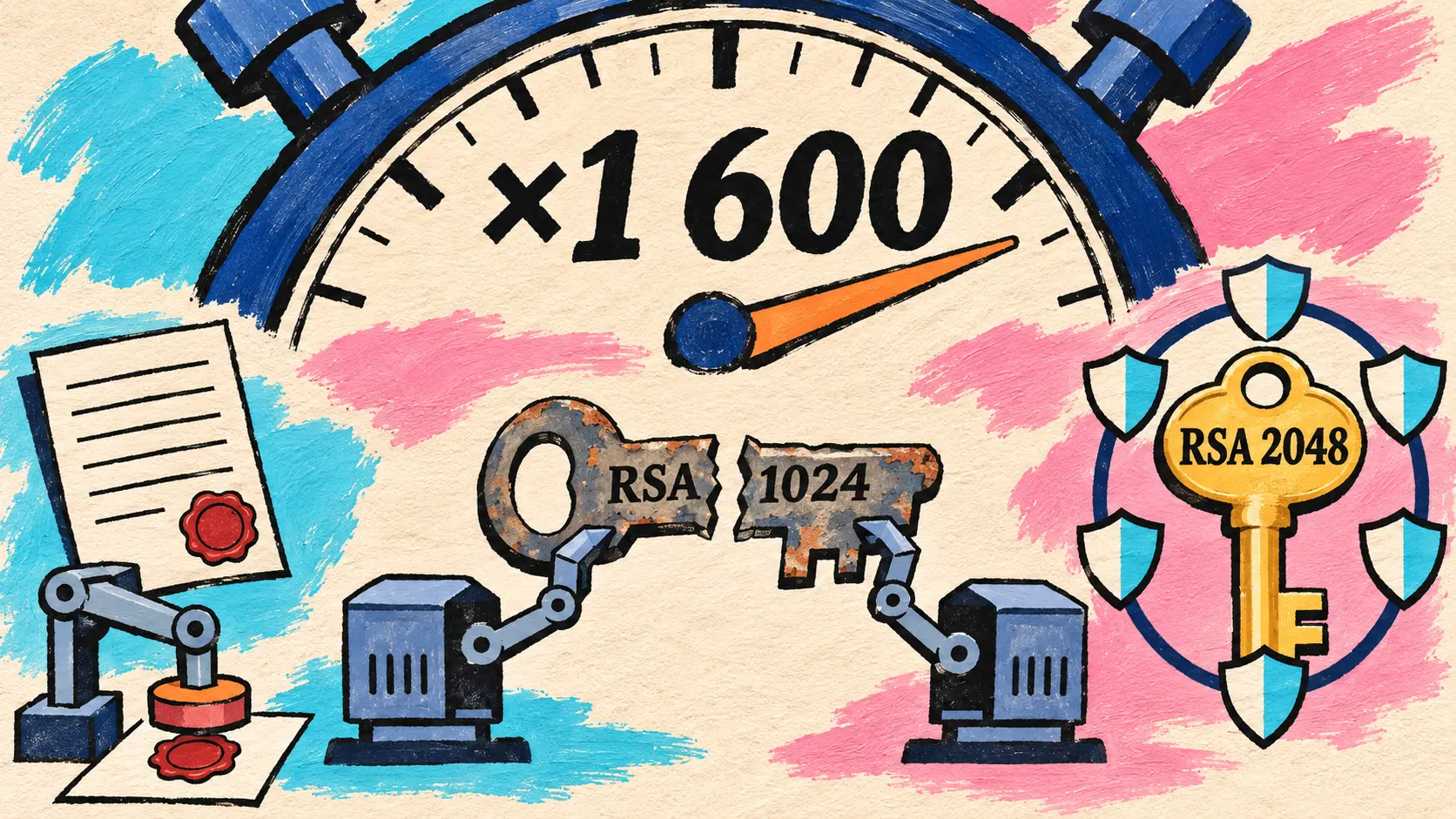
The first result concerns digital signatures, which guarantee that a software update, document or website comes from its stated source. Before signing, many standards add padding to the message (padding). The team shows that once an attacker controls roughly half of the signed block, this padding offers no protection at all. In an isolated simulation, without touching any real system, the agents carried out the attack on a 1024-bit reference key already solved by a previous study: the result is reproduced with CPU time reduced by a factor of 3,5, using less than a thousandth of the computing power needed to crack the key itself. When the attacker controls a smaller portion of the block, with a short 32-byte hash, a new algorithm would improve on the best previous method by roughly a factor of 1 600, according to the authors’ theoretical estimates.
The second result concerns batch factorization. Since RSA keys have standard lengths (1024 or 2048 bits), factoring many numbers of the same size is a key question: the agents found an algorithm with better asymptotic complexity, reducing the average cost of factoring each additional 1024-bit key by a factor of roughly 30 compared with previous batch methods.
| Result published by the authors | Reported gain | Stated condition |
|---|---|---|
| Signature forgery, attacker controls roughly half of the block | CPU time reduced by a factor of 3,5 | Isolated simulation, previously solved reference key of 1024 bits |
| Same attack, compared with cracking the key | Less than a thousandth of the computing power | Computing power needed to crack the key itself |
| Forgery with a hash of 32 bytes | Roughly 1 600 times better | Theoretical estimate, keys of 1024 bits |
| Batch factorization | Average cost roughly 30 times lower per additional key | Compared with previous batch methods |
| Keys of 2048 bits or more | Unaffected | Remain secure according to Google DeepMind |
While modern 2048-bit systems remain safe from these specific exploits, this work highlights a key shift. As we enter a new era of AI-enabled math and computation, we can no longer rely on historical hardness assumptions and must continuously stress-test cryptographic standards. — @GoogleDeepMind on X
🔗 Pushmeet Kohli’s article on X · Technical paper on digital signatures (PDF) · Technical paper on key factorization (PDF)
The Frontier Model Forum proposes a common framework for rating the severity of cyber jailbreaks
5 November — The Frontier Model Forum (FMF), which brings together leading AI labs, publishes version 1.0, described as preliminary, of its jailbreak rating framework for cyber threats (Jailbreak Rating Framework for Frontier Cyber Threats). The starting point: not all guardrail bypasses are equal. Some produce only responses of little practical use, while others unlock dangerous offensive capabilities, and without a common method, two organizations may assess the same jailbreak differently, risking prioritizing fixes for less serious ones. The framework assigns each jailbreak to a tier by combining scores across four categories: capability gain, capability scope, ease of deployment and ease of discovery.
Representatives from AWS, Anthropic, Google DeepMind, Microsoft and OpenAI support it in the post; OpenAI shared it on 6 November, stating that it had worked on it with the FMF and its members. A public consultation is open until 21 December 2026: the FMF will check whether different evaluators arrive at similar ratings and update the framework as new jailbreaks emerge. In July, Anthropic detailed a similar scale, CJS (Cyber Jailbreak Severity), developed with Amazon, Microsoft and Google; the FMF post does not establish a link between the two.
🔗 Introducing the FMF Jailbreak Rating Framework for Frontier Cyber Threats
Measuring AI in science: OpenAI’s BioBasicsBench for the wet lab, TCSExam for theoretical computer science
OpenAI releases BioBasicsBench: 100 wet-lab tasks, 66,7 % for GPT-6 Astra
6 November — OpenAI introduces BioBasicsBench, a benchmark designed with Ligo, a biotech company specializing in enzyme design, to measure agents’ ability to interpret raw data from routine wet-lab work (wet lab): gels and blots, culture plates, microscopy images, instrument exports or protocol videos. Its 100 tasks, drawn from real experiments and scored criterion by criterion using an expert rubric, cover five areas, from protein methods to molecular cloning; they also check that the agent spots errors and recognizes when the data does not support a conclusion.
Only OpenAI models are evaluated: seven models across 37 configurations, five trials per task, totaling 18 500 results. At xhigh effort, GPT-6 Astra earns 66,7 % of the available score, ahead of GPT-6.1 Sol and far ahead of GPT-5.6 Sol, with roughly half as many output tokens as the latter; according to OpenAI, these gains suggest that stronger native multimodality could be decisive.
| Evaluated model (xhigh effort) | Mean reward | 95 % confidence interval | Output tokens per task |
|---|---|---|---|
| GPT-6 Astra | 66,7 % | 60,3 to 73,1 % | 4 704 |
| GPT-6.1 Sol | 62,0 % | 55,6 to 68,4 % | 5 238 |
| GPT-5.6 Sol | 43,8 % | 37,6 to 50,0 % | 9 099 |
| GPT-6 Luna | 38,3 % | 32,3 to 44,5 % | 13 120 |
| GPT-5.5 | 35,4 % | 29,7 to 41,0 % | 11 135 |
| GPT-5.4 | 33,2 % | 28,3 to 38,4 % | 13 717 |
| GPT-5.2 | 31,2 % | 26,2 to 36,3 % | 27 620 |
OpenAI also details Astra’s failures: a familiar hypothesis overriding experimental controls, contradictory observations dismissed, a colony count overestimated by roughly 12 %. According to the post, better scores do not yet guarantee reliable judgments in the lab; OpenAI links this monitoring to biosafety and biosecurity, and does not mention releasing the task set.
🔗 Measuring how AI agents handle everyday wet-lab science (OpenAI)
TCSExam evaluates models in theoretical computer science: GPT-6 Astra leads the Full version, Opus 5.5 the Lite version
5 November — TCSExam, published under Moonshot AI’s GitHub organization with an arXiv paper submitted on 5 November, measures how far models can advance research in theoretical computer science (theoretical computer science). The authors listed by arXiv are Yifan Luo, Zhengying Liu, Yang Yuan, Zhilin Yang and Andrew Chi-Chih Yao. Four tracks: prove a published theorem in Lean, write a solver evaluated on hidden instances, produce a verified construction or bound, and fully prove or disprove open conjectures. The Full version has 100 expert-reviewed tasks, while the Lite version has 20, five per track. The index assigns a weight of 30 to each of the first three tracks and 10 to conjectures; solvers are scored against a fixed reference, Kimi K3.
| Evaluated model | Lite index (20 tasks) | Full index (100 tasks) |
|---|---|---|
| Opus 5.5 | 72,3 (provisional) | absent from the site’s table |
| GPT-6 Astra | 67,0 | 71,9 |
| Kimi K3.1 Pro | 53,5 | 57,4 |
| Kimi K3 | 48,6 | 46,8 |
| GLM-5.3 | 47,0 | 45,5 |
| Qwen3.8 Max (0902) | 45,4 | 44,8 |
| DeepSeek V4.1 Flash 1017 | 42,4 | 46,0 |
| Grok 4.6 | 42,1 | 40,5 |
No open conjecture is solved: the abstract claims only independently verified special cases and bounds. Two results nevertheless surpass the best known, to the authors’ knowledge: a graph with 630 edges on 124 vertices, with no triangles or four-edge cycles, constructed by Kimi K3 (629 for the construction by Goedgebeur et al.), and a quantum error-correcting code with distance 6, instead of 5, found by GPT-6 Astra to protect 7 logical qubits with 25 physical qubits. The benchmark runs Kimi Code by default and also supports Claude Code, Codex and Grok Build.
🔗 TCSExam results · arXiv paper 2611.07962
Agent research: memory and dreaming at Anthropic, outdated TODO items at Google, harness adapters
Anthropic shows how dreaming corrects and organizes Claude agents’ memory
November 6 — In a research and engineering post on its Engineering blog, Anthropic defines agent memory as what Claude retains from its experience across sessions, in the form of rereadable notes: neither weights, nor in-context learning, nor compaction. Dreaming (the agent’s “dream”) has it reread its logs and transcripts outside sessions to correct its notes, write new ones, build representations such as wikis, or choose what gets preloaded; the feature has been available in research preview in Claude Managed Agents since May 6.
The evaluations first show an improvement in judgment. In Pokémon Red, at around 10 000 steps, Sonnet 3.7 had written 413 memory files in 225 folders for a single badge, while Fable 5 kept to nine files and one global.md for four badges; Opus 5.5 completed the game with a small folder of notes. Anthropic recommends telling Claude what memory is for rather than how to use it: requiring it to record only failures strips Opus 5 and Opus 4.7 of much of the gain. An incorrect note about the location of the Mt. Moon PokéCenter, corrected through dreaming using the transcript, is enough to get the game moving again.
| Experiment conducted by Anthropic | Published result |
|---|---|
| Wiki alone, Stainless internal corpus (about 350 000 files), 2 then 128 dreaming sessions | 13 % then 48 % of scored criteria |
| Search plus wiki, same corpus | 54 % then 61 %, versus 53 % for search alone; about 20 000 tokens saved per question |
| Questions about a corporate merger (24, criteria spanning multiple documents) | 87 % with the wiki, 73 % with search alone |
| Facts drawn from contracts | 41 out of 57 with a shared table, 57 out of 57 with one page per contract quoted verbatim |
The post also points out the limitations: no gain when a single document suffices, a wiki sometimes larger than its sources, and a compute cost to keep memory up to date. Finally, it notes that Claude Code’s auto memory loads only the first 200 lines or 25 KB of MEMORY.md, which serves as an index.
🔗 The components of agent memory (Anthropic)
Google measures how stale TODO comments sidetrack its coding agents
November 6 — On the Google Developers blog, Sam Saccone and Madhuri Garikapati measure a hidden cost of coding agents: forgotten comments.
What is easy for humans to skim past in code, agents see as a call to action. — Sam Saccone and Madhuri Garikapati, Google Developers blog
The team cross-referenced every TODO(bug/...) or FIXME(bug/...) comment encountered by agents with the actual bug status and the user’s request, using traces from thousands of engineers and hundreds of millions of agent steps. Overall, 13 % of file-reading sessions expose the agent to such a reference. The agent ignores it in 94 % of cases but acts on it in 6 %, and 83 % of these actions were not requested by the developer: 41 % of these detours pursue already closed tickets, while 57 % expand the work to a still-open bug. With comparable developers, code complexity, task types, and model tiers, an unrequested detour adds 70 % more steps, 77 % more tokens, and 105 % more waiting time per session.
Google responded with cleanup agents that scan its codebases, trace the history of the bug, file, and changes, and propose removing a TODO only once its obsolescence has been confirmed: thousands of references removed in six months, with more than 95 % acceptance by human reviewers. The post advocates for agent friendly codebases.
The harness-hub project uses RL to train a LoRA for each agent harness, guarded by safeagents
November 6 — On the Hugging Face blog, Younes B., Lysandre, and Nathan Habib (the harness-hub organization) introduce harness adapters: a small LoRA adapter for each model and agent harness (pi, opencode, hermes), trained through reinforcement learning on verifiable tasks within the harness, without modifying it; a single server serves the base model and all adapters. In preliminary tests, the authors observe fewer tool calls than the base model on held-out tasks, with equal or better accuracy. The reward adds a small bonus for correct solutions that make fewer calls.
The tasks come from public coding sessions shared on the Hub, converted into verifiable environments by Repo2RLEnvs; the published version contains 270 tasks and is highly imbalanced: 253 build tasks (94 %), 11 repair tasks, 6 extension tasks, and no question-answering tasks. The safeagents proxy inspects every tool call during training: reward hacking attempts are blocked and scored 0, and enabling this guard does not change LFM2.5-24B-A2B’s held-out pass@1 (+0,0 ± 4,1 points). The final training runs cover Liquid AI’s LFM2.5-24B-A2B and LFM3-1.7B, and webAI’s TwIL-8B, a reasoning model never trained on agent data according to its model card; they run on HF Jobs and are livestreamed, including costs.
🔗 Harness adapters (Hugging Face blog)
Coding agents: Claude Code 2.1.319, Codex CLI 0.167.0, Copilot CLI 1.0.106, Antigravity CLI 1.5, Cursor voice chat, and Amp Spaces
Claude Code 2.1.319 moves MCP tasks into the background and adds permissions.denyInsteadOfPrompting
November 6 — Anthropic releases Claude Code 2.1.319: 146 entries in the release notes, including 90 fixes, compared with 119 entries for version 2.1.314 on October 30. The package has been on npm since 00:58 UTC and the release published on GitHub since 17:04 UTC, without a tweet; the stable channel remains on 2.1.311. The Agent SDKs follow the same day (TypeScript 0.3.319, Python 0.2.179).
| Modified item | What changes |
|---|---|
| MCP tasks in the terminal | When an MCP server executes a tool call as a task, Claude Code moves it into the background and delivers the result when it finishes |
permissions.denyInsteadOfPrompting | A call that would wait for a permission prompt is denied and the turn continues, including for subagents and teammates |
| Auto mode behind an LLM gateway | With telemetry or flags disabled, calls the server cannot verify are presented to the user or denied, without falling back to the built-in classifier |
/claude-api latency-optimize | Finds where code calling the Claude API causes delays and tests faster settings against the user’s evaluation |
/tasks | An “Earlier in this session” line to reopen a completed subagent and write to it |
Announced on October 23 without a version number, MCP tasks only appear in the CHANGELOG with this release; they also work without feature flags, including on Bedrock, Vertex, Foundry, or behind a gateway. The notes address several vulnerabilities: a Bash permission bypass through a crafted environment prefix, a sandbox escape when creating a worktree, an sed command that skipped the permission check in accept-edits or auto mode, and /rewind, which could modify a file through a directory symlink. The Claude apps gateway receives warnings ahead of the November 10 Claude Desktop change, which the notes do not detail. The same day, @ClaudeDevs announces that cloud sessions prepare a repository’s environment on their own (see Briefs).
🔗 Claude Code 2.1.319 release notes
Codex CLI 0.167.0 flags unread results and switches backends from the session picker
November 6 — OpenAI releases Codex CLI 0.167.0 at 01:40 UTC, the first stable release since 0.166.0 on October 29, with 120 entries in the PR list. The agent command center now opens with codex agents --no-daemon and, like the session picker, marks results the user has not yet viewed. The picker also allows switching between connected backends without losing drafts. Attached local images appear as previews while typing in supported terminals, the sign-in screen groups API keys and cloud providers under “Sign in another way,” and the gcp_setup_wizard option configures Google Cloud Vertex AI with Application Default Credentials or a credentials file. macOS and Windows system proxy settings can now be enabled through /experimental.
The fixes focus on continuity: saved conversations remain visible after switching model providers, Ctrl+L clears the screen without losing messages, which remain accessible through Ctrl+T, and automatic compaction accounts for retained output from failed responses. The app-server documentation describes prompt-user rules that require fresh human approval. In addition, openai-node 7.53.0 reports agent session errors as stream events.
🔗 Codex CLI 0.167.0 release notes
Copilot CLI 1.0.106 becomes stable with 227 previously unpublished entries, followed by 1.0.107 with identical notes
November 6 — Copilot CLI publishes its first stable release since 1.0.105 on October 28. Version 1.0.106 arrives at 01:47 UTC with notes covering the entire preview cycle: 637 entries, including 227 absent from the notes of the eleven previews published on GitHub. At 20:37 UTC, version 1.0.107 is released with exactly the same notes, apart from the header date: no changes specific to it are described, and it is now the version npm installs by default.
The previously unpublished entries include the COPILOT_SESSION_CWD variable for launching and developing local LSP and MCP configurations, GPT-6.1 Terra selectable in the New models section when the account has access, a Sandbox extensions setting that runs extension processes in the sandbox, and MATS telemetry for Microsoft Entra sign-in through OneAuth, which respects the client’s telemetry opt-out. /exit closes the current session rather than the CLI when the Sessions sidebar is open, sandbox deny rules accept glob patterns, and refusals due to cybersecurity risk explain that the session remains intact while suggesting /rewind. The Copilot SDK also becomes stable with version 1.0.29: 131 entries, truncated at the source, including a breaking change for Rust affecting SessionMetadata.
🔗 Copilot CLI 1.0.106 · Copilot CLI 1.0.107 · Copilot SDK 1.0.29
Antigravity CLI 1.5 becomes an ACP server for editors and runs its conversations on remote agents
November 4 and 5 — Antigravity’s CLI moves to version 1.5 in two stages. Version 1.5.0 (10 improvements, 3 fixes) adds agy acp, which runs the CLI as an Agent Client Protocol (ACP) server: a compatible editor can use it as an agent, with images and file context in prompts, the ability to steer an ongoing turn, default, accept-edits, and plan session modes, session resumption without replaying its history, and a model and reasoning level specific to each session; agy acp --login allows signing in from a terminal for editors connected over SSH. The same version adds --remote-agent, which runs conversations on remote agents, the command-line counterpart of those introduced in app version 2.29.0, as well as local projects in /projects and a mode without a UI (headless, -p) that waits for background tasks to finish instead of stopping them after a hidden 30-minute limit. A fix reveals that subagents connected through GEMINI_API_KEY were running on models two generations older instead of Gemini 4 Argon and Gemini 3.8 Flash.
Version 1.5.1 (5 improvements, 7 fixes) gives all ACP clients access to the account’s full set of models, whereas previously only a fixed list of editors was offered models other than Gemini, and reduces terminal command completion time from 5 seconds to about 1 second when a background process keeps output open. The rollout is gradual and may take a few days.
Cursor opens real-time voice chat with its agents, powered by Grok Voice
November 6 — Cursor now lets users talk to its agents in a real-time voice call: describe a change aloud, ask an agent what it is doing, and hear updates as work progresses. Voice chat works in the Agents Window, the IDE, the web version, and the iOS app. The call uses two agents: a voice agent listens, responds, and delegates coding work to the chat agent; it also provides read-only answers about diffs and runs, searches previous messages and calls, and switches workers within a Project. The coding agent speaks for itself through short progress notes and a brief response at the end.
Voice is powered by Grok Voice (Cursor has been part of SpaceX since August), while the coding agent keeps the selected model; several voices are available, including Ara, Eve, Leo, Rex, and Sal. With Privacy Mode, voice chat runs with zero data retention, and on iOS a Siri command starts a call with a new agent. A signed-in account is required (a session signed in with an API key cannot make calls), the call hangs up after about 10 minutes of silence when the agent has nothing running, and there is a daily limit, with no figure published. No pricing is mentioned; dictation, previously called Voice Mode, remains separate.
🔗 Voice Chat with Agents (Cursor changelog) · Voice chat documentation
Amp launches Spaces, an agent that creates and coordinates threads on the user’s behalf
November 6 — Amp launches Spaces: a space is a conversation with a single agent whose role is to launch and coordinate other agents. Users no longer have to create or organize their threads (threads): the space’s agent handles that. Amp presents it as a higher-level way to work with many agents; after a few weeks of internal use, the team thinks it may be the future of interacting with agents, providing an overview and the ability to drill down into the details.
The post gives three internal examples. Spaces were built inside a “Spaces v1” space, where the agent organized feedback, bugs and ideas posted in the chat into threads. Lewis managed the Service Accounts launch from a space: deployment, monitoring X, Slack and bug reports, fixes, then emails and refunds to affected users. Will assigned a space a recurring security review: the first pass divided the codebase into 16 areas, each reviewed in its own thread, and every finding was verified in another thread, with a summary artifact. To get started, use the + button in the Spaces section of the sidebar; the post mentions neither pricing nor plans. On the same day, Amp adds a widget that turns comments left on a website into an agent thread (see Briefs).
Building models: Meta trains specialized models with Muse Wonder, Hugging Face publishes a guide to MoE training
Meta deploys specialized models trained with Muse Wonder in Muse and Meta AI
November 6 — Meta brings the benefits of Muse Wonder, its frontier model launched on October 12, to Muse and Meta AI: specialized versions of its existing models, trained with Muse Wonder, are being deployed there; the post does not name them or provide their sizes or weights. Two of Muse Wonder’s capabilities carry over: active memory (Active Memory), which is intended to recognize when older information becomes useful again and distinguish what remains valid from what is outdated, and active focus (Active Focus), which is intended to help recover from an obstacle or find an alternative. In Meta AI, Meta describes an assistant that breaks problems into steps and asks more precise follow-up questions, without providing any figures.
| Meta’s internal metric | Current Muse model | Previous model |
|---|---|---|
| Personal Superintelligence Index | 47 % | 38 % |
| Active Memory Eval (critical context used correctly) | 90 % of tasks | 76 % |
| Forgetting critical information in Muse | reduced by a factor of 2,4 | — |
| Everyday tasks involving an unexpected event | +67 % | — |
All these measurements come from Meta, with no methodology published in the post.
🔗 Meta research post on specialized models for Muse and Meta AI
Hugging Face publishes The Ultimate MoE Training Handbook, drawing on 800 000 GPU-hours of experiments
November 5 — Hugging Face publishes The Ultimate MoE Training Handbook, a free, open guide to training mixture-of-experts (Mixture-of-Experts, MoE) models, written by Nouamane Tazi, Leandro von Werra and Thomas Wolf. Its starting point: according to the Artificial Analysis index, 18 of the top 20 open-weight models are MoEs, including DeepSeek V4.1 Flash 1017, GLM-5.3 and MiniMax-M3.1-Flash, while the expertise needed to train them remains concentrated in a handful of teams.
18 of the 20 best open models today are Mixture-of-Experts. Dense is basically over. And yet the know-how to train a good MoE still lives mostly in the heads of a handful of teams. So we spent 800k GPU hours running the experiments ourselves and wrote everything down. — @Thom_Wolf on X
The experiments ran on AWS P5 nodes with eight H100s; Jeff Boudier, in a tweet reposted by Hugging Face, mentions 2 million dollars spent. The guide contains around 70 000 words, 55 interactive figures and runnable code, with an estimated reading time of one to two days. It follows the practical questions teams face: how many experts, what size, shared or not; which router to use and why to keep it in FP32; auxiliary loss or DeepSeek-style loss-free bias for load balancing; starting from a dense model (upcycling) or from scratch; why training becomes 25 times slower with no errors in the logs. A final section covers serving: low-precision experts, expert parallelism and attention-FFN disaggregation.
🔗 The Ultimate MoE Training Handbook (Hugging Face)
Perplexity’s Agent API cuts costs across all effort levels, with equal or better quality according to Perplexity
November 5 — Perplexity lowers the cost per query of all existing effort levels (effort levels) in its Agent API, with equal or better research quality according to the company; the post also details ultra, the level introduced the same day for the broadest research tasks. An effort level is a ready-to-use configuration that sets the model, step budget, search settings and tools for a type of task. A query that calls a level by name benefits from the update without any code changes; pinning a version retains the old configuration. The scores cover BrowseComp and DSQA, two public benchmarks, and WANDR, Perplexity’s in-house benchmark for lengthy research across many entities.
| Effort level | Published result | Published cost |
|---|---|---|
| medium | from 55 % to 77 % on BrowseComp and DSQA | nearly 90 % less |
| high, with fetch_url extraction | 88,0 % versus 83,5 % without extraction | 0,073 dollars per query versus 0,094 |
| xhigh | 76,5 % on WANDR, maintained | around 25 % of the August configuration’s cost |
| ultra | 85,9 % on WANDR, highest score tested | 21,71 dollars per task |
The ultra level launches three agents in parallel on the entire task, then a fourth combines their findings and writes the answer. The post details the mechanisms: a cap on steps and tool calls with budget reminders (on one BrowseComp task, the agent given a reminder finds the answer in 13 of 40 steps, while the other exhausts all 40 without finding it), a smaller model that retains only the useful passages from a page (5 561 tokens reduced to 293), skills loaded on demand because preloading everything costs 13 % more, and an evaluation loop that adopts a new model only if it performs better at the same or lower cost. No pricing table by level is published.
🔗 Improvements to every Agent API effort level (Perplexity) · Thread by @perplexitydevs
Perplexity Computer summarizes long conversations in the background and opens Brain to all Projects
November 6 — Perplexity publishes its first product changelog since October 19, with sixteen sections; most revisit previously announced features, such as Teammates, fully local Computer on Mac or voice mode, and seven are new. In Computer, new long conversations summarize their history in the background (background compaction): according to Perplexity, this means 94 % fewer pauses when continuing work with a long context and 7 % fewer credits per turn. To edit a website created by Computer, users now select a specific element (heading, button, card, menu) instead of drawing a rectangle.
For Projects, Brain, the Project’s memory, is enabled for free in every Project and updates daily from its conversations and files; a Project info panel and a unified Settings panel become available to everyone. In Enterprise, @mentions bring a colleague into a thread or Computer task on the web, and role-based controls add a speed cap (Normal or Fast) alongside the effort settings already available. The Impeccable skill, which audits an interface’s hierarchy, accessibility, responsive behavior (responsive) and design system consistency, joins the official list. Finally, the changelog specifies that Agent Plugins are available on individual plans and self-service Enterprise, and that Computer runs entirely locally starting with Mac app 26.42.0. The cost reduction for effort levels, which it also covers, is detailed in the previous section.
🔗 Perplexity changelog for November 6
Voice: Gradium’s Phonon runs on-device, ElevenLabs gives Unity characters a voice
Gradium details Phonon, its open-weight on-device speech synthesis model
November 5 — In a Hugging Face blog post, Gradium revisits Phonon, released two weeks earlier: a speech synthesis model that runs entirely on-device, without a server or network, from phones to browser tabs and single-board computers. Phonon comes in two sizes, around 65 and 75 MB, and handles phone numbers, dates and codes. More than 100 voices are built in, and others can be created in Gradium Studio, either by cloning a short recording with the person’s consent or through a text description, before being downloaded to run locally.
| Phonon model | Supported languages | Usage license |
|---|---|---|
| Phonon 31m | English | Apache 2.0, free commercial use |
| Phonon 40m | English, French, German, Spanish, Portuguese | CC BY-NC, paid commercial use based on the number of users |
According to Gradium, Phonon ranks first for intelligibility in German and Spanish on Hugging Face’s Open TTS Leaderboard and is among the top three in every language evaluated, competing against models up to 100 times larger; it also leads the CPU streaming benchmark for time to first audio. Gradium reports more than 200 000 downloads in two weeks. Its ptts inference engine has more than ten backends (CPUs, GPUs via CUDA, Vulkan, Metal or WebGPU, Core ML and Snapdragon chips), and Transformers has integrated it since v5.21.
ElevenLabs launches a Unity SDK to give game characters a voice with ElevenAgents
November 5 — ElevenLabs releases a Unity SDK for ElevenAgents, its voice agent platform. It connects a game scene to an agent created in the ElevenLabs dashboard: the player approaches a character and speaks aloud, the SDK captures microphone input, plays the agent’s voice through a Unity AudioSource and manages the session through the Conversation API. The voice can come from the character, and its volume can animate a mouth; dynamic variables allow multiple characters to share the same agent with different moods; a contextual update informs the agent of a game event, such as picking up a key, without interrupting it; client tools let it trigger game code, such as opening a door.
| Target platform | SDK status | Transport used |
|---|---|---|
| Editor and desktop (macOS, Windows, Linux) | Supported | WebSocket |
| WebGL | Supported | WebSocket or WebRTC |
| iOS, Android, XR | Beta | WebSocket |
Installation uses Unity’s Package Manager, from ElevenLabs’ git repository pinned to v0.1.0 (released on GitHub on October 27, MIT license), with a setup time of around ten minutes advertised for the GettingStarted example. ElevenLabs reminds developers to re-enable authentication before release: a server must provide a short-lived signed URL, and the API key must never appear in a build. No specific pricing is announced.
🔗 Give your Unity NPCs a voice with ElevenAgents (ElevenLabs) · elevenlabs/unity repository
Ai2 officially introduces ToyBlocks, the first of its FoundationWorlds for studying robot learning
November 6 — Ai2 officially introduces ToyBlocks, whose code and data had been online since the previous day. The institute places it within a broader framework, foundation worlds (FoundationWorlds): a controlled simulated world, automatic generation of tasks and demonstrations, and metrics that track robot behavior over time, allowing researchers to vary data or models, replay a test and trace the cause of a failure. Demonstrations are produced without teleoperation, at up to 24 times real time on a single GPU. The initial results cover transfer to the real world and frontier agents:
| Evaluation published by Ai2 | Result achieved |
|---|---|
| ManiFlow’s atomic skills, in simulation and on a real robot | 80,0 % and 81,1 % |
| Molmo 2 + ManiFlow, in simulation and on a real robot | 55,5 % (111 out of 200) and 50,0 % (15 out of 30) |
| Claude Opus 5.5 via MCP, search and spell tasks (search and spell) | 63 % solved or correctly declared infeasible |
| Default, human expert and learned skill descriptions | 24 %, 36 % and 63 % success |
| Claude Opus 5.5 in classical planning | 30 stacking tasks out of 30 |
In the search and spell tasks, half the scenes are infeasible, and errors mainly stem from similar letters (13 %) or incorrect orientation (15 %). Ai2 specifies that further real-robot trials are needed for statistical confidence. A web interface lets users instruct the robot in natural language with Claude or another frontier model, and the companion allenai/agentic_robotics repository publishes the MCP-orchestrated agentic loop under the Apache-2.0 license.
🔗 ToyBlocks (Ai2 blog on Hugging Face) · allenai/agentic_robotics repository
GitHub introduces Copilot Verified Proficiency, a proficiency level calculated from actual Copilot usage
6 November — GitHub is highlighting Copilot Verified Proficiency, a new form of skills recognition (credential) shared by Microsoft and GitHub, linked to the Microsoft Pro Badge. Instead of an exam, proficiency is calculated continuously from tasks actually performed with Copilot, using telemetry, based on the breadth, depth and consistency of usage, rather than activity volume. Five skills are assessed: AI collaboration, prompt writing, code generation and validation, agent configuration, and tool and context integration. Three levels are available (Beginner, Intermediate, Proficient), with Advanced and Expert in development; Proficient grants a shareable Pro Badge, which expires after six months if the level is not maintained, and proficiency declines without Copilot usage.
Participation is opt-in, results are private by default, and neither employers nor organizations can see them unless users voluntarily share them; the rubrics and algorithms remain proprietary. Enterprise Managed Users accounts and GitHub Enterprise Cloud accounts with data residency are not supported. Its status remains unclear: the undated page offers to calculate users’ proficiency, but its FAQ describes a private preview conducted with invited partners.
🔗 Copilot Verified Proficiency (GitHub Learn) · Announcement from @github on X
NVIDIA quantifies the growth of its Aerial and Sionna open source 5G/6G tools through five research projects
6 November — One year after open-sourcing its Aerial wireless software, which joined Sionna in a suite of tools for 6G research, NVIDIA takes stock in a post by Soma Velayutham. According to NVIDIA, developer adoption of AI Aerial and Sionna has grown tenfold in one year, its open source 5G/6G tools have exceeded one million downloads, and more than 8 000 research institutions and universities use them. The post announces no products and illustrates these uses through five projects:
| Research team | Reported result | Measurement conditions |
|---|---|---|
| King’s College London | Robotic task execution time reduced by up to 52,6 % | Compact object descriptions instead of full images, deliberately induced failures |
| SoftBank | Higher uplink throughput across all 15 tested settings, maximum gain of around 60 % | Neural receiver in Aerial CUDA-Accelerated RAN, off-the-shelf 5G smartphone, controlled interference |
| ETH Zurich | Block error rate reduced by more than a third | Receivers tuned using local measurements, compared with selected pretrained versions |
| University of Leeds | Radio access network power consumption reduced by 45,6 % | Base station sleep scheduled 10 minutes in advance, compared with a full-power baseline |
| CTTC (Catalonia) | Simulation shortened from around 3 hours to 10 to 20 minutes | Initial evaluation, GPU channel models in the open source 5G-LENA simulator |
The post links to the 6G developer sessions at GTC Washington, D.C., and notes that Aerial and Sionna are available on GitHub.
🔗 How NVIDIA Open Source Tools Are Helping Researchers Build Next-Generation 6G Networks (NVIDIA)
Briefs
Coding agents and tools
- Claude Code cloud sessions — On Pro, Max and Ultra plans, Claude independently identifies the dependencies, network access and API keys a repository needs, then saves this environment for subsequent sessions; according to @ClaudeDevs, the keys are stored without Claude seeing them. The announcement consists of a single tweet, with no blog post or documentation. 🔗 source
- Amp feedback widget — A script tag, followed by a page URL with
?ampappended, lets users click an element on a site and write an instruction: Amp opens a thread in the project, and the agent makes the change in an orb, on a copy of the repository. Limited to workspace projects, with no pricing provided. 🔗 source - Gemini CLI — No nightly was published on 5 or 6 November because the workflow failed, but Gemini CLI merged around a dozen commits into main on the 6th: color themes in a standalone
theme.jsonfile, model name validation in/model, and fixes for quota waits lasting several hours in ACP mode and silent network hangs. None of this is in a release yet. 🔗 source - Qwen Code v0.26.9 — Skills can be installed from ZIP archives (Web Shell, daemon or TypeScript SDK), and a single request enables or disables up to 100 skills; Managed Agent automation is enabled by default, and image input support extends to Llama 4, Pixtral and Mistral Small. No breaking changes. 🔗 source
- Kimi Code 2.5.2 — Three fixes: duplicate tool declarations when MCP tool definitions change, steering messages incorrectly queued during a session, and project creation when the web interface is served over HTTP. 🔗 source
- ZCode v3.17.2 — On 4 November, without release notes, Z.ai’s coding workspace began routing local HTML file previews in its built-in browser through a
zcode-html://address restricted to their folder: by default, Electron lets afile://page read other files. 🔗 source - Coding agent fleet — Tony Dzi reviews 103 days of coding agents from the same family running on seven machines: a coordination protocol can satisfy all its safety invariants and still be abandoned. He publishes claw-consensus, his consensus engine without an LLM, and telemetry showing the collapse in its usage. 🔗 source
APIs, platforms and security
- GPT-Live outbound calls — On 2 November, OpenAI made outbound GPT-Live phone calls over SIP available to all organizations through the Live API: an E.164-formatted number, a carrier trunk, TLS signaling and SRTP audio, with ringing limited to 3 minutes and calls to 2 hours; no pricing provided. 🔗 source
- OpenAI Agents API — Michael Luo, a product lead at OpenAI, reviews October’s developments, most of which have already been covered, and offers five beta features on request: memory across sessions, agent access to the Decisions API, a dollar budget cap, an environment pool and v2 architecture. 🔗 source
- gemini-embedding-2-preview — The Gemini API is deprecating this model: since 6 November, its requests have been routed to
gemini-embedding-2at Gemini Embedding 2 pricing, with the same schema and embedding space; users only need to change the model name, without reindexing. 🔗 source - Copilot usage metrics — The API now tracks, by repository, the rate of Copilot code review comments addressed by developers, broken down by severity, review level and comment type, and flags users without telemetry or running versions below the minimum IDE and extension requirements. 🔗 source
- OpenAI and Hacktron — OpenAI is partnering with Hacktron, identified through its bug bounty program, to look for vulnerabilities in its own systems, particularly in their interactions with third-party services, and is expanding Hacktron’s access to frontier models through Daybreak Red; no amount disclosed. 🔗 source
- Transformers v5.22.2 — An interim patch from Hugging Face hardens the Jinja sandbox and now sets
device_idonly for NCCL; the notes cite no security advisory. 🔗 source
Business and education
- Australian universities — On 5 November, OpenAI details its collaborations with UNSW Sydney (ChatGPT Edu for more than 80 000 students and staff), the University of Sydney, La Trobe and Adelaide University; in an OpenAI-commissioned Pureprofile survey of 1 018 students, 81 % use AI several times a week. 🔗 source
- Cult.fit and Codex — On 5 November, an OpenAI case study shows the Indian gym chain standardizing its engineering on Codex: more than 20 internal applications built by nontechnical teams, more than 100 000 dollars in annual software savings, and customer support costs down by more than 50 %. 🔗 source
- Merge and GPT-6 Astra — On 5 November, startup Merge explains that a bot powered by GPT-6 Astra, connected to Salesforce, Gong, Google Sheets and Gmail, cuts client dinner preparation from dozens of hours to around 30 minutes; the company went from 8 dinners in the second quarter to 16 in the third. 🔗 source
- Franklin Templeton — On 5 November, the asset manager describes a connected intelligence layer, built with Codex among other tools, that links research, risk, compliance and trading for its portfolio managers; no performance figures provided. 🔗 source
- Flipsnack and ChatGPT Ads — On 5 November, this customer testimonial reports around 310 % more signups and a roughly 75 % lower cost per signup, with the daily budget unchanged, after switching five US campaigns from clicks to conversion optimization. 🔗 source
- Box and NVIDIA — On 5 November, at BoxWorks 2026, Box makes the open Nemotron models, starting with Nemotron 3 Ultra, available to Box AI Enterprise Advanced customers; Box Context Retrieval, built on Nemotron Retriever, is expected early next year and could, according to Box, improve retrieval accuracy by 20 % and use 90 % fewer tokens. 🔗 source
Google applications
- Gemini Notebook flashcards — The cards now support images, an optional timer lets users test their recall, and the mobile app schedules study reminders; no countries or plans specified. 🔗 source
- Gemini in Google Forms — In the Responses tab, Gemini analyzes responses by writing and executing Python code, identifies trends and correlations, then suggests actions; rollout began on 2 November for Rapid Release and will begin on 19 November for Scheduled Release, for eligible Business, Enterprise and Education plans and Google AI subscribers. 🔗 source
Voice, music and images
- Open ASR Leaderboard — Hugging Face’s speech recognition leaderboard adds two private test sets from Liva AI, featuring conversational English with Egyptian (1,34 hours) and Nigerian (1,55 hours) accents, and a breakdown inspired by Kachru’s circles; no model results are provided. 🔗 source
- Lebanese dialect — In the second installment of his series, following the one published on 5 November, Bilal Zaraket builds a Lebanese lexicon validated by three native speakers (429 entries) before generating speech data: the share of sentences requiring correction falls from 22 % to 4 %, below a threshold of 5 % set in advance. 🔗 source
- ElevenMusic and SoundCloud — ElevenLabs connects its music platform to SoundCloud: an original track is published directly to the artist’s profile, complete with a description, genre and tags. SoundCloud Artist Pro members receive three months of ElevenMusic free, then pay 9,99 dollars per month, with the offer valid until 31 October 2027. 🔗 source
- Ads Engine — ElevenLabs adds optional human review by ElevenProductions linguists and localization professionals and in-house creative specialists, covering visuals, Google Search ads and dubbed videos; access through the sales team, with no pricing or turnaround time provided. 🔗 source
- Suno Daily Song Challenge — The iOS and Android apps offer a daily song prompt, editable before creation, and organize songs in a library calendar, across all plans. 🔗 source
- Runway and GPT Image 2.6 — Runway adds OpenAI’s image model, described as 50 % faster, with GIF support, SVG export and edits that keep characters and products consistent; neither the variant nor the credit cost is specified. 🔗 source
Research, robotics and models
- Scientific models — Anthropic’s Science blog publishes a guest essay by Jakob Macke, Daniel Gedon and Stefan Wahl (ELLIS Institute Tübingen) on AI that builds, constrains and interprets scientific models, from the Hodgkin and Huxley model to simulation-based inference. 🔗 source
- SuperCLUE ranking — A VIDRAFT community post shares the November ranking (19 models): GPT-6.1-Sol leads in agentic coding (69,23), and DeepSeek-V4.1-Flash-1017 ranks first among open models in that category (65,38), with Kimi-K3.1-Pro achieving the highest overall score among them. 🔗 source
- LingYu Robotics — The company releases 139,4 hours and 13 263 successful episodes of bimanual teleoperation filmed from the robot’s viewpoint, across 15 task families, in LeRobot format and under a noncommercial license. 🔗 source
- Egocentric-EMG-Force — Harpreet Sahota converts eight episodes and 38,2 minutes of household tasks captured by a depth camera for FiftyOne, with an EMG wristband on each wrist recording forearm muscle signals. 🔗 source
- Qwen teaser — Qwen’s official account publishes a short, cryptic message with an image whose Chinese inscription leaves a name blank, without a model name, date or link; it received more than 1,3 million views that day. 🔗 source
What this means
AI is entering supervised, measured research. Google DeepMind’s agents worked under human supervision, with Inria researchers, on a retired 1024-bit RSA instance and an already solved reference key, in an isolated simulation: the theoretical speedup of around 1,600 times does not threaten 2048-bit keys, but it is a reminder that a hardness assumption is never guaranteed. BioBasicsBench and TCSExam follow the same discipline: OpenAI itself publishes GPT-6 Astra’s errors, including a colony count overestimated by around 12%, and TCSExam has every task checked by the Lean kernel or an executable verifier, without solving any open conjecture. The Frontier Model Forum applies the same logic to risk, with a shared framework for deciding which cyber jailbreaks to fix first.
What surrounds the model increasingly determines an agent’s success. At Anthropic, a single incorrect note about Mt. Moon stalls the Pokémon game until dreaming corrects it, and a maintained wiki saves around 20,000 tokens per question. At Google, an old TODO is enough to derail an agent: an unrequested detour adds 70% more steps, 77% more tokens and 105% more waiting time to the session, prompting Google to launch agents to clean up its codebases. Harness adapters tackle the problem through training, with one LoRA per harness that reduces tool calls at the same accuracy, and Perplexity’s techniques are similar: budget reminders, page extraction, skills loaded on demand.
Coding agents are changing interfaces. People talk to them, with Cursor’s voice chat separating the listening agent from the coding agent; delegate coordination to them, with an Amp space that launches threads itself, even dividing a security review into 16 areas; and connect them everywhere, since ACP makes Antigravity CLI the agent for any compatible editor, with all the account’s models. Release cycles are shortening in parallel (146 entries for Claude Code 2.1.319, 637 for Copilot CLI 1.0.106, 120 PRs for Codex CLI 0.167.0), with finer controls over what agents are allowed to do, from Claude Code’s refusal without prompting to Codex’s prompt-user rules.
Cost and access are shifting too. Perplexity makes its medium level nearly 90% cheaper while raising its score from 55% to 77%, and enables Brain for free in every Project. Phonon runs speech synthesis on the device, without a server, with models of around 65 and 75 MB, including an English version under the Apache 2.0 license. Meta transfers Muse Wonder’s capabilities into specialized models deployed to Muse and Meta AI users, and Hugging Face freely shares MoE training expertise acquired through 800,000 GPU-hours.
Sources
- Pushmeet Kohli’s post on cryptanalysis (X)
- @GoogleDeepMind: 2048-bit systems remain secure
- Technical paper on digital signatures (Google DeepMind, PDF)
- Technical paper on key factorization (Google DeepMind, PDF)
- Introducing the FMF Jailbreak Rating Framework for Frontier Cyber Threats (Frontier Model Forum)
- Measuring how AI agents handle everyday wet-lab science (OpenAI)
- TCSExam results
- arXiv paper 2611.07962 (TCSExam)
- The components of agent memory (Anthropic)
- Agent Distraction (Google Developers blog)
- Harness adapters (Hugging Face blog)
- Claude Code 2.1.319 release notes
- Codex CLI 0.167.0 release notes
- Copilot CLI 1.0.106
- Copilot CLI 1.0.107
- Copilot SDK 1.0.29
- Antigravity changelog
- Voice Chat with Agents (Cursor changelog)
- Cursor voice chat documentation
- Spaces (Amp)
- Meta research post on specialized models for Muse and Meta AI
- The Ultimate MoE Training Handbook (Hugging Face)
- @Thom_Wolf: 800,000 GPU-hours of experiments
- Improvements to every Agent API effort level (Perplexity)
- @perplexitydevs: lower costs across effort levels
- Perplexity changelog for November 6
- Phonon (Hugging Face blog)
- Give your Unity NPCs a voice with ElevenAgents (ElevenLabs)
- elevenlabs/unity repository (GitHub)
- ToyBlocks (Ai2 blog on Hugging Face)
- allenai/agentic_robotics repository (GitHub)
- Copilot Verified Proficiency (GitHub Learn)
- @github: Copilot Verified Proficiency
- How NVIDIA Open Source Tools Are Helping Researchers Build Next-Generation 6G Networks (NVIDIA)
- @ClaudeDevs: Claude Code cloud sessions
- Close the Loop (Amp)
- Gemini CLI, PR 30119: themes in theme.json
- Qwen Code v0.26.9
- Kimi Code 2.5.2
- ZCode v3.17.2
- Tony Dzi’s post on 103 days of coding agents and claw-consensus (Hugging Face blog)
- OpenAI API changelog
- @AzianMike: Agents API October roundup
- Gemini API release notes for November 6
- Usage metrics API: code review details (GitHub Changelog)
- Partnering with Hacktron to find vulnerabilities in OpenAI’s systems (OpenAI)
- Transformers v5.22.2
- Australian universities are creating AI-native graduates (OpenAI)
- Cult.fit builds operational muscle with Codex (OpenAI)
- Merge builds product and business tools with OpenAI technology (OpenAI)
- Franklin Templeton uses OpenAI to support investment research (OpenAI)
- Flipsnack grows product signups with conversion optimization (OpenAI)
- Box press release on its partnership with NVIDIA (BoxWorks 2026)
- @Gemini_Notebook: what’s new in Flashcards
- Actionable insights from Gemini in Google Forms (Google Workspace Updates)
- Open ASR Leaderboard and Liva AI (Hugging Face blog)
- Bilal Zaraket’s Lebanese lexicon, part two (Hugging Face blog)
- Share your ElevenMusic creations directly to SoundCloud (ElevenLabs)
- Ads Engine adds human review from localization experts and creative specialists (ElevenLabs)
- Daily Song Challenge (Suno release notes)
- @runwayml: GPT Image 2.6 in Runway
- Teaching AI to build scientific models (Anthropic)
- November SuperCLUE ranking (Hugging Face blog)
- LingYu Robotics dataset (Hugging Face blog)
- Egocentric-EMG-Force and FiftyOne (Hugging Face blog)
- @Alibaba_Qwen: November 6 teaser