ai-powered-markdown-translatorTranslated article from fr to en with gpt-5.4-mini.
June 9, 2026 marks a packed day: Anthropic launches Claude Fable 5, its first publicly accessible model in the Mythos class, along with general availability in GitHub Copilot. OpenAI reveals that it has submitted a confidential S-1 to the SEC while publishing its “phase 3” vision, while Google rolls out Gemini 3.5 Live Translate in continuous streaming for 70+ languages. Cohere enters open source with North Mini Code, and Luma launches Ray 3.2 with advanced cinematic control.
Claude Fable 5 and Mythos 5: the first public Mythos-class model
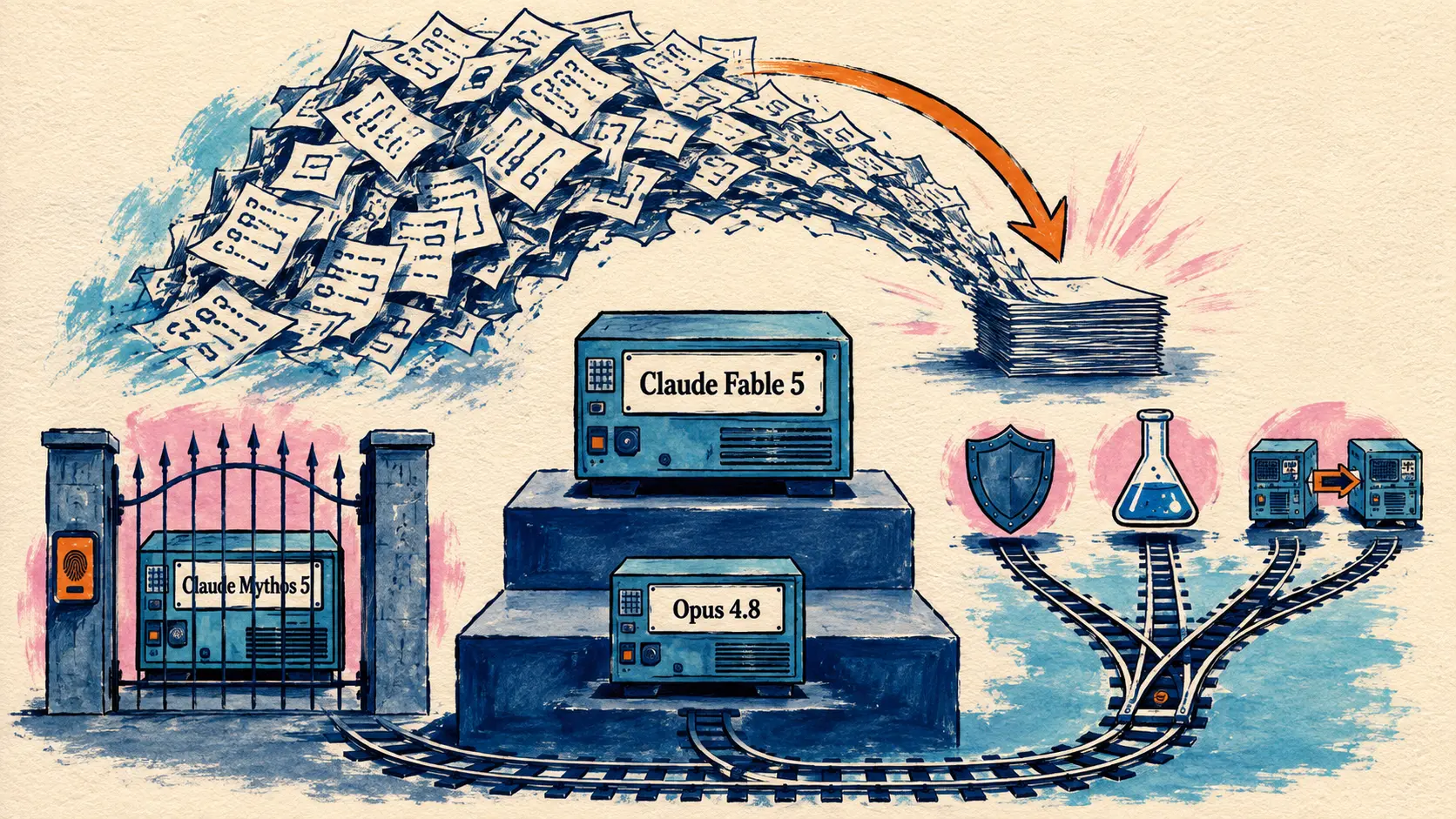
June 9 — Anthropic launches Claude Fable 5, the first publicly available model in its new Mythos class, alongside Claude Mythos 5 in restricted access. The Mythos class represents a tier above the Opus line — introduced in April 2026 with Mythos Preview as part of the Glasswing project. Fable and Mythos refer to the same underlying model: Fable is the public version with stronger guardrails, while Mythos is the restricted-access version with some guardrails removed.
Performance and benchmarks
Fable 5 claims state-of-the-art results on nearly every benchmark tested:
| Area | Notable result |
|---|---|
| Software engineering | Migrated Stripe’s 50 million-line Ruby codebase in 1 day (vs. 2 months for a team) |
| Analytical work | Top score on Hebbia Finance Benchmark for senior reasoning |
| Vision | First model to complete Pokémon FireRed with a vision-only harness |
| Long context / memory | Persistent memory 3× more efficient than on Opus 4.8 |
| Biology research | Novel scientific hypotheses preferred in 80% of blind comparisons |
| Genomics | Custom ML model outperformed a paper published in Science, with 100× fewer parameters |
Pricing and availability
| Parameter | Value |
|---|---|
| Input price | $10 / million tokens |
| Output price | $50 / million tokens |
| API model ID | claude-fable-5 |
| Subscriber availability (Pro, Max, Team, Enterprise) | Free from June 9 to 22, 2026 |
| Average fallback rate | < 5% of sessions |
Guardrails and Opus 4.8 fallback
Three areas trigger an automatic fallback to Opus 4.8 (the user is informed) rather than a hard refusal:
- Cybersecurity: vulnerability exploitation and agentic attack tasks
- Biology and chemistry: dual-use risks in advanced research
- Distillation: attempts to extract capabilities to train competing models
The Python, TypeScript, Go, Java, and C# SDKs receive a client-side fallback middleware for API providers that do not handle server-side fallback. A 30-day data retention requirement is mandatory across all traffic for Mythos-class models (for security purposes only, deletion guaranteed after 30 days).
Availability in GitHub Copilot
Claude Fable 5 is simultaneously launched in general availability (generally available) in GitHub Copilot, accessible to Pro+, Max, Business, and Enterprise plans — in VS Code, Visual Studio, Copilot CLI, GitHub cloud agent, GitHub Mobile, and JetBrains, Xcode, Eclipse IDEs. According to GitHub’s internal benchmarks, Fable 5 accomplishes equivalent work with fewer tool calls and lower token consumption than previous Opus models.
Important note: unlike the other Claude models in Copilot (Opus 4.8, Sonnet 4.5, Haiku 4.5 which operate under Zero Data Retention), Claude Fable 5 requires 30-day retention to run its safety classifiers. Enterprise/Business administrators must enable the Claude Fable 5 policy in Copilot settings (disabled by default). Billing is charged at the provider rate through the usage-based billing system.
“Fable 5 is the biggest step up I’ve felt in our models since Opus 4.5 back in November. […] It really has this ‘big model smell’ that I haven’t felt before.” — @bcherny on X
🔗 Anthropic announcement · GitHub Copilot changelog
Claude Code v2.1.169 and v2.1.170: access to Fable 5 and no-personalization mode
June 9 — Two new Claude Code releases accompany the launch of Fable 5.
v2.1.170 brings model access: update and then use /model claude-fable-5. A fix accompanies this release — sessions started from the integrated VS Code terminal no longer saved their transcripts or appeared in --resume.
v2.1.169 is especially feature-rich:
| Feature | Description |
|---|---|
--safe-mode / CLAUDE_CODE_SAFE_MODE | Starts Claude Code with no personalization at all (CLAUDE.md, plugins, skills, hooks, MCP servers) — ideal for debugging |
/cd | Changes a session’s working directory without breaking the prompt cache mid-session |
disableBundledSkills | Hides built-in skills, workflows, and slash commands (also via CLAUDE_CODE_DISABLE_BUNDLED_SKILLS) |
Among the fixes: correct history navigation for long multi-line commands, blocked claude -p regression on Windows fixed, enterprise MCP policies not applied on reconnect fixed, and 30-50 ms UI stall on macOS eliminated.
OpenAI submits a confidential S-1 to the SEC
June 8 — OpenAI announced that it had confidentially submitted an S-1 form to the Securities and Exchange Commission (SEC), the formal first step toward an initial public offering (Initial Public Offering). The announcement is framed with unusual candor: anticipating a leak of the document, the company chose to get ahead of it.
We recently submitted a confidential S-1. We expect it to leak so we’re just announcing it. We have not decided on timing yet; it may be a while because there are things we want to do that are likely easier as a private company. But it’s a complicated set of tradeoffs and this gives us the option to go public sooner if that ends up being best. — @OpenAINewsroom on X
A confidential S-1 filing allows a company to prepare a public offering without immediately disclosing its financial information to the market. OpenAI now has the option to accelerate its IPO if conditions warrant it — without being obligated to do so immediately. This announcement comes after the October 2025 recapitalization, which created the OpenAI Foundation (nonprofit entity) and OpenAI Group PBC (public benefit corporation), with the nonprofit stake valued at an estimated $130 billion. The tweet surpassed 3 million views in less than 24 hours.
🔗 Official OpenAI announcement
OpenAI “Built to benefit everyone”: phase 3 vision
June 8 — Sam Altman and Jakub Pachocki (OpenAI’s Chief Research Officer and CTO) co-author a long-form article outlining the strategic vision for the next period. OpenAI is entering its third phase: making advanced AI abundant, affordable, safe, and accessible to everyone.
| Objective | Description | Horizon |
|---|---|---|
| Automated AI researcher | AI system capable of accelerating and automating research, especially on alignment | March 2028 (significant fraction) |
| Accelerate the economy | Scientific productivity, economic growth, broad sharing of gains | Ongoing |
| Personal AGI for everyone | Every person on Earth has a personal AGI | Long term |
The article emphasizes the need for international coordination and a dedicated body for frontier AI safety (frontier AI). On the human role: “Entirely automating everything is not the future we want. The human role becomes more important: setting direction, making tradeoffs, applying judgment.”
Gemini 3.5 Live Translate: continuous-stream speech translation, 70+ languages
June 9 — Google launches Gemini 3.5 Live Translate, an audio model dedicated to near-instant speech translation. Unlike systems that wait until the end of a sentence, this model generates the translation continuously, staying a few seconds behind each speaker while preserving intonation, cadence, and pitch.
| Capability | Detail |
|---|---|
| Supported languages | 70+ with automatic detection |
| Processing mode | Continuous streaming (no turns) |
| Voice preservation | Intonation, rhythm, and pitch maintained |
| Robustness | Handles noisy environments |
Availability: Gemini Live API and Google AI Studio in public preview for developers; private preview in Google Meet this month (broader rollout later in the year); Google Translate app on Android and iOS available now. A listening mode (listening mode) on Android lets users receive translations directly in the earbud, without headphones. For Google Meet, the rollout will expand supported languages from 5 to 70+, with more than 2,000 language combinations in a single meeting. Grab is already testing the model for driver/passenger communications (more than 10 million voice calls per month). All generated audio content is marked with SynthID.
Cohere North Mini Code: first Apache 2.0 open-source code model
June 9 — Cohere launches North Mini Code, its first open-source code model, under the Apache 2.0 license. Mixture-of-experts (Mixture of Experts, MoE) architecture with 30 billion total parameters and only 3 billion active at once — a design aimed at efficiency and sovereign deployment.
| Parameter | Value |
|---|---|
| Name | North-Mini-Code-1.0 |
| License | Apache 2.0 |
| Total size | 30B parameters |
| Active parameters | 3B |
| Context window | 256K tokens (64K max generation) |
| Artificial Analysis Coding Index | 33.4 |
| Throughput vs Devstral Small 2 | 2.8× faster |
| Inter-token latency advantage | 30% |
| Minimum hardware | 1× H100 @ FP8 |
| Availability | HuggingFace, Cohere API, Model Vault, OpenRouter |
The model is optimized for agentic workflows: sub-agent orchestration, system architecture mapping, code reviews, and terminal tasks. According to Cohere, the goal is to demonstrate that world-class sovereign AI can be built and deployed independently.
Cohere × Government of Quebec — Canadian sovereign AI
That same day, Aidan Gomez (Cohere CEO) announces a partnership with the Government of Quebec to deploy secure, sovereign AI in service of Canadian citizens. This government partnership is separate from the Mila partnership announced in May 2026 to advance Quebec French in AI.
“This is an important step in showing how world-class AI can be built in Canada, adopted in Canada, and used to improve the public services citizens rely on every day.” — Aidan Gomez on X
🔗 Cohere blog — North Mini Code
Luma Ray 3.2: multiple keyframes and facial expression transfer
June 9 — Luma AI launches Ray 3.2, a new version of its video generation model, focused on precision cinematic control.
| Feature | Description |
|---|---|
| Multiple keyframes | Precise control over temporal consistency — most faithful model for keyframe controls |
| Facial expression transfer | High accuracy in video-to-video mode |
| Cinematic API | Direct integration into third-party products (lumalabs.ai/api) |
| Figma Weave integration | Available at launch in Figma Weave |
The model is available now on lumalabs.ai/ray3-2. The API is aimed at large-scale production: cinematic rendering accessible directly from design tools.
Claude for Apple’s Foundation Models framework
June 8 — Anthropic publishes a Swift package allowing Apple developers to integrate Claude into Apple’s Foundation Models framework, compatible with iOS 27, iPadOS 27, macOS 27, visionOS 27, and watchOS 27.
The Foundation Models framework handles fast local tasks (summarization, extraction). The new package allows a seamless hand off to Claude when the task requires multi-step reasoning, code generation, real-time web search, or data analysis. The experience remains continuous for the user: Apple’s framework handles Swift-typed inputs (via @Generable), then Claude responds in streaming within the same SwiftUI view. Available starting June 9 through an Anthropic API key.
Security for third-party agents in GitHub (CodeQL, Advisory DB, secret scanning)
June 9 — Automatic security validation is now generally available for third-party coding agents (Claude, OpenAI Codex) working directly in GitHub repositories. Generated code benefits from the same checks as the GitHub Copilot cloud agent: CodeQL analysis, verification against the GitHub Advisory Database, and exposed secret detection. Enabled by default, with no GitHub Advanced Security license required. Since October 2025, this mechanism has “proactively prevented hundreds of potential security leaks and vulnerabilities.”
Genspark Skills: reusable AI tools for teams
June 9 — Genspark launches Skills, a feature that lets teams create reusable AI tools dedicated to specific tasks. Teams can build a Skill from a prompt or by importing an existing Skill, share it internally, or draw from a community library. Available now on genspark.ai/skills.
NVIDIA NVFP4 on Blackwell: Llama 3 training 1.31-1.73× faster than FP8
June 8 — NVIDIA publishes the NVFP4 training recipe for Blackwell GPUs (GB200 and GB300) via JAX/MaxText, with gains ranging from 1.31× to 1.73× compared with FP8, without measurable loss of precision (a 0.026 nat difference on the loss curve at 10,000 steps — within background noise).
| Model | Hardware | Speedup vs FP8 |
|---|---|---|
| Llama 3 8B | GB200 | 1.35× |
| Llama 3 8B | GB300 | 1.31× |
| Llama 3.1 405B | GB200 | 1.44× |
| Llama 3.1 405B | GB300 | 1.73× |
4-bit format with 16-element micro-blocks, applied only to MLP layers (attention retains higher precision). GEMM throughput: 7× vs native FP8 on Hopper.
ElevenLabs × Trainline: voice agents for rail refunds
June 9 — ElevenLabs and Trainline (the largest rail booking platform in Europe, with 27 million customers) are deploying voice agents that automate refunds for cancellations or delays. The agents integrate directly with Trainline’s phone and ticketing systems. This rollout is part of ElevenLabs’ expansion push in the UK, alongside the MOU signed with the British government on June 8.
xAI + Gopuff: launch of the Go shopping agent
June 9 — Gopuff and SpaceXAI (xAI’s commercial division) are launching Go, a multimodal shopping assistant integrated into the Gopuff app and powered by Grok text, audio, and image models. Personalized from 13 years of demand data (hundreds of millions of orders), Go builds personalized carts, generates photo-realistic scenes via Grok Imagine, and relies on real-time signals from X and the web. Available on iOS and Android in the United States.
Codex CLI 0.138.0: handoff to Desktop and image paths
June 8 — OpenAI releases Codex CLI 0.138.0. Main new features: handoff of the CLI thread to Codex Desktop on macOS and native Windows, exposure of local image file paths to models, shortcuts for selecting reasoning effort, and enriched structured JSON output for plugins. Installation: npm install @openai/codex@0.138.0.
OpenAI Responses API: image results in web search
June 9 — Web search in OpenAI’s Responses API now supports image results in addition to text, making it possible to build applications that display products with visuals, places with photos, or visual references for inspiration.
Perplexity Billion Pound Build: £1M in Computer credits (UK)
June 9 — At London Tech Week, Perplexity announces a competition separate from the American Billion Dollar Build: the Billion Pound Build, reserved for UK teams. Prize: £1M in Perplexity Computer credits. Pitch phase open until July 6, 2026 on billionpoundbuild.pplx.app.
Briefs
- Observability for Claude connectors — Anthropic releases new observability features for developers building connectors on Claude Platform. 🔗 claude.com/blog
- NotebookLM in Gemini App — 100% rollout in Europe — The NotebookLM integration in the Gemini app is now fully rolled out for European users, after its launch in April 2026. 🔗 NotebookLM Tweet
- GitHub code scanning for inactive repositories — Security scans scheduled every 30 days now extend to repositories with no activity for 6 months or more, and can be enabled from Advanced Security settings. 🔗 GitHub Changelog
- ElevenLabs appoints Alex Holt as Field CTO — Alex Holt joins ElevenLabs as Field CTO to accelerate expansion among enterprises and the UK public sector. 🔗 ElevenLabs Tweet
- Grok becomes Vapi’s default voice engine — xAI partners with Vapi to power the platform’s 12 main voices (2.5M+ voice agents), after an independent evaluation won by Grok Voice. 🔗 xAI Announcement
What it means
Frontier and open-source models: two divergent strategies, one shared pressure. The launch of Claude Fable 5 / Mythos 5 illustrates the rise of frontier models with tiered access: a public version with strengthened guardrails, a restricted version for sensitive use cases (governments, research). At the same time, Cohere is entering open source with North Mini Code (Apache 2.0, 30B/3B MoE) — an efficient MoE architecture that competes directly with Devstral Small 2 on code benchmarks. These two opposing moves (secure closure vs. sovereign openness) reflect a maturing market: players are now positioning their models along distinct axes rather than confronting each other head-on.
The AI economy is entering a new regulatory and market era. OpenAI’s confidential S-1 is not an imminent IPO, but it sends a strong signal: OpenAI’s valuation, governance, and financial structure (with the nonprofit Foundation and OpenAI Group PBC) will have to withstand public scrutiny. Coupled with Altman and Pachocki’s “phase 3” vision — automated AI researcher by 2028, personal AGI for everyone — the picture reveals an organization that must now reconcile its transformative ambitions with the transparency obligations expected of a public company.
Agents and developer tooling: Fable 5 as a workflow accelerator. The availability of Fable 5 in GitHub Copilot, with automatic security validation for third-party agents (CodeQL, Advisory Database, secret scanning), sketches an ecosystem where autonomous coding agents are now treated as full-fledged contributors — with the same quality and security controls. The two versions of Claude Code (v2.1.169/170), Codex CLI 0.138.0, and Genspark Skills all converge on the same goal: equipping development teams to capture repeatable practices and replay them at scale.
Sovereign AI, voice, and public governance. The Cohere × Québec partnership, the Trainline × ElevenLabs rollout, and the appointment of ElevenLabs’ UK Field CTO reveal a structural trend: governments and large public-service companies are beginning to anchor their AI strategy in local partnerships, both for sovereignty reasons and for operational trust. Gemini 3.5 Live Translate voice translation (70+ languages, continuous streaming) arrives in this context with an infrastructure positioning, targeting B2B platforms directly (Google Meet, Grab) before the general public.
Sources
- Anthropic — Claude Fable 5 and Mythos 5
- @claudeai Tweet — Fable 5 launch
- @bcherny Tweet — “big model smell”
- GitHub Copilot Changelog — Claude Fable 5 GA
- @github Tweet — Fable 5 in Copilot
- @ClaudeDevs Tweet — Claude Code v2.1.170
- Anthropic — Claude for Apple Foundation Models
- Anthropic — Connector observability
- OpenAI — SEC confidential S-1
- @OpenAINewsroom Tweet — S-1
- OpenAI — Built to benefit everyone
- OpenAI Codex CLI 0.138.0 — GitHub Release
- @OpenAIDevs Tweet — Responses API images
- Google — Gemini 3.5 Live Translate
- @GoogleAI Tweet — Gemini 3.5 Live Translate
- @NotebookLM Tweet — Europe rollout
- Cohere — North Mini Code
- @aidangomez Tweet — Québec partnership
- @perplexity_ai Tweet — Billion Pound Build
- NVIDIA Tech Blog — NVFP4 Blackwell
- @LumaLabsAI Tweet — Ray 3.2
- @ElevenLabs Tweet — Trainline
- @ElevenLabs Tweet — Alex Holt Field CTO
- xAI — Gopuff Go
- xAI — Grok + Vapi
- GitHub Changelog — Third-party agent security validation
- GitHub Changelog — Code scanning inactive repositories
- @genspark_ai Tweet — Skills