ai-powered-markdown-translatorArticle translated from fr to en with gpt-5.4-mini.
On the eve of Google I/O (May 19), Google published 9 simultaneous Android announcements, including two major ones: Gemini Intelligence, a proactive AI layer that turns Android into an “intelligence system,” and the Googlebook, a Chromebook successor with an AI cursor developed with DeepMind. On the security side, OpenAI launched Daybreak, a platform combining frontier models and specialized partners to automate cyber defense. GitHub, for its part, shipped five Copilot and security updates, and Perplexity details its Blackwell infrastructure for serving Qwen3 235B.
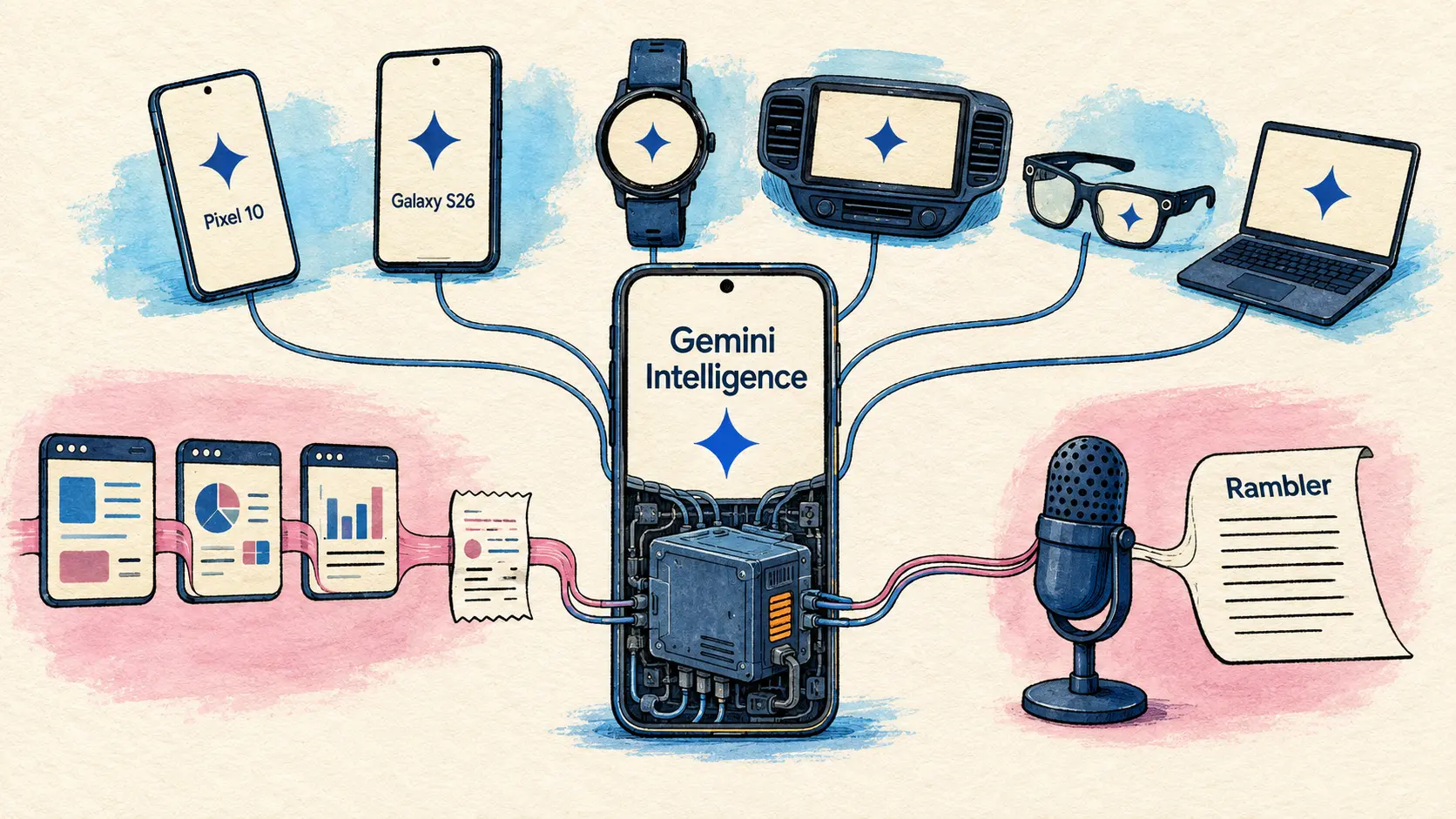
Gemini Intelligence on Android — proactive AI, Rambler and Create My Widget
May 12 — Google announces Gemini Intelligence, a native AI layer built into Android that turns the operating system into an “intelligence system.” Introduced during “The Android Show: I/O Edition 2026,” the feature is aimed primarily at premium devices — Samsung Galaxy S26 and Pixel 10 — with a summer rollout followed by expansion to watches, cars, glasses, and laptops by the end of 2026.
| Feature | Description |
|---|---|
| Multi-step automation | Gemini executes complex tasks by navigating between apps (orders, course search, shopping) |
| Gemini in Chrome (Android) | Smart browsing, web summaries, automatic booking — available at the end of June |
| Smart Autofill | Filling out complex forms using data from connected apps (strict opt-in) |
| Rambler | Multilingual voice conversion: natural speech → polished text, with no audio storage |
| Create My Widget | Generation of custom widgets through natural language (phone + Wear OS) |
| Material 3 Expressive | New animated visual language to reduce distractions |
The rollout vector is gradual: phones first in summer 2026, then expansion across the Android ecosystem (Wear OS watches, Android Auto, glasses, laptops) before the end of the year.
🔗 Gemini Intelligence announcement
Googlebook — The Chromebook successor with a DeepMind AI cursor
May 12 — Google introduces the Googlebook, a new category of laptops based on the Android + ChromeOS stack, designed natively for Gemini Intelligence. This is the first time in 15 years that Google has completely reworked its laptop proposition. The site googlebook.com is live, and launch is planned for fall 2026.
| Feature | Description |
|---|---|
| Magic Pointer | AI cursor co-developed with Google DeepMind — contextual suggestions on hover, image viewing, date-based actions |
| Create My Widget | Widgets generated by Gemini prompts with access to Gmail and Calendar |
| Quick Access | Access to files on the Android phone from the laptop, with no transfer |
| Glowbar | Distinctive visual signature across all devices |
| Hardware partners | Acer, ASUS, Dell, HP, Lenovo |
Magic Pointer is the central differentiator: rather than a simple cursor, it becomes a contextual entry point into Gemini — capable of suggesting actions, identifying hovered content, or detecting dates to propose calendar actions.
OpenAI Daybreak — Frontier platform for cyber defense
May 11 — OpenAI introduces Daybreak, an offering dedicated to cybersecurity teams. The platform combines frontier OpenAI models, the Codex agent, and a network of specialized partners to automate vulnerability detection, validation, and incident response.
“Daybreak brings together the most capable OpenAI models, Codex, and our security partners to accelerate cyber defense and continuously secure software.” — @OpenAI on X
The stated goal is to enable defense teams to “move at the speed defense requires.” Daybreak builds on GPT-5.5-Cyber (announced on May 7), but with a more complete product approach: it is not just a specialized model but a platform integrating security partners. The launch generated 5 million views in 24 hours.
Claude Code — Agent view available in research preview
May 11 — Claude Code introduces agent view, available immediately in research preview. This view centralizes all active and past sessions in a unified list, making it easy to navigate between the tool’s different instances.
“New in Claude Code: agent view. One list of all your sessions, available today as a research preview.” — @claudeai on X
The “research preview” mention indicates the feature is still experimental and may evolve. The exceptional engagement — 3.9 million views — confirms community interest in better multi-session management in AI-assisted development tools.
The Android Show: I/O Edition 2026 — 9 Android announcements in the pre-show
May 12 — On the eve of Google I/O, Google simultaneously published 9 Android-focused posts. Sameer Samat, President of the Android ecosystem, presents Android’s vision as an “intelligence system” — an OS that no longer just runs apps but reasons and acts on behalf of the user.
The 9 posts cover: Gemini Intelligence and Googlebook (covered above), Gemini in Chrome for Android (auto browse, end of June), the next generation of in-car Android, new Android 17 creation features (optimized Instagram, Adobe Premiere), file sharing and security, Pause Point (well-being feature against doomscrolling), and Noto 3D emoji.
🔗 Android Show: I/O Edition 2026
Copilot Platform and GitHub — 5 security and development updates
Copilot code review: severity labels and grouping
May 12 — Copilot code review comments now display severity labels (High, Medium, Low) visible in the top-right corner of each comment. Similar suggestions are automatically grouped to reduce noise on large pull requests — a common problem in projects with many modified files. These improvements are available to users who opted into the new pull request experience.
🔗 Copilot code review changelog
April reports: preparing for AI credit billing (June 1)
May 12 — April usage reports are available for Copilot Business and Enterprise admins as well as Pro/Pro+ users. The goal: estimate AI credit consumption before the switch to usage-based billing on June 1, 2026. Three points to note: usage from April 1 to 24 with a 0x multiplier is not included (~2% of activity), duplicates may appear for April 24-30, and some code review entries lack estimates.
CodeQL 2.25.4 — Swift 6.3.1, C# 14, Vercel serverless
May 12 — CodeQL 2.25.4 is deployed automatically on github.com with several notable improvements.
| Language | New feature |
|---|---|
| Swift | Support for Swift 6.3.1 |
| C# | Expanded remote ASP/ASP.NET sources, C# 14 composition operators |
| JavaScript/TypeScript | Vercel serverless functions (VercelRequest/VercelResponse) |
| Java/Kotlin | Path.toRealPath() recognized as a sanitizer, reduced sensitive-log false positives |
| 8 languages | Data-flow barrier extensions via data extensions (without modifying queries) |
Dependabot — Cross-organization access for internal repositories
May 11 — Dependabot can now access internal repositories hosted in other organizations within the same GitHub Enterprise. Until now, this limitation forced teams to maintain manual configurations for cross-organization dependencies. Activation is done from the company’s “Advanced Security Policies” page. Available on github.com, included in GHES 3.22.
🔗 Cross-org Dependabot changelog
Manus Preferred Browser — Personalized Chrome browser for Browser Operator
May 12 — Manus launches Preferred Browser, an update to Browser Operator that lets users designate a personal Chrome browser as the default environment for automated web tasks. The concrete benefit: logged-in sessions, installed Chrome extensions, and granted permissions are preserved from one task to the next, even from another computer.
| Before | With Preferred Browser |
|---|---|
| Web tasks tied to the current device’s browser | Manus uses the selected custom browser |
| Logins and extensions vary from one PC to another | Configuration kept in the same place |
| Repeated reconfiguration required | Guaranteed return to the same logged-in Chrome session |
The user installs the Manus Browser Operator Chrome plug-in on a dedicated computer (an always-on Mac mini, for example), authorizes it from Manus, and then marks it as preferred. All subsequent sessions use this configuration.
Genspark GenClipboard — Free universal clipboard
May 12 — Genspark launches GenClipboard, a universal, fully free clipboard tool. GenClipboard automatically captures everything the user copies — text, links, passwords, code, images, and screenshots — and makes it searchable at any time. The tool had been used internally at Genspark for several months before its public release.
NVIDIA GTC Taipei — Jensen Huang keynote on June 1
May 11 — NVIDIA announced that its CEO Jensen Huang will take the stage at the Taipei Music Center on June 1, 2026 at 11:00 a.m. (Taipei time) for NVIDIA GTC Taipei. The keynote will be streamed worldwide. NVIDIA promises to unveil “the breakthroughs that will power the next era of AI.”
🔗 NVIDIA GTC Taipei announcement
OpenAI Parameter Golf — 8-week competitive ML recap
May 12 — OpenAI publishes the recap of Parameter Golf, its machine learning challenge. Over 8 weeks, the competition brought together more than 1,000 participants for over 2,000 submissions, with a strict constraint: minimize loss on FineWeb with a maximum 16 MB artifact and 10 minutes of training on 8 H100 GPUs. RunPod sponsored $1 million in compute.
| Track | Best approaches | Best BPB |
|---|---|---|
| Record | GPTQ + Muon + spectral initialization | < 1.10 |
| Non-record | State-space + JEPA, byte-level H-Net | ~1.12 |
A striking fact: almost all participants used AI agents (notably Codex) to accelerate their experiments, which lowered the entry barrier but also generated noise. OpenAI developed an internal Codex-based triage bot to handle the volume. The challenge also served as a talent discovery surface.
🔗 What Parameter Golf taught us
Perplexity Research — Qwen3 235B on NVIDIA Blackwell GB200 NVL72
May 12 — Perplexity publishes a research article detailing its serving infrastructure for Qwen3 235B, deployed on GB200 NVL72 Blackwell racks. The architecture relies on 18 nodes × 4 Blackwell GPUs (72 GPUs, 180 GB HBM each) with 72-way NVLink interconnect at 1800 GB/s.
The central strategy is disaggregated prefill/decode: prefillers operate with Tensor Parallel TP=4/EP=4, decoders with Data Parallel + Expert Parallel up to 16 GPUs via NVLink (versus 8 max on Hopper). Additional optimizations include MXFP8 quantization, the SHARP protocol for reductions (-46% all-reduce latency), speculative decoding with MTP layers trained in-house, and CuTeDSL kernels ported to Blackwell.
“GB200 is a major step up over Hopper for high-throughput inference on large MoE models, not just a training platform.” — @perplexity_ai on X
Qwen3 235B is currently in production for part of Perplexity’s traffic, with a migration underway to Qwen3.5 397B and 122B.
🔗 Full Perplexity Research article
Briefs
- Claude Code v2.1.140 — Matching the
subagent_typeparameter in the Agent tool now accepts case-insensitive and separator-insensitive variants (e.g.claude-code-guidevsClaudeCodeGuide). 🔗 CHANGELOG - Code with Claude — Anthropic organized a community event where small computers were distributed to participants to build projects with Claude. 🔗 @claudeai tweet
- Synchroneous GitHub API SBOM deprecated — Removal planned for November 13, 2026. Migrate to the asynchronous endpoint
dependency-graph/sbom/generate-report. 🔗 Changelog - Luma Agents + Kling Omni — Luma creative agents can now generate videos with the Kling Omni model, expanding the catalog since
lumalabs.ai/app. 🔗 @LumaLabsAI tweet - Runway Big Pitch Contest — 20 winners announced for the first contest of fictional series pitches generated with Runway video tools, top 5 published in video form. 🔗 @runwayml tweet
- Qwen Ambassador Program — Qwen is launching an ambassador program for developers and local communities, form at qwen.ai/ambassador. 🔗 @Alibaba_Qwen tweet
What it means
Google chose to unveil its major Android announcements the day before Google I/O rather than during the keynote, creating a simultaneous 9-article “pre-show.” This decoupling strategy suggests that Google I/O itself will contain even bigger announcements — probably around Gemini 3 or Astra. Gemini Intelligence and the Googlebook together form a direct response to Apple Intelligence: while Apple integrates AI into iOS and macOS in a cohesive way, Google is mirroring the approach on Android while also launching a new hardware category. The Magic Pointer developed with DeepMind is the strongest signal: Google is trying to make the cursor the universal entry point to AI on laptops, a bet on the interface rather than on voice commands.
OpenAI Daybreak represents the first explicitly cyberdefense-positioned offering from a major AI company. After GPT-5.5-Cyber (May 7), Daybreak formalizes a B2B strategy aimed at security teams with a platform approach — models + Codex + partners. The differentiation versus tools like Microsoft Security Copilot remains to be confirmed, but the enthusiasm (5 million views in 24 hours) shows that the market was waiting for this kind of integrated offering.
The five GitHub updates this week sketch a GitHub that is becoming increasingly fragmented into premium services: Copilot severity labels, AI credit reports to prepare for June billing, cross-org Dependabot for large enterprises. The shift to AI credit billing on June 1 is the most structural signal — GitHub is gradually turning Copilot from a flat-rate subscription into a consumption-based service, which will fundamentally change the value calculation for teams.
Perplexity’s article on its Blackwell infrastructure illustrates a broader trend: providers serving large open source models (Qwen3 235B, soon 397B) are investing heavily in low-level optimization — disaggregated prefill/decode, MXFP8, CuTeDSL, specialized MoE kernels. The 46% gain in all-reduce latency between Hopper and Blackwell confirms that Blackwell is not just a faster GPU but an architecture that changes deployment strategies.
Sources
- Gemini Intelligence on Android
- Googlebook
- Android Show: I/O Edition 2026
- OpenAI Daybreak (tweet)
- Claude Code Agent View
- GitHub Copilot code review
- GitHub April reports
- GitHub CodeQL 2.25.4
- GitHub Dependabot cross-org
- GitHub API SBOM deprecated
- Manus Preferred Browser
- Genspark GenClipboard
- NVIDIA GTC Taipei
- OpenAI Parameter Golf
- Perplexity Research — Qwen3 on Blackwell
- Luma Agents + Kling Omni
- Runway Big Pitch Contest
- Qwen Ambassador Program
- Claude Code CHANGELOG
- Code with Claude