ai-powered-markdown-translatorArticle translated from French to English with gpt-6.1-sol.
Cursor has published its report on the security incident that led to the distribution of a malicious Claude Code extension in late October: according to the company, the attack originated from an access key issued for Fireworks, and the attacker’s last activity was on November 1. On the product side, Projects in Claude Code gains a more proactive coordinator and thread sharing, the desktop application supports custom themes, and Sierra releases version 1.0 of Poppy, enabled for all Shopify merchants. Deepnote publishes a benchmark for proactive agents, Thinking Machines details the 4-bit training of Inkling 2 Small, and Meta uploads MetaEncoder v1 without an announcement.
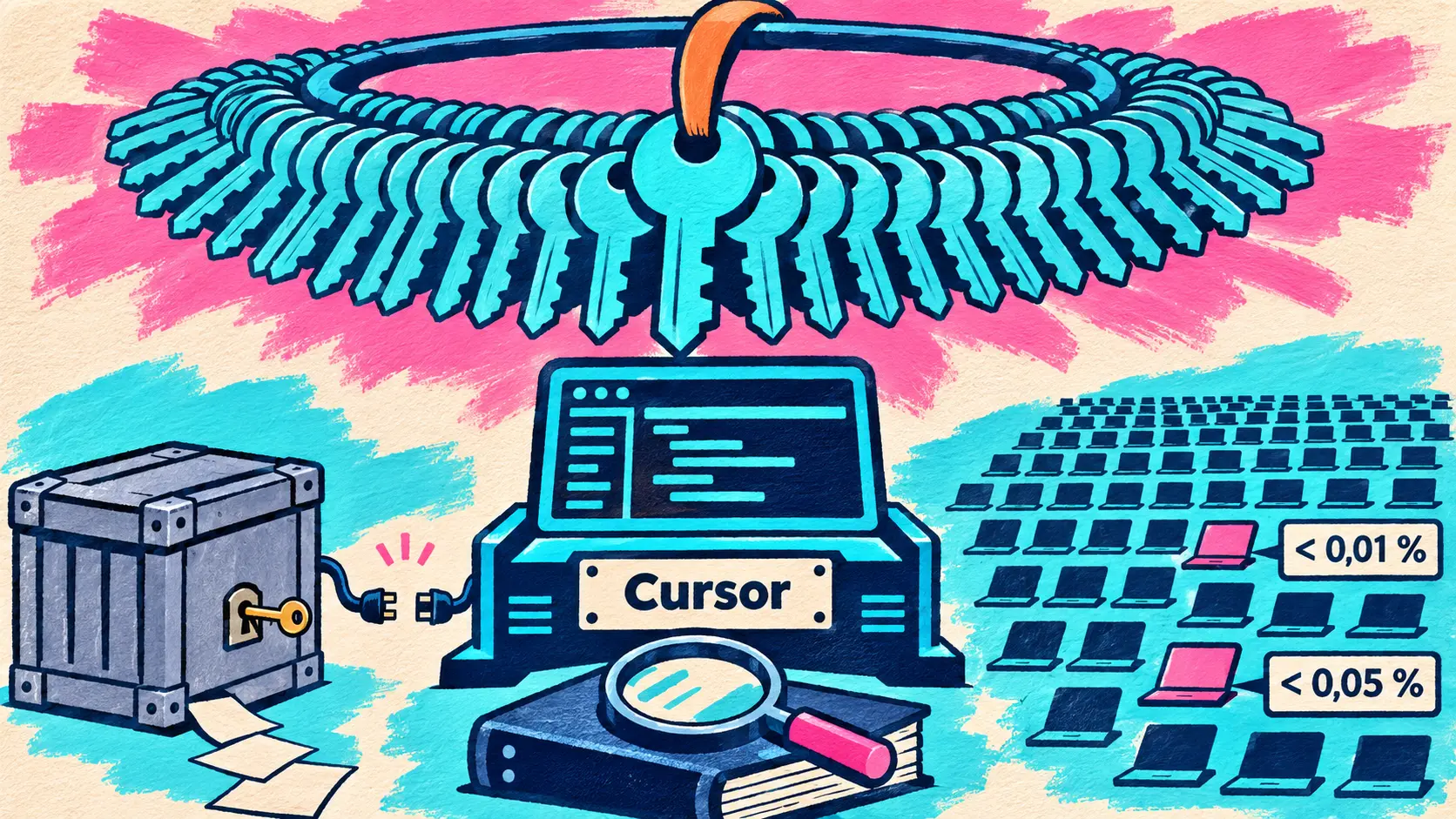
Cursor publishes its security incident report: according to the company, the attack originated from a key issued for Fireworks
November 13 — Cursor publishes the findings of its investigation:
It started at Fireworks. An attacker obtained an access key we had issued to Fireworks. The key was exposed by Fireworks, and the attacker used it to copy data from a read-only storage bucket we used to share data with them. — Cursor, “An update on our recent security incident”
According to Cursor, this bucket contained coding agent traces, mostly from 2025, from sessions outside Privacy Mode. Some contained unmasked credentials, which gave the attacker access to SaaS tools used by Cursor, then to archived non-production repositories and support data. The malicious extension, covered here on October 30, resulted from this: a stolen credential was used to place it in the marketplace cache on October 29, in versions Anthropic had not released.
| Findings according to Cursor | What the post says |
|---|---|
| Exposed API credentials | fewer than 0,01 % of customers |
| Exposed agent traces, sessions outside Privacy Mode | fewer than 0,05 % of users, all notified |
| Malicious Claude Code extension from October 29 | up to 5 000 users may have received it, online for about 11 hours |
| Last observed attacker activity | November 1, blocked |
| Unaffected scope | Privacy Mode, production, official application and updates, Cloud Agents, customer repositories |
Cursor has moved all its inference traffic away from Fireworks, disabled the key and cut off access to shared datasets; it has rotated all its internal credentials, scanned its repositories for secrets and redeployed its production environment. The quantities of exposed traces and credentials are given only as percentages.
🔗 Announcement from @cursor_ai
Claude Code: Projects becomes more proactive, and the desktop application supports custom themes
Two announcements from Anthropic’s developer account on the evening of November 13 concern the Claude Code applications: neither concerns the terminal CLI.
Projects: proactive coordinator, /btw and /fork in projects, reminders and thread sharing
November 13 — In Projects, where one conversation coordinates parallel threads, the coordinator becomes more proactive: it answers questions in the project chat and provides updates on ongoing threads. /btw and /fork arrive in projects: the former gives a side topic its own thread, while the latter starts a new thread from the current one to test another approach. A reminder hides a thread until the scheduled time, then Claude flags it in the chat. A thread can now be shared through a read-only link with anyone signed in to Claude, unless it has accessed the user’s computer.
All of this is coming to the web and desktop application, and the latest mobile application adopts the new design. According to the announcement, Projects remains in public beta on Pro and Max, with a waitlist; the documentation also lists Ultra, still excludes Team and Enterprise, and continues to state that a thread cannot be shared.
🔗 Thread from @ClaudeDevs · Projects documentation
Custom themes: colors and animated backgrounds in the desktop application, using mods
November 13 — A little over an hour later, Anthropic opens up custom Claude Code themes in the desktop application. They are built using mods, the TypeScript functions launched on October 1: according to the announcement, a theme changes the colors and places an animated background behind the conversation, and users simply describe the desired appearance to Claude. To get started, the official theme-examples 0.4.3 plugin (Apache-2.0) offers 20 animated backgrounds, applied per project or per session with /custom-theme. It adds /fireworks, which manually triggers the fireworks animation that also plays when Claude writes “merged”; despite its name, this command has no connection to the Fireworks company mentioned by Cursor.
For developers, $.theme.set and $.theme.clear replace $.ui.backdrop as of Claude Code v2.1.319, and the terminal displays no background. After updating the application, themes work in local sessions; cloud sessions are announced as coming “soon,” with no date.
Poppy 1.0: Sierra’s personal agent protocol is enabled for all Shopify merchants, and Manus joins its partners
November 13 — Sierra releases version 1.0 of the Personal Agent Protocol, nicknamed Poppy, which defines how a personal agent introduces itself to a business and discovers what it is allowed to do there. Announced on October 6, the protocol builds on existing standards (MCP, OpenAPI, Universal Commerce Protocol or UCP) and OAuth, which gives customers control over what their agent can do.
Version 1.0 arrives already deployed. Shopify enables it for all its merchants: every store automatically publishes a Poppy file, with UCP handling the purchase and Poppy handling what comes before it. Muse, Meta’s AI agent, looks for Poppy first on every site, for all its users. Sierra lists Mercury, Synchrony and Turkish Airlines among the partners moving into production, but still describes Synchrony’s integration in the future tense. Sixty companies join the design partners, bringing the total to more than a hundred; Manus is among them, alongside Salesforce and Cisco, and welcomed the release on November 14 without detailing its integration.
🔗 Sierra blog post · Tweet from @ManusAI
Agent Initiative Benchmark: GPT-6 Astra and GPT-6.1 Sol lead Claude Fable 5.2 on Deepnote’s benchmark
November 13 — Deepnote, the collaborative data notebook company, publishes a third-party benchmark for proactive agents (proactive agents), which follow a team’s conversations and independently decide whether to intervene or remain silent. Twelve models from six labs face 50 situations at PageMantle, a fictional company with 71 employees and data spread across 11 services, at high effort and with a 180-second budget; two LLM evaluators score each run from 0 to 10 in a blind evaluation. The announcement thread by Deepnote founder Jakub Jurovych was reshared by @OpenAIDevs.
| Model evaluated | Average score (0 to 10) | Cost per task (dollars) |
|---|---|---|
| GPT-6 Astra | 8,97 | 0,693 |
| GPT-6.1 Sol | 8,65 | 0,112 |
| Claude Fable 5.2 | 8,17 | 1,87 |
| Claude Opus 5.5 | 7,84 | 1,28 |
| Claude Fable 5.1 | 7,50 | 3,02 |
| Claude Sonnet 5.5 | 6,65 | 0,420 |
| GPT-6 Luna | 6,38 | 0,0070 |
| DeepSeek V4.1 Flash | 6,35 | 0,026 |
| Mistral Large 4 | 6,09 | 0,082 |
| Claude Haiku 5.5 | 6,05 | 0,075 |
| Gemini 4 Argon | 5,60 | 0,403 |
| Grok 4.7 | 4,51 | 0,425 |
The page qualifies this ranking: Sol falls within Astra’s confidence interval (8,30 to 9,52), so this task set does not distinguish between them, and Fable 5.2 remains within Sol’s interval. The costs are recorded expenditures, not prices: one month of PageMantle Slack activity (around 2 500 threads) would cost 281 dollars with Sol, 1 732 with Astra and 4 684 with Fable 5.2. When silence was appropriate, the models remained silent only 6 times out of 10. Deepnote acknowledges its limitations: 50 tasks, a single effort level, responses only in Slack, and results that depend on the harness.
🔗 Agent Initiative Benchmark (Deepnote) · Thread by Jakub Jurovych
Inkling 2 Small: Thinking Machines details its 4-bit training, from pretraining to RL
November 13 — In a post on Connectionism, its research blog, Thinking Machines explains how Inkling 2 Small, its 594-billion-parameter open-weight MoE introduced on November 12, was trained with a native NVFP4 forward pass, from the first pretraining step to the final reinforcement learning rollout. Backward passes remain in MXFP8, with stochastic rounding (stochastic rounding) to limit gradient bias. Expert outputs exchanged between GPUs use an 8-bit format (S2F6): 8,25 bits per value instead of 16.
| Numerical format | Bits per value | PFLOPS on GB300 |
|---|---|---|
| NVFP4 | 4,5 | 15 |
| MXFP8 | 8,25 | 5 |
| BF16 | 16 | 2,5 |
Compared with training entirely in MXFP8, the lab measures an 8 % wall-clock speedup in pretraining and 20 % in RL, at the cost of around 2 % in compute efficiency during pretraining, with no visible difference in RL reward. NVIDIA, which shared the post, highlights pretraining completed in 68 hours on GB300 NVL72 racks.
🔗 End-to-End 4-Bit Training (Thinking Machines) · Shared by @NVIDIAAI
MetaEncoder v1: Meta quietly uploads a 28,4-billion-parameter multimodal encoder
November 12 — Catch-up: Meta published MetaEncoder v1 on Hugging Face without a blog post or tweet, succeeding MetaEncoder-30B (covered on October 5). The old repository’s model card states that v1 “significantly improves” the model, without figures. It is used through three calls: encode produces vectors for text, images or videos, retrieve ranks a corpus against a query, and decide answers closed-ended questions about a state with probabilities, in the format the model card calls Jev.
| Model characteristic | Value according to the model card and Hub |
|---|---|
| Parameters | 28 431 795 200 |
| Vector dimension | 6 656, L2-normalized |
| Specified hardware | one 80 Go GPU in bf16 |
| Transformers version | 5.15 or later (muse_glimmer) |
| License and evaluations | no license or benchmark declared |
The Apache-2.0 license and scores from the old repository therefore do not apply to this version, which is more of a technical upload than a launch.
🔗 MetaEncoder v1 (Hugging Face) · Old MetaEncoder-30B repository
Briefs
Coding agents and CLI
- Devin November 13 release notes — Session outputs (PRs, previews, plan, attachments) are organized in a sidebar to the right of the chat; Review Analytics shows what happened to each custom reviewer’s findings, Devin Review places merge requests in GitLab merge trains, and the interface adds German. 🔗 source
- Codex CLI 0.171.0-alpha.5 — The release notes for this prerelease are empty; judging by the titles of the 126 commits since 0.169.0, the terminal workspace becomes stable and enabled by default, and the TUI negotiates real-time voice calls. Subject to change before the next stable release. 🔗 source
- Copilot CLI 1.0.112 — Promoted to stable on November 13, with nothing beyond prerelease 1.0.112-0, carrying over all 95 entries; SDK 1.0.34 follows the same path. 🔗 source
Platforms and companies
- GitHub October availability report — Eight incidents during the month, including the October 28 Copilot incident: roughly one in 10 requests to several GPT models failed because GitHub’s credential with the upstream provider had become invalid; switching models bypassed the error. 🔗 source
- Shield and GPT-6 Astra — In Forge, its platform for IT service providers, a computer-use agent powered by GPT-6 Astra handles portals without APIs (tickets, devices, licenses) thousands of times per month, 35 to 40% faster than older models, according to Shield. 🔗 source
- Synapsis AI at Cleveland Clinic — NVIDIA describes how Dyania Health’s tool, running behind the hospital’s firewall, was used in a study of more than 7,800 patients who underwent aortic valve replacement, with a predictive model for 3, 5 and 10 years; no new NVIDIA product. 🔗 source
- OpenUncensored traffic — Over one week, 157 paying customers and 150,292 requests: coding agents account for 49% of spending at this uncensored model provider, all agents for 65%, and chat and roleplay for 1.5%, according to the provider. 🔗 source
Images and video
- Seedance 2.5 Flash in HeyGen — The fast variant of ByteDance’s video model arrives in Creative Studio, up to 2 times faster than Seedance 2.5 with similar quality, according to HeyGen; no pricing or maximum duration specified. 🔗 source
- Grok Imagine in Grok — Image and video creation now takes place in Grok; SpaceXSI says it is bringing more of its products together in a single Grok experience, without specifying which ones or what will happen to the Grok Imagine app. 🔗 source
Open models and research
- CQ and GCMP from ThousandML — On Qwen3.8-27B, CQ 4-bit quantization reduces the model from 55.6 to 18 GB with no significant difference from BF16 across nine benchmarks, while NF4 loses 12 points on GSM8K; the GCMP adapter matches a rank-32 LoRA with 2.9 million parameters versus around 159 million, according to the developer. 🔗 source
- Four posts about Cohere Labs’ Aya models — Fine-tuned on verified corrections, Aya Expanse 32B goes from 14.5% to 51.5% of τ²-bench tasks; Tiny Aya Fire refuses 36 out of 36 harmful requests in Urdu script, but 17 out of 36 in romanized Urdu, according to the authors. 🔗 source · ScriptShield
- PEFT v0.21.3 — This patch gathers only the adapter weights when saving a model using tensor parallelism, eliminating a slowdown. 🔗 source
What it means
Cursor’s account shows how risk arises when a software vendor shares data with a service provider. According to its account, a single sharing key was enough to copy agent traces, and a few unmasked credentials in those traces provided access to SaaS tools used by the vendor, then to extension distribution. Coding agent traces thus become sensitive data in their own right; according to Cursor, traces from Privacy Mode sessions were unaffected. The announced measures target these two points: rotating all internal credentials and scanning repositories for secrets. This remains Cursor’s account.
Agents are taking more initiative, and the question becomes when they should stay silent. The Projects coordinator now checks in on ongoing threads on its own; Deepnote’s benchmark measures precisely this decision to intervene, showing that a message is sent 9 times out of 10 when help is expected, but models hold back only 6 times out of 10 when silence is called for. The cost difference, from 0.11 to 1.87 dollars per task between Sol and Fable 5.2, matters greatly for an agent that monitors continuously, as Deepnote’s calculation for a month of Slack activity shows. These results still come from a single benchmark, with a single harness, which Deepnote itself considers a determining factor.
Poppy 1.0 tackles the other end of the chain: how a personal agent introduces itself to a business and learns what it is allowed to do there. Rather than reinventing everything, the protocol builds on MCP, OpenAPI, UCP and OAuth, and default deployment at Shopify and in Muse gives the protocol a very large base from the outset. The examples cited keep the customer in the loop, with Mercury’s approval policy for a transfer or the traveler’s consent before paying for an upgrade at Turkish Airlines.
For open models, low precision is reaching training itself: Inkling 2 Small performed its forward pass in 4 bits from pretraining through RL, with a measured speed increase of 8 to 20%. ThousandML, meanwhile, makes the case for a calibration-free 4-bit format for fine-tuning, based on its own measurements. Finally, MetaEncoder v1 is a reminder that a model available for free download does not necessarily have an open license: its model card declares none.
Sources
- An update on our recent security incident (Cursor)
- Announcement from @cursor_ai
- Security advisory for the Claude Code extension (Cursor)
- Projects updates in Claude Code (@ClaudeDevs)
- Projects documentation in Claude Code
- Claude Code custom themes (@ClaudeDevs)
- Mods documentation: drawing in the interface
- theme-examples plugin (PR #7116)
- Releasing Personal Agent Protocol 1.0 (Sierra)
- Poppy 1.0 announcement (@SierraPlatform)
- Tweet from @ManusAI about Poppy
- Agent Initiative Benchmark (Deepnote)
- Thread by Jakub Jurovych
- Agent Initiative Benchmark code (GitHub)
- PageMantle dataset (Hugging Face)
- End-to-End 4-Bit Training (Thinking Machines)
- Post shared by @NVIDIAAI about Inkling 2 Small
- MetaEncoder v1 (Hugging Face)
- MetaEncoder-30B (Hugging Face)
- Devin November 13 release notes
- Codex CLI 0.171.0-alpha.5 (GitHub)
- Copilot CLI 1.0.112 (GitHub)
- GitHub availability report: October 2026
- Shield case study (OpenAI)
- How AI is helping care teams (NVIDIA)
- Uncensored models are agent infrastructure (OpenUncensored)
- Seedance 2.5 Flash in HeyGen (@HeyGen)
- Image and video creation in Grok (@imagine)
- CQ and GCMP (ThousandML)
- Reflexive Agents (Hugging Face blog)
- ScriptShield (Hugging Face blog)
- PEFT v0.21.3 (GitHub)