ai-powered-markdown-translatorArticle translated from French to English with gpt-6.1-sol.
Meta releases the weights of Muse Spark Open, a multimodal mixture-of-experts model with 816 billion parameters that it presents as the most capable American open model, supported on the same day by NVIDIA, Hugging Face, and seven API providers. NVIDIA also opens up Nemotron 3.5 Super VL, a model with 120 billion parameters for agents, while Cohere signs a letter of intent to acquire AISLE, a specialist in autonomous vulnerability discovery, and creates Cohere Cyber. Perplexity releases SPACE, Computer’s sandbox, as open source, Black Forest Labs opens up the weights of FLUX 3 Image Klein, and Cognition launches Devin Oncall, an on-call agent that investigates production incidents.
Muse Spark Open: Meta opens up a multimodal MoE with 816 billion parameters, NVIDIA and Hugging Face follow the same day
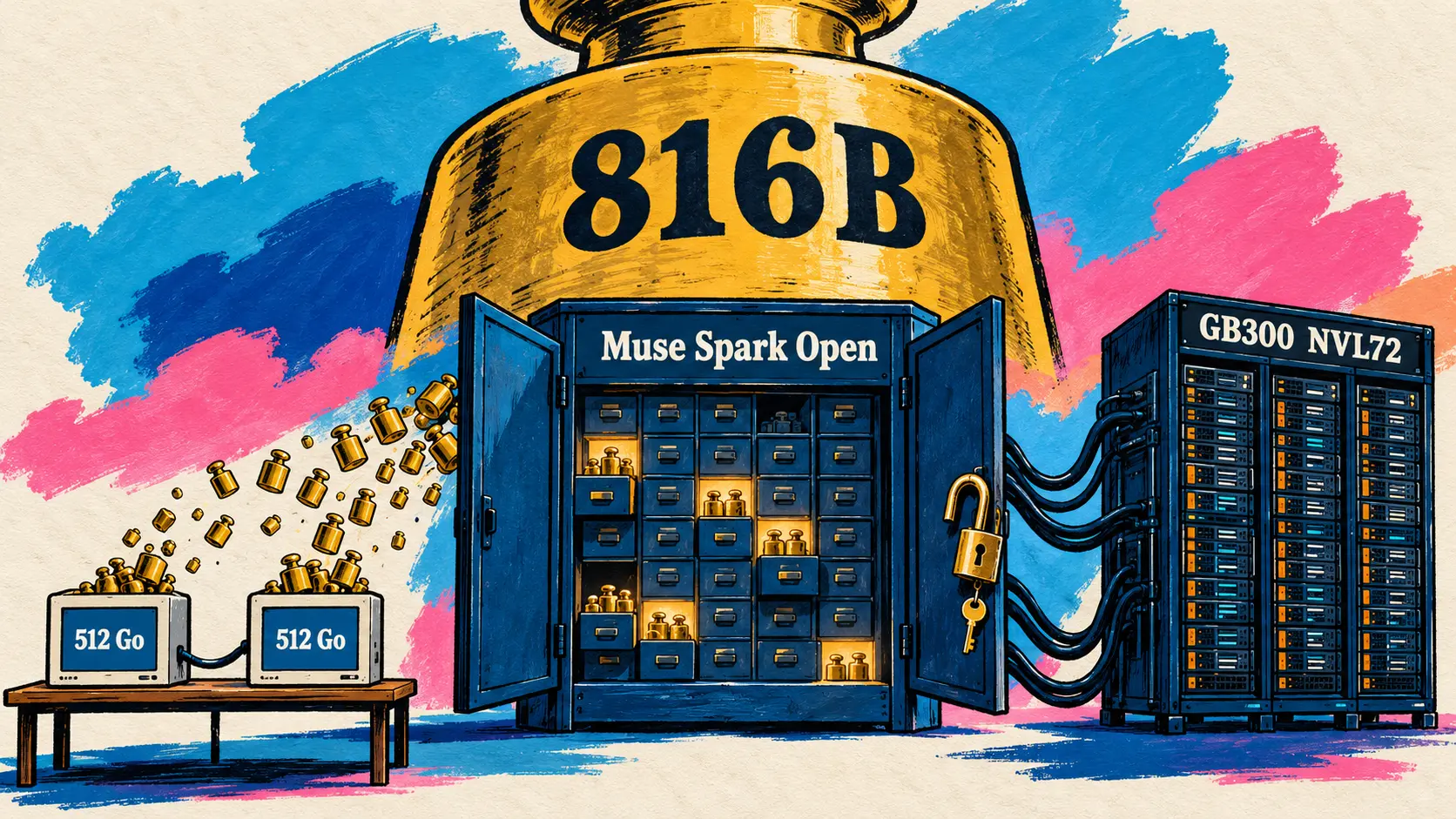
October 15 — Meta releases the weights of Muse Spark Open, a multimodal mixture of experts (mixture-of-experts, MoE) with 816 billion parameters, including 42 billion active per token, and a context window of one million tokens. The model reads text, images, video, and audio, and responds in text; Meta trained it for coding and agentic work. Within the Muse family, it becomes the large open model, above Muse Glimmer, the small dense model with 30 billion parameters released in August, and arrives three days after Muse Wonder, which remained closed.
Today we’re releasing Muse Spark Open, the most capable US open-weight model to date. Built for coding and agentic work, it excels at long-horizon tasks, complex software engineering, and multi-step reasoning. — @AIatMeta on X
The superlative should be read in a strict sense. In the table on the Hugging Face model card, where the model is evaluated at the xhigh setting, Muse Spark Open leads on eight rows of the full table, including MCP tool use and JobBench, but large Chinese open models remain ahead on the Artificial Analysis index (45 for GLM 5.3, 44 for Kimi K3, versus 39) and in coding. Among the three other American models in the table, Inkling from Thinking Machines, Nemotron 3 Ultra from NVIDIA, and Beam from Reflection AI, only Beam outperforms it in capabilities, on GPQA Diamond (90.5 versus 89.0) and Terminal-Bench 2.1 (80.1 versus 76.4).
| Benchmark (Hugging Face model card) | Muse Spark Open score (xhigh) | Best competitor in the table |
|---|---|---|
| MCP-Atlas | 89,2 | 84,5 (Qwen3.8-2.4T-A95B) |
| JobBench | 61,8 | 61,4 (GLM 5.3) |
| HLE-Diamond (without tools) | 26,1 | 22,2 (Kimi K3) |
| Artificial Analysis index | 39 | 45 (GLM 5.3) |
| OSWorld Verified | 80,4 | 84,8 (Kimi K3) |
| DeepSWE 1.1 | 60 | 68 (Kimi K3) |
| Terminal-Bench 2.1 (Terminus 2) | 76,4 | 85,0 (Kimi K3) |
| StrongREJECT v2 (lower = better) | 0,5 | 62,9 (GLM 5.3) |
Since all experts remain in memory, it requires the memory capacity of a model with 816 billion parameters to deliver the speed of a model with 42 billion. The BF16 weights take up about 1.5 TB (the Muse-Spark-Open-816B-A42B repository on Hugging Face, accessible after completing a form), and an NVFP4 version fits on a single B200 node. Meta nevertheless emphasizes local execution: the model is optimized for two connected Mac Studio M5 Ultra machines running MLX, each offering up to 512 GB of unified memory. Hugging Face tested a more modest setup, on a single Mac M3 Ultra with 512 GB: a 2-bit version running under llama.cpp takes up 304 GB and produces 18 tokens per second.
The weights are released under the Muse Model License, with limited commercial terms, which Meta says allows many developers to use the model for free. Seven providers serve it from day one: Baseten, Fireworks AI, Groq, Modal, Nebius, OpenRouter, and Together AI. Meta says it added safety post-training specifically for open weights and met the release thresholds of its Meta Superintelligence Scaling Framework, updated on October 2. On StrongREJECT v2, where a low score is better, the model scores 0.5, compared with 62.9 to 86.4 for the other models evaluated. On FORTRESS, it achieves the best average risk score (5.8, compared with 21.6 to 28.2) but the highest over-refusal score in the table (17.4, compared with 2.7 to 13.3).
NVIDIA accompanies the release with a technical post: Muse Spark Open was trained on GB300 NVL72 racks, and the NVFP4 checkpoints produced by Meta are optimized for Blackwell Ultra. For agentic workloads, NVIDIA claims up to 50,000 tokens per second per GPU and up to 600 tokens per second per user, and publishes deployment recipes for SGLang, vLLM, TensorRT LLM, and Dynamo, a NIM, and post-training with NeMo AutoModel.
The rest of the ecosystem followed during the day: Transformers and TRL integrate it (see below), mlx-lm 0.32.0 adds the NVFP4 version, Unsloth announces a 2-bit version that fits in about 256 GB, and Meta delivers Helion kernels for SGLang that are up to 3.95 times faster at the kernel level. In its post, Hugging Face even fine-tunes the full model on 64 H100 GPUs, with average per-token accuracy rising from 72 to 84%.
🔗 Meta’s post · The model card (Hugging Face) · Hugging Face’s post · NVIDIA’s technical post
Nemotron 3.5 Super VL: NVIDIA opens up a multimodal model with 120 billion parameters for agents, Perplexity integrates it the same day
October 15 — NVIDIA releases Nemotron 3.5 Super VL, an open mixture-of-experts model with 120 billion parameters, including 12 billion active per token. It combines reasoning, instruction following, and tool calls with an understanding of text, images, documents, and video, for agents that carry out long sequences of tasks: the same model reads a web page, chart, or PDF and then acts, without passing context from a text model to a vision model. According to NVIDIA, it achieves accuracy on multimodal agentic tasks comparable to that of its largest reasoning model, with about one-fifth of the parameters.
| Evaluation reported by NVIDIA | Nemotron 3.5 Super VL score | Comparison point |
|---|---|---|
| Hermes Bench | 63,44 % | 56,33 % (Nemotron 3 Ultra) |
| LangChain behavioral evaluations | 87,05 % | 84,3 % (Nemotron 3 Ultra) |
| CharXiv (chart reading) | 80,8 % (84 % with Python code) | 63 % (Nemotron 3 Nano Omni) |
NVIDIA particularly emphasizes efficiency: on a single GPU, throughput up to 5 times higher than other open models of its size on agent tasks, more than 600 tokens per second on the agentic tasks in the Artificial Analysis index via Baseten, and 10,000 coding tasks completed up to 4 times faster while maintaining good accuracy on SWE-Bench Pro. Distilled from Nemotron 3 Ultra, it surpasses that model on both harness evaluations in the table. On the serving side, LiLiCorr speculative decoding speeds up generation by up to 2.3 times on DGX Spark, and Dynamo serves up to 8 times as many users on 16 B200 GPUs at 50 tokens per second each, with 85% lower time to first token.
The release is comprehensive: base, post-trained, and NVFP4-quantized weights, recipes, reinforcement learning environments in NeMo Gym, and open datasets, including 40 vision-language datasets and a corpus of about 2.8 trillion tokens in 22 Indian languages, assembled with IIT Madras and its AI4Bharat lab. The model saw about 26 trillion tokens during training. It is available on Hugging Face, OpenRouter, ModelScope, and as a NIM microservice, with no pricing announced; NVIDIA cites adaptations at Scale AI for Skydance, with a reported 40-fold reduction in inference costs, as well as at Ramp, AI21, and Alice.
Perplexity added it the same day for its Pro and Max subscribers and to its Agent API. The API changelog prices perplexity/nemotron-3.5-super-120b-a12b at $0.20 per million input tokens ($0.04 for cached tokens) and $0.50 for output, with 1,048,576 tokens of context and up to 131,072 generated tokens, replacing Nemotron 3 Ultra. A small inconsistency: this entry describes a model with text-only input, whereas Perplexity’s tweet announces the VL version, which also reads images.
On the same day, Nemotron 3.5 Bolt 74B-A9B 24GB, announced on October 13, arrives on Hugging Face: natively quantized to 2 bits to fit in 24 GB, it targets the RTX Spark laptops available on October 16 and runs with llama.cpp, Ollama, LM Studio, Unsloth, and vLLM. NVIDIA ranks it first among open models in its category on PinchBench; Bolt E4B 4GB will follow on October 23.
🔗 NVIDIA announcement · NVIDIA technical post · Perplexity announcement · Perplexity API changelog
Cybersecurity: Cohere to acquire AISLE and creates Cohere Cyber, GitHub makes AI Scan and agentic autofix generally available
On the same day, two companies put AI to work finding and fixing vulnerabilities: Cohere acquires the expertise, while GitHub rolls it out broadly in its code scanning.
October 15 — Cohere is set to acquire AISLE, a young company building autonomous systems capable of discovering, validating, and helping fix previously unknown vulnerabilities in critical software. The two companies have signed a letter of intent (Letter of Intent): the deal has not yet closed, and neither its value nor its timeline has been published. Upon closing, AISLE’s headquarters in Prague will become Cohere’s Prague office.
| Published metric for AISLE | Reported value |
|---|---|
| Year founded | 2024 |
| Newly discovered vulnerabilities assigned a CVE | More than 500, across more than 100 codebases |
| OpenSSL, January security release | All 12 published vulnerabilities |
| curl, latest release | 18 of the 24 CVEs |
| High or critical severity CVEs | More than 200 (according to Aidan Gomez) |
Aisle is the state-of-the-art in defensive cyber, having found 200+ High/Critical CVEs in critical software like curl, FFmpeg, FreeBSD, Wireshark. — @aidangomez on X
In the same thread, Aidan Gomez, who leads Cohere, claims that AISLE outperformed Anthropic’s Glasswing (Mythos) and OpenAI’s Daybreak, with 29 new CVEs in curl while Mythos reportedly found none; this figure does not match the “18 of the 24 CVEs” cited in the two companies’ posts.
AISLE’s founding team takes on leadership roles. Ondrej Vlcek, AISLE’s CEO, becomes Senior Vice President of Cohere Cyber, a new unit tasked with bringing cybersecurity solutions to Cohere’s customers; Jaya Baloo becomes Cohere’s global Chief Information Security Officer; Stanislav Fort, AISLE’s CTO and Chief Scientist, becomes Vice President AI Security and will work with Ivan Zhang, Cohere’s CTO, to connect security research with model development and training.
Cohere sees this as another step in its European strategy, following Reliant AI and Aleph Alpha: the company plans a “substantial,” long-term investment in Prague, which is set to become its global AI cybersecurity center, a short journey from its new Berlin headquarters according to Aidan Gomez. The goal is twofold: to continue AISLE’s work on open source software security, and to enable critical infrastructure operators to analyze their software entirely privately, including in disconnected (air-gapped) environments. Both posts add an argument on the model side: difficult but verifiable security problems can be used to evaluate and improve Cohere’s future models.
🔗 Cohere’s post · AISLE’s post
GitHub: AI Scan for pull requests and agentic autofix for alerts reach general availability
October 15 — GitHub is bringing two AI-powered code scanning components into general availability: one finds vulnerabilities in pull requests, while the other fixes alerts.
AI Scan for pull requests complements CodeQL where the analyzer does not yet reach: PHP, Shell/Bash, Terraform configuration (HCL), Dockerfiles, JSP on the Java side, and Blazor on the C# side. It runs automatically on every pull request once code scanning and the repository’s AI Scan setting are enabled, and its results appear alongside CodeQL’s, marked “AI,” sometimes with an explanation of the risk and a suggested fix. They remain advisory: they do not fail the check and cannot block a merge, and scanning runs neither on pull requests from forks nor on those from Dependabot.
Agentic autofix (agentic autofix), meanwhile, handles an alert assigned to Copilot: it explores the relevant files, proposes a fix, reruns CodeQL to verify that the alert is closed, iterates if necessary, then opens a draft pull request. It can be assigned an alert on the default branch, up to 25 alerts to fix in a single pull request, or invoked through the REST API by assigning the alert to copilot-swe-agent[bot]; once enabled, it replaces the free Generate Fix option.
| GitHub component in general availability | Plans and requirements | Billing method |
|---|---|---|
| AI Scan for pull requests | Public repositories; Code Security or Advanced Security for private and internal organization repositories, with no Copilot license required | Code Security AI Credits |
| Agentic autofix for alerts | Code Security or Advanced Security on GitHub Enterprise Cloud, including data residency; Agentic autofix policy and a Copilot billing method required | AI Credits from the Code Security budget and GitHub Actions minutes |
The two launches conclude a series covered here since September: the AI Scan activation API on September 10, agentic autofix backed by Copilot Memory in preview on September 25, and AI Scan metrics in the security overview on October 13.
🔗 AI Scan for pull requests (GitHub changelog) · Agentic autofix for code scanning alerts (GitHub changelog)
SPACE: Perplexity open-sources Computer’s sandbox under the Apache 2.0 license
October 15 — Perplexity is open-sourcing SPACE (Sandboxed Platform for Agentic Code Execution), the sandbox platform (sandboxes) that runs every Perplexity Computer task. The day before, Perplexity detailed how SPACE routes each request to the appropriate sandbox execution; now the code itself is available on GitHub under the Apache 2.0 license. Each agent task runs in its own Firecracker microVM, with credentials and outbound traffic controlled from outside the virtual machine.
The security principle rests on one idea: the sandbox is considered untrusted. Computer’s agents run commands, install packages, and call external services with root access inside it, but the host remains beyond their reach, and a gateway dedicated to each sandbox enforces the egress policy on every connection; agents access authorized services without credentials being stored in their working environment. A sandbox also outlives the request that created it: it can be paused, duplicated (fork), or suspended in a memory and disk snapshot, then resumed.
| SPACE element | Value reported by Perplexity |
|---|---|
| Repository language and license | Rust, Apache 2.0 |
| Isolation | One Firecracker microVM per agent task |
| Production volume | Millions of sandboxes created daily, for all Computer sessions since July |
| Creation compared with the previous provider | Three to five times faster, on the same production traffic |
| Escaping SPACE, Part I | No escapes to the host in 108 attempts |
| Release schedule | 0.8.0 as the public baseline, followed by 0.9.0 and 1.0.0 |
September’s Escaping SPACE evaluation found no escapes from the virtual machine to the host, but did find ways to bypass network restrictions: these were fixed, and the identified methods no longer succeeded in subsequent tests, according to the post. The repository, written in Rust, can be installed locally on a test Kubernetes cluster (Kind), offers pools of prewarmed sandboxes (warm pools) and a compatibility layer for E2B’s API, tested with its Python SDK; 0.9.0 will be the last release to introduce breaking changes before a 1.0 with stable contracts.
CoreWeave and Akamai have tested and launched SPACE on their platforms and are working to offer it to their customers, while Crusoe will add it to its Managed AI Services offering. Perplexity presents SPACE as the first component of its agent execution platform (Agentic Runtime Platform), open-sourced to raise the security standard for agentic products.
🔗 Perplexity’s post · The thread from @perplexity_ai · The SPACE repository (GitHub)
Generative media: open-weight FLUX 3 Image Klein on a consumer GPU, Kling 4.0 for everyone, ElevenLabs’ Instant Soundtracks
October 15 — Black Forest Labs is releasing FLUX 3 Image Klein, a 5.6-billion-parameter, generator-only, open-weight image model that runs on a single consumer GPU. The same model generates images from text and edits using one or more references, up to 10 images; it inherits the flagship features of FLUX 3 Image, launched on October 1: native 4K generation, pixel-precise editing, and bounding boxes (bounding boxes), which specify an element’s position in the prompt or restrict an edit to a particular area.
According to BFL’s internal evaluations, Klein ranks first in text-to-image, multi-reference generation, and editing against larger open models, Qwen-Image 2.1 (7B) and Krea 2 (12.9B), and places above both closed models in the comparison, Ideogram V4.5 and FLUX.2 [pro]. Compared with its predecessor, FLUX.2 [klein] 9B, it gains 91 Elo points in text-to-image and 70 in editing, with 38% fewer parameters.
| Tested configuration | Reported result |
|---|---|
| BF16 / FP8 weights | 11,2 Go / 5,6 Go |
| INT8 version on GeForce RTX (ComfyUI or Diffusers) | Runs with 8 Go of VRAM |
| RTX 5090, distilled INT8 version (NVIDIA measurement) | Around 4 s per 1-megapixel image |
| RTX 4070, distilled INT8 version (NVIDIA measurement) | Under 9 s per 1-megapixel image |
| H100, distilled version in Diffusers | Around 2 s per 1024 × 1024-pixel image |
| GB300, distilled NVFP4 version | Under 0,6 s per 1-megapixel image |
Hugging Face integrated it into Diffusers the same day, with two checkpoints: the distilled version, using 16 steps and no CFG, and the base version, using 50 steps and intended for fine-tuning. These are accompanied by NVFP4 and FP8 weights, the Qwen3-VL text encoder, and LoRA fine-tuning scripts; in NVFP4, peak memory after inference reaches 15.3 GiB on an RTX 6000. ComfyUI, TensorRT-LLM, SGLang Diffusion, and vLLM-Omni also support it from launch, and the FP8, INT8, and NVFP4 versions were developed with NVIDIA.
The weights are released under the FLUX Kommunity license, free for commercial use by individuals and companies with less than $5 million in annual revenue, as well as for research; beyond that threshold, a self-hosted license or API access is required. BFL’s API offers flux-3-image-klein starting at $0.009 per 1K image. This is the second open model in the FLUX 3 family, after FLUX 3 Action, and BFL says more will follow.
🔗 Black Forest Labs’ post · The announcement from @bfl_ai · FLUX 3 Image Klein in Diffusers (Hugging Face)
Kling 4.0 becomes fully available, with access through MCP and the command line
October 15 — Kling AI is making Kling 4.0 available to everyone, following early access that opened on September 30. The video model can be used in a revamped creation interface on kling.ai and, for the first time, through MCP and the command line (CLI), allowing it to be integrated into production workflows with other tools. Two features are announced as coming soon, without a date: 10-bit HDR video output in 4K and 1080p, and API access for businesses and developers. The specifications presented on September 28 remain the reference: clips from 3 to 30 seconds, up to 4K, stereo audio, 10 keyframes, 15 references, and prompts of 8,000 tokens. The announcement provides neither pricing nor benchmarks.
🔗 Kling AI’s announcement · Kling release notes
Instant Soundtracks: ElevenLabs composes synchronized music and sound effects from a video
October 15 — ElevenLabs is launching Instant Soundtracks in ElevenCreative: upload a video, and the model composes original music, identifies moments that call for a sound effect, and places each effect at the right timestamp, such as a “whoosh” timed to an ad’s closing logo. The tool targets short-form content, with tighter timing around cuts and transitions, changes the musical mood from scene to scene, and can use the original audio as a reference for genre, tempo, and instrumentation. Effects arrive on separate tracks that can be edited before export.
| ElevenCreative Studio API parameter | Parameter’s role |
|---|---|
add_sfx | Adds synchronized sound effects |
separate_tracks | Returns music and effects as separate files (.ZIP) |
use_audio_as_reference | Uses the original audio as a musical reference |
Instant Soundtracks is available in ElevenCreative, ElevenMusic, and the API, which accepts up to 10 videos, 200 MB, and 10 minutes of video in total per request. ElevenLabs provides no pricing.
Coding agents: Cognition launches Devin Oncall, Claude Code 2.1.301 and Code Review, Delta 0.20, Antigravity CLI 1.3.6, Codex at OpenAI, the MX Keypad
October 15 — Cognition is launching Devin Oncall, now generally available: Devin automatically investigates alerts and bug reports, then helps the team diagnose and resolve production incidents. It connects out of the box to Datadog, Dynatrace, and Sentry, among others, and, according to Cognition, already handles thousands of production alerts every day at some of the world’s largest companies. Its architecture is model-agnostic: Cognition selects the most effective model for each on-call task.
| Agent and model evaluated | End-to-end success (SREGym-Lite) | Score source |
|---|---|---|
| Devin Oncall + Claude Opus 5.5 | 100 % (in 2 min 21 s) | Cognition’s internal evaluation |
| Devin Oncall + GPT-6 Astra | 100 % | Cognition’s internal evaluation |
| Devin Oncall + GPT-6.1 Sol | 94,1 % | Cognition’s internal evaluation |
| Devin Oncall + Claude Fable 5.1 | 85,3 % | Cognition’s internal evaluation |
| CloudThinker + Claude Opus 5 | 76,5 % | Public SREGym leaderboard |
| Codex + GPT-5.6 Sol | 76,5 % | Public SREGym leaderboard |
| Claude Code + Claude Sonnet 5 | 45,1 % | Public SREGym leaderboard |
SREGym-Lite comprises 17 failures drawn from real incidents: the agent must find the root cause and then fix the running system within the same run. Devin Oncall’s scores come from Cognition’s internal evaluation, while those of the other agents come from the public SREGym leaderboard as of October 15, where CloudThinker also reaches 100% with GPT-6 Astra. The benchmark is therefore saturated: according to Cognition, midrange models already achieve the maximum score, where the previous generation topped out between 50 and 60%.
The post focuses primarily on the tooling around the model. A review agent works alongside the investigation to prevent premature conclusions: mistaking correlation for causation, dismissing contradictory telemetry, or confusing a trigger with the cause. Three levels of memory accumulate company knowledge: memory specific to each responder, skills generated by regularly indexing the environment, and organization memory enriched by every investigation. Responders, presented as the next generation of Auto-Triage, monitor a stream of alerts and avoid around 60% of investigations by recognizing previously encountered problems, saving more than half the cost of conventional automations; Incidents mode places Devin in the incident channel, with an incident document kept up to date and child Devins assigned to engineers’ direct questions.
Three customers illustrate the launch. At Reducto, Devin opened an incident on its own, well before production alerts were triggered; at RV Tech, the Rivian and Volkswagen joint venture, it extracts vehicle identifiers and timestamps from customer reports, retrieves logs, and performs initial triage; at AngelList, it identifies the correct root cause 3.5 times more often than the in-house tool Sky and has handled half of incidents on its own, leading to Sky being retired. No pricing is announced: the Devin Oncall page offers options to get started or book a demo. The launch follows the arrival at Cognition in July of the founders of TierZero, a specialist in AI-assisted SRE.
🔗 Cognition’s post · The thread from @cognition · The Devin Oncall page
Claude Code 2.1.301: capped waits for usage limits in unattended mode, 37 fixes
October 15 — Released at 19:22 UTC, Claude Code 2.1.301 has 51 entries, including 8 additions, 37 fixes, 4 improvements and 2 changes, with a primary focus on unattended use. The new CLAUDE_CODE_RETRY_WATCHDOG_MAX_USAGE_LIMIT_WAIT_MS variable lets automatic retry mode (CLAUDE_CODE_RETRY_WATCHDOG) abandon a request when the usage limit reached would reset too late, instead of waiting. On the observability side, OpenTelemetry tool_decision events now carry classifier_verdict and permission_mode to distinguish an auto mode classifier decision from a permission rule, as well as classifier_category, the built-in rule responsible for a block (with OTEL_LOG_TOOL_DETAILS=1).
Several fixes address reliability: the fable alias (and best) no longer returns an error when the latest Fable is unavailable to the organization, as Claude Code retries once with the previous Fable; exiting a session no longer deletes a worktree created by a WorktreeCreate hook without asking, as it may contain unpushed commits; Grep and Glob report an error instead of saying “no matches” when a search fails. When switching to a model with a smaller context window, an overly long conversation is first summarized by the previous model. In VS Code, responses display LaTeX formulas, and the usage limit banner offers a “Get more usage” link to Pro and Max subscribers.
🔗 Claude Code 2.1.301 release notes
Claude Code’s Code Review leaves research preview for Team and Enterprise
October 15 — Seven months after its research preview launch on March 9, Code Review, the Claude Code service that automatically reviews GitHub pull requests, is becoming available to Claude Team and Enterprise organizations. According to Anthropic, most reviews finish about three times faster than during the preview, with concise findings that explain the problem, its trigger and the fix. An administrator chooses a level for each repository: Quick, Standard (the default) or Deep.
| Code Review key point | Details published by Anthropic |
|---|---|
| Review duration | Around 6 to 10 minutes, compared with around twenty during the preview |
| Review billing | Tokens consumed, deducted from usage credits beyond the plan’s included allowance, with a monthly cap |
| Launch credits | At least 10 000 dollars for eligible Enterprise organizations, to be claimed before January 15, 2027, valid for 30 days |
| Current exclusions | Zero Data Retention, HIPAA configuration and, for now, customer-managed encryption keys (CMEK) |
The principle remains the same: findings appear as inline comments ranked by severity, with a check run that never fails, and a review neither approves nor blocks a pull request, leaving the merge decision to the team.
🔗 Code Review is now generally available (Claude) · Code Review documentation
Delta 0.20: sub-agents become steerable subthreads, agents gain access to MCP servers
October 14 — Delta, the multiplayer coding environment from the creators of Zed, reaches version 0.20 (18 new features, 14 improvements and 29 fixes, followed by a fix in 0.20.1 on the same day). Sub-agents become ordinary subthreads that users can inspect, redirect and continue themselves, and subthreads can now be nested; the Enable Sub-agents setting becomes Delegation, with three options (Off, Only When Asked, Max). Agents gain access to MCP servers, which can be connected in Settings → MCP, and a review or Land started from a subthread also covers changes inherited from parent threads. The release adds Gemini 4 Argon using your own Google key, a /create-skill command and delta org commands for managing an organization from the terminal.
On October 15, a post based on a talk by Conrad Irwin details DeltaDB, the collaboration layer that sends every keystroke to the server and collaborators: CRDTs inspired by diamond-types, with each change anchored to a Git version or to earlier changes. Because each character knows which change created it, Delta can associate it with its author, the agent, or even the prompt.
🔗 Delta release notes · DeltaDB: The Future of Version Control
Antigravity CLI 1.3.6: Claude 5.5 via Google Cloud credentials, following Auto mode and /compact in 1.3.5
October 14 — Antigravity CLI, the command-line agent tool that Google presents as the successor to Gemini CLI, continues its run of releases: five have followed since 1.3.1, covered here on October 8. Version 1.3.6 adds Claude Opus 5.5 and Claude Sonnet 5.5 for users signed in with Google Cloud’s default credentials (Application Default Credentials, AGY_ADC_AUTH): Claude models appear in /model only if the Google Cloud project has access to them. It also puts an end to indefinite hangs: after 5 minutes without data from the model, the request is canceled and automatically retried.
The most visible new feature comes from 1.3.5: an Auto mode that independently approves file changes and commands deemed safe, but always asks before an irreversible action. Commands that would run outside the terminal sandbox are first examined by a separate agent; 1.3.6 speeds up this review, allows the project’s formatting and lint commands, and blocks commands that would send sensitive data. The mode is enabled with --mode auto, from /config or with Shift+Tab, on Linux and macOS (Windows later). Version 1.3.5 also adds /compact, which summarizes the conversation on demand to free up the context window.
| Antigravity CLI version | Changelog date | Improvements and fixes | Main highlight of the release |
|---|---|---|---|
| 1.3.6 | October 14 | 3 + 10 | Claude Opus 5.5 and Sonnet 5.5 via ADC, retry after 5 minutes stalled |
| 1.3.5 | October 13 | 5 + 1 | Auto mode, /compact, highlighting and folding in /diff |
| 1.3.4 | October 12 | 4 + 10 | agy plugin list --json, model selection without --effort |
| 1.3.3 | October 9 | 6 + 15 | MCP tools always loaded, stronger sandbox |
| 1.3.2 | October 7 | 6 + 4 | /plugin and official plugin marketplace |
Codex at OpenAI: the Core Experimentation team merges more than 1 400 maintenance PRs with GPT-6 Astra and GPT-6.1 Sol
October 14 — On the OpenAI Developers blog, an engineer from the Core Experimentation team, which maintains the experimentation software used throughout the company, describes how GPT-6 models took on repository maintenance in Codex. The starting point was a short, deliberately vague prompt asking the model to identify and clean up dead code. GPT-5.6 Sol did not see it through; GPT-6 Astra consulted old PRs, Slack threads, internal tracking tools and production profiling tables, then justified each deletion. Five engineers then adapted this prompt, working part-time for two weeks: more than 1 400 pull requests merged, more than 800 000 lines deleted, and one service’s container image reduced from 3.31 to 1.72 GB (-48%).
| Model and reasoning effort | Task API cost | Accepted findings | Cost per finding |
|---|---|---|---|
| GPT-6 Astra Ultra | 109,06 dollars | 142 | 0,77 dollar |
| GPT-6.1 Sol Ultra | 15,12 dollars | 131 | 0,12 dollar |
| GPT-6.1 Sol Medium | 5,27 dollars | 86 | 0,06 dollar |
On the same cleanup task, across more than 6 000 files and 1 million lines of Python, TypeScript, Go and Rust, GPT-6.1 Sol at Ultra effort therefore identifies 92% of GPT-6 Astra Ultra’s findings for 14% of the API cost; the gap mainly comes from constant feature flags (feature flags) used as dependencies of other flags, which Astra spots and Sol misses. Around thirty optimization PRs also brought median CI time down from about 10 to 4.5 minutes. The author acknowledges that some proposals added more complexity than they delivered in gains, and recommends starting small.
🔗 Maintaining software with the GPT-6 family (OpenAI Developers)
MX Keypad: GitHub and Logitech control the GitHub Copilot app from a programmable keypad
October 15 — In a post about “ambient intelligence,” Martin Woodward, GitHub’s VP of Developer Relations, presents the result of 18 months of work with Logitech: the MX Keypad, a programmable keypad, integrates with the GitHub Copilot app. A key can submit a parameterized prompt, open or resume a Copilot session, invoke an IDE command or launch a multistep sequence. The post places the device within a three-layer vision: the modality (text, voice, physical controls) captures intent, the harness plans and acts, and the control plane lets the developer inspect, redirect and approve. The author remains cautious: the experience is “still in its early days” (still early), and not every developer needs another device. A link offers a chance to try the MX Keypad with three free months of GitHub Copilot Pro+, with no price or availability date given in the post.
🔗 The next developer interface is ambient intelligence (GitHub Blog)
Model security: METR gains employee-level access at Anthropic, IPI Black puts 300 000 dollars on the line against prompt injection
Two initiatives announced on the same day to have third parties test model safety: a team of independent evaluators embedded at Anthropic, and a public competition for attacks against agents.
METR gains access at Anthropic comparable to an employee’s
October 15 — Anthropic has begun embedding a team from METR, the nonprofit organization that evaluates frontier AI models, with access “comparable to an employee’s” (employee-like access). Six METR staff have company hardware, office space and access to internal tools and systems roughly equivalent to Anthropic’s risk evaluation teams; only customer data, information protected by attorney-client privilege and model architectures remain off limits. METR will publish its risk analyses, and Anthropic cannot veto them: it can only require redaction of information falling within narrow categories defined in advance, and METR remains free to say publicly whether it considers those redactions justified.
| Evaluator access level | Access to information | Publication rights | Evaluator named by Anthropic |
|---|---|---|---|
| Level 1 | Targeted investigations, access determined by Anthropic | With Anthropic’s approval | SecureBio |
| Level 2 | More information | Without approval, with possible redaction of specific categories | None named |
| Level 3 | Comparable to an employee’s | Same as Level 2 | METR |
Anthropic is also preparing a partnership with Accenture and Faculty (model evaluation and red-teaming, alignment evaluations, safeguard testing) and is holding preliminary discussions with other organizations, including Hugging Face. The company draws a parallel with banking supervision, where resident examiners work inside the largest banks, and frames the arrangement as a follow-up to its signing of the White House Accord on Super Intelligence, under which companies commit to working with independent external evaluators.
🔗 An update on independent evaluators (Anthropic)
IPI Black: Gray Swan launches an indirect prompt injection competition with 300 000 dollars in prizes
October 15 — Gray Swan is launching IPI Black (Indirect Prompt Injection: Black), a public indirect prompt injection competition with 300 000 dollars in prizes, supported by Anthropic, Meta, Google DeepMind, Reflection AI, OpenAI, Amazon, Thinking Machines and the AI Security Institute. Participants, with no experience required, attack agents placed in simulated environments with realistic tools (Gmail, Slack, GitHub, X): for example, getting a social media manager’s writing agent to publish harmful content on the company’s official accounts. In white-box mode, participants see the agent’s responses and refine their attacks; in black-box mode, they submit their payload without seeing anything.
The competition runs in three week-long waves, opening on October 15, 22 and 29, each with its own leaderboards sharing 100 000 dollars between white-box and black-box tracks. The first wave offers ten scenarios, six white-box and four black-box, ranging from leaking a credential in a GitHub issue comment to a fake whistleblower report. The collected attacks will feed into the benchmark that partner labs use to measure their models’ robustness. Boris Cherny, the creator of Claude Code, shared the competition: in his view, Claude models have made significant progress against prompt injection in recent years, but solving the problem across the industry is becoming urgent as agents do more.
🔗 Gray Swan’s thread · The competition page · Boris Cherny’s post
New models: Timestral for time series, StepFun’s Step 5 Preview, Apertus 1.5 and Jev 1.14
Four releases of different kinds: a family of forecasting models from Mistral, a large open MoE from StepFun, fully open models from Switzerland and a decision model from TypeSafe.
Timestral: Mistral releases its first family of foundation models for time series
October 15 — Mistral releases Timestral, its first family of foundation models for time series (time-series foundation models), in four sizes sharing the same architecture and training recipe: 5M, 28M, 123M and 209M parameters. The models produce probabilistic (21 quantiles) and multivariate forecasts, account for covariates known only in the past or known in advance (production schedules, planned shutdowns, weather forecasts), including categorical ones such as a machine’s state, and read up to 32 768 time steps of history.
| Benchmark and metric (lower = better) | Timestral-209M | t0-gamma | TimesFM-3 | Chronos-2 |
|---|---|---|---|---|
| GIFT-Eval, MASE | 0,658 | 0,661 | 0,667 | 0,698 |
| GIFT-Eval, CRPS | 0,446 | 0,452 | 0,456 | 0,485 |
| TIME, MASE | 0,626 | 0,637 | 0,640 | 0,662 |
| TIME, CRPS | 0,522 | 0,534 | 0,536 | 0,556 |
According to Mistral, the 209M ranks first on GIFT-Eval, TIME and fev-bench among pretrained models used without adaptation (zero-shot), with a single checkpoint and no ensemble, and surpasses the previous state of the art with two-thirds of its parameters; the gaps at the top remain narrow, and the small 28M already beats Chronos-2, roughly four times its size, on GIFT-Eval and TIME. Timestral does not need a GPU: on an 8-thread server processor, forecasting one day from three weeks of history at 15-minute intervals takes 10 ms with the 5M and 140 ms with the 209M. The weights are on Hugging Face under a “modified MIT” license that excludes companies with more than 20 million dollars in consolidated monthly revenue, the code is on GitHub under Apache-2.0, and the documentation describes Timestral 1.0 as a public preview; Mistral Forge supports fine-tuning on proprietary data, with offline deployment possible.
🔗 Introducing Timestral (Mistral) · Timestral-209M on Hugging Face
Step 5 Preview: StepFun releases a 600-billion-parameter open MoE for 24-hour agent tasks, according to NVIDIA
October 15 — NVIDIA welcomes the release of Step 5 Preview, which its @NVIDIAAI account describes as StepFun’s largest open-weights release: a mixture of experts with 600 billion parameters designed for agent tasks lasting up to 24 hours. NVIDIA announces nearly 8 000 tokens per second per GPU on GB300 in NVFP4, with an NVFP4 checkpoint published on Hugging Face, deployment recipes for SGLang and vLLM, post-training with NeMo AutoModel and a NIM launched with a single command. NVIDIA’s post provides neither benchmarks nor a license.
Apertus 1.5: Swiss AI details fully open 8B and 70B models, with image, audio and 262 144 tokens of context
October 15 — The Swiss AI initiative publishes the release notes and technical report for Apertus 1.5, its family of fully open models. The 8B and 70B weights had been available online since July 24 under Apache 2.0; the report also releases intermediate checkpoints (base, SFT, RLVR, DPO), data mixtures and evaluation sheets, so other researchers can study the effect of each training phase.
| Apertus 1.5 model | Added pretraining tokens | Total tokens |
|---|---|---|
| 8B | 4 000 billion | 19 000 billion |
| 70B | 2 000 billion | 17 000 billion |
Images and audio pass through the tokenizer, without a separate encoder: a 512 × 512 pixel image becomes 1 024 tokens, and one second of audio becomes 40 tokens, so training runs at the same speed as text alone; the models understand images and audio but generate only text, and audio remains experimental. They also gain an optional thinking mode and a context window of 262 144 tokens, four times longer. The authors acknowledge that they still trail the best open models, while citing the 8B as ahead of models its size in instruction following and multilingual tasks, without numerical scores in the post. Results are published in the Every Eval Ever format, designed for compliance with the EU AI Act.
🔗 Apertus 1.5 release notes (Hugging Face)
Jev 1.14: TypeSafe previews images, Box questions and a context window four times longer
October 14 — TypeSafe announces Jev 1.14, a new version of its decision model, described as “new and improved” without supporting figures. It comes with three experimental features: images, which can be placed anywhere text could go and are also available to the current Jev; a new System One question type, Box, which returns an object’s bounding box in an image as four edges expressed as fractions of its width and height; and a context window four times longer, although TypeSafe still recommends limiting it. These features remain in preview, not yet ready for production according to TypeSafe, and are enabled with the TypeSafe-Danger-Zone-Images: true header; Box questions require Jev 1.14, called with jev-preview or jev-1.14.0. Zed welcomed the release by citing Wes Bos, who puts the cost of a question about an 850 × 850 pixel image at 0.000096936 dollars, or roughly 10 000 images for one dollar: a calculation by Wes Bos, not a price published by TypeSafe.
🔗 TypeSafe’s announcement · Box documentation
AI for science: CERN and Mistral aim for a Large Physics Model, Sakana AI presents The Agentic Scientist, OpenAI funds mathematicians
Three ways to put AI to work for research: a foundation model for collider physics, coding agents guided through end-to-end research, and funding for mathematicians to verify AI-generated results.
CERN and Mistral partner to develop a Large Physics Model
October 15 — CERN and Mistral have signed a declaration of intent (statement of intent) toward a long-term strategic partnership focused on foundation models for scientific discovery. At the heart of the project is a single pretrained Large Physics Model, which CERN describes as the first foundation model for collider physics, trained on billions of simulated proton-proton collisions at the Large Hadron Collider (LHC). It is intended to serve several tasks at once: reconstructing collisions, identifying particles, spotting unexpected signals and evaluating future detector designs, where analysis currently relies on a chain of specialized algorithms. CERN has already stored around one exabyte (one million terabytes) of experimental LHC data, and the number of collisions is expected to increase tenfold with the High-Luminosity LHC (HL-LHC), expected around 2030. The announcement quotes Enrica Porcari, Chief Information Officer at CERN, and Johannes Brandstetter, Vice-President of AI for Engineering at Mistral, but provides no funding amount, timeline or computing resources.
🔗 CERN’s announcement · The thread from @MistralAI
The Agentic Scientist: Sakana AI guides coding agents through end-to-end research
October 15 — Sakana AI presents The Agentic Scientist, the next generation of its AI Scientist, the project that has been testing how far AI can conduct research on its own since 2024. Its starting point is an observation:
Coding agents such as Codex and Claude Code now carry out long software tasks on their own. Handing them a research problem, however, tends to produce a strong hyperparameter optimizer rather than a scientist: scores go up, but ideas stay narrow, and the reasons for the gain are rarely examined. — @SakanaAILabs on X
The answer is a scaffold around existing coding agents (Codex, Claude Code, OpenCode, Pi): parallel agents test hypotheses against evaluation rubrics set before any experiments, share their successes and failures in a common memory, and then the system works through baselines, ablations, a sealed final evaluation and analyses, all the way to writing the paper. Sakana AI evaluated it on 5 topics with 9 models (4 GPT, 4 Claude, 1 DeepSeek) and 4 harnesses, making 14 model-harness combinations and 70 research runs: newer models produce better papers, and the choice of harness matters less than the choice of model. A development version co-authored a paper with researchers on Error Diffusion, a biologically inspired learning rule, accepted for an oral presentation at ALIFE 2026; for fact retrieval from long documents (Doc-to-LoRA), the system raises accuracy from 52 % to 98 % without retraining the model. The code is open under Apache 2.0; Sakana AI reiterates that humans must still choose the questions and verify the claims, and that the agents run with full permissions, with Docker recommended.
🔗 Sakana AI’s blog post · The paper on arXiv · The AI-Scientist-v3 repository
OpenAI contributes 5 million dollars to a Simons Foundation initiative for mathematicians
October 15 — OpenAI announces a contribution of 5 million dollars to a new Simons Foundation initiative intended to help mathematicians examine, understand and build on AI-generated results, including those OpenAI recently published. On October 6, the company released 722 manuscripts of mathematical results from an unreleased internal model, warning that some results that had not been formalized could contain errors. The funds will be managed and allocated by the foundation and will support workshops, conferences and special programs; OpenAI will also provide access to its models and computing resources to researchers supported by the Simons Foundation. The post cites the Simons Foundation’s own post, which commits a total of 15 million dollars to workshops and initiatives, with free computing resources for the researchers it supports through new partnerships with Anthropic and OpenAI. The announcement, made in a simple post on X, specifies neither the initiative’s name nor its timeline.
🔗 OpenAI’s announcement · The 722 manuscripts from October 6 (OpenAI)
Claude Opus 5.5: fast mode leaves research preview, at 8 and 40 dollars per million tokens
October 15 — Fast mode (fast mode) for Claude Opus 5.5 leaves research preview on Claude Platform, with no waitlist. It is the same model, with the same weights, served with up to 2.5 times as many output tokens per second and billed at twice the standard Opus 5.5 rate. Requests no longer need the fast-mode-2026-02-01 beta header (those still sending it remain accepted), and each usage tier now has a default rate limit for this mode, separate from the one for Opus at standard speed.
| Claude model in fast mode | Status as of October 15 | Price per million tokens (input / output) |
|---|---|---|
| Opus 5.5 | Available, with no waitlist or beta header | 8 / 40 dollars (4 / 20 at standard speed) |
| Opus 5 | Research preview, beta header required | 10 / 50 dollars |
| Opus 4.8 | Research preview, beta header required | 10 / 50 dollars |
The gain concerns output throughput, not time to first token, and switching speeds invalidates the prompt cache; the mode remains unavailable with the Batch API. It is also offered in Microsoft Foundry for deployments hosted on Azure, as the documentation now confirms; Google Cloud is expected to follow according to @ClaudeDevs, and the mode remains unavailable on Amazon Bedrock and Claude Platform on AWS. In Claude Code, nothing changes: fast mode continues to consume extra usage credits.
🔗 Announcement from @ClaudeDevs · Fast mode documentation
Hugging Face libraries: Transformers 5.20.0 and TRL 1.16.0 add support for Muse Spark Open
Hugging Face’s two flagship libraries are released on the day Muse Spark Open launches and support it, each with its own new features.
Transformers 5.20.0: seven models added and quantization during export
October 15 — Hugging Face releases Transformers 5.20.0, a version driven by the arrival of Muse Spark Open, supported on the day of its release. Six other models join the library.
| Model added to Transformers | Model publisher | Technical feature |
|---|---|---|
| Muse Spark Open | Meta | Multimodal MoE, 816 billion parameters including 42 billion active |
| Ling 3.0 Flash | InclusionAI | Hybrid MoE, five Kimi Delta Attention layers for every MLA layer |
| Kolibri 1 | Aleph Alpha | German-English reasoning MoE, 6 experts out of 384 per token |
| MiniCPM-V 4.7 | OpenBMB | M-RoPE canvas positions for images and video |
| UnlimitedOcr | Baidu | OCR with 3 billion parameters, constant KV cache |
| UltraBERT | DMIS Lab | Encoders with 150M and 380M parameters, 32K tokens of context |
| MOSS-Transcribe-Diarize | OpenMOSS | 0,9 billion parameters, transcription and diarization in more than 50 languages |
On the tooling side, exporters can now quantize during export to ONNX, OpenVINO or ExecuTorch, and checkpoints from FSDP training combined with tensor parallelism can be reloaded in a different configuration. Hugging Face warns, however, of an inference speed regression with expert parallelism, which is being fixed, and several breaking changes, including the removal of deprecated cache methods.
🔗 Transformers 5.20.0 release notes
TRL 1.16.0: training on AWS Trainium and up to 3.1 times faster AsyncGRPO
October 15 — TRL 1.16.0 brings Hugging Face’s training library to AWS Trainium chips: a new default setting prevents Trainium from recompiling for every new sequence length, halving the time needed for a small test training run, with 20 SFT steps for Qwen3-0.6B on Trainium2 completed in 130 seconds instead of 260. The other new feature targets reinforcement learning for agents: in multi-turn or multi-generation trajectories (rollouts), the same conversation opening repeats across rows, and AsyncGRPO now organizes it into a prefix tree so it only needs to be computed once. On Qwen3-1.7B, with 32K tokens per trajectory, the speedup reaches 3.10 times and peak memory drops from 35.2 to 13.5 GiB; without a shared prefix, the overhead is around 1%. The release also supports Muse Spark Open, which can be fine-tuned with LoRA on 64 H100 GPUs (14.2 seconds per step, 40.2 GB per GPU), and AMD GPUs in asynchronous trainers.
GPT-Live-1.1: new voices and more natural accents in ChatGPT, Codex and dots
October 15 — OpenAI is updating its voice model. GPT-Live-1.1 and its smaller variant GPT-Live-1.1 Quip, described as a mini version of the model, are rolling out in voice mode in ChatGPT, Codex and dots, the persistent agents launched on September 29, with more natural accents across languages. The model also uses a wider variety of short phrases when starting a search: OpenAI sums up the improvement as “less checking…”.
Six languages are getting new Live voices: French, German, Hindi, Japanese, Korean and Mexican Spanish, alongside an English voice named Bubbie; available voices may vary by region and account, and can be selected in Settings > Voice. The update starts rolling out to all users on October 15 and will arrive “soon” in the API, where GPT-Live-1 has been available since September 10 at $0.05 per minute. OpenAI provides neither benchmarks nor a breakdown of GPT-Live-1.1 and Quip availability across plans.
🔗 OpenAI announcement · ChatGPT release notes
Universal Cart: Google launches a shared cart for Google Search and the Gemini app in the United States
October 15 — Google is launching Universal Cart in the United States. This “smart” shopping cart, previewed at Google I/O in May, is rolling out in both Google Search, including AI Mode, and the Gemini app: a product added from either surface stays in the same cart, regardless of the retailer. The post gives the example of a bag added in AI Mode, followed by a sweater and lip gloss added in the Gemini app, all found together later.
| Universal Cart feature | What it offers according to Google |
|---|---|
| Multi-retailer cart | A single cart retained across Google surfaces |
| Price and stock alerts | Price drops and restocks across more than 60 billion listings in the Shopping Graph |
| Google Wallet integration | Benefits from saved cards to help choose a payment method, relevant promo codes |
| Checkout | Google Pay from the cart (Universal Commerce Protocol) or transfer to the merchant’s website |
Direct checkout works with Nike, Sephora, Target, Ulta Beauty, Walmart, Wayfair and many Shopify merchants; in all cases, the merchant remains the seller and handles confirmations and customer service. Google places the tool among features that leave buyers in control, alongside its work on agentic capabilities that act on their behalf. No date is given for other countries.
🔗 Universal Cart (Google blog)
Manus Automations: recurring tasks launched on a schedule or by a trigger
October 15 — Manus is launching Automations, which puts repetitive work “on autopilot”: users describe when a task should start and what the result should look like. Three launch modes are available: a schedule, such as every weekday at 8 a.m.; a trigger tied to a connected app, such as an invoice arriving in Gmail; and, in beta, advanced automation combining multiple sources and conditions described by the user. The feature builds on May’s Scheduled Tasks 2.0 and the event-triggered automations announced with Manus 2.0 on September 28. The thread specifies neither the required plan nor the credit cost.
Briefs
Coding agents and tools
- Devin’s October 14 release notes — The day before the launch of Devin Oncall, Devin adds Splunk, Elastic, Dynatrace, Chronosphere and Google Cloud Monitoring as observability plugins, a Review manager role that manages review rules without admin rights, and export of code scan findings in SARIF 2.1.0 format, in addition to CSV. 🔗 source
- Warp and its software factories — In two posts on methodology, with no new feature, Warp founder Zach Lloyd says he reduced his team’s cost per PR from $80 to $20 in six weeks, with fewer rollbacks and PR throughput 40% higher than the previous month. 🔗 source
- Qwen Code v0.25.2 — The release becomes stable two days after its October 13 preview, with 68 pull requests absent from that preview, including 11 features (file drag-and-drop in the Web Shell, reviewing MCP Apps messages before sending, workflow task cancellation and persistence across 32 tables for the Managed Agent) and 38 fixes. 🔗 source
- Copilot CLI 1.0.99 preview — Two previews in one day, with no stable release: the sandbox allows local network access by default, /share opens a full-screen menu, plugins from trusted repositories install automatically, and verified Skills and plugins can be installed from a GitHub link. 🔗 source
- Antigravity SDK 0.1.22 — Adds dynamic workflow orchestration and skills defined in memory: in an October 11 update, the Python SDK offers typed building blocks in beta (
phase,agent,parallel,pipeline) for writing agent workflows, skills declared without a file (InlineSkill) and a per-step output token limit beyond 64k tokens. 🔗 source - google/adk-recipes — A restructured successor to adk-samples, the example repository for Google’s Agent Development Kit is now designed for coding assistants: each recipe provides
manifest.yamlandAGENTS.md, the first industry plugin targets retail, and Horizon serves as a reference harness for agents working across multiple days. 🔗 source - DeepSeek Harness 0.2.1-alpha.4 — The 28th preview, still without a stable release: reasoning effort can be configured per model for custom APIs, directly in the interface, and plugins can be installed from custom indexes; on the same day, FlashMLA switches to the stable binary interfaces of CPython and LibTorch. 🔗 source
- Three models leave Copilot on November 16 — Claude Opus 4.8 and Claude Opus 5, to be replaced by Claude Opus 5.5, and GPT-5.6 Terra, to be replaced by GPT-6.1 Sol or GPT-6 Luna; individual subscribers on annual plans retain Claude Opus 4.8, and the replacements are enabled automatically on Business and Enterprise. 🔗 source
Assistants, businesses and guides
- Genspark in messaging apps — Message @genspark_ai in iMessage, WhatsApp, Slack or LINE to summarize a PDF or create a presentation, and the result comes back in the same conversation; no plan or pricing specified. 🔗 source
- Kimi Work 3.2.17 and a third tutorial — Three days after 3.2.16, conversations display images and remote control allows users to select Agent Swarm mode; Moonshot AI also publishes a third introductory video, on workflow automation, with no feature presented as new. 🔗 release notes · 🔗 tutorial
- Anthropic fellowships — Applications are open until October 28 for STEM Fellows and a new fellowship, Conceptual Reasoning Fellows (philosophy, cognitive science, economics, public policy, law): four months full-time, from January 12 to May 8, 2027, paying $100,000 to $167,000, with U.S. work authorization required. 🔗 source
- Claude Enterprise Compliance API — In beta, the API returns to administrators the personal instructions saved by each member in claude.ai and Cowork; the day before, scheduled deployments of Managed Agents became available on Claude Platform on AWS. 🔗 source
- Block and OpenAI Daybreak — In an OpenAI case study from October 14, Block’s security team (Square, Cash App, Afterpay) says it reduced the time from a submitted vulnerability to a proposed patch to 18 minutes during simulated attack exercises, freeing up around 600 analyst hours per quarter. 🔗 source
- AI for Educators in Brazilian Portuguese — For Teachers’ Day, OpenAI publishes this version of its free course on OpenAI Academy, aimed at educators from primary school through higher education, and highlights ChatGPT’s Study Mode. 🔗 source
- Superwhisper Meetings — Superwhisper launches a meeting recorder and note-taker that it describes as the first to run entirely locally, powered by Tiny Aya and Cohere Transcribe; no pricing or platforms specified. 🔗 source
- Three guides from Cohere — With no new product or figures, Cohere publishes posts on AI at energy and utility companies, focused on North, on agent sprawl in enterprises, with the idea of pitting a challenger agent against the incumbent agent, and on measuring return on investment. 🔗 utilities · 🔗 agents · 🔗 ROI
- Perplexity’s research guide — A guide surveys 12 foundational AI papers and six recent works, compares assisted research tools and offers a seven-step framework; no new feature. 🔗 source
Generative media
- Suno — Two collaboration features: workspaces shared with invitees only, with view or edit access (Pro and Premier), and custom models that can be shared with collaborators and tuned with twice as many inputs (Premier). 🔗 source
- Eleven v4 in blind tests — ElevenLabs says listeners judged Eleven v4 more expressive than other voice models in every blind test conducted across eight languages, without naming competitors or providing a score in the text. 🔗 source
- Luma’s Shot Coverage — The feature generates multiple moving camera angles from a single video shot for use in editing; the announcement specifies no model, pricing or launch date. 🔗 source
- HeyGen and Jan Hotovec — HeyGen highlights Jan Hotovec, who has cerebral palsy and worked with Fameplay and Nolimi to create an avatar with his likeness and voice to tell his life story in his own words. 🔗 source
Research, computing and infrastructure
- NVIDIA and the AI in Science Enablers Initiative — At the AI in Science Summit in Dublin, NVIDIA joins the European Commission’s initiative with its open models, a hub of open course materials from the Deep Learning Institute and access to computing through national AI factories, with no amount announced. 🔗 source
- NVIDIA in the Nordic countries — Ahead of GTC Berlin, NVIDIA takes stock of its Nordic ecosystem: the Sferical One supercomputer (1,152 GB300 GPUs), 1 gigawatt of AI cloud capacity planned by the end of 2027 and a Stockholm AI Lab with the Norrsken foundation in 2027; the GTC Berlin keynote is scheduled for October 21. 🔗 source
- BERT tokenization 50 times faster — Simon Brandeis of Hugging Face explains how the upcoming version 1.0 of tokenizers makes BERT’s tokenizer around 50 times faster than with 0.23 by handling ASCII characters separately; the changes are still under review. 🔗 source
GitHub, outside AI
- End of push emails — GitHub no longer sends email notifications for repository push events, which could be used for spam, and points users to a GitHub Actions workflow with its own SMTP server. 🔗 source
- GitHub Code Quality licenses — A CSV report lists each active committer consuming a license and the repositories affected over 90 days, to identify licenses that can be freed up, on GitHub Team and Enterprise Cloud. 🔗 source
What it means
Open models are scaling up, and their ecosystems now follow from day one. Muse Spark Open arrives with seven API providers, NVFP4 weights produced by Meta, and immediate support in Transformers, TRL, mlx-lm, and Unsloth; Nemotron 3.5 Super VL releases weights, data, and training recipes; FLUX 3 Image Klein joins Diffusers and ComfyUI on release day. But “open” covers very different terms: the Muse Model License restricts commercial use, the FLUX Kommunity license is free only below $5 million in annual revenue, and the license for Timestral’s weights excludes companies earning more than $20 million per month, while Apertus 1.5 releases its weights under Apache 2.0 along with its training data. Meta’s superlative also reminds us that the race is playing out between countries: Muse Spark Open presents itself as the best American open model, but GLM 5.3 and Kimi K3 remain ahead of it on the Artificial Analysis index and in coding.
Cybersecurity is becoming a field where AI finds and fixes vulnerabilities at scale. By acquiring AISLE, Cohere gains expertise credited with discovering more than 500 previously unknown vulnerabilities; GitHub makes AI Scan generally available for languages CodeQL does not cover, along with an autofix that reruns CodeQL to verify its own fix; and Block says it reduces the time from a vulnerability to a proposed fix to 18 minutes during simulated attack exercises. These tools remain under human control: AI Scan results are advisory, autofix opens a draft pull request, and Claude Code’s Code Review neither approves nor blocks a merge. The other side is isolating the agents themselves: SPACE, now open source, keeps credentials and outbound traffic outside the virtual machine, and IPI Black pays attackers to assess agents’ resistance to indirect prompt injection.
Trust also depends on outside scrutiny. By giving six people from METR access comparable to an employee’s, with no veto over their publications, Anthropic goes beyond a one-off audit and compares the arrangement to resident examiners at major banks. The same demand for verification runs through research: Sakana AI sets evaluation rubrics before any experiment so that coding agents do more than optimize a score, and OpenAI funds mathematicians through the Simons Foundation to examine AI-generated results, following its 722 manuscripts from October 6. CERN and Mistral set out the broadest ambition, a Large Physics Model trained on billions of simulated collisions, but give no funding amount or timeline.
On the tooling side, the trade-off between cost, speed, and quality is becoming explicit. At OpenAI, GPT-6.1 Sol at Ultra effort recovers 92% of GPT-6 Astra Ultra’s findings for 14% of the cost; Opus 5.5’s fast mode offers 2.5 times the throughput for twice the price; Code Review bills for tokens consumed, subject to a monthly cap. Agents are also taking on unattended tasks: Devin Oncall handles on-call duties, Claude Code 2.1.301 stops waiting for a usage limit far in the future and logs every verdict from its classifier, and Auto mode in the Antigravity CLI assigns a separate agent to review commands that would run outside the sandbox. Benchmarks struggle to keep pace: on SREGym-Lite, Devin Oncall and CloudThinker both reach 100% with GPT-6 Astra.
Sources
- Muse Spark Open announcement (@AIatMeta)
- Muse Spark Open (Meta research blog)
- Muse-Spark-Open-816B-A42B model card (Hugging Face)
- Muse Spark Open (Hugging Face blog)
- Muse Spark Open on GB300 NVL72 (NVIDIA technical blog)
- Nemotron 3.5 Super VL (NVIDIA blog)
- Nemotron 3.5 Super VL (NVIDIA technical blog)
- Nemotron 3.5 Super VL in Perplexity (@perplexity_ai)
- Perplexity API changelog
- Cohere welcomes AISLE (@aidangomez)
- Cohere to acquire AISLE (Cohere blog)
- AISLE and Cohere to Join Forces (AISLE blog)
- AI Scan for pull requests generally available (GitHub changelog)
- Agentic autofix for code scanning alerts (GitHub changelog)
- Open-sourcing SPACE (Perplexity)
- SPACE goes open source (@perplexity_ai)
- perplexityai/SPACE repository (GitHub)
- FLUX 3 Image Klein (Black Forest Labs blog)
- FLUX 3 Image Klein (@bfl_ai)
- FLUX 3 Image Klein in Diffusers (Hugging Face blog)
- Kling 4.0 fully available (@Kling_ai)
- Kling release notes
- Introducing Instant Soundtracks (ElevenLabs blog)
- Introducing Devin Oncall (Cognition blog)
- Devin Oncall (@cognition)
- Devin Oncall page
- Claude Code 2.1.301 release notes (GitHub)
- Code Review is now generally available (Claude)
- Code Review documentation (Claude Code)
- Delta 0.20 release notes
- DeltaDB: The Future of Version Control (Delta blog)
- Antigravity CLI changelog
- Maintaining software with the GPT-6 family (OpenAI Developers)
- The next developer interface is ambient intelligence (GitHub Blog)
- An update on independent evaluators (Anthropic)
- IPI Black (@GraySwanAI)
- IPI Black competition page (Gray Swan)
- IPI Black according to Boris Cherny (@bcherny)
- Introducing Timestral (Mistral)
- Timestral-209M (Hugging Face)
- StepFun’s Step 5 Preview (@NVIDIAAI)
- Apertus 1.5 release notes (Swiss AI’s Hugging Face blog)
- Jev 1.14 (@typesafeai)
- Box questions (TypeSafe documentation)
- CERN and Mistral (CERN press release)
- The Large Physics Model (@MistralAI)
- The Agentic Scientist (@SakanaAILabs)
- The Agentic Scientist (Sakana AI)
- The Agentic Scientist (arXiv)
- AI-Scientist-v3 repository (GitHub)
- Simons Foundation initiative (@OpenAI)
- Sharing AI progress in mathematics (OpenAI)
- Opus 5.5 fast mode (@ClaudeDevs)
- Fast mode documentation (Claude Platform)
- Transformers 5.20.0 release notes (GitHub)
- TRL 1.16.0 release notes (GitHub)
- GPT-Live-1.1 (@OpenAI)
- ChatGPT release notes
- Universal Cart (Google blog)
- Manus Automations (@ManusAI)
- Devin release notes for October 14
- Rolling out software factories (Warp blog)
- Qwen Code v0.25.2 (GitHub)
- Copilot CLI 1.0.99-1 (GitHub)
- Antigravity SDK changelog
- google/adk-recipes (Google Developers)
- DeepSeek Harness 0.2.1-alpha.4 (GitHub)
- Copilot model retirements in November (GitHub changelog)
- Genspark in messaging apps (@genspark_ai)
- Kimi Work release notes
- Third Kimi Work tutorial (@Kimi_Moonshot)
- Anthropic grants (@AnthropicAI)
- Claude Platform release notes
- Block case study (OpenAI)
- AI for Educators in Brazilian Portuguese (OpenAI)
- Superwhisper Meetings (@cohere)
- Deploying AI in the Utilities Sector (Cohere blog)
- How to Manage Agent Sprawl in the Enterprise (Cohere blog)
- How to Measure AI ROI (Cohere blog)
- AI Research: Major Papers and Top Tools for Researchers (Perplexity)
- Shared workspaces (@suno)
- Eleven v4 in a blind test (@ElevenLabs)
- Shot Coverage (@LumaLabsAI)
- Jan Hotovec and his avatar (@HeyGen)
- NVIDIA and the AI in Science Enablers Initiative (NVIDIA blog)
- NVIDIA’s Nordic ecosystem (NVIDIA blog)
- BERT tokenization 50 times faster (Hugging Face blog)
- End of push emails (GitHub changelog)
- GitHub Code Quality licenses in CSV (GitHub changelog)