ai-powered-markdown-translatorArticle translated from fr to en with gpt-6.1-sol.
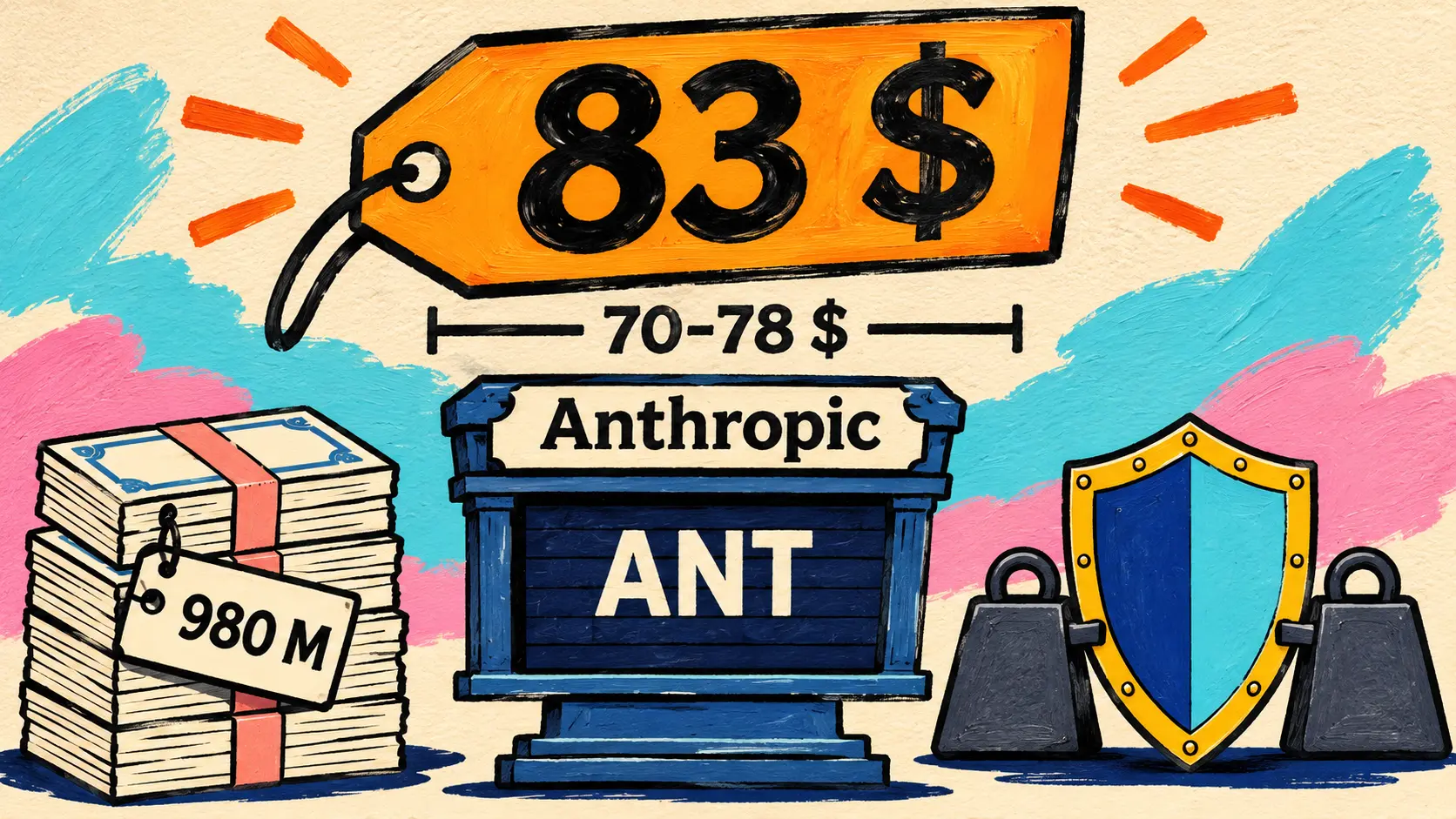
Anthropic has priced its IPO at 83 dollars per share, above the 70 to 78 dollar range, with the offering expanded to 980 million shares and trading expected on Nasdaq under the ticker ANT. OpenAI has published new measurements of its agent-accelerated research, with agents now completing 46 % of two- to four-hour tasks on their own, and shows how Codex agents track down ChatGPT slowdowns. Ideogram 4.6 generates images in native 4K, Gemini 4 Neon tops CursorBench 4.1 and arrives in GitHub Copilot, Genie 4 opens to developers at around 0.10 dollars per second, and the Gemini app for Mac learns to use the computer.
Finance: Anthropic prices its IPO at 83 dollars per share
November 18 — Anthropic has priced its IPO at 83 dollars per Class A share, above the 70 to 78 dollar range announced at the launch of its investor tour (roadshow) on November 10. The offering has also grown: it now covers 980 million shares, up from the planned 825 million. Anthropic is selling 956,351,354 shares and existing shareholders 23,648,646, from which the company receives no proceeds. The banks also have a 30-day option on 147 million shares.
| Offering detail | November 10 announcement | Price set on November 18 |
|---|---|---|
| Price per share | 70 to 78 dollars | 83 dollars |
| Shares offered | 825 000 000 | 980 000 000 |
| of which sold by Anthropic | 801 351 354 | 956 351 354 |
| of which existing shareholders | 23 648 646 | 23 648 646 |
| Banks’ option (30 days) | 123 750 000 | 147 000 000 |
The SEC declared the registration statement effective on November 18. Trading was expected to begin on November 19 on the Nasdaq Global Select Market under the ticker ANT, with the transaction closing on November 20. Anthropic has not disclosed either the amount raised or its valuation. At the set price, the 956,351,354 shares sold by the company represent approximately 79.4 billion dollars in gross proceeds, calculated from the figures in the press release. For retail investors in the European Economic Area, including France, the European prospectus provided for a final price identical to that of the US offering.
On November 19, @AnthropicAI posted a short video, followed by a text by Dario Amodei. The executive recalls that he and Daniela Amodei lost their father to a disease that became curable a few years later. In his view, sufficiently powerful AI, working with humans, could compress a century of scientific and medical progress into a decade, although results remain preliminary for now. He names the risks: malicious use by individuals or states, economic disruption, and loss of control over systems. He commits to pacing model training and deployment for as long as necessary to ensure they are safe and remain under human control.
We will not bend to either business or political pressure. — @AnthropicAI on X
For Dario Amodei, the transaction strengthens the company’s financial position and, with it, its resolve; he returns to the idea of a “race to the top” (race to the top).
🔗 IPO pricing announcement (Anthropic) · @AnthropicAI on X: the final price
Agents at work at OpenAI: the research acceleration report and the Performance Factory
November 18 — Two months after its first report, OpenAI has published new measurements of how its own agents accelerate its research. The title sums up the conclusion: the frontier is uneven (jagged frontier). Between March and October, the share of tasks estimated to require two to four hours of human work that agents complete without intervention rose from 23 % to 46 %, and from 13 % to 35 % for four- to eight-hour tasks. It all depends on the work: a 79 % success rate for monitoring a training run, 72 % for answering a technical question, and just 25 % for writing inference and serving code. OpenAI notes that the tasks assigned may have changed alongside the models.
| OpenAI internal metric | Published value |
|---|---|
| Success without assistance, 2- to 4-hour tasks | 23 % in March, 46 % in October |
| Success without assistance, 4- to 8-hour tasks | 13 % in March, 35 % in October |
| Median agent spending per researcher per day | 2 400 dollars in October (+62 %) |
| Spending at the 90th percentile | 23 000 dollars in October (+105 %) |
| Agent-days per researcher per day | from 0,5 to 5,7 |
| Documented time on safety and alignment | +77 % from January to September |
| OpenAI model frontier on the OECI index | +16,4 points per year, versus 14 observed by Epoch |
Spending is calculated at API list prices, and researchers have no quota. Agent time per researcher has increased elevenfold; by mid-October, more than two-thirds of the researchers tracked were running at least four agents simultaneously at the peak of their day. In September, the value of this usage was approximately twice the research organization’s non-equity compensation, while internal deployment accounts for only 2 % of the compute dedicated to research.
The report also tracks where ideas come from. For GPT-6.2 Astra, pre-training researchers developed some ideas through conversations with Codex, with one crediting it with key insights; those for GPT-6 Astra were entirely human-generated. To have access for three months to coding agents better than GPT-5.2, the researchers surveyed would give up a median of 40 % of their team’s headcount or 30 % of its compute. The interviews highlight the limitations: poor judgment in choosing research ideas, low-quality code, and detours through unnecessary steps, requiring close human supervision.
Time spent on safety and alignment shows the largest absolute increase of any area, with an inflection point following the July Hugging Face incident. OpenAI also introduces OECI, an index derived from the Epoch Capabilities Index, on which its models perform better than on Epoch’s index, probably because of the benchmark mix, according to OpenAI. Finally, it argues that labs should be required to track and publish indicators of recursive self-improvement (recursive self-improvement, RSI), the process by which AI accelerates the development of future systems, while clarifying that this publication should not be read as an intention to pursue full RSI. The report presents its figures as a partial, partly self-reported view.
🔗 Research acceleration: The jagged frontier (OpenAI) · @OpenAI on X
OpenAI details the Performance Factory, where Codex agents investigate ChatGPT slowdowns
November 19 — OpenAI’s Engineering blog provides a concrete example of this work assigned to agents: the Performance Factory, an autonomous cloud system where Codex agents track down ChatGPT performance regressions. An alert opens a task, one agent traces the root cause, another proposes a fix as a pull request, an engineer decides whether to merge it, and then an agent checks after deployment that the metrics have returned to normal. In just over three months, this initial workflow has tracked more than 1,700 investigations and identified the cause in over 600 cases, amounting to 17 automated investigations per day.
The team’s expertise is captured in a shared skill, perf-forensics, which tells Codex which tools to use from more than 30 performance tools. To prevent an agent from stopping at the first plausible explanation, a second Codex session attempts to refute each diagnosis: of 100 root causes reviewed manually, 70 % were judged correct. OpenAI acknowledges that fixing issues remains the hardest step, and is exploring proactive regression detection and the delivery of low-risk fixes without human involvement, with no timeline.
🔗 How OpenAI’s Performance Factory keeps ChatGPT fast · @OpenAIDevs thread
Generative images and video: Ideogram 4.6 in native 4K, Kling 4.0 in 4K and 10-bit HDR
November 19 — Ideogram launches Ideogram 4.6, a new image model that generates directly in 4K, without enlargement (upscaling): every detail, from skin to fabric, is produced at full resolution. Ideogram says it has worked to remove the “AI” look and waxy skin from images, with visible pores, fine lines, and natural textures, and promises much better color and material fidelity, targeting e-commerce and product photography.
Editing remains at the heart of the model: much less pixel shifting (pixel drift) outside the edited area, and sketch-based generation that stays closer to the original drawing. Ideogram claims version 4.6 ranks first on Rapidata’s multi-step editing leaderboard (Multi-step Image Edit), ahead of all other models, including Seedream 5.5 and FLUX 3 Image, without citing a score; version 4.5 had already claimed the top spot on a Rapidata sequential editing leaderboard on November 10.
| Access to Ideogram 4.6 | What is announced |
|---|---|
| Ideogram app and API | available from November 19 |
| Partner platforms (12) | Leonardo, Runway, fal, Comfy, Runware, Scenario, Invideo, MyDesigns, Sociaro, Moda, HeyGen and Luma |
| Pricing | no pricing in the announcement |
| Open weights | open version of 4.6 promised, with no date |
On open weights, Ideogram is changing its plans. Asked about those for version 4.5, promised “soon” since September 30, it replies that it will skip 4.5 and move straight to an open version of 4.6, without giving a date. Ideogram 4.0 was released with open weights on June 3.
We’ll skip 4.5 open and go directly to 4.6 open. — @ideogram_ai on X
🔗 Ideogram 4.6 announcement on X
Kling 4.0 moves to native 4K with 10-bit HDR output
November 19 — The same shift is happening in video: Kling announces that Kling 4.0 now supports native 4K resolution and 10-bit HDR output, in both 4K and 1080p, for more detail and richer colors. This HDR output had been promised “soon,” without a date, when Kling 4.0 became fully available on October 15; Kling 3.0 had already been generating in native 4K since April 23. The announcement consists of a single tweet: no blog post, release notes, credit pricing, maximum duration, or API details.
Gemini 4 Neon in Cursor and GitHub Copilot: topping CursorBench 4.1, available for Pro+, Max, Business and Enterprise
A few hours after its launch by Google, covered here on November 18, Gemini 4 Neon is arriving in third-party coding tools. Cursor and GitHub Copilot made it available on the evening of November 18; Genspark and Antigravity CLI followed on the 19th (see Briefs).
Cursor makes Gemini 4 Neon available, topping CursorBench 4.1 at 65.4 % with Extra High effort
November 18 — According to Cursor, Gemini 4 Neon establishes a new cost-performance frontier on CursorBench 4.1 at its default effort level: 63.7 % versus 57.3 % for Gemini 4 Hydrogen, which it replaces for everyday agentic coding, while Gemini 4 Carbon remains recommended for the hardest tasks. CursorBench 4.1 is a new version of the benchmark, dated the same day (modified instruction-following problems, more time allowed for the agent): its scores cannot be compared with the CursorBench 4.0 scores published for Carbon and Hydrogen in early November.
| Model and effort (CursorBench 4.1) | Score | Average cost per task |
|---|---|---|
| Gemini 4 Neon Extra High | 65,4 % | 10,67 dollars |
| Gemini 4 Neon High | 63,7 % | 6,54 dollars |
| Gemini 4 Carbon High | 61,5 % | 8,52 dollars |
| Gemini 4 Hydrogen Extra High | 61,4 % | 8,09 dollars |
| Claude Fable 5.2 Max | 61,3 % | 48,11 dollars |
| Gemini 4 Carbon Medium | 60,4 % | 7,22 dollars |
| Claude Fable 5.2 Extra High | 58,8 % | 17,84 dollars |
| Claude Opus 5.5 Max | 58,1 % | 11,88 dollars |
| Gemini 4 Neon Medium | 57,7 % | 3,07 dollars |
| Gemini 4 Hydrogen High | 57,3 % | 4,57 dollars |
In Cursor, Neon (gemini-4-neon, 200K-token context, up to 1M) is priced at 3 dollars per million input tokens, 0.15 dollars for cache reads, and 15 dollars for output. Like other third-party models, it is not part of included usage: it is charged against The X Subscription’s prepaid credit, or the “Other Models” pool on older Cursor plans.
🔗 Cursor announcement on X · CursorBench table (Cursor)
Gemini 4 Neon arrives in GitHub Copilot for Pro+, Max, Business and Enterprise
November 18 — GitHub makes Gemini 4 Neon generally available in Copilot, presenting it as a model designed for agentic coding, multistep tool use and knowledge work. The changelog repeats Google’s pitch: quality close to Gemini 4 Carbon at a lower token cost per task, faster response starts, fewer unrequested code changes and fewer unsupported claims about tools or test results, without supporting figures.
Neon is available to Copilot Pro+, Max, Business and Enterprise subscribers; the Pro plan is not mentioned, although Gemini 4 Hydrogen arrived there on November 13. It works across ten surfaces: VS Code, Visual Studio, Copilot CLI, the coding agent, the GitHub Copilot app, github.com, GitHub Mobile, JetBrains IDEs, Xcode and Eclipse. It is billed based on usage at the provider’s list price, with a gradual rollout. For businesses, it is enabled automatically as long as new models remain enabled by default, unless the administrator disables this model.
🔗 Gemini 4 Neon in GitHub Copilot (changelog) · @github on X
Coding agents: Claude Code 2.1.328, Kimi Code 2.7.0, Devin Security Threats, Devin for Databricks Migrations, Amuse and Replit’s Optimization-Bench
Claude Code 2.1.328 opens auto mode to Opus 4.6 and Sonnet 4.6 on third-party providers and refocuses /code-review on bugs
November 19 — Claude Code 2.1.328 has 144 entries, including 91 fixes. Auto mode becomes available to Claude Opus 4.6 and Sonnet 4.6 on Amazon Bedrock, Google Cloud’s Agent Platform, Microsoft Foundry and the Claude apps gateway: an interactive session launched without a permission mode starts directly in auto mode, and the disableAutoMode setting can disable it. On November 19, the permission modes documentation page still restricted auto mode on these providers to Sonnet 5 and later, Opus 4.7 and later, Haiku 5.5 and Fable models.
On most models, the /code-review command now reports only bugs and deviations from CLAUDE.md; cleanups (reuse, simplification, efficiency) go through /simplify, and each finding is marked Important, Pre-existing or Nit. Blocking on failure ("onFailure": "block"), added on October 8 to command and HTTP hooks, extends to mcp_tool hooks. In the terminal on the Anthropic API, the small, fast model now writes sub-agent progress summaries. Code Mode gets 22 entries, including the removal of a 0.75-second pause after most scripts in auto and bypass modes, and the self-hosted runner gets 26. A regression in 2.1.327 that disabled sub-agent effort on Bedrock, Agent Platform and Foundry is fixed; the stable channel remains on 2.1.311.
Kimi Code 2.7.0 supports Amazon Bedrock, Kimi Code Desktop 1.4.0 connects to Claude Code, Codex and Cursor
November 19 — Moonshot AI releases Kimi Code 2.7.0 (24 entries), the first minor release since 2.6.0 on November 12, followed by the Kimi Code Desktop 1.4.0 app (34 entries) thirteen minutes later. The CLI supports Amazon Bedrock providers, experimentally displays a prediction of the next prompt after each turn, and adds a “Follow-up behavior” setting whose Steer mode makes the Enter key redirect the current turn instead of queuing the message. For automation, kimi server starts the local server without opening a browser, and three new HTTP endpoints allow sessions to be controlled. Each project can target its own SSH hosts; the old /api/v2 endpoints are removed in favor of /api/v1, an API change nevertheless classified as a simple fix.
The desktop app connects to external agents, such as Claude Code, Codex and Cursor, to hand off sessions, review history and collaborate across turns. It also adds Qwen Coding Plan as a provider.
🔗 Kimi Code 2.7.0 · Kimi Code Desktop 1.4.0
Cognition launches Devin Security Threats, a managed index of recent vulnerabilities to scan with one click
November 19 — Cognition adds a managed index of newly disclosed vulnerabilities to Devin Security. The company starts with two announcements from this week: Java4Shell (November 17), which affects the Java runtime, and NGINX2Root (November 18), five memory corruption bugs in nginx; both can lead to remote code execution. Each threat describes what is affected, how an attacker would exploit it and what fixes it. Cognition publishes threats for major disclosures, and each team can write its own from a bug bounty report, a vendor advisory or an incident review.
The Scan with Devin button launches a threat-focused scan of the selected repositories, then Devin opens pull requests for review. In Auto-triage mode, Devin rescans the selected repositories whenever a new threat exceeds a minimum severity. Two open source skills written in Markdown, fix-nginx-vuln and fix-java-vuln, join the Vulnerability Fixes plugin in the Devin Marketplace and can be used by another coding agent. No pricing is announced.
🔗 Devin Security Threats (Cognition) · @cognition on X
Cognition launches Devin for Databricks Migrations to move legacy data warehouses to Databricks
November 19 — Together with Databricks, Cognition launches a dedicated migration offering. Devin converts code from legacy data warehouses (Teradata, Oracle, SQL Server, Informatica, Redshift, Snowflake), tests it in the customer’s workspace, fixes failures and reconciles each source with its copy on Databricks before cutover: schema, row counts, aggregates, then row-by-row comparison. According to Cognition, a Fortune 500 energy company migrated a platform with 142 objects to Unity Catalog in eight days, and the firm Zeb delivered a NetSuite migration in two and a half weeks against a planned four.
The offering is available on the Databricks Marketplace and counts toward the customer’s existing spending commitment with Databricks (Universal Commit). Cognition also says it uses Databricks as a strategic inference provider for open source and frontier models served through a single endpoint. No pricing is disclosed.
🔗 Devin for Databricks Migrations (Cognition)
Replit releases Amuse, an open source personal assistant that Missions rebuilt in three days
November 19 — After TernSign, Replit showcases another creation from Missions, its agent swarm harness: Amuse, an open source personal AI assistant (Apache 2.0) that runs on the user’s computer. According to Replit, the swarm was challenged to reproduce “the benchmark AI assistant,” without naming it, and succeeded in three days, with the platform’s Security Scanner then used to fix the vulnerabilities found.
Amuse searches the web with sources, operates a browser that users can watch and take over, manages reminders and background tasks, and builds small applications. Its memory is stored in readable files, its credentials in an encrypted vault whose substitute tokens are all the model can see, and it asks for approval before any sending, form submission, payment or new scheduling. “Free” excludes the model: it requires an OpenAI API key (GPT-6.2 Sol for the agent, GPT-6 Luna for quick steps) and a PostgreSQL database, and remains limited to one person on one computer, without MCP servers.
🔗 Replit’s announcement on X · replit/amuse repository
Replit releases Optimization-Bench: the best solo agent does not make the best swarm
November 19 — Replit’s research team releases Optimization-Bench, a performance optimization benchmark using frozen versions of open source libraries, four of fourteen of which are analyzed: NumPy, SQLite, SQLGlot and Git. Six models worked alone, then in swarms of 8, 16 and 32 agents, for two hours, with evaluation running on a machine the agents could not access.
| Optimization-Bench metric | Result published by Replit |
|---|---|
| GPT-6.2 Astra solo, on NumPy | more than 3 times faster than Opus 5.5 solo |
| Swarms of 32 GPT-6.2 Astra agents | below its solo score on 3 out of 4 tasks |
| Median gain for Opus and Sonnet 5.5 swarms | 1.30 times their solo score, at 16 and 32 agents |
| Opus 5.5 messages sent to the shared board | 82 % |
GPT-6.2 Astra dominates solo, but its swarms plateau at 8 agents. By contrast, Claude Opus 5.5 and Claude Sonnet 5.5 swarms beat their solo runs every time; on NumPy, Opus goes from 3.7 times solo to 18.9 times in a swarm of 32, a figure already reported at the launch of Missions. Replit attributes the gap to organization: effective teams write to a shared board and let the coordinator distribute and then merge work (in the NumPy swarm of 32 Opus agents, it never messaged any individual worker), while the others turn the coordinator into a switchboard whose inbox grows with each agent added.
🔗 Throwing Headcount at the Problem (Replit) · @Replit on X
Consumer assistants: computer use in Gemini for Mac, ChatGPT Health on Android, desktop, dots and sites
The Gemini app for Mac controls applications and the web in the background with computer use
November 19 — The Gemini app for Mac can now use the computer (computer use) on the user’s behalf. Gemini carries out multistep tasks across local files, desktop applications and the web: clicks, typing, menus, forms. It works in an isolated window in the background, with a live preview in the conversation, leaving the main screen and cursor available. Users choose which applications are accessible, follow each step, can pause everything and approve significant actions before they run.
Google’s examples range from batch photo editing to filling out shipping quotes from local PDFs and creating a Google Slides presentation from dashboards; the video posted on X turns a sketch into an animatable 3D model in Blender. The feature is rolling out in English in the United States for Google AI Plus, Pro and Ultra subscribers, on Apple Silicon Macs running macOS Sequoia 15.0 or later, with a personal Google account belonging to someone aged 18 or older. For developers, the Gemini API’s Computer Use tool has been generally available since late October; the consumer app now brings this control to the user’s Mac.
🔗 Computer use in Gemini for Mac (Google) · @GeminiApp on X
ChatGPT expands Health to Android with Health Connect, the desktop app, dots and sites
November 19 — ChatGPT’s Health space expands to the desktop app, dots, sites and Android. On Android, it connects to Health Connect to identify sleep and activity trends. Dots, ChatGPT’s personal agents, can proactively suggest another workout slot when a meeting conflicts, or remind users of preventive care options based on connected medical records. On desktop, OpenAI gives the example of a site built to track marathon training. The rollout is gradual and limited to the United States, for Free, Go, Plus and Pro plans; dots remain exclusive to the Pro plan. Health is available in the sidebar or the Explore menu.
Gemini API: Genie 4 opens to developers, Tool Retrieval in preview
Genie 4 arrives in the Gemini API and Google AI Studio, at around 0.10 dollars per second of generated world
November 19 — A day after arriving in Project Genie for Google AI Ultra subscribers, Genie 4 opens to developers in the Gemini API, through the Interactions API, and in Google AI Studio, with an interactive canvas and starter applications. From text, a reference image or both, the world model generates a continuous environment with synchronized sound, from ambient audio to dialogue; users move through it with the keyboard and can change the weather, lighting, objects or events through text along the way.
| Genie 4 feature in the API | Documented value |
|---|---|
| Model identifier | models/genie-4 (Interactions API) |
| Video and audio output | 1280x720, 16:9, 24 frames/s, 48 kHz stereo audio |
| Access | paid-tier API key |
| Billing | 240 video tokens per frame, or around 0.10 dollars per second |
| Session duration | possible degradation after 60 to 90 s, limit of 120 s |
| Service regions | United States, Western Europe, Japan |
The documentation warns that closing the tab does not stop generation immediately: only explicitly ending the session (complete()) stops billing. Genie 4 does not retain a 3D scene in memory: an object out of view for 8 seconds or more, or a full turn around, can cause landmarks to move or reset. Every output carries a SynthID watermark.
🔗 Genie 4 in the Gemini API (Google) · Genie documentation (AI Studio)
The Gemini API launches Tool Retrieval in preview, loading tool schemas on demand
November 19 — Google adds the tool search capability already offered by OpenAI and Anthropic to the Gemini API. With Tool Retrieval, in preview in the Interactions API, an agent connected to dozens or hundreds of tools no longer sends all their parameter schemas with every request: simply add a tool_search tool and mark the tools to keep in reserve as defer_loading: true. The model sees only their names and descriptions, requests a tool by name when it needs it, and the API loads the schema within the same request, on the server side, with no index to build.
The mechanism extends to remote MCP servers and preserves prefix caching, since loaded schemas are appended later in the conversation. Teams that manage their own tool registry can run the search themselves, at the cost of an additional round trip. Tool Retrieval is not billed separately: tool_search adds a small fixed block of input tokens, each loaded schema is billed as input for the rest of the conversation, and Google, which publishes no savings figures, recommends measuring the gain on your own traffic. The feature works with Gemini 3.6 and later models, including the entire Gemini 4 family.
🔗 Tool Retrieval in the Gemini API (Google)
Voice: GPT-Live-1.1 arrives in the API, with standby at 0,02 dollars per minute
November 19 — Just over a month after its arrival in ChatGPT Plus and Pro voice on October 15, GPT-Live-1.1 joins OpenAI’s API (gpt-live-1.1 on v1/live/sessions). The model improves pronunciation, accent consistency and transcription in multilingual voice conversations, and plugs into an existing Live session configuration.
The most concrete addition is standby (standby), available for both GPT-Live-1 and GPT-Live-1.1 in WebRTC sessions. After a configurable silence of 5 to 60 seconds, the model pauses without disconnecting the call, and the per-minute rate drops from 0,05 to 0,02 dollars until someone starts speaking again.
| GPT-Live session type | Rate per minute |
|---|---|
| Active session | 0,05 dollar |
| Standby (WebRTC, inference paused) | 0,02 dollar |
Backend model and tool usage remain billed separately, and the two versions have separate concurrent session limits. Python SDK 3.56.0 and Node SDK 7.61.0 add the model, and OpenAI accompanies the release with a guide to languages and regional accents.
🔗 @OpenAIDevs announcement · GPT-Live-1.1 model page · Prompting GPT-Live for languages and regional accents
Hardware and cloud: NVIDIA and Microsoft at Ignite, RTX Spark mini PCs available
NVIDIA and Microsoft expand their collaboration at Ignite, from Vera Rubin in Azure to Nemotron 3.5 in Foundry
November 19 — At Microsoft Ignite, NVIDIA details the expansion of its collaboration with Microsoft in a post by Dave Salvator. Vera Rubin NVL72 systems are running in Azure data centers, and access to virtual machines powered by them is expanding; the post describes a Vera Rubin preview on Azure, with no general availability date.
| NVIDIA and Microsoft announcement | Status according to the post |
|---|---|
| Azure VMs on Vera Rubin NVL72 | expanded access, preview |
| Nemotron 3.5 Super, Lightning, Embed, Rerank, Parse and Content Safety | expanded lineup on Foundry Managed Compute |
| Nemotron 3.5 Bolt and Transcribe | coming soon |
| Nemotron 3.5 and Cosmos models in Foundry Local | expanded support, including Azure Local environments |
| Azure Local | RTX PRO 6000 Blackwell GPUs coming, expansion to Jetson Thor and Jetson Orin |
| Direct Stream on Windows 365 | two 4K streams at 60 frames/s, public preview in early 2027 |
| BioNeMo and ALCHEMI in Microsoft Discovery | added to the catalog, first RFD4-Proteina integration |
One example cited: EY adapted open Nemotron models with Programmed Training, Foundry’s serverless post-training service, to classify purchase records; accuracy improves by 55 % on its evaluation set, at a cost 15 times lower than leading proprietary models, according to the post. Microsoft AI also uses NVIDIA Dynamo for inference during reinforcement learning rollouts (rollouts) in its post-training. The post also highlights Azure’s MLPerf results: up to 10 240 NVIDIA GPUs on GB200 NVL72 systems in Training v6.1, the largest scale in the round, and, in Inference v6.1, Azure’s GB300 NVL72 systems leading other cloud submissions by more than 10 % in interactive throughput on DeepSeek-R1, according to Signal65. No pricing is disclosed.
🔗 NVIDIA and Microsoft at Ignite (NVIDIA)
RTX Spark mini PCs from ASUS, Dell and MSI are available, NVIDIA announces
November 18 — NVIDIA announces the availability of RTX Spark desktop mini PCs from ASUS, Dell and MSI, such as the ASUS ProArt GR1X and the MSI EdgeMesa N AI+ series; models from Acer, GIGABYTE and HP are coming soon, as is the Microsoft Surface RTX Spark Dev Box. They use the same platform as the laptops launched in October: a 20-core NVIDIA Grace processor, a Blackwell RTX GPU with 6 144 CUDA cores, up to 128 GB of unified memory and up to 1 petaflop of AI performance. NVIDIA says they can run models with 120 billion parameters locally. No pricing is given.
On the software side, Switchyard, which distributes agent tasks between local and cloud models, is available in Hermes. Adobe cuts turnaround times by more than 50 % for common H.264 deliverables in Premiere, and Illustrator, now native on Windows on Arm, runs up to 30 % faster than its emulated version; Blender 5.3 integrates DLSS 4.5 Ray Reconstruction. Announced at Ignite, Windows Server 2028 is coming to DGX Station for Windows, and Windows ML runs any GGUF model from Hugging Face through llama.cpp.
🔗 RTX Spark mini PCs available (NVIDIA)
Open models: DaisyRose-27B and the Hermes adapter push Qwen3.8-27B further, OVHcloud releases Olala mini, PEFT v0.22.0
RadixArk releases DaisyRose-27B, a Qwen3.8-27B model fine-tuned with RL that doubles its Terminal-Bench 4.1 score
November 18 — RadixArk releases DaisyRose-27B, presented as its first model: a Qwen3.8-27B model retrained through reinforcement learning with Miles, its open source framework, on around 1 200 long agent tasks (up to 1,5 hours and more than 100 tool calls per attempt), designed with Eigent AI to target the original model’s errors. The weights are released under Apache 2.0 in BF16, FP8 and NVFP4, retaining the base model’s 256K-token context and image understanding. Training took 18 days on 144 H200 GPUs.
| Benchmark (score in %) | Qwen3.8-27B | DaisyRose-27B |
|---|---|---|
| Terminal-Bench 4.1 (pass@1) | 5,6 | 12,0 |
| Terminal-Bench 2.1 | 73,0 | 75,5 |
| DeepSWE v1.1 | 42,2 | 46,2 |
| SWE Bench Pro v2 | 91,3 | 94,7 |
| GPQA Diamond | 89,2 | 90,7 |
RadixArk also reports 37 % GPU utilization (MFU), compared with 16 % for the open source trainer based on Megatron, amounting to 57 % less GPU time; these are the developer’s figures.
🔗 DaisyRose-27B (RadixArk post) · DaisyRose-27B-NVFP4 (Hugging Face)
The harness-hub project releases the Hermes adapter for Qwen3.8-27B, raising SWE-Bench Pro from 29,4 to 43,1 % without thinking
November 19 — Following pi and OpenCode, the harness-hub project releases a third LoRA adapter for Qwen3.8-27B, this time for Hermes, Nous Research’s agent harness, with a GGUF version.
| Benchmark (pass@1) | Qwen3.8-27B | With the Hermes adapter |
|---|---|---|
| SWE-Bench Pro (51 difficult tasks), without thinking | 29,4 % | 43,1 % |
| SWE-Bench Pro (51 difficult tasks), xhigh thinking | 45,1 % | 51,0 % |
| Terminal-Bench 2.1, without thinking | 44,7 % | 58,8 % |
| Terminal-Bench 2.1, xhigh thinking | 58,8 % | 57,6 % |
The main appeal is efficiency: without thinking, the adapter matches the base model with xhigh thinking while using 3,5 to 4,4 times fewer tokens. Within a budget of 10 000 tokens per task, it solves 51 % of Terminal-Bench 2.1 and 39 % of SWE-Bench Pro, compared with 28 % and 0 % for the base model on xhigh. The recipe (TRL’s AsyncGRPOTrainer, OpenEnv, safeagents) is due to be detailed in a post announced for Friday.
🔗 Announcement by @yb2698 on X · Qwen3.8-27B-hermes-adapted (Hugging Face)
OVHcloud uploads Olala mini 7A1B weights to Hugging Face, with an average score of 68,0 across twelve benchmarks
November 19 — Announced on November 17, Olala mini 7A1B, the model that launches OVHcloud’s first family of language models, is now available to download on Hugging Face under the Apache 2.0 license, in base, SFT, GGUF and MLX versions.
| Olala mini 7A1B specification | Published value |
|---|---|
| Parameters | 6,8 billion, including around 1 billion active per token |
| Architecture | hybrid Mamba-3 and attention with a mixture of experts, KV cache on 7 of 36 layers |
| Context | 32K tokens, 128K version announced as coming soon |
| Training | 12,8T tokens, in English and 36 other languages |
| Estimated footprint | around 40 t of CO2 and 1,16 GWh |
| Average across twelve benchmarks | 68,0, or 15,2 points above the SFT checkpoint |
The model was trained on three European public supercomputers: JUPITER (including 1 024 GH200 GPUs), Jean Zay and MeluXina. It reasons before answering, with four effort levels, and was trained through reinforcement learning to call tools; its strength is instruction following, and its weakness is competition mathematics.
🔗 @OVHcloud on X · Olala-v1.0-mini-7A1B (Hugging Face)
Hugging Face releases PEFT v0.22.0, with PaCA, Astra and NoRA methods, ahead of PEFT 1.0
November 19 — Hugging Face’s parameter-efficient fine-tuning library moves to v0.22.0. It adds PaCA (Partial Connection Adaptation), which does not add adapter layers but directly fine-tunes randomly selected input columns in the pretrained weights: according to the original paper, it requires 22 % less training time and 16 % less memory than LoRA, with comparable accuracy. Two new LoRA initializations, Astra and NoRA, round out the release, which also improves tensor parallelism and FSDP2 support and adds a model health check. PEFT now requires Python 3.11, and the notes announce that the next version will be 1.0, with an API cleanup and a few minor breaking changes, preceded by a release candidate (release candidate).
Science: Ai2 launches Theorizer in Asta, an agent that proposes theories linked to publications
November 19 — Ai2 makes Theorizer available in Asta, its agent platform for scientific research, and releases its code under the Apache-2.0 license. The agent searches the literature, defines what to extract from each paper, compares results and formulates theories in which every claim links to supporting papers; it flags those it considers novel, while warning that a search may miss prior work. Ai2 illustrates this with real cases: for lung adenocarcinomas with no known driver mutation (around 20 to 30 % of cases), a preliminary lead suggesting dependence on the CDK2 protein, which still requires laboratory validation; 50 candidate theories about VIP interneurons for an Allen Institute neuroscientist who expected one or two. Ai2 covers usage in Asta up to a token limit, the technical paper was published at ACL 2026, and a webinar is scheduled for December 10.
🔗 Theorizer in Asta (Ai2) · allenai/asta-theorizer repository
Enterprise AI: Sakana AI and Salesforce sign a memorandum of understanding for Japan’s public sector
November 19 — Sakana AI announces a memorandum of understanding with Salesforce to integrate its AI models into the US software company’s products for Japanese government agencies and local authorities. The stated goal is to help improve administrative efficiency and support these organizations’ digital transformation, and Sakana AI says it intends to continue developing technologies tailored to the needs of Japan’s public sector. The tweet, in Japanese, shares a report from the Jiji news agency; the announcement provides no timeline, named product or financial amount.
Briefs
Gemini 4 Neon elsewhere
- Antigravity CLI 1.5.12 — Gemini 4 Neon becomes accessible with a simple Gemini API key (
GEMINI_API_KEY), across its four thinking levels; Remote Control’s browser view displays multiple conversations side by side, and/forktakes a few seconds instead of up to an hour. 🔗 source - Genspark — Gemini 4 Neon arrives in AI Chat and the Code Agent, with Google’s pitch (3rd overall in Artificial Analysis’s ranking at xhigh effort, 1st in its coding agents index, cost per task 50 to 80% lower than the best models), with no plan or credit details specified. 🔗 source
Coding agents and development tools
- Codex CLI 0.172.0-alpha.2 — The release notes for this preview are empty; judging by the titles of its 62 commits, it prepares argument completion for slash commands, on-demand startup by default for local MCP servers, and custom status lines in
/experimental. The contents may change before the stable release. 🔗 source - Codex on iOS — Version 1.2026.314 of ChatGPT for iOS saves side conversations on the paired computer, adds a selector to launch a task in the cloud or on a specific computer and project, and now counts only sub-agents that are still active. 🔗 source
- Copilot CLI 1.0.115 and Copilot SDK 2.0.2 — Two CLI previews fix, among other things, connections to MCP servers that omit a refresh token scope; SDK preview 2.0.2-preview.0 removes the 16 flagged keys from the eMudhra certificate authority from trust anchors on macOS and Linux. The stable release remains at 1.0.114. 🔗 source · 🔗 Copilot SDK
- GitHub CLI 2.105.0 — In preview,
gh event listenwaits for a pull request event (review, conflict, new commit, completed check suite) instead of polling for it, and bothgh prandgh runnow suggest it to agents; access to Event Streams still requires joining a waitlist. 🔗 source - Copilot MCP connectors — Eight services verified by GitHub join the more than 25 existing ones, in public preview across all plans: Box, Buildkite, Calendly, ClickUp, Mixpanel, Supabase, Webflow and Wix. 🔗 source
- Gemini CLI v0.69.0 and v0.70.0 — After nine days without a new release, two stable versions ship on the same day, and v0.70.0 delivers the policy engine security fixes merged since November 10; preview v0.71.0-preview.0 makes PowerShell command analysis asynchronous. 🔗 source · 🔗 v0.71.0-preview.0
- mistral CLI 0.19.0 and 0.20.0 —
mistral ocr processconverts a document or image into Markdown or structured data,mistral evals judgegives way tomistral evals scorer, andmistral agents initnow creates a standalone Agents SDK project, without an API key. 🔗 source · 🔗 0.20.0 - Delta 0.28 — Zed’s environment for coding with agents searches threads across the entire organization and enables soft compaction by default, pruning old tool results without calling a model. 🔗 source
- Amp for Windows — On November 17, ten days after an experimental release, Amp announces its Windows application, native on x64 and Arm, with a built-in runner, MSIX packages deployable through Intune, and Group Policy settings. 🔗 source
- Warp Learn — Warp launches a free course, Build a Self-Improving Software Factory, taught by Ben Holmes: two of its three units are online, covering everything from the agent development loop to fixes triggered by error monitoring. 🔗 source
- DevinDash — Cognition adapts its Devin Bots into a model that orders meals through DoorDash’s MCP server; Devin for Startups companies attending drop-in sessions (office hours) in San Francisco or New York can receive $1,000 in DoorDash credit. 🔗 source
APIs and platforms
- Perplexity Agent API — The xhigh effort level switches to GPT-6.2 Sol, with no fallback model, replacing Claude Opus 5.5; pinning version
xhigh@2026-11-11.0preserves the old configuration. 🔗 source - Qwen4-Max on Together AI and Nous Portal — Together AI serves Alibaba’s flagship model (a 2.4T-parameter MoE with 71B active parameters and a 1M context) at a 30% discount, and Nous Research makes it free for five days in Nous Portal with Inferact, with no end date or usage limits specified. 🔗 Together AI · 🔗 Nous Research
Assistants and enterprise
- ChatGPT adds an Accounting plugin for reconciliations and monthly closes in the desktop application — The plugin helps reconcile transactions, draft billing entries and prepare month-end reports; it uses computer use on macOS or Windows, with administrator approval required in Enterprise (ChatGPT release notes for November 18, linked above).
- Perplexity Brain — Perplexity shares personal skills written by Brain on X and announces the feature there for all consumer and enterprise subscribers in the United States, while its blog post refers to Max subscribers; in the randomized test, 72.9% of users with automatic improvement obtained a new personal skill, compared with 6.5% of the control group. 🔗 source · 🔗 post
- RAG as a service — Perplexity publishes a guide to RAG offered as a service and ranks seven providers, with Perplexity Enterprise ahead of AWS Bedrock, OpenAI, Azure AI Search, Pinecone, LlamaIndex and Vectara; the ranking is Perplexity’s own. 🔗 source
- Sumitomo Life — The Japanese life insurer, which switched to ChatGPT Enterprise in June 2026, reports weekly usage above 80% and an estimated return on investment, based on reported time savings, of 203% overall and 524% on average among employees who use it at least 101 times per month. 🔗 source
- SSO for external members — Owners of ChatGPT Enterprise, Edu and Healthcare workspaces can exempt external members whose domain is unverified from SSO; the exemption applies to a single workspace and is removed when the member leaves. 🔗 source
- Candid Health and ElevenAgents — The American revenue cycle management platform entrusts ElevenLabs’ voice agents with its calls to insurers about reimbursement denials: 12,860 calls, more than 850 hours saved per month and 59% of pilot calls resolved, with integration completed in 48 hours. 🔗 source
- Enterprise Live Migrations — Beyond AI: live migrations from Azure DevOps Services to GitHub Enterprise Cloud with data residency become generally available, with Git history, branches, tags and pull requests remaining synchronized until cutover. 🔗 source
- GitHub Actions RHEL runners — Beyond AI: Red Hat Enterprise Linux 9 and 10 images for hosted larger runners become generally available for Team and Enterprise Cloud plans. 🔗 source
Open models, research and simulation
- Genspark Deep Research — Genspark shares work published by Baseten on November 10: a Qwen3.5-397B post-trained for deep research scores 0.759 on Genspark’s internal grader, compared with 0.612 for the base model and 0.738 for Opus 5.5; it becomes the agent’s default model, and Genspark retains the weights. 🔗 source · 🔗 Baseten post
- Muse Wonder on the BAR benchmark — Meta shares the November ranking from Legora, a legal AI platform, where Muse Wonder achieves the highest overall quality score and leads on four task types, including analysis and extraction. 🔗 source
- Clairic — A demo of Clairic, the 27-billion-parameter typed structured extraction model released by Cloudflare on Hugging Face, is available on the Hub; the model dates from October 16 and its Flash version from November 12. 🔗 source
- Gemma 4 E2B at Airbnb — According to Google’s Gemma account, Airbnb used Gemma 4 E2B for rule classification on a single RTX Pro 6000 GPU: maximum F1 rose from 0.563 to 0.902, with median latency of 35 ms versus around 900 ms for frontier models, at roughly 1% of their cost at high volume. 🔗 source
- Atto — NeuML releases a family of tiny document retrieval models, ranging from 840 parameters to 28 million: the 90,000-parameter dense model achieves an nDCG@10 of 0.4257 on a subset of BEIR, compared with 0.4802 for all-MiniLM-L6-v2, which is around 256 times larger. 🔗 source
- ja-NCM — A developer releases a small Japanese open-weight model that generates text through concepts rather than token by token: according to the developer, it is around 6 times faster than an autoregressive model and 2.4 times faster than a diffusion model, at comparable quality. 🔗 source
- Into the Omniverse — NVIDIA republishes its post on simulations built by agents for the third time, with new examples: Falkor’s (KONGSBERG) digital twins of industrial sites with GPT-6 Astra, and an intensive care unit assembled by Claude Code where 766 out of 768 Microduck robots remained standing. 🔗 source
What it means
Financial and technical milestones at frontier labs now come with safety commitments. Anthropic sets its price above the range and increases its offering from 825 to 980 million shares; the next day, Dario Amodei promises to pace training and deployment to ensure that models are safe and remain under human control, without giving in to commercial or political pressure. OpenAI, which measures the growing share of its research entrusted to agents, calls for labs to be required to publish recursive self-improvement metrics. Both messages address the same question: demonstrating that safety keeps pace as resources and capabilities grow so quickly.
Agents now perform a measurable share of the labs’ own work. At OpenAI, they complete nearly half of two-to-four-hour tasks on their own and account for a median of $2,400 per researcher per day at list prices; the Performance Factory assigns them 17 investigations per day into ChatGPT slowdowns. Replit shows that organization matters as much as the model: the best standalone agent produces worse swarms than Claude Opus 5.5, which coordinates through a shared board. Humans retain decision-making authority throughout: an engineer merges the Performance Factory’s fixes, OpenAI researchers supervise closely, and Devin opens pull requests for review.
Billing increasingly reflects actual usage. Gemini 4 Neon is sold in Cursor on a cost-per-task basis, from $3.07 at Medium effort to $10.67 at Extra High; Genie 4 is billed per second of generated world, at around $0.10, and GPT-Live drops to $0.02 per minute when nobody is speaking. Tool Retrieval, like its equivalents at OpenAI and Anthropic, pursues the same goal for developers: paying in tokens only for the schemas of tools actually used.
For open models, the focus is on what can be extracted from an existing base. DaisyRose-27B and the Hermes adapter both start from Qwen3.8-27B: the former doubles its Terminal-Bench 4.1 score through reinforcement learning, while the latter matches the maximum thinking mode using 3.5 to 4.4 times fewer tokens. PEFT is preparing version 1.0 to provide tools for these fine-tuning efforts, OVHcloud releases a European model trained on public supercomputers along with its carbon footprint, and Ideogram promises the weights for version 4.6. These figures remain those reported by the vendors.
Sources
- IPO pricing announcement (Anthropic)
- @AnthropicAI on X: pricing set
- @AnthropicAI on X: Dario Amodei’s statement
- Research acceleration: The jagged frontier (OpenAI)
- @OpenAI on X: research acceleration
- How OpenAI’s Performance Factory keeps ChatGPT fast (OpenAI)
- @OpenAIDevs on X: Performance Factory
- @ideogram_ai on X: Ideogram 4.6
- @ideogram_ai on X: 4.6 open weights
- @Kling_ai on X: 4K and 10-bit HDR
- @cursor_ai on X: Gemini 4 Neon in Cursor
- CursorBench (Cursor)
- Gemini 4 Neon in GitHub Copilot (GitHub changelog)
- @github on X: Gemini 4 Neon
- Claude Code v2.1.328
- Kimi Code 2.7.0
- Kimi Code Desktop 1.4.0
- Devin Security Threats (Cognition)
- @cognition on X: Devin Security Threats
- Devin for Databricks Migrations (Cognition)
- @Replit on X: Amuse
- replit/amuse repository (GitHub)
- Throwing Headcount at the Problem (Replit)
- @Replit on X: Optimization-Bench
- Computer use in Gemini for Mac (Google)
- @GeminiApp on X: computer use
- ChatGPT release notes
- Genie 4 in the Gemini API (Google)
- Genie documentation (AI Studio)
- Tool Retrieval in the Gemini API (Google)
- @OpenAIDevs on X: GPT-Live-1.1
- GPT-Live-1.1 model card (OpenAI)
- Prompting GPT-Live for languages and regional accents (OpenAI)
- NVIDIA and Microsoft at Ignite (NVIDIA)
- RTX Spark mini-PCs available (NVIDIA)
- DaisyRose-27B (RadixArk blog post)
- DaisyRose-27B-NVFP4 (Hugging Face)
- @yb2698 on X: Hermes adapter
- Qwen3.8-27B-hermes-adapted (Hugging Face)
- @OVHcloud on X: Olala mini 7A1B
- Olala-v1.0-mini-7A1B (Hugging Face)
- PEFT v0.22.0
- Theorizer in Asta (Ai2)
- allenai/asta-theorizer repository (GitHub)
- @SakanaAILabs on X: memorandum of understanding with Salesforce
- Antigravity changelog
- @genspark_ai on X: Gemini 4 Neon
- Codex CLI 0.172.0-alpha.2
- Codex changelog, ChatGPT for iOS 1.2026.314
- Copilot CLI 1.0.115-1
- Copilot SDK 2.0.2-preview.0
- Waiting for pull request events with GitHub CLI (GitHub changelog)
- Supabase, Box, Calendly, and other connectors for Copilot (GitHub changelog)
- Gemini CLI v0.70.0
- Gemini CLI v0.71.0-preview.0
- mistral CLI 0.19.0
- mistral CLI 0.20.0
- Delta 0.28.0 release notes
- Amp for Windows (Amp)
- Warp Learn (Warp)
- @cognition on X: DevinDash
- Perplexity API changelog
- @togethercompute on X: Qwen4-Max
- @NousResearch on X: Qwen4-Max in Nous Portal
- @perplexity_ai on X: Brain’s personal skills
- Self-improving skills (Perplexity)
- RAG as a service (Perplexity)
- Sumitomo Life case study (OpenAI)
- ChatGPT Enterprise and Edu release notes (OpenAI)
- Candid Health (ElevenLabs)
- Enterprise Live Migrations from Azure DevOps (GitHub changelog)
- RHEL runner images generally available (GitHub changelog)
- @genspark_ai on X: Deep Research model with Baseten
- Baseten and Genspark train a research model (Baseten)
- @AIatMeta on X: Muse Wonder on the BAR benchmark
- @HuggingApps on X: Clairic
- @googlegemma on X: Gemma 4 E2B at Airbnb
- Atto (NeuML, Hugging Face)
- ja-NCM (Hugging Face)
- Into the Omniverse (NVIDIA)