ai-powered-markdown-translatorArticle translated from French to English with gpt-6.1-sol.
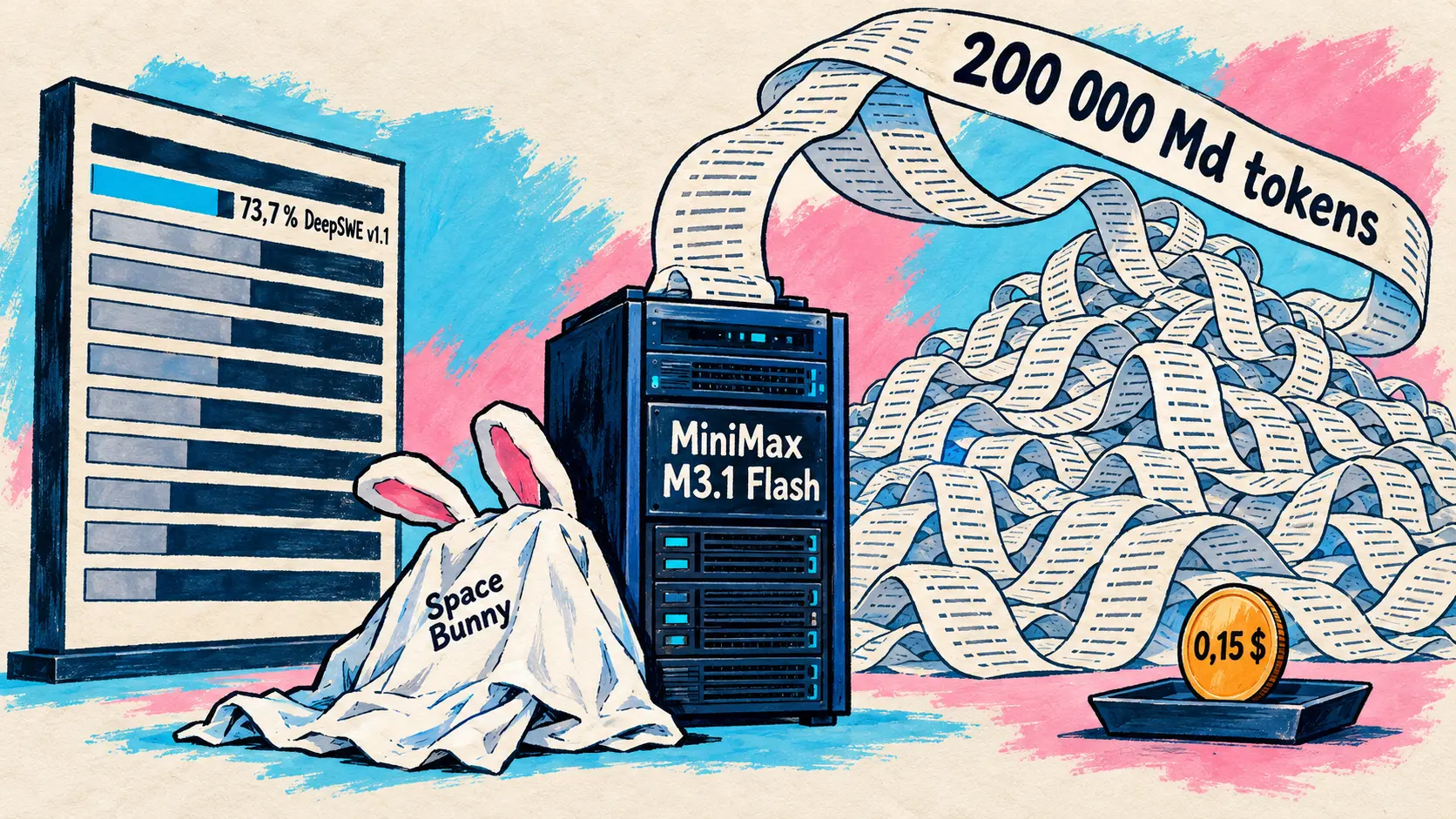
MiniMax launches M3.1 Flash, a model for agents and coding priced at 0.15 dollars per million input tokens, and reveals that Space Bunny, the anonymous model that processed more than 200 trillion tokens, was a preview of it. Black Forest Labs and fal launch FLUX 3 Max, which generates a 10-second video in 12.45 seconds, about 22 times faster than Seedance 2.5, and ties for first in an image-to-video arena whose results are still preliminary. OpenAI sets January 14, 2027 as the retirement date for GPT-4o and GPT-4.1 from its API, Meta details Prometheus, the supercomputer that trained Muse Wonder, and Devin now rates each engineer’s efficiency from 0 to 100.
MiniMax launches M3.1 Flash: Space Bunny was a preview, at 0.15 dollars per million input tokens
October 19 — MiniMax officially launches M3.1 Flash, its new Flash model, and clears up the mystery surrounding an anonymous model:
Space Bunny 🐰, which processed more than 200 trillion tokens while operating anonymously, was an early version of MiniMax M3.1 Flash. — MiniMax, launch post
M3.1 Flash succeeds M3.1-Flash-Preview, which appeared on September 27 in MiniMax Code and then in the Token Plan, without benchmarks or pricing, and Space Bunny Alpha, a stealth model listed on September 23 by OpenRouter without a named provider and covered here on the 27th. MiniMax describes it as a generational leap for agent tasks, coding, computer use (Computer Use), and cybersecurity. All the scores below come from MiniMax:
| Benchmark | Score reported by MiniMax |
|---|---|
| DeepSWE v1.1 | 73,7 % |
| OSWorld V2 | 61,7 |
| Agents’ Last Exam (ALE) | 29,6 |
| BankerToolBench | 76,2 |
| CyberGym | 82 % |
| Automation-Bench | 62 % (pinned tweet) |
On OSWorld V2 and Agents’ Last Exam, M3.1 Flash ranks first among Chinese models; on AutomationBench-AA, the post only calls it “among the best,” but the pinned tweet gives a score of 62% on Automation-Bench.
The other selling point is cost. Greater sparsity (sparsity) pushes output speed beyond 200 tokens per second (with a median above 170) and reportedly makes online inference nearly three times faster. Usage costs for agent tasks fall by 70% compared with the previous model according to the post, while the pinned tweet cites one-third of M3’s cost at triple the speed. Pricing is fixed:
| Pricing type | Price per million tokens |
|---|---|
| Input | 0,15 dollars |
| Output | 0,60 dollars |
| Cached input | 0,015 dollars |
M3.1 Flash is available now through the MiniMax API, the M Plan subscription, and the MiniMax Code application. The weights will arrive on October 23 according to the pinned tweet, while the post only says “later,” and a Pro version will follow, with no date announced. That evening, MiniMax shared news of day-one support from Ollama, with US hosting and no data retention, and claimed twelve days at the top of OpenCode with the preview version.
🔗 The pinned announcement from @MiniMax_AI
FLUX 3 Max: Black Forest Labs and fal generate 10 seconds of video in 12 seconds, 22 times faster than Seedance 2.5
October 19 — Black Forest Labs (BFL) introduces FLUX 3 Max in a pinned tweet. The fal page describes it as the new video model post-trained by fal Research, built with BFL on FLUX 3, supporting both text-to-video and image-to-video at 720p.
Generate a 10-second video in 12 seconds. Tied for #1 in image-to-video. 22× faster than Seedance 2.5 at the same quality. FLUX 3 is a model designed for customization. @fal adapted and optimized it to create FLUX 3 Max. — @bfl_ai on X
| Metric published by fal | FLUX 3 Max | Comparison provided by fal |
|---|---|---|
| Generation time for a 10-second video | 12,45 s | 277,80 s for Seedance 2.5, 126,44 s for FLUX 3 |
| Elo, Artificial Analysis image-to-video arena | 1 139, tied for first | Seedance 2.5 also at 1 139; MiniMax H3 (768p) leads at 1 141, within the margin of uncertainty; FLUX 3 at 1 089 |
| 720p price on fal, through November 7 | 0,0425 dollars per second | 0,17 dollars at the list price |
Compared with the original FLUX 3, fal’s inference work makes generation about 10 times faster, while post-training adds 50 Elo points. The Artificial Analysis ranking, based on blind human votes, is only a preliminary snapshot: MiniMax H3 leads at 1 141, and FLUX 3 Max, whose margin of uncertainty overlaps with those of the leaders, is described as tied for first, ahead of Gemini Omni Flash 1.1, Wan 3.0, and H3 Max. BFL also highlights voices, physical realism, sound effects, and performance on unusual requests.
The launch price reflects the 75% discount for two weeks announced by BFL, for both text-to-video and image-to-video, with no minimum or subscription. fal follows the approach used for H3 Max, its post-trained version of MiniMax H3, served through the same API: switching between them requires changing only the identifier. This is the third announcement in the FLUX 3 family in one week, following the FLUX 3 Video price cut on October 14 and FLUX 3 Image Klein on the 15th.
OpenAI sets January 14, 2027 as the retirement date for GPT-4o, GPT-4o mini, GPT-4.1, and GPT-4.1 mini from its API
October 14 — Catching up: according to its API deprecations page, OpenAI notified affected developers on October 14 that four GPT-4 series models would be retired on January 14, 2027, including fine-tuned versions (fine-tuned). The same page lists two sets of retirements announced on October 1:
| Model being retired from the API | Retirement date | Recommended replacement |
|---|---|---|
GPT-4o (gpt-4o-2024-08-06, gpt-4o-2024-11-20) | January 14, 2027 | gpt-6-luna |
GPT-4o mini (gpt-4o-mini-2024-07-18) | January 14, 2027 | gpt-6-luna |
| GPT-4.1 and GPT-4.1 mini (April 14, 2025 snapshots) | January 14, 2027 | gpt-6-luna |
gpt-5.3-codex and gpt-5.1, announced on October 1 | April 1, 2027 | gpt-6-sol |
gpt-5.4-nano, announced on October 1 | April 1, 2027 | gpt-6-luna |
tts-1, tts-1-hd, and gpt-4o-mini-tts, announced on October 1 | January 6, 2027 | gpt-realtime-2.1-mini |
These dates appear only on the deprecations page, with no entry in the API changelog; Node SDK 7.37.0, released on October 17, adds shutdown notices for GPT-4 model aliases.
🔗 The OpenAI API deprecations page
Training models: Meta’s Prometheus, Luma’s MARBLE, Together Post-Training, and TorchNeuron on Trainium
Four of today’s announcements focus on training at four levels: Meta’s computing facility, Luma’s parallelism across GPUs, Together AI’s post-training service, and the PyTorch backend for AWS chips.
Prometheus: Meta’s supercomputer that trained Muse Wonder targets one million GPUs
October 19 — Meta describes Prometheus, its gigawatt-scale supercomputer in New Albany, Ohio, which trained its Muse models, including Muse Wonder; our October 12 coverage had only mentioned its name. The first phase comprises hundreds of thousands of GPUs spread across several buildings.
| Prometheus metric | Value published by Meta |
|---|---|
| Useful throughput (goodput), Muse Wonder | over 85 % in pretraining, over 90 % in RL |
| Mean time between interruptions | about 47 000 GPU-hours, over 54 000 since then |
| Interruptions per 8 000 GPUs | nearly 1 000 per day in mid-2025, down 99 % |
| NVIDIA platforms | GB200 and GB300 NVL72, followed by Vera Rubin NVL72 |
With NVL72, a failure affects a 72-GPU domain: Meta uses only 64 per rack and keeps the other 8 as spares, plus about 2% of racks in reserve, amounting to 523 racks (37,656 GPUs) for 32,768 active GPUs. Hyperion, its next supercomputer in Louisiana, will build on these lessons.
🔗 Inside Prometheus (Engineering at Meta)
MARBLE: Luma makes sequence parallelism exact across millions of multimodal tokens
October 19 — Luma publishes MARBLE (Mask-Aware Ring with Balanced, Lossless Execution), a sequence parallelism method for training multimodal models on packed sequences of 1 to 8 million tokens, mixing causal text with bidirectional images and video. MARBLE represents this mask with four integers per token and chooses between ring attention, sparse all-to-all, and Ulysses for each layer.
| Configuration tested by Luma | MARBLE result |
|---|---|
| Against a FlashMask + Ulysses hybrid | faster in 47 out of 48 cases |
| Median speedup at 32, then 128 H100 GPUs | 1,28 times, then 2,63 times |
| Gemma 3 27B step, 1 million tokens, 32 GPUs | 13,2 s, versus 32,5 s with FlashMask |
A modified FlashAttention-4 kernel keeps the softmax state in fp32: outputs and gradients are identical to those from a single GPU. Luma acknowledges that the kernel is limited to Hopper GPUs and that it built the comparison hybrid itself; code is promised, with no release date.
Together Post-Training: the customer writes the SFT or RL loop, Together AI runs the GPUs
October 19 — One week after its recipe repository (post-training-cookbook) went online without an announcement on October 12 and was covered here on the 13th, Together AI officially launches the service. Customers write their own training loop, using supervised fine-tuning (SFT) or reinforcement learning (RL); Together AI runs the underlying trainer and generators on dedicated GPUs.
| Service feature | Details announced by Together AI |
|---|---|
| Weight adaptation | LoRA, multiple adapters on the same GPUs, or full weights on selected models |
| Built-in losses | GRPO, CISPO, DPPO, cross-entropy, or a custom loss |
| Models at launch | Muse Spark Open, GLM 5.3, Kimi K3, Qwen 3.8-27B |
| Launch price | 9 dollars per B200 GPU-hour for eight weeks |
Billing is per GPU-minute, and migration from the Tinker API takes one line.
🔗 Together Post-Training (Together AI blog)
TorchNeuron: Transformers, Diffusers, and Kernels run natively on AWS Trainium
October 19 — Hugging Face adds native support for TorchNeuron, AWS’s new PyTorch backend for its Trainium chips, in Transformers, Diffusers, and Kernels; the public beta opens on October 20. Until now, users had to go through Optimum Neuron, built on PyTorch XLA, with static shapes and recompilation at every graph break. TorchNeuron turns the chip into a regular PyTorch device, with eager execution (eager), torch.compile, and FSDP2.
For inference, 89% of the 100 most widely used text-generation architectures work out of the box, compared with 46% with Optimum Neuron v0.4.5, and Hugging Face now recommends using Transformers, Diffusers, Accelerate, PEFT, and TRL instead of Optimum Neuron. A standard TRL SFT script runs on 8 Trainium2 chips, and a Neuron kernel shared on the Hub speeds up vision transformers by up to 2.4 times.
🔗 TorchNeuron (Hugging Face blog)
OpenAI’s Python and Node SDKs handle the tool loop for computer use and browser use
October 16 — Catching up: in a thread reposted by @OpenAIDevs, Kevin Whinnery from OpenAI’s developer experience team introduces new helper functions (helpers) in the Python and Node.js SDKs that handle the Responses API’s tool loop (tool loop). The code arrived on October 14 in openai-python 3.31.0 and openai-node 7.33.0, the first installment in a four-part series.
| SDK component | What it exposes to the model |
|---|---|
ComputerToolset | screenshots, mouse and keyboard actions, through the computer tool |
BrowserToolset | page text, controls, and tabs, as function tools |
| Responses tool runner | streamed progress and checkpoints (checkpoints) |
A driver (driver) written or imported by the developer executes the actions, and the application stays in control: exposed operations, confirmation of changes, security checks, and step limits. The guide lists integrations with Browserbase, Browser Use, Daytona, and E2B. Claude’s SDKs received comparable toolsets in beta on October 7.
🔗 Kevin Whinnery’s thread · The Computer use guide
Perplexity: role-based connector access, local folders in Projects, Nano Banana 2.1 and the Reverse Engineer skill
October 19 — Perplexity publishes its first product changelog since October 5: seven of its thirteen sections are new.
| Changelog addition | What changes | Who it’s for |
|---|---|---|
| Role-based connector access | each connector can be open to everyone, admins or specific roles | admins of sales-assisted Enterprise plans |
| Local folders in Projects | Computer reads from and saves to a folder on the Mac by default | Mac app 26.38 or later |
| Nano Banana 2.1 in Computer | image generation and editing, with follow-up requests in the same thread | everyone with access to Computer |
| Reverse Engineer skill | inspect software you are authorized to analyze, then rebuild and test it | free until October 31, up to 10 000 credits per account |
Role-based access control, introduced in late July, thus extends to individual connectors, with audit logs. Other additions include a thumbnail strip in Computer, an in-house font (PPLX) and an outline in the input area indicating Ask or Computer mode. Among topics already covered, Gemini 4 Argon is available in Computer to Pro and Max subscribers, but in search only to Max subscribers.
LiteRT Tensor API: Google lets developers write embedded models in C++ that run on CPU, GPU and NPU
October 19 — Google AI Edge releases the LiteRT Tensor API, a layer of its embedded inference stack that lets developers write a model by hand, operation by operation, in C++. The same graph runs with LiteRT on CPU, on GPU through the ML Drift engine, released as open source on October 8, or on NPU, and can run directly on CPU through XNNPACK. Weights load from Hugging Face .safetensors files without conversion, and tensors move through accelerator memory without copying.
| Google’s measurement on SAM 2 | Reported result |
|---|---|
| Frames per second at 512x512 on WebGPU | from under 10 to over 30 |
| Speed versus Apple MLX (MacBook Pro, fp16) | about 1,5 times faster |
In a demo, SAM 2, Meta’s segmentation model, runs in the browser with prompts interpreted by Gemma 4 E2B; according to the post, a coding agent, Antigravity, wrote it using the Tensor API, then accelerated it. Conversion remains the recommended approach for most projects.
Coding agents: Devin scores its users’ efficiency, Amp becomes an agent in Linear, Mistral releases Vibe CLI 3.0.0, Gemini 4 Argon opens to Google AI Pro subscribers in Antigravity
Cognition and Amp add team features, Mistral releases a major version of its CLI, and Google opens Gemini 4 Argon to another subscription tier.
Devin scores each engineer’s efficiency from 0 to 100 and automatically raises limits for the highest scorers
October 19 — Cognition adds three spending management features to Devin’s Enterprise plan. The Efficiency Score rates each engineer’s recent usage by combining efficiency E, in productive hours per ACU (Devin’s billing unit), and volume V, in productive hours per day: Score = 100 × (E + 0.2 × V × (1 − E)). Volume carries little weight: an average engineer scores 55, an equally efficient heavy user 60, an inefficient heavy user 41, and a cautious but highly efficient user 76.
Devin Coach comments on a prompt before execution, without ever silently rewriting it. With the Approve based on efficiency option, the administrator sets a ceiling: when an engineer rated Healthy or Satisfactory approaches their limit, Devin raises it without requiring a request, up to that ceiling and within the organization’s limits. Anything beyond that, along with requests from engineers rated Needs Improvement or Unknown, goes to an administrator, and no request is automatically denied. Available now to all Devin Enterprise customers, these approvals have no published pricing.
Amp becomes an agent in Linear: assigning an issue or mentioning @Amp launches an orb
October 19 — Assigning a Linear issue to Amp, or mentioning it with @Amp in a comment, now opens an agent session (Agent Session) in Linear and launches an orb, an agent thread that works on the person’s behalf. Amp responds in that session, reacts to messages sent along the way and indicates whether it has stopped on an error or is waiting for tool approval. According to the documentation, subscriptions can also launch an orb for each new issue. An Amp workspace administrator installs the application, a Linear administrator approves it, then each user links their account, and Linear joins their MCP servers. No pricing is listed; Amp has already been able to respond to Linear webhooks since July 23.
Vibe CLI 3.0.0: Mistral keeps only the Rust CLI and Unified Harness
October 19 — Mistral releases Vibe CLI 3.0.0 without an announcement, its first 3.x version: 95 entries, including 54 fixes and 5 removals. The old Python interface, the old runtime and Plan mode are removed, vibe still launches the Rust TUI, and all interfaces, from the CLI to Desktop, use the Unified Harness.
Several changes can break an installation: Python 3.14 minimum instead of 3.12, certificates validated under stricter RFC 5280 rules, support for Vibe 1.x sessions dropped, and sub-agent tools renamed to agents.*. Among the additions, /branch forks a conversation into a new session, Vibe Desktop imports sessions from another coding agent, and an enable_mcp flag lets administrators block MCP servers. On Windows, a command can no longer bypass the approval check by hiding part of itself.
🔗 The Vibe CLI 3.0.0 release notes
Gemini 4 Argon opens to Google AI Pro subscribers in Antigravity, with a separate weekly quota
October 15 — Catching up: Gemini 4 Argon is no longer exclusive to Ultra subscribers in Google Antigravity. The @antigravity account announced its arrival for paying Google AI Pro subscribers in the desktop application and CLI, whereas at general availability on October 13, only Google AI Ultra and eligible Gemini Enterprise customers had access. For Pro, a separate Argon quota, weekly only and with no figures disclosed, is added alongside the Gemini 3.8 Flash quota.
| Subscription tier | Gemini 4 Argon in Antigravity |
|---|---|
| Free and Google AI Plus | no |
| Google AI Pro | yes, outside the trial period |
| Google AI Ultra | yes |
| Enterprise | yes |
Argon works in Antigravity App, Antigravity CLI and the IDE extensions, but not in Antigravity IDE. On October 19, Zed 1.24.3 also added it to its stable release.
🔗 The @antigravity announcement · Antigravity’s Models page
Briefs
Coding agents and tools
- Claude Code 2.1.303 — Released on October 18, this version has a single line of notes covering bug fixes and reliability improvements, without listing the issues fixed; the TypeScript Agent SDK follows at 0.3.303. 🔗 source
- Qwen Code v0.25.3 — The stable release follows the preview covered on October 16, with no known breaking changes: 41 features and 81 fixes since v0.25.2, mainly for the Managed Agent, which runs its tools over SSH or in a native macOS workspace and gains Plan mode. 🔗 source
- Copilot CLI 1.0.100 — The first stable release since 1.0.98 on October 14 brings nothing new: its 49 entries repeat previews 1.0.99-0 through 1.0.100-1, covered here from October 15 to 17. 🔗 source
- ZCode v3.16.1 — Z.ai synchronizes ZCode’s open source repository with version 3.16.1, without a release or release notes; the only documented addition is a CLI usage guide in Chinese. 🔗 source
- Gemini CLI, October 19 nightly — No changes: this is the third consecutive nightly on the same commit, with nothing merged since the evening of October 16, and both stable v0.64.0 and preview v0.65.0-preview.0 remain unchanged. 🔗 source
- Zed 1.24.3 — This stable release’s sole note adds Gemini 4 Argon to the Google AI models, where it has already been available since October 14 in preview 1.25.0. 🔗 source
- Figma’s MCP partners — Catching up on October 15, Figma announces 20 new MCP partners at Config India, including Amp, JetBrains’ Junie, OpenCode, Cline, Delta and Zed, but its list contains 21 names and specifies neither the features enabled nor their availability; Zed shared the announcement on October 19. 🔗 source · 🔗 Zed
- Navan and Cursor’s cloud agents — Catching up on October 16, Cursor describes how Navan migrated to Spring Boot 4 (8 applications, 15 libraries) in about a week, compared with over a month two years ago, using cloud agents running on its own machines; 36 % of merged PRs in its main repository were written with Cursor over 30 days. 🔗 source
- Resuming a GitHub Copilot app session in VS Code — A GitHub Blog tutorial shows how the Open in VS Code action reopens a session in its worktree, with the task, plan, conversation and diff, before review, edits, local tests and a push to the session’s pull request. 🔗 source
- COOKED — OpenAI Developers launches a video show about what the team and community are building with Codex; the first episode (13 min 20 s) showcases features already available, from Codex cloud environments to an 8-bit ramen game built with Ultrafast. 🔗 source
APIs, harnesses and integrations
- Perplexity’s Agent API — The
require_approvalsetting requires application approval before MCP tool and connector calls execute, and the xhigh preset increases to 512 000 output tokens from 128 000; Perplexity also corrects its October 5 entry, covered here: xhigh also uses Fast Search. 🔗 source - Harness engineering — Perplexity publishes a guide to the harness (harness), everything surrounding the model in an AI tool, organized into six components, from the agent loop to verification; it cites an unnamed independent test in which changing only the harness caused the same model’s score on a coding test to vary by up to 11 %. 🔗 source
- SPACE at Crusoe — Crusoe announces a partnership with Perplexity to integrate SPACE, Perplexity’s open source sandbox, into Crusoe Cloud’s Managed AI offering, with no date or pricing; Crusoe was already among the partners named when SPACE was open sourced on October 15. 🔗 source
- Perplexity in Lovable — Catching up on October 15, Perplexity joins Claude, Firecrawl, Gemini, OpenAI, p0 and TypeSafe among the providers powering the AI features Lovable integrates into applications, offering real-time web answers with citations; no pricing or technical details. 🔗 source
- A voice agent that keeps talking — A Google Developers guide shows how the ADK’s streaming and non-blocking tools prevent silences from a voice agent on gemini-3.8-live: in a sales reporting workflow, the delay before its first words drops from 14.4 seconds to 1.2 seconds, without any new feature. 🔗 source
- DeepSeek-V4.1-Flash-1017 on Together AI — Covered here on October 17, DeepSeek’s model is live on Together AI, “at the same price” according to the hosting provider. 🔗 source
Open models and research
- Muse Glimmer — Meta publishes the technical report for its open 30B model for agent tasks on consumer hardware, launched in August: text and images, over a hundred languages, around 4 bits on a single GPU, Apache 2.0 license; Meta says it leads its category against Gemma4-31B and Qwen3.6-27B, without figures in the summary. 🔗 source
- SlideOn and mSlideOn — LightOn releases two sparse search (sparse retrieval) models derived from DenseOn and mLateOn, with 174M (English) and 339M parameters (multilingual): SlideOn scores 56.68 on BEIR-15 versus 56.20 for DenseOn, and mSlideOn gains 10.19 points on MLDR over mDenseOn. 🔗 source
- tokenizers v1.0.0-rc.3 — The third release candidate of tokenizers v1 brings the library to the browser through WebAssembly bindings published on npm as
tokenizers-wasm, and enables loading ModernBERT, NLLB and models converted from SentencePiece. 🔗 source - Transformers v5.20.2 — Bug-fix release: inputs no longer lose their type during generation, which affected multimodal models, and expert gradients are no longer zero in bfloat16 with expert parallelism. 🔗 source
- Sorting your prompts — In a community post, Abdennacer Badaoui makes unmodified vLLM 12 to 17 % faster on Qwen3-30B-A3B and 7 to 12 % faster on gpt-oss-120b by sorting prompts by domain before batch inference, because similar requests activate the same experts; the gain disappears in latency-sensitive online serving. 🔗 source
- Nesso3-0.4B-Agentic — mii-llm releases a bilingual Italian-English model with 0.4 billion parameters for tool calling, under the Apache-2.0 license: 74/100 on its authors’ bilingual suite versus 67 for Qwen3-0.6B, but 48 % versus 84 % on generic tools in English. 🔗 source
- S²-MAS and Fin-Laya — Yang Li simulates 12 million agents drawn from 500 million household personas in 3 h 59 on 14 GPUs, and presents Fin-Laya, a financial decision model with 74.5544 % accuracy and 9.10 ms average latency, versus 206.77 ms for Jev 1.13, according to his own measurements. 🔗 source
- BlenderWorld — Catching up on October 15, Qwen releases a benchmark for 3D creation in Blender (223 tasks, 2 651 binary criteria): across 13 models, GPT-6-Astra leads with 79.9 out of 100 ahead of Opus-5 (73.0) and GPT-5.6-Sol (67.7), Qwen3.8-Max ranks fifth (60.6), and the leader meets every criterion on only 42.2 % of tasks. 🔗 source
Hardware, consumer products and creation
- RTX Spark laptop pricing — Catching up on October 16 news: NVIDIA’s launch press release announces worldwide availability of RTX Spark laptops from ASUS, Dell, HP, Lenovo, Microsoft and MSI starting at $2,599; NVIDIA’s October 17 blog post, however, says prices start at $2,399 for the same manufacturers. 🔗 press release · 🔗 blog post
- Grok Bot on the Action button — The @bot account, belonging to Grok Bot, shows in a video that the assistant can be assigned to the iPhone’s Action button, like the OpenAI dots covered here on October 18; no iOS version or subscription plan is specified, and there is no post on x.ai or reshare from @SpaceXSI. 🔗 source
- Chroma Awards, season 2 — ElevenLabs opens the second season of the AI creation competition it says it incubated: five divisions, $1 million in trial credits and more than $450,000 in prizes; the post lists a January 1, 2027 deadline, then January 7 in its terms, ahead of a ceremony on February 11, 2027. 🔗 source
GitHub, beyond AI
- Authenticated HTTPS clones — During periods of unusual traffic, GitHub may temporarily require authentication for certain
git cloneandgit fetchoperations over HTTPS on public repositories; SSH, pushes and authenticated operations are unaffected, and GitHub recommendsGITHUB_TOKENor a GitHub App token for continuous integration. 🔗 source - CodeQL, Xcode 27 and Swift 6.4 — Because some Apple system binaries lack
x86_64code, CodeQL no longer traces builds with Xcode 27 and does not support Swift 6.4 on any platform; support for Intel Macs will be deprecated in mid-December, and GitHub recommends pinning macOS 26 and Xcode 26. 🔗 source
What it means
MiniMax and Black Forest Labs are competing on the same ground: task speed and cost, more than raw quality. M3.1 Flash exceeds 200 output tokens per second, reduces usage costs for agent tasks by 70% and charges $0.15 per million input tokens; FLUX 3 Max renders a 10-second video in 12.45 seconds, at $0.0425 per second until November 7. The claimed quality matches the best without surpassing it: FLUX 3 Max is tied for first in a ranking where MiniMax H3 leads it by two points, within the margin of uncertainty, and M3.1 Flash claims the top spot among Chinese models on two agent benchmarks. MiniMax’s model has also been tested in real-world conditions: Space Bunny processed more than 200 trillion tokens without revealing where it came from, and its preview version topped OpenCode for twelve days, according to MiniMax. All these figures remain vendor-reported, and the Artificial Analysis ranking is still preliminary.
Post-training is becoming a product in its own right. fal did not create FLUX 3 Max from scratch: it adapted and optimized Black Forest Labs’ FLUX 3, just as it had turned MiniMax H3 into its H3 Max; according to fal, post-training added 50 Elo points to the model, and inference work made generation about ten times faster. Together AI now sells this capability to its customers, who write their own training loops, SFT or RL, for open models, while TorchNeuron opens AWS Trainium chips to ordinary PyTorch scripts from Transformers and TRL. At the other end of the chain, pretraining is becoming more concentrated: Prometheus is targeting one million GPUs, and most of Meta’s post focuses on reliability, with 8 spare GPUs per rack and interruptions reduced by 99%. MARBLE tackles the same scaling problem on the software side, for sequences of several million tokens.
Agents are also gaining administrative guardrails: who can run what, with what budget, and after whose approval. Devin independently raises the limits of engineers it deems efficient and refers the others to an administrator; Perplexity makes each connector available to selected roles, and its Agent API can suspend an MCP call until the application approves it; OpenAI’s toolsets let the application confirm changes and limit the number of steps; Vibe CLI 3.0.0 gives administrators a flag that disables MCP servers. Amp, meanwhile, works in Linear on behalf of the person who assigns it an issue: the agent integrates into the team’s tools and acts through each person’s Linear connection.
Finally, for developers, autumn brings its share of migrations. GPT-4o and GPT-4.1 leave OpenAI’s API on January 14, 2027, while the text-to-speech models tts-1 and gpt-4o-mini-tts leave as early as January 6, and these dates appear only on the deprecations page: monitoring only the API changelog misses them. On Trainium, Hugging Face recommends moving from Optimum Neuron to Transformers and TRL on TorchNeuron. And Vibe CLI 3.0.0 requires Python 3.14, validates certificates more strictly and no longer reopens Vibe 1.x sessions, which could surprise anyone updating without reading the release notes.
Sources
- MiniMax M3.1 Flash (MiniMax blog post)
- The pinned M3.1 Flash announcement (@MiniMax_AI)
- The FLUX 3 Max announcement (@bfl_ai)
- FLUX 3 Max (fal)
- Deprecations (OpenAI API documentation)
- Inside Prometheus: Meta’s Journey to a Gigawatt-Scale Supercluster (Engineering at Meta)
- MARBLE, packed multimodal attention (Luma)
- Together Post-Training (Together AI)
- TorchNeuron: running HF models on AWS Trainium is easier than ever (Hugging Face blog)
- The SDKs’ computer use and browser use toolsets (@kevinwhinnery)
- Computer use guide (OpenAI API documentation)
- October 19 product changelog (Perplexity)
- Native model authoring for edge with LiteRT Tensor API (Google Developers)
- Efficiency-based cost controls (Devin)
- Assign it to Amp (Amp)
- Vibe CLI 3.0.0 (GitHub)
- Gemini 4 Argon for Google AI Pro (@antigravity)
- Antigravity models (documentation)
- Claude Code 2.1.303 (GitHub)
- Qwen Code v0.25.3 (GitHub)
- Copilot CLI 1.0.100 (GitHub)
- ZCode v3.16.1 sync (GitHub)
- Gemini CLI v0.66.0-nightly.20261019 (GitHub)
- Zed 1.24.3 (GitHub)
- Figma’s new MCP partners (@figma)
- Zed’s reshare (@zeddotdev)
- The Navan case study (Cursor)
- Resume a GitHub Copilot app session in VS Code (GitHub Blog)
- COOKED, episode 1 (@OpenAIDevs)
- Perplexity API changelog
- Harness engineering (Perplexity)
- SPACE in Managed AI (@CrusoeAI)
- Perplexity in Lovable (@perplexitydevs)
- An ADK voice agent that never stops talking (Google Developers)
- DeepSeek-V4.1-Flash-1017 on Together AI (@togethercompute)
- Muse Glimmer 30B: An On-Device Agentic Model (Meta)
- SlideOn and mSlideOn (Hugging Face blog)
- tokenizers v1.0.0-rc.3 (GitHub)
- Transformers v5.20.2 (GitHub)
- Sort your prompts (Hugging Face blog)
- Nesso3-0.4B-Agentic (Hugging Face blog)
- S²-MAS (Hugging Face blog)
- BlenderWorld (GitHub)
- The RTX Spark PC launch (NVIDIA press release)
- RTX Spark launch parties (NVIDIA blog)
- Grok Bot on the Action button (@bot)
- Chroma Awards, season 2 (ElevenLabs)
- Some Git over HTTPS may temporarily require authentication (GitHub Changelog)
- CodeQL changes for macOS 27, Xcode 27, and Swift 6.4 (GitHub Changelog)