ai-powered-markdown-translatorArticle translated from fr to en with gpt-5.4-mini.
July 6 marks a dense day spanning foundational interpretability and physical infrastructure: Anthropic publishes research on the J-space, a global workspace discovered in LLMs that echoes neuroscientific theories of consciousness; Runway announces its first office in France with USD 30M invested in physical AI research; and the Claude Code team finally documents the four types of agentic loops that structure autonomous workflows. On the open-source side, LeRobot v0.6.0 and the Google DeepMind × Apptronik partnership clarify the anatomy of robotics AI in 2026.
Anthropic Research — The J-space, a global workspace in LLMs
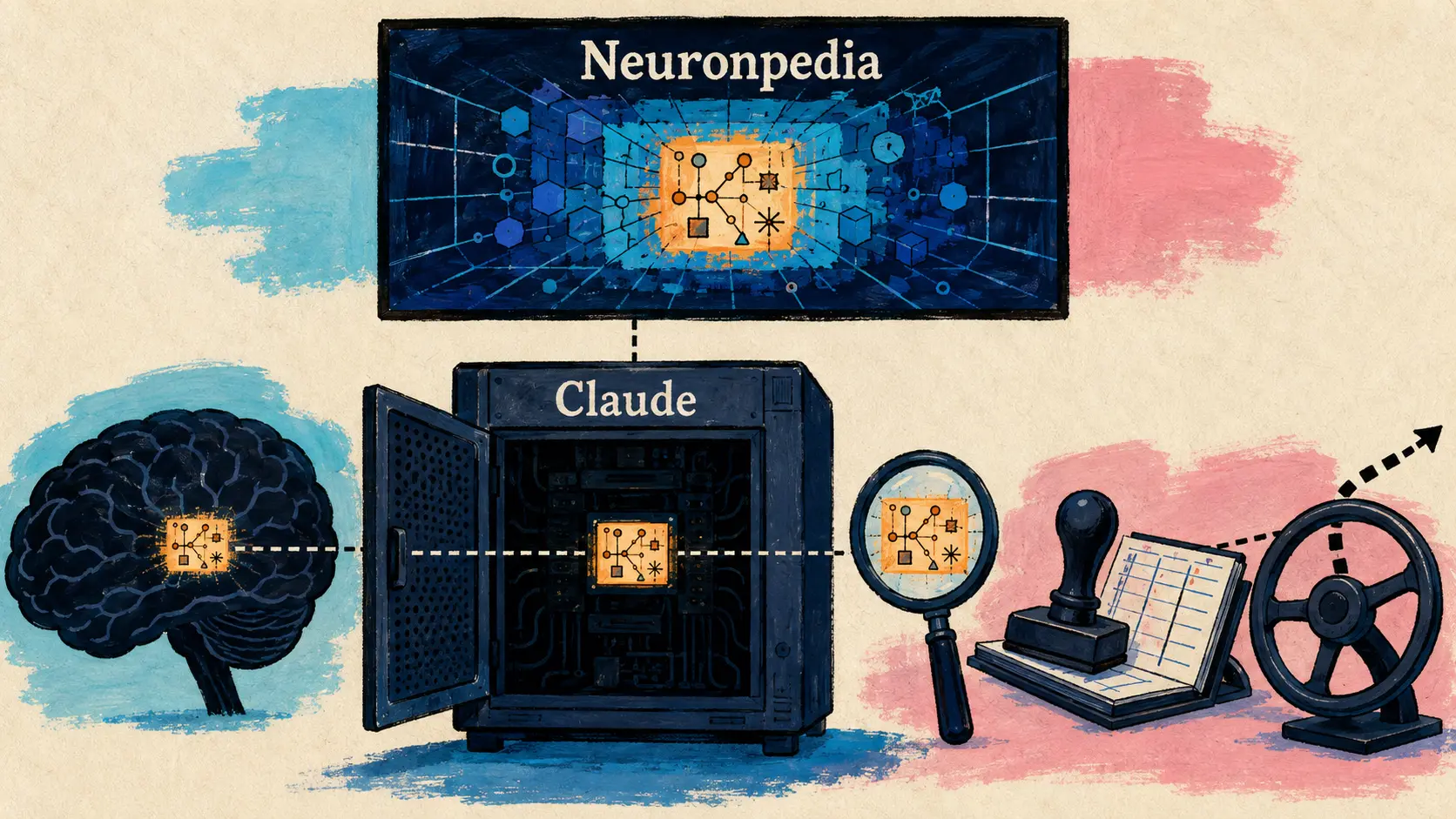
July 6 — Anthropic publishes a new interpretability study on transformer-circuits.pub: LLMs have a mechanism analogous to the global workspace (global workspace) described by cognitive neuroscience — an active, conscious information zone accessible to reasoning. This mechanism, named J-space, emerges naturally in language models without having been explicitly designed.
The research establishes that, just as the human brain makes only a fraction of its neural activity accessible to consciousness, LLMs concentrate their active reasoning in this limited space. This discovery has three concrete implications:
- Read what Claude is actively reasoning about at a given moment
- Audit intermediate reasoning states
- Steer the model’s thought process while it runs
Anthropic’s X thread mentions an interactive demo available via Neuronpedia on open-weights models, making it possible to explore J-space directly. The research is part of Anthropic’s mechanistic interpretability program (mechanistic interpretability), which aims to understand the internal representations of models to ensure their reliability as they grow in capability.
New Anthropic research: A global workspace in language models. Of everything happening in your brain right now, only a tiny fraction is consciously accessible—thoughts you can describe, hold in mind, and reason with. We found a strikingly similar dynamic inside language models. The J-space lets us read, audit, and shape what Claude is actively thinking about—useful tools for keeping models trustworthy as they grow more capable. And it suggests surprising parallels between language models and our own minds.
New Anthropic research: a global workspace in language models. Of everything happening in your brain right now, only a tiny fraction is consciously accessible — the thoughts you can describe, hold in mind, and reason about. We found an astonishingly similar dynamic in language models. J-space lets us read, audit, and steer what Claude is actively thinking about — useful tools for keeping models reliable as they gain capability. And it suggests surprising parallels between language models and our own minds. — @AnthropicAI on X
🔗 Full paper — transformer-circuits.pub
Runway opens its first office in France in Paris
July 6 — Runway announces the opening of its first French office in Paris, dedicated to research in world models and physical AI. This hub is part of Runway’s European expansion, six weeks after the opening of its first London office.
| Item | Detail |
|---|---|
| Location | Paris, France |
| Initial team | 10 people |
| Investment | USD 30M |
| Focus | World models, physical AI |
| Hiring | Paris + Europe |
“France has one of the deepest concentrations of AI research talent in the world. We’re excited to plant a flag in Paris as we continue to grow our global research presence.”
“France has one of the deepest concentrations of AI research talent in the world. We are thrilled to plant our flag in Paris as we continue to build our global research presence.” — Anastasis Germanidis, co-CEO, Runway
The co-CEO cites the density of talent from major French research institutions and government support as key factors. Runway is actively hiring in Paris and across Europe. The USD 30M investment positions Paris as a center for fundamental research, complementing the London hub focused on commercialization.
🔗 Official Runway announcement
Claude Code — Guide to the four types of agentic loops
July 6 — The Claude Code team publishes, via @ClaudeDevs, a substantive guide, already viewed 316,000 times, on designing agentic loops. The guide starts from a precise definition: a loop is an agent that repeats work cycles until a stopping condition is reached.
| Loop type | Trigger | Stopping condition | Claude Code primitive | Typical use case |
|---|---|---|---|---|
| Turn-based (turn-based) | User prompt | Claude judges the task complete | Agentic loop | Short and exploratory tasks |
| Goal-based (goal-based) | Prompt + explicit criterion | Criterion met or max turns reached | /goal | Tasks with a verifiable exit criterion |
| Time-based (time-based) | Time interval | Cancellation or end of work | /loop, /schedule | Recurring work or external systems |
| Proactive (proactive) | Event or schedule without human | End of each subtask | Dynamic workflows + auto mode | Well-defined recurring workflows |
Concrete examples given in the guide: /goal get the homepage Lighthouse score to 90 or above, stop after 5 tries (goal-based), /loop 5m check my PR, address review comments, and fix failing CI (time-based). The guide also covers code quality management in long loops (SKILL.md for self-checking, second agent for review) and token usage steering (choosing the right model, clear stopping criteria).
🔗 @ClaudeDevs thread — Getting started with loops
Government of Alberta — 466 million lines audited in 20 hours
July 6 — Anthropic publishes a detailed use case from the Government of Alberta (Canada): since 2025, the province has used Claude Code with Opus and Sonnet models to audit the security of its government IT systems. The results are striking.
| Metric | Value |
|---|---|
| Code lines scanned | 466 million |
| Scan duration | 20 hours |
| Parallel agents | ~50 (Opus + Sonnet) |
| Applications covered | 1,280 |
| Repositories covered | 3,400 |
| Ministries involved | 27 |
| Security checks per pass | ~95 |
The architecture relies on two types of agents built with the Claude Agent SDK: a “red team” agent that probes applications like an attacker, and a “blue team” agent that evaluates defenses against an international security standard and drafts the remediation plan. A 25-year-old Java grants portal was rebuilt in 4 to 5 days (versus 5 months originally). Alberta is publishing technical white papers so that other governments can reproduce the approach.
Sakana AI launches Sakana Translate — real-time JA/EN/ZH translation
July 6 — Sakana AI, a Tokyo-based lab specializing in bio-inspired neural networks, launches Sakana Translate, integrated into its Sakana Chat service. The tool supports bidirectional Japanese ↔ English ↔ Chinese translation with three distinct modes:
| Mode | Operation |
|---|---|
| Translate | Long-form real-time translation |
| Proofread | Refines tone and phrasing with track changes |
| Ask | Clarifies nuanced word choices |
This launch marks Sakana AI’s entry into consumer translation tools, with a deliberately focused positioning on the three major East Asian languages. The service is accessible at translate.sakana.ai.
HuggingFace LeRobot v0.6.0 — world models, reward models, 9 benchmark families
July 5-6 — HuggingFace releases LeRobot v0.6.0 under the title “Imagine, Evaluate, Improve,” a version that structures robotic learning along three complementary axes.
Policies with a world model:
| Policy | Description |
|---|---|
| VLA-JEPA | Compact VLA (Qwen3-VL-2B) that predicts the future in latent space |
| LingBot-VA | Autoregressive video-action model predicting future video and actions together |
| FastWAM | Evaluates whether inference-time imagination actually improves performance |
New integrated VLAs: GR00T N1.7 (NVIDIA), MolmoAct2 (Allen AI, inference ~12 GB), EO-1, Multitask DiT, EVO1 (0.77B parameters).
Reward models: Robometer (zero-shot on any LeRobot dataset) and TOPReward (uses Qwen3-VL as judge).
Benchmarks now cover 9 families: LIBERO, Meta-World, NVIDIA IsaacLab-Arena, and 6 new ones. The infrastructure is enriched with the lerobot-rollout CLI for deployment with a DAgger strategy, FSDP support for training models larger than available GPU memory, and HF Jobs for one-line cloud training.
🔗 LeRobot v0.6.0 — HuggingFace Blog
Google DeepMind × Apptronik — Expanded Robot Park, Apollo 2 data for Gemini Robotics
July 6 — Google DeepMind announces the expansion of its research partnership with Apptronik. On the occasion of the expansion of Apptronik’s Robot Park, real-world data collected by the Apollo 2 humanoid platform will directly feed training for Gemini Robotics.
| Item | Detail |
|---|---|
| Partner | Apptronik (expanded Robot Park) |
| Platform | Apollo 2 (humanoid robot) |
| Use | Real data → Gemini Robotics training |
This announcement illustrates Google DeepMind’s strategy: ground robotics AI in field data rather than simulations, relying on physical humanoid robots deployed in real environments.
Briefs
- Kimi K2.7 Code vs Claude Fable 5 — landing pages at -94% cost — Together AI publishes a comparison: 12 landing pages generated, Kimi K2.7 Code costs about 4 cents per page versus USD 1.09 for Fable 5 (16× cheaper on average), for GPT-5.5 scores that differ by 4 to 12 points depending on the pages. Kimi’s advantage is amplified with a visual reference MCP server. 🔗 Together AI Blog
What this means
Interpretability is moving from the lab to the supervision tool. Anthropic’s discovery of J-space is not an isolated academic result: it is the first time an internal LLM mechanism can be read, audited, and steered in real time, without modifying the model. If supervision tools based on this research become operational, they would fundamentally change how we verify what an autonomous agent is planning — something that matters as much to security teams as to developers debugging agentic workflows.
Physical AI is taking root in Europe via Paris. Runway’s opening of a Paris office, combined with HuggingFace’s LeRobot v0.6.0 and the Google DeepMind × Apptronik partnership, sketches a coherent ecosystem around physical AI: models that imagine their actions before executing them (world model policies), real data from humanoid robots for training, and cloud infrastructure to democratize access. Runway is choosing Paris for the density of fundamental research — a signal about the future geography of this field.
Agentic AI is entering government production. The Alberta case is not a pilot: 466 million lines scanned in 20 hours by 50 parallel agents, 1,280 applications and 27 ministries covered, white papers published for other governments. Combined with the Claude Code guide on loops, which documents the primitives /goal, /loop, /schedule for fully autonomous workflows, it is a sign that agentic AI is now reliable enough to be deployed on critical systems — with supervised multi-agent architectures.
The cost-quality equation is shifting. The Kimi K2.7 Code vs Fable 5 comparison published by Together AI captures a structural tension: for high-frequency tasks (page generation, repetitive workflows), well-optimized open-weight models cut cost by a factor of 16 for a quality gap measured at less than 10%. That does not mean closed models lose value, but rather that their advantage is increasingly concentrated in tasks where marginal quality really matters.
Sources
- J-space paper — transformer-circuits.pub
- Anthropic tweet — J-space
- Anthropic tweet — Neuronpedia demo
- Runway Paris announcement — runwayml.com
- Runway Paris tweet
- Claude Code loops thread — @ClaudeDevs
- Alberta case study — anthropic.com
- Sakana Translate tweet
- LeRobot v0.6.0 — HuggingFace Blog
- Google DeepMind × Apptronik tweet
- Kimi K2.7 Code vs Claude Fable 5 — Together AI