ai-powered-markdown-translatorArticle translated from fr to en with gpt-5.6-sol.
NVIDIA Research has released Sol-H3, an inference stack that brings the generation time for five seconds of video below the clip’s playback duration, under the Apache 2.0 license. On the same day, a publisher released two model lines designed for CPUs on Hugging Face, with promises unsupported by any measurements, while an Indian team opened a noisy-speech corpus in which every timestamp passes through a documented verification process. Google Research is also expanding its trials of contrail-avoiding flight paths to Asia.
Sol-H3 generates five seconds of video in 1.653 seconds, faster than playback
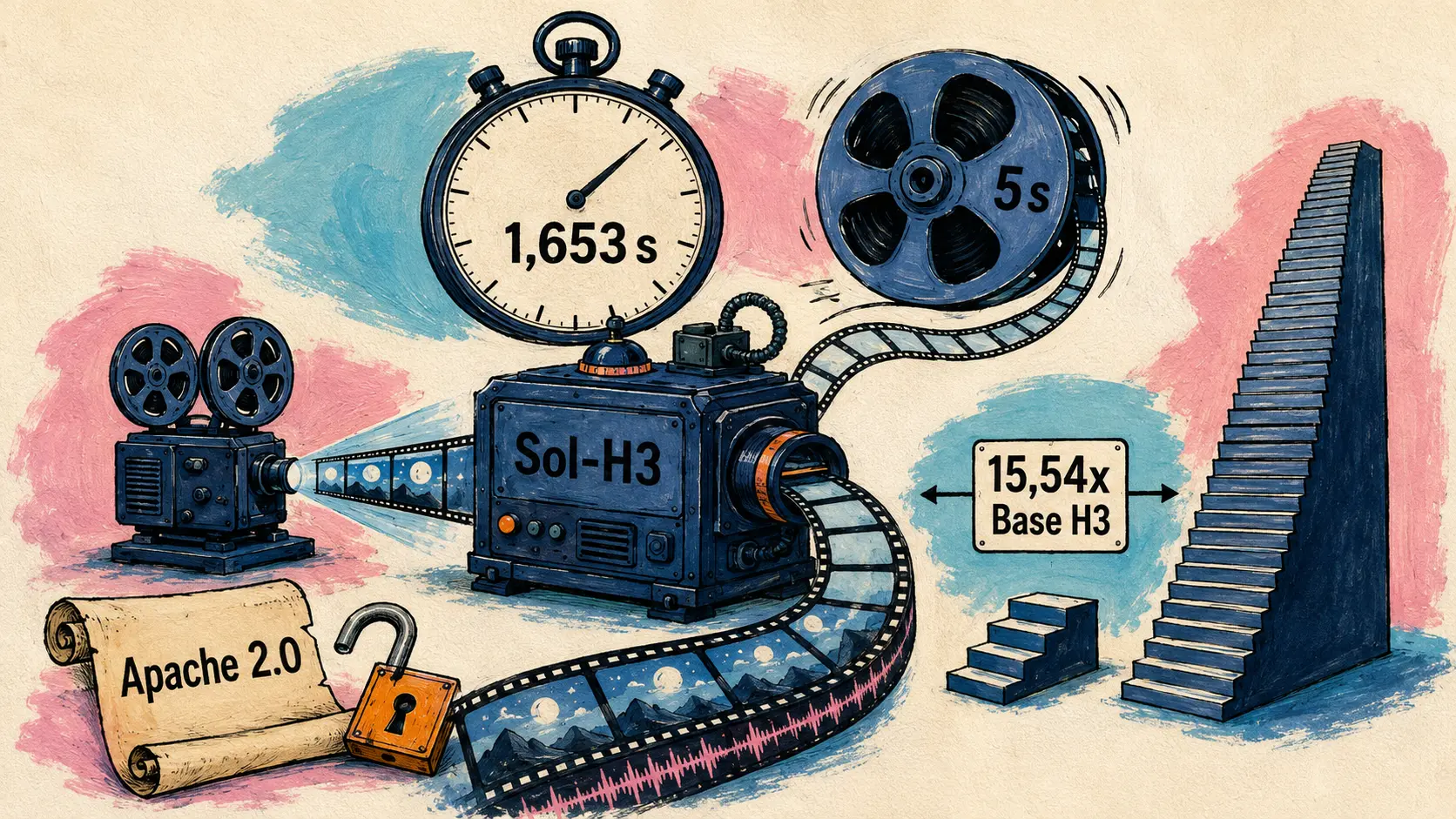
September 7 — NVIDIA Research’s Efficient AI team, together with its Singapore laboratory, has released Sol-H3, a complete inference stack for the MiniMax-H3 video model. The result can be summed up in one sentence: five seconds of 1344×768 video at 24 frames per second, with stereo audio generated in the same pass, produced in 1.653 seconds on a system with eight B300 Blackwell accelerators. The model therefore creates the clip faster than a viewer can watch it.
The comparison covers complete profiles, not merely an attention-kernel change. The reference profile, Base H3 Dense, uses 50 scheduler steps, representing 49 forward passes through the DiT network; Sol-H3 uses only four.
| Hardware configuration | Generated duration | Base H3, 50 steps | Sol-H3, 4 steps | Speedup |
|---|---|---|---|---|
| 8× B300 | 5 s | 18,250 s | 1,653 s | 11,04× |
| 8× B300 | 10 s | 50,660 s | 3,732 s | 13,57× |
| 8× B300 | 15 s | 99,513 s | 6,612 s | 15,05× |
| 4× B300 | 5 s | 35,328 s | 2,918 s | 12,11× |
| 4× B300 | 15 s | 194,930 s | 12,542 s | 15,54× |
| 1× B300 | 5 s | 129,898 s | 13,745 s | 9,45× |
The speedup peaks at 15,54×, achieved on four B300s for fifteen seconds of video. The protocol is unusually explicit: medians from three runs after warm-up, using the same prompt and seed; the timer covers text encoding, DiT denoising, and VAE decoding, but excludes model loading and final MP4 encoding.
The stack combines two components developed separately: Sol-Engine for the video inference runtime and Sol-Attn for sparse attention applied on the fly, without retraining. It also includes fused kernels, inter-GPU communication in INT8 for QKV projections and FP8 for outputs, parallelized and batched VAE decoding, and AdaLN parameter caching. Sparse-attention preparation falls from 1,206 to 0,285 milliseconds, VAE decoding from 7,55 to 0,602 seconds, and approximately 24 GB of memory is freed per GPU.
Two decisions make the release useful beyond the demonstration: the code is released under the Apache 2.0 license, and any previously trained few-step LoRA for MiniMax-H3 works with the same runtime. Open API access through Reactor from day one avoids tying up eight B300s just to try it.
For us, the bigger milestone is crossing from “fast generation” into “faster than playback.” That opens the path toward continuous 24 FPS generation and truly interactive video systems. — @xieenze_jr on X
🔗 Sol-H3 project page, NVIDIA Research
🔗 Day-one API access through Reactor
An open corpus timestamps 106,892 real-world noises in 58 Indian languages
September 7 — The ARTPARK team at the Indian Institute of Science has released the Vaani Noise Event Timestamp Dataset, a layer of human annotations built on the Project Vaani spontaneous-speech corpus. Each background noise is labeled with its type and start and end times, accurate to the millisecond.
| Corpus property | Value |
|---|---|
| Total annotated audio | more than 122 hours |
| Timestamped noise events | 106 892, across 7 categories |
| Speech segments and speakers | 72 756 segments, 38 541 voices |
| Linguistic and geographic coverage | 58 languages, 30 states |
| Verified set and raw set | approximately 22 h and approximately 100 h |
The key lies in the methodology: speech and noise were captured together on ordinary phones, without adding synthetic noise or mixing it in afterward. Non-speech human sounds, coughs, and laughter appear in approximately 38 percent of segments but last less than half a second; animals and traffic are rarer and much longer, and together account for the largest share of total noise time. Each timestamp passes through annotation, a consistency check, an internal recheck, and then an independent audit of a randomly selected tenth of the corpus: if even one fails, the entire batch is redone.
🔗 ARTPARK-IISc post on Hugging Face
CMS Manhattan releases two CPU model lines, without supporting benchmarks
September 6 — CMS Manhattan has published two open-weight releases on Hugging Face intended for CPU rather than GPU inference. Both posts are self-published by the model developer, and everything that follows is presented accordingly.
The first, the JiRack Ultra series, comprises four models with 1.58-bit ternary weights in the style of BitNet, derived, according to the publisher, from the DeepSeek-R1-Distill-Qwen-32B architecture. The most interesting element is not the quantization but the tokenizer, expanded with dedicated tokens for routing, tool calling, robotic-control tags, and media, targeting agentic systems and embedded robotics. The second, JiRackDeltaNet_27b, uses a 27-billion-parameter Qwen 3.8 migrated to a DeltaNet architecture, which alternates full attention with Gated DeltaNet layers related to state-space models, with an advertised context length of 262,144 tokens.
| Model line | Base claimed by publisher | Published weight format | License and packaging |
|---|---|---|---|
| JiRack Ultra, four sizes | DeepSeek-R1-Distill-Qwen-32B | 1.58-bit ternary weights, GGUF Q2_K to Q4_K_M | weights on the Hub, Docker images, and a subscription-based interface |
| JiRack DeltaNet 27B | Qwen 3.8 27B migrated to DeltaNet | standard llama.cpp GGUF files produced from FP16 | weights under the MIT license, Docker image, and interface at 12 dollars per user per year |
Two caveats matter for readers. Despite the ternary and bitnet labels in the DeltaNet repository, the published GGUF line consists of standard llama.cpp quantizations rather than a separate ternary checkpoint, as the post itself acknowledges. And the claim of quality close to Opus 4.6 Max used in the title of the second post is not supported by any benchmark result: that is precisely what is missing—a published comparative measurement—to assess these models on anything beyond their documentation.
🔗 JiRack Ultra series on Hugging Face
🔗 JiRack DeltaNet 27B on Hugging Face
Why RL environments work today but did not in 2016
September 7 — Sergio Paniego has published a retrospective on the Hugging Face blog that begins with a striking observation: the description of OpenAI Universe, published in December 2016, could appear verbatim in a cutting-edge lab post today. Yet the repository has been archived.
The timeline runs from the Arcade Learning Environment in 2012 to OpenAI Gym in 2016 and its minimal vocabulary, reset() and step(), which has since moved to Gymnasium under the Farama Foundation. Then came the domain-specific wave, from World of Bits to WebArena, followed by SWE-bench and Terminal-Bench: a task often begins as a benchmark before becoming a training environment.
The core of the analysis consists of five elements that were missing in 2016: no pretrained model worthy of serving as a starting point, a task beyond reach, an interface designed around humans rather than machines, no recipe for sparse rewards, and no way to orchestrate thousands of disposable sandboxes. GRPO and verifiable rewards now provide the fourth. The article concludes with OpenEnv, a standard interface announced in October 2025 by Meta’s PyTorch team and Hugging Face, and with an environment market that includes Prime Intellect and Mechanize.
🔗 Retrospective on RL environments
Google has more than 80 Cathay Pacific flights follow contrail-avoiding routes
September 7 — Google Research is expanding its contrail-avoidance trials to the Asia-Pacific region, with Cathay Pacific as its first commercial airline partner there. The solution is simple on paper: slightly adjust altitude to avoid cold, humid zones where contrails persist as heat-trapping blankets.
| Metric from the first phase | Value |
|---|---|
| Flights targeted across the Cathay Pacific network | more than 100 |
| Flights that actually followed an avoidance route | more than 80 |
| Estimated reduction in contrails’ warming impact | approximately 40 % |
| Hong Kong-Singapore corridor’s share of the gains | more than 50 % |
| Contrails’ share of aviation’s climate impact | approximately one-third |
The system combines predictions produced by Google’s models, satellite imagery, and advanced weather data. Forecasts are sent to the cockpit through onboard Wi-Fi and the airline’s Electronic Flight Folder, without disrupting standard procedures, while adjustments remain within established safety parameters. An expanded second phase is beginning, with Contrails.org as a partner.
Contrail mitigation remains one of the most immediately available, scalable, and cost-effective ways to reduce aviation’s climate footprint, and it can get started now, with today’s aircrafts and fuel. — Kemal Armada and Max Vogler, Google Research
Genspark adds Muse Spark 1.3 to three of its products
September 7 — Genspark has integrated Muse Spark 1.3, Meta’s model, into AI Chat, Code Agent, and Claw, five days after its announcement. The platform repeats the two figures cited by Meta to justify the choice: 20 percent fewer tool calls and 25 percent lower token usage, two metrics that directly affect the cost of an agent running in a loop on lengthy tasks.
The pace is the real signal. In six days, Genspark integrated four models from different providers: Claude Fable 5.1 on September 2, Gemini 3.8 Flash on September 3, GPT-6 Astra on September 5, and Muse Spark 1.3 on September 7. The platform is positioning itself less as a model than as an orchestration layer that absorbs releases from every lab within days of publication.
Briefs
- Replit opens its first international office in London — the company is making it the hub of its European operations, alongside London Mayor Sadiq Khan, the UK government, and London & Partners, and is announcing an upskilling pilot with TLMA for young Londoners not in employment, education, or training. 🔗 Post
- Tolquane, a composable parallelism library for Python — the same graph runs without code changes using threads, processes, async, distributed execution, or sequentially, at 5.6 times the baseline speed on free-threaded Python 3.14t versus 0.9 times with GIL-bound threads. Non-blocking behavior is established as a design rule, with an error that names the blocked nodes. 🔗 Post
- A dedicated action for installing an agent skill — the Aiden firmware now routes a skill URL to a single action that stages, validates, and then publishes atomically. Reproduction on a real agent reduces a multi-tool trace to a single call. 🔗 Post
- Together AI pits GLM-5.3 Flash against GPT-5.6 Terra on cost per task — the same score on Artificial Analysis’s Intelligence Index, but 82 percent less per task according to the host, which publishes neither its calculation method nor a detailed post and itself serves the model being compared. 🔗 Post
- A manifesto for a Brazilian AI ecosystem — a Portuguese-language text extending the metaphor of a natural ecosystem to the country’s AI community, with no model, dataset, or measurement. Included for completeness. 🔗 Post
- Google DeepMind selects 16 organizations for its AI for the Planet Accelerator in Asia-Pacific — the inaugural cohort begins with an intensive bootcamp in Singapore, followed by three months of access to the AnthroKrishi, ForestCast, AlphaEarth Foundations, SpeciesNet, and Perch models, spanning nature protection, sustainable agriculture, and carbon solutions. 🔗 Post
- GitHub puts the canvases in its Copilot app back in the spotlight — a renewed push for an August 17 article presenting the canvas as a shared, persistent surface where work state remains visible, with a rarely published figure: 2,000 to 3,000 AI Credits to build each of the two cited examples. 🔗 Post
- GitHub launches an alias generator for GitHub Universe — a promotional community activation ahead of the October 2026 edition, unrelated to AI or any product feature. 🔗 Post
- Synthesia outlines its three research tracks for ECCV 2026 — audio-driven generative avatars, voice research applied to speech recognition, and interactive avatars, under the banner of the human-centered world model. 🔗 Post
- Mati Staniszewski puts the conversational Turing test six to twelve months away — the ElevenLabs co-founder and CEO makes the statement on the GDIY podcast, whose interview is available dubbed into French through the company’s audio service. 🔗 Post
- QwenCloud publishes its recap of Qwen Conference Thailand 2026 — nearly 400 customers and developers gathered in Bangkok on September 4, with an end-to-end demonstration in which the agent itself is the customer, from registration to payment and billing without human intervention. 🔗 Post
- Cohere shares a CNN report on Toronto as a global AI hub — a communication with no product announcement, citing the city’s third-place global ranking for tech talent according to CBRE, more than $2 billion committed through Canada’s national strategy, and a surge in customer inquiries reported by Cohere following export controls on Anthropic’s models. 🔗 Post
What It Means
The threshold crossed by Sol-H3 is not just another record on a list. As long as a clip takes longer to produce than to watch, video generation remains a batch process: start it, wait, then view it. Dropping below that threshold opens up another category of use, one where the image is created as it is being watched. The detail that matters to practitioners is that the gain does not come from a new model: the model is the same, and only the inference stack changes. The 15-fold improvement therefore lay in execution engineering, not in the weights, and it is released under Apache 2.0 with compatibility for existing LoRAs.
The day’s releases contrast two ways of publishing open weights. On one side are two self-published posts whose quality claims are unsupported by any comparable measurement, with repository labels that do not match the format actually delivered, and a cost-per-task comparison announced by the winning model’s host without a published methodology. On the other is a speech corpus in which every timestamp passes through an audit pipeline and the team explicitly separates 22 verified hours from 100 unverified hours. In a public repository where anyone can publish, verification discipline becomes the only usable signal, and it costs more to produce than a catchy headline.
The retrospective on RL environments and Genspark’s pace of integration describe the same shift at two different scales. The first explains why a 2016 idea works today: what was missing was not the algorithms but the surrounding infrastructure, from the starting model to disposable sandboxes. The second shows what that infrastructure becomes once available, when a platform connects four models from four providers in six days. In both cases, value migrates from the model to the layer around it, and that layer is becoming standardized, with OpenEnv on one side and multi-model orchestrators on the other.
What remains lies outside the model race. The trial with Cathay Pacific involves existing aircraft and fuels: the only addition is a forecast delivered to the cockpit at the right time, for an estimated reduction of about 40 percent on the flights concerned. The Vaani corpus covers 58 Indian languages, several of which previously had no noisy-speech resources, and DeepMind’s Asia-Pacific accelerator distributes specialized models to sixteen field teams. None of these three efforts has a benchmark to beat. Their constraint lies elsewhere, in the data that must be collected and the deployment that must succeed, and that is also where the gap between a demonstration and a measurable effect is determined.
Sources
- Sol-H3, announcement by Enze Xie on X
- Sol-H3 project page, NVIDIA Research
- Sol-H3 API access via Reactor
- Vaani Noise Event Timestamp Dataset, ARTPARK-IISc
- JiRack Ultra series, CMS Manhattan
- JiRack DeltaNet 27B, CMS Manhattan
- History of RL environments, Hugging Face
- Contrail avoidance on ultra-long-haul flights, Google Research
- Muse Spark 1.3 in Genspark
- Replit opens its London office
- Tolquane, composable parallelism in Python
- Direct skill installation in the Aiden firmware
- Together AI compares GLM-5.3 Flash and GPT-5.6 Terra
- Manifesto for a Brazilian AI ecosystem
- AI for the Planet Accelerator in Asia-Pacific, Google DeepMind
- Canvases in the Copilot app
- Alias generator for GitHub Universe
- Synthesia at ECCV 2026
- Mati Staniszewski on the GDIY podcast
- Qwen Conference Thailand 2026 recap
- Cohere shares CNN’s report on Toronto