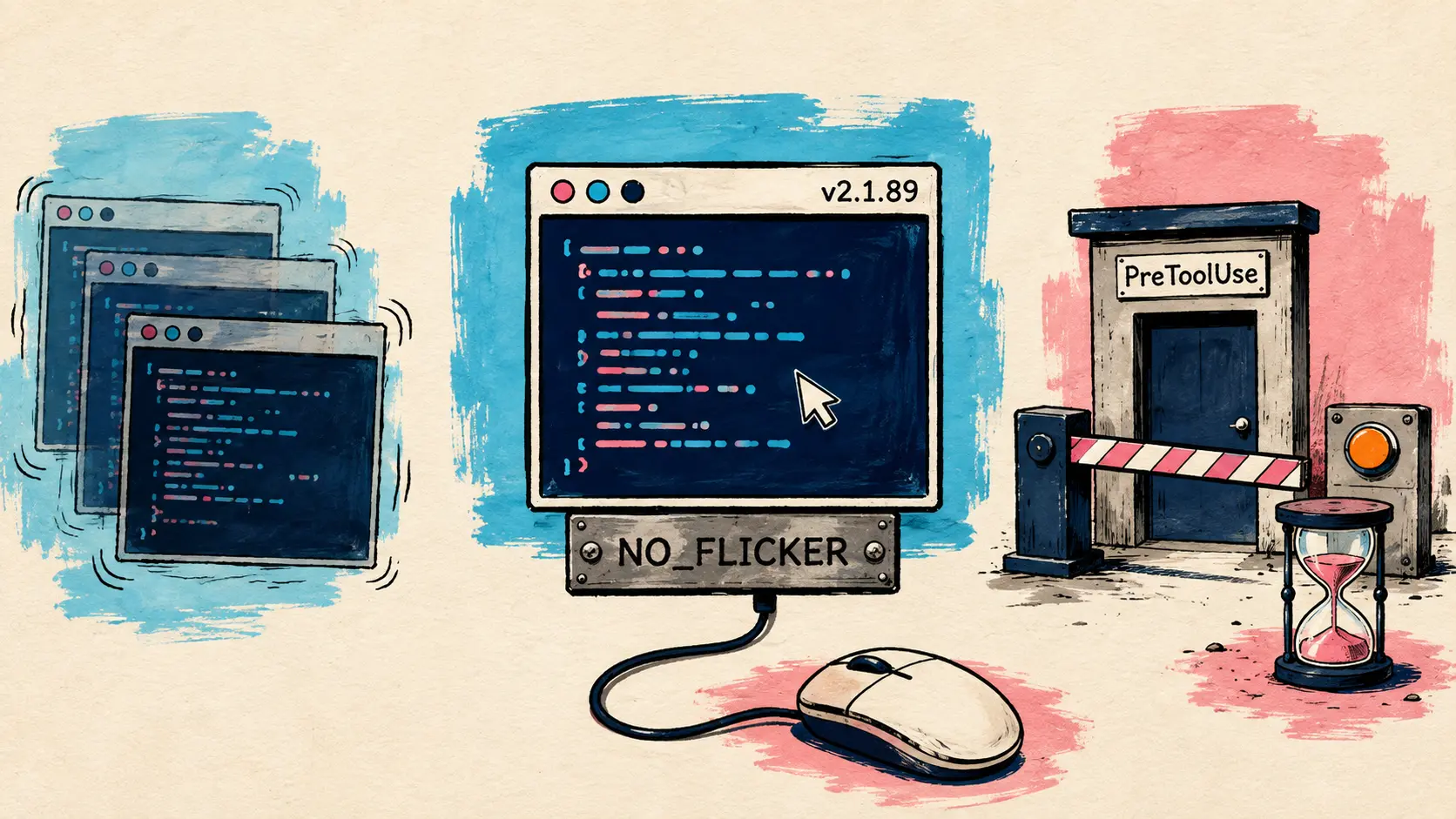
April 1, 2026 brings an unusually high number of substantial announcements: Claude Code v2.1.89 introduces a new flicker-free rendering engine and Computer Use in the terminal, Copilot CLI launches /fleet for parallel agent orchestration, and Perplexity Computer arrives in Slack with a claimed $776 million in delegated work. As a bonus, two well-executed April Fools’ jokes deserve their own section.
Claude Code v2.1.89: NO_FLICKER and new permissions
April 1, 2026 — Version 2.1.89 of Claude Code introduces NO_FLICKER mode, an experimental terminal rendering engine that addresses a long-standing issue reported by the community.
NO_FLICKER mode
Enabled via the CLAUDE_CODE_NO_FLICKER=1 environment variable, this renderer virtualizes the entire viewport and hooks keyboard and mouse events directly at the application level. The result: no more flickering or uncontrolled scrolling, plus support for mouse events in the terminal. Most internal Anthropic users prefer this mode over classic rendering. It remains experimental, with a few technical trade-offs related to terminal architecture.
To enable it:
CLAUDE_CODE_NO_FLICKER=1 claudeNew hooks and permissions capabilities
Version 2.1.89 also brings several improvements for automated workflows:
| Feature | Description |
|---|---|
"defer" permission (PreToolUse hooks) | Headless sessions can suspend on a tool call and resume with -p --resume |
PermissionDenied hook | Triggers after a classifier refusal in auto mode; {retry: true} reruns the action |
MCP_CONNECTION_NONBLOCKING=true | For -p mode: skips waiting for MCP connection (capped at 5 seconds) |
| Named sub-agents | Visible in @ mention autocomplete |
| Refused commands (auto mode) | Display a notification + appear in /permissions → Recent tab, rerunnable with r |
Fixes include: symlink resolution in permission rules, handling of CRLF files on Windows, StructuredOutput schema cache fixes, and elimination of a memory leak in long-running sessions.
Ship ship ship — @bcherny on X
🔗 @bcherny announcement 🔗 Fullscreen rendering documentation
Computer Use in Claude Code CLI
March 30, 2026 — Claude Code now integrates computer use directly into the terminal. Claude can open applications, navigate the graphical interface, and test what it has just built without leaving the CLI.
The feature is available in research preview on Pro and Max plans (macOS only). It is enabled with the /mcp command in a Claude Code session. It supports anything that can be opened on a Mac: compiled SwiftUI applications, local Electron builds, browsers, and more.
The goal is to close the loop between code generation and visual validation — Claude writes, then verifies the result itself in the interface.
The announcement tweet has surpassed 15.4 million views.
Claude Code — GitHub connection via /web-setup
March 31, 2026 — A new /web-setup command lets users link their local GitHub account to Claude Code web (claude.ai/code) without manual configuration. The command, run inside a local claude session, uses existing GitHub credentials to automatically configure the connection.
GitHub Copilot CLI: /fleet for parallel agents
April 1, 2026 — GitHub is expanding Copilot CLI with the /fleet command, which makes it possible to orchestrate multiple AI agents simultaneously instead of processing tasks sequentially.
An orchestrator breaks the objective down into work items with their dependencies, then dispatches independent tasks to multiple sub-agents working in parallel. Each sub-agent has its own context but shares the file system. The orchestrator monitors progress, dispatches the next waves, and synthesizes the final results.
Suitable use cases:
- Refactoring multiple files simultaneously
- Generating documentation across several components
- Implementing a feature spanning API, UI, and tests in a single pass
🔗 GitHub Blog: Run multiple agents at once with /fleet
GitHub Copilot cloud agent: research, plan, and code
April 1, 2026 — The Copilot cloud agent (formerly “Copilot coding agent”) is expanding its capabilities well beyond simple pull request generation. Three new modes are available:
| Mode | Description |
|---|---|
| PR flow control | The agent generates code on a branch without automatically creating a PR — the developer reviews the diffs before deciding |
| Implementation plans | By adding “Ask for a plan” to the prompt, the agent details its approach before writing a single line |
| Deep research | The agent investigates an entire repository to answer questions grounded in the project’s context |
These features are available via the repository’s Agents tab and Copilot Chat, on all paid Copilot plans. For Business and Enterprise accounts, activation by an administrator is required.
🔗 GitHub changelog: Research, plan and code with Copilot cloud agent
Perplexity Computer in Slack
April 1, 2026 — Perplexity is making Computer in Slack public after several weeks of internal-only use. Computer is an AI orchestrator that manages a team of agents to execute complex tasks directly in Slack channels and direct messages.
Reported figures
Over four weeks of internal use by 300 employees, Perplexity claims $1.6 million in work completed. Since opening access to Max subscribers, McKinsey, Harvard, MIT, BCG, and Nielsen benchmarks have resulted in a cumulative total of $776 million in equivalent work completed for Enterprise, Pro, and Max subscribers.
How it works
Simply mention @Computer in a channel or send a direct message. The agent can perform deep web research, analyze data, generate content, and access more than 400 connectors (GoHighLevel, Snowflake, and others). It also orchestrates Claude Code and GPT Codex for coding tasks.
A new MCP connector gives Computer expanded access to Slack context: workspace search, thread reading, and message sending. Tasks started in Slack can continue on the Perplexity web platform without losing context.
Availability: Max, Pro, and Enterprise subscribers, via the Slack Marketplace.
🔗 Perplexity Blog: Computer in Slack
Codex CLI 0.118.0
March 31, 2026 — Version 0.118.0 of Codex CLI brings four new features and several fixes.
| New feature | Description |
|---|---|
| Windows network sandbox | Applies network egress rules at the operating system level, without environment variables |
| Device code flow (app-server) | Reliable ChatGPT sign-in even when browser redirection is not available |
codex exec + stdin | Accepts both stdin input and a command-line prompt |
| Dynamic bearer tokens | Custom model providers can refresh short-lived tokens without static credentials |
Fixes include: protection of local .codex files from creation onward, more reliable Linux sandbox startup, restoration of several TUI workflows in app-server mode (/copy, /resume, /agent), more robust MCP startup, and resolution of a Windows access rights issue when applying patches.
npm install -g @openai/codex@0.118.0Z.ai: GLM-5V-Turbo, vision, and code
April 1, 2026 — Z.ai (the lab behind the GLM models) announces GLM-5V-Turbo, a visual coding model (Vision Coding Model) that natively understands multimodal inputs to generate and modify code.
Unlike traditional code models, GLM-5V-Turbo directly processes images, videos, design mockups, and documents to produce the corresponding code. Z.ai claims state-of-the-art results on multimodal coding, tool use, and GUI agent benchmarks.
The model is explicitly designed to integrate into agentic workflows with Claude Code and OpenClaw, rather than as a standalone model. It is available immediately via chat.z.ai and the documented API. An early access “Coding Plan” program is open via form.
GrandCode/Qwen: three consecutive wins on Codeforces
April 1, 2026 — The GrandCode team announces that its agentic AI system, powered by Qwen, took first place in the last three live Codeforces competitions (Rounds 1087, 1088, and 1089), surpassing all human participants, including the world’s top players.
Codeforces is one of the reference platforms for competitive programming. Winning three consecutive rounds against the global elite is a first for an AI system. Alibaba Qwen describes the event as a “turning point for coding intelligence.”
Huge congratulations to the @GrandCode team — powered by Qwen — for winning 3 consecutive Codeforces rounds (Round 1087, 1088, and 1089), surpassing all human participants. — @Alibaba_Qwen on X
Runway Builders and Characters API
March 31, 2026 — Runway launches Runway Builders, a program for startups from Seed to Series C developing products based on generative video and real-time conversational AI.
The launch is accompanied by Runway Characters, a real-time video agent API powered by GWM-1 (Runway’s General World Model). Participating startups receive up to 500,000 API credits, priority access to the highest rate limits, a private Slack community, and direct support.
The founding cohort includes Cartesia, MSCHF, Oasys Health, Spara, Subject, and Supersonik, active in customer support, synthetic media, and interactive AI. The Characters API has also been available in the iOS app since March 31.
🔗 Runway Blog: Introducing Runway Builders 🔗 @runwayml announcement
Anthropic × Australia: MOU and AUD 3 million in API credits
March 31, 2026 — Anthropic has signed a Memorandum of Understanding with the Australian government. CEO Dario Amodei traveled to Canberra to formalize the agreement with Prime Minister Anthony Albanese.
The MOU establishes collaboration with the Australian AI Safety Institute: sharing data on model capabilities, joint safety evaluations, and access to data from the Anthropic Economic Index to track AI adoption in the economy.
Anthropic is investing AUD 3 million in API credits with four research institutions:
| Institution | Field |
|---|---|
| Australian National University (ANU) | Genetic sequencing for rare diseases |
| Murdoch Children’s Research Institute | Pediatric medicine and stem cells |
| Garvan Institute of Medical Research | Clinical genomics, rare disease diagnostics |
| Curtin Institute for Data Science | Multidisciplinary research (health, law, engineering) |
A deep tech startup program offers up to USD 50,000 in API credits (drug discovery, materials science, climate modeling). The announcement also foreshadows the opening of the Sydney office, Anthropic’s fourth office in Asia-Pacific.
🔗 Official Anthropic announcement
In brief
GitHub Mobile — Redesigned Copilot tab (April 1) — The GitHub mobile app (iOS and Android) is getting a redesign of the Copilot tab: direct access to sessions and history, native session logs viewable without going through the web browser, sessions filterable by status, and full controls (create PRs, review results, stop an active session).
GitHub Mobile — Agent assignment from issues (April 1) — An “Assign an Agent” option appears in the issues menu on iOS and Android, with the ability to add custom instructions and select a different repository for delegation.
Deprecation of Claude Sonnet 4 in Copilot (March 31) — GitHub Copilot announces the deprecation of Claude Sonnet 4 on May 1, 2026, replaced by Claude Sonnet 4.6 across all Copilot experiences (chat, inline edits, ask/agent modes, code completions). Enterprise administrators must update their model policies before that date.
GPT-5.4 mini in Copilot Student (April 1) — GPT-5.4 mini is now available via automatic model selection (Auto) in Copilot Chat for users on the Copilot Student plan, in VS Code, Visual Studio, JetBrains, Xcode, and Eclipse.
NotebookLM × Royal Society: Benjamin Franklin notebook (March 31) — NotebookLM is releasing a featured notebook in partnership with Google Arts & Culture and the Royal Society, dedicated to Benjamin Franklin. It lets users interact with his work, his personal and professional relationships, and build a new perspective on this polymath.
Google AI recap — March 2026 (April 1) — Google publishes its monthly recap highlighting, among announcements not yet covered here: Ask Maps (a question-and-answer mode for Google Maps), vibe coding in Google AI Studio with the Antigravity agent, and the expansion of Personal Intelligence to AI Mode, Chrome, and the Gemini app.
April Fools
Claude Code /buddy — the official easter egg
Version 2.1.89 of Claude Code delivers an official easter egg: the /buddy command hatches a small creature that settles into the terminal and watches you code. The CHANGELOG is explicit: “is here for April 1st”. This is not a joke about the joke — the feature really works in the released version. An easter egg shipped to production, on April 1, with a note in the official changelog. Hats off.
Suno Keyboard v1 — the fictional musical keyboard
On April 1, Suno published a tweet announcing “Suno Keyboard v1”, presented as a “new feature” with a demo video. With 15,600 views and mostly sarcastic replies, the product is clearly fictional — a physical musical keyboard for an AI music generation platform. Pleasant, but not very subtle.
What this means
April 1, 2026 looks less like an April Fools’ day and more like an intense shipping day. On the developer tooling side, three signals converge: Claude Code closes the loop between generation and visual validation with Computer Use in the terminal, Copilot CLI introduces parallel agent orchestration with /fleet, and Perplexity Computer shows that an agent orchestrator can integrate directly into the team communication tools already in place (Slack). These three products answer the same question: how to reduce the time between developer intent and verified result.
GrandCode/Qwen’s victory across three consecutive Codeforces rounds is a concrete indicator that agentic systems are reaching a level of performance in competitive programming that even the best humans can no longer systematically match. This is no longer a lab benchmark.
On Anthropic’s side, the Australian MOU confirms its strategy of building institutional relationships with governments, alongside commercial deployments.
Sources
- Claude Code v2.1.89 announcement — @bcherny
- Fullscreen rendering documentation — Claude Code
- Computer Use in Claude Code CLI — @claudeai
- GitHub Copilot CLI /fleet
- GitHub Copilot cloud agent: research, plan, and code
- GitHub Mobile — redesigned Copilot tab
- GitHub Mobile — agent assignment from issues
- Claude Sonnet 4 deprecation in Copilot
- GPT-5.4 mini in Copilot Student
- Perplexity Computer in Slack
- Codex CLI 0.118.0
- Z.ai GLM-5V-Turbo — @Zai_org
- GrandCode/Qwen — @Alibaba_Qwen
- Runway Builders
- Anthropic Australia MOU
- NotebookLM × Royal Society — Benjamin Franklin
- Google AI — March 2026 recap
- Suno Keyboard v1 — @suno
This document was translated from the fr version into en using the gpt-5.5 model. For more information about the translation process, see https://gitlab.com/jls42/ai-powered-markdown-translator