ai-powered-markdown-translatorArticle translated from fr to en with gpt-5.4-mini.
A week marked by two major announcements: DeepSeek releases its new flagship model V4 Preview with a one-million-token context window at very low prices, and Anthropic demonstrates that Opus 4.7 rivals reference NMR software in synthetic chemistry. On the developer tooling side, Claude Code keeps shipping new versions and GitHub Copilot opens its REST API for agentic tasks.
DeepSeek-V4 Preview — V4 Flash and V4 Pro models, 1M-token context
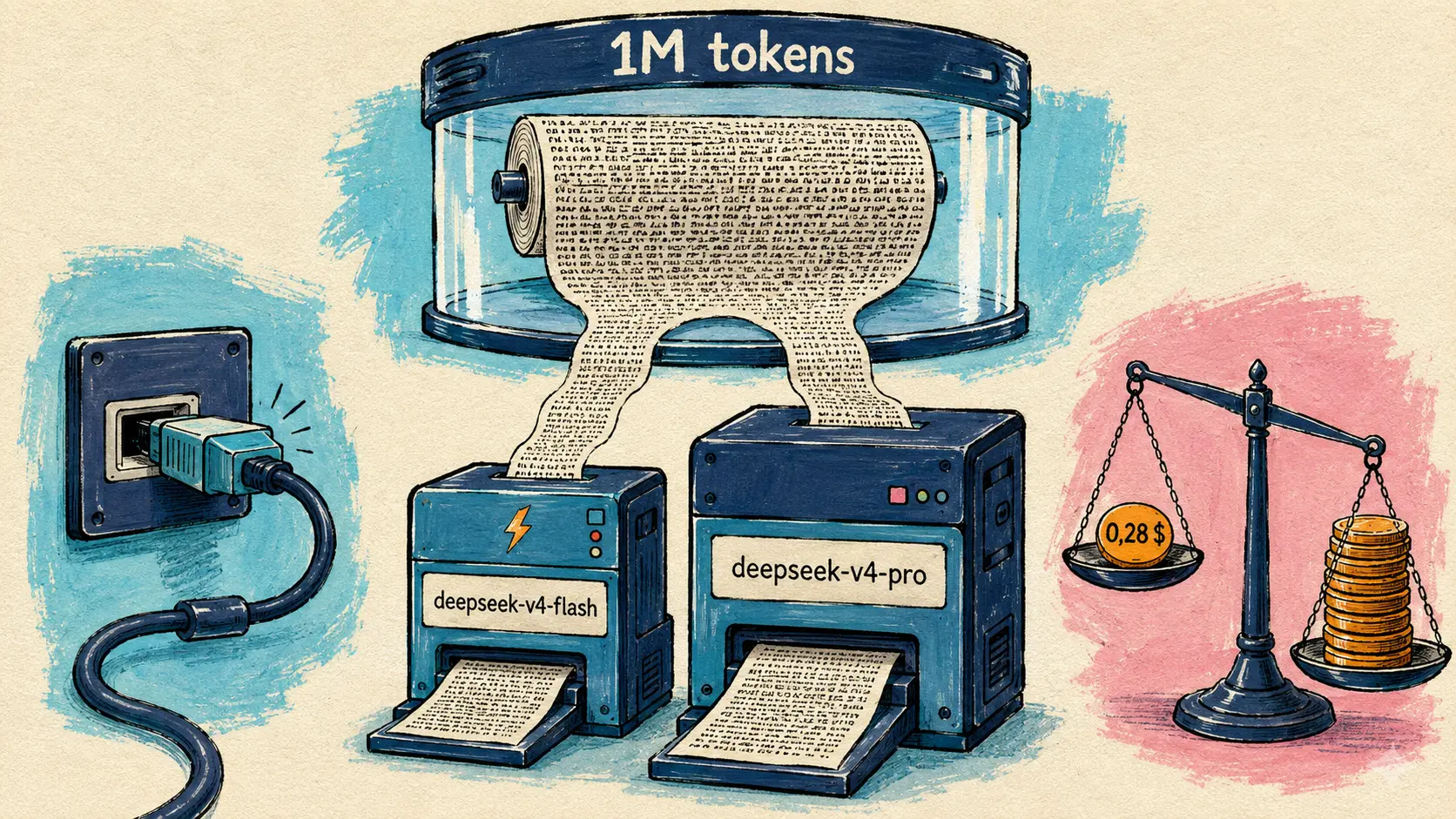
June 6 — DeepSeek releases a preliminary (preview) version of DeepSeek-V4, its new flagship model, in two variants: deepseek-v4-flash and deepseek-v4-pro. Both expose a 1 million token context window and a maximum output of 384,000 tokens — capabilities that sit at the upper end of the frontier market.
The official announcement banner highlights the model’s positioning on reasoning and agentic capabilities (Agent capabilities):
🎉 DeepSeek-V4 Preview is here with stronger Agent capabilities and top-tier reasoning. Now available on Web, App, and API. — deepseek.com (official announcement banner)
Each model supports a reasoning mode (thinking, enabled by default) and a standard mode (non-thinking). Availability is immediate on the web, the mobile app, and the API. The old identifiers deepseek-chat and deepseek-reasoner will be deprecated on July 24, 2026; they now correspond respectively to the non-thinking and thinking modes of deepseek-v4-flash.
Notable detail for developers: the DeepSeek API exposes an endpoint compatible with the Anthropic format (https://api.deepseek.com/anthropic) in addition to the OpenAI format — which makes it possible to use V4 in tools like Claude Code via the ANTHROPIC_BASE_URL variable without code changes.
Official pricing (api-docs.deepseek.com)
| Model | Context | Max output | Input cache miss /1M | Input cache hit /1M | Output /1M | Concurrency |
|---|---|---|---|---|---|---|
| deepseek-v4-flash | 1M | 384K | $0.14 | $0.0028 | $0.28 | 2 500 |
| deepseek-v4-pro | 1M | 384K | $0.435 | $0.003625 | $0.87 | 500 |
These prices remain far below comparable Western frontier models: flash at $0.28 / 1M output tokens, pro at $0.87 — roughly an order of magnitude cheaper than GPT-5.x or Claude 4.x offerings with equivalent capabilities.
Claude chemist — Opus 4.7 rivals ChemDraw and MestReNova on NMR
June 5 — Anthropic publishes a detailed scientific paper on its AI program for chemistry. The study, led by David Kamber, a chemist at Anthropic, compares Claude’s performance on NMR spectroscopy (Nuclear Magnetic Resonance) — the reference analytical tool in synthetic chemistry — against the dedicated software ChemDraw and MestReNova.
Evaluation protocol: 20 compounds extracted from ChemRxiv preprints published after the models’ training dates, split into 4 structural families (chloropyridazines, maleimides, spiroketones, silylated sulfonamides), with 5 compounds per family.
Direct prediction (simulated spectrum from a structure):
| Tool | ¹H error (MAE) | ¹³C error (MAE) |
|---|---|---|
| Opus 4.7 | ±0.079 ppm (best) | ±1.37 ppm (tied with MestReNova) |
| MestReNova | — | ±1.48 ppm |
| Opus 4.6 | Middle | Middle |
| Sonnet 4.6 | Lower | Lower |
Opus 4.7 is the most accurate on hydrogen (¹H), and tied with MestReNova on carbon (¹³C). On peak shapes (splitting patterns), Claude models predict spacing within a 0.5 Hz tolerance for about 80% of cases, compared with 26 to 35% for ChemDraw and MestReNova.
Reverse elucidation (structure from a spectrum): Opus 4.7 correctly recovers 8/8 simple structures on every attempt from the spectrum alone and the molecular formula. For the 7 complex structures, with the starting material provided, it achieves 3/3 attempts for 4 of them, and 2/3 for the others.
The limitations stated by the authors: only 20 compounds, 4 structural families, no 2D NMR, no stereochemistry, 3 solvents tested. Anthropic announces plans to expand the program to reading structures from patents, retrosynthesis (retrosynthesis), and reaction mechanisms.
Claude Code & Cowork — A packed week of updates
Cowork — usage limits doubled until July 5
June 6 — Anthropic temporarily doubles Claude Cowork usage limits for all paying subscribers, valid until July 5, 2026. The measure applies to 5-hour rate limits (5-hour rate limits).
| Detail | Value |
|---|---|
| Increase factor | ×2 |
| Duration | June 6 → July 5, 2026 |
| Plans affected | All paid plans |
| Access | Claude desktop app + claude.com/cowork |
We doubled Claude Cowork usage limits for the next month. This applies to your 5-hr rate limits. — @bcherny on X
Claude Code v2.1.163 — managed versions, /plugin list, richer hooks
June 4 — Claude Code version 2.1.163 introduces several features for administrators and plugin developers:
| Feature | Detail |
|---|---|
requiredMinimumVersion / requiredMaximumVersion | Enforces an allowed version range; refuses to start outside the range |
/plugin list | Lists installed plugins with filters --enabled and --disabled |
Hooks Stop / SubagentStop | Returns hookSpecificOutput.additionalContext without triggering an error |
Skills — escaping \$ | Include a literal $ before a number in command bodies |
| MCP stdio | Receives the same CLAUDE_CODE_SESSION_ID as hooks and Bash during --resume |
Claude Code v2.1.166 — fallbackModel, cross-session security, reasoning control
June 5-6 — The most feature-rich release in the batch:
| Feature | Detail |
|---|---|
fallbackModel | Up to 3 fallback models tried in order; CLI option --fallback-model in interactive mode |
Glob patterns in deny | "*" blocks all tools; unknown names generate a warning |
SendMessage security | Messages relayed from other sessions no longer carry user authority |
MAX_THINKING_TOKENS=0 | Disables reasoning on models that reason by default via the Claude API |
claude update | Announces the target version before download |
GitHub Copilot — Enterprise plugins and agentic REST API
Enterprise-managed plugins in VS Code in public preview
June 5 — VS Code version 1.122 extends enterprise-managed plugin functionality to VS Code clients, previously available only in Copilot CLI. Administrators can now configure and distribute plugins to their entire organization via a settings.json file placed in .github-private/.github/copilot/settings.json.
| Aspect | Detail |
|---|---|
| Plans | Copilot Business, Copilot Enterprise |
| Supported clients | VS Code v1.122+, Copilot CLI |
| Plugin types | Custom agents, skills, hooks, MCP configurations |
| Installation | Automatic upon authentication |
Agent Tasks REST API — public preview for Pro, Pro+ and Max
June 4 — The Agent Tasks REST API makes it possible to programmatically start and monitor Copilot cloud agent tasks. Covered use cases: large-scale refactoring across many repositories, setting up new repositories from an internal developer portal, automated preparation of new releases.
| Aspect | Detail |
|---|---|
| Plans | Copilot Pro, Pro+, Max |
| Status | Public preview |
| Authentication | Classic PATs, fine-grained PATs, OAuth tokens |
OpenAI Codex & mathematical reasoning
Codex CLI 0.137.0 — Multi-agent v2 and enterprise limits
June 4 — Codex CLI moves to version 0.137.0 with several advances for multi-agent workflows and enterprise deployments:
| New feature | Detail |
|---|---|
| Multi-agent v2 | Each thread keeps its runtime choice; cleaner metadata |
| Enterprise credit limits | View monthly caps + apply cloud configuration bundles |
| Remote control | Pairing and access management via app-server v2 |
| Web and image tools | Available in more flows in code mode |
Erdős conjecture — a reasoning model finds a counterexample after 80 years
June 4 — OpenAI announces that one of its reasoning models found a counterexample to an 80-year-old mathematical conjecture by Erdős. The announcement takes the form of episode 20 of the OpenAI podcast, in which three researchers — Alex Wei, Hongxun Wu and @wjmzbmr1 — tell the story of the discovery and explain how mathematicians and models can collaborate to produce new knowledge. The podcast generated more than 227,000 views on X.
What happened when one of our models found a counterexample to an 80-year-old Erdős conjecture? Researchers @alexwei_, @HongxunWu, and @wjmzbmr1 shared the story on the OpenAI Podcast with @AndrewMayne and explained how mathematicians and models can work together to make new discoveries. — @OpenAI on X
Research & CVPR 2026 — Meta SAM 3D and NVIDIA PixelDiT recognized
The CVPR 2026 conference (Computer Vision and Pattern Recognition) awards two research papers from the AI industry.
Meta AI SAM 3D — Best Paper Honorable Mention
June 5 — Meta AI’s SAM 3D team receives a Best Paper Honorable Mention at CVPR 2026. SAM 3D is a three-dimensional extension of the Segment Anything (SAM) model, enabling object segmentation in 3D scenes — a key capability for robotics, augmented reality, and autonomous driving.
🔗 @AIatMeta tweet · 🔗 ArXiv paper
NVIDIA PixelDiT — Best Paper Finalist
June 6 — NVIDIA Research announces that PixelDiT (Pixel Diffusion Transformers) has been selected as a Best Paper finalist at CVPR 2026. The architecture is a pipeline innovation: whereas all current diffusion models (Stable Diffusion, FLUX, etc.) compress the image through an autoencoder before diffusion — introducing cumulative quality loss — PixelDiT operates directly in pixel space in a single stage, removing this preprocessing. This single-stage approach eliminates intermediate degradation and simplifies the pipeline.
NotebookLM — Source Attribution and Grok on Cloudflare AI Gateway
NotebookLM launches Source Attribution
June 4 — Google launches Source Attribution in NotebookLM, a much-requested feature. Users can now see the exact formula — a combination of prompts and sources — used to generate each artifact. An “Iterate” button makes it possible to directly adjust the formula and customize the artifacts produced, making the generation process transparent and reproducible.
| Element | Detail |
|---|---|
| Feature | Source Attribution |
| Key button | “Iterate” to customize |
| Availability | NotebookLM (web) |
Grok available on Cloudflare AI Gateway
June 4 — xAI announces that its Grok models (LLM, audio, image and video) are accessible via Cloudflare AI Gateway. Billing is centralized through Cloudflare, with no additional authentication setup or separate xAI API keys to manage — an integration simplification for developers already in the Cloudflare ecosystem.
Briefs
- Claude Code v2.1.165 — Bug fixes, reliability improvements, no new features. 🔗 Release
- Claude Code v2.1.167 — Bug fixes. 🔗 Release
- Claude Code v2.1.168 — Latest release to date (June 7), bug fixes and reliability. 🔗 Release
- GPT-5.2 and GPT-5.2-Codex deprecated in Copilot — Starting June 5, these models are replaced by GPT-5.5 and GPT-5.3-Codex. GPT-5.2 remains available in code review only. 🔗 Changelog
- Fix with Copilot for GitHub Actions expanded — Pro, Pro+ and Max subscribers can fix a failed GitHub Actions job with one click (analysis + fix PR). 🔗 Changelog
- GitHub budget management APIs in GA — Full budget lifecycle via API (create, update, delete), usage summary filterable by org, repository, product or SKU. 🔗 Changelog
- GitHub billing usage report API in GA — Programmatic generation of CSV reports for GitHub Enterprise administrators. 🔗 Changelog
- Suno — Voices guide “Your Voice, Reimagined” — 6 practical tips for using the Voices feature (singing with your own voice, available to paying subscribers). 🔗 Suno article
- Codex — quality-of-life updates (June 5) — Settings search by category, state persistence across restarts (drafts, zoom, unread indicators), general UI polish. 🔗 @OpenAIDevs tweet
- Codex — personalized profile card — The profile sharing card adapts to the selected theme and includes the chosen virtual pet. 🔗 @OpenAIDevs tweet
- Perplexity integrates Nemotron 3 Ultra (NVIDIA) — NVIDIA open-source model for long-duration agents available to Pro and Max subscribers. 🔗 @perplexity_ai tweet
- Cohere at the Far-Field ASR Leaderboard webinar (HuggingFace) — Cohere Transcribe presented during the FFASR Leaderboard webinar on June 11, 2026. 🔗 @cohere tweet
What it means
The race for low-cost open-weight models is intensifying. DeepSeek-V4 Preview sets a new price floor for 1M-token context windows: 0.87 for the pro version. These rates put direct pressure on Western players that charge orders of magnitude more for comparable capabilities. The Anthropic compatibility of the DeepSeek API is a strong signal: DeepSeek is playing the interoperability card to lower migration costs.
Developer agentic tooling is reaching operational maturity. In one week, Claude Code ships four releases (v2.1.163, .165, .166, .168), GitHub Copilot opens its REST API for agentic tasks and extends enterprise plugins to VS Code, and OpenAI releases Codex CLI 0.137.0 with multi-agent v2. This is no longer experimentation: the three players are shipping governance features (managed version control, credit limits, inter-session security) that point to enterprise-scale deployment.
AI applied to science is producing its first measurable results. Anthropic’s NMR study brings something rare: a rigorous comparison, on unseen data, between a general language model and software dedicated to chemistry work. Opus 4.7 achieves the best absolute error on hydrogen and 80% accuracy on peak shape — compared with 26-35% for specialized tools. It is not yet a replacement for ChemDraw, but it demonstrates that frontier models can compete with vertical tools without specific fine-tuning.
Computer vision is benefiting from double academic recognition. CVPR 2026 simultaneously honors SAM 3D (Meta) and PixelDiT (NVIDIA). These two recognitions reflect complementary technical directions: SAM 3D pushes segmentation into 3D, while PixelDiT rethinks the foundations of diffusion pipelines by removing autoencoder preprocessing. The AI industry is no longer focused solely on language models — 3D visual perception and high-quality image generation are advancing in parallel.
Sources
- DeepSeek — official announcement banner
- DeepSeek — official API pricing
- Anthropic — Making Claude a chemist
- Cowork ×2 announcement — @claudeai
- Cowork ×2 announcement — @bcherny
- Claude Code v2.1.163
- Claude Code v2.1.165
- Claude Code v2.1.166
- Claude Code v2.1.167
- Claude Code v2.1.168
- GitHub Copilot — Enterprise managed plugins VS Code
- GitHub Copilot — Agent Tasks REST API
- GitHub Copilot — deprecated GPT-5.2
- GitHub Copilot — Fix with Copilot for Actions
- GitHub — budgets and usage APIs GA
- GitHub — billing reports API GA
- OpenAI Codex Changelog
- OpenAI — Erdős conjecture (tweet)
- OpenAI — Podcast episode 20 (YouTube)
- OpenAI Codex — QoL update (tweet)
- OpenAI Codex — profile share card
- Meta AI SAM 3D — CVPR 2026
- Meta AI SAM 3D — arXiv paper
- NVIDIA PixelDiT — CVPR 2026
- NotebookLM — Source Attribution
- xAI — Grok on Cloudflare AI Gateway
- Suno — Voices guide
- Perplexity — Nemotron 3 Ultra
- Cohere — HuggingFace FFASR webinar