ai-powered-markdown-translatorArticle translated from fr to en with gpt-5.4-mini.
On August 12, 2026, NVIDIA announced financing partnerships exceeding $500 billion to build the AI infrastructure of the next decade, while Alibaba released the open weights for Qwen3.8-2.4T-A95B, its 2.4-trillion-parameter reasoning model. Zed unveiled Delta, a multiplayer environment for coding with agents, Google DeepMind launched SL2T to translate sign language into text on Pixel 11, and Suno signed a global partnership with BMG. Also on the menu: new open models from Cohere and Liquid AI, progress on development tools (Devin, Replit, GitHub Copilot), and an OpenAI study on the adoption of agentic AI in enterprise.
NVIDIA mobilizes more than $500 billion for AI infrastructure
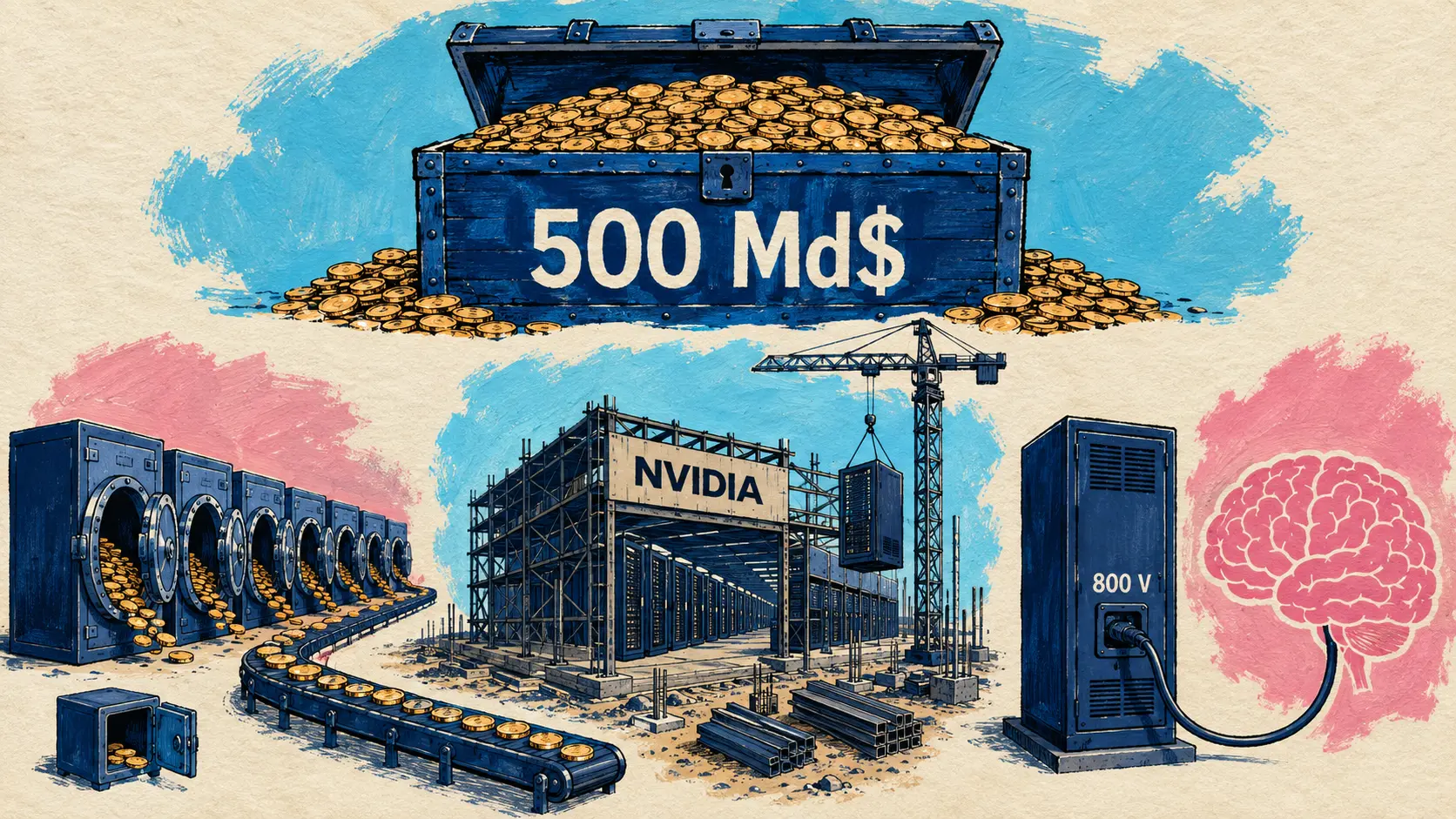
August 12 — NVIDIA announced partnerships with six major finance and investment players — Apollo, BlackRock, Blackstone, Brookfield, Goldman Sachs, and KKR — to set up independent financing platforms aimed at mobilizing more than $500 billion in third-party capital. The goal: to support, over the long term, the construction of “AI factories,” the massive data centers dedicated to training and inference for models.
NVIDIA presents this move as a structural turning point for the industry: financing the deployment of AI computing capacity would no longer rest solely on the balance sheets of technology companies themselves, but would now rely on dedicated financing vehicles backed by leading financial institutions rather than just the sector’s big firms.
This announcement continues other NVIDIA infrastructure initiatives detailed in recent days: the 800-volt DC power architecture for future generations of accelerators, and the NSF program for regional AI hubs in the United States. It confirms the scale of the capital needs required to support computing demand, at a time when the race for AI infrastructure is accelerating across all major cloud providers.
Alibaba releases the open weights for Qwen3.8-2.4T-A95B, a 2.4-trillion-parameter reasoning model
August 12 — Alibaba releases the open weights for Qwen3.8-2.4T-A95B, the flagship model initially announced in early August under the name Qwen3.8-Max. This is the effective release of the weights: a fine-grained Mixture-of-Experts model totaling 2.4 trillion parameters, of which 95 billion are active per token, designed for demanding reasoning and agentic workloads.
The architecture alternates full attention layers and linear attention layers: the former handle token-to-token interaction, while the latter rely on a bounded recurrent state to control memory as context grows. The model supports a context window of up to 1 million tokens, with an output length of up to 128K tokens, and includes configurable reasoning-depth control (low/high/xhigh) to balance compute cost and response quality depending on the task.
NVIDIA, which details the deployment in a dedicated technical post, reports native throughput exceeding 4,000 tokens per second per GPU on a GB300 NVL72 (72 Blackwell Ultra GPUs) in FP8 precision, with NVFP4 optimizations expected soon.
| Measured indicator | Measured value |
|---|---|
| Total / active parameters | 2.4 trillion / 95 billion |
| Context window | up to 1 million tokens |
| Throughput per GPU | more than 4,000 tokens/s (GB300 NVL72, FP8) |
| Throughput per user | more than 350 tokens/s |
| Weight availability | Hugging Face, ModelScope |
The weights are available on Hugging Face and ModelScope, with deployment supported by SGLang, vLLM, NVIDIA Dynamo, and NVIDIA NIM; fine-tuning is possible via NVIDIA NeMo AutoModel (LoRA and SFT).
🔗 NVIDIA announcement on X · NVIDIA technical post
Zed launches Delta, a multiplayer environment for coding with agents
August 12 — Zed unveils Delta, a multiplayer environment for coding with agents and reviewing what they produce. The product is built on DeltaDB, the database introduced in early access in early July under the label “Google Docs for code.” Delta is its first concrete application, with the first private beta invitations sent starting August 12.
In Delta, the conversation with the agent becomes a document in its own right: the cursor works everywhere in the thread, with the same keyboard shortcuts as in the code editor. To respond to a specific point, you just place the cursor there and start typing, with nothing out of reach in the thread.
Review happens right where the work took place: the agent that wrote the code remains present in the thread, making it possible to ask it a question directly rather than reconstructing its intent from a diff. A thread can be shared in one click, and teammates participate as full-fledged actors — they can explore the history, co-edit prompts, or pick up the work several days later without wondering whether the latest code was properly committed.
Delta is built on DeltaDB, which keeps your code and conversation in sync for everyone in the thread, in real-time. It works with the git repo you already have. Every edit and conversation is captured between your commits. — @zeddotdev on X
Zed is gradually expanding invitations over the coming weeks; waitlist sign-ups are open.
SL2T: Google DeepMind translates sign language into text on Pixel 11
August 12 — Google DeepMind introduces SL2T (sign-language-to-text), a model that converts sign language directly into written text. The feature is coming to Android: users can now sign directly in Gboard and Live Transcribe instead of typing, for web search, message drafting, or queries sent to Gemini.
Technically, the system relies on a MediaPipe Holistic model running on-device, which tracks body positions (hands, arms, torso, head, face) rather than recording raw video — the original video is immediately deleted, and only the geometric pose coordinates are sent to servers for translation. This choice protects privacy while enabling direct translation from coordinates to text, without going through intermediate annotations that until now limited the precision of existing systems.
The model was trained on more than 100,000 hours of data covering more than 50 sign languages, including about 25% in American Sign Language (ASL). On the FLEURS-ASL benchmark, SL2T achieves a zero-shot score of 70 BLEURT, which Google DeepMind describes as significantly higher than any previously reported score.
The development involved the Deaf community at every stage through a dedicated advisory committee, which co-authored a joint impact report detailing the system’s capabilities and limits. The feature launches with ASL to English on Pixel 11, with other devices and sign languages planned for the future.
SL2T is state-of-the-art on academic benchmarks, plus it’s optimized for real-world use like one-handed signing while holding a phone. To protect privacy, it tracks body poses on-device, while our servers translate them into text. — @GoogleDeepMind on X
🔗 Official Google DeepMind announcement
Suno announces a global partnership with BMG
August 12 — Suno announces a global partnership with BMG (Bertelsmann Music Group), one of the world’s leading record labels and music publishing companies. The company describes the deal as a “landmark” for building a creative ecosystem that brings together artists and songwriters rather than bypassing them.
This partnership comes in a particular context: Suno was the subject of lawsuits in 2024-2025 from the three major record labels — Universal Music Group, Warner Music Group, and Sony Music — for unauthorized use of copyrighted recordings in training its models. A deal with BMG therefore marks a strategic shift toward negotiated licensing relationships with the music industry rather than a legal power struggle, a trend already underway on the video side through the agreement between Runway and Bertelsmann in July — of which BMG is precisely a part.
The press release does not detail the financial terms or the exact scope of the agreement (catalog available for training, compensation for rights holders, tools offered to BMG artists). These elements remain to be clarified through forthcoming official communications from Suno and BMG.
Agentic development tools: Devin, Replit, VS Code, and JetBrains
Several AI-assisted development tools moved forward in parallel on August 12, between new models becoming available, infrastructure control, and agent plugin standardization.
Grok 4.6 available in Devin, Cognition ranks it behind Opus 5 and Fable 5
Cognition adds Grok 4.6 (xAI, announced the same day) as an available model in Devin. The team positions it as a significant improvement over Grok 4.5, ranking it ahead of GPT-5.6 Sol and just behind Opus 5 and Fable 5 in its own internal ranking. Cognition highlights a particular strength in deep code exploration and root-cause analysis before any modification — a useful point for complex debugging tasks where Devin must understand a system before touching it.
Replit lets users choose the hosting region for workspaces (Pro/Enterprise)
Replit opens the choice of hosting region for new workspaces to Pro and Enterprise customers, between North America, Europe, and Asia. The goal is twofold: reduce perceived latency during development and give control over the location of data and application previews, a point often required in enterprise contexts (compliance, user proximity). The feature adds to the already existing ability to choose the region for published applications, and becomes available immediately for eligible accounts.
Agent Plugins 1.0 arrives in VS Code, Copilot CLI, and the Copilot app
The open standard Agent Plugins 1.0, published on August 6 with AWS, Anysphere (Cursor), Microsoft, OpenAI, and Vercel — and since joined by Google as a maintainer — now arrives in VS Code, Copilot CLI, and the Copilot app. A plugin packaged once (agent skills + MCP servers) becomes installable from the Awesome Copilot marketplace and works unchanged across multiple compatible clients, with no mandatory migration for existing Copilot plugins. For enterprises, governance passes through managed-settings.json, available on Copilot Business and Enterprise plans.
Copilot for JetBrains gains persistent memory and local Ollama access
GitHub Copilot for JetBrains receives a broad update: persistent memory now makes it possible to retain and recall useful information from one agent chat session to another, avoiding repeating the project context or preferences. Another notable addition, Ollama becomes a BYOK (Bring Your Own Key) provider, giving access to models run locally directly in JetBrains’ model selector. Enterprises also gain server-side controls over plugin availability, MCP access, and permission-bypass behavior.
Open models and embedded AI
On the model side, several labs are releasing back-to-back open versions optimized for local inference and document understanding.
Hugging Face: Transformers.js exceeds 10 million monthly downloads
Clément Delangue, CEO of Hugging Face, announces that Transformers.js, the library that lets AI models run directly in the browser, has passed the 10 million monthly downloads mark — growth close to 10x in just six months, built in-house over the past three years. Delangue links this growth to a broader trend: a growing share of AI workloads moving to local execution, for reasons of cost, privacy, and resilience in the face of compute shortages. The message contains no additional technical details: it is a traction announcement about an existing project.
Ai2: OlmoEarth Studio now allows exporting custom embeddings
Ai2 (Allen Institute for AI) adds Earth observation embedding vector computation and export to OlmoEarth Studio, in three variants: Nano (128 dimensions, 1.4 million parameters), Tiny (192 dimensions, 6.2 million), and Base (768 dimensions, 89 million). The vectors, stored in Cloud-Optimized GeoTIFF, can be used directly in standard GIS tools (QGIS, GDAL, rasterio). Demonstrated use cases include similarity search, few-shot segmentation — a land-cover map trained on 60 annotated pixels reaches a weighted F1 of 0.84 — and temporal change detection. Models and code are published on Hugging Face and GitHub.
Liquid AI: LFM2.5-VL-3B, a vision-language model for the edge
Liquid AI releases LFM2.5-VL-3B, a 3.1-billion-parameter vision-language model optimized for on-device inference. It combines a 400M SigLIP2 visual encoder with a 2.6-billion-parameter text backbone, trained on about 34 trillion tokens. On benchmarks, it scores 81.0% on MMBench (versus 80.0% for the previous version), 87.9% on RefCOCO grounding, and 91.1% on DocVQA. Speed-wise: 228 tokens/second on CPU (M5 Max) and 20 tokens/second on mobile (Galaxy S26 Ultra), for a memory footprint of about 3 GB. The model is available on Hugging Face with llama.cpp, MLX, vLLM, and SGLang integrations.
Cohere launches North Micro Vision, its smallest vision-language model
Cohere is expanding its North model family with North Micro Vision, its smallest vision-language model to date. This 2.4-billion-parameter model is designed for sophisticated document understanding and released as open source under the Apache 2.0 license, with weights available on Hugging Face. Despite its reduced size, it includes native-resolution visual processing, multi-turn image-and-text conversations, spatial reasoning, and multilingual image understanding. Cohere says it outperforms Gemma 4 E2B and Ministral 3 3B across a wide range of visual understanding benchmarks, without providing precise figures in the announcement.
Connected assistants: Gemini and Runway expand their integrations
Gemini adds 14 new connected apps
Google is expanding the list of apps that can be connected directly to Gemini from settings: 14 new services are joining the catalog, including Zoho Bigin, Granola, Wix, GetYourGuide, Ticketmaster, OpenTable, Pandora, iHeartRadio, Thumbtack, Zocdoc, and Otter.ai. Once the service is connected, you just ask Gemini, for example, “Find an eye doctor appointment near work on Zocdoc,” and the assistant interacts directly with the service. The rollout is happening gradually over the coming weeks, continuing Google’s strategy of making Gemini a single entry point to multiple third-party services.
🔗 Official Google announcement
Runway connects Agent to Figma, Dropbox, and Notion
Runway is adding Figma, Dropbox, and Notion connectors to Agent, its production assistant built into the platform, to prevent creative assets from staying siloed in separate tools. Agent can now directly sync designs, files, and documents from these third-party platforms into a single workspace. This feature is available on all paid plans, in line with Runway’s strategy of making Agent a central media-production hub connected to creative teams’ existing tool ecosystem.
OpenAI study on enterprise adoption of agentic AI
OpenAI is publishing two complementary studies on enterprise use of AI: “Enterprise Signals,” a practical overview of agentic AI among its customers, and a companion working paper on how adoption spreads across companies, roles, and seniority levels. The central finding: usage is shifting from assistance to execution. In June, Codex generated 64% of the combined token volume produced by Codex and ChatGPT among enterprise customers. The gap is widening between the most advanced companies and the rest: “frontier firms” (top 10% in monthly usage) now generate 8.3 times more output tokens per active user than typical companies, up from a 2.6x ratio in January. Since February, weekly Codex users in enterprise have increased 108-fold in legal and 41-fold in sales, versus a 5-fold increase in engineering.
Briefs
- Grok 4.6 available in v0 (Vercel) — on the same day xAI announced it, v0 adds Grok 4.6 to its model selector for app generation. 🔗 Tweet
- Open_MOSS releases FP8/NF4 versions of MOSS-VL — quantized versions of MOSS-VL-Instruct and MOSS-VL-Realtime for local inference with only 24 GB of VRAM. 🔗 Tweet
- Google AI Studio offers a 3D viewer for the total solar eclipse on August 12 — real-time tracking of the Moon’s shadow across the globe, with local-sky simulation from Reykjavík or Valencia. 🔗 Tweet
- GitHub Enterprise Server 3.22 in release candidate — Copilot CLI in disconnected environments, Enterprise Teams generally available, refined controls for secret scanning and rulesets. 🔗 Changelog
- Rule insights available at organization level (public preview) — the ruleset audit dashboard expands beyond the repository level, with CSV export. 🔗 Changelog
- Automatic migration of branch protection rules to rulesets — a “Convert to ruleset” button automatically translates a classic rule into the equivalent ruleset. 🔗 Changelog
- Seedance 2.5 arrives in Genspark’s AI video agent — 30-second generation in a single pass, up to 30 reference images and 10 video/audio clips. 🔗 Tweet
- Genspark at Grant Thornton — accelerated proposal generation — the firm generates RFP responses from a single prompt, with systematic human review. 🔗 Tweet
- GitHub Monthly Enterprise Roundup — August 2026 edition — the roundup highlights AI’s shift from code completion to end-to-end governed engineering workflows. 🔗 Tweet
- LTX-2.5 available on Runway — Lightricks’ open world model, released on August 11, joins Runway’s model catalog. 🔗 Tweet
- FLUX 3 available on Luma — Black Forest Labs’ first unified multimodal model (image, video, audio) arrives on Luma, with native video-to-audio generation. 🔗 Tweet
- Nemotron 3.5 Lightning available in Perplexity’s Agent API — NVIDIA’s open 30B MoE model joins the high-volume execution layer of Perplexity agents. 🔗 Tweet
- Qwen-Image-3.0 available on OpenArt — Alibaba’s image-generation model expands its distribution to a new third-party platform. 🔗 Tweet
- Qwen3.8-Max rises to 4th place on the Legal Research Bench — the model moves from 22nd to 4th place in this legal research benchmark. 🔗 Tweet
- Daybreak models (cybersecurity) available via Amazon Bedrock — OpenAI’s Daybreak Blue and Daybreak Red are accessible to authorized defenders directly from the Bedrock console. 🔗 OpenAI
What this means
AI infrastructure financing is scaling up: the $500 billion mobilized by NVIDIA from traditional financial players (Apollo, BlackRock, Goldman Sachs, KKR…) marks the shift from a model funded only by tech balance sheets to dedicated capital vehicles. This macroeconomic move pairs with a more concrete reality: Qwen3.8-2.4T-A95B, released the same day, runs natively at more than 4,000 tokens per second per GPU on NVIDIA GB300 infrastructure — capital appetite and compute demand feed each other, with every new massive model further justifying the announced investments.
Open weights continue to expand across every scale: from Alibaba’s 2,400-billion-parameter frontier model to Cohere’s 2.4-billion vision-language model, via Liquid AI’s LFM2.5-VL-3B designed to run on mobile. This diversification by size — not just by performance — confirms the traction measured by Hugging Face: Transformers.js has been downloaded 10 million times per month, nearly 10 times more than six months ago, proof that local inference is moving beyond the experimental stage to become a full-fledged production option.
AI-assisted development tools are converging toward richer collaboration formats. Zed turns the exchange with the agent into a shared, versioned document with Delta, GitHub is standardizing agent plugins across VS Code, Copilot CLI, and JetBrains via Agent Plugins 1.0, and both Devin and v0 integrate Grok 4.6 on the very day of its release by xAI. The common thread: these tools are no longer just isolated assistants, but interoperable infrastructure layers, where the choice of underlying model and memory between sessions matter as much as code generation itself.
Finally, AI is embedding more deeply into everyday uses and industrial relationships that are negotiated rather than imposed. Google DeepMind’s SL2T translates sign language directly on Pixel 11 with an architecture designed for privacy, Gemini and Runway are expanding their connectors to dozens of third-party services, and Suno has signed a licensing agreement with BMG that contrasts with the 2024-2025 legal disputes — a sign that the music industry is now negotiating with generative models rather than systematically fighting them. On the enterprise side, OpenAI’s study confirms that this shift toward agentic execution is already widening sharply between the most advanced organizations and the rest.
Sources
- NVIDIA — $500 billion financing partnerships
- NVIDIA — Qwen3.8-2.4T-A95B announcement on X
- NVIDIA — Qwen3.8-2.4T-A95B technical post
- Zed — Delta announcement on X
- Zed — DeltaDB on X
- Google DeepMind — SL2T, sign language
- Google DeepMind — SL2T on X
- Suno — BMG partnership
- Cognition — Grok 4.6 in Devin
- Replit — workspace region selection
- GitHub — Agent Plugins 1.0
- GitHub — Copilot JetBrains, memory, and Ollama
- Hugging Face — Transformers.js 10 million downloads
- Ai2 — OlmoEarth Studio embeddings
- Liquid AI — LFM2.5-VL-3B
- Cohere — North Micro Vision
- Google — 14 new apps connected to Gemini
- Runway — Figma, Dropbox, Notion connectors
- OpenAI — study on enterprise adoption of agentic AI
- v0 — Grok 4.6
- Open_MOSS — FP8/NF4 versions
- Google AI Studio — eclipse 3D viewer
- GitHub — GHES 3.22 RC
- GitHub — Rule insights organization
- GitHub — migration from branch protection to rulesets
- Genspark — Seedance 2.5
- Genspark — Grant Thornton
- GitHub — Monthly Enterprise Roundup August 2026
- Runway — LTX-2.5
- Luma — FLUX 3
- Perplexity — Nemotron 3.5 Lightning
- Alibaba Qwen — Qwen-Image-3.0 on OpenArt
- Alibaba Qwen — Legal Research Bench
- OpenAI — Daybreak on Amazon Bedrock