ai-powered-markdown-translatorArticle translated from fr to en with gpt-5.4-mini.
Claude Code version 2.1.198 reaches a new milestone with Claude in Chrome moving to general availability and background agents automatically creating draft PRs in worktrees. GitHub simultaneously confirms the permanent shutdown of GitHub Models on July 30, 2026, repositioning Copilot as the platform’s single AI entry point. The day is rounded out by Cognition’s enterprise vulnerability remediation program, Together AI’s ParallelKernelBench benchmark for multi-GPU kernels, a SynthID update from Google DeepMind with unprecedented collaborations with OpenAI, NVIDIA, and Apple, and several GitHub Copilot updates.
Claude Code v2.1.198 — Chrome GA and automatic PR drafts
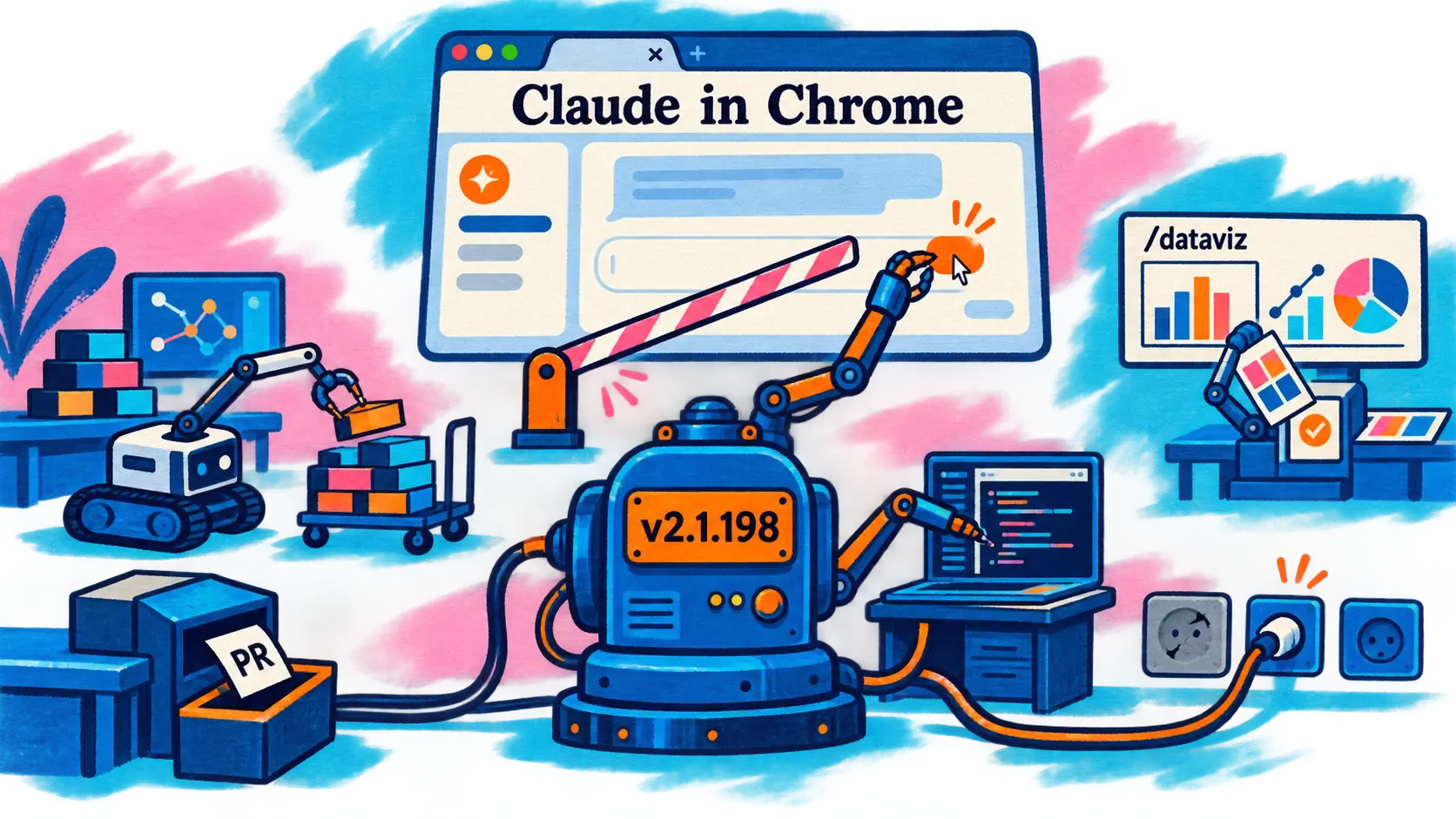
July 1 — Claude Code version 2.1.198 moves the Claude in Chrome extension to generally available (generally available), enabling the agent to interact directly with web pages open in Chrome from the Claude Code interface. The extension, available in beta for several weeks, is leaving the experimental phase.
The second major addition concerns background agents: those launched from claude agents in a worktree now automatically create a commit, push the code, and open a draft PR when they finish, without pausing to ask for confirmation. This change reduces manual back-and-forth in agentic development workflows.
| Feature | Details |
|---|---|
| Claude in Chrome GA | The Chrome extension moves from beta to general availability |
| Automatic draft PRs | Background agents commit, push, and open a draft PR without manual intervention |
Skill /dataviz | New skill for designing charts and dashboards, with an executable color palette validator |
| AWS Gateway | anthropicAws (Claude Platform on AWS) added as an upstream provider; “model not found” errors automatically advance the failover chain |
| Explore inherits model | The built-in Explore agent inherits the session model (capped at Opus) instead of running on Haiku |
| Inherited extended thinking | Subagents and context compaction inherit the session’s extended thinking configuration |
Among the notable fixes: transient network errors (ECONNRESET) now trigger a retry with exponential backoff instead of ending the turn; the AWS/Mantle STS token is automatically refreshed via awsAuthRefresh; conditional .claude/rules/ rules load correctly even through symlink paths (symlink). Version 2.1.199, released on July 2 on npm, is mentioned in the npm registry but its changelog had not yet been updated at the time of scanning.
GitHub Models permanently removed on July 30, 2026
July 1 — GitHub confirms the permanent shutdown of GitHub Models on July 30, 2026. The playground, model catalog, inference API, and BYOK (bring your own key) mode will be removed for all customers — including active existing users who were still accessing the service.
The shutdown for new customers had been announced in June 2026. GitHub is planning two preliminary brownouts on July 16 and July 23 to prepare for the transition. After July 30, any request to the GitHub Models inference API will return an error.
| Alternative | Use case |
|---|---|
| Azure AI Foundry | Third-party model catalog for teams that want direct access to models independent of Copilot |
| GitHub Copilot | Integrated access to models within GitHub, automatic selection by task, billing via AI credits |
GitHub Models was launched as a testing space for AI models directly from the GitHub interface. Its removal marks a strategic repositioning: GitHub is unifying model access under GitHub Copilot, which now includes open-weight models (Kimi K2.7 since July 1), automatic selection by task type, and granular control over credits.
Teams using the GitHub Models inference API must migrate before July 30 or risk service interruption. The July 16 and 23 brownouts are intended to test pipeline resilience before the final shutdown.
🔗 Changelog — GitHub Models removed
Devin Security Vulnerability Remediation Program
July 2 — Cognition launches the Devin Security Vulnerability Remediation Program, a six-week enterprise support program to clear backlogs of application vulnerabilities. It is built on Devin Security Swarm (announced the day before) as the engine for continuous vulnerability discovery.
The program is based on two pillars. The first targets backlog reduction: Devin ingests reports from existing scanners (Snyk, SonarQube, Checkmarx, Semgrep, Wiz, Veracode), validates vulnerabilities, and submits fix PRs. The second pillar, continuous remediation, entrusts Devin Security Swarm with finding the vulnerabilities that static scanning tools miss — business logic flaws, chained authentication bypasses, cross-service exploit paths.
| Week | Activity |
|---|---|
| 1-2 | Inventory, scope, Devin setup, workflow mapping |
| 3-4 | Large-scale remediation across priority repositories |
| 5-6 | Results review, planning for broader rollout |
The program is reserved for enterprise customers deploying Devin Cloud at scale. Eligible teams can sign up through their Cognition account manager.
🔗 Cognition — Devin Security Vulnerability Remediation Program
ParallelKernelBench — frontier LLMs struggle with multi-GPU kernels
July 2 — Together AI publishes ParallelKernelBench, an open-source benchmark of 87 problems extracted from real codebases (Megatron-LM, DeepSpeed, TensorRT-LLM, NeMo-RL) to evaluate LLMs’ ability to generate high-performance multi-GPU CUDA kernels — tensor parallel, expert parallel, FSDP/ZeRO, NVLink communication. Current frontier models solve less than one third of the problems.
| Model | pass@3 | fast1@3 (correct AND faster than the reference) |
|---|---|---|
| GPT-5.5 | 36/87 | 27/87 |
| Claude Opus 4.7 | 31/87 | 20/87 |
| Gemini 3 Pro | 30/87 | 19/87 |
| DeepSeek V4 Pro | 3/87 | 1/87 |
The main bottleneck is NVLink communication and advanced mechanisms (TMA, NVLS), which are practically absent from current model generations. In agentic mode (Gemini 3 Pro with terminal access), the score rises to 35/87 correct and 26 faster than the PyTorch+NCCL reference. Some generated kernels outperform existing public implementations, including a NeMo kernel (Gemini 3 Pro) with no known optimized equivalent.
🔗 Together AI — ParallelKernelBench
SynthID: 100 billion watermarked assets, text code open-sourced
July 1 — Google DeepMind shared a maturity update on SynthID via @GoogleAI, its digital watermarking technology for AI-generated content. More than 100 billion images and videos now carry the SynthID watermark, in addition to 60,000 years of marked audio content. More than 50 million checks have been performed by users via Google Search, the Gemini extension for Chrome, and the Gemini app.
Google is adopting the open standard C2PA (Content Authenticity Initiative) across all of its generative tools: images and videos created in the Gemini app now include both the SynthID watermark and C2PA metadata. The watermarking code for text is being released as open source.
A key highlight: Google announces collaborations with OpenAI, NVIDIA, and Apple to extend SynthID to the generative media of these players. This is the first time Google has publicly communicated concrete partnerships with these three companies on AI content provenance.
GitHub — New Copilot features
AI credit pools included for cost centers
July 2 — GitHub cost centers can now limit the share of included AI credits (monthly pool) consumed by department. This feature is separate from the per-user budgets introduced on June 30, which only manage the additional billing phase.
GitHub automatically calculates the cap based on the licenses assigned to the cost center. Two behaviors can be configured when the cap is reached: block usage or switch to additional billing. Available via the REST API (GUI coming soon) for Copilot Business and Copilot Enterprise on GitHub Enterprise Cloud.
Issue fields generally available
July 2 — Structured issue fields (Priority, Effort, Start date, Target date) become generally available for all GitHub organizations (Free, Team, Enterprise). More than 40,000 organizations were already using them since the public preview in May. Field values now appear directly in repository issue lists, and public projects benefit from visibility controls.
The most notable integration: the GitHub MCP server exposes these fields to Copilot for both reading and writing, paving the way for agentic workflows that create and update issues with structured metadata from Copilot chat or the agent.
Synthesia — Speak, listen, see: the three levels of interactive video avatars
July 2 — Synthesia publishes a research paper defining a new model category: Interactive Avatar Models. These models differ from classic video generation systems in their ability to sustain real-time dialogue, with latency low enough to make the interaction feel natural.
The paper structures capabilities into three progressive levels:
| Level | Capability |
|---|---|
| Speak (Talk) | Video speech generation from text |
| Listen (Listen) | Understanding and responsiveness to humans |
| See (See) | Visual understanding of the conversational context |
This is the first conceptual framework published by a major avatar player to formalize this category — positioning Synthesia as a research lab in addition to its role as a commercial platform, in a market fiercely competing with HeyGen and Microsoft Azure AI Avatar.
Fable 5 back as orchestrator in Perplexity Computer
July 2 — Perplexity announced via @perplexity_ai that Claude Fable 5 is available again as the orchestrator model in Perplexity Computer, its desktop automation product. The announcement follows Anthropic’s global restoration of Fable 5 on July 1. The tweet generated 55,529 views and 943 likes.
Perplexity Computer lets users delegate automation tasks to an AI agent that acts on the desktop. Bringing Fable 5 back as orchestrator strengthens the system’s reasoning and planning capabilities, after its removal imposed by U.S. export controls in June 2026.
Briefs
- Amp — unlimited thread reading and agents in Orbs — Amp can now read threads of any size (up to 271 documented rounds), and publishes a technical post on the Orbs architecture for running agents on remote headless machines. 🔗 Chronicle Amp
- C++ skill for Copilot CLI — Microsoft’s C++ language server is available as a Copilot CLI plugin, with a skill that automatically generates and maintains the
compile_commands.jsonfile for CMake and MSBuild. Installation:/plugin install cpp-language-server@copilot-plugins. 🔗 Changelog
What it means
Agentic tooling is crossing a threshold of autonomy. Claude Code v2.1.198 illustrates a clear trajectory: agents no longer stop to ask for confirmation on technical steps — they create commits, push code, open draft PRs, and notify at the end. The Devin Security Remediation program pushes the same logic on the security side: Devin ingests existing scanner reports, validates vulnerabilities, and submits PRs without per-repository configuration. Amp rounds out the picture with its Orbs, which run agents on remote headless machines. These three announcements on the same day converge on a model where the agent manages the workflow end to end, with humans validating the final result rather than every intermediate step.
Infrastructure and benchmarks reveal structural gaps. GitHub Models being removed signals that the market does not support generic model-access layers: GitHub is repositioning toward Copilot (native integration, credit control, automatic selection by task). ParallelKernelBench provides a complementary view of the current limits of LLMs: even the best frontier models (GPT-5.5: 27/87, Claude Opus 4.7: 20/87) struggle to generate high-performance multi-GPU CUDA kernels, a domain where NVLink communication remains an unresolved bottleneck. The two GitHub cost-center mechanisms (user budgets from June 30 + included credit pools from July 2) also show that governing enterprise AI spending is becoming as critical as model performance.
SynthID and cross-industry provenance: unprecedented momentum. The SynthID milestone — 100 billion watermarked assets, C2PA adoption, open-source text code — goes beyond the numbers to signal a turning point: for the first time, Google is announcing concrete collaborations with OpenAI, NVIDIA, and Apple on watermarking AI content. The fact that direct competitors are coordinating on the provenance of generated media, in a context of growing regulatory pressure, shows that this issue has moved out of each company’s silo and become shared trust infrastructure.
Sources
- Claude Code changelog
- GitHub Changelog — GitHub Models removed
- Cognition — Devin Security Vulnerability Remediation Program
- Together AI — ParallelKernelBench
- @GoogleAI tweet — SynthID
- GitHub Changelog — Cost centers
- GitHub Changelog — Issue fields GA
- Synthesia blog
- @perplexity_ai tweet — Fable 5 in Perplexity Computer
- Amp Chronicle
- GitHub Changelog — C++ skill for Copilot CLI