ai-powered-markdown-translatorArticle translated from fr to en with gpt-5.4-mini.
On June 2, 2026, Microsoft Build 2026 triggers a massive wave of GitHub Copilot announcements — expanded app with Canvases, SDK in general availability, fully revamped CLI, cloud and local sandboxes — while NVIDIA unveils its unified agentic AI stack (RTX Spark, DGX Station for Windows, OpenShell, Nemotron 3 Ultra). In parallel, OpenAI extends Codex to all professional roles with 6 new plugins and 5 million weekly users, and Anthropic expands Project Glasswing to 150 new organizations in 15 countries while launching Claude Security, its public cybersecurity product.
GitHub Copilot at Microsoft Build 2026 — Expanded app, Canvases and agentic infrastructure
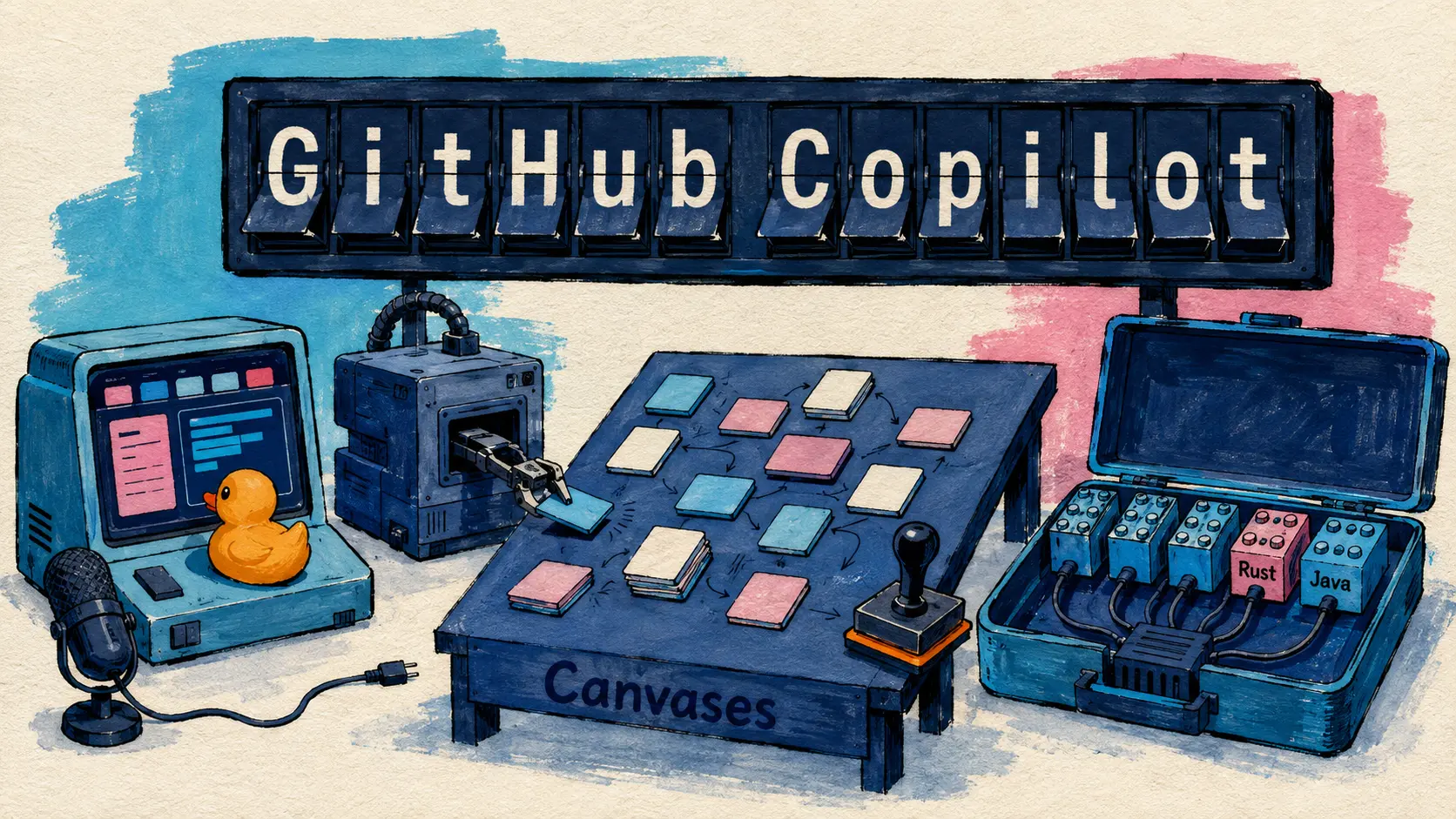
June 2 — Microsoft Build 2026 is the setting for a wave of 13 GitHub Copilot announcements in a single day. The centerpiece: the Copilot app moves from limited preview to availability for all Pro, Pro+, Business and Enterprise subscribers, with a major new feature — Canvases.
Canvases are bidirectional agent ↔ human work surfaces: the agent updates the canvas in real time while it works, and the human can edit, reorder and approve directly. Other flagship app features: voice on-device (no audio leaves the machine), cloud sessions (copilot --cloud), agentic navigation in the integrated browser (clicking, typing, screenshots), rubber duck (adversarial thinking before committing), and /chronicle to query all past sessions.
Canvases are described in the GitHub changelog as “a new bidirectional workspace where the agent updates the canvas as it works, and the human can edit, reorganize and approve in real time.”
🔗 Copilot App — GitHub Changelog
Copilot CLI — rubber duck GA, voice GA, scheduling
The Copilot CLI gets a major overhaul for Build 2026. Three features reach general availability:
- Rubber duck: during a task, the main agent delegates its current plan to an internal critic agent for adversarial review and actionable feedback before committing
- Voice input: hold space to dictate; local processing (downloadable STT model), no audio sent to the cloud
- Scheduling:
/every 30m <prompt>and/after 2h <prompt>to schedule recurring or delayed tasks in the session
A new experimental terminal interface (accessible via /experimental) introduces a streamlined layout with tabs (Session, Issues, Pull Requests, Gists) and adapted color modes (including high-contrast and colorblind).
🔗 Copilot CLI — GitHub Changelog
Copilot SDK — general availability in 6 languages
The Copilot SDK reaches general availability with 6 supported languages, including two new ones at GA:
| Language | Status at GA |
|---|---|
| Node.js/TypeScript | Available |
| Python | Available |
| Go | Available |
| .NET | Available |
| Rust | New at GA |
| Java | New at GA |
The SDK makes it possible to integrate the Copilot agentic runtime into third-party applications. Capabilities: custom tools + MCP, fine-grained system prompt customization by section, OpenTelemetry tracing (W3C), flexible authentication (OAuth, GitHub Apps, tokens, BYOK for OpenAI/Azure/Anthropic). Available to all Copilot subscribers including Copilot Free; BYOK access without a Copilot subscription.
🔗 Copilot SDK GA — GitHub Changelog
Cloud and local sandboxes for Copilot (public preview)
GitHub introduces two types of sandboxes to secure agentic workflows:
| Type | Command | Infrastructure | Availability |
|---|---|---|---|
| Local sandbox | /sandbox enable | Microsoft MXC (macOS/Linux/Windows) | Included in the standard Copilot seat |
| Cloud sandbox | copilot --cloud | Ephemeral Linux hosted by GitHub | Continuous sessions across devices |
Local sandboxes restrict the filesystem, network and system capabilities. They are configurable via Microsoft Intune/MDM for enterprise deployments. Cloud sandboxes make it possible to offload intensive workloads and parallel sessions. The infrastructure reflects Copilot’s evolution from in-editor assistant to autonomous agent that runs commands and modifies files.
🔗 Copilot sandboxes — GitHub Changelog
OpenAI Codex for every role, tool and workflow
June 2 — OpenAI announces a major expansion of Codex beyond software development. With more than 5 million weekly users, non-developers now account for 20% of users and are growing 3 times faster than developers.
Three major new features:
1. Role-specific plugins (6 plugins launched)
| Plugin | Target audience | Integration examples |
|---|---|---|
| Data Analytics | Analysts, business teams | Snowflake, Databricks, Tableau |
| Creative Production | Marketing, creatives | Figma, Canva, Shutterstock |
| Sales | Sales teams | Salesforce, HubSpot, Outreach |
| Product Design | Product designers | Figma, Canva |
| Public Equity Investing | Equity investors | Moody’s, FactSet, S&P, PitchBook |
| Investment Banking | Bankers | Research and diligence data |
Total: 62 applications and 110 skills. No-code installation required. Next announced plugins: Corporate Finance, Private Equity Investing, Marketing Strategy, Strategy Consulting, Legal.
2. Sites (Business/Enterprise preview): Codex can create and share hosted interactive websites — dashboards, planners, galleries, lightweight tools — shareable via URL in the workspace. Ecosystem partners: Vercel, Wix, Base44, Replit, Lovable, Figma, Webflow, Emergent.
3. Expanded annotations: annotations (precisely selecting an element to edit) expand to documents, spreadsheets and presentations (in addition to code, Markdown and sites).
“We’re making Codex more useful for your work by expanding plugins beyond individual tools. These plugins turn Codex into a specialist for a specific role with a single install, no coding required.” — OpenAI on X
🔗 Codex for every role — OpenAI
OpenAI on AWS — general availability
June 1 — OpenAI announces the general availability of its frontier models and Codex on AWS via Amazon Bedrock, in Commercial and GovCloud regions. This allows companies to integrate OpenAI into their existing AWS workflows (security, compliance, billing, governance). Cited partner customers: Amgen (GPT-5.5 to speed up drug discovery) and Autodesk (building design workflows). A future announcement concerns Daybreak (cyber models + Codex Security) for security teams — secure code review, threat modeling, patch validation, dependency analysis.
Codex Changelog — integrated browser, computer use macOS, automations
June 2 — The Codex update introduces several major features in the application:
| Category | Feature |
|---|---|
| Verification | Integrated browser — open local or public pages, annotate on render |
| Verification | Computer use macOS — see, click and type in apps (outside EEA/UK/CH) |
| Task management | Chats — threads without a project folder (research, writing, planning) |
| Task management | Thread automations — scheduled reactivation of a thread |
| Software development | Integrated GitHub pull request workflow — PR inspection, diff review |
| Rich outputs | Artifact viewer — PDF, spreadsheet, presentation previews |
| Persistence | Memories — persistent context between sessions |
| Advanced (alpha) | Remote SSH connections, multi-terminals, Intel Mac |
🔗 Codex Changelog — OpenAI Developers
Anthropic expands Project Glasswing and launches Claude Security
June 2 — Anthropic announces a significant expansion of Project Glasswing, its collaborative cybersecurity initiative launched in early April 2026. Access to Claude Mythos Preview is expanded to about 150 new organizations across more than 15 countries.
During the initial phase with the ~50 original partner organizations, more than 10,000 critical or high-severity vulnerabilities were detected in real codebases. This expansion covers new sectors that had previously been underrepresented:
| Sector | Initial presence | June 2026 expansion |
|---|---|---|
| Technology | Yes | Yes |
| Finance | Yes | Yes |
| Energy / Water | No | Yes |
| Healthcare | No | Yes |
| Communications | No | Yes |
| Hardware | No | Yes |
The common selection criterion: a successful attack on the software infrastructure of these organizations could affect more than 100 million people. Many are critical software vendors that provide infrastructure to other organizations, including governments.
In parallel, Anthropic launches Claude Security, a public-facing product using the latest public frontier models (including Claude Opus 4.8) to scan codebases and suggest fixes. It is the public version of the internal tooling developed for Project Glasswing.
“Cheap, fast AI models with powerful cyber capabilities are around the corner. We want Project Glasswing to spur institutions toward operating norms that reflect this reality.” — Anthropic, Expanding Project Glasswing
Anthropic warns that within 6 to 12 months, other AI companies will have Mythos-class models — potentially without safeguards to prevent abuse. A Cyber Verification Program is in development to grant Mythos-class capabilities to more organizations for specific cyber-defense tasks.
Claude Code v2.1.160 — strengthened security, ultracode renaming, Windows/WSL fixes
June 2 — Claude Code moves to version v2.1.160 with a notable focus on file-operation security and several important fixes for Windows/WSL.
| Category | Change |
|---|---|
| Security | Confirmation before writing to .zshenv, .zlogin, .bash_login, ~/.config/git/ |
| Security | acceptEdits : confirmation before build-tool files (.npmrc, .yarnrc, .bazelrc…) |
| UX | workflow → ultracode renamed as the trigger keyword for dynamic workflows |
| Windows/WSL | Clipboard fix via PowerShell interop (solves MobaXterm issues) |
| Agents | Session resume fix — chat history preserved, prompt not replayed |
| Performance | Auto mode classifier: reduced latency on routine actions |
| Cleanup | Removal of CLAUDE_CODE_OPUS_4_6_FAST_MODE_OVERRIDE and JetBrains suggestion |
The workflow → ultracode renaming is a breaking change for existing workflows triggered by the keyword workflow.
🔗 Claude Code v2.1.160 — GitHub Releases
NVIDIA unveils its agentic AI stack at Microsoft Build 2026
June 2 — Jensen Huang joins Satya Nadella’s keynote from Taipei to announce an expanded NVIDIA × Microsoft partnership covering Windows, Azure and on-prem deployments.
Agentic AI hardware:
| Product | Key specs | Availability |
|---|---|---|
| RTX Spark | 1 AI petaflop, up to 128 GB unified memory, all-day battery life | Fall 2026, via Surface/ASUS/Dell/HP/Lenovo/MSI |
| DGX Station for Windows | GB300 Grace Blackwell Ultra, up to 748 GB coherent memory, 20 FP4 petaflops, models up to 1 trillion parameters | Q4 2026, via ASUS/Dell/GIGABYTE/HP/MSI/Supermicro |
Software and models:
- NVIDIA OpenShell: secure agentic runtime (sandboxing, policies as code), integrated into GitHub Copilot, open source under Apache 2.0 license
- Nemotron 3 Ultra: open frontier model for long-running agents (coding, research, enterprise), available this month on Foundry; plus Nemotron 3.5 ASR (speech recognition) + Nemotron 3.5 Content Safety
- NVIDIA Vera Rubin: validated by Microsoft for Azure deployment — 10x inference throughput per megawatt, one order of magnitude lower agentic token cost
- Fairwater Wisconsin: NVIDIA AI datacenter operational ahead of schedule, hundreds of thousands of Grace Blackwell systems
The integration of OpenShell into GitHub Copilot marks a direct convergence between NVIDIA’s hardware stack and Microsoft’s agentic infrastructure.
🔗 NVIDIA × Microsoft Build — NVIDIA Blog
NVIDIA Jetson JetPack 7.2 — Physical agentic AI at the edge
June 1 — Announced at COMPUTEX Taipei, JetPack 7.2 and NemoClaw support on Jetson bring agentic AI to physical deployments (robotics, inspection, industrial automation).
New capabilities: OS Yocto support (lightweight Linux base for memory-constrained deployments), CUDA 13 on Jetson Orin, MIG + real-time kernel on Jetson Thor for deterministic workloads, and Jetson AGX Orin 32GB up +20% performance to 241 TOPS. NemoClaw on Jetson now deploys with a single command.
Announced production adoptions: Solomon (humanoid robots), Advantech (smart factory), SandStar (vending — 30+ countries, -40% memory), Hexagon Robotics, Zipline (medical delivery drones). 1X (Neo Humanoid robot) and Universal Robots plan to adopt JetPack 7.2 with OS Yocto.
🔗 Jetson JetPack 7.2 — NVIDIA Blog
Search and generative media
Perplexity launches Search as Code — search becomes programmable for agents
June 1 — Perplexity introduces Search as Code (SaC), a new search architecture for AI agents. Instead of calling a monolithic pipeline via function calls or MCP, the model generates Python code that directly orchestrates the primitives of the search stack via an Agentic Search SDK. Available now in Agent API and Computer (default).
Benchmarks (Table 1):
| Benchmark | Perplexity (SaC) | OpenAI | Anthropic | Exa | Parallel |
|---|---|---|---|---|---|
| DSQA | 0.871 | 0.733 | 0.815 | 0.530 | 0.810 |
| BrowseComp | 0.805 | 0.720 | 0.598 | 0.380 | 0.560 |
| HLE | 0.612 | 0.614 | 0.566 | 0.387 | 0.515 |
| WideSearch | 0.651 | 0.522 | 0.590 | 0.471 | 0.584 |
| WANDR | 0.386 | 0.130 | 0.152 | 0.057 | 0.126 |
SaC dominates 4 out of 5 benchmarks. On WANDR, SaC is 2.5× better than OpenAI. Gains vs Perplexity baseline without SaC: +19.77 points on DSQA (+29%), +12.00 points on WANDR (+45%). A CVE case study demonstrates 200+ high-severity CVEs identified with 100% precision, token usage reduced by 85.1% (from 288,700 to 42,900 tokens). New WANDR benchmark for complex professional tasks, with details to be published in the coming weeks.
🔗 Search as Code — Perplexity Research
Cohere and RWS launch Language Weaver Pro — AI translation outperforming DeepL in 31/32 languages
June 1 — Cohere and RWS (one of the world’s largest translation providers) announce Language Weaver Pro, an enterprise AI translation solution co-developed on the same foundation as Cohere LLMs (Command A).
Benchmarks (automated evaluations):
| Comparison | Language Weaver Pro Result |
|---|---|
| vs DeepL NextGen | Wins in 31 out of 32 languages |
| vs GPT-5, Gemini 3 Flash | Outperforms in automated evaluations |
| vs Claude Sonnet 4.5 | Outperforms in automated evaluations |
| Overall human evaluation | 55% win rate vs DeepL NextGen |
| English → Japanese (sentences) | 100% win rate |
| English → Czech | 3/4 tests won |
Priority use cases: legal, regulatory, and financial translations, specialized terminology (chemical formulas, Japanese/Chinese name formats). Deployed on secure RWS infrastructure; RWS retains full ownership of the data; model operable on just 2 GPUs.
🔗 Language Weaver Pro — Cohere Blog
xAI Composer 2.5 in Grok Build
June 1 — xAI announces the availability of Composer 2.5 in Grok Build, its agentic development environment (848,000 views in a few hours). Composer 2.5 is described as a fast, state-of-the-art model, designed for long-running tasks and following complex instructions. Accessible via /model in Grok Build, then select “Composer 2.5”. Reserved for SuperGrok and X Premium+ subscribers.
Simultaneous update to Grok Build Beta CLI: native subagent view, Plan Mode integration, mouse support, fullscreen terminal UI.
Runway Aleph 2.0 via API
June 2 — Runway makes Aleph 2.0 available via the Runway API for integration into third-party applications.
“Aleph 2.0 is now available via the Runway API. Bring precise video editing directly into your apps, products and platforms. Edit up to 30 seconds of video at 1080p across multi-shot sequences, changing only what you want.” — @runwayml on X
Available on dev.runwayml.com.
Briefs
-
Agent Apps Marketplace — AI agents from partners are now installable from GitHub Marketplace. Initial wave: Amplitude, Bright Security, LaunchDarkly, Miro, Sonar, PagerDuty, Endor Labs. 3 entry points: issue assignment, @mention PR, UI Agents. 🔗 source
-
Copilot Cloud Agent Automations — The Copilot cloud agent can now run automatically on schedule (hourly/daily/weekly) or on repo events (new issue, PR). Use cases: issue triage, overnight test fixes, weekly release notes. 🔗 source
-
Copilot Memory Business/Enterprise — Cross-repo user preferences (communication style, tech stack, git conventions) are moving into public preview for Business and Enterprise. New admin controls: audit export, bulk deletion, user opt-out, isolation by billing entity. 🔗 source
-
Gemini 3.1 Pro (Preview) and 3.5 Flash in Copilot — Both Gemini models are now available in Copilot CLI, cloud agent, app (technical preview), and SDK. Pro+ plans for Flash, Student+ for 3.1 Pro Preview. 🔗 source
-
MAI-Code-1-Flash — Microsoft’s first purpose-built model for GitHub Copilot. Gradual rollout on VS Code. Free, Pro, Pro+, Max plans. First in a new wave of Microsoft code models. 🔗 source
-
NVIDIA local agents at COMPUTEX — OpenClaw and Hermes agents announced for RTX PC and DGX Spark, available locally, without cloud reliance. 🔗 source
-
Runway opens its European headquarters in London — London becomes Runway’s new European HQ and a hub for world model research. USD 100 million invested in the UK AI ecosystem over 18 months, amount more than doubled by 2028. 🔗 source
-
Martin Scorsese advisor to Black Forest Labs — Robin Rombach (BFL co-founder) announces that Martin Scorsese is an official advisor and uses FLUX for storyboarding and scene exploration. Next phases: multimodal and interactive visual AI. 🔗 source
-
OpenAI — Youth safety (G7 Évian) — OpenAI calls for the creation of an international institute dedicated to youth safety in the face of AI ahead of the G7 summit in Évian. 9 principles published. OpenAI Forum announced in Paris. 🔗 source
-
OpenAI — Policy position — Transparency statement: no PAC, no political donations. Separation between the personal activities of executives (Greg Brockman, Leading the Future) and OpenAI’s official positions. 🔗 source
-
Perplexity Computer — local/cloud hybrid inference — Perplexity announces that Computer will be able to split tasks between a local model (private data on the device) and frontier models in the cloud. Status: coming soon. 🔗 source
-
Perplexity connects to Apple Health — Perplexity Computer connects to Apple Health on iPhone (sleep, activity, HRV). Perplexity Health integrates the entry of lab results (biomarkers, blood tests). 🔗 source
-
Gemini CLI v0.44.1 — Stability patch for stable release v0.44.0. One fix only: PTY resize conflict resolution against crashes when resizing the window (PR #27496). v0.44.1 is now the recommended Latest release. 🔗 source
What it means
The battle for agentic platforms is underway. Microsoft Build 2026 marks a structural milestone: GitHub Copilot is no longer positioning itself as a code assistant but as a full agentic execution platform — with its own sandboxes, SDK in 6 languages, scheduled automations, and partner marketplace. The integration of NVIDIA OpenShell directly into Copilot, open source under Apache 2.0, shows that the secure agentic execution layer is becoming a common good for the ecosystem, not a proprietary differentiator. Competition is shifting toward work surfaces (Canvases), local voice, and the ability to orchestrate third-party agents in a trusted context.
Developer tooling is becoming more professionalized and expanding to every role. The expansion of Codex with 6 role-specific plugins, 62 applications, and 110 skills sends a clear signal: the 5 million weekly users are no longer mostly developers. Non-developers (analysts, bankers, designers) are growing 3 times faster. The GA Copilot SDK in 6 languages, the general availability of OpenAI models on AWS Bedrock Commercial and GovCloud, and the Codex Changelog with macOS computer use and integrated browser — all of this converges toward a general-purpose professional AI toolkit, anchored in existing enterprise workflows (AWS, GitHub, Microsoft 365).
AI security is becoming a product, not just a promise. The launch of Claude Security and the expansion of Project Glasswing to 150 organizations in 15 countries signal a maturation: AI-assisted cybersecurity (vulnerability detection, rewriting legacy code into memory-safe languages, automated penetration testing) is moving out of the lab and becoming a commercial product. The 10,000+ flaws detected during Glasswing’s initial phase illustrate the scale of the problem. Anthropic’s warning about the next 6 to 12 months — other AI companies will have Mythos-class models, potentially without guardrails — gives this announcement a strategic dimension beyond the product launch.
Agentic AI hardware is taking shape. RTX Spark (1 petaflop, 128 GB, fall 2026), DGX Station for Windows (748 GB, 20 FP4 petaflops, Q4 2026), Jetson JetPack 7.2 with +20% performance and NemoClaw in one command — NVIDIA is drawing a coherent range from physical edge to personal workstation. Microsoft Azure’s validation of Vera Rubin (10x inference throughput per megawatt) and the early operationalization of Fairwater Wisconsin show that the agentic compute infrastructure is catching up with model evolution speed. The convergence of software (OpenShell) and hardware in the same Microsoft-NVIDIA partnership is a strong signal of the direction agentic AI is taking beyond the cloud.
Sources
- GitHub Copilot App — Changelog
- Copilot CLI — Changelog
- Copilot SDK GA — Changelog
- Copilot Sandboxes — Changelog
- Agent Apps Marketplace — Changelog
- Cloud Agent Automations — Changelog
- Copilot Memory Business/Enterprise — Changelog
- Gemini models in Copilot — Changelog
- MAI-Code-1-Flash — Changelog
- Codex for every role — OpenAI
- OpenAI on AWS — OpenAI
- Codex Changelog — OpenAI Developers
- OpenAI Youth Safety G7
- OpenAI Policy Position
- Project Glasswing expansion — Anthropic
- Project Glasswing announcement — @AnthropicAI on X
- Claude Code v2.1.160 — GitHub Releases
- NVIDIA × Microsoft Build — NVIDIA Blog
- Jetson JetPack 7.2 — NVIDIA Blog
- NVIDIA RTX AI COMPUTEX — NVIDIA Blog
- Search as Code — Perplexity Research
- @perplexity_ai on X — SaC
- Language Weaver Pro — Cohere Blog
- Composer 2.5 — xAI
- @xai on X — Composer 2.5
- Aleph 2.0 API — @runwayml on X
- Runway London HQ — @runwayml on X
- Martin Scorsese BFL — @robrombach on X
- Perplexity Hybrid Inference — @perplexity_ai on X
- Perplexity Apple Health — @perplexity_ai on X
- Gemini CLI v0.44.1 — GitHub Releases
- @OpenAI on X — Codex plugins