ai-powered-markdown-translatorArticle translated from fr to en with gpt-6.1-sol.
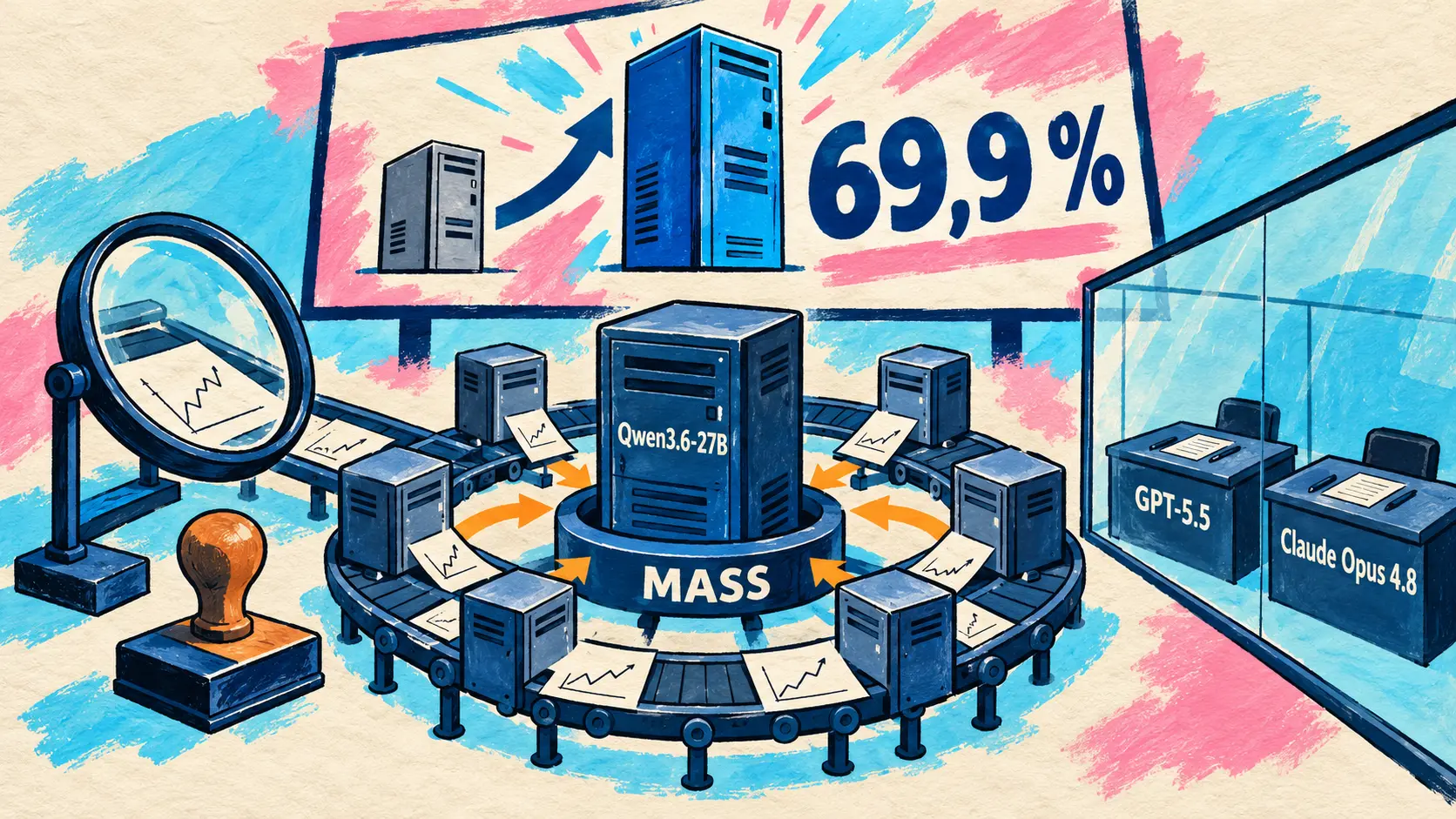
Sakana AI and researchers from UC Berkeley introduce MASS, a method in which Qwen3.6-27B is fine-tuned on the best runs of its own team of agents: after two rounds, it beats its base version in 69,9 % of comparisons on tasks held out from training. In brief, FINAL-Bench launches the Open Quantum Challenge, a quantum simulation and error correction competition to be run on a single GPU, and Qwen Code v0.25.1 becomes a stable release.
MASS: Sakana AI and UC Berkeley improve Qwen3.6-27B using the work of its own team of agents
October 11 — Sakana AI and UC Berkeley introduce MASS, a recursive self-improvement method: Qwen3.6-27B solves research tasks with a team of sub-agents, rewrites the team’s workflow and judges the results itself, then undergoes LoRA fine-tuning on its best runs. Two external judges, GPT-5.5 and Claude Opus 4.8, measure progress.
| Reported metric | Published value |
|---|---|
| Wins against the base model after two rounds, held-out tasks | 69,9 % |
| Score per output token, four research benchmarks | 1,2 to 1,6 times the base |
| Same metric, Terminal-Bench 2.0 and SWE-bench Verified | 0,96 and 0,94 times the base |
The authors themselves consider the gains uneven across benchmarks and believe they can address this by adding software engineering tasks. The code is published with no declared license, and the paper has been on arXiv since October 8.
🔗 MASS blog post · arXiv paper · Code on GitHub
Briefs
- Open Quantum Challenge — On Hugging Face, FINAL-Bench (VIDRAFT) opens two seasons to be run on a single GPU, without a quantum computer: estimating the ground-state energy of Fermi-Hubbard systems until February 28, 2027, and designing an error correction decoder (QEC) until March 31, 2027, with 1 000 dollars per season. 🔗 source · 🔗 competition space
- Qwen Code v0.25.1 — The stable release brings together the three prereleases covered here since October 6 and adds just 17 entries, including a Send now button for queued messages in the Web Shell. The notes total 57 features and 85 fixes since v0.25.0, with no known breaking changes. 🔗 source
What this means
MASS starts from an observation: on an open-ended research task, no automated rule determines whether an answer is good, and the model itself can become the most capable supervisor available. Sakana AI highlights the accompanying safety concern: when a model is its own evaluator, shared blind spots can make errors appear to be progress, then reinforce them during training. To measure progress without influencing the loop, the protocol relies on external judges whose verdicts are not passed to MASS; agreement between the evaluator and those judges rises from 73 % for the base model to 93 % after the second round.
The experiment also reveals something about agent data. According to the authors, team trajectories provide better training than those of a single agent: a model trained on the former wins 68,3 % of its comparisons against the base model with 28,8 million supervised tokens, versus 64,0 % with 42 million for a model trained on the latter. The experiment also runs in Qwen Code, the coding agent whose v0.25.1 becomes stable on the same day: a developer tool serves here as a research workbench.
The Open Quantum Challenge approaches the problem from the other end. Each submission is scored automatically against a fixed reference answer, and the participation guide is designed to be handed to a coding agent such as Codex or Claude Code. When a task can be verified, a computed score is enough to rank participants; when it cannot, MASS makes the model its own judge, under the scrutiny of external judges.