ai-powered-markdown-translatorArticle translated from fr to en with gpt-5.6-sol.
No new model this Sunday, but two concrete developments for developers. DeepSeek V4.1 Flash, released on September 10, is coming to Together AI at DeepSeek’s peak-hour rates, and Together says it is three times cheaper per task than GPT-5.6 Sol, a claim that should be read with some nuance; meanwhile, Perplexity now makes it possible to register an MCP server once and for all in its Agent API. Sakana AI revisits a Royal Society special issue, and three contributors to the Hugging Face community blog examine, each in their own way, how results are verified.
Together AI serves DeepSeek V4.1 Flash and says it is three times cheaper per task than GPT-5.6 Sol
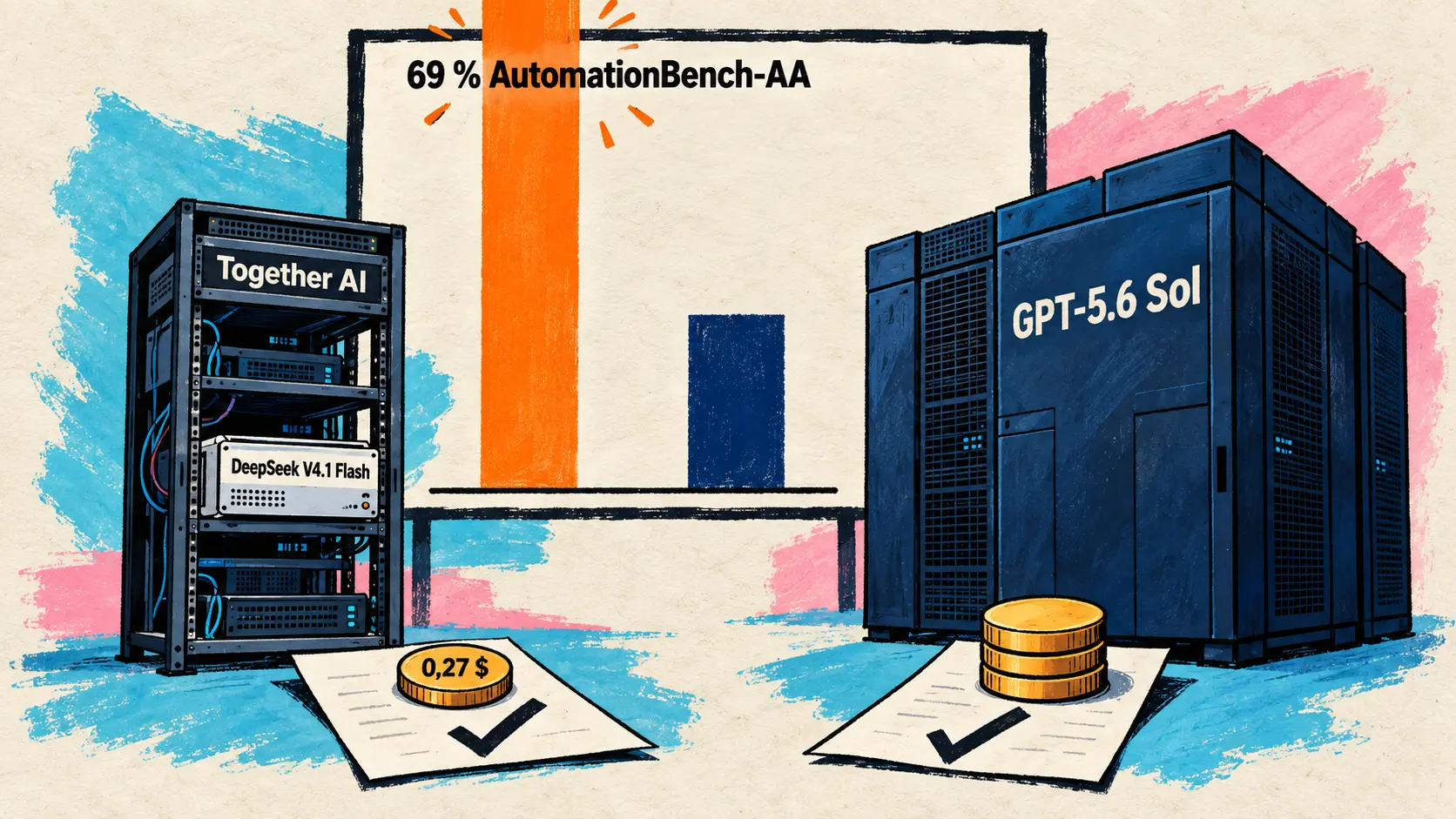
September 13 — DeepSeek V4.1 Flash is coming to Together AI, both serverless and as a dedicated deployment, at 0.30 dollars per million input tokens and 1.20 dollars per million output tokens: exactly the DeepSeek API’s peak-hour prices, which DeepSeek halves during off-peak hours.
Citing measurements from Artificial Analysis, Together claims that the model beats GPT-5.6 Sol on agentic benchmarks at one-third of the cost per task:
| Metric compared | DeepSeek V4.1 Flash | GPT-5.6 Sol (high) |
|---|---|---|
| AutomationBench-AA | 69 % | 55 % |
| Terminal-Bench v4.0 | 27 % | 21 % |
| GDPval-AA v2 | 1632 | 1524 |
| Average cost per task (Intelligence Index) | 0.27 dollars | 0.81 dollars |
Two caveats: Together’s own model page places V4.1 Flash behind GPT-5.6 Sol in reasoning (90.9 versus 94.1% on GPQA Diamond, 36.8 versus 47% on HLE), and on Terminal-Bench v4.0, the advantage measured by Artificial Analysis is reversed in the table published by DeepSeek on September 10, which reported 31.2 for V4.1 Flash versus 39.9 for GPT-5.6 Sol.
🔗 Together AI announcement on X
Perplexity opens its Agent API to custom connectors, with an MCP server registered once and for all
September 13 — Perplexity is adding custom connectors to its Agent API. An administrator registers a remote MCP server once in their project’s connectors: name, URL, API-key authentication or none, and Streamable HTTP or SSE transport. Perplexity stores the server’s access key, and requests made with any API key from the project only need to reference the connector identifier using type: "connector".
By contrast, when an MCP server is passed in the request (type: "mcp"), its URL and credentials accompany every call, with Streamable HTTP as the only supported transport. These connectors extend the managed connectors introduced on August 27 for GitHub, Slack, Google Drive, and Datadog, now numbering six with Linear and Notion. Tool discovery, deferred by default, has the model search before loading the relevant schemas, so max_steps should be set high enough. No specific pricing is given.
🔗 Perplexity connector documentation 🔗 Perplexity API changelog
In brief
- Sakana AI revisits a special issue devoted to world models — a Japanese-language post from September 12 about the issue of Philosophical Transactions of the Royal Society A published on May 14, 2026, whose introduction was co-authored by Sakana AI CEO David Ha and thirteen other authors. The news is the blog post, not the issue’s publication. 🔗 source
- REINFORCE escapes a trap where exact gradient ascent remains stuck — an individual contribution to the Hugging Face community blog, not a laboratory publication: after forty-two rounds of verification by the same reader, RDTvlokip shows that at 20,000 steps, exact ascent produces an unambiguous code (a bijection) in none of the 12 trials, compared with 11 out of 12 for REINFORCE. All these figures nevertheless depend on the Adam optimizer. 🔗 source
- Phionyx proposes a proof contract for AI audits — another individual contribution: Ali Toygar Abak wants to prevent a dashboard or report from silently broadening what the evidence establishes—for example, presenting a rejected tool call as an incident stopped by the guardrail. His proposal, eight groups of metadata attached to each claim, remains an engineering and testing plan with no experimental results. 🔗 source
- darkc0de proposes judging agent models by the time needed to obtain a validated result — a third individual contribution: Sonny DeSorbo argues that a weaker but faster model can correct itself several times before a slower model finishes its first attempt, and sketches out a benchmark, Persistent Challenge Completion, that measures validated work per second. It is a thought experiment without experimentation, which the author advises readers not to take too seriously. 🔗 source
What it means
The first thread concerns agent tooling. With custom connectors, an MCP server becomes a project resource rather than a parameter repeated in every request: an administrator registers it once, Perplexity stores its access key, and the code calling the Agent API no longer has to carry it. Perplexity thus extends the logic of the managed connectors introduced in late August to anyone’s MCP servers, protected by an API key or requiring no authentication, while also supporting SSE transport in addition to Streamable HTTP. The tradeoff lies in deferred tool discovery, which requires giving the model enough steps to search before acting. Connecting a tool becomes an administrative operation performed once for an entire project, more than a setting to reproduce in every call.
The second thread concerns price and measurement. Together AI charges for an open model released under the MIT license at exactly DeepSeek’s peak-hour rate: for users who can concentrate their calls during off-peak hours, DeepSeek’s API remains half the price. The cost per task being highlighted must likewise be read in light of its discrepancies. Together’s claim concerns agentic benchmarks, not reasoning, where V4.1 Flash remains behind GPT-5.6 Sol; and even on an agentic test such as Terminal-Bench v4.0, the ranking depends on the source: V4.1 Flash leads GPT-5.6 Sol according to Artificial Analysis (27 versus 21%), but trails it in DeepSeek’s table (31.2 versus 39.9). Each of today’s three community posts returns to this requirement for verification: RDTvlokip subjected the results to forty-two rounds of review by the same reader, Phionyx wants to prevent a report from silently broadening what the evidence establishes, and darkc0de proposes measuring validated work per second rather than success on the first attempt. Whether the subject is a score, a cost, or an audit conclusion, the question remains under what conditions the figure was obtained.
Sources
- Together AI on X, DeepSeek V4.1 Flash
- Together AI, DeepSeek V4.1 Flash model page
- DeepSeek, API Models & Pricing page
- DeepSeek, API changelog
- Perplexity, Agent API connector documentation
- Perplexity, API changelog
- Sakana AI, post about the Royal Society special issue
- Hugging Face, Forty-two more rounds with the same reader
- Hugging Face, Access Is Not Yet Verifiability
- Hugging Face, I love speed. We all love speed