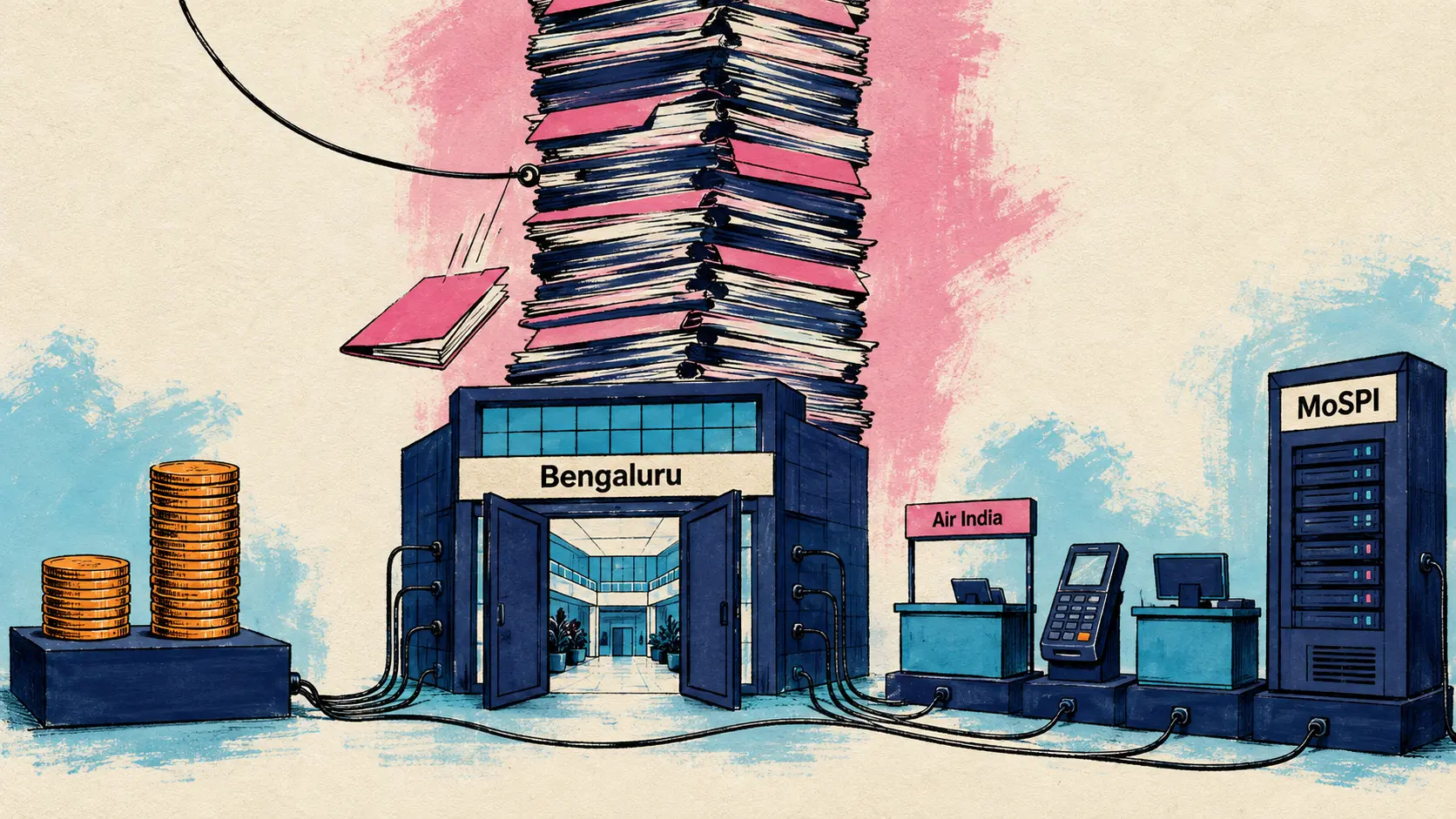
Anthropic formalizes its Indian expansion with an office in Bengaluru and a wave of partnerships covering enterprises, education, and public services. On the product side, Kimi launches Claw — a native OpenClaw app integrating 5,000+ community skills — and GitHub Copilot natively adopts the Model Context Protocol (MCP) to directly connect your development tools.
Anthropic opens Bengaluru office and deploys partnerships in India
February 16 — Anthropic inaugurates its second Asia-Pacific office in Bengaluru, confirming India as its second market after the United States. Indian annual revenue has doubled since October 2025, with nearly half of Claude usages in India focusing on computational and mathematical tasks.
The office, led by Irina Ghose (Managing Director India), comes with a series of strategic partnerships:
| Sector | Partner | Details |
|---|---|---|
| Airline | Air India | Claude Code accelerates software delivery |
| FinTech | CRED | 2x faster delivery, +10% test coverage |
| Consulting | Cognizant | Deployment to 350,000 employees |
| Payments | Razorpay | AI integrated into risk systems |
| Support | Enterpret | Claude at the heart of AI assistant, MCP integration |
| Software | Emergent | $25M ARR, 2M users in 5 months, built on Claude |
Anthropic also launched an effort to improve its models for 10 Indian languages (Hindi, Bengali, Marathi, Telugu, Tamil, Punjabi, Gujarati, Kannada, Malayalam, Urdu), collaborating with Karya and the Collective Intelligence Project to create locally relevant evaluations.
On the public sector side, the Indian Ministry of Statistics (MoSPI) launched the first official MCP server of the Indian government. Swiggy uses MCP to order groceries and book restaurants via Claude. Adalat AI deploys a WhatsApp helpline powered by Claude to help Indian litigants — a country with 50 million pending cases. Pratham pilots the “Anytime Testing Machine” with 1,500 students in 20 schools, with expansion planned to 100 schools by end of 2026.
Kimi launches Claw: native OpenClaw app with 5,000+ skills
February 15 — Moonshot AI unveils Kimi Claw, a native OpenClaw application integrated directly into kimi.com, running 24/7 in the browser tab.
| Feature | Details |
|---|---|
| ClawHub | 5,000+ accessible community skills |
| Cloud Storage | 40 GB included |
| Pro-Grade Search | Live data extraction (Yahoo Finance, etc.) |
| Bring Your Own Claw | Connect third-party OpenClaw, bridge to Telegram and other apps |
| Chaining | Discover, call, and chain skills directly in kimi.com |
Kimi Claw is currently in open beta for Allegretto members and above. The announcement generated strong engagement: 3.6 million views, 10K likes, and 626 replies on X. This skill marketplace approach recalls the ChatGPT plugin ecosystem, but with a stronger focus on autonomous agents and skill composition.
GitHub Copilot Coding Agent natively supports MCP
February 14 — GitHub announces that Copilot coding agent supports the Model Context Protocol (MCP) natively. Developers can configure an MCP server to directly connect their tools to the agent, without copying/pasting logs or specs.
| Tool | Capability via MCP |
|---|---|
| Sentry | Automatic crash report retrieval |
| Notion | Access to specs and project documentation |
| GitHub | Read issues, PRs, repo history |
| Custom | Proprietary MCP servers for internal tools |
In practice, Copilot can retrieve a crash report from Sentry, read the associated spec in Notion, and generate a corrective PR — all without manual intervention. The configuration is codified and versioned in the repo, with read-only permissions by default.
🔗 GitHub Tweet · 🔗 MCP Documentation
OpenAI: Codex recap and launch of “First Proof” challenge
February 14 — OpenAI Developers published an article summarizing recent Codex advancements, presented as the first model treated as a high cybersecurity capability under the OpenAI Readiness Framework. The article details the Codex application as a “command center” for developers, with progressive scaling.
The same day, Jakub Pachocki (Chief Research Officer at OpenAI) announced the launch of the “First Proof” challenge, a frontier AI research initiative. His message on X highlights that “original frontier research is perhaps the most important thing we can do”. The post received over 2,600 likes and 435 reposts, signaling marked interest from the research community.
🔗 Codex recap · 🔗 First Proof
SentientAGI reaches 1.8 million users on NVIDIA Blackwell
February 14 — SentientAGI surpassed the milestone of 1.8 million registered users in 24 hours and processed 5.6 million requests in one week, all with low and constant latency.
| Metric | Value |
|---|---|
| Users (24h) | 1.8 million |
| Requests (1 week) | 5.6 million |
| Infrastructure | NVIDIA Blackwell |
| Inference | Fireworks AI |
| Cost Reduction | 25-50% vs previous deployment |
The infrastructure relies on NVIDIA Blackwell GPUs via the Fireworks AI inference platform, confirming the viability of Blackwell for high-concurrency AI inference workloads in production.
Meta AI present at India AI Impact Summit
February 16 — The Meta AI team participates in the India AI Impact Summit & Expo (Bengaluru, February 13-16). At the Meta booth (Exhibition Hall 3, Booth 3.7), the team presents research demos including omnilingual ASR and SeamlessExpressive (speech-to-speech translation), as well as hands-on demos of Oakley Meta Vanguard glasses integrating AI. Lightning talks cover AI applications in language, accessibility, and health.
What this means
Anthropic’s expansion in India illustrates the race for emerging markets: India, with its massive developer base and digital public service needs, is becoming a strategic ground for AI providers. The coincidence with Meta AI’s presence at the same summit in Bengaluru is not insignificant.
On the product side, the trend is clear: AI agents are becoming platforms. Kimi Claw with its marketplace of 5,000+ skills, Copilot with MCP, and OpenAI’s Codex all converge towards the same model — agents capable of connecting to external tools and composing complex workflows without human intervention. MCP, initially created by Anthropic and now at the Linux Foundation, imposes itself as the de facto interoperability standard.