ai-powered-markdown-translatorArticle translated from fr to en with gpt-5.4-mini.
July 3, 2026 brings together several major announcements: Claude Code v2.1.200 tightens permission control with a Manual mode now set by default and fixes a long list of background-agent issues. On the open-model front, Together AI shows that an open source model can rival Claude Sonnet 5 at one-fifth the cost, while the share of tokens consumed on open source models has tripled in a year. GitHub Copilot adds session streaming to enterprise governance, and Anthropic democratizes Artifacts and raises its API rate limits.
Claude Code v2.1.200 — Manual mode by default and a wave of background fixes
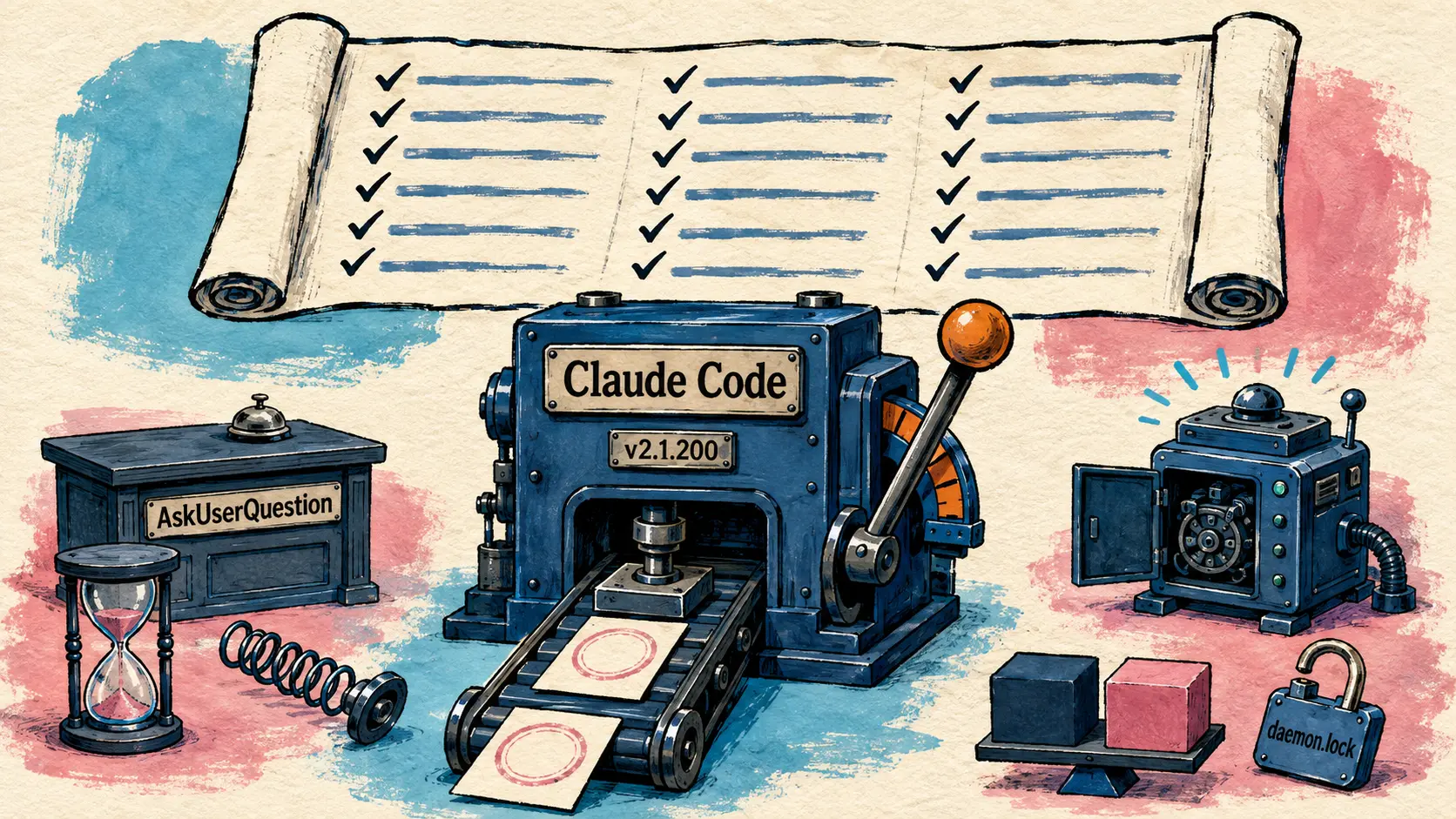
July 3 — Claude Code v2.1.200 introduces two behavioral changes and a series of fixes that improve the reliability of background agents.
“Manual” mode officially made the default. The permission mode default is renamed “Manual” across all surfaces: CLI, --help help, VS Code, and JetBrains. The values --permission-mode manual and "defaultMode": "manual" are now accepted in place of default. This vocabulary change aligns the displayed name with the actual behavior: Claude asks for confirmation before every sensitive action. Teams that had explicitly configured default mode in their configuration files will see identical behavior — only the label changes.
AskUserQuestion without automatic resumption. User-question dialogues no longer automatically resume after an idle timeout. The previous behavior (auto-continue) becomes opt-in and must be explicitly enabled via /config. This change prevents unwanted resumptions in long or lightly monitored sessions.
Background-agent fixes. This version closes several stability issues affecting daemon sessions:
| Fixed issue | Details |
|---|---|
| Background sessions silently stopping after sleep/wake | Resolved |
| Esc-canceled turn replayed after daemon restart | Resolved |
Agents permanently stuck on a stray daemon.lock (OS reused PID) | Resolved |
| Older build taking over the daemon after reinstall | Resolved — built-in build timestamp comparison |
| Temporary roster corruption permanently disabling agents | Resolved |
An ancillary fix also addresses a startup crash when disabledMcpServers or enabledMcpServers in .claude.json is set to a non-array value.
The daemon fixes are especially welcome for overnight workflows or CI pipelines that run background agents without continuous supervision. A stray daemon.lock or roster corruption could silently prevent any agent from restarting until manual intervention.
Anthropic
Fable 5 cyber safeguards — CJS framework (Cyber Jailbreak Severity)
July 2 — Anthropic publishes a technical article on Claude Fable 5’s cybersecurity safety mechanisms and proposes an initial draft of an industry framework for scoring model jailbreaks.
Fable 5’s cybersecurity classifiers are organized into four categories based on the asymmetry between attacker and defender:
| Category | Examples | Behavior |
|---|---|---|
| Prohibited use | Critical exploitation, high asymmetry | Systematically blocked |
| High-risk dual use | Pentesting, privilege escalation | Blocked until better controls |
| Low-risk dual use | OSINT, public scanning, TLS research | Allowed with a safety margin |
| Benign use | Debugging, defensive config, training | Allowed |
The CJS — Cyber Jailbreak Severity framework was co-developed with Glasswing partners (Amazon, Microsoft, Google). It scores the severity of a jailbreak across four axes: capability gain (0–4), scope (0–2), weaponization ease (0–2), and discoverability (0–2). The sum yields a CJS-0 (informational) to CJS-4 (critical) level. A dedicated HackerOne program is open; submissions are accepted at cyber-safeguards@anthropic.com.
🔗 Fable 5 safeguards — Anthropic
Claude Code Artifacts available on Pro and Max plans
July 2 — Claude Code Artifacts, previously reserved for Team and Enterprise plans, are now available to Pro and Max subscribers.
An Artifact is an interactive web page generated by Claude during a work session — a project dashboard, PR summary, or data visualization. The page is published live on claude.ai, updated in real time while Claude continues working, remains private to the user account, and is fully autonomous. This expansion to individual plans makes an advanced feature available to a much wider audience without requiring an enterprise subscription.
Claude API rate limits raised ×5 — automatic tiers decoupled from spending
July 2 — Anthropic significantly raises Claude Platform API rate limits and simplifies the access-tier structure.
Two core changes: rate limit tiers no longer depend on how much has been spent on the API, and progression between tiers is now automatic. The latest versions of Claude Sonnet and Haiku benefit from 5x higher limits at the highest tier. All recent models (Opus, Sonnet, Haiku) share the same per-minute request quotas and token throughput within a given tier, making it possible to choose the model best suited to the task without quota trade-offs. The “Request rate limit increase” button remains available in Claude Console for manual requests.
“Built with Claude: Life Sciences” hackathon — USD 100,000 in credits
July 2 — Anthropic announces Built with Claude: Life Sciences, a global virtual hackathon organized in partnership with the Gladstone Institute. The event invites researchers and developers to build with Claude Science and Claude Code for one week. The prize pool is USD 100,000 in credits. The hackathon fits into the momentum of Claude Science, launched at the end of June as a scientific work environment integrating tools, research packages, and compute resources.
Open source models and benchmarks
Together AI — GLM 5.2 reaches 80% of Sonnet 5 at 20% of the price
July 3 — Together AI publishes a comparative analysis between GLM 5.2 (Zhipu AI, open source) and Claude Sonnet 5 on the DeepSWE benchmark — 113 long-horizon software bug-fixing tasks, 4 trials each, with maximum reasoning enabled.
The main result: GLM 5.2 delivers about 80% of Claude Sonnet 5’s capabilities at about 20% of the price on this benchmark. The analysis is signed by Zain Hasan and republished by Together AI, which hosts GLM 5.2 on its platform.
| Model | Type | Relative performance | Relative cost |
|---|---|---|---|
| Claude Sonnet 5 | Proprietary | Baseline (100%) | Baseline (100%) |
| GLM 5.2 | Open source | ~80% | ~20% |
The DeepSWE benchmark is designed for long-running engineering tasks: it goes beyond typical synthetic problems to evaluate the ability to solve real bugs in existing repositories. A 4-to-1 cost/performance ratio on this kind of task is a strong argument for teams with constrained budgets or high-volume pipelines.
🔗 Together AI analysis — GLM 5.2 vs Sonnet 5
Together AI — open source models go from 10% to 30% of tokens in one year
July 3 — Together AI reveals that usage of open source models has tripled in one year on its platform, rising from 10% to 30% of all tokens consumed. This figure fits into the context of CEO Vipul Ved Prakash’s article, “The Economy of Tokens” (June 29), and the already covered USD 800 million Series C funding round. It confirms a macro trend: the open source wave is no longer a niche technical phenomenon but a growing share of real AI token consumption.
HydraHead — hybrid Full+Linear Attention architecture (Tongyi Lab / Qwen)
July 3 — Tongyi Lab (Alibaba / Qwen) publishes HydraHead, an attention hybridization architecture at the head level rather than the layer level. The motivation comes from mechanistic interpretability: only the so-called “retrieval-critical” heads keep Full Attention; the others switch to Linear Attention, reducing compute complexity on long sequences.
| Metric | Result |
|---|---|
| NIAH improvement at 512K context | +69% |
| Training tokens | 15 billion |
| Overall performance | Close to Qwen3.5 |
The normalized fusion module allows both attention types to coexist in the same layer. The approach aims to enable long context windows (512K tokens and beyond) without the quadratic cost of pure Full Attention. The results are presented in the July 3 Tongyi Weekly.
🔗 Tongyi Weekly — July 3, 2026
ZCode — the official Z.ai IDE for GLM-5.2
July 1 — Z.ai has launched ZCode, the official development environment for GLM-5.2, available on macOS, Windows, and Linux. Subscribers to the Coding Plan benefit from a 1.5x usage quota increase in ZCode. BYOK (Bring Your Own Key) support makes it possible to use ZCode with existing subscriptions or API keys. The zcode.z.ai site offers two pricing plans: Lite and Pro (USD 64.80/month → USD 72).
GitHub Copilot
Session streaming in public preview
July 2 — GitHub Enterprise Cloud customers with managed users can now stream Copilot agent session data (prompts, responses, tool calls) to an external collector. Two access modes are available: a streaming endpoint to a SIEM tool (Microsoft Purview is supported in public preview), and a REST API to retrieve the last 48 hours of data on demand (GET /enterprises/{enterprise}/copilot/usage-records). Activation is done in the company’s AI settings via “Enable everywhere” for “Copilot Usage Records Streaming” and “Copilot Usage Records API”.
This feature addresses traceability and auditing requirements for teams subject to compliance constraints — they can now ingest Copilot sessions into their existing monitoring pipelines rather than relying solely on GitHub dashboards.
🔗 Changelog — Copilot agent session streaming
Copilot CLI without PAT in GitHub Actions
July 2 — Copilot CLI can now authenticate in GitHub Actions with the built-in GITHUB_TOKEN, without requiring a long-lived personal access token (Personal Access Token — PAT). The required permission in the workflow is copilot-requests: write. Consumed AI credits are billed directly to the organization, with management via cost centers, budgets, and session limits. The usage policy must be enabled on the organization side: “Allow use of Copilot CLI billed to the organization.” The update is performed via copilot update or npm install -g @github/copilot.
🔗 Changelog — Copilot CLI without PAT
Gemini 2.5 Pro and Gemini 3 Flash deprecated in Copilot on July 31
July 2 — GitHub announces the deprecation of two Gemini models across all Copilot experiences (chat, inline edits, ask/agent modes, code completions) on July 31, 2026:
| Deprecated model | Date | Alternative |
|---|---|---|
| Gemini 2.5 Pro | 31-07-2026 | Gemini 3.1 Pro |
| Gemini 3 Flash | 31-07-2026 | Gemini 3.5 Flash |
Copilot Enterprise administrators must enable the alternative models in their model policies. No action is required to remove the old models after the deprecation date.
🔗 Changelog — Gemini deprecation in Copilot
Generative media
Runway Agent Skills — create campaigns on demand
July 2 — Runway has launched Agent Skills, a system of capabilities accessible from Runway Agent via the / command. Users type / and choose a skill to trigger complex workflows in a single step. The skills available at launch cover: advertising campaign creation, commercial production, and ad localization for different markets. Runway positions this feature as an on-demand marketing scaling tool.
Black Forest Labs — Dev Playground for FLUX models
July 2 — Black Forest Labs (BFL) has launched a Dev Playground for developers working with the FLUX API. The tool makes it possible to compare FLUX models side by side (side-by-side) with the same prompt, adjust API parameters directly from the interface to obtain an output identical to production, and evaluate differences in quality, latency, and cost. The playground includes the latest models as soon as they are released. It is accessible via api.bfl.ml.
Briefs
- Amp — More Orb Sizes — Amp now lets you choose CPU and memory sizes for Orbs that run remote agents, following the June 30 announcement “Agents in Orbs.” 🔗 Chronicle Amp
- Copilot — More precise usage metrics — The Copilot metrics API now reports code lines suggested by the CLI (v1.0.57+, deduplication since v1.0.64), identifies the IDE for server-side users, and fixes AI credit attribution for two previously missed cases. 🔗 Changelog
What it means
The Anthropic ecosystem is deepening rapidly. Claude Code v2.1.200 is not just a rename: formalizing “Manual” as the default mode anchors a philosophy of explicit control as agents gain autonomy. The simultaneous fix for five daemon issues shows that the reliability of unsupervised workflows (overnight pipelines, CI) has become a top priority. Extending Artifacts to Pro/Max plans and increasing API rate limits by 5x round out the picture by lowering access barriers for individual developers and small teams. The Life Sciences hackathon with the Gladstone Institute, meanwhile, signals that Claude Science is seeking real-world validation in a highly regulated domain.
The open source wave is scaling up. Together AI’s figure — 30% of AI tokens consumed on open source models versus 10% a year ago — is not a niche statistic: it is a signal of a structural shift. The GLM 5.2 / DeepSWE analysis makes it concrete: a well-positioned open source model can cover 80% of the use cases of a frontier proprietary model at one-fifth of the cost. HydraHead adds an architectural dimension to this dynamic — labs like Tongyi are looking to extend usable context (512K tokens, +69% NIAH) without the quadratic cost of Full Attention, which further broadens the range of tasks accessible to open models. ZCode closes the loop by giving GLM-5.2 IDE tooling comparable to that of proprietary models.
Copilot enterprise governance is becoming denser. Session streaming to SIEMs and PAT-free authentication in GitHub Actions converge on the same goal: making Copilot auditable and operable without violating enterprise security policies. For teams subject to SOC 2, ISO 27001, or sector-specific regulatory constraints, these are two operational hurdles that disappear at the same time. The deprecation of Gemini 2.5 Pro and 3 Flash likewise shows that GitHub is maintaining modernization pressure on the Copilot model catalog — administrators who do not anticipate these transitions risk service interruptions on July 31.
Generative media agents: from generation to orchestration. Runway’s Agent Skills and BFL’s Dev Playground chart two complementary paths: Runway moves up the abstraction ladder (creating a full campaign from a /), while BFL goes down into the technical details (comparing quality, latency, and cost per model at the API level). These two approaches reflect a growing market maturity, where users of generative media are splitting between those who want the result without friction and those who optimize the production pipeline.
Sources
- Claude Code CHANGELOG
- Fable 5 safeguards — Anthropic
- Artifacts announcement Pro/Max — @ClaudeDevs
- Rate limits ×5 — @ClaudeDevs
- Life Sciences hackathon — @claudeai
- GLM 5.2 vs Sonnet 5 — @togethercompute
- Open models 30 % — @togethercompute
- Tongyi Weekly — HydraHead
- ZCode — Z.ai
- Copilot session streaming
- Copilot CLI without PAT
- Gemini deprecation in Copilot
- Runway Agent Skills — @runwayml
- BFL Dev Playground — @bfl_ai
- Chronicle Amp
- Improved Copilot metrics