An exceptionally busy day on April 16: Anthropic launches Claude Opus 4.7 in general availability with significant gains on agentic benchmarks, OpenAI simultaneously unveils Codex with computer use on macOS and GPT-Rosalind, its first frontier model dedicated to the life sciences. Google expands the Gemini app with personalized image generation via Nano Banana 2 and Google Photos, Perplexity launches Personal Computer for Mac, and GitHub opens the gh skill command for inter-agent management of skills.
Claude Opus 4.7: general availability
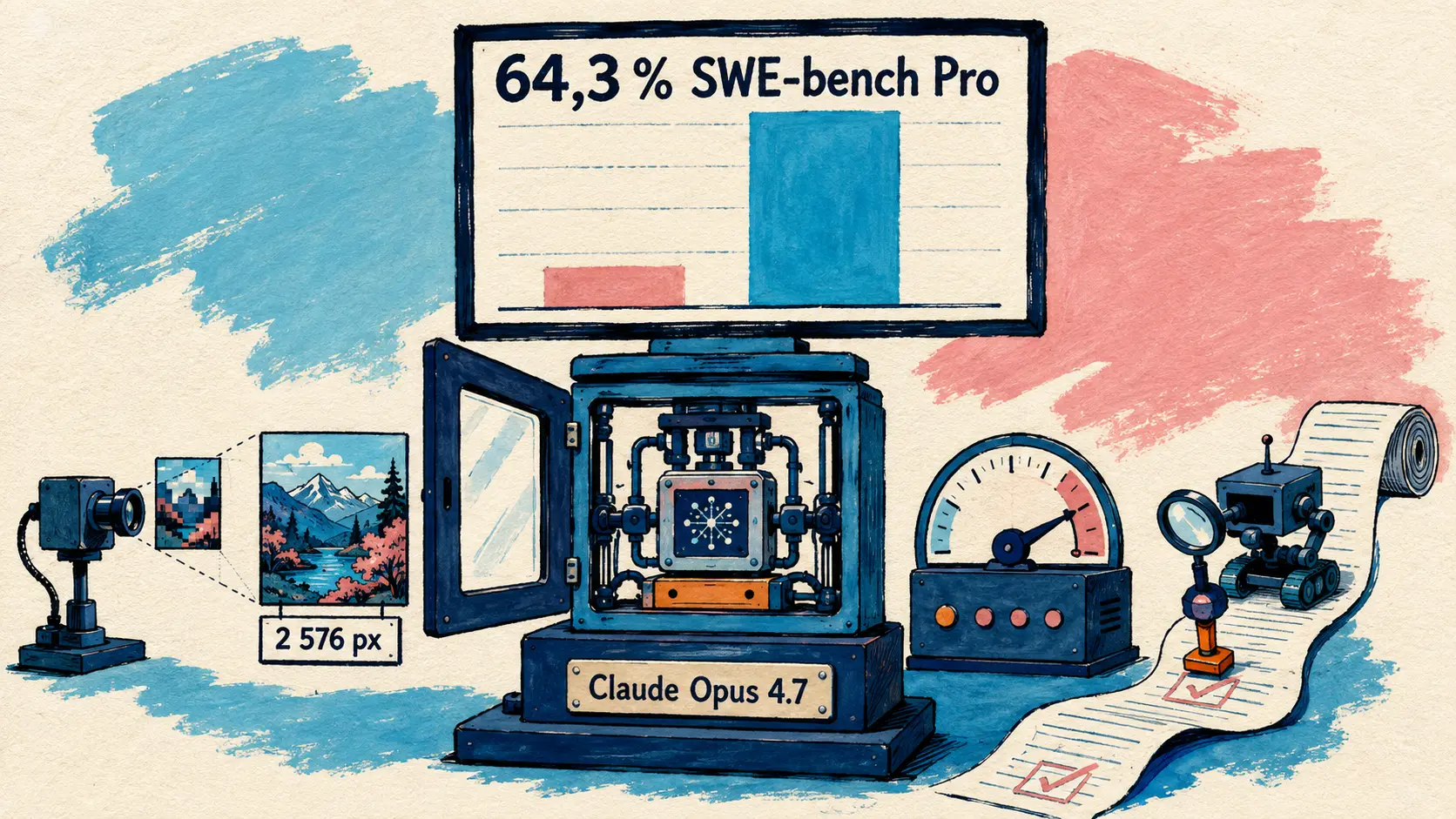
April 16 — Anthropic launches Claude Opus 4.7 in general availability (generally available). The model succeeds Opus 4.6 with notable improvements on long tasks, agentic autonomy, and instruction following.
“Opus 4.7 handles complex, long-running tasks with rigor and consistency, pays precise attention to instructions, and devises ways to verify its own outputs before reporting back.” — @claudeai on X
Key capabilities
| Feature | Description |
|---|---|
| High-resolution vision | Images up to 2,576 px on the long side (~3.75 megapixels), 3× the previous resolution |
| xhigh effort level | Intermediate level between high and max, fine control over reasoning/latency |
| File system memory | Better persistence between work sessions |
| Enhanced autonomy | Verification of outputs before sending, strict instruction following |
| Professional quality | Higher-quality interfaces, slides, and documents |
Benchmarks
| Benchmark | Opus 4.7 | Opus 4.6 | GPT-5.4 | Gemini 3.1 Pro |
|---|---|---|---|---|
| SWE-bench Pro | 64.3% | 53.4% | 57.7% | 54.2% |
| SWE-bench Verified | 87.6% | 80.8% | — | 80.6% |
| Terminal-Bench 2.0 | 69.4% | 65.4% | 75.1%* | 68.5% |
| Multidisciplinary reasoning (with tools) | 54.7% | 53.3% | 58.7% | 51.4% |
| Tool use at scale – MCP-Atlas | 77.3% | 75.8% | 68.1% | 73.9% |
| Computer use – OSWorld Verified | 78.0% | 72.7% | 75.0% | — |
| Advanced reasoning – GPQA Diamond | 94.2% | 91.3% | 94.4% | 94.3% |
| Visual reasoning (with tools) | 91.0% | 84.7% | — | — |
* GPT-5.4: self-reported result with a specific harness
The most notable gains are on SWE-bench Pro (+10.9 points), visual reasoning (+6.3 points with tools), and MCP-Atlas (+1.5 points) — benchmarks directly tied to agentic use cases.
Pricing and availability
Opus 4.7 is available starting today via the Claude API (identifier claude-opus-4-7), Amazon Bedrock, Google Cloud Vertex AI, Microsoft Foundry, and in all Claude products. Pricing is unchanged from Opus 4.6: $5 per million input tokens, $25 output.
Two points for developers migrating from Opus 4.6: the new tokenizer can generate 1.0× to 1.35× more tokens depending on content type, and Opus 4.7 produces more reasoning tokens at higher effort levels. Anthropic has published a dedicated migration guide.
Opus 4.7 is also the first model to benefit from the new cybersecurity safeguards in the Glasswing project. A Cyber Verification Program is open to legitimate professionals.
Claude Code v2.1.111: /ultrareview, auto mode Max, xhigh by default
April 16 — Version 2.1.111 of Claude Code accompanies the launch of Opus 4.7 with several significant additions.
| Feature | Description |
|---|---|
/ultrareview | In-depth code review in parallel across multiple agents. No argument = current branch; /ultrareview <PR#> for a GitHub PR. 3 free trials for Pro and Max. |
| Auto mode for Max | Auto mode (Claude decides permissions on its own) is now available for Max subscribers with Opus 4.7. |
| xhigh effort by default | Default effort level is raised to xhigh for all plans. |
/less-permission-prompts | Scans transcripts and suggests a prioritized allowlist for .claude/settings.json. |
| PowerShell tool | PowerShell support (gradual rollout). Can be enabled via CLAUDE_CODE_USE_POWERSHELL_TOOL=1 on Linux/macOS. |
| Named plans | Plans named after the initial prompt (fix-auth-race-snug-otter.md) rather than randomly. |
| Read-only commands | cd, ls, cat and read-only commands no longer trigger a permission prompt. |
Version 2.1.112 (rolled out on the evening of April 16) immediately fixes a “claude-opus-4-7 is temporarily unavailable” error appearing in auto mode.
Boris Cherny (@bcherny) also announced increased rate limits for all subscribers, to offset the higher reasoning token volume of Opus 4.7. A rate limiting bug on long-context requests was fixed and the 5h and weekly limits reset.
GitHub Copilot also integrates Opus 4.7 in GA starting today, with a gradual rollout in VS Code, Visual Studio, the CLI, GitHub Mobile, and other Copilot clients. For Copilot Pro+, it will replace Opus 4.5 and 4.6 in the coming weeks. Promotional pricing (7.5× multiplier) applies until April 30.
🔗 Claude Code changelog 🔗 Tweet @bcherny 🔗 Claude Opus 4.7 in GitHub Copilot
OpenAI: Codex moves to computer use, GPT-Rosalind and cyber ecosystem
Codex — computer use on macOS, integrated browser, persistent memory
April 16 — OpenAI releases an important update to Codex, used by more than 3 million developers per week. This release expands Codex far beyond code.
“Codex can now use your computer alongside you, seeing, clicking, and typing with its own cursor.” — @OpenAI
Computer use — Multiple Codex agents can work simultaneously on macOS without interfering with open applications. Use cases: iterating on interfaces (frontend), testing applications, working in apps without an exposed API. EU/UK availability coming soon.
| Feature | Description |
|---|---|
| Integrated browser | Comment directly on web pages to instruct the agent on frontend development and games |
| Image generation | gpt-image-1.5 integration to create assets and mockups in the same workflow |
| 90+ new plugins | Atlassian Rovo, CircleCI, CodeRabbit, GitLab Issues, Microsoft Suite, Neon, Remotion, Render, Superpowers… |
| Persistent memory | Preferences, fixes, and context accumulated across sessions |
| Scheduled automations | Recurring tasks over days or weeks, with automatic wake-up |
| SSH devboxes | Connection to remote servers (alpha) |
| Multiple terminal tabs | Several simultaneous terminals |
GPT-Rosalind — first frontier life sciences model
April 16 — OpenAI launches GPT-Rosalind, its first frontier model dedicated to biology, drug discovery, and translational medicine. The name pays tribute to Rosalind Franklin, whose work helped reveal the structure of DNA.
GPT-Rosalind is optimized for scientific literature synthesis, hypothesis generation, experimental planning, and biological data analysis.
| Benchmark | Result |
|---|---|
| BixBench (real-world bioinformatics) | Best performance among models with published scores |
| LABBench2 | Outperforms GPT-5.4 on 6 tasks out of 11 |
| RNA sequence prediction (Dyno Therapeutics) | Top 95th percentile of human experts (best-of-10) |
| RNA sequence generation (Dyno Therapeutics) | ~84th percentile of human experts (best-of-10) |
A free Life Sciences plugin for Codex is available on GitHub: access to more than 50 public biological databases (human genomics, proteomics, biochemistry). GPT-Rosalind is available in research preview for qualified Enterprise customers in the United States via the Trusted Access program. Usage does not consume existing credits during the preview.
Announced partners: Amgen, Novo Nordisk, Moderna, Thermo Fisher Scientific, NVIDIA, Allen Institute, UCSF School of Pharmacy, Los Alamos National Laboratory.
Cyber defense ecosystem — $10M in API credits
April 16 — OpenAI is committing 10 million dollars in API credits to support open-source security teams and vulnerability researchers. First recipients: Socket, Semgrep, Calif, Trail of Bits.
The Trusted Access for Cyber program expands to new organizations: Bank of America, BlackRock, BNY, Citi, Cisco, CrowdStrike, Goldman Sachs, JPMorgan Chase, Morgan Stanley, NVIDIA, Oracle, Zscaler. GPT-5.4-Cyber is also provided to the U.S. Center for AI Standards and Innovation (CAISI) and the UK AI Security Institute (UK AISI) for independent evaluations.
Gemini: personalized images with Nano Banana 2 and Google Photos
April 16 — Google introduces new personalized image generation features in the Gemini app, powered by Personal Intelligence, Nano Banana 2, and the user’s Google Photos library.
Until now, creating a truly personal image with Gemini required detailed prompts and manually uploaded photos. Personal Intelligence now gives Gemini an implicit understanding of the user’s context: simple phrases like “Draw my dream house” or “Create an image of my desert-island essentials” are enough, with Gemini automatically filling in details from connected Google apps.
By connecting their Google Photos library, the user can generate images in which they and their loved ones appear directly. Thanks to labels already created in Photos (people, pets), a request like “Create a claymation image of me and my family doing our favorite activity” is enough.
| Feature | Detail |
|---|---|
| Available styles | Watercolor, charcoal pencil, oil painting, claymation |
| Sources button | Shows which photo was automatically selected |
| Refinement | Indicate what was incorrect, choose another reference photo |
| Privacy | Gemini does NOT train on the private Google Photos library |
| Opt-in | Connection of Google apps remains optional and configurable |
Availability: rollout underway over a few days for Google AI Plus, Pro, and Ultra subscribers in the United States only for now. Coming soon to Gemini in Chrome desktop and to more users.
Gemini CLI v0.38.0
April 14 — Version v0.38.0 of Gemini CLI is available with several command-line experience improvements.
| Feature | Detail |
|---|---|
| Chapters (narrative flow) | Groups interactions into “chapters” according to intent and tool use |
| Context Compression Service | Intelligently distills history for long sessions |
| Persistent approvals | Approve tool execution without being asked every time |
| UI flicker fix | Fixes unstable rendering via Terminal Buffer mode |
Perplexity Personal Computer: local agent on Mac
April 16 — Perplexity launches Personal Computer, a local agent feature integrated into the Mac app.
“Today we’re releasing Personal Computer. Personal Computer integrates with the Perplexity Mac App for secure orchestration across your local files, native apps, and browser. We’re rolling this out to all Perplexity Max subscribers and everyone on the waitlist starting today.” — @perplexity_ai on X
The agent securely orchestrates local files, native applications, and the browser, without using the cloud for sensitive data. Rollout is gradual: Perplexity Max subscribers first, then the waitlist.
This is a notable pivot for Perplexity: after building its reputation on AI web search, the company is now tackling local orchestration on the desktop — terrain already explored by Apple Intelligence and OpenAI’s Operator.
GitHub: the gh skill command in public preview
April 16 — GitHub launches gh skill in public preview in the GitHub CLI (v2.90.0+). This new command makes it possible to install, discover, update, and publish agent skills — portable sets of instructions, scripts, and resources that configure the behavior of AI agents.
gh skill install github/awesome-copilot documentation-writergh skill install github/awesome-copilot doc-writer --agent claude-codegh skill search mcp-appsgh skill update --allSkills work across multiple platforms: GitHub Copilot, Claude Code, Cursor, Codex, Gemini CLI, and Antigravity. The command includes supply chain security mechanisms: pinning by tag or commit SHA, immutable releases, and provenance tracking via frontmatter. The open specification is available on agentskills.io.
Qwen3.6-35B-A3B open-source and Meta Muse Spark Safety
Qwen3.6-35B-A3B: open-source MoE under Apache 2.0
April 15–16 — Alibaba announces the open-sourcing of Qwen3.6-35B-A3B, a sparse MoE (mixture-of-experts) model with 35 billion total parameters but only 3 billion active parameters per inference.
| Aspect | Detail |
|---|---|
| Architecture | Sparse MoE: 35B parameters, 3B active |
| License | Apache 2.0 |
| Multimodal | Native (vision + reasoning) |
| Modes | Thinking / non-thinking |
| Benchmark | Qwen3.6-35B-A3B |
|---|---|
| SWE-bench Verified | 73.4 |
| SWE-bench Multilingual | 67.2 |
| AIME 2026 | 92.7 |
| GPQA | 86.0 |
Available on Hugging Face / ModelScope, Qwen Studio, and via the Alibaba Cloud API (qwen3.6-flash). Natively compatible with Claude Code, Qwen Code, and OpenClaw. 🔗 Official Qwen Blog
Meta Muse Spark: safety report published
April 15 — Meta AI publishes the safety and preparedness report (Safety & Preparedness Report) for Muse Spark, its first non-open-weights multimodal model developed by Meta Superintelligence Labs.
| Aspect | Detail |
|---|---|
| Framework used | Meta Advanced AI Scaling Framework |
| Risks assessed | Chemical/biological, cybersecurity, loss of control |
| Chem/bio result | Initial risk “potentially high” → mitigations validated → acceptable residual risk |
This report marks a notable milestone: Meta now follows a formal pre-deployment safety assessment process for its advanced models, similar to the approaches of Anthropic and OpenAI.
Media and various updates
Runway publishes two updates on April 16: Seedance 2.0 moves to 1080p rendering, and Runway Characters now integrates text-script animation (choose a character, write the script, generate). NVIDIA is present at NAB Show 2026 to demonstrate AI in media production, fan engagement, and content monetization.
Grok iOS gets an animated visual indicator in voice mode: a small circle now shows that Grok is actively listening.
🔗 Runway — Seedance 2.0 in 1080p 🔗 Runway Characters — script animation
What this means
April 16 illustrates a day of agentic convergence across the board: Claude Opus 4.7, Codex with computer use, Perplexity Personal Computer, and gh skill share the same logic — agents capable of acting on the local system (files, applications, computer), coordinated across multiple platforms via portable standards.
The gh skill command is particularly structural: by establishing an open inter-agent installation specification (Copilot, Claude Code, Cursor, Codex, Gemini CLI), GitHub is building a common infrastructure that could become the npm install of the agentic world.
GPT-Rosalind, meanwhile, marks an evolution in OpenAI’s strategy: after general-purpose models, the company is starting to build specialized frontier models by domain — an approach that echoes the vertical diversification already explored by Google DeepMind in computational biology.
Sources
- Anthropic — Introducing Claude Opus 4.7
- Tweet @claudeai — Opus 4.7 GA
- Tweet @bcherny — Increased rate limits
- CHANGELOG Claude Code (GitHub)
- GitHub Changelog — Claude Opus 4.7 in Copilot
- OpenAI — Codex for almost everything
- OpenAI — Introducing GPT-Rosalind
- OpenAI — Accelerating Cyber Defense Ecosystem
- blog.google — Gemini: personalized images with Nano Banana 2
- Gemini CLI Changelog
- perplexity.ai/computer
- Tweet @perplexity_ai — Personal Computer
- GitHub Changelog — gh skill
- Qwen Blog — Qwen3.6-35B-A3B
- Meta AI — Muse Spark Safety Report
- Tweet @runwayml — Seedance 2.0 1080p
- Tweet @runwayml — Runway Characters script
This document has been translated from the fr version into the en language using the gpt-5.4-mini model. For more information about the translation process, see https://gitlab.com/jls42/ai-powered-markdown-translator