ai-powered-markdown-translatorArticle translated from fr to en with gpt-6.1-sol.
Voice is becoming a way to control agents: OpenMOSS introduces MOSS-Live, a system that listens, speaks and launches tools simultaneously, and Antigravity details its Gemini Live voice mode, both in the application and in the terminal. NVIDIA strengthens its GPU software layer with CUDA 13.5, the Reshard collective for reinforcement learning and FLUX 3 Image Klein accelerated on Blackwell. GitHub describes Rubicon, its new Git storage system tested with 5,000 agents on one repository, and makes Copilot a team tool, with code review managed through an API and @GitHub generally available in Slack and Teams.
Voice controls agents: OpenMOSS’s MOSS-Live and Antigravity’s Gemini Live voice mode
The two announcements share the same architecture: a model converses in the foreground while an agent works in the background, as in the voice chat that Cursor launched on November 6 using Grok Voice.
OpenMOSS introduces MOSS-Live, a full-duplex voice system that sees, listens and launches tools
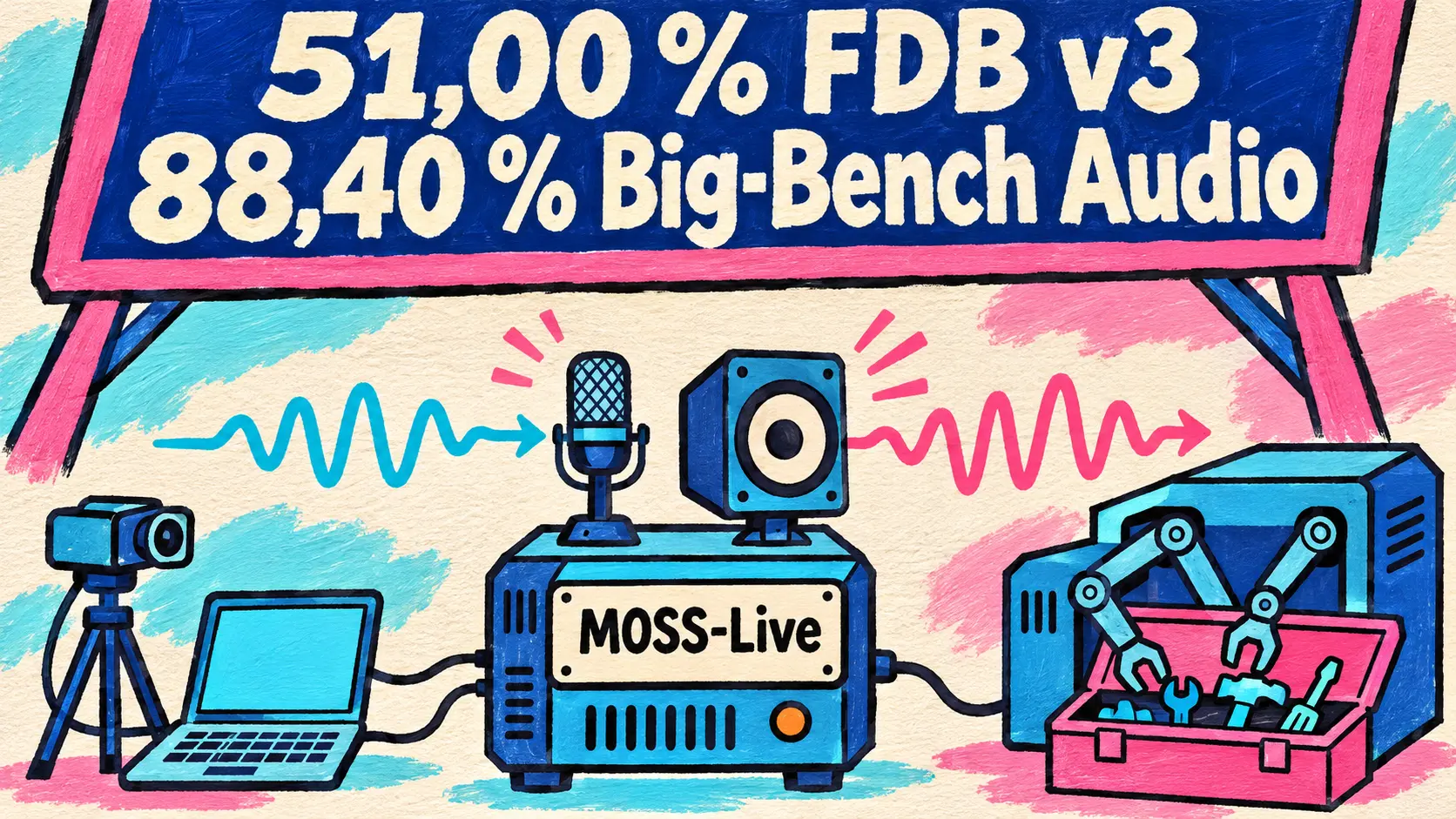
November 7 — The OpenMOSS team introduces MOSS-Live, a real-time conversation system that listens and speaks simultaneously (full duplex, full-duplex), understands what the camera or screen sharing shows and delegates searches and lengthy tasks to a second model without interrupting the conversation. In the post by Chen Yang on the Hugging Face community blog, a foreground interaction model decides whether to respond, wait or yield the floor, a background model reasons and calls tools, and a coordination layer shares memory and task status. MOSS-Live needs to distinguish an “mm-hmm” from a real interruption, ignore speech not addressed to it and provide simultaneous interpretation.
| Benchmark and metric (according to OpenMOSS) | MOSS-Live score | Best competitor cited |
|---|---|---|
| FDB v3, tool call success | 51,00 % | 51,00 % (Doubao SeedDuplex) |
| τ-Voice, multi-turn tasks (pass¹) | 57,93 % | 67,68 % (GPT-Live-1) |
| τ-Voice, selectivity for speech not addressed to it | 78,90 % | 66,99 % (GPT-Live-1) |
| Big-Bench Audio, accuracy | 88,40 % | 90,50 % (Doubao SeedDuplex) |
| FDB v3, tool scenario latency | 2,36 s | 1,61 s (GPT Realtime 2.1) |
MOSS-Live is not an open model: the GitHub repository contains only documentation, with no license or weights. The system can be tried in an online testing environment (playground) and integrated through a real-time API on the MOSS platform.
🔗 MOSS-Live on the Hugging Face blog · MOSS-Live documentation on the MOSS platform
Antigravity details its Gemini Live voice mode, in the application and in Antigravity CLI 1.5.0
November 6 — The Antigravity blog details the voice interface (voice mode) that began rolling out with application version 2.29.0 on November 3. Gemini Live hears voice directly, without going through a transcription, responds in real time and can be interrupted: users assign a task, redirect it while it runs (“What are you doing?”, “stop”) and respond to permission requests by voice. The post adds something the changelog did not mention: the mode also works in Antigravity CLI, starting with version 1.5.0.
Destructive actions, such as deleting files, running commands with elevated privileges, or force-pushing to a Git remote, can’t be approved by voice. — Antigravity Blog, Voice mode in Antigravity
| Setting or limit | Value stated by Antigravity |
|---|---|
| Starting in the CLI | /voice live or F6; agy mic-serve over SSH |
| Voices and speaking rate | 9 voices; from 0,75x to 2x in the application, from 0,5 to 3 in the CLI |
| Progress updates on request | approximately every 30 seconds (“keep me posted”) |
| Voice mode conversations | only one at a time, local only |
Voice mode does not work in Remote Control, in conversations running in the cloud or in a session with a remote agent, and microphone audio is sent to Google’s servers. No plan is mentioned: the documentation only warns that the mode may not yet be available to all accounts.
🔗 Announcement by @antigravity on X · Voice mode documentation
NVIDIA GPU software: CUDA 13.5, NCCL M2N Reshard and FLUX 3 Image Klein on Blackwell
CUDA 13.5 brings Vera Rubin support to general availability
November 4 — NVIDIA releases CUDA 13.5. The main addition: support for the Vera Rubin architecture moves from developer early access to general availability (general availability), ready for enterprise production according to NVIDIA. Windows on Arm, generally available since CUDA 13.4, expands to DGX Station running Windows, and on Rubin, TCC mode is dropped in favor of WDDM and MCDM. For GPU sharing, MPS moves to version 3 (weighted time slices, lending and borrowing of streaming multiprocessors (SMs) between partitions, routing through cgroup v2); CUDA Tile gains multi-GPU communication within kernels.
| Library or tool | Addition announced by NVIDIA |
|---|---|
| CCCL 3.5 | Batched Top-K, already integrated into FlashInfer; reproducible floating-point scans |
| cuBLAS | faster NVFP4 and MXFP8 multiplications on Vera Rubin, with no figures provided |
| cuSPARSE | sparse matrix products 1,65 to 2,27 times faster |
| Nsight Perf SDK for AI | public preview, continuous profiling of long training runs |
| Compute Sanitizer | skill to help coding agents diagnose memory errors |
🔗 NVIDIA CUDA 13.5 Brings NVIDIA Vera Rubin GA Support
NCCL M2N Reshard speeds up weight transfers in reinforcement learning by 2.7 to 5.7 times
November 6 — In reinforcement learning (reinforcement learning, RL), the inference GPUs generating trajectories must regularly receive weights updated by the training GPUs: this is weight updating (refit). The usual method gathers each parameter and then broadcasts it (gather-and-broadcast), transferring roughly twice the model’s size at each step, nearly 11.2 TB for Kimi K3 according to NVIDIA. Reshard, a new type of collective communication, treats this update as the resharding of a distributed tensor: each GPU receives only its portion, a single copy crosses the network per NVLink domain, and the GPUs then exchange the remaining data over NVLink.
The reference implementation, NCCL M2N Reshard, is open source and integrated into NeMo RL, where it transfers the weights of feed-forward layers (feed-forward), roughly 95% of the parameters. According to NVIDIA, weight updating becomes 2.7 to 5.7 times faster:
| Test platform | Model trained | Conventional method | With Reshard |
|---|---|---|---|
| DGX H100 | Qwen 3 235B | 6,4 s | 1,9 s |
| DGX H100 | DeepSeek V3 671B | 14,9 s | 2,6 s |
| DGX GB200 | DeepSeek V3 671B | 6,1 s | 2,3 s |
| DGX GB200 | Nemotron Ultra v3 | 8,2 s | 2,3 s |
🔗 Accelerating Reinforcement Learning Weight Refit with the Reshard Collective · NVIDIA/nccl-extensions repository
FLUX 3 Image Klein up to 4.45 times faster on Blackwell with TensorRT LLM VisualGen
November 6 — NVIDIA publishes a tutorial on FLUX 3 Image Klein, Black Forest Labs’ open-weight image model, in TensorRT LLM VisualGen, the TensorRT LLM runtime dedicated to visual generation. On a single B200 GPU, at 2048x2048, combining optimizations (compilation, NVFP4 weights, Sol-Attention sparse attention, Cache-DiT caching) makes Klein Base up to 3.46 times faster for text-to-image and 4.45 times faster for image-to-image compared with uncompiled BF16 inference.
| Measured configuration (2048x2048) | Uncompiled BF16 inference | After optimizations | Measured speedup |
|---|---|---|---|
| Text-to-image, Klein Base, 1 B200 | 22,36 s | 6,46 s | 3,46x |
| Image-to-image, Klein Base, 1 B200 | 54,64 s | 12,28 s | 4,45x |
NVIDIA measures visual differences using the LPIPS score (the lower it is, the closer the image remains to the reference): 0.095 for text-to-image and 0.045 for image-to-image. Moving from one to eight B200s reduces Klein Base’s median text-to-image latency from 14.90 to 3.00 seconds; on an RTX PRO 6000 Blackwell Server Edition, speedups range from 1.73 to 3.25 times. The tutorial provides a TensorRT LLM container, YAML configurations and an OpenAI-compatible endpoint through trtllm-serve.
🔗 Speed Up Image Generation with FLUX 3 Image Klein on NVIDIA Blackwell GPUs
GitHub details Rubicon, its new Git storage architecture tested with 5,000 agents on one repository
November 5 — GitHub publishes the third post in its series on Git infrastructure designed for agents, following those of October 6 and 21, and shares it on X on November 6. Karthik Raman and Brian Celenza describe Rubicon, the new Git storage architecture announced at GitHub Universe. The busiest repositories currently receive at most a few dozen writes per second, in bursts; GitHub expects a sustained rate within a year, and another of its posts gives a sense of scale: more than 1.2 billion commits in one week in October.
Through internal testing, we’ve demonstrated the ability to support 5,000 concurrent agents working on a repository, sending 7,200 pushes per second to a repo, all while serving read traffic with consistently low latency. — @github on X
Spokes continues to route requests, but now to disposable virtual replicas whose local disks serve only as caches. Git packs live in Azure Blob Storage, references in Ref-CAS (Reference Compare-and-Swap), a replicated log where each update is validated by a quorum: an initial all-blob prototype topped out at a few hundred writes per second, while Ref-CAS handles tens of thousands. Rubicon is in a limited private preview, with a broader rollout planned for early next year.
🔗 Inside GitHub’s new Git storage architecture
Copilot for teams: code review can be managed through an API, @GitHub becomes generally available in Slack and Teams
Copilot code review can be configured through REST and GraphQL APIs and gets a more compact summary
November 6 — After enabling reviews to be triggered through an API in October, GitHub now allows Copilot code review settings to be read and changed through REST and GraphQL APIs, from enterprise policy down to individual repositories. Responses also identify what Copilot wrote, the effort used and the skills, MCP servers and instructions it cites as sources.
| Settings level | What the API can configure |
|---|---|
| Enterprise | enable or disable reviews for all organizations, or let them choose |
| Organization | enablement, default effort, runners, without overriding enterprise choices |
| Repository | effort, use of custom instructions and MCP tools |
Limitation: enterprise and organization endpoints reject GitHub Apps and fine-grained personal access tokens (fine-grained PAT), which only repository endpoints accept. The summary comment becomes more compact (effort and surveys in the footer, a single “Files not reviewed” section), review sessions display AI credits consumed, and Balanced effort moves to three review models, with another model combining their findings. A failed review is retried once, with a possible switch to another model. Pro, Pro+, Max, Business and Enterprise plans.
🔗 Copilot code review: API management and review overview updates
@GitHub becomes generally available in Slack and Microsoft Teams, with Canvas in Teams
November 6 — Following a public preview launched on August 21, the @GitHub agent becomes generally available in Slack and Microsoft Teams. Users mention it in a conversation to investigate a bug, create an issue, implement a change or open a pull request, without switching tools. The only new feature is Canvas in Teams: implementation plans, code changes and previews appear alongside the discussion, where the team can comment on them and refine the work.
The rest consists of adjustments: the repository is inferred from the message without another selection, follow-up messages that could go unanswered are fixed, and issues and pull requests created from a conversation carry the name of the person who requested them. The page specifies neither the plans covered nor usage figures.
🔗 @GitHub in Slack and Teams is generally available and more
Briefs
Coding agents and tools
- Copilot CLI 1.0.108-0 and 1.0.108-1 — Two prereleases published on November 7, the day after stable version 1.0.107: /index commands and shared tgrep indexing enabled by default on eligible repositories, a CLI that answers questions about its own operation using its documentation, and 72 fixes, including MCP denial rules enforced even with
--allow-all-tools. 🔗 source - Qwen Code v0.27.0 — Stable release from November 7, the day after v0.26.9, with no breaking changes: 73 entries, including FileChanged notifications for local session hooks, a GitHub repository event filter (allow and block) for channels, and concurrent questions from Managed Agent child agents. 🔗 source
- Antigravity remote agents — A single project combines a GitHub repository and a Google Drive folder, with read and write access; a task started on the web can be resumed in the app, and permissions can be granted from a phone. The tweet lists all paid consumer plans; the documentation lists Google AI Pro and Ultra, excluding Google AI Plus and business accounts. 🔗 source
- Support in Replit’s Agent — When asked for support, the Agent first checks ongoing incidents, documentation, and known platform limitations without leaving the conversation; if the problem persists, it submits the ticket itself with debugging details from the environment, on the Pro plan. 🔗 source
- OpenAI Developers Showcase — The OpenAI Developers plugin gains a Showcase tab: API starter projects (agents, creative tools, data visualization, voice) to open in Codex; the API demos page lists twelve, including eight that can be opened directly in Codex or downloaded. 🔗 source
GitHub Copilot
- GitHub Copilot app recap — The November 6 weekly recap details new app features: Agent Merge configured from the pull request and kept active while checks are pending, conversation compaction at the context limit, CSV and TSV files opened as tables, and opt-in personal instructions for assisted approval. 🔗 source
- Copilot impact dashboard — The dashboard tracks nine Copilot experiences instead of seven, adding Copilot Chat and the VS Code Agents window; the “Passive users” cohort becomes “Chat-first users,” with no changes to adoption phases or cohort sizes. 🔗 source
- 1.2 billion commits in one week — In a guide to agentic engineering with no product announcements, written by Nick Liffen and Philip Holleran, GitHub says it recorded more than 1.2 billion commits in one week in October, up more than 400% from a year earlier. 🔗 source
Inference, rankings, and open models
- Together Compiler — Introduced on November 4, Together AI’s agents that continuously optimize each customer’s kernels return with a single new figure: +12 to +20% median tokens per second on serverless endpoints already optimized by hand, according to Together AI. 🔗 source
- MiniMax M3.1 Flash on Fireworks — MiniMax announces in a tweet that M3.1 Flash is available on Fireworks AI, with an invitation to an evening event in San Francisco on November 10; neither pricing nor throughput is specified. 🔗 source
- Construction AI Leaderboard — ONESTRUCTION publishes a model ranking for construction, averaging five benchmarks (plans, BIM models, cost estimation, IDS generation): Claude Opus 5.5 leads with 73.7 points, one tenth ahead of Gemini 4 Argon (73.6), followed by Claude Opus 5 (72.7) and GPT-6.1 Sol (70.2). Vendor measurements. 🔗 source
- kniv v7.1 — Dragonscale says it improved its six extraction encoders, introduced on November 2, without any retraining: in Claude Code, Claude Opus 5.5 identified a limit of 50 antecedents for coreference, raised to 100 in the ONNX graph; coreference improves across all six models and runs 7 to 16% faster. 🔗 source
Open robotics
- Robotics at Hugging Face — According to Clément Delangue, the Hub hosts nearly 100,000 public robotics datasets (+48%) and more than 30,000 models (+41%), LeRobot has surpassed one million downloads, and Microduck and Reachy Mini would likely exceed 50,000 units sold and 20,000 delivered by the end of the year. 🔗 source
- HapTile in FiftyOne — Harpreet Sahota (Voxel51) converts the HapTile dataset for FiftyOne: 1,699 episodes and 12.36 hours of a teleoperated UR5e arm, with gel-based tactile sensors, two RGB-D cameras, and the level of haptic feedback felt by the operator, under a CC BY 4.0 license. 🔗 source
Businesses and use cases
- Harper and Grok Bot — On November 5, insurance broker Harper describes the ambient agents, built on Grok Bot, that run its back office, triggered by an email or a deadline. According to Harper, one of them has helped bring more than 200 small businesses up to date with their financing provider since September, with no cancellations. 🔗 source
- Replit and Plaid — In a tweet accompanied by a video, Replit highlights its Plaid connector, which connects financial accounts so the Agent can build tools around users’ money without code; Plaid explores this in an interview with Michele Catasta, Replit’s president. According to Replit’s documentation, the connector is limited to paid plans with a team workspace, where an administrator configures Plaid credentials once, and provides access to balances, transactions, and investments. 🔗 source · 🔗 documentation
- Perplexity’s accessibility guide — Perplexity publishes a guide on AI for people with disabilities and the accessibility of AI tools themselves, with no product announcement or figures of its own; it cites a Microsoft test in which 12% of pages generated without instructions pass automated checks, compared with 86% when models test and fix their code. 🔗 source
What this means
Voice is becoming an agent interface, with a recurring architecture: one model handles conversation in the foreground, while an agent acts in the background. MOSS-Live makes this the core of its system, with a coordination layer between the two models; Antigravity puts it in both the app and the terminal, on the same day Cursor opened up its voice chat. The limitations remain clear: Antigravity restricts voice mode to one local conversation at a time and requires a click for destructive actions; MOSS-Live publishes neither weights nor a license, and its own scores place it behind GPT-Live-1 on τ-Voice’s multiturn tasks.
Infrastructure is being recalibrated for agent workloads. GitHub is sizing Rubicon for bursts of writes expected to become a continuous stream, is testing 5,000 agents on a single repository, and recorded more than 1.2 billion commits in one week in October. The same shift affects how work is organized: Copilot code review can be configured through an API from the enterprise level down to the repository, like any infrastructure policy, and @GitHub is coming to Slack and Teams, where teams already discuss what needs fixing.
Gains also come from software. CUDA 13.5 brings Vera Rubin support to general availability and accelerates libraries such as cuSPARSE, Reshard makes weight transfers 2.7 to 5.7 times faster during reinforcement learning, and stacking optimizations makes FLUX 3 Image Klein up to 4.45 times faster on a single B200. Together AI, for its part, claims 12 to 20% higher median throughput with agents that continuously optimize kernels. All these figures come from the vendors, measured on their own configurations.
Sources
- MOSS-Live (Hugging Face blog, OpenMOSS)
- MOSS-Live documentation (MOSS platform)
- Voice mode in Antigravity (Antigravity blog)
- Voice mode announcement by @antigravity
- Antigravity voice mode documentation
- NVIDIA CUDA 13.5 Brings NVIDIA Vera Rubin GA Support (NVIDIA)
- Accelerating Reinforcement Learning Weight Refit with the Reshard Collective (NVIDIA)
- NVIDIA/nccl-extensions repository
- Speed Up Image Generation with FLUX 3 Image Klein on NVIDIA Blackwell GPUs (NVIDIA)
- Inside GitHub’s new Git storage architecture (GitHub Blog)
- @github: Rubicon in an X Article
- Copilot code review: API management and review overview updates (GitHub Changelog)
- @GitHub in Slack and Teams is generally available and more (GitHub Changelog)
- Copilot CLI 1.0.108-0
- Qwen Code v0.27.0
- @antigravity thread on remote agents
- Replit changelog for November 6
- OpenAI Developers plugin Showcase (@OpenAIDevs)
- GitHub Copilot weekly releases, November 2 (GitHub Changelog)
- Copilot impact dashboard adds chat and VS Code agent usage (GitHub Changelog)
- Beyond code generation: A developer’s guide to agentic engineering (GitHub Blog)
- Together Compiler (@togethercompute)
- M3.1 Flash on Fireworks AI (@MiniMax_AI)
- Construction AI Leaderboard (Hugging Face blog, ONESTRUCTION)
- kniv v7.1 (Hugging Face blog, Dragonscale)
- Open robotics at Hugging Face (@ClementDelangue)
- HapTile in FiftyOne (Hugging Face blog)
- Ambient agents (Harper Engineering)
- Replit and Plaid (@Replit)
- Plaid connector (Replit documentation)
- AI accessibility (Perplexity)