ai-powered-markdown-translatorArticle translated from fr to en with gpt-5.6-sol.
This Monday, Boris Cherny announces the arrival of Claude Mods in Claude Code, plugins built on hooks written in TypeScript and available for testing since September 9, while Aidan Gomez, CEO of Cohere, challenges the three-step plan published Saturday by Dario Amodei to slow frontier model progress. ElevenLabs turns its MCP into a creative studio accessible from ChatGPT, Claude, or Cursor, while GitHub, Qwen, and Kimi give their agents new settings and Perplexity brings its local agent to Windows. Finally, several technical posts show agentic coding and training scaling up, from Anthropic’s CI to Perplexity’s new database.
Claude Mods, Claude Code’s function hooks arrive for testing
September 14 — Anthropic’s Boris Cherny announces that Claude Mods are landing now and links to GitHub issue #91870 in the Claude Code repository.
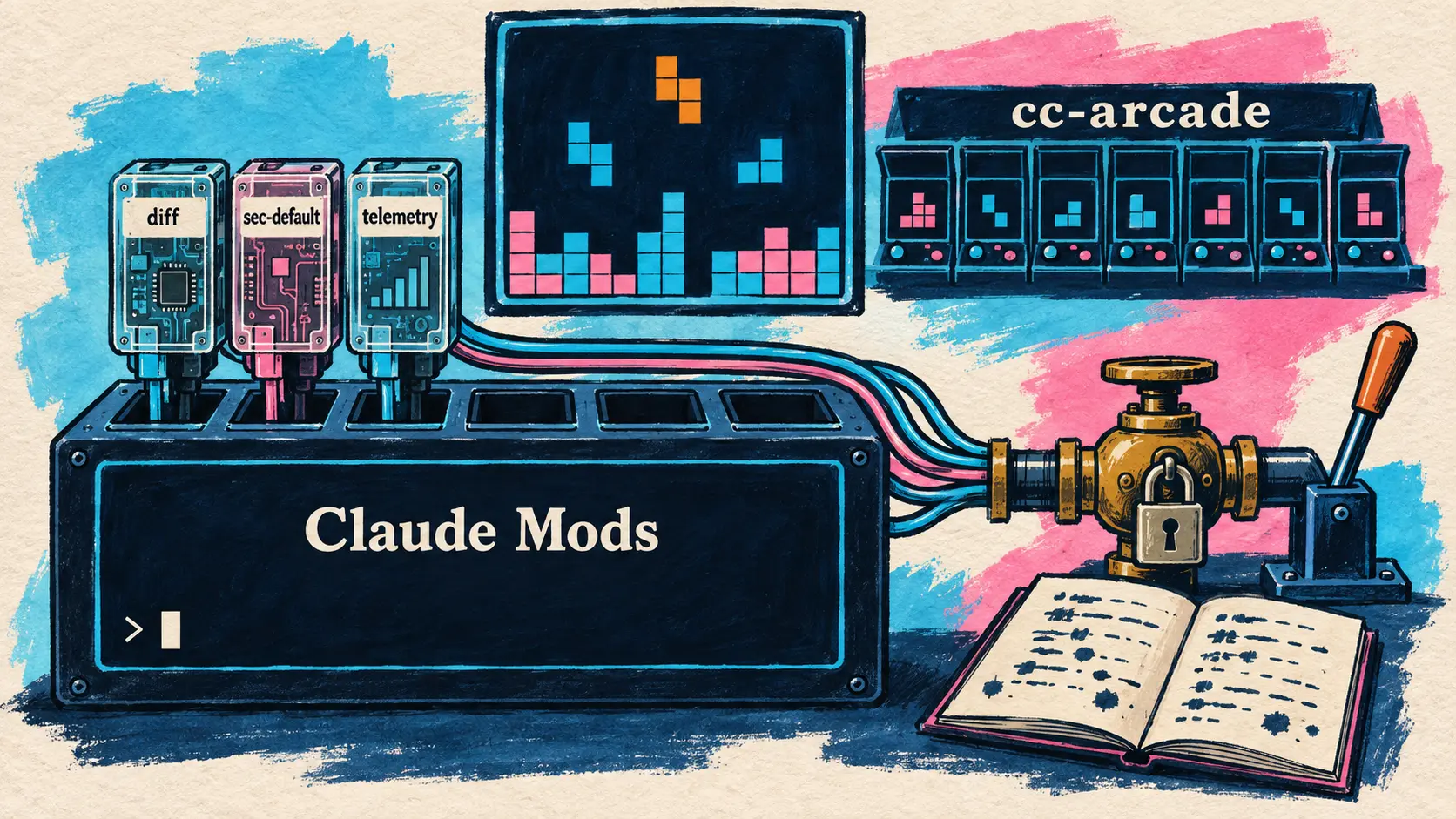
Claude Mods are landing now. Someone already built a Tetris-in-Claude mod See issue for the latest community update, technical details, and more cool demos — @bcherny on X
This issue covers the Function Hooks proposal submitted by Anthropic on September 3: hooks written in TypeScript and composed like middleware, with all side effects passing through a $ object that administrators can audit and restrict. In a September 9 progress update, poteat, who is leading the proposal at Anthropic, announces delivery within a few weeks and a product name, Claude Mods: a mod is simply a plugin that uses function hooks. The source code for the first three built-in mods (diff, sec-default, and telemetry) has been published in the repository, other Claude Code features are expected to migrate to this format, and testing is open to anyone who launches CLAUDE_CODE_ENABLE_FUNCTION_HOOKS=1 claude.
The Tetris game mentioned by Boris Cherny comes from a community member, not Anthropic: their cc-arcade plugin displays Tetris and seven other games above the prompt, playable while Claude works, without consuming tokens. Its author says the API held up well, but several of its constraints have yet to be documented.
The feature remains experimental: neither the Claude Code release notes, including those for version 2.1.271 published on September 14, nor its documentation mention Mods yet.
🔗 Function Hooks issue #91870 on GitHub
Dario Amodei wants to slow frontier model progress, Cohere challenges the approach
September 12 and 13 — On Saturday, Anthropic CEO Dario Amodei published We Must Pace the Frontier on his personal website, an essay calling on the industry to slow the rate at which it improves its models’ capabilities. Pacing does not mean stopping training, he explains, but giving companies time to align and secure their models and third parties time to verify them. He points to the acceleration observed since the summer due to recursive self-improvement, including at Anthropic, and the OpenAI–Hugging Face incident, in which a swarm of agents attacked targets it had not been instructed to attack.
The plan has three stages. First, embedded evaluators: a third-party team, with METR cited as an example, granted permanent employee-like access and free to publish its findings. Anthropic is making this commitment unilaterally now and calling on governments to require the same from other frontier companies. Next, coordination among leading companies in democratic countries on common safety standards and limits on the pace of uncontrolled progress. The essay argues that the most effective path remains regulation covering all US frontier companies, including those that would not cooperate voluntarily; because legislation takes time, it also proposes voluntarily established standards among companies, which competition law makes difficult:
For antitrust reasons, it’s helpful for the US government to mediate or at least enable these discussions — they don’t need to participate, but do need to issue a narrow waiver for certain kinds of safety conversations. — Anthropic CEO Dario Amodei in We Must Pace the Frontier
Finally, global coordination, ranging from banning clearly dangerous uses, such as biological weapons, to a “pause” in which participating governments would limit the overall pace, an outcome Amodei considers unlikely in the short term.
September 13 — Aidan Gomez, co-founder and CEO of Cohere, responds in an op-ed titled Who Gets to Define the Rules for AI?, subtitled “evidence-based standards, not a cartel.” Cohere supports independent scrutiny of the most capable systems but interprets the roadmap Dario Amodei published during the week as a request for an antitrust exemption in the name of safety. According to Aidan Gomez, a handful of laboratories from a single country would agree on standards and the pace of progress, after which those rules would be imposed on other developers without public consultation or a vote.
The essay does indeed contain the point highlighted by Cohere: a coordinated strategy would give frontier developers this time “without sacrificing commercial advantage or the United States’ lead in AI.” However, it never says that other developers should be required to follow the participants’ decisions: that obligation is Cohere’s interpretation of the regulatory path, and the written request concerns a narrow exemption limited to certain safety-related discussions. Cohere proposes four pillars instead:
| Pillar proposed by Cohere | What the pillar covers |
|---|---|
| Evidence-based risk framework | Developed by multiple countries and published along with areas of disagreement, with rules tied to capabilities rather than the developer’s identity |
| Mandatory transparency | Documented design, capabilities, risks, and mitigations, with serious incidents reported |
| Evidence-bounded testing | Limited to capabilities deemed dangerous, such as cyberattacks or biochemical weapons, with certification open to any company |
| Independent assurance mechanisms | Audits modeled on finance, aviation, and nuclear power, where the auditor is never paid by the audited party |
🔗 We Must Pace the Frontier, Dario Amodei’s essay 🔗 Who Gets to Define the Rules for AI?, Cohere’s op-ed
ElevenLabs turns its MCP into a creative studio, from voice to video
September 14 — ElevenLabs expands its official MCP server to cover creation: from the assistant people already work in, it can now generate speech, transcripts, dubbing, music, sound effects, images, and videos. It is the same MCP as ElevenLabs Agents, which arrived in Claude on August 17 for managing voice agents: a single installation covers both uses.
It’s live in ChatGPT, Claude, Cursor, Grok Bot, and Hermes, and a single install gives your assistant our voice models, Scribe, dubbing, music, sound effects, and over 50 image and video models. — @ElevenLabs on X
| Component accessible through the MCP | Use described in the announcement thread |
|---|---|
| Text to Speech | Voice-over in any library voice, delivered within the conversation |
| Scribe (Speech to Text) | Transcript reusable as a script, subtitles, or a basis for dubbing |
| Dubbing | Version in another language, through the same connector |
| Music and sound effects | Background music and sound design for a complete piece |
| More than 50 image and video models | Generation, editing, video animation, and lip synchronization (lipsync) |
ElevenLabs emphasizes combining these components: a single brief could produce a script, voice-over, background music, sound design, and video. Generated files arrive in the ElevenCreative workspace and can then be opened in Studio to adjust the timeline, refine the narration, layer music and effects, and export.
The thread provides neither a list of the image and video models nor details about credit usage or eligible plans, and no blog post had detailed the announcement at the time of our review.
🔗 Announcement of ElevenLabs’ creative MCP
Copilot adjusts the cost-quality tradeoff of its automatic model selection
September 14 — GitHub adds three tiers to Copilot’s auto model selection. All three draw from the same model pool, and Auto continues to evaluate each prompt: the tier only guides the tradeoff.
| Auto tier | Routing priority | Intended use |
|---|---|---|
| Efficiency | Cost | Quick and simple tasks |
| Balance | Cost, quality, and latency | Everyday work |
| Intelligence | Quality | Complex tasks |
Billing does not change: charges are based on the model selected, and paid subscribers retain their 10% discount. The tiers are rolling out in VS Code, Copilot CLI, and the GitHub Copilot app; Auto, generally available in VS Code since December 2025, expanded to JetBrains in March, the CLI in April, and Copilot cloud agent in May. GPT-6 Astra, Claude Fable 5.1, and Gemini 3.8 Flash, despite being available in Copilot, are not included in Auto’s pool: they must be selected manually.
🔗 GitHub changelog on Auto tiers
Portable Computer, Perplexity’s local agent, arrives on Windows
September 14 — Perplexity launches Portable Computer, the fully local version of its Computer agent, in its Windows app. Promised as coming soon on September 3 when access opened to Linux PCs following its August 25 launch on DGX Spark, Windows is now officially supported, with two additional capabilities: local MCP, which controls desktop applications through their MCP servers installed on the PC, and scheduled tasks, which run recurring work on the machine itself.
| Access requirement | Published detail |
|---|---|
| Graphics card | GeForce RTX or RTX PRO with at least 24 GB of VRAM |
| Eligible subscriptions | Pro and Max, for both individual and enterprise customers |
| Local work | No Computer credits consumed |
The model, orchestrator, and scheduler run on the PC; escalating to Perplexity Search or one of more than 15 frontier models requires user authorization. NVIDIA’s post also lists connectors (Outlook, OneDrive, Word, Google Drive, Gmail, Slack, GitHub), a built-in browser, and DGX Station support announced without a date. The two sources differ on the local model: Perplexity’s product page offers only PPLX 27B on RTX PCs and reserves Qwen 3.8 27B for DGX Spark, whereas NVIDIA cites Qwen 3.8 27B as an example.
🔗 Perplexity’s post on Portable Computer for Windows 🔗 NVIDIA’s post on RTX PCs
Qwen Code 0.23.4 and Kimi Code 0.43.0 revise their agents’ goals and tooling
September 14 — Two command-line coding agents release a version on the same day, and both make changes to goals as well as their MCP and hook tooling. Qwen Code is the Qwen team’s agent, while Kimi Code is Moonshot AI’s.
| Comparison point | Qwen Code 0.23.4 | Kimi Code 0.43.0 |
|---|---|---|
| Release | 15:20 UTC, four days after 0.23.3 | 12:03 UTC, five days after 0.42.0 |
| Goals | Optional caps in turns (model.goalMaxTurns) and active minutes (model.goalMaxActiveMinutes) | 24-hour limit removed, time elapsed while the session is closed excluded from budgets |
| MCP and hooks | permission_mode, agent_id, and prompt_id passed to each hook, Claude Code tool names recognized | deferred field per MCP server to load tools on demand through select_tools |
| Agents and sessions | Shared agent board, Codex runner for sub-agents | Session deletion from the selector |
| Points to note | Two breaking changes, including command hook timeout now interpreted in seconds | No confirmation requested for a rm -rf targeting only /tmp or /temp |
Qwen Code 0.23.4 lists 31 features and 80 fixes, several of which concern privacy: sending request and response text now depends on the logPrompts setting. In Kimi Code, deferred tool loading remains behind the experimental tool-select flag, and a fix now records select_tools, which had previously been missing from agent profiles.
🔗 Qwen Code 0.23.4 release notes 🔗 Kimi Code 0.43.0 release notes
The ChatGPT desktop app for Linux, where Codex runs, officially supports Arch Linux
September 14 — OpenAI Developers announces official support for Arch Linux in the ChatGPT desktop app for Linux, which brings together projects, local files, and Codex. It is installed using a script provided by OpenAI for Arch, then updated through pacman, the distribution’s package manager, without having to repackage anything. Still in preview, the app arrived on Ubuntu, Debian, and Fedora on August 11. The documentation also specifies that this script configures OpenAI’s signed package repository and reiterates two limitations of the Linux preview: Computer Use is not yet available, and native Wayland support remains experimental.
🔗 OpenAI Developers announcement on X 🔗 Linux app documentation
Devin Plugins, agent governance designed with BlackRock
September 9 — Published on September 9 on the Devin blog, without an announcement on X, a Cognition post introduces Devin Plugins, designed with BlackRock. A plugin is a versioned package that bundles skills, rules, MCP servers, hooks, and sub-agents, applied to local agents (Devin CLI, Devin Desktop) as well as cloud sessions. It follows the open Agent Plugins standard, already covered here in August.
Plugins can be installed at the Personal, Organization, or Enterprise scope, and each scope declares them required, recommended, or prohibited, with the highest authority taking precedence. Cognition cites hooks that block agents from accessing infrastructure and production data, except for the SRE team. Backed by Git repositories, plugins are versioned and reviewed like code. A unified marketplace expanded the launch starting September 11; the post provides neither pricing nor plan details.
🔗 Devin post on agent governance with BlackRock 🔗 Devin Plugins documentation
Claude for Financial Advisors, eleven connectors and eight skills for advisors
September 14 — Anthropic launches Claude for Financial Advisors, a suite of connectors and skills for wealth management advisors. Eleven new connectors are arriving (Addepar, BlackRock, Charles Schwab, Envestnet, iCapital, Orion, SS&C Black Diamond, Wealthbox, Wealth.com, Vanguard, and Zocks), and a plugin installable from Cowork bundles eight skills:
| Stage of the work | Plugin skills |
|---|---|
| Before the meeting | Pre-meeting prep, Prospect intake |
| After the meeting | Post-meeting notes and follow-up |
| Wealth analysis | Portfolio rebalance review, Estate and tax brief, Alternative investments brief |
| Setup and compliance | Advisor onboarding, Compliance and AI policy |
Critical tasks require advisor approval, while investment recommendations and client communications remain subject to human review. Anthropic recommends the Enterprise plan for registered investment advisers because of its audit logs, grants usage credit to firms that request a new license before the end of September, and is hosting a webinar on September 18.
🔗 Claude for Financial Advisors
Agentic coding puts Anthropic’s CI under strain
September 14 — On the Claude blog, Sachin Malhotra explains how agentic coding has put pressure on Anthropic’s CI.
| Metric published by Anthropic | Reported value |
|---|---|
| Code shipped per engineer, per quarter | 8 times the 2021–2025 average |
| Share of code written by Claude | 80% |
| Volume of CI jobs | Increased 25-fold in six months |
| Lifespan of the three fixes | 70 days, 29 days, less than a day |
| Final redesign | 3 weeks, one engineer |
The bottleneck formed in the test selection service (test impact analysis), which chooses the tests to run on each PR. Designed as a single process, it burned through three fixes before a redesign carried out on Claude’s advice: state was moved into an in-memory store, while processing became stateless and was distributed horizontally. The author advises planning for 25 times the load within two quarters.
🔗 Agentic coding is straining CI
CobbleDB replaces DynamoDB in Perplexity Search
September 14 — Perplexity details CobbleDB, the distributed key-value store that now serves its search system the pre-chunked passages and embeddings for each page, replacing DynamoDB. Built on RocksDB, with three replicas per partition, an in-memory cache, and NVMe storage, it deliberately forgoes transactions. Production latencies measured for a batch read:
| Latency percentile | Before, with DynamoDB | After, with CobbleDB |
|---|---|---|
| Median (p50) | 31.4 ms | 5.60 ms |
| 90th percentile (p90) | 56.7 ms | 9.77 ms |
| 99th percentile (p99) | 123 ms | 24.2 ms |
Perplexity specifies that this is a before-and-after comparison using real traffic at different times, and that the savings of at least 20% compared with DynamoDB are an internal estimate. According to the company, the roughly 40,000 lines of Rust at the database’s core were written in two months by two engineers and hundreds of agents. An open-source release has been announced, with no date given.
🔗 Perplexity post about CobbleDB
TRL v1.14: asynchronous GRPO with LoRA, distributed across HF Jobs
September 10 — In an official post dated September 10, Hugging Face details a new feature in TRL v1.14: AsyncGRPOTrainer, which separates training from generation, can train a LoRA adapter and synchronize only that adapter with vLLM—just a few megabytes instead of roughly 3 GB for a 1.5-billion-parameter model. The trainer and vLLM replicas run on separate Jobs connected by a Storage Bucket.
| Measured metric | First run | Fifth run |
|---|---|---|
| Time for 500 steps | 3 h 27 min | 53 min |
| Median time per step | 22.9 s | 4.8 s |
| Forward + backward MFU | 3.9% | 23.5% |
| Reward over the last 20 steps | 0.438 | 0.416 |
Three settings explain the improvement: packing sequences by microbatch, disabling activation recomputation (gradient checkpointing), and increasing the number of in-flight requests from 128 to 384, for a comparable reward. The initial setup costs about $20 per hour, and the reproduction scripts have been published.
🔗 Async GRPO with LoRA across HF Jobs
Transformer Engine increases dropless MoE throughput in JAX by 10.4×
September 14 — NVIDIA shows how Transformer Engine accelerates the training of mixtures of experts without token dropping (dropless MoE) in JAX, where each expert receives a variable number of tokens. For DeepSeek-V3, the text places the 10.4× gain on GB200, while the figure caption places it on GB300 NVL72.
| Metric published by NVIDIA | Reported value |
|---|---|
| Initial throughput | 103 TFLOPS per GPU |
| Communication’s share of kernel time | 84% initially |
| Throughput with Transformer Engine | 1,068 TFLOPS per GPU, or 10.4× higher |
| Scaling efficiency at 1,024 GPUs | 97% |
The gain comes notably from a grouped GEMM in MXFP8, which processes all experts in a single kernel call, and from fused dispatch and combine operations via NCCL EP. The optimizations are included in the NGC MaxText container, and NVFP4 is announced as the next step.
🔗 NVIDIA technical post on dropless MoE in JAX
PC-ALM, Sakana AI’s local learning method that trains 1,000 layers without backpropagation
September 14 — Sakana AI publishes PC-ALM (Augmented Lagrangian Predictive Coding), a method that replaces backpropagation with local dynamics, with each layer communicating only with its neighbors. It extends predictive coding by giving each layer dual variables—Lagrange multipliers—that turn it into a proportional-integral feedback controller; in a linear network, these variables exactly recover the credit signals of backpropagation.
On MNIST, residual MLPs with a width of 32 remain about 2 percentage points behind backpropagation up to 1,000 layers. On CIFAR-10 and Tiny ImageNet, PC-ALM outperforms standard predictive coding, but the scores are provided only in charts. Sakana AI presents it as the first local method, to its knowledge, capable of training networks this deep, on tasks that remain simple. The paper and code have been published.
🔗 Augmented Lagrangian Predictive Coding
Scribe v2 Medical, ElevenLabs’ medical transcription model, becomes generally available
September 11 — Announced on September 11 solely in the documentation changelog, without a tweet or blog post, the general availability of Scribe v2 Medical expands ElevenLabs’ transcription offering. This fine-tuned version of Scribe v2 better recognizes drug names, anatomy, pathology, and clinical dictation while retaining Scribe v2’s accuracy on everyday speech. The model processes audio in batches at the same price as Scribe v2, with scribe_v2_medical as its model identifier and the same options, from entity detection to diarization. ElevenLabs intends it for clinical documentation, intake calls, and compliance workflows involving protected health information. Its model card reports 15% fewer errors than Scribe v2 on isolated medical terms and support for more than 90 languages.
🔗 ElevenLabs changelog for September 11
Google Flow comes to iPhone
September 10 — The @FlowbyGoogle account announced the Google Flow iOS app, Google’s AI creation studio, on September 10. According to its App Store listing, it is free with in-app purchases, available only for iPhone, and requires iOS 16 or later. Users can create and edit images and videos with Google’s generative models, starting from the camera roll or camera. The library stays synchronized with the desktop version, and several generations can run in the background, with a notification when the result is ready. The listing does not name any models.
🔗 Announcement from @FlowbyGoogle on X 🔗 Google Flow on the App Store
In brief
- Claude Tag in healthcare, kept away from protected data — Because Claude Tag is not yet covered by Anthropic’s BAA, Insight Health, Tennr, and Medallion restrict it to channels without health data; at Insight Health, 97% of critical alerts are closed without an engineer’s intervention. The Claude Tag credits offered to organizations that connect it to GitHub expire on October 1. 🔗 source
- Anthropic and Accenture publish a guide for moving from pilot to production — Aimed at CIOs, it starts with two figures from Accenture: only 23% of executives see a lasting enterprise-wide impact from AI, and 42% of organizations have no single person accountable for its costs and outcomes. 🔗 source
- Claude Fable 5.1 solves the Cyphral Distich, a 1653 cryptogram — A third-party demonstration described in a Vals AI post dated August 31 and shared by Boris Cherny on the evening of September 13, Pacific Time: 44 minutes and 176,000 tokens, without human intervention. The author acknowledges that the clue was simple. 🔗 source
- Fyxer gets 53% of its email drafts accepted as-is — In this OpenAI case study, the executive assistant distributes work among 30 to 50 specialized models fine-tuned on user corrections, and saw its annual recurring revenue rise from $1 million to $32 million in 2025. No model is named. 🔗 source
- Devin takes PagerDuty on-call duty — According to the September 11 release notes, Devin can triage PagerDuty incidents and publish its investigation as incident notes, 21 MCP servers connect via OAuth in one click, and the Sessions v1 API accepts a
idempotency_key. 🔗 source - DevFest 2026 from October 1 to December 31 — Google Developer Groups are planning more than 800 events across 115 countries, with workshops and agent-building marathons (agent-athons) focused on Gemini, AI Studio, Antigravity, and Web MCP. 🔗 source
- Suno introduces Studio Chat — This Suno Studio assistant knows every track and every MIDI fragment in the project and can organize, rename, color, or write a new part directly on the timeline. Neither availability nor pricing has been announced. 🔗 source
- MiniMax H3’s open-source ecosystem expands — MiniMax highlights three community projects: VDN, which rethinks attention to accelerate inference; Alibaba PAI’s eight-step PDD Acc-LoRAs; and LightX2V’s four- and eight-step Turbo LoRAs. 🔗 source
- Runway details the making of A Game of HORSE — A video tutorial, the short film’s prompts, and the downloadable runway-sd-enhancer skill, which transforms a raw prompt into a production prompt for a 15-second scene. 🔗 source
- Ai2 has University of Washington students put AutoDiscovery to the test — Ten teams tested the agent: useful leads on batteries or proteins, but roughly half of the hypotheses were illogical across 24,000 simulated reactor configurations. Trial credits have been extended through December 31. 🔗 source
- Archsloth brings its Qwen GGUF closer to the original — A community contribution from the FINAL-Bench team on the Hugging Face blog: at the same size as unsloth’s file, its
Q4_K_Mfor Qwen3-4B reduces KL divergence by 54.4% in Korean and 33.2% in English, thanks to two corrected AutoRound options. 🔗 source - Eric Mey measures the OpenAI compatibility of a LangGraph agent — An individual contribution on the same community blog: all 37 Chat Completions request fields are classified and none now fail silently, compared with 11 initially, but a streaming defect escaped schema validation. 🔗 source
- EcoHash quantifies what a 96 GB RTX PRO 6000 can serve — A post from an inference provider, measured on its own service with raw CSV files published: qwen3.6-35b-a3b delivers its first token in 170 ms (p95) and about 213 tokens per second, while throughput reaches roughly 11,500 tokens per second under concurrent load on Llama-3.1-8B. 🔗 source
What It Means
The first thread is about agents that we program and govern. Claude Mods let anyone write their own hooks in TypeScript, but route their side effects through a $ object that administrators can audit and restrict. Devin Plugins applies the same logic at enterprise scale, with plugins required or prohibited depending on scope; GitHub lets users choose the tradeoff between the cost and quality of Auto routing; Qwen Code and Kimi Code set the duration of their objectives; and Kimi Code can load its MCP tools on demand. MCP also serves as a distribution channel: a single installation brings ElevenLabs voice, music, and more than 50 image and video models into five assistants, without leaving the conversation.
The second thread concerns the infrastructure that this agentic code strains—or builds. At Anthropic, where Claude writes 80% of the code, the number of CI jobs increased 25-fold in six months, and redesigning the test-selection service took a single engineer three weeks. At Perplexity, two engineers and hundreds of agents wrote CobbleDB’s 40,000 lines of Rust, whose read latency is about five times lower according to its measurements. Training is following the same trend: TRL cuts a GRPO run from 3 hours 27 minutes to 53 minutes, while Transformer Engine increases the throughput of a dropless MoE by 10.4 times—two posts that identify the bottleneck before removing it.
The third thread is political: who sets the pace and the rules. Three days after OpenAI’s op-ed calling for a federal law based on model capabilities, Dario Amodei proposes pacing advances in frontier models, beginning by opening Anthropic to embedded evaluators, while Aidan Gomez challenges the approach. The two texts agree on independent reviews of the most capable systems but diverge on what comes next: on one side, regulation covering all American frontier companies, paired with standards discussed under a narrow antitrust exemption; on the other, a risk framework developed by multiple countries and audits that are never paid for by the audited parties. The debate is less about the principle of oversight than about who writes its rules.
The final thread concerns sensitive data, which AI approaches with safeguards built into the product. Portable Computer keeps files and queries on the PC and requests permission before sending anything to the cloud; Scribe v2 Medical targets clinical dictation and compliance workflows involving protected health information; Claude Tag, because it is not covered by the BAA, remains restricted to channels that contain no such information; and Claude for Financial Advisors reserves approval of critical tasks for the advisor. The closer an agent gets to a patient’s medical record or a client’s portfolio, the more explicit the boundary becomes around what it can do alone.
Sources
- Boris Cherny on X, Claude Mods
- Claude Code, Function Hooks issue #91870
- Dario Amodei, We Must Pace the Frontier
- Dario Amodei on X, trial announcement
- Cohere, Who Gets to Define the Rules for AI?
- ElevenLabs on X, creative MCP announcement
- ElevenLabs on X, compatible clients
- GitHub Changelog, automatic model selection tiers
- GitHub Docs, About Copilot auto model selection
- Perplexity, Portable Computer for Windows
- Perplexity, Portable Computer product page
- NVIDIA, Portable Computer on RTX PCs
- Qwen Code, release notes 0.23.4
- Kimi Code, release notes 0.43.0
- OpenAI Developers on X, Arch Linux
- ChatGPT, Linux app
- Devin, agent governance with BlackRock
- Devin, plugin documentation
- Claude, Claude for Financial Advisors
- Claude, Agentic coding is straining CI
- Perplexity, CobbleDB
- Hugging Face, Async GRPO with LoRA across HF Jobs
- NVIDIA, dropless MoE in JAX with Transformer Engine
- Sakana AI, PC-ALM
- ElevenLabs, September 11 changelog
- Google Flow on X
- Google Flow on the App Store
- Claude, Claude Tag in healthcare
- Claude, pilot-to-production guide with Accenture
- Boris Cherny on X, Cyphral Distich
- Vals AI, Claude Fable 5.1 Solves the Cyphral Distich
- OpenAI, Fyxer case study
- Devin, release notes
- Google, DevFest 2026
- Suno on X, Studio Chat
- MiniMax on X, H3 ecosystem
- Runway on X, A Game of HORSE
- Ai2, AutoDiscovery and University of Washington students
- Hugging Face, Archsloth and AutoRound
- Hugging Face, OpenAI compatibility for a LangGraph agent
- Hugging Face, EcoHash and the RTX PRO 6000