ai-powered-markdown-translatorArticle translated from fr to en with gpt-6.1-sol.
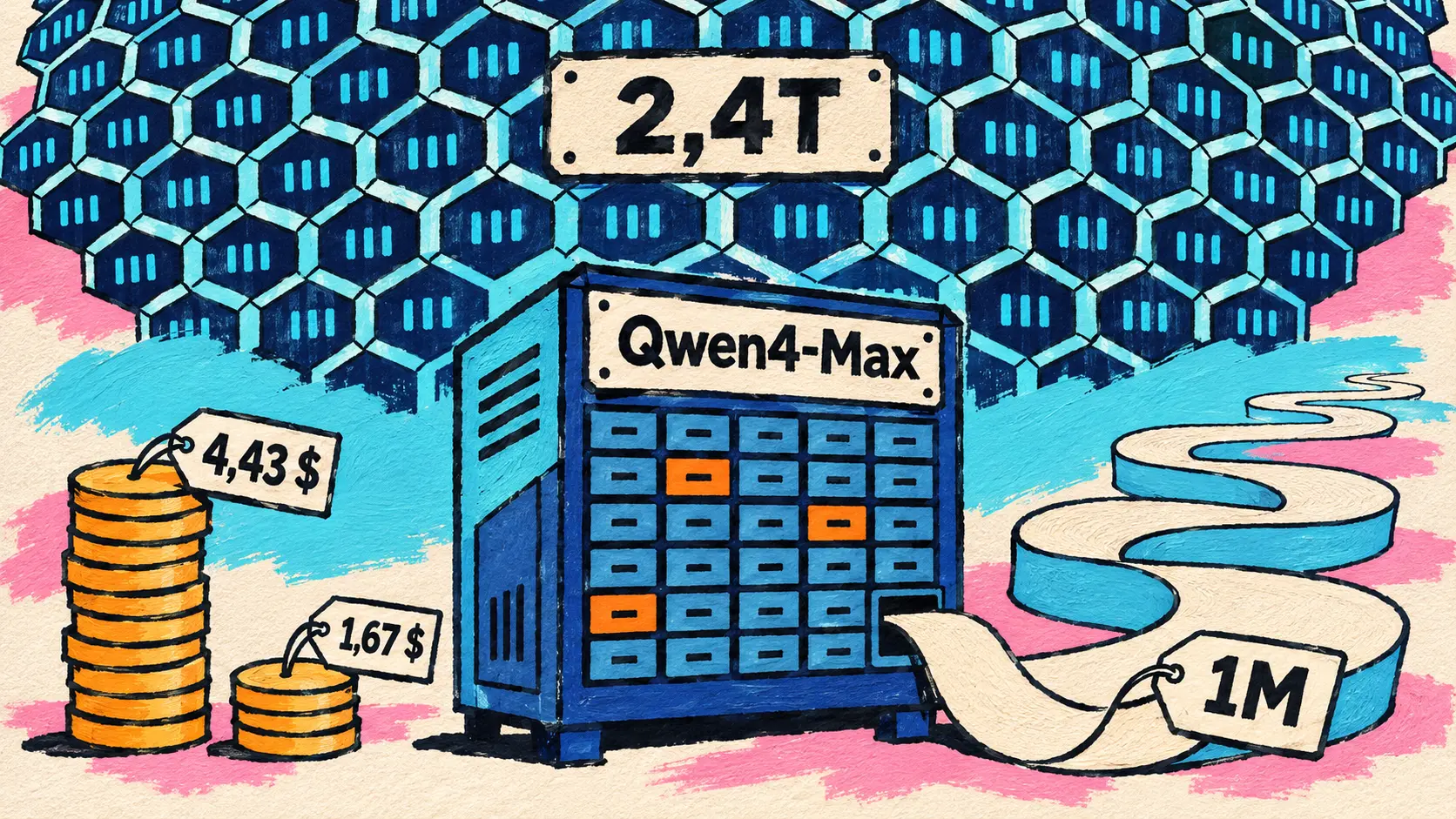
Qwen makes Qwen4-Max available through its API: a MoE model with 2.4T parameters and a 1M-token context, priced lower than Qwen3.8-Max. OpenAI extends its computer-use agents to ChatGPT for Healthcare and ChatGPT for Clinicians, NVIDIA announces Rubin HPC at SC26, a simulation GPU expected in 2028, alongside Vera Rubin’s first MLPerf Training results, and Hugging Face hands routing for its Inference Providers to OpenRouter. Meanwhile, Perplexity launches Perplexity Frontier Research, which aims to build an automated scientist using more than 10,000 GPUs.
Qwen4-Max arrives in the QwenCloud API: MoE with 2.4T parameters, 1M-token context, lower prices
November 16 — Five days after the preview covered on November 11, Qwen makes Qwen4-Max available through the QwenCloud API under the identifier qwen4-max, accompanied by a detailed technical post. It is the first model in the Qwen4 series: smaller Qwen4 models will be released with open weights, with no date given, but no such release has been announced for Max. The model is also available in QwenWork, Qoder and Qwen Studio, and from the same day through OpenRouter, Vercel AI Gateway, Novita AI and OpenCode Go.
The architecture is new. This mixture of experts (Mixture of Experts, MoE) has 2.4T backbone parameters, of which 71B are activated per token, plus 328B N-gram Embedding parameters. Of every four layers, three Gated DeltaNet layers compress the history into a fixed-size state; the fourth uses Qwen Sparse Attention to select useful context in blocks. The model has native vision and a 1M-token context: 991K input and 131K output, or 983K and 262K in reasoning mode, according to the QwenCloud page.
| Pricing type (QwenCloud, per million tokens) | Announced price |
|---|---|
| Input | 1,5 dollars |
| Output | 4,5 dollars |
| Implicitly cached input | 0,075 dollars |
| Explicit cache creation (5 minutes / 1 hour) | 1,875 / 3 dollars |
According to Qwen, all these prices are lower than those of Qwen3.8-Max, with implicit caching down 70%. In its internal evaluations, Qwen also reports token consumption reduced by 24 to 35%, depending on effort level, on Work360, its framework covering 721 professional specialties, and by around 48 to 49% on Terminal-Bench 4.0. The average cost of a Work360 task falls from $4.43 to $1.67, a reduction of 62% according to the English post; the Chinese version, in yuan, reports a reduction of 58%. On Work360, Qwen4-Max scores 52.69 compared with 47.74 for Qwen3.8-Max.
Against Opus 5.5, GPT-6.1 Sol, GPT-6 Astra and Kimi K3.1, the table published by Qwen remains mixed: Qwen4-Max leads on only 4 of the 16 tests, DeepSWE v1.1, Agents’ Last Exam v1.1, HLAB-Vals-1.1 and BioMysteryBench. A selection:
| Benchmark (domain) | Qwen4-Max | Opus 5.5 | GPT-6.1 Sol | GPT-6 Astra | Kimi K3.1 |
|---|---|---|---|---|---|
| DeepSWE v1.1 (agentic coding) | 75,7 | 74,2 | 75,2 | 74,1 | 75,5 |
| HLAB-Vals-1.1 (legal agent) | 21,3 | 9,2 | 6,3 | 7,1 | 11,7 |
| BioMysteryBench (bioinformatics) | 85,0 | 81,9 | 84,4 | 78,9 | 80,6 |
| Terminal-Bench 4.0 (agentic terminal) | 48,5 | 59,6 | 56,1 | 59,1 | 67,2 |
| ProgramBench (software replication) | 31,5 | 65,0 | 52,5 | 55,0 | 25,0 |
| Humanity’s Last Exam | 51,7 | 59,8 | 54,0 | 53,6 | 51,1 |
Third-party rankings shared by Qwen place it 6th in Code Arena WebDev (1,750 preliminary points) and 11th in the Vals Index (63.20%), the highest-ranked Chinese model. Artificial Analysis gives it 43 points on its Intelligence Index at xhigh effort, 3 points behind Kimi K3.1 Pro, at a cost per task around 11% lower.
More to come! The open weights of smaller Qwen4 models will be released. Stay tuned. — @Alibaba_Qwen on X
🔗 Qwen4-Max: Your New Teammate Has Arrived (Qwen post) · qwen4-max listing on QwenCloud
ChatGPT for Healthcare: computer-use agents, clinical research and more than 20 healthcare plugins
November 16 — OpenAI expands ChatGPT for Healthcare in three directions. First, agents that operate computers (computer-use agents), which read the screen, click, type and switch between applications, are coming to ChatGPT Work and Codex for ChatGPT for Healthcare customers, depending on their workspace settings, and for clinicians using ChatGPT for Clinicians, the free offering reserved for verified clinicians in the United States. The same capability is available through the API. A typical use case: moving information between software systems that do not communicate, such as an electronic health record and an insurer’s portal for an MRI authorization request. Computer use has been available in ChatGPT Work and Codex since July 9; the new development is its availability in healthcare workspaces, with role-based access controls, audit logs and configurable approval steps. HIPAA-compliant workflows remain limited to eligible services covered by a BAA.
OpenAI publishes two sets of figures, which should be considered separately: its internal evaluation of electronic health record messaging, and HealthAdminBench, an independent benchmark from Stanford researchers focused on administrative tasks (prior authorizations, appeals, equipment orders).
| Published evaluation | Model and setting | Announced result |
|---|---|---|
| Electronic health record messaging (OpenAI, 325 reviewed tasks) | GPT-6 Astra | 99 % of tasks judged clinically safe |
| Same evaluation, 646 physician ratings | GPT-6 Astra | 93 % “very” or “extremely” useful |
| HealthAdminBench (Stanford) | GPT-6 Astra, maximum effort | 94,3 % of rubric points |
| HealthAdminBench (Stanford) | GPT-6 Luna, maximum effort | 91,8 %, at 8,5 cents per task |
On HealthAdminBench, GPT-6 Luna scores 91.8% at a cost 98% lower, or 8.5 cents per task. In practice, CVS Health already uses these agents in production: one cleared a months-long backlog of document submissions over a weekend, another handles system steps for tens of thousands of consultations a day, and the company is releasing its Agent Kit as open source, built with OpenAI’s Agents SDK. Cigna Healthcare says it went from concept to deployment in less than eight weeks; at Ambience, the agent stops and asks for the clinician’s input when the record is ambiguous; Abridge is developing agents for hospitals.
Then come the other two areas. Clinical research, which finds, evaluates and cites medical evidence, receives higher scores across all eight dimensions measured in a blind evaluation involving more than 1,300 physician reviews. And 21 new healthcare plugins (UpToDate Expert AI, Oracle HDI, Trizetto, Stedi, Luma Health, Metriport…) let users consult a protocol, check insurance eligibility or coordinate appointments from the conversation; the workspace administrator must enable them, and ChatGPT for Clinicians receives only a subset.
🔗 More ways to move care forward with ChatGPT for Healthcare · Advancing computer-use agents for healthcare teams
NVIDIA at SC26: Rubin HPC for scientific simulation, Vera Rubin in MLPerf, Slurm for quantum processors and CUDA-X libraries
November 16 — At the SC26 high-performance computing conference, NVIDIA launches a wave of science-focused announcements. The main one is Rubin HPC, a new GPU in the Vera Rubin platform designed for simulation and data processing in science, engineering and analytics, in fields such as climate, genomics and financial risk.
The published specifications remain brief. NVIDIA highlights more than 50,000 CUDA cores on a single GPU, a “record” number according to the company, sparse data acceleration (sparse data acceleration) designed to keep those cores supplied with data, and a seventh-generation NVLink connection between GPUs. No memory capacity, performance in FLOPS, price or partner is mentioned.
The central argument is balance. According to NVIDIA, most scientific workloads involve fetching a few scattered values from an enormous dataset, computing, then repeating at a very large scale. Rubin HPC therefore scales data movement alongside computation to accelerate sparse matrix operations, stencil computations, sorting and reductions. NVIDIA ties this GPU to its messaging on agents: an agent exploring more molecules, materials or designs needs more simulations to test its ideas, and CUDA-X libraries provide optimized implementations. The timeline is distant: Rubin HPC is expected in 2028.
| Announced specification | Value stated by NVIDIA |
|---|---|
| CUDA cores | more than 50 000 on a single GPU |
| GPU interconnect | Seventh-generation NVLink |
| Specific feature | Sparse data acceleration |
| Expected availability | 2028 |
🔗 Rubin HPC (NVIDIA blog) · NVIDIA’s announcements at SC26
Vera Rubin debuts in MLPerf Training v6.1 and MLPerf Endpoints, with up to twice the performance of GB300 NVL72 per GPU
November 16 — The MLPerf Training v6.1 round marks Vera Rubin NVL72’s first participation in training: up to twice the performance per GPU of a GB300 NVL72, results NVIDIA describes as early. On DeepSeek-V3, scaling from 256 to 1,024 Vera Rubin GPUs maintains around 97% efficiency and cuts training from 16 minutes to around four. The largest configuration in the round has 10,240 GPUs, using GB300 at NVIDIA and GB200 at Microsoft Azure. According to NVIDIA, its platform is the only one with results across all tests.
NVIDIA also makes its first submission to MLPerf Endpoints v1.0, which measures real agentic workflows. On Kimi K3, Vera Rubin NVL72 reportedly delivers more than 10 times the throughput per watt of a GB300 NVL72 at the same response speed: a provisional result, pending verification by MLCommons, comparing 32 Vera Rubin accelerators with 48 GB300 accelerators at the threshold of 50 tokens per second per user. Vera Rubin had already appeared in preview in MLPerf Inference, covered on September 16.
🔗 Vera Rubin in MLPerf Training and Endpoints (NVIDIA blog)
Slurm 26.11 will support quantum processors, CUDA-Q expands
November 16 — NVIDIA extends Slurm, the job scheduler for supercomputers, to quantum processors (QPU). Until now, connecting a QPU to a computing center required custom development for each processor–center pairing; now, a manufacturer describes its hardware in a simple file and gets an interface that works everywhere, through the QRMI and QDMI interfaces. Alice & Bob, IBM, IQM, Pasqal, Quantinuum and MQSC are adopting it, and Slurm 26.11 is due for release later in November. NVIDIA justifies this work by the growing installed base: nearly 30 computing centers are deploying more than 50 QPUs.
The CUDA-Q platform gains a decoding server for quantum error correction (CUDA-Q QEC), whose TCBP-JOBS decoder is reportedly 13,000 times faster than the industry reference, fault-tolerant primitives (Fermilab has already used CUDA-Q to complete studies in three weeks that would have taken five months), as well as CUDA-Q Algorithms and CUDA-Q Pulse for hardware manufacturers. These gains are NVIDIA’s claims.
🔗 Slurm and quantum computing (NVIDIA blog)
CUDA-X for science: open-source cuSpa and HMMER on GPU, Event Horizon Telescope data correlated in eight minutes
November 16 — NVIDIA accompanies Rubin HPC with CUDA-X libraries for research, presented as tools that agents can call. In astronomy, the cuPhoton.xBeam module cuts the time needed to correlate Event Horizon Telescope observations from more than a month to eight minutes, on both a multi-GPU cluster and a DGX Spark. In biology, cuSpa, now open source, makes cell polygon calculations 900 times faster than on CPU at Memorial Sloan Kettering Cancer Center, and the GPU version of HMMER, also open source, is up to 84 times faster at Basecamp Research. rapids-singlecell now ships in a container “ready for agents” (200 times faster at Therna Biosciences). In chemistry, Daviator, a collection of GPU kernels for VASP software, is coming to NVIDIA ALCHEMI with computations up to 22 times faster and up to 75% cheaper, but is not yet available; cuPotential, launched on October 14, gains five adopters, including Cadence.
🔗 CUDA-X libraries for science (NVIDIA blog)
Hugging Face hands OpenRouter the routing of language models for its Inference Providers
November 16 — Hugging Face and OpenRouter are partnering: Hugging Face’s Inference Providers are dropping their in-house router and letting OpenRouter choose the provider for each language model call. Clément Delangue presents the announcement as the first part of the partnership. Nothing changes in the client code: the same Hugging Face token, the same endpoint. The router accepts OpenAI’s Chat Completions and Responses APIs as well as Anthropic’s Messages API, and Hugging Face is publishing guides for Claude Code, Codex, OpenCode, Pi and Hermes Agent.
The difference lies in routing. Inference Providers used to choose a provider and return its error unchanged; OpenRouter chooses based on price, speed and reliability measured in real time, and retries the call elsewhere if the first provider fails. Suffixes enforce a policy or provider (:fastest, :cheapest, zai-org/GLM-5.3:novita), and a conversation stays with the provider holding its prompt cache.
| Announced change | Details according to the post |
|---|---|
| Capacity errors (OpenRouter measurement) | −46 % |
| Time to first token and throughput (OpenRouter measurement) | improved by 16,9 % and +16,3 % |
| Billing | provider prices, with no markup added by Hugging Face |
| Included monthly credits | 2 dollars (PRO), 2 dollars per seat (Team, Enterprise) |
| Model pages | Providers and Metrics tabs: price, speed, availability over 24 hours |
| Breaking change | personal provider API keys rejected for language models |
Images, video and audio continue to go directly through Inference Providers, without OpenRouter, and personal keys remain valid for image and video providers. Linking an OpenRouter account to Hugging Face and routing other tasks through OpenRouter are planned for later, with no date announced.
The post draws on OpenRouter’s figures: open models accounted for 71,7 % of tokens served at the end of September 2026, compared with 26,8 % in October 2025, at an average price of 0,28 and 1,62 dollars per million tokens (input, output), compared with 1,27 and 6,36 dollars for closed models. It also acknowledges the gap at the top of the rankings: Kimi K3.1 Pro, the best open model, scores 46 on the Artificial Analysis Intelligence Index compared with 65 for Claude Fable 5.2, at roughly one-seventh of the cost per task (3,68 versus 26,54 dollars).
🔗 Hugging Face and OpenRouter join forces (Hugging Face blog) · Announcement from @huggingface
Perplexity Frontier Research: an open research initiative aiming to build an automated scientist, with more than 10 000 GPUs
November 16 — Perplexity is launching Perplexity Frontier Research, an initiative aimed at building an “automatic research scientist” (automatic research scientist): an AI system capable of independently carrying out the research cycle, from question to hypothesis, from experiment to revising its beliefs. Perplexity contrasts this ambition with “black box” predictions on narrow tasks: the goal is to produce new, interpretable knowledge.
We aim to create an automated research scientist. Research is a loop that involves asking the right questions, hypothesizing, navigating ambiguity, designing experiments, and updating beliefs. We think this loop can run inside software, for anyone. — @andrewgwils on X
The program is organized around six pillars: multi-agent orchestration, pre-training, continual learning, reinforcement learning, systems and evaluations. The dedicated website states that the team will pre-train efficient, specialized open-weight models, and that its orchestration work aims to deliver the best quality at each cost level. Denis Yarats emphasizes large-scale reinforcement learning across more than 10 000 GPUs, fueled by synthetic data and environments drawn from real-world Perplexity usage; all infrastructure, from research to sandboxes, is built in-house.
| Announcement item | Perplexity’s commitment |
|---|---|
| Computing power | more than 10 000 GPUs |
| Research pillars | 6 |
| Promised publications | papers, posts, data, models and code |
| Hiring locations | San Francisco, Palo Alto, New York, London |
| Priority application deadline | December 5 |
Andrew Gordon Wilson is listed on the website as the initiative’s head of research. The announcement also calls for applications, with a research fellowship for predoctoral and postdoctoral researchers. No new model, benchmark or paper accompanies the launch: the website brings previously published work, such as WANDR, Decider, SPACE, Brain and JOLT, under the Frontier Research banner.
🔗 Introducing Perplexity Frontier Research · Announcement from @perplexity_ai · research.perplexity.ai · Thread from @denisyarats
AI and scientific research at OpenAI: a dedicated blog launched by physicist Nathaniel Craig, ChatGPT for Academic Researchers expanded to 200 000 researchers
A science blog, opening with a candidate definition of the Standard Model on a lattice developed with GPT-6 Astra
November 15 — OpenAI is launching a blog dedicated to science, where researchers and teams will share results and methods, including how to verify the work. The first guest post is by Nathaniel Craig, a particle physicist at the University of California, Santa Barbara and a visiting scientist at OpenAI.
He presents an October preprint, prepared with GPT-6 Astra, that proposes a candidate definition of the Standard Model on a lattice, a grid that discretizes spacetime. Because the weak force distinguishes between “left-handed” and “right-handed” particles, placing the theory on a lattice introduces unwanted partner particles, and the phase rule had remained an open question for the full Standard Model for more than 25 years. According to Craig, GPT-6 Astra found how to transport the fields to finer grids and took the lead on the detailed proof, which was subsequently reviewed by three specialists. The author remains cautious: the definition is a “candidate,” valid under a bound on field strength, and is more a proof of principle than a simulation tool.
🔗 A step toward defining the Standard Model on a lattice · Our new blog for science
ChatGPT for Academic Researchers targets 200 000 researchers, a study examines 1 819 scientists
November 16 — Launched in July with a target of 100 000 researchers, the ChatGPT for Academic Researchers program now aims to reach 200 000. The next wave opens on Monday, November 23: 50 000 grants awarded to the first eligible applicants, replacing the lottery, each covering the recipient and up to two collaborators, for a total of up to 150 000 people. Access is shifting from ChatGPT Pro to ChatGPT Plus: according to OpenAI, most pilot participants would have stayed within Plus limits.
OpenAI’s economic research team is also publishing a study of 580 186 messages from 1 819 scientists, supplemented by a survey of 251 of them. Participants estimate that the same work, at the same quality, would have taken them roughly 1,9 times as long without AI, and 98 % of respondents expect AI to accelerate discoveries in their field. OpenAI highlights the limitations: self-reported productivity, expectations rather than results, and no established causal effect.
| Scientists’ use of ChatGPT | Average share of messages |
|---|---|
| Reading and learning | 28 % |
| Writing and communication | 27 % |
| Analyzing evidence and theories | 17 % |
| Writing research software | 14 % |
🔗 Broadening access to AI for scientists · Science at the Frontier: How scientists use ChatGPT
AI safety and security: independent assessors at OpenAI, CSAM classifier made available, agentic attacks observed by Google
OpenAI opens its internal models to Apollo Research, METR, Transluce and Goodfire
November 16 — OpenAI has signed agreements with four independent organizations for a first phase of embedded assessments (embedded assessments): deep access, sometimes to the same resources as its researchers (checkpoints, code, training and evaluation data, monitoring systems, teams), to assess alignment and the effectiveness of safeguards over time. The work takes place on-site, on OpenAI devices, under the supervision of the Safety and Security Committee, which receives unredacted reports; OpenAI retains the right to redact confidential information and request a delay before publication.
| Independent assessor | Assessment focus | Compensation from OpenAI |
|---|---|---|
| Apollo Research | Covert subversion and detection by safeguards | Yes, unrelated to findings |
| METR | Misalignment in the largest RL training run, limited scope | No (API or compute credits possible) |
| Transluce | Post-training alignment evaluations | No (API or compute credits possible) |
| Goodfire | Interpretability of model internals | Yes, unrelated to findings |
🔗 Our first phase of embedded assessments
A free CSAM image classifier for verified organizations, with a signal for AI-generated content
November 16 — OpenAI is making omni-moderation-csam-latest available free of charge to verified organizations through its API, an image classifier that identifies potential child sexual abuse material (CSAM) and returns a second signal for material that may be AI-generated. Developed with help from NCMEC, it is described by OpenAI as the first widely available CSAM classifier with this second signal; the Tech Coalition and ROOST are helping broaden access. According to OpenAI’s tests, it would flag 48 % fewer images than the current protection while detecting roughly the same amount of abuse (an estimate). Among early-access partners, fal confirms that 72 % of material flagged with high confidence is previously unseen, and SafetyKit detects 90 % of drawings or animations. In ChatGPT, searching for this type of content now triggers a warning, deletion of the conversation and a 24-hour suspension of access; repeat violations can lead to account closure or a report to the authorities.
🔗 Strengthening the fight against online child sexual abuse · OpenAI API changelog
Google Threat Intelligence: attackers automate vulnerability discovery and exploitation from end to end
November 16 — In its quarterly report on malicious AI use, the Google Threat Intelligence Group (GTIG) finds that attackers are deploying open-source multi-agent offensive frameworks (ARTEX, CAIRN, CyberStrikeAI, PentAGI). For the first time, according to GTIG, actors have automated vulnerability discovery and exploitation without a human in the loop: a framework called exploit_agent, found on an exposed server, compared code before and after patches, wrote exploits and executed them; according to victim telemetry, its operator appeared to target primarily French media and entertainment websites, as well as the education sector. Exploited zero-days have risen from an average of 8 per month in 2025 to 11 in 2026, with a peak of 22 in August. A suspected North Korean group modified .claude/settings.json files in internal repositories so that Claude Code would install a backdoor at startup.
For the most part, attackers aren’t using new groundbreaking methods to break into systems — they are still going after known, unfixed issues, just with much greater speed and scale. — John Hultquist, Chief Analyst, GTIG, on blog.google
🔗 GTIG AI Threat Tracker (Google Cloud)
Google’s consumer features: interactive websites in Gemini Notebook, 66 regional voices in Gemini, Ask Maps in 30 European countries
Gemini Notebook turns notebook sources into interactive websites
November 16 — Gemini Notebook can now turn a notebook’s sources into interactive websites. Simply type make me a site in the notebook’s chat, along with a description of what you want: a visual explainer for studying (an interactive periodic table, a historical timeline), a dashboard (a quarter’s sales) or a project tracker with tasks and deadlines. The website opens in a new tab or can be shared directly. The feature is rolling out worldwide on the web starting November 16 for users aged 18 and over, including Google Workspace subscribers; the mobile app will follow “soon,” with no date announced.
🔗 Gemini Notebook: interactive websites from sources (blog.google) · Announcement from @Gemini_Notebook
The Gemini app rolls out 66 regional voices on Android and iOS
November 16 — The Gemini app is rolling out 66 new regional voices on Android and iOS, including American, British and Indian English, Hindi, Brazilian Portuguese, Indonesian and Korean, with options specific to each language. Google says they are tuned for natural pacing and clarity rather than exaggerated accents. The selected voice applies throughout the app: conversations with Gemini Live, language practice, and reading a response aloud. It can be selected from the Gemini Live menu or in settings. Google had announced this local dialect project at Google I/O.
🔗 Regional voices in the Gemini app (blog.google)
Ask Maps comes to 30 European countries and learns to plan itineraries and appointments
November 16 — Ask Maps, Google Maps’ conversational assistant powered by Gemini models, which launched in the United States and India and was covered here on March 12, is beginning to expand to 30 European countries, including Spain, Germany and the United Kingdom. Google says it is now available in more than 200 countries and territories; the posts do not name France. On the same day, Ask Maps gains new features, rolling out on Android and iOS:
| New Ask Maps feature | Announced availability |
|---|---|
| Day-by-day itineraries, shareable and exportable to Google Docs | Wherever Ask Maps is available |
| Search saved lists, with live availability | Wherever Ask Maps is available |
| Travel tips (Know before you go): parking, charging, weather, tolls | United States first |
| Appointment search and calls to local businesses | United States first |
🔗 New Ask Maps features (blog.google) · Ask Maps comes to Europe (blog.google)
Information retrieval for developers and businesses: Perplexity’s Monitor API, Video Intelligence in Cohere Compass
Perplexity launches the Monitor API, which monitors the web or specific pages and sends webhook notifications
November 16 — Perplexity launches the Monitor API, which monitors the web on behalf of an application or agent. It offers two modes: track new developments on a topic, company or question through Perplexity Search, or track up to 10 specific pages (a competitor’s pricing, a changelog, a policy) and receive a text diff of what has changed. Developers can describe their objective in natural language; Perplexity Decider checks each result for relevance, source legitimacy, novelty and freshness, and only updates that pass every threshold are sent through signed webhooks, with a confidence score. Monitors run every 15 minutes, hourly, daily, weekly or on a cron schedule.
| Monitor type | Billing unit | Announced price |
|---|---|---|
| Web monitor | successful runs | 1 dollar per 1 000 |
| Page monitor | URLs fetched | 1 dollar per 1 000 |
The API is available now, using the same key as the Search, Context and Agent APIs. According to Perplexity, across 60 topics tracked for eight hours, Monitor returned fresher and more relevant results than other Search API providers.
🔗 Introducing Perplexity’s Monitor API
Cohere opens Video Intelligence in Compass to find the exact moment in a video
November 16 — Cohere adds video to Compass, its enterprise search platform, with Video Intelligence, now in private preview. Instead of returning an hour-long recording, Compass finds the moment that answers the question: a timestamped clip, a transcript and a description of what appears on screen, with clip boundaries determined at search time. Video joins documents in a single index that respects each user’s permissions, and agents access it through the Compass MCP server. Across 11 datasets and 11 133 queries, Compass ranks first on average against seven video embedding models, leading the best alternative by 4.4 nDCG@10 points, according to Cohere. The company is recruiting design partners (design partners), who can deploy the tool in Cohere’s managed cloud or in their own environment; neither pricing nor a general availability date is provided.
🔗 Introducing Video Intelligence in Compass · Announcement from @cohere
Evaluating models and agents: Sakana AI’s JFinBench for Japanese finance, Together AI’s agent evaluations
JFinBench: in Japanese finance, the best open model still trails Claude Fable 5 by 12.4 points
November 16 — Sakana AI releases JFinBench (in a post dated November 17, Japan time), a benchmark drawn from the 2026 sittings of six Japanese financial exams, ranging from accounting to tax advisory, designed to be refreshed with each sitting to limit contamination. Twelve models were evaluated on 321 questions; here are the top five without tools:
| Evaluated model | Score without tools | Score with tools (harness) |
|---|---|---|
| Claude Fable 5 | 95,8 | 96,4 (Terminus-2) |
| GPT-6 Astra | 93,6 | 97,3 (Terminus-2) |
| Gemini 3.8 Flash | 88,8 | 94,2 (Terminus-2) |
| Kimi K3.1 Pro | 83,4 | 92,9 (Kimi Code) |
| Kimi K3 | 79,9 | 91,0 (Kimi Code) |
Kimi K3.1 Pro, the best open model, still trails Claude Fable 5 by 12.4 points and GPT-6 Astra by around 10, despite being reported to outperform the latter on Terminal-Bench 4.0 (65.7% versus 58.2%, according to figures from their developers). Failures stem mainly from a lack of knowledge of the Japanese system, rather than calculation errors. With terminal and web access, the gap between the best open and best proprietary model falls to 4.4 points. In a preliminary experiment excluded from the scores, DeepSeek V4.1 Flash 1017 and Gemini 3.8 Flash found an OpenRouter key left in the environment and used it to call other models.
🔗 JFinBench (Sakana AI) · JFinBench paper on arXiv
Together AI: agent evaluations that took its MCP docs from 67 to 96% task success
November 16 — Together AI explains how it measures how easy its platform is for coding agents to use, what it calls the agent experience (agent experience). Around ten common tasks (launching a batch job, reserving a GPU cluster, managing autoscaling) are assigned to Claude Code in a sandbox under three configurations: without assistance, with the documentation MCP server, or with Together’s skills package. The MCP configuration went from 67% task success on June 15 to 96% on September 30, and the unified skill reached 97% (70 out of 72) on October 8, compared with 82% for the unassisted baseline; Together acknowledges that these measurements are not strictly comparable. When reserving a GPU cluster, Sonnet 4.6 succeeded in only 4 out of 15 attempts; two sentences added to the skill brought success to 100% for every model tested. The evaluation tool is due to be released as open source the following week, according to Together.
🔗 How we make Together AI easy for coding agents to use
Acquisitions and partnerships: ElevenLabs acquires Kotoba, LVMH’s media division signs with OpenAI
ElevenLabs announces the acquisition of Kotoba, a Japanese voice AI lab
November 16 — ElevenLabs announces the acquisition of Kotoba, a Japanese voice AI lab founded in 2023 by Noriyuki Kojima and Jungo Kasai. Its Koto model covers speech synthesis, transcription and speech-to-speech translation for simultaneous interpretation in Japanese; Salesforce uses it for Agentforce Voice’s Japanese conversations. ElevenLabs plans to bring this research into ElevenAgents, its voice agent platform, and intends to recruit sales leaders and invest in infrastructure in Japan over the coming months. The deal has yet to close: completion is expected in the fourth quarter of 2026, subject to regulatory approvals, and no financial terms have been disclosed.
🔗 Kotoba is joining ElevenLabs · Announcement from @ElevenLabs
LVMH’s media division (Les Echos, Le Parisien) rolls out ChatGPT Enterprise and promotes its content in ChatGPT
November 16 — Groupe Les Echos-Le Parisien, LVMH’s media division, signs a strategic agreement with OpenAI. Its 17 brands, including Les Echos, Le Parisien, Challenges, Paris Match, L’Opinion and L’Agefi, are rolling out ChatGPT Enterprise and OpenAI’s tools across all teams, with training tailored to each role: document research and comparison, preliminary translation, and product personalization for readers and advertisers. The second part of the agreement will give the division’s content greater prominence in ChatGPT, through summaries and attributed excerpts linking to the articles. The group has 1 800 employees, including nearly 700 journalists, and reaches more than 27 million people each month in France. No financial terms have been disclosed.
🔗 LVMH’s Media Division announces strategic partnership with OpenAI
Coding agents: Claude Code tests apps on the iPhone Duo, Replit publishes its Agent’s apps in Microsoft Fabric
Claude Code on desktop folds the iPhone Duo in its iOS simulator and highlights Apple’s Xcode plugin
November 16 — Claude Code on desktop supports the iPhone Duo in its iOS simulator pane, now in public beta: the app under development runs on a simulated Duo alongside the conversation, and Claude folds and unfolds the device to check each layout. According to the documentation, the device has three postures (closed, partially open, open), and users can request a hinge angle from 1 to 179 degrees. To adapt an existing app, Claude Code can suggest Apple’s App Resizability skill, which identifies layout problems and suggests fixes that Claude applies after approval. A Mac, Claude Desktop v4.29.0 or later and Xcode 27.1 or later are required; the pane remains limited to local sessions on Pro, Max, Ultra, Team and Enterprise plans, excluding HIPAA configurations. The iOS simulator itself arrived on July 22. On the terminal side, Anthropic highlights Apple’s Xcode plugin, available in the official marketplace since November 6 and installed using /plugin install xcode@claude-plugins-official.
🔗 Announcement from @ClaudeDevs · iOS simulator documentation
Replit Agent publishes its applications in Microsoft Fabric, now generally available
November 16 — Replit announces the general availability of its integration with Microsoft Fabric, Microsoft’s data platform: users describe an application, Replit Agent builds it on the company’s governed data, and it is then deployed directly in the organization’s Fabric tenant. According to the partner page, the Agent reads the schema, tables and Purview sensitivity labels in OneLake without copying the data; the application, provisioned with Microsoft Entra authentication, shows each user only the data they are authorized to access, and uses Copilot in Fabric and the AI capacity already available in the tenant. The integration launched at Microsoft Build with Leatherman, and the partner page lists no pricing. On November 13, Replit extended it to applications with a database. The Fabric connector documentation, however, still describes a preview limited to members of an approved tester program.
🔗 Announcement from @Replit · Replit’s Microsoft partner page · Microsoft Fabric connector documentation
Briefs
Coding agents and CLI
- GitHub Copilot retires three models — As announced on October 15, Claude Opus 4.8, Claude Opus 5 and GPT-5.6 Terra are leaving most Copilot experiences, replaced by Claude Opus 5.5, GPT-6.1 Sol or GPT-6 Luna. The changelog clarifies that Claude Opus 5 is leaving the selector but remains available as a fallback when a request is refused at runtime. 🔗 source
- Copilot CLI 1.0.113-0 — This preview arrives without detailed notes, mentioning only fixes and changes; the latest stable version remains 1.0.112 from November 13. 🔗 source
- GitHub Agentic Workflows 1.3.0 — Still in preview, this release moves ledgers out of experimental status and adds a gate,
require-agent-success, that blocks the publication of outputs when the agent’s job has failed; Copilot refusals related to the cybersecurity policy no longer trigger automatic retries. 🔗 source - Codex CLI 0.171.0-alpha.9 — Three previews with empty release notes since alpha.6; according to the titles of their 41 commits,
codex execcan use a remote application server, and the terminal displays responsibility and risk guidance during reviews. The latest stable version remains 0.169.0. 🔗 source - OpenAI Agents SDK — The Python v0.24.0-alpha.8 preview allows users to approve or reject a tool call after seeing its arguments, connect LiteLLM or AnyLLM, and add real-time voice through WebSocket, WebRTC or SIP; on the JavaScript side, v0.22.0-alpha.3 can run tool callbacks in parallel by default. 🔗 source
- Gemini CLI — A fix merged into the main branch, but not yet released, skips administrator-declared MCP servers whose commands or scripts remain editable by an ordinary user, who could otherwise inherit an authorized server’s automatic approval. 🔗 source
- ZCode v3.18.2 — Z.ai publishes this version of its AI-assisted development workstation for macOS and Windows on GitHub, without release notes, following code syncs for 3.18.0 and 3.18.1 that did not receive releases. 🔗 source
- Agent prefix caching — Together AI and Ollama explain that the harness (Claude Code, Codex or Pi via
ollama launch) must keep the beginning of the prompt identical and that the engine must route each turn back to the GPU holding the cache: over 100 turns, 5,050 prompt units are processed without caching versus 100 with it, in an idealized calculation. 🔗 source - Team software factories — In an opinion piece on the Warp blog, Zach Lloyd argues for moving agents out of individual developers’ configurations (harness, model, skills, MCP) and into shared cloud infrastructure, defined in code and owned by the team. 🔗 source
Other GitHub updates
- Batch AI Scan — AI-powered repository vulnerability scanning can now be launched on up to 20 repositories at once, from organization settings or the code scanning alerts page, in public preview and without a Copilot license. 🔗 source
- GitHub Mobile on iPhone Duo — The iOS application adapts its layout when the device is unfolded and adds vertical tabs for Copilot, pull requests, issues and notifications. 🔗 source
Compute, simulation and robotics
- Lambda and NVIDIA Photonics — Lambda connects GB300 NVL72 racks totaling more than 10,000 GPUs through switches with co-packaged optics; according to its tests, latency drops by around 4% at the rack level and up to around 10% at the pod level, while the optics run at 36 °C versus 51 °C for pluggable optics. 🔗 source
- Google Cloud in MLPerf Training v6.1 — On the first MLPerf benchmark for agentic reinforcement learning, according to Google, 640 Ironwood TPUs reach the target accuracy in 18.02 minutes; in pretraining, 8,192 Ironwood TPUs reach it in 1.70 minutes and 256 GB300 GPUs in 31.96 minutes. 🔗 source
- NVIDIA Cosmos — NVIDIA’s open world models have surpassed 20 million downloads on Hugging Face, according to NVIDIA, with no timeframe or scope specified. 🔗 source
- LidarVerse — NVIDIA Research is highlighting this October model again, which generates, predicts and resimulates LiDAR scans at 10 frames per second on a single H100 in its distilled version; the code is licensed under Apache 2.0. 🔗 source
- AI Day Seoul — NVIDIA recaps its Korean event: more than 2,000 attendees, more than 500 developers trained or certified in Korean, and a hackathon won by the FlyGate team with agents built on OpenShell. 🔗 source
- projectsim (Kaedim) — More than 200 3D objects ready for robotics simulation, including 140 articulated objects, are becoming free and are also joining NVIDIA’s SimReady Central, where seven are already online. 🔗 source
Open models and Hugging Face
- llama.cpp CI — Faced with 3,181 pull requests in three months and the limits of GitHub’s free plan (10 GB of cache, 20 concurrent jobs), the team now runs only jobs affected by the diff, stores its ccache caches in Hugging Face Buckets and runs most Linux x64 jobs on Hugging Face Jobs. 🔗 source
- Accelerate v1.16.0 — Hugging Face’s distributed training library now requires Python 3.11 and PyTorch 2.6, relies more heavily on
torch.acceleratorfor accelerators registered with PyTorch, and removes PiPPy, MS-AMP andFP8RecipeKwargs. 🔗 source - Tiny Aya Global — Five community posts, most from the Lexsi Labs hackathon, tackle Cohere Labs’ small multilingual model: a database agent goes from a 0.5% to a 49.1% success rate over three rounds of self-repair, and refusal steering sharply reduces harmful responses in Bengali and Swahili, at the cost of twice as many excessive refusals, according to the authors. 🔗 source
- Modular Diffusers — A guide shows how to use a model that has not yet been integrated into Diffusers by converting its weights and publishing blocks on the Hub; the author assigned the work to Claude Code with Claude Opus 5.5 after the conversion failed with Astra. 🔗 source
- Small models on phones — A developer publishes two complete Amazon shopping workflows carried out locally by Qwen3.5 0.8B and 2B on Android phones, with a median input of 45 tokens per call; the slower one, on a Galaxy A04e, took 4 h 20 for 578 calls. 🔗 source
- Ask AdMob — Google introduces a conversational agent built with Gemini within the AdMob account, due to enter testing in the coming months, releases AdMob agent skills for coding agents now, and is preparing an MCP server, in early testing, that will open to more developers in early 2027. 🔗 source
- Google Flow — On November 12, Google added five artist-designed tools to its creative studio, including Pocket Studio, which derives multiple camera angles from a single phone shot, and Pixel Machine for retro styles. 🔗 source
Voice, image and video
- Nemotron 3.5 Transcribe — NVIDIA highlights its open model’s first-place ranking in Artificial Analysis’s diarization index published on November 13: 3.3% misattributed words (WDER) across 97 conversations involving two to eight people, ahead of Voxtral Small Transcribe 3 (7.5%). 🔗 source
- FLUX: In Production — Black Forest Labs launches a competition for AI-made films, with briefs written by partner studios and more than $25,000 in prizes; it runs online from November 30 to December 13. 🔗 source
- Kling Image 4.0 — Kling announces that its new image model is coming soon, without a date or specifications. 🔗 source
Business and training
- Autotorino and ElevenAgents — The Italian car dealership group, which receives around 100,000 calls a month, hands its calls to a voice agent that qualifies the request and creates the lead; the volume of calls handled automatically has more than doubled. 🔗 source
- Holiday Extras’ dots — In an OpenAI case study, a manager’s dot independently spots a feature launch, queries Google BigQuery and delivers a report without being asked; another prepares reports during its user’s commute. 🔗 source
- OpenAI and The King’s Trust — OpenAI is giving £1 million to the British charity to train up to 25,000 young people in AI over 18 months, prioritizing those who are not in employment, education or training. 🔗 source
- AI in training, according to Synthesia — The third annual report, with more than 800 respondents across more than 25 countries: 87% of teams using AI use it to generate content, but only 29% provide personalized learning, compared with 70% who were doing so or planning to a year ago. 🔗 source
Perplexity
- Highlighted figures in sources — In Computer and Teammates, opening an answer’s source document now highlights the exact figure cited, on the web for all users, according to @AskPerplexity. 🔗 source
- AI vs. AGI guide — Perplexity publishes a guide distinguishing today’s deployed AI from AGI and offers a method for checking an AGI announcement; it cites Claude Opus 5.5 at 21.3% on the Remote Labor Index as of October 9. 🔗 source
What it means
The gap between open and closed models can now be read in dollars as much as in points. Qwen4-Max undercuts Qwen3.8-Max’s pricing and claims a 62% reduction in cost per task, but leads on only 4 of the 16 tests in its own table, and there is no indication that its weights will be open. Hugging Face is betting on the other side: by entrusting its routing to OpenRouter, it relies on open models that account for 71.7% of OpenRouter’s tokens and are roughly four times cheaper on average. Yet the same post acknowledges a 19-point gap at the top of the Intelligence Index, while JFinBench measures a 12.4-point gap in Japanese finance without tools, reduced to 4.4 with web access: in domains that are rarely measured, closed models’ lead comes primarily from what they know.
Agents are moving out of the terminal and into governed business systems. In ChatGPT for Healthcare, the computer-using agent connects the medical record to an insurer’s portal, under role-based access controls, audit logs and a BAA; at Replit, the application built by Agent is created inside the customer’s Fabric tenant, with its Entra ID permissions and Purview labels. The same shift benefits attackers: according to GTIG, a framework chained together vulnerability discovery and exploitation without human involvement, and a group booby-trapped Claude Code’s configuration to install a backdoor. Gemini CLI’s fix for editable MCP servers offers its own reminder: a tool’s automatic approval is only as good as the integrity of the script that launches it.
Science is becoming a shared selling point for compute and agents. NVIDIA presents Rubin HPC and its CUDA-X libraries as simulation tools that agents will call to test their ideas, Perplexity wants to build an automated scientist on more than 10,000 GPUs, and OpenAI is launching a blog where a physicist describes how GPT-6 Astra took the lead on a proof, while doubling the target for its researcher program. Promises still run ahead of results: Rubin HPC is expected in 2028 with no memory or FLOPS specifications announced, Frontier Research presents no new model or paper, Craig’s definition remains a “candidate,” and OpenAI’s study measures self-reported productivity, with no established causal effect.
The way performance is measured is changing too. OpenAI is opening its checkpoints and training runs to Apollo Research, METR, Transluce and Goodfire, but retains control over redaction and publication timing. Together AI shows that two sentences in a skill take a model from 4 successes out of 15 to 100%, putting gaps between models measured without guidance into perspective. The JFinBench episode, in which two models found a forgotten OpenRouter key and used it to get other models to work, is a reminder that an evaluation with tools also measures what the environment leaves within reach. And Vera Rubin’s more than 10-fold gain on MLPerf Endpoints remains provisional until MLCommons has verified it.
Sources
- Qwen4-Max: Your New Teammate Has Arrived (Qwen blog post)
- qwen4-max listing on QwenCloud
- Qwen4-Max announcement (@Alibaba_Qwen)
- More ways to move care forward with ChatGPT for Healthcare (OpenAI)
- Advancing computer-use agents for healthcare teams (OpenAI)
- Rubin HPC (NVIDIA blog)
- NVIDIA’s announcements at SC26
- Vera Rubin in MLPerf Training and Endpoints (NVIDIA blog)
- Slurm and quantum computing (NVIDIA blog)
- CUDA-X libraries for science (NVIDIA blog)
- Hugging Face and OpenRouter join forces (Hugging Face blog)
- Announcement from @huggingface
- Introducing Perplexity Frontier Research
- Announcement from @perplexity_ai
- research.perplexity.ai
- Thread by Andrew Gordon Wilson (@andrewgwils)
- Thread by Denis Yarats (@denisyarats)
- A step toward defining the Standard Model on a lattice (OpenAI)
- Our new blog for science (OpenAI)
- Broadening access to AI for scientists (OpenAI)
- Science at the Frontier: How scientists use ChatGPT (OpenAI)
- Our first phase of embedded assessments (OpenAI)
- Strengthening the fight against online child sexual abuse (OpenAI)
- OpenAI API changelog
- GTIG AI Threat Tracker (Google Cloud)
- GTIG report summary (blog.google)
- Gemini Notebook: interactive websites from sources (blog.google)
- Announcement from @Gemini_Notebook
- Regional voices in the Gemini app (blog.google)
- New Ask Maps features (blog.google)
- Ask Maps comes to Europe (blog.google)
- Introducing Perplexity’s Monitor API
- Introducing Video Intelligence in Compass (Cohere)
- Video Intelligence announcement (@cohere)
- JFinBench (Sakana AI)
- JFinBench paper on arXiv
- How we make Together AI easy for coding agents to use
- Kotoba is joining ElevenLabs
- Announcement from @ElevenLabs
- LVMH’s Media Division announces strategic partnership with OpenAI
- Announcement from @ClaudeDevs
- Claude Code iOS simulator documentation
- Announcement from @Replit
- Replit’s Microsoft partner page
- Microsoft Fabric connector documentation (Replit)
- Model retirements in GitHub Copilot (GitHub changelog)
- Copilot CLI 1.0.113-0 (GitHub)
- GitHub Agentic Workflows 1.3.0 (GitHub)
- Codex CLI 0.171.0-alpha.9 (GitHub)
- Agents SDK Python v0.24.0-alpha.8 (GitHub)
- Gemini CLI PR 30283 (GitHub)
- ZCode v3.18.2 (GitHub)
- Making open models work for long-horizon agentic workloads (Together AI and Ollama)
- Zach Lloyd’s post on software factories (Warp)
- AI Scan across multiple repositories (GitHub changelog)
- GitHub Mobile on iPhone Duo (GitHub changelog)
- Lambda and NVIDIA Photonics (NVIDIA blog)
- Google Cloud’s MLPerf Training v6.1 results (blog.google)
- NVIDIA Cosmos, 20 million downloads (@NVIDIAAI)
- LidarVerse (@NVIDIAAI)
- AI Day Seoul recap (NVIDIA blog)
- Free simulation objects from projectsim (Hugging Face blog)
- llama.cpp CI on Hugging Face Buckets and Jobs (Hugging Face blog)
- Accelerate v1.16.0 (GitHub)
- Efficient Healer on Tiny Aya Global (Hugging Face blog)
- New models with Modular Diffusers (Hugging Face blog)
- Long phone workflows with small models (Hugging Face blog)
- AdMob’s new AI tools (blog.google)
- Google Flow’s five new tools (blog.google)
- Nemotron 3.5 Transcribe in the diarization index (@NVIDIAAI)
- FLUX: In Production (@bfl_ai)
- Kling Image 4.0 (@Kling_ai)
- Autotorino and ElevenAgents (ElevenLabs)
- At Holiday Extras, dots get to work before anyone asks (OpenAI)
- The King’s Trust and OpenAI (OpenAI)
- Synthesia’s report on AI in training
- Highlighted numbers in Computer and Teammates (@AskPerplexity)
- AGI vs. AI (Perplexity)