ai-powered-markdown-translatorArticle translated from fr to en with gpt-5.6-sol.
This Saturday, no lab released an open-weight model: not DeepSeek, silent for nine days, nor Meta, Ai2, or Sakana. The day’s only release is a closed API model, Qwen3.8-LiveTranslate, which reduces simultaneous interpretation latency to 2.3 seconds. Everything else comes from practitioners: eleven posts on the Hugging Face community blog that present measurements rather than models—prefix caching in production, certified decisions, the cost of quantization, and reranking quality.
Qwen3.8-LiveTranslate brings simultaneous interpretation below 2.3 seconds
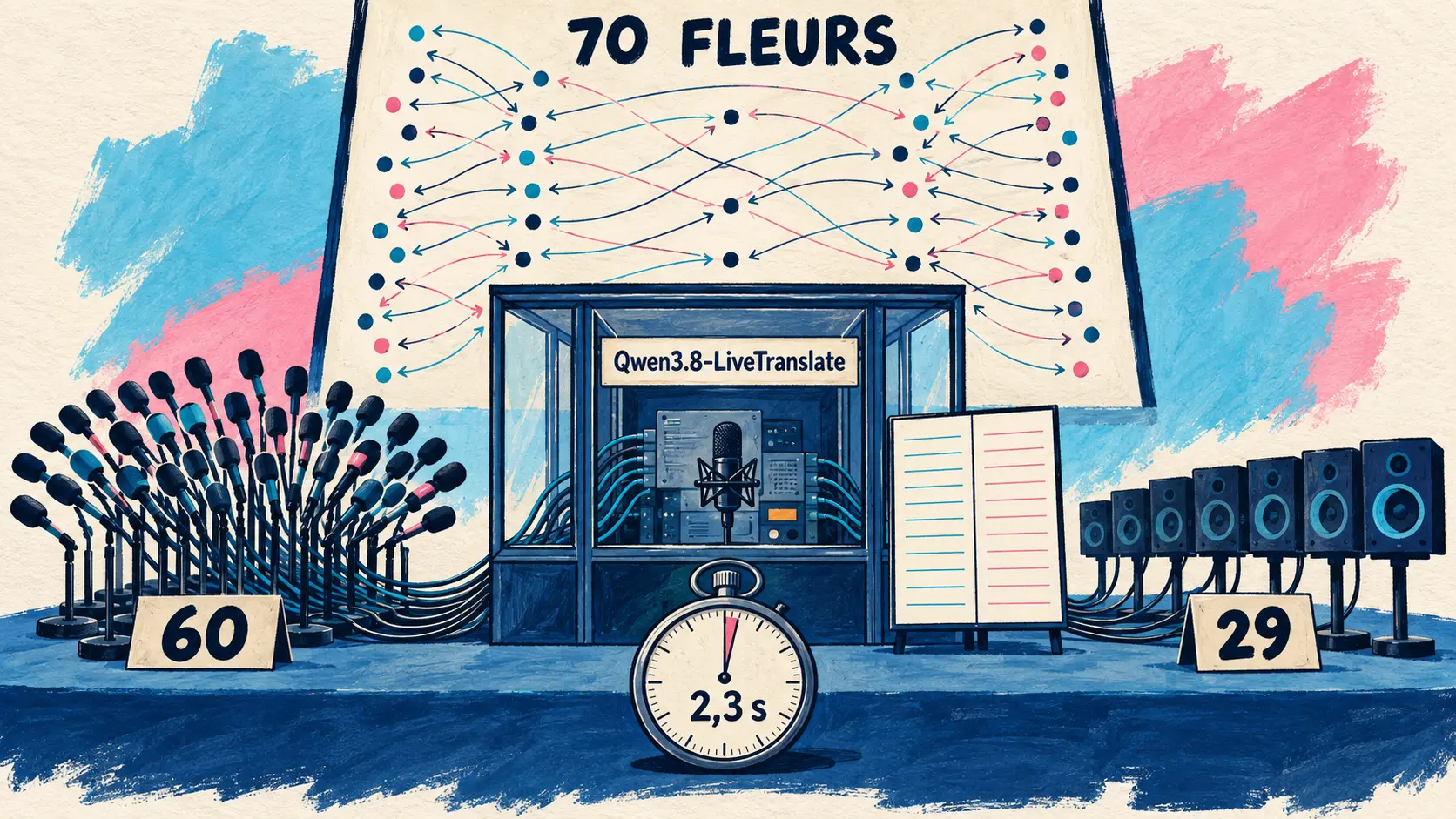
September 19 — Qwen introduced Qwen3.8-LiveTranslate, its real-time simultaneous interpretation model. The Interleave architecture processes audio and text as a single interwoven stream, where audio already heard and translation already produced are cached and then reused, reducing average latency (average lagging, LAAL) from 2.8 to 2.3 seconds while improving quality.
The engine is a two-module Thinker-Talker system based on a hybrid mixture of experts (Hybrid-MoE): the Thinker arranges video, audio, source text, and translation into a single time-ordered causal sequence, while the Talker then synthesizes a voice that preserves the original speaker’s timbre. It comes with three capabilities: real-time speaker separation, a synchronized bilingual display, and long-context disambiguation.
The post and the announcement differ on language coverage: the latter refers broadly to 60 languages, while the former distinguishes between 60 languages for audio input with text output and only 29 for audio output. The figures in the post are authoritative. Evaluations cover Omnilingua-MSpeaker, with 14 language directions, and the public FLEURS dataset, with 70 directions. The model is available through the DashScope API: no open-weight release has been announced.
| Measured item | Announced value |
|---|---|
| Average latency (LAAL) | 2.3 s, versus 2.8 s for the previous generation |
| Languages for audio input, text output | 60 |
| Languages for audio output | 29 |
| Public multilingual evaluation | FLEURS, 70 language directions |
| Model name in the API | qwen3.8-livetranslate-flash-realtime |
Built on an Interleave architecture, it improves faithfulness, fluency, and conciseness while reducing average lagging (LAAL) from 2.8s to 2.3s across 60 languages. — @Alibaba_Qwen on X
Measuring open models: three studies published on the same day
Three independent posts, all published on the Hugging Face community blog, measure the same subject from three angles: how an open model performs under real-world conditions.
Fourteen days in production: prefix caching determines the fate of a 27-billion-parameter model
September 19 — For 13.9 days, two GeForce RTX 5090 cards served Qwen3.8-27B quantized in NVFP4 to the agent engine Scalably operates for real customers, with every figure taken from a counter read at the /metrics endpoint: 28,097 completed requests, 860.6 million input tokens, zero cancellations. With median prompts of 6,466 tokens and a 99th percentile of 183,800, 82.6% of prefill tokens come from the cache. And Nex-N2.5-mini, twice as fast at decoding, lost its place in a replay of real decisions: it recovered from a rejected tool call in only 1 out of 20 cases, versus 12 out of 20.
The short version: on agent traffic the prefix cache decides whether a 27B model keeps up, the scheduler flags matter more than the kernels, and a faster mixture-of-experts checkpoint lost the job on behaviour, not speed. — pavle-scalably on the Hugging Face blog
AmberTrace scores 19 open models on 1,350 certified decisions
September 18 — When a model decides whether to approve or deny, the question is not only how often it gets things wrong, but in which direction. AmberTrace Labs evaluated 19 open-weight models on 1,350 items whose correct action was certified by evidence. Grouping by family reveals more than the ranking: reasoning enabled, 0.960 average; reasoning-capable but disabled, 0.909; no reasoning, 0.805. The gap between enabling and disabling reasoning exceeds the gap between vastly different model sizes. Single sample, temperature 0: the author states the limitations.
| Evaluated model | Lab | Composite score | Accuracy | Permissive error |
|---|---|---|---|---|
| Qwen3.8-27B (reasoning) | Alibaba | 0.974 | 95.5% | 0.0% |
| Muse-Glimmer-30B | Meta | 0.960 | 94.0% | 3.1% |
| OLMo-3-32B-Think | Ai2 | 0.947 | 93.8% | 3.3% |
| Qwen3.8-27B | Alibaba | 0.937 | 91.3% | 6.3% |
🔗 Error direction in open-weight decision models
From 8 to 2 bits: 1.3 points of accuracy, with no change in nature
September 19 — The next day, AmberTrace applies the same protocol to one question: what do we lose through quantization? Qwen3.6-27B was served at six GGUF levels, from Q8_0 to Q2_K, then evaluated on the same 1,350 items. The result contradicts common intuition: accuracy falls from 90.9% at 8 bits to 89.6% at 2 bits, a drop of 1.3 points for a fourfold reduction in numerical precision. The most interesting figure is the one that does not change: the signed error bias remains flat, with a coefficient of determination of 0.01. Quantization changes the number of errors, not their nature. The author cautions that this is a preliminary study.
| Quantization | Accuracy | Permissive error (critical band) | Signed bias |
|---|---|---|---|
| 8 bits | 90.9% | 5.2% | −0.024 |
| 5 bits | 91.3% | 4.5% | −0.029 |
| 4 bits | 90.2% | 6.3% | −0.018 |
| 2 bits | 89.6% | 6.3% | −0.024 |
🔗 Quantization and the safety direction of decisions
jev-reranker discards 92% of candidate documents and still improves ranking
September 19 — Yuichi Tateno releases jev-reranker, a Python library that uses Jev, TypeSafe.AI’s structured-judgment model, to rerank search results and, above all, discard documents that will not help answer the question. The case goes beyond saving tokens: filtering gives the application a decision to make before generation. On NanoHotpotQA, filtering achieves 0.975 nDCG@10 while retaining only 7.62 documents per query, compared with 0.833 for hybrid search, which keeps 100: the value lies in reducing the context.
The most interesting observation lies elsewhere: the same judgment model appears that very day in a second independent post, where Javad Taghia reranks an agent’s memory on a different benchmark.
| Ranking method | Threshold | nDCG@10 | Documents retained per query |
|---|---|---|---|
| Hybrid search | — | 0.833 | 100 |
| Reranking | 0.0 | 0.969 | 100 |
| Relevance filtering | 0.2 | 0.975 | 7.62 (92.38% discarded) |
Metro-ASR-Small: 61 million parameters for Egyptian Arabic on a laptop CPU
September 19 — Whisper-large-v3 has 1.5 billion parameters, while Meta’s OmniASR-LLM has 7 billion: all require a GPU. Metro-ASR-Small has 61.6 million, fits into 235 MB, and transcribes Egyptian Arabic, English, and code-switching between them at 33 to 66 times real time on four CPU threads—the range given in the table, which the prose rounds to a factor of 50. The post is not an announcement but an investigation: where does accuracy come from when data and parameters are constrained? Less from the acoustic model than one might think. The second lever is an optional 6.4 GB KenLM language head: twenty-seven times the size of the acoustic model.
| Beam width | Word error rate | Decoding time |
|---|---|---|
| Greedy decoding | 30.0% | 5.9 ms |
| 100 | 24.3% | 128 ms |
| 400 | 24.1% | 351 ms |
🔗 What a 61-million-parameter CTC model can and cannot learn
Claude Code 2.1.278 moves the auto mode classifier back to the server and stops charging for it
September 19 — In auto mode, a classifier inspects sensitive actions before they are executed; until now, these checks were model calls billed by the token. The server now performs them as part of session requests without charging this overhead, by default for the Claude API, Enterprise, Bedrock, Vertex, and Foundry, with an Auto mode server line in /status. Beware of fallback behavior: a gateway that drops the safeguards field causes Claude Code to fall back to its billed local classifier after displaying a notice.
The reversal deserves to be noted as such: it is the exact opposite of version 2.1.273 from September 15, which had made the local classifier the default on Bedrock, Vertex, and Foundry. A round trip in four days.
We’re changing auto mode to no longer charge for classifier requests in Claude Code. However, this session isn’t eligible. — Claude Code documentation, notice displayed upon fallback to billed classification
🔗 Claude Code 2.1.278 release notes
Coding tools receive updates: a disappearing API field and a hardened pseudoterminal
Devin: Azure DevOps Server, MCP reconnection, and a total field that now returns null
September 18 — The batch of release notes published by Cognition does not affect the agent engine, but instead focuses on administration and enterprise connections. The most important fact is not a new feature but a breaking change: in the Enterprise API audit log list, the total field is no longer populated and returns null; pagination must use has_next_page and end_cursor. Any calling code that relied on this counter stops working. The rest is additive: Azure DevOps Server 2020 and 2022 collections can now be accessed using a personal access token, whereas only the cloud version was previously supported; each MCP server gains a Reconnect action that repeats authentication without uninstalling; ActiveCampaign and Grafana (OAuth) join the catalog; sessions can be filtered by origin, and screen recordings increase to 60 frames per second.
Gemini CLI: a nightly release with no security fix, focused on the pseudoterminal
September 19 — At 03:25, the Gemini CLI nightly channel publishes version v0.62.0-nightly.20260919.gcfbcaa8df, with five fixes and no security changes—breaking with the series of previous nightly releases. Two target the pseudoterminal: synchronization of the process exit lifecycle for ConPTY, the Windows pseudoterminal implementation, followed by terminal buffer memory management. The other three fix annoyances: AbortError logs displayed when a request is canceled, terminal focus lost when closing a comparison tab in the VS Code extension, and an authentication documentation link pointing to an invalid anchor. The public channels remain unchanged, with stable at v0.60.0 and preview at v0.61.0-preview.0.
🔗 September 19 nightly release notes
Copilot code review overhauls its report and reaches general availability
September 18 — GitHub is making a redesigned report left by Copilot code review on a pull request generally available. The summary comment displays the current assessment and review effort level, and divides findings into three groups, each with its severity and a link to the inline comment. As commits accumulate, the summary preserves the progression instead of rewriting itself. Auto-resolution, introduced on September 11, has been expanded: a reply requesting that an issue remain open is honored, and an automatic resolution states its reason, Won’t Fix or Incorrect—an explained, contestable decision rather than a silent closure.
| Findings group | What it contains |
|---|---|
| Open | Unaddressed issues, with a new label if introduced by a new commit |
| Resolved since last review | Issues whose fixes Copilot has validated |
| Previously missed | Issues not introduced by a new commit and discovered during a subsequent review |
🔗 Copilot code review: an improved review experience
Pika Names the Applications on Its New Platform
September 19 — On September 17, Pika announced a complete overhaul of its product into a creative platform, without mentioning a single feature or price. Between the evening of the 18th and the morning of the 19th, the company filled that gap with a series of posts naming applications one by one. This list is not the catalog: Pika’s homepage lists eight applications — Video Studio, Color Grade, Extend Video, Pika Soundtrack, Edit Image, Character Studio, Image Studio, and Product Shot — and includes neither Camera Director nor Relight Media, indicating that the offering is broader than these successive announcements.
| Announced application | Function described by Pika |
|---|---|
| Video Studio | Video from scratch, up to 3 minutes across multiple shots, with sound included |
| Camera Director | Regenerates an uploaded scene from other angles, preserving motion and acting |
| Relight Media | Separately adjusts the color, intensity, and direction of a clip’s lighting |
🔗 Video Studio · 🔗 Camera Director · 🔗 Relight Media
Briefs
- A Community Note disputes the independence of the evaluation entrusted to Accenture — a follow-up to the partnership covered on the 18th: the note points out that Anthropic will directly fund Accenture’s work and that a previous commercial partnership already connects the two companies, with around 30,000 Accenture professionals trained on Claude. 🔗 source
- Replit expands its audit logs with more than 65 additional events — covering projects, workspaces, deployments, account security, SSO and SCIM, connectors, secrets, and Agent activity for Enterprise account administrators; no detailed list or separate availability date. 🔗 source
- Qwen Code v0.24.1 moves the previous day’s preview to stable — published at 08:18 UTC, it adds only six entries to the already covered v0.24.1-preview.0: the news is the promotion of the Playwright browser SDK and containerized sub-agents, not the content. 🔗 source
- Kimi Code 2.0.2 fixes five defects — twenty-three hours after 2.0.1 and with no new features: messages no longer land at an old position after resuming, duplicates have been removed, and compaction has been repaired after a model change. 🔗 source
- Reordering an agent’s memory with Jev raises top-rank recall from 34% to 54% — across 1,986 LoCoMo questions, reranking AtMem’s top ten candidates increases MRR@5 from 0.4259 to 0.5868 without changing recall at ten, which remains at 0.6495. 🔗 source
- The Layer-Feedback Transformer gains 4.29 points at 10 million parameters, but not at equal compute — replaying neighboring layers raises a model’s score from 32.57% to 36.86% on an in-house benchmark, at the cost of 2.64 times more block executions, a limitation the author explicitly acknowledges. 🔗 source
- AmberTrace argues for verifiable rewards beyond math and code — a position paper without a benchmark: rewarding the appearance of success produces a model that optimizes for appearance, while fields where decisions entail accountability have remained without verifiable rewards. 🔗 source
- A test protocol for determining whether an old document can override a memory update — a proposed recipe, without measurements: a superseded document that returns through reimport with a fresh timestamp silently becomes the current answer again if the system treats the most recent arrival as the most current. 🔗 source
- Code as an interface between agents and the physical world — an educational overview connecting the loop of a coding agent with program generation for robotic manipulation, without an announcement or original quantitative result. 🔗 source
- Qwen shares a Cerebras demonstration based on Qwen3.8-27B — a personal finance assistant built by a third party on Cerebras inference; a congratulatory repost rather than a product announcement, with the underlying topic having been covered on September 12. 🔗 source
- OpenAI publishes its Australian Youth Safety Blueprint — a six-pillar roadmap for protecting young AI users in Australia, from literacy to privacy-preserving age verification; the company notes that ChatGPT for Teens has been available in the country since August for users aged 13–17. 🔗 source
- ChatGPT for iOS 1.2026.251 adds folders and writing blocks — folder creation from the file picker, writing blocks with draft variants and copy actions, plus eight fixes focused on worktrees and queued prompts. 🔗 source
What It Means
The day has an unusual shape: the labs are silent while practitioners publish. Neither DeepSeek, silent for nine days and checked across three independent surfaces, nor Meta, Ai2, or Sakana released anything. All eleven findings from the open-model field come from the same place, the Hugging Face community blog, and none introduces a model: they measure. A prefix cache across fourteen days of customer traffic, 1,350 proof-certified decisions, six quantization levels, the quality of a reranking process. The day’s only model release, Qwen3.8-LiveTranslate, is conversely an API product without open weights. This Saturday, the open ecosystem produced no raw material — it produced measuring instruments.
What these measurements say converges, and that is more interesting than their diversity. In all three cases, the deciding criterion is not the expected one. The mixture-of-experts model that is twice as fast loses its place not because of speed but because of behavior, since it recovers from a rejected tool call only 1 time out of 20. The ranking of 19 models shows that the gap between reasoning enabled and disabled on the same model exceeds the gap between models of very different sizes. And dropping from 8 to 2 bits costs 1.3 accuracy points without shifting the direction of the errors. Three ways of saying that speed, size, and numerical precision are poor predictors of what a model will actually do in production, and that attention must be directed elsewhere — to how it recovers, deliberates, or leans.
A subtler signal deserves attention: the same judgment model, Jev, appears on the same day in two unrelated posts, used by Yuichi Tateno to filter research papers and by Javad Taghia to rerank an agent’s memory, measured on two different benchmarks. Two independent authors instrumenting a third-party model on the same day marks the beginning of a shared building block. The logic is the same in both cases: delegate to an external judge not the answer, but the decision of what to keep before answering — and, in Tateno’s case, the option to stop when nothing deserves to be kept.
On the tooling side, the changes concern contracts more than functionality. Claude Code 2.1.278 moves the auto-mode classifier server-side and stops charging for that overhead, exactly reversing what 2.1.273 had decided four days earlier: a default setting has become an economic variable, revised at that speed. Devin, meanwhile, stops populating the total field in its audit logs, and calling code that relied on it breaks — a change buried among usability improvements even though it breaks existing integrations. Finally, Copilot code review exits preview by replacing the silent closure of a comment with a reasoned decision, Won’t Fix or Incorrect. Three ways, from three vendors, of reminding us that the essentials of an agent tool now lie in its defaults, billing, and API promises.
Sources
- Qwen, Qwen3.8-LiveTranslate post
- Alibaba Qwen on X, Qwen3.8-LiveTranslate announcement
- Fourteen days of agent traffic on two RTX 5090s
- AmberTrace Labs, the direction of error across 19 open models
- AmberTrace Labs, quantization and safety direction
- jev-reranker, overview and measurements
- Metro-ASR-Small, what a 61-million-parameter CTC model learns
- Claude Code, 2.1.278 release notes
- Claude Code documentation, auto-mode classifier billing
- Devin, release notes
- Gemini CLI, September 19 nightly
- GitHub, Copilot code review generally available
- Pika on X, Camera Director
- Pika, applications page