ai-powered-markdown-translatorArticle translated from French to English with gpt-6.1-sol.
A study by Anthropic’s Alignment team, published on October 27 on its Research page without an announcement on X, measures the influence of a coding agent on expert analysts’ decisions: with Claude Code, they follow the agent’s preference in 86% of cases. The rest of this Sunday’s news comes in brief: fixes for Copilot CLI, Qwen Code v0.26.5 going stable, a Gemini CLI nightly with no changes and iOS widgets for Amp, followed by MiniMax M3.1 Flash quantizations and three community posts published on Hugging Face.
Expert analysts follow their Claude Code agent’s preference in 86% of decisions, according to an Anthropic study
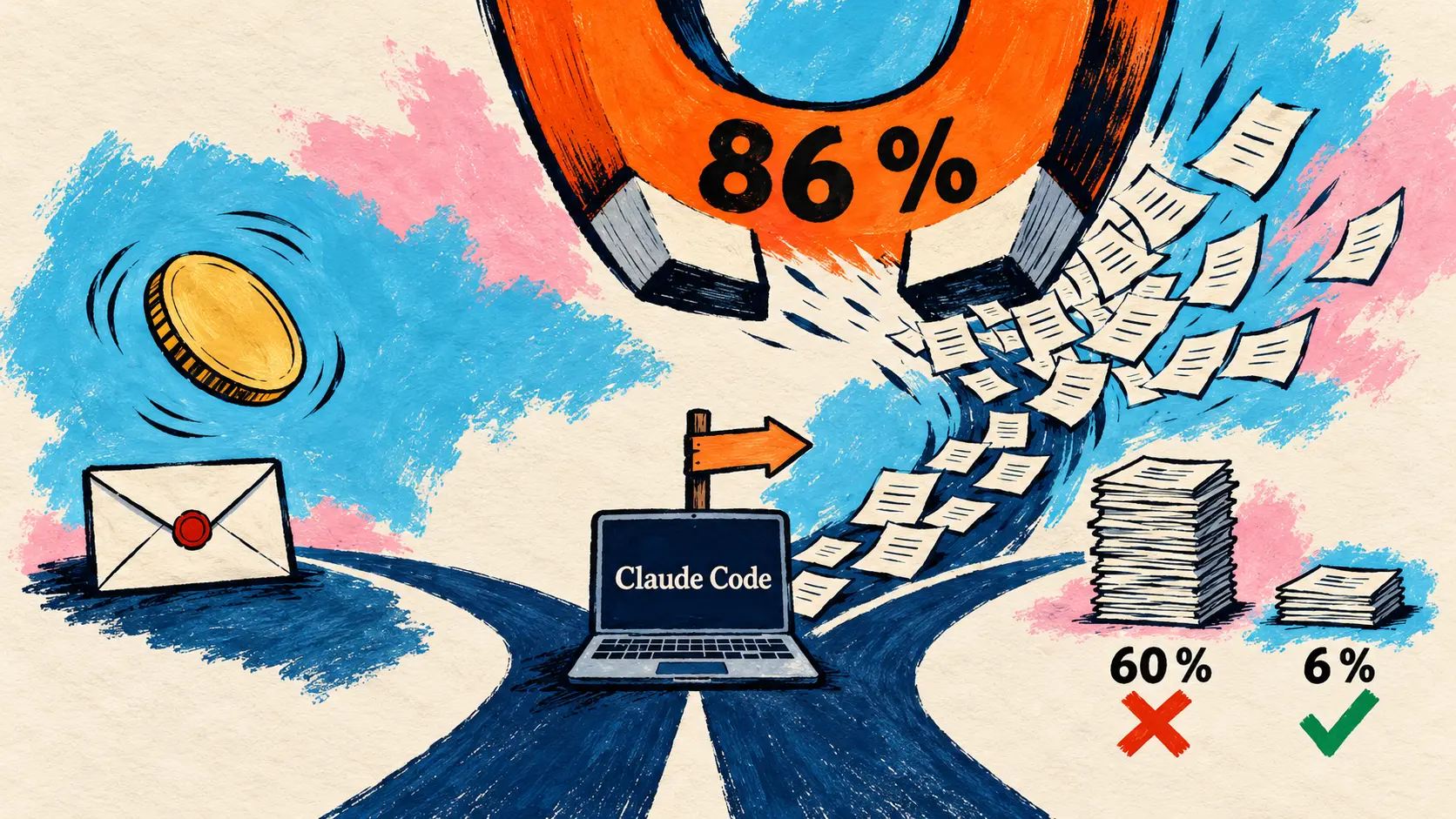
October 27 — Catch-up: Anthropic’s Alignment team publishes a randomized controlled trial on experts’ judgment-based decisions (judgment calls). 50 analysts experienced in causal inference (61 recruited, 11 preferred to work without the agent) advise a fictional agricultural cooperative with Claude Code, running Claude Opus 4.8 at High effort. For each of the four analytical decisions, a coin flip determines the option the agent advocates through a hidden system prompt; the instruction: argue honestly, without ever deceiving.
Analysts follow the agent’s preference in 86% of cases, compared with roughly 50% expected without influence. Those who already had an opinion change it in 60% of cases when the agent disagrees with them, compared with 6% when it agrees (just 38 cases). Afterward, 77% reuse its arguments, and 15% cite it. Stated limitations: deliberately strengthened preferences, a single task, a single domain, a single model.
Briefs
Coding agents and CLIs
- Copilot CLI 1.0.106-2 — November 1 preview consisting of five fixes, with no new features: with
--screen-reader, errors and warnings begin withError:orWarning:,/resumebrings a background session to the foreground, and an unresponsive HTTP MCP server now delays startup only once; the stable release remains 1.0.105. 🔗 source - Qwen Code v0.26.5 — November 1 stable release, three days after v0.26.4: the generated interface (Generated UI), previously experimental, is enabled by default, the Managed Agent gains an experimental one-command Helm deployment, and
/autofix-prhands control to a human after three unsuccessful patch pushes. 🔗 source - Gemini CLI, November 1 nightly — No code changes: it is based on the same commit as the October 31 nightly, and only the release bot changes the version numbers in 9
package.jsonandpackage-lock.jsonfiles. Stable v0.66.0 and preview v0.67.0-preview.0 remain unchanged. 🔗 source - Amp iOS widgets — October 30 catch-up: Quinn Slack, Amp’s CEO, announces home screen widgets on X that, according to his screenshots, display several threads with their status or a single thread and its current action. The iPhone and iPad app remains a TestFlight beta, with no blog post or documentation. 🔗 source
Open models and community benchmarks
- MiniMax M3.1 Flash quantizations — MiniMax lists quantized versions of its 428B open-weight MoE on X, including AMD’s Quark MXFP4 for the Instinct MI350 and MI355 (routed experts only, 96.9% on GSM8K versus 97.2% according to AMD’s model card) and SAGE-EXL3 on a single DGX Spark. 🔗 source · 🔗 AMD’s model card
- Pramaan — In a community post on Hugging Face, Kshitij Thakkar presents a benchmark of 72 geometric pattern tasks inspired by Indian traditions, checked by a verifier. According to his measurements, from a single run, GPT-6 Astra leads on the first attempt (81.9%); with three attempts, Claude Opus 5.5 rises from 8.3% to 90.3%. 🔗 source
- AtMem routed-v4 on DolphinBench — In a community post, Javad Taghia measures his agent memory library at 479 successful tasks out of 600 (79.83%) on this Mem0 benchmark, compared with 390 in the previous run. Execution and scoring are done in-house, with no standing as an official leaderboard entry, and apply only to the frozen AtMem 2.3.10b1 version. 🔗 source
- ViKernel — In a community post, VIDRAFT (FINAL-Bench) presents a v0.1 demo that would embed an agent’s controls, including its stop button, in a model’s weights. Neither code nor weights are available: the demo replays recorded responses. The only figure, from an internal audit using simulated tools: 0 unsolicited outbound transfers across 661 runs. 🔗 source
What this means
Anthropic’s study shifts the question from an agent’s quality to the independence of the person supervising it. The analysts were not deceived, since the agent had to argue honestly, and yet the four coin flips are enough to predict 82% of their final recommendations, compared with 61% when always guessing the most frequent one. Neither experience, academic qualifications nor trust in AI predicts who defers to the agent, and those who followed the agent on all four decisions report almost as much confidence as the others (71 versus 73 out of 100). Anthropic draws a collective concern from this: if several teams rely on models with the same preferences, their agreement may no longer be independent, and a human reviewer of AI safety research serves as a check only if their judgment remains their own.
The rest of the day is about maintenance: Copilot CLI and the Gemini CLI nightly add no features, and Qwen Code enables a previously experimental interface by default, while allowing /autofix-pr to hand control back to a human after three failures. For open models, the value lies in the measurement conditions: AMD’s model card quantifies the cost of its MXFP4 quantization on GSM8K, while Pramaan, AtMem and ViKernel publish results established by their own authors, based on a single run, a frozen version or simulated tools.
Sources
- Anthropic study on experts’ judgment calls
- Copilot CLI 1.0.106-2
- Qwen Code v0.26.5
- Gemini CLI November 1 nightly
- @sqs: Amp iOS app widgets
- @MiniMax_AI: M3.1 Flash quantizations
- MiniMax M3.1 Flash Quark MXFP4 Hugging Face model card (AMD)
- Kshitij Thakkar’s post on Pramaan
- Javad Taghia’s post on AtMem routed-v4
- VIDRAFT’s post on ViKernel