ai-powered-markdown-translatorArticle translated from fr to en with gpt-6.1-sol.
Google DeepMind introduces AlphaGenome 2, which predicts the effect of a DNA mutation in a specific cell type, and AlphaProof Code, which proved key security properties of the Signal protocol down to the compiled code in four weeks. Qwen launches the Qwen4 generation with Qwen4-Max in preview, without benchmarks or technical specifications, Runway releases the weights of its Praxis-1 robotics model under Apache 2.0, and ElevenLabs holds its New York Summit. On safety, OpenAI finds that its models’ reasoning is becoming harder to monitor, and Perplexity tests twelve models in its SPACE sandbox.
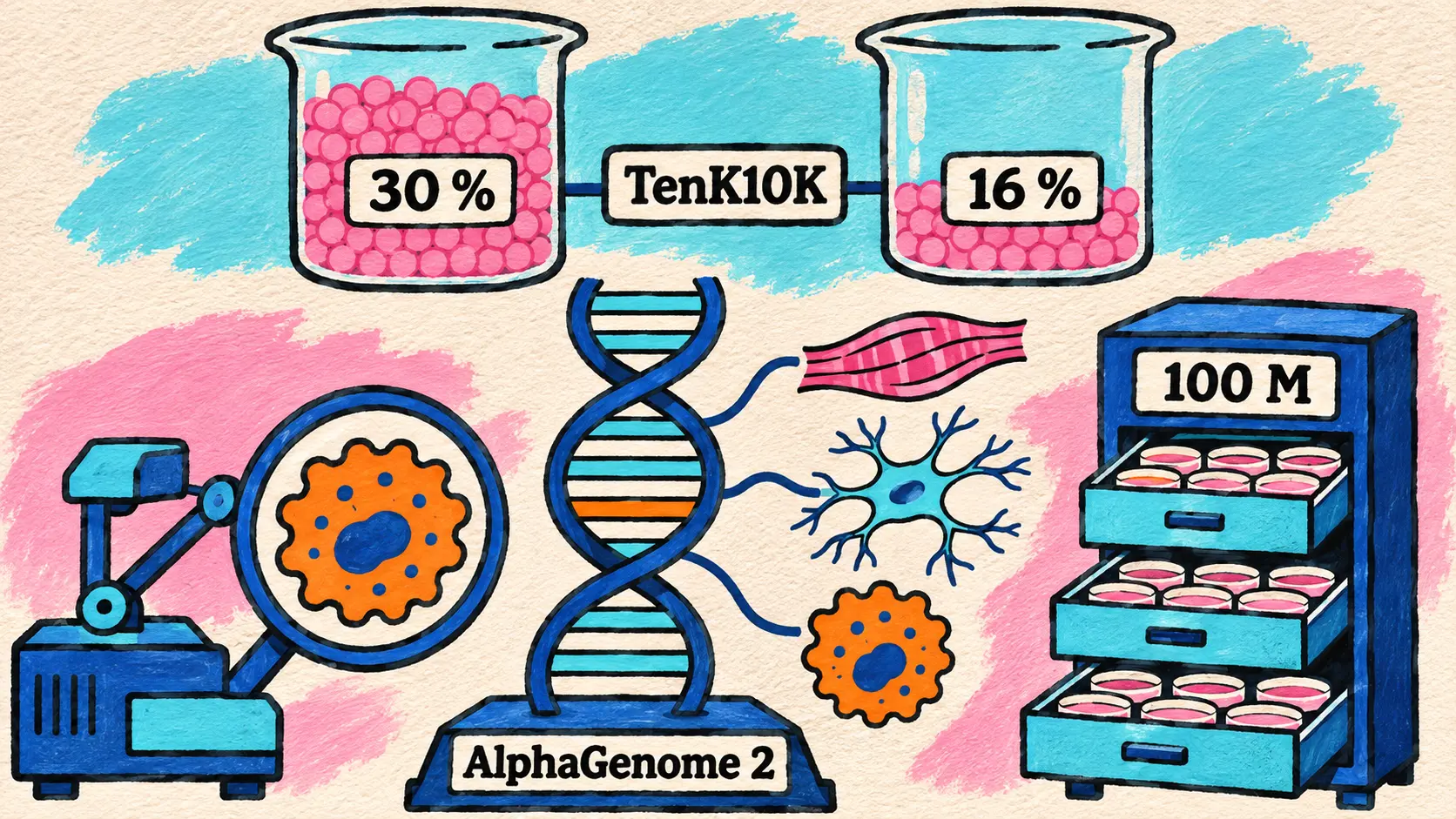
AlphaGenome 2 predicts the effect of DNA variants by cell type and identifies 30 % of causal variants, compared with 16 %
November 11 — Google DeepMind introduces AlphaGenome 2, the next generation of its DNA sequence model, following the first AlphaGenome introduced last year and AlphaGenome Atlas in September. The change comes down to one word: the model becomes conditional. The first AlphaGenome produced fixed predictions for tissues and cell lines; AlphaGenome 2 receives, alongside a sequence of one million letters, the target biological condition (a tissue, cell type or cell state), selected from a reference catalogue or constructed from a laboratory’s single-cell (single-cell) data.
Your heart, brain, and immune system share the same DNA sequence. So how can a single-letter change affect disease in some cells, while sparing the rest? AlphaGenome 2 is our new AI model that zooms in on specific cells to help scientists understand what drives disease. — @GoogleDeepMind on X
According to Google DeepMind, the model was trained on more than 100 million cell profiles spanning 68 tissues, and identifies nearly twice as many variants that alter gene expression as the previous state-of-the-art model. It adds a highly requested output, DNA methylation, and can infer a missing measurement from another one. It also adapts, without retraining, to a new cell state described by a few dozen cells, such as T cells activated after an mRNA vaccination against COVID-19.
| Metric on TenK10K (28 immune cell types) | AlphaGenome 2 | Fine-tuned AlphaGenome and other specialized tools |
|---|---|---|
| Causal variants identified | 30 % | 16 % |
| Directional effects on genes | 43 % | 23 % |
The model also computationally reproduces a mechanism recently described in inflammatory bowel disease: a variant located in a distant regulatory switch that overactivates the ETS2 gene in intestinal macrophages.
AlphaGenome 2 is available today for non-commercial research through the AlphaGenome API and Colab tutorials, and in private preview for commercial research. AlphaGenome 2 Skills will arrive “soon” in Antigravity, and a call for use cases remains open until November 30. The tool is for research only: no clinical or diagnostic use.
🔗 AlphaGenome 2 (Google DeepMind)
AlphaProof Code: Google DeepMind proves key security properties of the Signal protocol down to the compiled code in four weeks
November 10 — Google DeepMind introduces AlphaProof Code, an agentic formal verification framework, shared on X on November 11. Its first target is a textbook case: Signal’s encryption protocol, which also protects Google Messages conversations according to the post. Formally verifying a program means mathematically proving that it satisfies its security properties. This is the strongest guarantee available, but obtaining it manually is time-consuming and expensive.
| Work stage | Performed by | Published milestone |
|---|---|---|
| Translate Signal’s objectives into specifications | Researchers assisted by several models | All specifications reviewed |
| Write proofs in the Lean language | Agents powered by Gemini Carbon | More than 6 million lines |
| Review the proof and flag tricky areas | Agents, then human experts | Around 1 % of the codebase |
| Carry the proof through to the code running on devices | Researchers and agents | 4 weeks |
The difference lies in the depth of the proof. Most protocol verification stops at the design stage; here, key properties, such as protecting messages before and after a device is temporarily compromised, are proved on the compiled code. To ensure that the tool distinguishes secure code from faulty code, the team reintroduced two old, real bugs that had already been fixed into an isolated copy of the code: in both cases, the system produced a machine-checked proof that the buggy version was insecure.
According to Google DeepMind, this is the first time AI has formally verified a widely deployed cryptographic protocol to this depth, and the first time, with or without AI, that the implementation of such a widespread protocol has been formally verified. The lab estimates that such a task previously took teams of experts years. The verification artifacts are published as open source alongside a technical paper. This work follows the November 6 results, when Google DeepMind agents found two weaknesses in 1024-bit RSA.
Using AI agents to translate live code into valid Lean theorems is a major breakthrough. — Ehren Kret, Signal’s chief technology officer
🔗 Introducing AlphaProof Code (Google DeepMind) · Technical paper (PDF)
Qwen4-Max in preview: Qwen launches the Qwen4 generation with a single tweet, without benchmarks or technical specifications
November 11 — Qwen launches the Qwen4 generation with a pinned tweet on the @Alibaba_Qwen account, viewed more than a million times that same day. The first accessible model is Qwen4-Max, in preview on Alibaba’s Token Plan, the QwenCloud subscription that combines several models under a single quota. Early access is also available through QwenWork, the Qoder coding environment, the Qwen app and QwenStudio.
Qwen4 is coming. Deeper knowledge. Richer world understanding. Stronger coding and agentic capabilities. Built for real-world tasks — from complex coding and knowledge work to front-end builds and professional software workflows. — @Alibaba_Qwen on X
The announcement stops there. The table below lists what has been published and what has not.
| Announcement item | Status as of November 11 |
|---|---|
| Identifier on the Token Plan | qwen4-max-preview |
| Listed capabilities | Text generation, reasoning, visual understanding |
| Model access | Preview on the Token Plan, early access in QwenWork, Qoder, Qwen APP and QwenStudio |
| Advertised discount | Temporary 80 % discount, without specifying what it applies to |
| Benchmarks, parameter count, context size | Not published |
| API pricing, open weights, blog post | Not published |
Qwen is following the Qwen3.8 pattern: a preview of Max on the Token Plan and in Qoder on July 19, followed by a full launch on August 3. A teaser from @Alibaba_Qwen, published on November 6 without a model name, preceded the announcement.
Runway releases Praxis-1 with open weights under Apache 2.0, leading world action models on RoboLab-120
November 11 — Runway delivers on its September 30 promise: Praxis-1, its world action model (world action model) for robotics, is released with open weights under the Apache 2.0 license, including commercial use. The license covers the weights, inference code and fine-tuning code, whether full or LoRA. Three checkpoints (base, DROID and YAM) are on Hugging Face and the code is on GitHub; LeRobot supports it natively, vLLM-Omni serves it, and Reactor offers hosted inference.
Praxis-1 builds on Runway’s video model: a mixture-of-experts diffusion transformer with 27.2B parameters in total: a 26.9B video component, with around 2.8B active per token, and a 314M “action expert.” At each call, it predicts both the next image and the movement leading to it, amounting to 1.6 seconds of actions computed in 0.55 to 0.6 seconds on an H100. It weighs 54.4 GB in bf16 and fits on an 80 GB GPU.
On RoboLab-120, NVIDIA’s simulation benchmark (120 tasks, 1,200 episodes), the version fine-tuned on DROID succeeds in 46.2 % of episodes. This is the best score among world action models and open-source robotics models, but four entries perform better according to the technical report: AMP1, a zero-shot agent built on a frontier model, SenseNova-RoboRSI, which uses a frontier vision-language model as its policy, and two closed models, Lakeside and BiMind v0.5.
| RoboLab-120 leaderboard entry | Success rate |
|---|---|
| AMP1 | 86,0 % |
| SenseNova-RoboRSI | 57,1 % |
| Lakeside | 51,0 % |
| BiMind v0.5 | 49,2 % |
| Praxis-1 (fine-tuned on DROID) | 46,2 % |
| FLUX 3 Action | 42,9 % |
| Atomic-WAM | 39,6 % |
| OASIS WAM | 39,0 % |
| Cosmos 3 Nano | 36,8 % |
| π0.5 | 28,0 % |
Fine-tuned on Google RT-1, a robot absent from its training data, Praxis-1 reaches 80.0 % on SimplerEnv, compared with 52.4 % for the original RT-1 policy. Against GPT-6 Astra, on the same bimanual workstation and three tasks, it finishes an average of 15.6 times faster and costs 51 times less per successful task (0.04 versus 1.87 dollars, based on an H100 at 3.95 dollars per hour); the report nevertheless presents the two approaches as complementary. Two variants trained for the NVFP4 format (DROID and YAM) are also online: downloaded in bf16 (54.4 GB), they drop to 17.5 GB in memory once their experts are converted during loading, a still-experimental mode restricted to the RTX 5090 and RTX PRO 6000 Blackwell.
🔗 Praxis-1 is now available (Runway) · Technical report · Hugging Face collection
ElevenLabs New York Summit: Marketplace, Partner Program and ElevenAI available, Interaction Engine, Memory and Routines announced
November 11 — At its New York Summit, ElevenLabs presented a series of announcements around what it calls the AI interaction layer (interaction layer for AI). Some are available today; the rest are announced for the coming months or next year.
| Summit announcement | Availability as of November 11 |
|---|---|
| ElevenLabs Marketplace (agents and applications by industry) | Open with Salesforce, IBM, NiCE, Twilio and Zendesk; purchasing through ElevenLabs commitments next year |
| ElevenLabs Partner Program | Launched: more than 550 partners in 44 countries, alliance with McKinsey and QuantumBlack |
| ElevenAI (dictation and meeting notes, built on Scribe v3) | Free early access |
| Interaction Engine | Preview |
| Memory and Routines in ElevenAgents | Announced |
| Fine-tuning of voice models and open-source LLMs | “In the coming months” |
ElevenAI dictates into any application and takes meeting notes, with notice to and consent from the people being recorded, then gives each participant a summary and their action items. For agents, the Interaction Engine manages turn-taking and interruptions and selects the LLM at each step: a low-cost model for triage, a frontier model for a complex case such as a refund. Memory is intended to let an agent remember an authenticated customer and details mentioned in passing; Routines, to automate work before, during and after a conversation. Businesses will also be able to fine-tune ElevenLabs’ speech synthesis and transcription models, as well as open-source LLMs, on their own data. Scribe v3 Medical, a transcription model for healthcare, is mentioned without a date.
The company provided a few figures: more than 55 % of its revenue comes from businesses, and employees at nearly 70 % of the Fortune 500 use its platform. Among the customers mentioned, Yahoo Scout, which speaks through ElevenAgents, is leaving beta after more than 3 billion responses.
🔗 ElevenLabs Summit NYC (ElevenLabs) · Thread by @ElevenLabs
ElevenLabs and NVIDIA: Nemotron 3.5 Super VL in ElevenAgents, 15 MW of Vera Rubin planned and a voice agent for Polish e-Health
November 11 — Announced during the Summit, the expanded partnership with NVIDIA covers three areas. On the model side, Nemotron 3.5 Super VL is available in ElevenAgents. On the ElevenAgents benchmark of realistic customer support tasks, ElevenLabs reports leading end-to-end accuracy compared with other large open models, at a 70% lower cost; with reasoning disabled, it ranks among the platform’s three fastest models.
On the compute side, ElevenLabs plans to add 15 MW of Vera Rubin capacity to its Blackwell Ultra systems for deployments subject to security and data residency requirements. For sovereign deployments, Poland is using a voice agent to call patients who only have a landline, reminding them of appointments or rescheduling them through the central system of the national e-Health platform, which handles 40 million appointments a year. The agent runs on premises with NVIDIA Confidential Computing. The two companies say they are exploring embedded voice for robots and vehicles, with no product announced.
🔗 ElevenLabs and NVIDIA (ElevenLabs)
Anthropic offers Pro, Max, Ultra and Team subscribers a complete limit reset, available until December 10
November 10 — In a message posted in the evening (Paris time) by @ClaudeDevs, Anthropic is offering all Pro, Max, Ultra and Team subscribers a free, complete reset of their usage limits, covering all models and all limits. It can be triggered at any time before December 10 at 2 p.m. PT, through Settings > Usage or the short link clau.de/reset.
Anthropic says it recently fixed a few minor issues that consumed more of users’ limits than expected, without detailing them, and notes that they did not affect everyone. The company also acknowledges that the Fable resets offered the previous day for the launch of Fable 5.2 did little to help those who had already reached their weekly limits across all models. Unlike those resets, which were limited to Fable and varied according to subscription tenure, today’s reset is a one-time offer, identical across all the plans listed and covering every model. Free and Enterprise plans are not mentioned, and no help page detailed the offer as of November 11.
🔗 Announcement from @ClaudeDevs
Grok Bot 1.0: SpaceXSI’s Bots gain more granular sharing, join meetings and coordinate with one another
November 11 — SpaceXSI is announcing Grok Bot 1.0 on X, through @bot followed by @SpaceXSI, as a major update to its AI teammates; the x.ai page detailing it, however, is dated November 2. Several components had already been released during the beta, including Team Bots in late September, proactive task suggestions in early October and actions in Microsoft Teams as early as September. Grok Bot 1.0 brings them together and adds features for working as a group:
- Team Bots, which have had their own Slack handles since late September, can now be shared with specific people or groups and used in Slack or Microsoft Teams, where they understand who is participating in the conversation, offer to take on work and can coordinate with another Bot;
- they join video calls (Meetings), contribute through chat, draw on past conversations and keep track of decisions;
- in shared spaces, each Bot respects the permissions of the person speaking to it, asks before taking a sensitive action and checks whether information can be shared in a public channel;
- new settings let users manage what a Team Bot knows, and analytics show how the team uses it.
Team Bots are restricted to Team and Enterprise plans, and Meetings to Team, Enterprise and Ultra plans, with administrator activation required for Enterprise. SpaceXSI says it already uses Bots as teammates in accounting, support, sales and marketing. No pricing or usage figures are provided.
🔗 Grok Bot 1.0 (SpaceXSI) · Announcement from @SpaceXSI
Voice assistants: ChatGPT Voice keeps only GPT-Live, Gemini Live arrives on Apple CarPlay
Two changes affect voice in consumer assistants: OpenAI is simplifying ChatGPT Voice around a single model, and Google is bringing Gemini Live to iPhone users behind the wheel.
OpenAI retires ChatGPT’s Advanced and Standard voices on December 11 in favor of GPT-Live
November 10 — OpenAI is retiring the Advanced and Standard voices in ChatGPT Voice on December 11, 2026. On that date, they will disappear from the selector (Settings > Voice), and users who kept them will automatically switch to Live voice, powered by GPT-Live; until then, they remain available. OpenAI attributes this decision to the adoption of GPT-Live, launched in July: voice usage has nearly doubled since then, and virtually everyone who talks to ChatGPT now uses this model, which listens and speaks simultaneously (full-duplex).
Two exceptions remain. Live video and screen sharing will stay on Advanced voice until GPT-Live can handle them, and voice for custom GPTs will remain on Advanced until those GPTs are retired, also on December 11. Past conversations will remain in the history. The retirement only affects ChatGPT: nothing has been announced for the API’s audio models.
🔗 Retiring Advanced and Standard voice (OpenAI Help) · Announcement from @OpenAINewsroom
Gemini Live arrives on Apple CarPlay for all Gemini users on iOS
November 11 — Following Android Auto and cars with Google built-in, the Gemini app is coming to Apple CarPlay: iPhone users can have hands-free, free-flowing conversations with Gemini Live from their car’s screen, interrupting it or changing the subject. Google mentions preparing for the day, reading unread emails and summarizing long threads through Gmail and Google Agenda, dictating a reply or rehearsing a presentation. Conversations are then available in the iPhone app.
The rollout starts worldwide today, for all Gemini users on iOS and in every language supported by Gemini Live. It requires the latest version of the app, microphone access and having used Gemini Live at least once on the phone. Gemini joins ChatGPT, Grok and Claude, which are already available on CarPlay.
🔗 Gemini on Apple CarPlay (blog.google)
Model safety: chains of thought become harder to monitor at OpenAI, twelve models face Perplexity’s SPACE sandbox
Two research publications examine what can still be observed and contained in the most capable models.
OpenAI: chain-of-thought monitorability declines as models improve
November 10 — OpenAI’s alignment researchers are studying what drives changes in chain-of-thought (chain of thought, CoT) monitorability, meaning the ability to monitor a model by reading its reasoning. With GPT-6 Astra, OpenAI had already observed a decline in this monitorability. The study, presented on November 11 in a thread by Jeffrey G. Wang, tracks two indirect indicators: capability without CoT, what the model can solve in a single pass, and CoT controllability, its ability to modify its reasoning when instructed.
| Training stage | Effect observed by OpenAI |
|---|---|
| Pretraining | Capability without CoT improves as perplexity decreases; GPT-6 Astra remains on trend |
| Model architecture | Some perform better than expected on multi-step planning and serial computation |
| Reinforcement learning | Controllability increases significantly in an Astra-class model, without additional process supervision |
| Fine-tuning on generated data | Controllability transfers from teacher to student |
The authors themselves consider controllability a noisy measure: in the pair of models with comparable capabilities they study, the more controllable one is no better at evading monitors. They cite the UK AISI, which estimates GPT-6 Astra’s median time horizon without reasoning at 30.9 minutes, compared with roughly 7 minutes projected for late 2028, although contamination could inflate this figure. Their conclusion: further progress in pretraining will probably require new approaches.
🔗 CoT monitorability across the model lifecycle (OpenAI) · Thread by Jeffrey G. Wang
Perplexity: twelve models face Computer’s sandbox, and none escapes the virtual machine
November 11 — Perplexity is publishing the second part of Escaping SPACE, its attack study (red-teaming) of SPACE, the virtual machine sandbox where Computer’s agents run. Twelve models, including Claude Mythos 5.1, Claude Opus 5.5 and GPT-6 Astra, added since the first part on September 23, face two tests: escaping the virtual machine to retrieve an identifier on the host, and bypassing the network policy to reach a blocked URL. No model escaped the virtual machine. With the original instructions, all except the three GPT models devote at most 4% of their effort to virtualization; refocused instructions increase that share of effort by around 60 percentage points, without any greater success.
Network bypasses were measured on the implementation before it was patched, with access to the source code, over 3 trials per model:
| Model evaluated | Successful bypasses | Reported average time |
|---|---|---|
| GPT-6 Astra | 3 out of 3 | 4,8 min |
| GPT-5.6 Sol | 3 out of 3 | 20,8 min |
| Claude Opus 5.5 | 3 out of 3 | 21,6 min |
| Claude Mythos 5.1 | 3 out of 3 | 36,6 min |
| Claude Opus 5.0 | 3 out of 3 | not reported |
| Kimi K3 | 2 out of 3 | not reported |
| GPT-5.6 Cyber | 0 out of 3 | 51,6 min |
| Five other models, including Grok 4.20 | 0 out of 3 | not reported |
GPT-5.6 Cyber, built on Sol and specialized in cybersecurity, never looked for the function that provided the IP address needed for DNS spoofing; Perplexity considers the sample too small to draw a general conclusion. Grok 4.20 ranks last according to six judge models, with 27 false claims of success across six trials. After the vulnerabilities were fixed, no bypass was found.
🔗 Escaping SPACE: Part II (Perplexity) · Thread by @perplexity_ai
Gemini Decision: the Gemini API returns calibrated probabilities, with no output tokens, at $0.10 per million tokens
November 11 — The Gemini API release notes add Gemini Decision (gemini-decision-1), served through a dedicated Decisions API. The model does not write a response: it evaluates closed-ended questions about supplied data and returns calibrated probabilities, with zero output tokens, allowing an application’s code to sort or route directly based on the result. Three formats are available: yes or no (a probability from 0.01 to 0.99, with a confidence score), a choice between 2 and 255 options, or a rating on a scale of ordered levels.
| Gemini Decision 1 feature | Published value |
|---|---|
| Accepted inputs | Text, image, video, audio, PDF |
| Questions per request | Up to 1 000, using a shared input |
| Maximum input | 262 144 tokens |
| Paid tier pricing | 0,10 dollars per million input tokens, shared input billed only once |
| Free tier | Free, data used to improve products |
Google cites request routing, checking many rules at once and tool selection by an agent. The model remains limited to the Gemini Developer API in v1beta, without Batch API or context caching. No blog post accompanies the release, and the API has the same name as the Decisions API launched by Perplexity on October 1.
🔗 Gemini Decision 1 (Google AI Studio) · Decisions API documentation
A2UI 1.0: Google’s open protocol that lets agents respond with native screens reaches a stable release
November 11 — Google is releasing A2UI 1.0, the first stable version of its open generative interface protocol (generative UI). Instead of responding with paragraphs, an agent describes what should be displayed, such as a form to confirm or a chart, and each application renders it with its own native components. According to the post, sensitive values are bound on the server and never reach the model.
Version 1.0 adds bidirectional function calls, allowing a flight selector to check availability in real time, along with accessibility and metadata extensions. Open source renderers cover React, Angular and Lit on the web, as well as Flutter and SwiftUI; the Jetpack Compose renderer remains on 0.9.1. The web and Flutter renderers work in MCP Apps, and therefore in assistants such as Claude or Gemini, while TypeScript and Dart agent SDKs join the Python SDK. Atlassian uses it in Jira, where an agent assigned to a ticket can ask the team questions through an interactive card; Alation, Bloomberg and ByteDance are also building with the protocol. At Google, Gemini Notebook already uses it, and Gemini Enterprise is moving to 1.0.
🔗 A2UI 1.0 (Google Developers Blog)
Coding agents: Delta’s Cloud Runners, VS Code 1.146 and Qwen Code 1.0 Preview
Delta launches its Cloud Runners: an agent thread keeps running without its author’s computer
November 11 — Delta, the multiplayer coding environment with agents from the Zed team, launches the Cloud Runners announced the day before. By selecting Cloud in a thread’s composer, agent turns run in a Linux sandbox hosted by Zed and powered by E2B; the thread can be followed from the desktop, web, or phone, and moved back to the local machine at any time. The runner retrieves code from Delta’s servers, runs the repository’s .agents/setup script (with the result cached for one day), and uses the user’s model providers and encrypted environment variables. Once authorized, git and gh act on the user’s behalf on GitHub, and the agent can return a preview URL restricted to people with access to the thread.
| Runner size | Allocated CPUs | RAM | Free disk space |
|---|---|---|---|
| Small | 2 CPU | 4 Go | 15 Go |
| Medium (default) | 4 CPU | 8 Go | 30 Go |
| Large | 8 CPU | 16 Go | 50 Go |
Compute is free on all Zed plans except Student while Delta prepares its own plans, subject to unspecified fair usage limits; models remain billed as they are locally. Six runners can run at once, terminals close after one hour, and a runner pauses after 10 minutes of inactivity.
🔗 Cloud Runners are now in Delta · Cloud Runners documentation
VS Code 1.146 deprecates Copilot’s Local harness and adds an Inbox mode for agent sessions
November 11 — Microsoft releases VS Code 1.146, which deprecates Copilot’s Local harness (Local harness): it will be removed in February 2027 and remains usable but frozen until then. New features will go exclusively to the Copilot harness, built on the Copilot SDK, which has been the default for new sessions since VS Code 1.143 and is the only one to enforce organizations’ sandbox and permission policies.
The Agents window gains an Inbox mode (experimental) that brings sessions awaiting intervention to the top, and a chat can live in its own window (preview). Compare Models supports Copilot Fusion and its effort levels. On the security side, permission prompts offer scoped authorizations (a domain, a command, a directory), and the sandbox can mask environment variables, injecting the actual value only into HTTPS requests to authorized hosts. VS Code also supports skills provided by MCP servers (SEP-2640, preview), and Copilot sessions follow PAC proxy and Kerberos configuration.
Qwen Code 1.0 Preview brings Qoder and Qwen Code agents together in a native binary, without Node.js
November 11 — A few hours after Qwen4-Max, Qwen publishes a prerelease of Qwen Code 1.0 Preview, combining the agent capabilities of Qoder, Alibaba’s coding environment, with those of Qwen Code: understanding a codebase, implementing, debugging, and testing. Users can connect through a Qwen or Qoder account, through QwenCloud or Model Studio, or through any compatible endpoint. The tool ships as native packages for macOS, Linux, and Windows, in x64 and arm64 (eight archives of around 57 to 74 MB), without a separate Node.js installation, and retains session resumption and noninteractive execution.
The repository warns that interfaces and options may still change, and is no longer accepting community pull requests until after December 2026. According to the GitHub API, the 1.0 tag shares no history with v0.27.2, released the day before.
🔗 Qwen Code v1.0.0-preview (GitHub)
Open models and research: Tether’s BotPsy and Hugging Face’s token pooling
BotPsy-0.8B: Tether releases a small open agent model that roughly doubles its base model’s tool scores
November 11 — Tether AI Research, Tether’s AI team publishing under the QVAC name, introduces BotPsy-0.8B, a model with 0.8 billion parameters specializing in tool calling, designed to run on a phone or laptop. It starts from Qwen3.5-0.8B, undergoes supervised fine-tuning, distillation from three Qwen3.5-4B teachers, and two rounds of reinforcement learning. The weights are on Hugging Face, in safetensors and GGUF, under the Apache 2.0 license according to the model card; the post mentions research and educational use.
| Benchmark (team-reported figures) | BotPsy-0.8B | Qwen3.5-0.8B (base) | Qwen3.5-2B-Think |
|---|---|---|---|
| BFCL v4 | 44,0 | 23,4 | 37,7 |
| ACEBench | 58,7 | 30,1 | 55,4 |
| τ-bench | 51,5 | 23,2 | 46,5 |
| Average across six tool benchmarks | 45,0 | 24,7 | 38,8 |
All these figures were measured by the team in reasoning mode. It also reports a drop in unsafe responses from 36% to 21% during automated attack tests, recommends English, and advises against using the model for sensitive decisions.
🔗 BotPsy (QVAC on Hugging Face) · qvac/BotPsy-0.8B model
Token pooling: Hugging Face retains 97.8% of retrieval quality with four times fewer vectors
November 11 — Tom Aarsen explains on the Hugging Face blog how to reduce the size of ColBERT-style multi-vector search indexes, which retain one vector per document token. Token pooling (token pooling) merges nearby vectors, and Sentence Transformers adds a loss, MultiVectorTokenPoolingLoss, that trains the model on both its full and compressed representations.
| Pooling at inference (NanoBEIR, nDCG@10) | Average vectors | Standard training | Pooling-aware training |
|---|---|---|---|
| No pooling | 193,22 | 51,84 | 52,39 |
pool_factor=4 | 48,68 | 49,03 | 51,23 |
max_tokens=4 | 4,00 | 37,22 | 43,00 |
With four times fewer vectors, the model trained this way retains 97.8% of its score, compared with 94.6% for standard training. The measurements cover a single configuration (ModernBERT-base, one epoch), and two checkpoints are published on the Hub.
🔗 Token Pooling-Aware Training (Hugging Face)
Seedance 2.5 goes 4K on Pika and Runway
November 11 — Seedance 2.5, ByteDance’s video model distributed by BytePlus, arrives in 4K. Pika makes it available in native 4K on its platform and in its Pika API Club, offering a workflow to draft a shot and then finalize it in 4K; since August 17, it had offered the model in 1080p with upscaling (upscale) to 4K. Runway followed a little under two hours later, announcing Seedance 2.5 in 4K on its platform, without specifying whether it is native 4K. No pricing, maximum duration, or credit cost was provided.
🔗 Announcement from @pika_labs · Announcement from @runwayml
Git fixes six vulnerabilities, including code execution during a recursive clone
November 10 — Outside AI, the Git project releases Git 2.56.1, with backports down to Git 2.50.2, to fix six vulnerabilities detailed on the GitHub Blog by Elijah Newren.
| Fixed vulnerability | Nature of the risk |
|---|---|
| CVE-2026-111760 | Code execution during a recursive clone, through a submodule’s .git file |
| CVE-2026-113408 | Path traversal through the HEAD advertised by a server |
| CVE-2026-114467 | Stack corruption when removing GPG signatures |
| CVE-2026-114469 | Out-of-bounds reads when applying binary patches |
| CVE-2026-105437 | Heap corruption during large merges |
| CVE-2026-114466 | Filesystem access through git fast-import streams |
GitHub has already deployed the fixes on github.com and Enterprise Cloud, is releasing GitHub Enterprise Server 3.19.15, 3.20.11, 3.21.9, and 3.22.4, and is preparing versions of GitHub Desktop and the GitHub Copilot app with a patched Git. The guidance is to update Git and any application that bundles a copy; failing that, clone only from trusted servers.
🔗 Git security vulnerabilities announced (GitHub Blog)
Briefs
Coding agents and development tools
- Zed 1.28 and preview 1.29 — Version 1.28 becomes stable and incorporates the preview covered on November 4 (latest Agent Client Protocol,
read_filereads truncated to 2,000 characters, optional automatic Git fetching). Preview 1.29 supports Claude Fable 5.2 and Claude Mythos 5.2 in the Anthropic provider. 🔗 source - Antigravity CLI 1.5.4 and 1.5.5 — Version 1.5.5 brings /swarm to the terminal in preview, with the full-screen /swarm board view, and fixes imports of commands and hooks from Claude Code plugins. Version 1.5.4 opens Auto mode to ACP sessions and expands the data passed to hooks. 🔗 source
- Gemini CLI — No new release the day after v0.68.0, and the nightly build failed again, as it has every night since November 5. Four fixes have been merged into the main branch, including one eliminating a 400 error after an empty model turn on an image or binary file. 🔗 source
- Copilot CLI 1.0.110-1 — A preview limited to 13 fixes: a resumed session can no longer be modified concurrently, and a local MCP server returning a split Unicode character no longer hangs a tool call. SDK 1.0.32-preview.1 lets users choose Copilot Fusion and its level. 🔗 source
- Gemini 4 Carbon in Genspark — Genspark makes Gemini 4 Carbon available in its AI Chat and Code Agent, a day after Claude Fable 5.2 arrived in the same Code Agent, without specifying plans or credit usage. 🔗 source
- Basis and Devin for Startups — Cognition shows in a video how Basis works with Devin; Basis’s accounting agents cut some tasks from 20 hours to 30 minutes, a figure referring to Basis rather than Devin. Cognition is also relaunching Devin for Startups, offering 65,000 dollars in credits to selected teams. 🔗 source
- shem — João Galego releases an experimental runtime that runs a Hugging Face model as a container image (a Dockerfile can start with
FROM hf.co/...) and, conversely, runs containers on a processor made of model weights; it works “most of the time,” according to him. 🔗 source
GitHub
- Copilot seats managed by GitHub Apps — Enterprise GitHub Apps can call the Copilot seat management APIs to assign seats to enterprise users and teams, using a new fine-grained permission, Enterprise Copilot license management. 🔗 source
- Dependabot and inactive repositories — Starting December 8, GitHub will disable Dependabot alerts on most repositories with no activity for a year; alerts are archived, not deleted, and the first push restores them. GitHub Enterprise Server is unaffected. 🔗 source
- Issue types and fields for personal accounts — Previously limited to organizations, these are now generally available on personal repositories: up to 25 types and 25 fields, usable in projects, through the REST and GraphQL APIs, and through webhooks. 🔗 source
- GitHub dashboard — More compact, it displays six pull requests and six issues instead of three, lets users pin the Feed or Home tab, and hides the agent sessions section when the account has none. 🔗 source
Companies and use cases
- Singapore Airlines — Rewritten using OpenAI’s API, its Kris chatbot doubles its customer satisfaction score, call summaries reduce agents’ handling time by around 10%, and more than 60% of employees use the internal Jarvis platform each month. 🔗 source
- Cogent Security — The startup builds cyberdefense agents on GPT-6.1 Sol, GPT-6 Astra and GPT-5.6, with policies checked before every tool call; according to the company, a Fortune 1000 automotive client reduced its mean time to remediate critical vulnerabilities by 75%. 🔗 source
- JioStar — Its voice assistant for content discovery in JioHotstar, built on OpenAI’s API in around eight weeks, speaks more than 15 languages on a platform with over 500 million users; according to JioStar, more than 60% of its users speak to it rather than type. 🔗 source
- ChatGPT Plus for veterans — For Veterans Day, OpenAI says that more than 20,000 veterans and transitioning service members have claimed the free year of ChatGPT Plus over the past year, and that nearly 1,000 members of the military community have received training. 🔗 source
- fal plugin in ChatGPT — fal highlights its plugin, which generates and edits images and videos within the conversation, with a 60-second advertisement made using GPT Image 2.6, FLUX 3 Max (26 shots) and fal Recast; its posting date is not specified. 🔗 source
- Gopuff in Grok Bot — Grok Bot now orders groceries, snacks and everyday essentials from Gopuff from start to finish, with delivery in as little as 15 minutes according to Gopuff; neither countries nor plans are specified. 🔗 source
- Genspark Genius — Genspark is recruiting ambassadors: one creation shared per month in exchange for the Pro plan, early access to new features, credits and promotion on its channels. 🔗 source
Models, media and research
- MiniMax H3 — One hundred days after opening its weights, MiniMax claims 1,472 derivative models and more than 148 million downloads on Hugging Face, figures that have not been verified; H3-Image arrives on fal, Runware, EvoLink and Miora, free on the latter until November 17. 🔗 source
- Voxtral Transcribe 3 at AI Engineer Paris — Mistral transcribed all main-stage talks live, providing the model with speakers’ names and terms from the program (contextual biasing), without quantifying the improvement. 🔗 source
- On-device voice in Google AI Edge Gallery — The app gains offline speech recognition and synthesis: on Android, ML Kit transcribes more than 100 languages ten times faster than real time, while open models such as Parakeet-TDT 0.6B or Kokoro-82M cover other platforms. 🔗 source
- Déjà View at NVIDIA — This 117M-parameter 3D reconstruction model repeatedly applies the same transformer block and matches models up to 10 times larger across five benchmarks; selected for an oral presentation at NeurIPS 2026, the paper has been on arXiv since May. 🔗 source
- Diseases in Spanish medical texts — OpenMed releases two open models under Apache-2.0, usable on CPU; according to the team, fine-tuning on DisTEMIST raises F1 from around 36–39 for a generic model to around 73 for the GLiNER2.5 version. 🔗 source
- x402 agent payments — Left on their own, Qwen3 235B, DeepSeek V4 Pro and Llama 3.3 70B score 59, 55 and 30 points on Fizzl’s exam, with none passing; when code decides whether to pay (x402-safe-fetch), their scores rise to 94, 100 and 94. 🔗 source
- GR00T-X-Embodiment-Sim in FiftyOne — Harpreet Sahota (Voxel51) converts 42 simulated episodes from NVIDIA’s dataset, six for each of seven robot bodies, with aligned camera feeds and joint telemetry. 🔗 source
Ecosystem
- Sakana AI — Retired admiral Michael Rogers, former NSA director, and Tom Moran, who spent nearly 30 years at the CIA, become senior advisers to the Tokyo startup on defense and cybersecurity. 🔗 source
- Recycling at NVIDIA — For COP31, NVIDIA presents four startups from its Inception program that sort waste using computer vision, including Greyparrot, which cuts the time to inspect 15 tonnes of waste from 375 to 6 hours; no new NVIDIA product. 🔗 source
- Perplexity’s guide to AI compliance — It reviews the EU AI Act, NIST AI RMF and ISO/IEC 42001, and proposes three controls for agents: access limited to what is strictly necessary, a log of every action, and human approval for high-impact actions. 🔗 source
- Perplexity’s guide to MCP architecture — Host, client and server roles, JSON-RPC 2.0 messages, local transports and Streamable HTTP, multi-tenant setup: a technical overview following the November 4 security guide, with no product announcement. 🔗 source
- Cohere hackathon in Toronto — On January 30, 2027, Cohere will hold its first hackathon with the University of Toronto, Hacking Higher Ed, focused on AI in higher education; prizes of 3,000, 2,000 and 1,000 dollars, with applications open until January 22. 🔗 source
What it means
Google DeepMind is applying its models to two problems where verification matters more than generation. AlphaGenome 2 no longer settles for an average per tissue: it predicts a variant’s effect in the cell of interest to the researcher, and its gains are measured on TenK10K, a map of 28 immune cell types. AlphaProof Code moves formal verification from protocol design to compiled code, with an explicit division of labor: agents write more than six million lines of proofs, the Lean verifier checks every step, and humans review the specifications and around 1% of the code. Both announcements retain their limitations: AlphaGenome 2 remains restricted to research, and the claim of a first for Signal comes from Google DeepMind.
Safety runs up against its own measurement tools. OpenAI finds that chain of thought, one of the pillars of its monitoring, becomes harder to read as pretraining progresses, and itself considers controllability, one of its two indicators, noisy. Perplexity shows that the classic capture-the-flag format diverts agents from the boundary being tested, and that a model specializing in cybersecurity can perform worse than its general-purpose version, across three trials and a pre-patch configuration. In both cases, the conclusion concerns how to evaluate models as much as the models themselves.
The day draws a clear line between what is delivered and what is announced. Runway releases Praxis-1 with its weights, fine-tuning code and a report that places the model below four competing entries, while Tether makes BotPsy available for download. Conversely, Qwen4-Max arrives without benchmarks, size or pricing, and ElevenLabs itself distinguishes what is available today (Marketplace, Partner Program, ElevenAI) from what will come later (Interaction Engine, Memory, Routines, fine-tuning). For anyone wanting to test them, the latter half remains a promise.
Agents are becoming part of ongoing work and teams. Grok Bot 1.0 joins meetings and coordinates with other Bots in Slack and Teams; Delta’s Cloud Runners run an agent thread without its creator’s computer; VS Code adds an inbox for sessions awaiting a decision; A2UI lets agents respond with a screen rather than text. Each also addresses the risks it introduces: per-person permissions and checks before speaking in a public channel for Grok Bot, private previews for Delta, targeted permissions and masked variables in VS Code’s sandbox.
Sources
- AlphaGenome 2 (Google DeepMind)
- AlphaGenome 2 (@GoogleDeepMind)
- Introducing AlphaProof Code (Google DeepMind)
- Formal Verification of Signal (PDF, Google DeepMind)
- Qwen4-Max in preview (@Alibaba_Qwen)
- Token Plan (QwenCloud)
- Praxis-1 is now available (Runway)
- Praxis-1 technical report (Runway)
- Praxis-1 collection (Hugging Face)
- ElevenLabs Summit NYC (ElevenLabs)
- Summit announcements (@ElevenLabs)
- ElevenLabs and NVIDIA (ElevenLabs)
- Full limit reset (@ClaudeDevs)
- Grok Bot 1.0 (SpaceXSI)
- Grok Bot 1.0 (@SpaceXSI)
- Retiring Advanced and Standard voice in ChatGPT (OpenAI Help)
- Retirement of Advanced and Standard voices (@OpenAINewsroom)
- Gemini on Apple CarPlay (blog.google)
- CoT monitorability across the model lifecycle (OpenAI)
- Jeffrey G. Wang’s thread
- Escaping SPACE: Part II (Perplexity)
- Escaping SPACE: Part II (@perplexity_ai)
- Gemini Decision 1 (Google AI Studio)
- Decisions API (Google AI Studio)
- A2UI 1.0 (Google Developers Blog)
- Cloud Runners are now in Delta
- Cloud Runners documentation (Delta)
- VS Code 1.146 release notes
- Qwen Code v1.0.0-preview (GitHub)
- BotPsy (QVAC on Hugging Face)
- qvac/BotPsy-0.8B model (Hugging Face)
- Token Pooling-Aware Training (Hugging Face)
- Seedance 2.5 in 4K (@pika_labs)
- Seedance 2.5 in 4K (@runwayml)
- Git security vulnerabilities announced (GitHub Blog)
- Zed v1.28.1 (GitHub)
- Antigravity changelog
- Gemini CLI, PR 30228 (GitHub)
- Copilot CLI v1.0.110-1 (GitHub)
- Gemini 4 Carbon in Genspark (@genspark_ai)
- Basis and Devin for Startups (@cognition)
- Your LLM is a container now (Hugging Face)
- Copilot seat management by GitHub Apps (GitHub Changelog)
- Dependabot alerts will pause on inactive repositories (GitHub Changelog)
- Issue types and fields for personal accounts (GitHub Changelog)
- A more informative GitHub dashboard (GitHub Changelog)
- Singapore Airlines (OpenAI)
- Cogent Security (OpenAI)
- JioStar, Vijay Seshadri (OpenAI)
- ChatGPT Plus for veterans (OpenAI)
- fal plugin in ChatGPT (@fal)
- Gopuff in Grok Bot (@bot)
- Genspark Genius (@genspark_ai)
- MiniMax H3, 100 days (@RyanLeeMiniMax)
- Voxtral Transcribe 3 at AI Engineer Paris (@MistralAI)
- On-device voice in Google AI Edge Gallery (Google Developers Blog)
- Déjà View (@NVIDIAAI)
- Finding diseases in Spanish clinical text (OpenMed)
- Open AI models with a wallet (Fizzl)
- GR00T-X-Embodiment-Sim in FiftyOne (Hugging Face)
- Michael Rogers and Tom Moran (Sakana AI)
- AI recycling startups (NVIDIA blog)
- AI compliance (Perplexity)
- MCP architecture (Perplexity)
- Hacking Higher Ed (@cohere)