ai-powered-markdown-translatorArticle translated from French to English with gpt-6.1-sol.
Anthropic closes its IPO: approximately $93.5 billion in gross proceeds from the offering, and another $26 billion contributed by seven groups, including NVIDIA, Google and Microsoft, in a concurrent private placement. Thinking Machines releases Inkling 2 Mini, an open-weight model with 26.4 billion parameters that fits in 20 GB, and OpenAI reduces the success rate of attacks that extract protected reasoning from its models from 54.0% to 0.2%. ChatGPT Space opens to Plus subscribers, Runway entrusts agents with 38% of its code merges, and Claude Code, Codex CLI and Vibe CLI each release a new version.
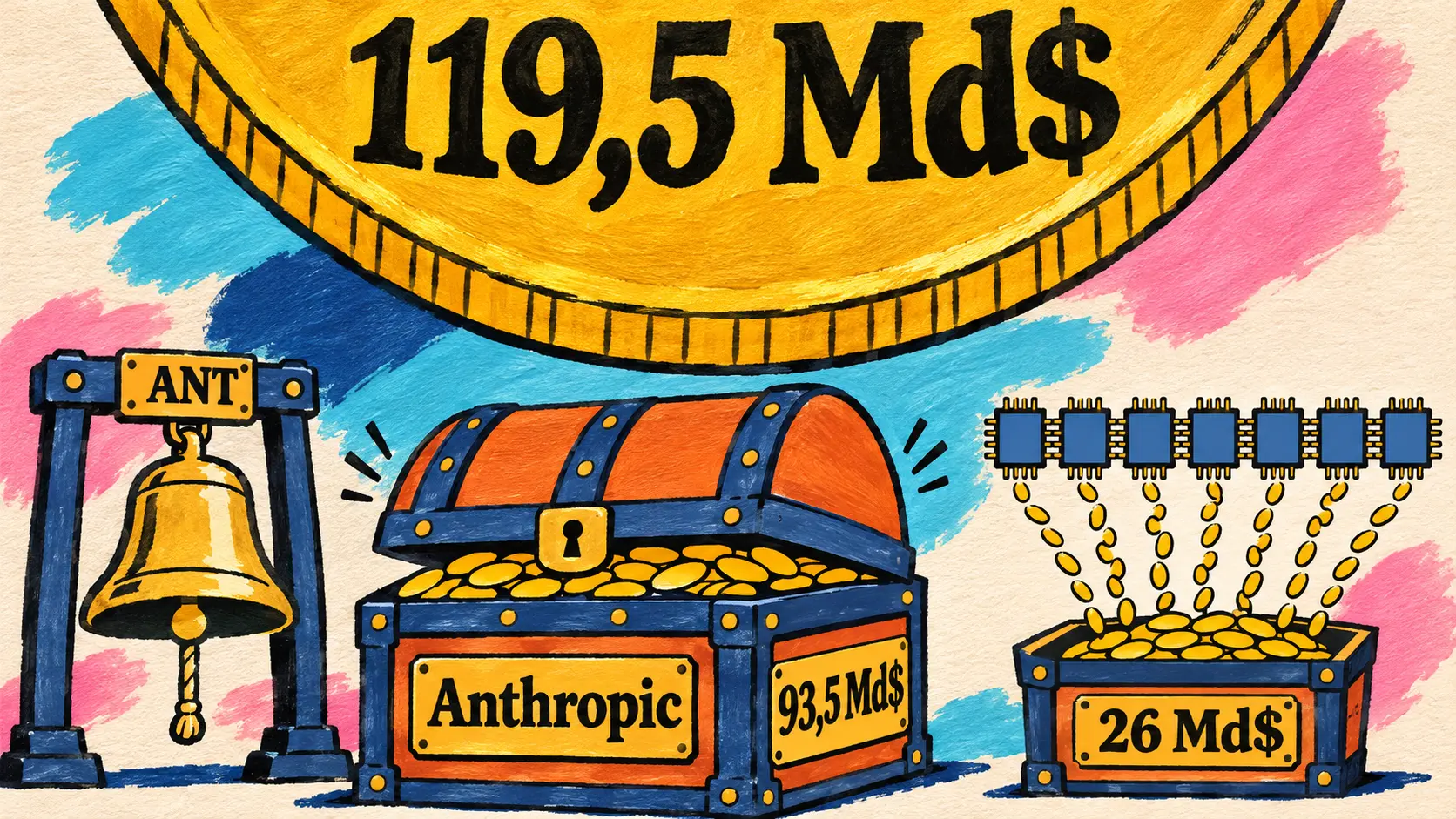
Finance: Anthropic closes its IPO, with $93.5 billion in gross proceeds and a $26 billion private placement
November 20 — The day after its shares began trading, Anthropic announces the closing of its IPO, which was priced on November 18 at $83 per share. The banks fully exercised their option to purchase 147 million additional shares: a total of 1,127,000,000 Class A shares were sold. Gross proceeds reach approximately $93.5 billion before commissions and expenses, including approximately $91.6 billion for Anthropic, which receives no proceeds from the 23,648,646 shares sold by existing shareholders.
The post also reports a concurrent private placement that has also closed and was not mentioned in the pricing announcement: 313,253,007 Class N shares, sold at the same price of $83 to seven semiconductor and computing groups (AMD, Broadcom, Google, Micron, Microsoft, NVIDIA and TSMC Partners), for approximately $26.0 billion. These shares are not registered under the Securities Act of 1933. Combining the public offering and this placement brings the gross amount to nearly $119.5 billion, before commissions and expenses.
| Transaction component | Value announced by Anthropic |
|---|---|
| Class A shares sold | 1 127 000 000, including 147 000 000 under the banks’ option |
| of which sold by Anthropic | 1 103 351 354 |
| of which by existing shareholders | 23 648 646 |
| Price per share | 83 dollars |
| Gross proceeds from the offering | approximately 93,5 billion dollars |
| Proceeds received by Anthropic | approximately 91,6 billion dollars |
| Private placement (Class N) | 313 253 007 shares, approximately 26,0 billion dollars |
| Gross total, offering and placement | approximately 119,5 billion dollars |
| Listing | since November 19, Nasdaq Global Select Market, symbol ANT |
The post confirms the listing without providing a share price or market capitalization. Goldman Sachs and Morgan Stanley led the transaction, with a syndicate of around twenty banks, including J.P. Morgan, Citigroup, BNP Paribas, Crédit Agricole CIB and Société Générale. The same day, @AnthropicAI published a video in which the seven cofounders, Dario Amodei, Daniela Amodei, Tom Brown, Jack Clark, Jared Kaplan, Sam McCandlish and Chris Olah, tell the company’s story.
🔗 IPO closing (Anthropic) · @AnthropicAI on X: the cofounders
Open models: Thinking Machines’ Inkling 2 Mini, Tencent Hy4, a single super-adapter for Qwen3.8-27B, Ayb 0.5 and Depth Pro 2
November 20 — Thinking Machines Lab releases Inkling 2 Mini, the smaller sibling of Inkling 2 Small (594 billion parameters, covered here on November 12). This open-weight mixture of experts (Mixture-of-Experts), released under the Apache 2.0 license, has 26.4 billion parameters, with 3.4 billion active per token. It reads text and images, with a context window of one million tokens. Its weights are distributed at training precision, NVFP4 for twenty layers and MXFP8 for the final four, totaling approximately 20 GB without conversion loss: it runs with Ollama on any Mac with at least 32 GB.
Today we are releasing Inkling 2 Mini, a fast, powerful model that’s small enough to run on your laptop. — Thinking Machines Lab, Inkling 2 Mini announcement
Its distinguishing feature is architectural: it is a transformer with loops (looped transformer). Of its 24 layers, the middle 12 are traversed three times, giving 48 layer passes per token for 24 stored layers, hence 5.4 billion weight activations per token. During training, the lab also pruned two-thirds of the experts (from 384 to 128), then repaired the model with 1 trillion tokens distilled from a larger internal Inkling model. According to the lab, at the same loss, a model without loops would require 7.5% less training compute but 140% more inference compute.
| Benchmark (Thinking Machines table) | Inkling 2 Mini | Qwen3.8-27B | Nemotron 3.5 Super VL |
|---|---|---|---|
| Weight activations per token / total parameters | 5,4B / 26,4B | 27,0B / 27,0B | 12,0B / 124,5B |
| AA Index v5.0 | 20,1 | 20,1 | 13,6 |
| DeepSWE v1.1 | 48,2 % | 42,2 % | 24,7 % |
| SWE-bench Pro v2 Hard | 77,9 % | 73,8 % | 44,1 % |
| Terminal-Bench 2.1 (pi) | 71,6 % | 73,0 % | 60,7 % |
| BrowseComp | 79,0 % | 61,6 % | 78,9 % |
| MCP Atlas | 82,7 % | 77,3 % | 67,7 % |
According to Thinking Machines, the model leads open models with fewer than 100 billion parameters on DeepSWE v1.1 and the Vals Index v2.2 (46.5%). It remains behind Qwen3.8-27B on Terminal-Bench 2.1, and Thinking Machines acknowledges that it is not the best small model for multi-turn conversations (50.0% on MultiChallenge) or instructions with multiple constraints (33.4% on ComplexConstraints v1.1); the chart caption states that evaluation configurations vary between models. Stanford researchers with early access measured 0.703 intelligence per joule on DGX Spark, compared with 0.430 for Qwen3.6-35B-A3B.
The lab also uses it to study chain-of-thought monitoring (chain of thought): a looped model performs more computation without writing it down, which could escape a monitor’s notice. On a variant with a variable number of passes, also released, the task it can solve without written reasoning increases from 16 to 37 seconds of human work as the number of passes rises from one to three. At five passes, the reasoning is half as long (1,661 versus 3,703 tokens on average on GPQA Diamond) and remains equally readable; Thinking Machines observes no increase in agentic sabotage as the number of loops rises. The model is available on Tinker, Ollama, SGLang, vLLM, llama.cpp, MLX and Transformers, with GGUF versions from Unsloth.
🔗 Inkling 2 Mini (Thinking Machines) · Hugging Face post · Weights on Hugging Face
Together AI serves Tencent Hy4, a mixture of experts with 770 billion parameters, at $0.83 per million input tokens
November 19 — Together AI adds Tencent Hy4 to its serverless inference offering, with a context window of one million tokens, tool calling and JSON output. According to the hosting provider, Tencent’s flagship model is a mixture of experts with 770 billion parameters, including 49 billion active per token; it succeeds Hy4 Preview, adds computer use and becomes the first in the Hy family to read images.
| Price per million tokens | Together AI | Tencent (November 4 announcement) |
|---|---|---|
| Input | 0,83 dollar | approximately 0,90 dollar |
| Cached input | 0,042 dollar | approximately 0,045 dollar |
| Output | 2,50 dollars | approximately 2,70 dollars |
Tencent launched Hy4 on November 4, presenting it as one of the best open-source models and promising the weights within a few days; the tencent/Hy4 repository is on Hugging Face under an “other” license type. Its announcement cited a blind financial evaluation (213 professionals, 579 tasks) in which Hy4 scored 3.04, ahead of DeepSeek-V4.1-Flash-1017 (2.97), and an internal hallucination rate reduced from 12.95% to 7.2%.
🔗 Tencent Hy4 on Together AI · Tencent’s November 4 announcement
Hugging Face releases the recipe for its harness adapters and a single super-adapter for Qwen3.8-27B
November 20 — After three days of releases, including the Hermes adapter covered here yesterday, Hugging Face provides the full recipe for its harness adapters: LoRAs trained through reinforcement learning inside an agent harness (pi, Hermes Agent or OpenCode), on top of Qwen3.8-27B. The new addition is a super-adapter: the three rank-32 LoRAs are concatenated into a single rank-96 LoRA that works in all three harnesses. Since their updates are nearly orthogonal (cosine similarity of 0.01 to 0.02), the combination applies all three exactly.
| SWE-bench Pro (51 difficult tasks), with thinking | Base model | With the super-adapter |
|---|---|---|
| Hermes Agent harness | 45 % | 61 % |
| OpenCode harness | 47 % | 67 % |
| pi harness | 74 % | 74 % |
With thinking, the average across the six harness-benchmark pairs rises from 55.5% to 63.5%, with 19% to 48% fewer tool calls, according to the team’s thread; without thinking, the super-adapter gains 6 to 18 points on SWE-bench Pro, with 53% to 73% fewer tool calls, according to the post. Scores cannot be compared across harnesses because their default settings differ. Training required 598 steps and 167 million tokens; the safeagents guard checked 1.3 million tool calls and blocked 647. Tasks, adapters, GGUF files and evaluation trajectories are published.
🔗 Harness adapters at scale (Hugging Face) · @yb2698 on X
Metric AI releases Ayb 0.5, OhanTTS and OhanASR, open text and speech models for Armenian
November 20 — Armenian team Metric AI releases three model families for its language on the same day. Ayb 0.5 brings together three language models (0.8B, 4B and 9B) built on Qwen3.5 and adapted to Armenian, from an extended tokenizer to post-training; Ayb-9B handles multi-turn dialogue, tool calling and images. OhanTTS-v0.1 synthesizes speech in eight languages, including Armenian and French, and clones a voice from 3 to 10 seconds of audio. OhanASR-v0.1, a 2B speech recognition model, is fine-tuned on 820 hours of Armenian.
| Metric AI model | Result published by the authors |
|---|---|
| Ayb-9B | 3rd overall on ArmBench (0,6164) |
| OhanTTS-v0.1, 61 hours of Armenian | 14,70 % WER, first audio in 331 ms on a GB10 |
| OhanASR-v0.1 | 16,12 % WER (2nd) and 3,49 % CER (1st) on ArmBench-ASR |
Ayb-9B’s weights are under a noncommercial license (CC BY-NC 4.0) and accessible after manual approval.
🔗 Ayb 0.5 (Metric AI) · OhanTTS · OhanASR
Apple releases Depth Pro 2, which estimates depth in meters in photos and videos
November 19 — Apple releases Depth Pro 2, a family of models that estimate depth in meters in both photos and videos, at native resolution. According to the paper’s abstract, existing methods had to choose between consistency across frames and sharp boundaries; Depth Pro 2 targets both with a single network. The weights are on Hugging Face in four sizes (S, B, L, H), with a Core ML version and a shared focal length estimator, useful when the EXIF focal length is missing.
| Resolution processed by DepthPro2-L (334M, on B200) | Frames per second |
|---|---|
| VGA | 150,1 |
| 720p | 33,7 |
| 1080p | 9,1 |
| 4K | 0,7 |
The weights are restricted to noncommercial research (Apple Machine Learning Research Model license), and the code is on GitHub. The release was highlighted on November 20 by Pedro Cuenca of Hugging Face, with an online demo.
🔗 @pcuenq on X · arXiv paper 2611.26603 · DepthPro2-L (Hugging Face)
Model security: OpenAI counters adversarial distillation, Sakana AI creates its Security Research Group
OpenAI details its fight against adversarial distillation and cuts extraction of protected reasoning from 54,0 % to 0,2 %
November 20 — OpenAI publishes a post on adversarial distillation (adversarial distillation): the unauthorized use of a frontier model’s outputs to train another model, deployed without the same safeguards, for example for attacks that the original model would have refused. The post focuses primarily on protected reasoning, the chain of thought produced before the answer: according to an internal study, a student model generally improves more with exact reasoning traces than with summaries of them.
| Attack measured (adaptive evaluation, six attacker models) | GPT-6 Astra, original safeguards | GPT-6.2 Astra, updated safeguards |
|---|---|---|
| Reasoning from a previous request | 54,0 % | 0,2 % |
| Reasoning from the current request | 22,9 % | 0,9 % |
The defense combines adversarial training, input and output classifiers (including tool call arguments), API controls and investigations, with weekly enforcement against campaigns involving a few thousand to a few tens of thousands of accounts. With GPT-6.2 Astra and Sol, protected reasoning is tied to the history that produced it: the API discards it if a previous message is rewritten, and older model families can no longer read it. OpenAI recalls reporting activity to Congress in February indicating that DeepSeek was attempting to distill American models, then attributing a campaign in September to individuals associated with Moonshot AI; it says it supports the Chip Security Act, the AI OVERWATCH Act and the MATCH Act.
🔗 Combatting adversarial distillation (OpenAI) · @OpenAI on X
Sakana AI creates its Security Research Group, an independent team for collective cyberdefense
November 20 — Sakana AI launches its Security Research Group, an independent R&D team based in Tokyo, separate from its commercial operations and focused on the public interest.
Excited to announce the Sakana AI Security Research Group, an independent, public-interest R&D team in Tokyo co-led by Akihiro Umegai and me. — @hardmaru on X
David Ha is Sakana AI’s cofounder and CEO. The team will work on three areas: prevention by design, collective defense through agents distributed across organizations, and securing the defender agents themselves, whose authority will be limited to their task and whose actions will be logged. It builds on in-house work such as Digital Red Queen, ShinkaEvolve and Fugu-Cyber, for which Sakana AI reports 86,9 % on CyberGym and 72,1 % on CTI-REALM; a note in the post specifies that the Fugu-Cyber page provides neither baseline scores nor an evaluation protocol. It will publish white papers, benchmarks and defensive guides, but no exploit material, and any vulnerabilities found will undergo coordinated disclosure. Sakana AI notes that CVE requests increased by 263 % between 2020 and 2025, according to NIST.
🔗 Security Research Group (Sakana AI)
Agents connected to software delivery: Runway’s factory, Google Labs’ Stitch Loop
Runway entrusts its software delivery pipeline to agents, which drove 38 % of its October merges
November 20 — Runway publishes a quantitative report on its “software factory” (software factory) on its engineering blog: seven stages, from writing code to coordinating merges, handed over to agents one by one. Cloud agents drove 38 % of pull requests merged in October, and of 100 such PRs merged in the first half of November, 78 contained no human commits.
| Software factory metric | Starting point | Latest measurement |
|---|---|---|
| Merges driven by cloud agents | 0,1 % (June) | 38 % (October) |
| Median wait for a first approval | 2,3 h (September) | about 5 min (mid-November) |
| Average weekly merges | 929 (September) | 2 235 (since mid-October) |
Since mid-October, AI has independently approved PRs classified as low risk, and medium risk if the repository allows it; high risk goes to a person, and code owners still sign off on migrations, CI and deployment configuration, secrets and authentication. In September and October, a person challenged 15 of the 977 PRs approved by AI, and merges approved by AI alone have a rollback rate of 0,10 %, compared with about 1 in 200 for human approvals. Agents also test App Studio as a user would (86 confirmed bugs in four days), and a coordinator distributed more than 14 000 tasks in two weeks. These are internal tools, with no product or pricing.
🔗 Building a Software Factory (Runway)
Google Labs launches Stitch Loop, a product agent that continuously improves a live application
November 18 — Google Labs introduces Stitch Loop, a long-running product agent that picks up where a coding agent stops: after deployment to production. It connects to the GitHub repository and live product data (logs, user behavior, feedback) through more than 180 integrations, custom MCP servers or uploads from a local CLI, and works continuously toward measurable goals.
Each loop proposes ideas backed by data, details solutions and their tradeoffs, writes code in an isolated cloud sandbox and opens a pull request for approval, then monitors live metrics. Three loops are included by default (cybersecurity, latency, accessibility); the security loop pairs Gemini 4 Carbon with CodeMender, Google DeepMind’s code security agent. Nothing is merged without the team’s review. Stitch Loop also serves as a source of product context for coding agents such as Google Antigravity, through the Stitch CLI and MCP, and can be used in Slack. Only a waitlist is open, worldwide, with priority access for eligible Google AI Ultra subscribers.
Consumer assistants: ChatGPT Space for Plus subscribers, GIFs in the Gemini app, Perplexity Computer in Chromium browsers
ChatGPT Space opens to Plus subscribers worldwide
November 20 — ChatGPT Space, introduced at DevDay on September 29 and previously limited to Pro, Business and Enterprise plans, is rolling out worldwide to Plus subscribers aged 18 and over. Space replaces the Library in the sidebar (pages, slides, images, uploaded files), on the web, the desktop app, iOS and Android.
Users can create interactive pages and presentations with ChatGPT, which other people with access to Space can enrich. Pages and slides can update themselves from connected apps: OpenAI cites a task list that updates itself or a project plan that tracks decisions made in Slack. Mentioning ChatGPT in a comment is enough to request a change, and a dot can be invited to collaborate. Sharing remains restricted: viewers need read permission and a Plus, Pro, Business or Enterprise account with access to Space; Free accounts cannot open shared content, and there is no public link.
The Gemini app creates animated GIFs with Gemini Omni 1.2 Flash, for free in France
November 20 — The Gemini app now creates animated GIFs (looping photo effects, memes) with Gemini Omni 1.2 Flash, the video model Google launched on November 5, for smooth motion and consistent quality from one frame to the next, according to Google. Users type their request in the main chat, or open the image or video tool, then choose GIF in the format selector.
GIFs are now available to all Google AI subscribers and free of charge in the U.S., Japan, Korea, Australia, Canada, U.K., Germany, and France. — @GeminiApp on X
Users in France without a subscription therefore have access. Google follows OpenAI, whose animated GIFs in ChatGPT with Images 2.6 were covered here on November 5.
🔗 @GeminiApp on X: GIFs in Gemini
Perplexity Computer works directly in Chromium browsers through the Perplexity extension
November 20 — Perplexity Computer now works directly in Chromium-based browsers through the Perplexity extension. Users assign a task from the extension’s side panel, then watch Computer as it works in their tabs and tools. The announcement tweet specifies neither the plans concerned nor the list of supported browsers.
Two precedents: on October 5, Mac app 26.38.0 allowed Computer to use Chrome, Edge or Brave through an extension, and on October 30, a Chrome extension connected the Computer Mac and Windows apps to the user’s browser. This time, the task is assigned from the extension’s side panel, in the browser.
APIs and SDKs for developers: Codex in the Python Agents SDK, Decider in Perplexity’s Context API
OpenAI’s Python Agents SDK releases a 1.0 preview that makes Codex a model provider
November 20 — OpenAI’s Python Agents SDK begins its 1.0 series with a preview that changes its approach: instead of a separate native engine, as in the 0.24 preview covered here on November 16, Codex becomes a model provider selected for each run. Users create a CodexProvider and pass it to the Runner through RunConfig(model_provider=provider); the agent then runs with the saved Codex login, or with an API key.
The Python wheel bundles Codex Core (rust-v0.166.0, unmodified) through PyO3: the SDK calls the Codex core directly, without launching codex app-server or going through JSON-RPC. Python tools, transfers to a specialist agent (handoffs), approval before a tool runs and typed output remain available, and native commands follow Codex’s sandbox and approval rules. The 1.0.0a1 wheels are distributed only through GitHub Releases (Linux x86-64 and ARM64, macOS 11 and later on Apple silicon, Windows x64, CPython 3.10 to 3.14). Saved states from preview 0.24.0-alpha.8 are not compatible with the Runner, and the stable release remains 0.25.0 from November 18.
🔗 openai-agents-python v1.0.0-alpha.1
Perplexity adds Decider to the Context API to score pages, including prompt injections
November 19 — Perplexity adds Decider, its decision model, to the Context API launched two days earlier (1 dollar per 1 000 URLs). Users can ask up to five closed questions (yes or no) about each retrieved page, and Decider scores each answer from 0 to 1. The highlighted use case concerns security: detecting a prompt injection (prompt injection) in a page before an agent reads it. Perplexity also cites lead qualification, moderation and identifying unsourced health claims.
The API does not filter anything itself: it returns all pages with their scores, and the application’s code applies a threshold. Scoring is billed as Decisions API input tokens, on top of the per-URL price, and can add up to 15 seconds to the request. The documentation’s cookbook shows a check run on November 18 with a threshold of 0,7:
| Page tested (November 18 cookbook) | Injection score | Check decision |
|---|---|---|
| Injection demonstration (Greshake et al., 2023) | 0,97 | quarantined |
| OWASP, prompt injection page | 0,0018 | passed through |
| RFC 9111 | 0,0007 | passed through |
The cookbook warns that a low score does not make a page safe: according to Perplexity’s BrowseSafe++ research, every model tested still followed some injections it had itself flagged.
🔗 Thread by @perplexitydevs · Documentation · Cookbook
Coding agents: Claude Code 2.1.329, Codex CLI 0.171.0, Vibe CLI 3.1.4 and Gemini 4 Neon in Devin
Claude Code 2.1.329 shows where hooks originate when opening a folder and groups scheduled tasks in /tasks
November 19 — Claude Code 2.1.329 has 130 entries, including 91 fixes, 20 changes and 7 additions. On security, the dialog asking whether to trust a folder now indicates where its hooks are declared, and Claude Desktop and other non-interactive hosts warn when hooks required by managed settings (managed settings) fail to load. /tasks also lists the session’s scheduled tasks, /loop wakeups, the current goal and conversation forks; most scheduled tasks saved by previous versions will need to be rescheduled.
/code-review without a target now reviews, on most models, the entire branch against the default branch, and with a PR number it reads the PR itself through gh pr diff. On macOS, computer use switches to newer security rules, which refuse certain actions. The automatic retry added in 2.1.326 after an max_tokens error is removed: behind a gateway, CLAUDE_CODE_MAX_OUTPUT_TOKENS must be configured. Code Mode receives 17 entries, including support for OpenTelemetry events and metrics. Version 2.1.330 has been available on npm since November 20.
Codex CLI 0.171.0 makes GPT-6.2 Sol the default and enables the terminal workspace
November 20 — Codex CLI 0.171.0 is the first stable release since 0.170.0 on November 18 and brings together 339 pull requests. GPT-6.2 Sol and GPT-6.2 Astra enter the model catalogs, with Sol selected by default, and the /rc and /remote commands manage local remote control from the terminal and display device pairing codes.
Several features from the November 14 to 17 previews become stable: the TUI workspace, enabled by default, displays document and image previews and subagent transcripts alongside the conversation; codex exec --remote starts or resumes a non-interactive session on an existing app server; the composer gains undo and redo; /statusline selects status lines provided by an MCP server, behind an option. Among the fixes, drafts and queued retries remain attached to their conversation, and enterprise MCP login works with identity providers that do not issue a refresh token.
Vibe CLI 3.1.4 separates the agent from the approval policy and removes agents’ ability to waive confirmations
November 20 — Mistral releases Vibe CLI 3.1.4, two days after 3.1.3 made Mistral Large 4 the default model. Its 79 entries (18 additions, 41 changes, 18 fixes, 2 removals) focus primarily on permissions: each session now combines two independent settings, an agent (default, lean or custom) and an approval policy (ask, accept-edits, smart-approve or auto-approve), selected using --approval-policy or default_approval_policy.
An agent no longer decides on its own what runs without asking: its safety, bypass_tool_permissions and permission = "always" settings are ignored. A project can no longer override an approval policy in its .vibe/agents/ directory, and forks and child sessions inherit the original policy. The interface gains a “rail” of chips above the input (subagents, background tasks, pull requests, goal, tasks), a keep_awake setting prevents sleep during a turn, and Vibe accepts system certificates, helping it work behind a corporate proxy. Only the 8 most recent images are now sent to Mistral models, and custom compaction prompts are removed.
Devin adds Gemini 4 Neon, scoring 46,2 % on FrontierCode 2.0 at 4,38 dollars per task
November 19 (post dated November 18) — Following Cursor and GitHub Copilot, covered here yesterday, Cognition makes Gemini 4 Neon available in Devin Desktop and Devin CLI. On FrontierCode 2.0, its benchmark assessing whether a pull request deserves to be merged, Neon scores 46,2 %, the best result for a Google model according to Cognition. It comes within about one point of Claude Opus 5.5 (47,3 %) at roughly one-third of the cost: 4,38 dollars per task versus 12,82 dollars.
| Model evaluated on FrontierCode 2.0 | Score published by Cognition |
|---|---|
| Claude Fable 5.2 | 50,2 % |
| Claude Opus 5.5 | 47,3 % |
| Gemini 4 Neon | 46,2 % |
| GPT-6.2 Astra | 44,2 % |
| GPT-6.2 Sol | 43,8 % |
| Gemini 4 Carbon | 42,6 % |
The cost reflects average spending per run at the API’s list price, including public discounts, and a solution that fails a mandatory criterion receives a score of zero. Several scores in this chart differ from values published in previous weeks, with no explanation in the post.
🔗 Gemini 4 Neon in Devin (Cognition) · @cognition on X
Science: OpenAI releases MedChemBench, a medicinal chemistry benchmark on which GPT-6.2 Astra scores 84,5 %
November 20 — OpenAI introduces MedChemBench, a benchmark measuring models’ ability to reason like a medicinal chemist: connecting a molecule’s structure to experimental results, comparing compounds, and predicting their properties. It brings together 99 problems drawn from 117 papers and patents, with 761 distinct molecular structures, and scores four components: structures, scientific reasoning, compound selection, and property prediction.
| Model evaluated (xhigh reasoning level) | Credit earned |
|---|---|
| GPT-6.2 Astra | 84,5 % |
| GPT-6 Astra | 83,3 % |
| GPT-6.1 Sol | 82,0 % |
| GPT-6.1 Terra | 75,1 % |
| GPT-5.6 Sol | 58,2 % |
Performance is uneven: GPT-6 Astra earns 95,4 % of the credit on structures, but around half on compound selection and numerical value prediction. OpenAI remains cautious: the benchmark uses historical data and does not establish that models can discover new drugs, prior exposure to the source publications cannot be ruled out, and only GPT models were evaluated. It follows BioBasicsBench, covered here on November 6.
🔗 Introducing MedChemBench (OpenAI) · Full paper (PDF)
Generative video and audio: ElevenLabs adds ad variations to Ads Engine without reshoots
November 20 — ElevenLabs expands Ads Engine, its ad creation tool integrated into ElevenCreative and launched in June. Connected to Google, Meta, LinkedIn and now TikTok ad accounts, it uses existing ads and their results to produce variations without reshoots. It identifies the opening hook (hook) and writes new ones based on ads that performed well; they are spoken by a digital replica of the original speaker’s voice, with lip sync and updated captions. New soundtracks, composed by the ElevenLabs Music API based on the tone and pace of the footage, are available for commercial use.
For localization, already handled by Dubbing v2, Ads Engine now syncs the speaker’s lips to the target language and replaces burned-in captions with a translated version, matching the timing and brand fonts. Human review remains available before release, including by a native-speaking localization professional, and the tool can publish directly to the platforms. Access is through the sales team, with no published pricing.
🔗 Video ad variations and localization in Ads Engine (ElevenLabs)
Briefs
Coding agents
- Copilot CLI 1.0.115-2 — In this prerelease with 351 entries, including 335 fixes, Gemini 4 Hydrogen joins the model picker with Extra High effort when the account has access, GPT-6.2 Astra is supported, and
/modelalso handles models from custom providers; the stable version remains 1.0.114. 🔗 source - Codex CLI 0.173.0-alpha.1 and alpha.2 — The notes for these prereleases are empty; according to the titles of the 71 commits, MCP connection sharing and OAuth discovery for configured servers are becoming enabled by default, and administrators will be able to disable Codex daemon updates. The content may change before the stable release. 🔗 source
- Gemini CLI — First nightly since November 4 (v0.71.0-nightly.20261120); on the main branch,
gemini --resumereopens the most recently used session rather than the last one started, and paths beginning with~\are finally expanded on Windows. 🔗 source - Antigravity IDE 2.8.0 — Google’s editor starts its backend instantly and checks for updates in the background, automatically forwards ports for remote connections, supports searching within a conversation using the keyboard, and accepts custom certificates and a proxy when connecting. 🔗 source
- Qwen Code 0.28.1-preview.1 — This prerelease with 179 entries makes GitHub the third supported channel adapter, adds WeCom, Microsoft Teams and generic outgoing webhooks configurable from the web interface, and brings a screen reader layout to the CLI; the stable version remains v0.28.0. 🔗 source
- Kimi Code 2.7.1 and 2.7.2, Kimi Code Desktop 1.4.1 and 1.4.2 — Four patch releases the day after 2.7.0: the thinking effort selected in a draft no longer resets to the default after sending, and forks no longer fail after restoring a session steered mid-turn. 🔗 source
- mistral CLI 0.20.1 —
mistral evals execnow exits with a failure (code 1) when all calls in a run have failed, for example on a 401 error, instead of reporting success; a Ctrl-C interruption is reported as such. 🔗 source - Replit — Workspaces (Workspaces) can now be searched and pinned, an option that only appears once there are five workspaces. 🔗 source
- Devin Bot for Manim — Cognition showcases the Devin Bot that Grant Sanderson set up to help him with Manim, the open source animation system behind 3Blue1Brown’s videos (96,6 k stars, 250 000 downloads per month); the tweet specifies neither the tasks assigned to the bot nor its results. 🔗 source
APIs and platforms
- Gemini API — Since November 17, Gemini 3.5 Transcribe, in both its standard and live versions, can edit, rewrite and format dictated or existing text using voice instructions (
source_textparameter), and Google also mentions translation. Since November 18, the API lets users process, and pay for, only the relevant parts of uploaded files: page ranges, tabs, cells, time intervals or content layers. 🔗 source - Time awareness in the Agents API — An experimental option (
experimental={"time_awareness": True}) regularly reminds the model of the time so it can adapt its work to a deadline; combined with asynchronous tools, it allows an agent to ask a question and keep searching while waiting for the answer, as demonstrated in a post on OpenAI’s developer blog. 🔗 source - Conversation history with GPT-6.2 — @OpenAIDevs asks users to stop modifying earlier messages in the Responses API, because the API discards the reasoning following the edit. A new Reasoning removals section in the Usage dashboard helps identify this, and the accompanying guide suggests adding a
configuration_updateoradditional_toolsitem instead to change the effort or tools. 🔗 source
Consumer assistants
- ChatGPT rolls out a new mobile app with a tab for the dot and pinned favorites — Codex, Projects or Images can be pinned to the tab bar; the rollout begins with Pro users aged 18 and over where dots are available, excluding the European Economic Area (including the EU), the United Kingdom, Switzerland and Korea, and with a small group of Plus users (November 19 release notes, linked above).
- Perplexity Teammates — Max subscribers can now create a teammate from any Computer task on the web, then change its name, role or avatar in the same conversation. 🔗 source
- Perplexity Mac app — Now faster, it adds “Send now” to steer an ongoing task, ⌘F to search tables, Markdown and previews, and ⌘⇧T to reopen a closed tab. 🔗 source
Generative video and audio
- Seedance 2.5 Flash on Pika — Following Runway and HeyGen, Pika adds the fast variant of ByteDance’s video model for projects requiring many takes: videos up to 30 seconds long at 480p or 720p, with up to 10 images, 5 videos and 5 audio clips as references; the tweet gives no pricing. 🔗 source
- HeyGen Avatar 6 — New blind tests from the technical report: when the people filmed, HeyGen employees, choose the video that looks most like them, Avatar 6 wins 86,5 % of the time against Seedance 2.5 and 87,9 % against Wan 3.0; these evaluations are conducted by HeyGen. 🔗 source
- Qwen3 TTS at Together AI — The open text-to-speech model Qwen3-TTS-12Hz-1.7B (Apache 2.0) is served at 20 dollars per million characters, with nine voices adjustable through a natural-language instruction, ten languages including French, and first audio in as little as 97 ms. 🔗 source
Infrastructure and research
- Together Storage Accelerator — Together AI includes an NVMe cache for S3 storage and the Hugging Face Hub with every GPU cluster, requiring no code changes; according to its measurements, reading a 2 Gio file from Cloudflare R2 drops from 12,7 to 15,0 s to 0,64 to 0,72 s, and a 200-node cluster downloads from the origin only once. 🔗 source
- Hugging Face CDN — Hugging Face serves nearly an exabyte of open models and datasets per month, according to its cofounder Julien Chaumond, and has built its own content delivery network (CDN) for AI downloads. 🔗 source
- Superfluid by basecompute — The local server now distributes inference across Apple, AMD and NVIDIA machines: six machines raise throughput from 112 to 534 output tokens per second for 64 simulated users, and shutting down a node causes no requests to be lost, according to the developer. 🔗 source
- WavLate — This open late-interaction model searches for sounds using text and for text using sound, with one vector every 0,31 seconds of audio and one per word; its author reports an average Recall@1 of 37,9 on AudioCaps and Clotho, the best of the nine open models compared, and releases weights and data. 🔗 source
- WorldTrace — NVIDIA Research introduces memory for interactive video world models, requiring no retraining (paper accepted at NeurIPS 2026): on LoopBench, recall of revisited scenes improves by 32,6 % over the sliding window, using 3,1 Go of GPU memory and 27 % more runtime. 🔗 source
- Dynamo for reinforcement learning — NVIDIA details how Dynamo serves post-training rollouts: routing based on the KV cache, differential weight transfer with ModelExpress, and recovery of failed worker processes. Microsoft AI, Cognition (for SWE-1.7), Prime Intellect and H Company use it; H Company saves up to 20 % of the time per training step. 🔗 source
- Sparse attention — In a November 17 guide, NVIDIA gives eight design rules for sparse attention trained on its GPUs; the indexer that selects tokens and Top-k account for 47 % of a DeepSeek V3.2 prefill layer at 128K tokens. 🔗 source
GitHub
- GitHub Enterprise Server 3.23 release candidate — AI secret detection, in public preview, runs on the appliance’s CPU, without a GPU, hosted LLM or outbound connection, including in isolated (air-gapped) environments; the release also extends detection of known malicious packages to seven ecosystems beyond npm. 🔗 source
- Beyond AI — GitHub clarifies merge status on the new pull request Overview page, GitHub Desktop 3.7.0 supports multiple accounts on the same host, and the dashboard displays up to 25 favorite repositories. 🔗 Overview · 🔗 Desktop · 🔗 favorites
Enterprise and essays
- Hebbia — In its financial research tests in August and September, a preview of GPT-6 Astra cites relevant excerpts 99,5 % of the time and meets 97,9 % of presentation requirements, 14,4 points ahead of the best alternative tested, which the case study published by OpenAI does not name. 🔗 source
- The Silent Consensus — OpenAI publishes an essay by Dean Ball in its Intelligence Age (Intelligence Age) section, adapted from a talk at Harvard and presented as reflecting the author’s views, challenging the idea that abandoning human primacy is inevitable; he argues for agents tied to people, with limited and revocable permissions. 🔗 source
- Data enrichment — A Perplexity guide describes how to complete and verify CRM records using a model connected to the web, in six steps; Apollo runs 5,6 million enrichments per month through Perplexity’s API. 🔗 source
What it means
Anthropic’s IPO brings together money from the markets and industry in a single deal. The public offering raises approximately $91.6 billion in gross proceeds for the company, and the private placement adds another $26 billion, subscribed at the same price of $83 by seven semiconductor and computing groups: AMD, Broadcom, Google, Micron, Microsoft, NVIDIA and TSMC Partners. In total, the deal approaches $119.5 billion in gross proceeds: alongside the offering’s investors, seven industry groups are buying shares in an AI lab now listed on Nasdaq.
Security is increasingly being enforced through the tools’ own mechanisms. OpenAI binds GPT-6.2’s reasoning to the history that produced it, reducing the measured extraction rate from 54.0% to 0.2%, but requiring developers to stop rewriting their conversations. Vibe CLI removes agents’ ability to bypass confirmations themselves, Claude Code shows where a folder’s hooks come from before the folder is trusted, and Decider scores pages before an agent reads them. Sakana AI, meanwhile, is creating a team dedicated to collective defense, pledging not to publish exploit material.
Agents are moving beyond writing code and into the delivery pipeline. At Runway, they drive 38% of October’s merges, and AI independently approves low-risk changes; Stitch Loop monitors a live product and opens pull requests to achieve a measurable goal. In both cases, a person retains control over what matters: sensitive areas at Runway, every merge at Stitch Loop. The tooling is following suit: the Python Agents SDK makes Codex a model provider, and Cognition evaluates models on the question these pipelines raise: whether to merge the PR.
For open models, the focus is on getting more out of lighter weights. Inkling 2 Mini runs through its middle layers three times to match Qwen3.8-27B on the AA Index in 20 GB, Hugging Face’s super-adapter fits three specializations into a single LoRA, and Metric AI starts from Qwen3.5 to build Armenian models. The figures remain those reported by the developers, and MedChemBench highlights the limits of the exercise: OpenAI evaluates only its own models on it and does not rule out their having seen the source publications.
Sources
- Closing of the IPO (Anthropic)
- @AnthropicAI on X: the cofounders
- Inkling 2 Mini (Thinking Machines)
- Hugging Face blog post on Inkling 2 Mini
- Inkling-2-Mini (Hugging Face)
- Tencent Hy4 on Together AI
- Tencent press release on Hy4
- Harness adapters at scale (Hugging Face)
- @yb2698 on X: the super-adapter
- Ayb 0.5 (Metric AI)
- OhanTTS (Metric AI)
- OhanASR (Metric AI)
- @pcuenq on X: Depth Pro 2
- arXiv paper 2611.26603: Depth Pro 2
- DepthPro2-L (Hugging Face)
- Combatting adversarial distillation (OpenAI)
- @OpenAI on X: adversarial distillation
- @hardmaru on X: the Security Research Group
- Security Research Group (Sakana AI)
- Building a Software Factory (Runway)
- Stitch Loop (Google)
- ChatGPT release notes
- @GeminiApp on X: GIF availability
- @GeminiApp on X: GIFs in Gemini
- @perplexity_ai on X: Computer in Chromium
- openai-agents-python v1.0.0-alpha.1
- @perplexitydevs on X: Decider in the Context API
- Score pages with criteria (Perplexity documentation)
- Anti-injection cookbook (Perplexity documentation)
- Claude Code v2.1.329
- Codex CLI 0.171.0
- Vibe CLI v3.1.4
- Gemini 4 Neon in Devin (Cognition)
- @cognition on X: Gemini 4 Neon
- Introducing MedChemBench (OpenAI)
- Full MedChemBench paper (PDF)
- Video ad variants and localization in Ads Engine (ElevenLabs)
- Copilot CLI 1.0.115-2
- Codex CLI 0.173.0-alpha.2
- Gemini CLI, PR 30389
- Antigravity changelog
- Qwen Code v0.28.1-preview.1
- Kimi Code 2.7.2
- mistral CLI 0.20.1
- Replit changelog for November 20
- @cognition on X: Devin Bot for Manim
- Gemini API release notes
- Time awareness and async input for personal agents (OpenAI)
- @OpenAIDevs on X: GPT-6.2 history and reasoning
- @AskPerplexity on X: teammates from Computer
- @AskPerplexity on X: Mac app
- @pika_labs on X: Seedance 2.5 Flash
- @HeyGen on X: blind tests of Avatar 6
- Qwen3 TTS on Together AI
- Together Storage Accelerator (Together AI)
- @julien_c on X: Hugging Face’s CDN
- Superfluid across a fleet (basecompute)
- WavLate (Hugging Face)
- @NVIDIAAI on X: WorldTrace
- Dynamo and RL rollouts (NVIDIA)
- Sparse attention on NVIDIA GPUs (NVIDIA)
- GitHub Enterprise Server 3.23 release candidate (GitHub changelog)
- Pull request Overview page (GitHub changelog)
- GitHub Desktop and multiple accounts per host (GitHub changelog)
- Favorite repositories on the dashboard (GitHub changelog)
- Hebbia and GPT-6 Astra (OpenAI)
- The Silent Consensus (OpenAI)
- AI data enrichment (Perplexity)