ai-powered-markdown-translatorArticle translated from French to English with gpt-5.6-sol.
Meta is launching Muse, a personal agent that gives each user their own Linux machine in the cloud, while publishing the security architecture surrounding it on the same day, with a bug bounty program open to everyone offering rewards of up to $300,000. Mistral has announced a €3 billion Series D, the largest equity raise ever completed by a European technology company. OpenAI, meanwhile, has published a finite-time singularity proof for the Navier–Stokes equations, produced by an agent system, while Google DeepMind has precomputed the effects of all 9 billion possible mutations in human DNA.
Meta launches Muse, its personal agent, and publishes its security architecture
September 8 — Meta is launching Muse, a personal agent available through iOS and Android apps, a web interface, and WhatsApp, powered by Muse Spark 1.3. The model itself is not new: it arrived in Muse Code and the Meta Model API on September 2, and its highest reasoning tier became publicly available on September 4. What is new is the consumer product built around it.
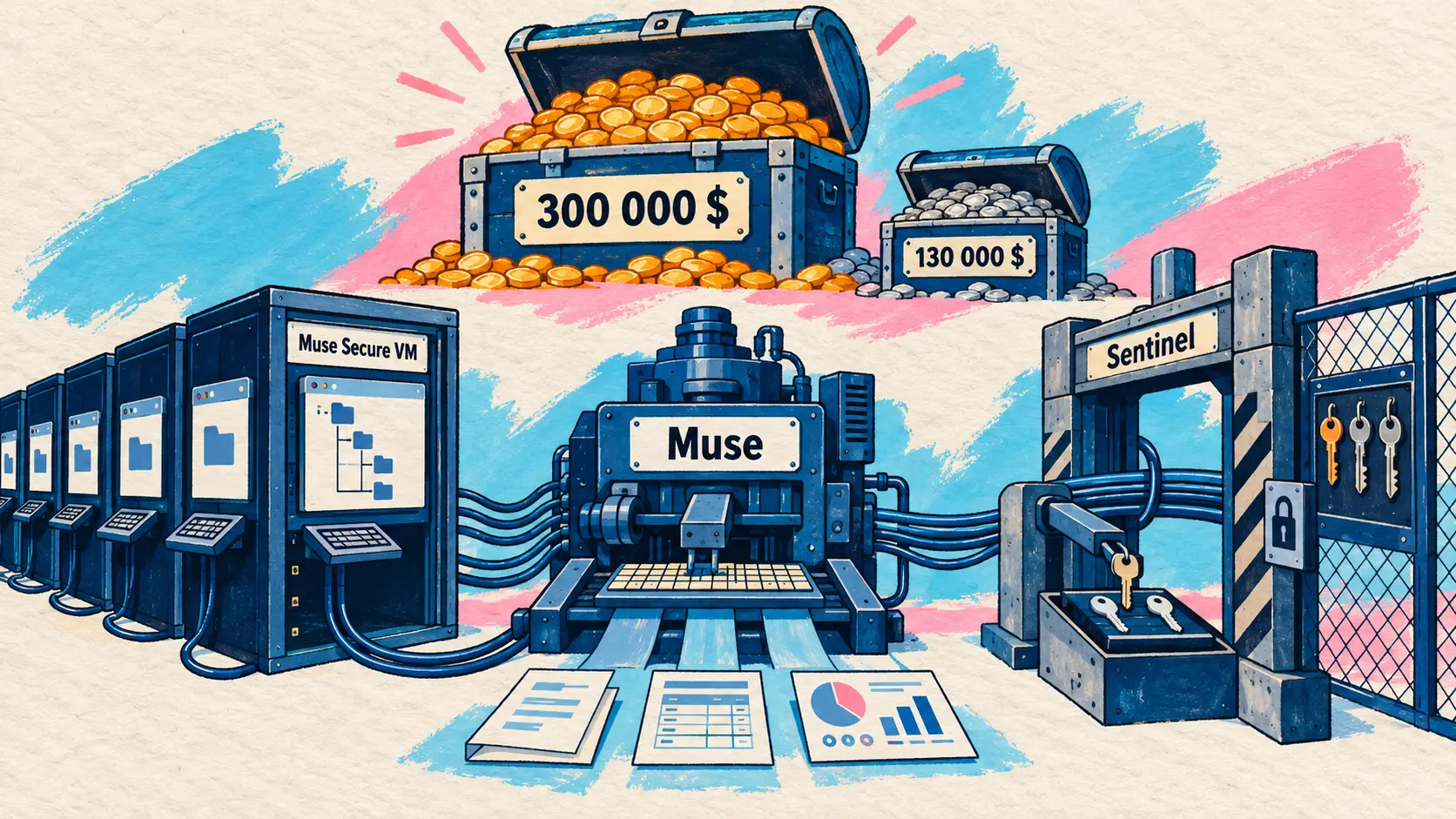
The architecture rests on an idea that is simple to state but difficult to implement: each user receives their own computer in the cloud. The Muse Secure VM is a persistent, isolated Linux machine equipped with a file system, terminal, and full browser, with enough storage, processing power, and memory to compile code, develop custom skills, and run sub-agents in parallel. This machine, rather than centralized Meta infrastructure, serves as the system of record for data and credentials from connected services. When a task requires a missing tool, the agent writes it itself, and it produces manipulable objects instead of blocks of text: itineraries, PDFs, web pages, and dashboards, which Meta calls Artifacts.
The second claimed breakthrough is that the agent works in the background while the app is closed, according to a schedule and in response to events, then decides whether the result warrants a notification. Its memory is persistent and can be viewed and edited by the user, while a Goals tab provides an overview of everything the agent is tracking. What remains is what Meta does not say: no pricing has been published, and the launch is not accompanied by a list of countries where it is available.
Twenty minutes after the product announcement, Meta published an engineering document authored by Tarek Sheasha, software engineer and vice president at Meta Superintelligence Labs, covering the security of this system. The guiding principle is stated from the outset: the system is designed on the assumption that the agent will be attacked. The agent harness, called Hatch in the code, runs inside a systemd-nspawn container whose root is mapped to an unprivileged host user, with filtered system calls and kernel capabilities removed. Four services deliberately reside outside this container so that an attacker who compromises the agent cannot disable them: security classifiers, privilege-separated workers, the credential storage daemon, and Sentinel.
Sentinel is the central component: as the sole authority capable of authorizing a connector action or network egress, it evaluates every request at layers 4 and 7 and checks the address that was actually resolved. Crucially, the agent handles only surrogate tokens, which are replaced with the real credentials at the network boundary. Prompt-injecting the agent to make it reveal a secret becomes moot because it never possessed the secret. This is supplemented by kernel-level flow tracking called tainted egress: any process that reads user data is marked and loses its automatic authorization. The implementation combines eBPF programs attached to cgroups with Linux Security Module hooks added by Meta.
| Architecture component | Selected approach |
|---|---|
| Agent harness container | systemd-nspawn, root mapped to an unprivileged user |
| Authorization authority | Sentinel, outside the container, layers 4 and 7 |
| Credentials visible to the agent | surrogate tokens only |
| Email connector | filtering of one-time codes and reset links |
| Browser sub-agent | accessibility tree, no raw DOM, no in-page JavaScript |
| Payments | Stripe Link at launch, Shop Pay later, single-use card |
| Bug bounty, maximum per valid report | 300,000 dollars |
| Bug bounty, prompt injection | up to 130,000 dollars |
Two announcements accompany the document. The bug bounty program is open to everyone from launch, offering up to 130,000 for a successful prompt injection affecting a user. Muse Confidential VM, planned for release by the end of the year, is intended to make it cryptographically and verifiably impossible for Meta to access a virtual machine’s data, with its design and source code already submitted to external auditors. The document’s conclusion is unusually candid for a corporate publication: prompt injection remains an open problem across the industry, and Muse will make mistakes.
🔗 Muse launch · 🔗 Agent security and safety, Meta
Mistral raises €3 billion in European tech’s largest-ever equity round
September 8 — Mistral has announced a €3 billion Series D at a post-money valuation exceeding €21 billion. The company describes the round as the largest equity raise ever completed by a European technology company, just three years after its founding.
Samsung Electronics is leading the transaction. The Scaleup Europe Fund, managed by EQT, and existing shareholder PSG Equity are co-leading it. Three new investors are joining the cap table: Advent, funds and accounts managed by BlackRock, and the Grand Duchy of Luxembourg. The list of existing investors is long and spans three continents, from a16z to Salesforce Ventures, as well as ASML, BNP Paribas CIB, Bpifrance, DST Global, General Catalyst, Index Ventures, Korelya Capital, Lightspeed, and NVIDIA.
The detail worth noting is the nature of the two successive lead investors. ASML led the Series C, and Samsung Electronics is leading the Series D: both are advanced manufacturing companies, not generalist technology funds. Mistral sees this as a sign of confidence in its ability to deploy frontier models within complex industrial environments, where control over data and infrastructure determines adoption.
| Metric | Value |
|---|---|
| Amount raised | 3 billion euros |
| Post-money valuation | more than 21 billion euros |
| Company age | 3 years |
| Lead investor | Samsung Electronics |
| Co-lead investors | Scaleup Europe Fund managed by EQT, PSG Equity |
| Countries of operation | 20 |
| Major enterprise customers | more than 125, including Airbus, ASML, and HSBC |
Regarding the use of funds, the company cites frontier research first, followed by expanding training compute capacity, extending infrastructure, and accelerating international commercial growth. Its argument reiterates the position it has promoted since the summer: the question organizations now face is no longer who builds the most powerful model, but how to harness AI without surrendering control of their infrastructure. Mistral describes itself as the only company in the sector assembling the complete stack required, from open-weight models and products to compute capacity.
Today marks a major step for Mistral: we’re announcing a €3B Series D, the largest equity round ever raised by a European tech company, just three years after launch. — @MistralAI on X
OpenAI’s scientific agents: a Navier–Stokes proof and calibrated qubits at MIT
September 8 — OpenAI has published a proof of finite-time singularity formation for the three-dimensional Navier–Stokes equations, accompanied by a formalization in the Lean proof assistant. The announced result is that an initially smooth, stationary three-dimensional fluid subjected to a smooth external force can experience unbounded velocity growth in finite time, even as viscosity tends to smooth the motion and the system’s energy remains finite. In the Clay Mathematics Institute’s official formulation, this corresponds to statements “C” and “D,” which constitute a counterexample rather than a proof of regularity.
What OpenAI is and is not claiming deserves to be stated precisely. The proof was produced by a coordinated agent system backed by an internal model with no public name, described by the company as significantly more capable than GPT-6 Astra and still undergoing training since August 28. The only verification described is its formalization in Lean, entrusted to GPT-6 Astra and completed 17 hours after the solution. The announcement mentions neither peer review nor validation by the Clay Mathematics Institute, and OpenAI says it does not intend to claim the Millennium Prize, presenting its result as a snapshot rather than a culmination.
The method is at least as remarkable as the result. The effort began on September 1, after rumors claimed that two Millennium Prize Problems had just been solved. Separate groups of agents received different variants of the statement, with versions “A” and “B” oriented toward a proof and versions “C” and “D” toward a counterexample. On a related problem—the regularity of the unforced Euler equations—nearly 100 agents produced a counterexample in about 50 hours; this result was then incorporated into the prompts of the agents working on Navier–Stokes.
| Metric | Value |
|---|---|
| Concurrent agents, Navier–Stokes group | on the order of 10,000 |
| Time to solution | approximately 88 hours |
| Lean formalization and verification | 17 additional hours, via GPT-6 Astra |
| Messages exchanged, Navier–Stokes | 2.7 million |
| Output tokens, Navier–Stokes | approximately 130 billion |
| Messages exchanged, all attempted problems | 4.9 million |
| Output tokens, all attempted problems | approximately 300 billion |
| Counterexample to unforced Euler regularity | nearly 100 agents, approximately 50 hours |
Concurrent work complicates the picture. Levent Alpöge, an Anthropic employee, and Tristan Buckmaster, a mathematics professor at NYU, had obtained a result on the forced version of the Euler equations. OpenAI contacted them on September 6, after completing and verifying its project, to propose a joint publication and acknowledge their priority, before discovering that their result concerned a different statement from its own.
This model represents a step-function improvement on many benchmarks, and its training is ongoing. Our internal model group arrived at the Navier–Stokes solution in 88 hours, using around 10,000 coordinating AI agents. Throughout the effort, we maintained the strict safeguards—including monitoring and isolation—that we apply to all our frontier evaluations. — @OpenAI on X
On the same day, OpenAI published a much more modest and much more verifiable case study. Beatriz Yankelevich, a PhD student in MIT’s Engineering Quantum Systems group, connected GPT-5.6 Sol-powered Codex to the software coordinating her experiments to calibrate an uncalibrated six-superconducting-qubit chip. The agents received skills specific to each type of measurement, describing how to perform it and how to evaluate it. With clear signals, Codex carried out a complete sequence with little intervention: identifying transition frequencies, calibrating control and readout pulses, and measuring how long quantum information was preserved. With weak or noisy signals, it takes longer to find usable parameters and sometimes requires the judgment of an experienced researcher, who remains faster than the model. The benefit, therefore, is not speed but the absence of constant supervision: characterizing one of these standard chips takes a researcher several days, and the group now delegates routine measurements to agents.
🔗 Navier–Stokes solution, OpenAI · 🔗 Codex and quantum experiments, OpenAI
ChatGPT Images 2.5, with Sketch and two image models in the API
September 8 — OpenAI is launching ChatGPT Images 2.5 across its products and in the API. The usage figure shared at the outset highlights the stakes: more than 3 billion images are created each week using ChatGPT Images and the API’s GPT-Image models. The most tangible improvement is latency, reduced by up to 50 percent compared with Images 2.0, while the remaining enhancements focus on fidelity to reference photos and consistency throughout long conversations, with earlier edits preserved more effectively.
Three features are coming to ChatGPT. Sketch lets users draw directly in the conversation to provide visual guidance by typing “@Sketch.” Templates cover common formats, such as posters and merchandise. Comments can be placed on the image to target an edit. Sharing an image can now include the prompt that produced it. The rollout covers all ChatGPT, ChatGPT Work, and Codex users across desktop, mobile, and web, on every plan.
| API model | Announced positioning | Latency |
|---|---|---|
| GPT-Image-2.5 Flare | default choice, social content, high-volume generation | up to 50 percent lower than Images 2.0 |
| GPT-Image-2.5 Sunburst | precision, campaign-ready assets | longer generation times |
Both models support the new xhigh and max quality settings and use the same token pricing as GPT Image 2: on the Standard tier, 30.00 per million image output tokens, and $5.00 per million text input tokens. C2PA metadata and the invisible watermark remain in place, and a system card accompanies the release.
Manus integrates the model on the same day
Manus added GPT-Image-2.5 to its platform on the evening of the announcement, citing OpenAI’s post published an hour and a half earlier. The agent lab, which regained its independence on September 1, provides a figure from its own evaluations rather than OpenAI’s: the model it calls Flare produces high-quality images two to four times faster than GPT-Image-2. For an agent generating visuals throughout a conversation, this factor matters more than a marginal quality improvement because it determines whether generation remains part of the workflow or forces users to wait. Manus also highlights improved transparent-background generation, eliminating the manual background-removal step that breaks end-to-end automation.
AlphaGenome Atlas, the predictive map of 9 billion human DNA mutations
September 8 — Google DeepMind is launching AlphaGenome Atlas, a database that predicts the molecular effect of every possible single-letter mutation in human DNA. The human genome contains approximately 3 billion base pairs, only 2 percent of which encode proteins; the remaining 98 percent remains largely unexplored, even though a single letter change can disable an essential biological regulator.
The method reverses the computational burden. Instead of having each laboratory query the model one variant at a time, Google DeepMind precomputed AlphaGenome’s predictions for all 9 billion possible substitutions. The result is a 1-petabyte dataset, described as more than thirty times the size of the AlphaFold Database. To make this volume usable, the Atlas introduces the AVI score (AlphaGenome Variant Impact), a single number that aggregates predictions across coding and non-coding regions and indicates which biological processes a variant disrupts, with feature-level attributions. It also includes a catalog of more than 2,500 recurring sequence motifs, the regulatory units Google describes as the genome’s “words.”
| Metric | Value |
|---|---|
| Precomputed variants | 9 billion, covering every single-letter change |
| Dataset size | 1 petabyte, more than 30 times the AlphaFold Database |
| Cataloged sequence motifs | more than 2,500 |
| UK Biobank participants analyzed | more than 54,000 |
| Additional non-coding associations | 22 percent more |
| BMI-associated genetic regions identified | 19 |
Two documented uses illustrate the scale of the improvement. At the Broad Institute, Laura Covill and her team used the AVI score to prioritize candidate variants in rare diseases that had remained undiagnosed: the tool highlighted a variant in the DNM1 gene by predicting that it created an incorrect splice site, providing the decisive evidence needed to solve the case. At the University of Exeter, Gareth Hawkes applied the Atlas to data from more than 54,000 UK Biobank participants and found 22 percent more non-coding genetic associations, then identified 19 genetic regions associated with body mass index by focusing on the top 1 percent of variants with the greatest predicted impact.
Access is the second notable point. The Atlas is available through a no-code web portal for clinicians and biologists who do not program, as well as through the AlphaGenome API, on Cloud via Model Garden, with the research data published on GitHub. One detail will interest developers following Google’s agent ecosystem: the Atlas is also distributed as a skill in Google Antigravity, making it directly available to a coding agent.
🔗 AlphaGenome Atlas, Google DeepMind
NVIDIA launches CUDA Rust, while Cosmos sweeps the ECCV AI City Challenge
September 8 — NVIDIA is releasing CUDA Rust, its response to an increasingly visible gap: the systems layer of AI is increasingly written in Rust, but GPU kernels remained the exception. Developers could already launch a kernel from Rust, but they had to write it elsewhere. CUDA Rust closes this gap by compiling Rust kernels natively to PTX through two distinct tracks aligned with the two programming models CUDA already offers in C++ and Python.
| Component | cuda-oxide, SIMT track | cutile-rs, Tile track |
|---|---|---|
| Maturity | early alpha | published on crates.io |
| Required Rust toolchain | pinned nightly (nightly-2026-04-03) | stable 1.89 or later |
| CUDA version | 12.x or later | 13.3 |
| LLVM required | yes, plus clang and libclang | no |
| Compilation | to PTX at build time | JIT via CUDA Tile IR |
| Cited external uses | none | Hugging Face’s Grout, mistral.rs |
NVIDIA’s recommendation is explicit: start with Tile because the source code then encodes no architecture-specific choices, and move down to SIMT when fine-grained control over threads and memory becomes necessary. This tradeoff currently comes at a cost because, in SIMT, shared memory—the foundation of fast kernels—still requires unsafe. The core argument is compile-time memory safety: both tracks reject the traditional aliasing pattern in which a buffer serves as both input and output, using error[E0502] on the SIMT side and error[E0382] on the Tile side. NVIDIA does not oversell their maturity: neither project is production-ready, and the stated commitment extends through 2027 and beyond, with joint work alongside the rust-cuda maintainers.
On the same day, NVIDIA published the results of the ECCV 2026 AI City Challenge. In Track 5, focused on generative video forecasting for traffic scenes, four of the five leading solutions use versions of the Cosmos world foundation models. Team Qyn topped the public leaderboard with CosmosAlign, which adapts the frozen 16-billion-parameter Cosmos3-Nano model using a two-stage LoRA recipe, generates four forecasts, selects the medoid, and reinjects stable regions from the observed history: 76.39 versus 76.04 for team SSUPER, a lead of 0.35 points. NVIDIA carefully notes that this is an adaptation and inference recipe, not a new architecture. Cosmos also appears as a judge: on both out-of-domain leaderboards in Track 3, team UWIPL_ETRI won with UniTraffic, which has disputed claims checked by an independent Cosmos-Reason1 verifier.
🔗 CUDA Rust, NVIDIA · 🔗 AI City Challenge results
Cognition raises more than 48 billion valuation
September 8 — Cognition, the company behind the Devin development agent, announced that it has raised more than 48 billion valuation. The round was led by two new investors, Andreessen Horowitz and Accel, alongside existing investors Founders Fund, General Catalyst, and Avenir. About thirty other participants joined the round, including NVIDIA, Benchmark, Bessemer, Kleiner Perkins, Greylock, Lightspeed, T. Rowe Price, and Bain Capital Ventures.
| Metric | May 2026 | September 2026 |
|---|---|---|
| Total amount raised in round | more than $1 billion | more than $2 billion |
| Valuation | $26 billion | $48 billion |
| Annualized revenue | $492 million | nearly $900 million |
| Lead investors | Lux Capital, General Catalyst, 8VC | Andreessen Horowitz, Accel |
The valuation has therefore nearly doubled in four months and increased almost fivefold in one year, with annualized revenue following the same trajectory. Cognition details the use cases driving this growth: Devin works on chip design at NVIDIA, aviation at GE Aerospace, financial services at Citi, automotive development at Mercedes-Benz, and AI infrastructure at Modal. NVIDIA’s role as both a customer and an investor in the round illustrates how these companies secure access to the tools they use internally. Three recent capabilities move Devin from task execution toward autonomous action: Auto-Triage for the first pass of incident investigation, Security Swarm for vulnerability triage, and Automations triggered by Slack, GitHub, or Linear events. Six offices have opened in one year, including five outside the United States, in addition to the hubs in San Francisco, New York, and Austin.
In the next chapter of software engineering, agents will become proactive by default, software will improve itself, and compute will automatically get allocated toward the highest impact use cases. We’re still at the dawn of the self-driving software era. — @cognition on X
Suno signs with Believe and TuneCore, which until recently refused to distribute its music
September 8 — Suno announced a global strategic partnership with artist development company Believe and its self-distribution platform TuneCore. The agreement covers two distinct areas. First, Believe will participate in designing the new music models Suno is developing with the industry. Second—and this is the tangible point for users—tracks created with this new partner model will become eligible for distribution through Believe and TuneCore, and therefore to Spotify, Apple Music, Amazon Music, and YouTube.
The context reveals the announcement’s significance. Suno bluntly notes that earlier this year, Believe and TuneCore announced that they would not distribute music produced with models that failed to meet their criteria, including Suno’s models at the time. The reversal is presented as the product of discussions that revealed shared values: giving artists meaningful choices and opening paths to distribution and revenue.
The agreement fits into a coherent sequence. It extends Spark, Suno’s program for independent and emerging artists, and complements existing agreements with Warner Music Group and BMG by adding independent labels and self-releasing artists. Suno also explicitly links it to its recent safeguards: audio watermarking and acoustic fingerprinting designed to identify its tracks outside the platform, as well as download limits introduced on September 3 to prevent mass distribution to streaming services. These protections will apply to music distributed by Believe and TuneCore. The announcement concludes with a timeline: Suno says its new models, whose family was named v6 on September 4, will launch very soon.
Cohere Open-Sources a Serving Engine Built Around a Megakernel, 1.58x Faster Than vLLM
September 8 — Cohere has released an inference serving engine built entirely around a decoding megakernel under the Apache 2.0 license. The company claims a first: not a laboratory speed demonstration, but a complete server capable of handling real requests behind an OpenAI-compatible endpoint, with continuous batching, paged attention, prefix caching, and tool calling. The model being served is North Mini Code, a 30-billion-parameter mixture of experts with only 3.3 billion active parameters per token.
The problem being addressed can be summed up in one sentence: during decoding, the GPU spends a lot of time waiting instead of computing. A conventional stack launches one kernel per operation, and each kernel boundary imposes a barrier across the entire compute grid. Yet autoregressive decoding is limited by memory bandwidth: at each step, North Mini Code transfers 6.6 GB of weights from HBM memory, plus around 0.5 GB of key-value cache at an 8K context length, putting the theoretical ceiling at around 470 tokens per second on an H100’s 3.35 TB/s. A megakernel removes these boundaries by launching a single persistent kernel that remains resident throughout the decoding step, with dependencies reduced to counters in global memory.
| Measurement | Megakernel | vLLM v0.24 | Gain |
|---|---|---|---|
| Decoding, batch size 1, 8K context (tok/s) | 292 | 185 | 1.58x |
| AIME 2025, end-to-end (tok/s) | 935 | 661 | 1.41x |
| SciCode, end-to-end (tok/s) | 711 | 560 | 1.37x |
| MMLU-Pro, computer science subset (tok/s) | 948 | 713 | 1.33x |
| LiveCodeBench v6, end-to-end (tok/s) | 803 | 625 | 1.28x |
| GPQA, end-to-end (tok/s) | 787 | 631 | 1.25x |
The 292 tokens per second at batch size 1 represent 62 percent of the theoretical ceiling, compared with 39 percent for vLLM. Quality remains unchanged: 38.9 percent versus 38.2 on SciCode, and 70.3 percent on both sides on LiveCodeBench v6, averaged over seven runs. One detail deserves attention: the lead depends on the expert distribution, with a 1.32x gain under the model’s actual routing versus 1.14x under simulated uniform routing, making uniform measurements the worst-case scenario. Finally, Cohere emphasizes a counterintuitive point: writing a megakernel may be simpler than its reputation suggests, with a single CUDA file in which sixteen opcodes cover the entire decoding step. The limitations are acknowledged and characterized as implementation limitations: decoding only, with prefill still running on standard PyTorch kernels, H100 and BF16 only, and batch sizes from 1 to 8.
Anthropic Documents How to Lower Claude Platform Costs Without Sacrificing Performance
September 8 — Anthropic has published an engineering guide that challenges the common assumption that reducing an agent’s cost means accepting worse results. It documents three levers: maximizing the prompt cache hit rate, removing prompt anti-patterns when moving to a frontier model, and calibrating effort to the task. The method is provided as executable commands in Claude Code, with /claude-api prompt-audit and /claude-api hillclimb joining /claude-api cost-optimize.
| Benchmark, Sonnet 5 baseline | Cost reduction | Measured detail |
|---|---|---|
| LegalBench | around 58 percent | reasoning tokens from 102,779 to 8,284 |
| tau2-bench retail | around 73 percent | prompt caching with explicit breakpoints |
| OfficeQA Pro | around 52 percent | from 136.20 to 64.87 dollars |
| SWE-bench Verified | around 55 percent | median steps from 29 to 17, prompt tokens cut by more than half |
The most actionable figure does not appear in this table. On CursorBench 3.2, Claude Fable 5.1 at low effort matches Fable 5 at high effort for one-third of the cost, partly because cache reads are priced at 0.25 dollars per million tokens, down from 1.00 dollar previously. Conversely, on Humanity’s Last Exam without tools, the highest effort tier buys around half a point for 46 percent more cost, a gain lost in the benchmark’s noise.
🔗 Reducing Costs on Claude Platform
Claude Code 2.1.265: Plugin Directories, 1 GB Limit, and Prompt Cache Fixes
September 8 — Claude Code has moved to version 2.1.265 with fifty changelog entries, including thirty-four fixes, two days after version 2.1.263, which had only one. The --plugin-dir option now accepts an entire plugin directory, loading every subdirectory that contains a manifest and detecting additions and removals made during execution. A 1 GB limit applies to tool results written to disk, with the preview indicating when a file has been truncated.
The densest section concerns prompt caching, echoing the guide published the same day. Two separate fixes address cases in which Claude Code itself broke cache reuse: resuming a foreground sub-agent changed its tool list and system-prompt prefix, while resumed agent teammates and sub-agents moved the context from SubagentStart hooks and preloaded skills outside the prefix. Two fixes concern security: a plugin path containing a backslash bypassed symlink containment checks on macOS and Linux, while on Windows the read and write tools rejected every file inside an AppContainer or a restricted-token sandbox. Reading an artifact written by a third party is now treated as untrusted content.
Amp Replaces Message Queuing with Live Steering
September 8 — Amp is changing its agent’s default behavior for messages sent while it is working. Previously, a message entered while the agent was running was queued and processed only after the turn ended; it is now delivered at the earliest possible opportunity. The company highlights two benefits: the agent incorporates feedback sooner, and it stops undertaking verification steps rendered unnecessary by the new instruction, saving time and tokens in the common case where the user sees the agent heading in the wrong direction.
The change is not without side effects, and Amp documents them. If steering proves too abrupt, the company recommends phrasing requests as “When done, then…” rather than “Now, …” to state explicitly that the instruction applies after the current task. Ship, Review, and the other built-in actions retain the old behavior and remain queued, since users generally want the work completed before shipping it or starting a review. Manual queuing remains available in both the application and the CLI.
Muse Spark 1.3 Comes to Cursor with CursorBench’s Best Score-to-Cost Ratio
September 8 — Cursor has added Muse Spark 1.3, the agentic model from Meta Superintelligence Labs, six days after its unveiling. The published figures tell a story not of raw performance but of cost. On CursorBench 3.2, the company’s in-house benchmark built from real multi-file tasks, the Max tier scores 67.9 percent at 1.31 dollars per task and ranks twelfth.
| Model and tier | CursorBench 3.2 score | Cost per task, in dollars | Tokens per task | Rank |
|---|---|---|---|---|
| Fable 5.1 Max | 73.4 percent | 9.64 | 72,060 | 1 |
| Grok 4.6 Extra High | 70.8 percent | 2.81 | 41,136 | 3 |
| Opus 5 Max | 70.0 percent | 8.23 | 61,838 | 5 |
| Gemini 3.8 Flash High | 69.2 percent | 2.38 | 81,524 | 9 |
| Muse Spark 1.3 Max | 67.9 percent | 1.31 | 33,034 | 12 |
| GPT-5.6 Sol Max | 67.2 percent | 5.69 | 28,320 | 13 |
| Muse Spark 1.3 Low | 55.0 percent | 0.45 | 12,181 | 49 |
Meta’s model therefore ranks well behind Claude Fable 5.1 Max in score, but the latter costs more than seven times as much per task. More importantly, it outperforms GPT-5.6 Sol at its Max tier while costing more than four times less. Cursor is maintaining its practice of systematically publishing both the score and per-task cost of every model it adds, rather than simply announcing availability.
Grok Bot Lets Users Fill In Forms and Credentials from Chat, While Grok Imagine Gains Keyframe Control
September 8 — SpaceXAI now lets users complete forms and login pages for its Grok Bot without leaving the conversation, with announced support for any password manager. The feature addresses a point of friction specific to persistent agents: whenever the agent must get past a login screen or submit a form containing personal information, it needs either stored credentials or user intervention. Bringing this step into the conversation thread rather than handling it in a separate browser session is as much a usability choice as a security one.
Two hours later, Grok Imagine gained control over the starting and ending frames of a video scene, as well as seamless loop generation, with better instruction following and reportedly higher video quality. Keyframe control changes the nature of the tool for anyone producing consecutive shots: fixing the final frame of one shot makes it possible to reuse it as the first frame of the next, allowing sequences to be linked without their continuity depending on the randomness of generation. The announcement comes three days after the launch of the Grok Imagine Video 1.5 agent powered by the Image 2.0 model.
🔗 Filling In Forms in Grok Bot · 🔗 Keyframes in Grok Imagine
Three Research Posts on the Hugging Face Blog
September 8 — Three Hugging Face community publications are worth reading on the same day, covering weather, model safety, and biologically inspired models.
Running an Open Weather Model Without a GPU
Hugging Face and Earthmover have published a joint post about a rarely discussed problem: machine-learning weather models are lightweight enough to run on a laptop, yet almost nobody runs them. Three obstacles are identified: compute—several models, including AIFS, depend on flash attention, which is limited to certain graphics-card architectures—storage, and above all bandwidth, with around 1 GB of initial conditions per forecast. The answer comes in the form of three public artifacts: a demo space, a storage bucket, and a reproducible tutorial that runs Aurora, Microsoft’s model, in its pretrained 0.25-degree version, with ERA5 initial conditions served by the Earthmover data marketplace. No GPU is required: each compute step takes two to three minutes on a CPU and a few seconds on a graphics card, with four six-hour steps producing a twenty-four-hour forecast that is then compared with ERA5.
🔗 Open Weather Models with Earthmover
A Supposedly Safer Model That Refuses Three-Quarters of Harmless Questions
Multiverse Computing has published a result that deserves attention far beyond alignment research. By training Qwen3-8B to reject requests for political manipulation, the team obtains figures that look like a clear victory: the average harmful response rate across HarmBench, StrongREJECT, and WildJailbreak falls from 26.26 to 0.14 percent. At the same checkpoint, over-refusal on XSTest rises from 2.00 to 74.00 percent. In other words, the configuration that appears safest on paper is a refusal machine, and nothing in the usual measurements reveals it. Two corrections do the job: replacing external compliance responses with verified responses from the target model brings XSTest over-refusal down from 15.20 to 5.20 percent, while adding benign boundary pairs reduces over-refusal on the comply side from 32.94 to 4.16 percent, with refusal on the harmful side losing only four points.
🔗 Safety for Whom, Multiverse Computing
A Fly Connectome Does Not Beat Its Own Shuffled Wiring
Oruk has published a methodological lesson that applies beyond connectome-inspired models. The team copied 499 highly connected neurons from the public MaleCNS reconstruction of a fly into a recurrent network used as a reservoir, with only a ridge readout trained on top. The fly wiring achieves 16.84 percent mean test accuracy, while shuffled wiring achieves 16.88 percent: the difference is minus 0.04 points, with a confidence interval spanning zero. The second experiment could have seemed like evidence to the contrary, since removing the 50 neurons with the largest readout-weight norms causes accuracy to fall from 16.91 to 10.83 percent. The authors explain why there is no contradiction: a dramatic ablation never demonstrates that a biological topology was necessary. Notably, the post itself states that it was prepared by an AI agent from a non-peer-reviewed paper, and the complete evaluation dataset remains private.
🔗 Connectome and Shuffled Wiring, Oruk
Runway Hires the Team from Paris-Based Lab Kinetix
September 8 — Runway has announced that the team from Kinetix, a Paris-based AI research lab, is joining the company. The lab worked on 3D human motion and physics-grounded video generation, two topics that Runway directly connects to its research on world models for robotics. The team is joining the company’s Paris hub, which is also hiring locally for research and engineering roles.
The technical argument is summed up in one sentence from the announcement: a genuinely useful robot must understand and handle unfamiliar environments, tasks, and situations, and Runway believes that large-scale video pretraining offers the most effective path to solving these generalization problems. This directly continues the work of Solaris, unveiled on August 31, and GWM Worlds 2, unveiled on September 3: after teaching models to simulate the world, Runway wants to teach them to act within it. Yassine Tahi, CEO of Kinetix, dates the lab’s founding bet back six years. No financial terms or transaction structure have been disclosed.
Sarah Friar quantifies OpenAI’s scale and its models’ effect on costs
September 8 — Sarah Friar publishes an op-ed on how OpenAI turns its research advances into economic activity. The text is notable for three previously undisclosed figures rather than for its argument.
| Metric | Value |
|---|---|
| Weekly active users | more than one billion |
| Business customers | 2.5 million |
| Daily messages after six months, individual plans | about 50 percent more than in the first month |
| Distinct tasks tried after six months | about twice as many |
| End-to-end serving costs after optimization | down 20 percent |
| Token generation efficiency | up more than 15 percent |
The third figure completes an interesting loop. GPT-5.6 Sol was used to improve OpenAI’s production serving software, resulting in 20 percent lower serving costs, along with an efficiency gain of more than 15 percent in token generation. In other words, the model funds part of its own infrastructure by optimizing the layer that serves it. The individual usage trajectory also answers an often-asked but rarely documented question: retention.
🔗 Work now within reach, OpenAI
OpenAI commits $5 million to independent research on adolescents
September 8 — OpenAI is launching a 1 million per project. Applications close on October 6, 2026; selected projects will be notified by November 13, 2026; a progress update is expected in the first quarter of 2027; and overhead costs are capped at 10 percent per grant.
Two details are worth noting. The first concerns the stated independence: the evaluation criteria include a project’s ability to produce reliable findings whether or not they are favorable to AI product providers, and publication is encouraged without being a condition of funding. The second is administrative but significant, since the grants are funded and managed by OpenAI Group PBC, the commercial entity, rather than the OpenAI Foundation. The timing is not neutral: OpenAI endorsed California’s bill on protecting minors from AI on August 31, and the post says the goal is to inform regulators’ decisions.
🔗 Research grants on adolescents
Briefs
- Boris Cherny publicly assesses other labs on prompt injection risk — the creator of Claude Code places OpenAI’s new model on par with Gemini Flash and Opus 4.8 for prompt injection, and stands by publicly naming labs until they take security more seriously. He softens his tone about twenty minutes later in a reply to his own thread. 🔗 Post
- Anthropic publishes a video of founders building on Claude Managed Agents — interviews with the founders of Wispr Flow, Actively, and Pendo about using outcomes, sandboxing, and memory to scale. 🔗 Post
- RelayShield scans instruction files rather than repository code — a paid service that reads AGENTS.md, CLAUDE.md, .cursorrules, and mcp.json to detect hostile natural-language instructions that static analysis misses. A figure for malicious repositories cited in the post does not match its own source. 🔗 Post
- Ai2 announces its presence at ECCV 2026 — papers and talks spread across the conference, with no titles or schedule provided. 🔗 Post
- Prismberry publishes an essay on the enterprise agent tool layer — a positioning piece that distinguishes between information, analysis, and action tools, without an announcement or metrics, and promotes its publisher’s Agent IQ product. 🔗 Post
- A hardware maintenance log published on the Hugging Face blog — diagnosis of bearing wear in the fan of a 650 W power supply, with no content related to artificial intelligence. 🔗 Post
- Missouri opens Gemini for Education to 1.1 million students — a statewide partnership providing nearly 100,000 teachers and more than 1.1 million students with free access to Gemini for Education, Gemini Notebook, and Google certifications, with data excluded from training and adoption left to each institution’s discretion. 🔗 Announcement
- Dependabot reads private GitHub registries without a personal token — Dependabot’s
GITHUB_TOKENcan request thepackages: readpermission and pull from private GitHub Packages registries. The feature, released and then rolled back in June, returns with automatic credentials reduced to a fallback role. 🔗 Changelog - GitHub’s support portal moves to help.github.com — support, documentation, learning, community, and account resources are brought together in one place, with Copilot-powered search requiring no sign-in. 🔗 Changelog
- Genspark opens Spark House during SF Tech Week with early access to GenTeam — a community initiative giving participants early access to GenTeam and private conversations between founders and investors. 🔗 Post
- Ethan Tandowsky becomes ElevenLabs’ chief financial officer — the second executive appointment at ElevenLabs in six days, after Ashley Kramer was named chief revenue officer on September 2. 🔗 Post
- MiniMax brings together Japanese entertainment voices and four generative AI companies in Tokyo — a September 11 event in Shibuya with producer Yasushi Akimoto, KADOKAWA, KAGAMIAI, Higgsfield, Krea, Runway, and HeyGen, with no launch or figures. 🔗 Post
- Two Nemotron Labs broadcasts on the same day, on OpenShell and Domyn — 49 minutes 44 seconds on securing autonomous agents with OpenShell, and 54 minutes 20 seconds on Domyn’s use of Nemotron, with no descriptive text or transcript. 🔗 Post
- HeyGen pits two avatars of the same face against each other without naming a tool or model — a marketing comparison with no named competing tool, cited model, or measurement. 🔗 Post
- OpenAI expands its journalism program to journalism schools — more than 400 ChatGPT Edu subscriptions for master’s students and faculty at CUNY’s Newmark J-School and Northwestern’s Medill School for 2026–2027. 🔗 Announcement
- Perplexity publishes a guide to the return on investment of AI integration — an educational post with no product announcement, whose figures all come from third parties or customer testimonials. 🔗 Post
What it means
The personal agent is becoming an infrastructure product, and its security is becoming a product in its own right. Meta is not merely shipping Muse: on the same day, it publishes the most detailed description yet of how to contain an agent with access to a shell, a browser, and an email inbox. The most instructive choice is the use of surrogate tokens, which makes prompt injection irrelevant to credential theft—not because the model is more resistant, but because it never possesses the secret. Tainted egress follows the same logic: the model is not trusted; the kernel is instrumented. The $300,000 bug bounty and the candid conclusion, which acknowledges that Muse will make mistakes, say the same thing as Boris Cherny when he publicly evaluates other labs on this risk. Agent security is no longer a box to check; it is an engineering surface that is published and that people are paid to break.
The day is also a lesson in AI economics, and the unit of account is no longer the score but the cost per task. Mistral raises €3 billion at a valuation above €21 billion, Cognition more than 48 billion valuation, with industry players and customers at the table in both cases rather than technology funds alone. At the same time, Cursor publishes a table in which Muse Spark 1.3 achieves 67.9 percent for 9.64 for six additional points, and Anthropic documents cost reductions of 52 to 73 percent without performance loss, showing that a stronger model at lower effort often beats a weaker model pushed to its limit. Sarah Friar quantifies the other end of the chain, with a 20 percent reduction in serving costs achieved by having GPT-5.6 Sol optimize the layer that serves it. These are four ways of saying that the tradeoff has shifted from capability to the price of that capability.
On the scientific front, the question is no longer whether agents produce results, but how those results are verified. OpenAI announces a proof of singularity for Navier–Stokes produced by roughly 10,000 agents in 88 hours and formalized in Lean, with no peer review or institutional validation mentioned and using an internal model that no outsider can query. The company’s caution—declining the Millennium Prize and describing the result as a snapshot—is itself informative. The day’s other two studies highlight the contrast: at MIT, Codex handles well-defined protocols but struggles with ambiguous signals, while an experienced researcher remains faster; at Google DeepMind, AlphaGenome Atlas claims to prove nothing, instead precomputing 9 billion predictions and shifting the effort toward experimental validation. Oruk’s post completes the demonstration by showing that a spectacular ablation proves nothing without a matched comparison, while Multiverse Computing’s post is a reminder that a security figure means nothing unless the benign side is measured with equal rigor.
Then there is the low-level layer, where gains no longer come from the weights. Cohere open-sources a complete serving engine in which the only change is the removal of kernel boundaries, delivering 1.58x the throughput of vLLM at identical quality, and makes a point of saying that the difficulty of writing a megakernel is overstated. NVIDIA opens two paths for writing GPU kernels in Rust, one of which is already being used outside the company in Hugging Face’s Grout inference engine and in mistral.rs, while acknowledging that nothing is production-ready. In the AI City Challenge, four of the five best video solutions rely on Cosmos models adapted with LoRA, with the winning team emphasizing that this is an adaptation recipe rather than a new architecture. Earthmover’s weather tutorial tells the same story from the other end: the Aurora model runs on a CPU; the bottleneck was not computation but the gigabyte of initial conditions that had to be downloaded. In every case, the value lies in the engineering around the model, and that engineering is being published.
Sources
- Muse launch, Meta
- Agent security and safety with Muse, Meta
- Mistral Series D
- Series D announcement on X
- Solution to the Navier–Stokes problem, OpenAI
- OpenAI thread on the internal model
- Codex and quantum computing experiments at MIT
- ChatGPT Images 2.5, OpenAI
- Manus integrates GPT-Image-2.5
- AlphaGenome Atlas, Google DeepMind
- CUDA Rust, NVIDIA
- ECCV 2026 AI City Challenge, NVIDIA
- Cognition Series E
- Cognition thread on X
- Suno, Believe, and TuneCore partnership
- Decoding megakernel, Cohere
- Reducing costs on Claude Platform, Anthropic
- Claude Code 2.1.265
- Live agent steering, Amp
- Muse Spark 1.3 in Cursor
- Form filling in Grok Bot
- Keyframes and loops in Grok Imagine
- Open weather models with Earthmover, Hugging Face
- Security for whom, Multiverse Computing
- Fly connectome and shuffled wiring, Oruk
- Kinetix joins Runway
- Sarah Friar’s op-ed, OpenAI
- Research grants on adolescents, OpenAI
- Boris Cherny on prompt injection risk
- Founders building on Claude Managed Agents
- RelayShield and instruction files
- Ai2 at ECCV 2026
- The agent tool layer, Prismberry
- Hardware maintenance log
- Gemini for Education in Missouri
- Dependabot and private GitHub registries
- New GitHub support portal
- Spark House during SF Tech Week, Genspark
- Ethan Tandowsky, ElevenLabs’ chief financial officer
- MiniMax event in Tokyo
- Nemotron Labs broadcasts
- HeyGen avatar comparison
- OpenAI’s journalism program
- Guide to the return on investment of AI, Perplexity